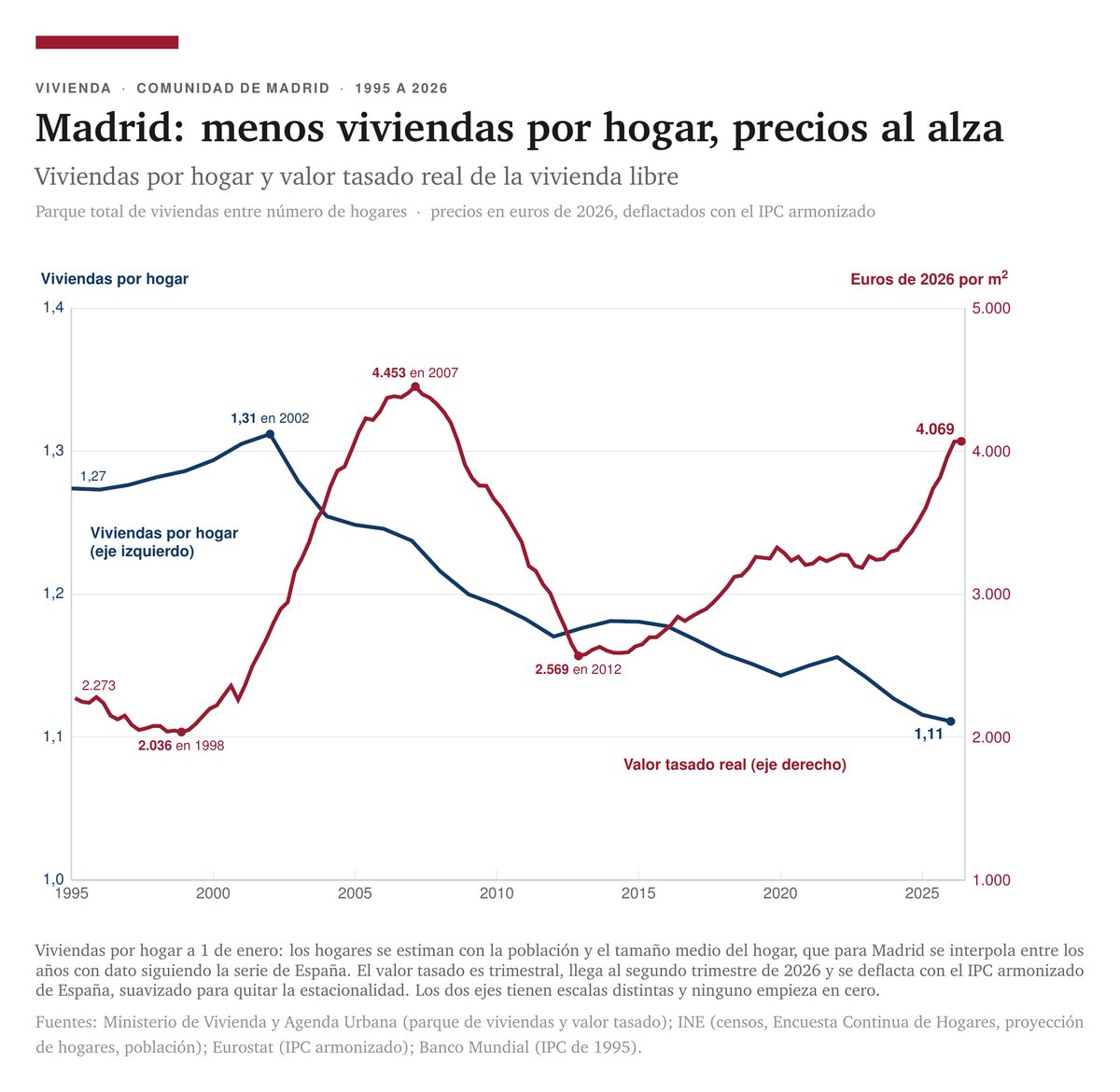
Jesús Fernández-Villaverde pointed out that the Community of Madrid went from 1.27 homes per household in 1995 to a peak of 1.31 in 2002 and to 1.11 in 2026. According to his figures, during that period the real price per square meter rose from 2,273 to 4,069 euros. He attributed the drop in the ratio to both the growth of the Madrid population—from 5.1 million to 7.2 million—and the reduction in the average size of households, from 3.1 to 2.6 people. The author argued that smaller households also increased the demand for housing: even with the 1995 population, Madrid would today need about 20% more homes. He cited Castilla y León, where the real price per square meter remained at the 1995 level and households averaged 2.2 people, as an example of similar family evolution. Fernández-Villaverde indicated that the price per square meter reached 4,453 euros in 2007, when there were 1.24 homes per household, and he argued that the boom was due to cheap credit and speculation, not excessive construction. Between 2002 and 2008, he claimed, Madrid added about 400,000 households and only about 310,000 homes. He also described both the 4,453 euro price from 2007 and the 2,569 euro price from 2012 as temporarily distorted. In his view, measures that only affected prices, including the two decrees from the previous week, did not address the limitation of supply. He suggested that Spain had to choose between competing for the existing homes or betting on building more. #Vivienda #Madrid #PreciosInmobiliarios (translated)