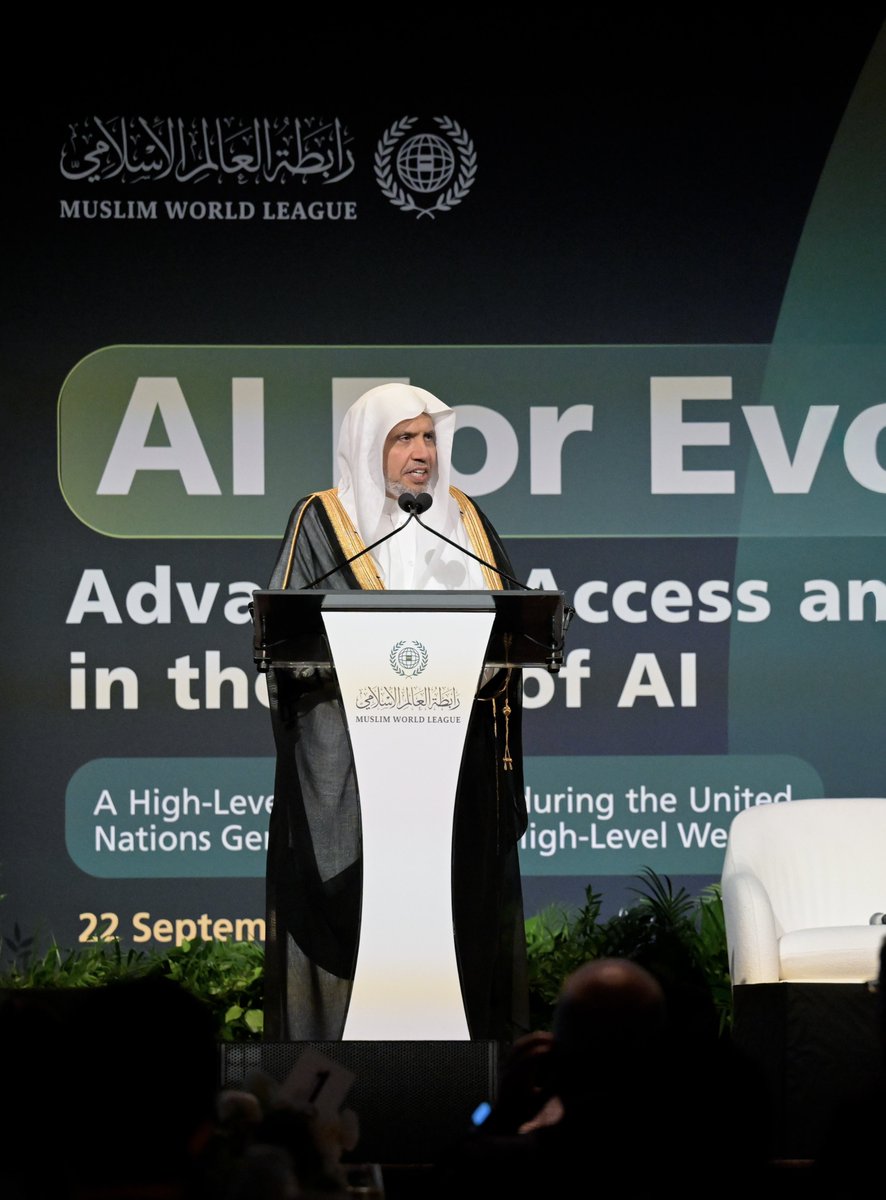
I had the pleasure of launching the event of the World Islamic League dedicated to the ethics of artificial intelligence, in its two religious and civilizational dimensions, with the support and high-level participation of the United Nations, as part of the high-level week of the 81st session of its General Assembly in New York. I also had the pleasure of welcoming representatives of the largest artificial intelligence companies in the United States, the World Bank, prestigious American universities, as well as the main candidates for the position of Secretary-General of the United Nations, along with a large number of religious, intellectual, political, and academic figures, and specialized research centers on the ethics of artificial intelligence. I was equally pleased with the recommendation made by the conference to entrust the United Nations Alliance of Civilizations with the development of the Alliance of Civilizations Code for the Ethics of Artificial Intelligence (UNAOC, Code of Ethics for AI), as well as the acceptance of this recommendation by the Alliance. As part of this event, I announced that the World Islamic League will launch, in cooperation with several technology companies, an artificial intelligence laboratory tasked with developing programs for religious, educational, and humanitarian institutions working in the religious field. I also announced that the League will work on digitizing a number of Islamic and Arab sources and works in order to make them accessible to artificial intelligence companies, in compliance with intellectual property rights. Finally, I announced the establishment of a special unit to detect and correct translation errors. Indeed, many errors have been noted in the translation of certain Islamic texts and the sciences related to them, in some content generated by artificial intelligence. They have led to interpretations unrelated to reality and have engendered profoundly erroneous perceptions and convictions. (translated)