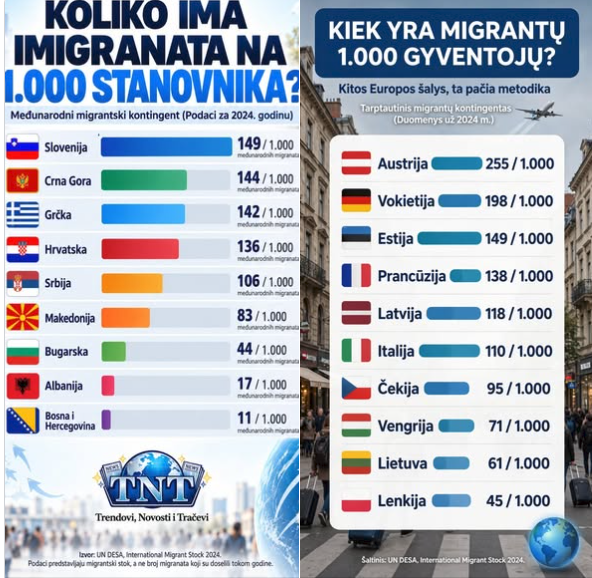
I found an interesting table about the number of migrants in individual Balkan region countries. I compared it with the same UN data for other countries. On the left of the picture is the number of migrants per 1,000 inhabitants in Balkan countries, and on the right, I asked for a chart representing the same number of foreigners per 1,000 inhabitants in several other European countries, including Lithuania. It is important to note that this does not represent people who arrived in a single year, but rather the total migrant population - how many people live in that country but were born in another country. For example, the figures for Estonia and Latvia are significantly inflated by "stateless persons," who were born in other former USSR republics and have remained since the Soviet era. The figures for Germany and Austria are also boosted by guest workers who arrived in the 1970s and are still alive today. So, what do the numbers show? The Balkans do not fall out of the overall European context. They are part of it. Slovenia - like Estonia. Croatia - like France. Serbia - like Italy. Bulgaria - like Poland. The second conclusion is perhaps a well-known paradox: those countries where the migration issue is not the greatest are where politicians shout the loudest about it. Hungary - 71. Lithuania - 61. Poland - 45. These are among the lowest figures in Europe. Meanwhile, Austria - 255, Germany - 198. No one denies that migration is real. It changes cities, schools, and the labor market. But now those who shout the loudest about it are the ones for whom this problem is the least relevant. Data: UN DESA, International Migrant Stock 2024. (translated)