Farewell to Corrado Augias. An intellectual who dedicated his life to culture, freedom, and human dignity. (translated)
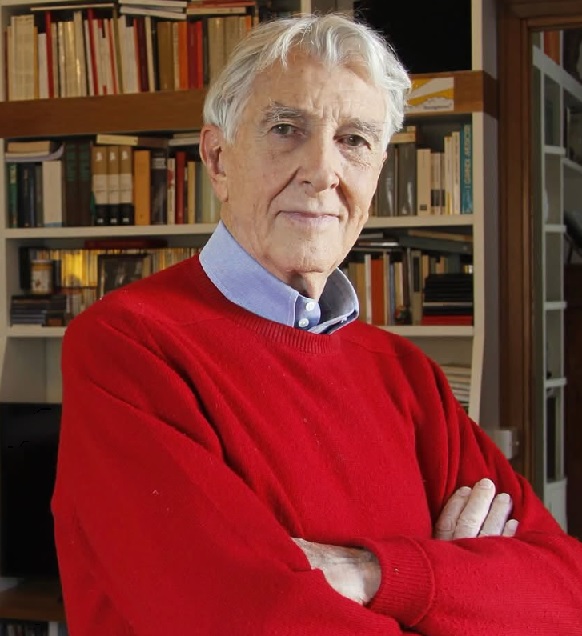
Farewell to Corrado Augias. An intellectual who dedicated his life to culture, freedom, and human dignity. (translated)
www.heliosmag.it - A future without fear is possible (editorial by Pino Rotta) https://youtu.be/lHhTGw271r4?si=MLPL7W5Zl5SKIIYb (translated)

Coordinated solitude, author Claudio Aloisio Written by Pino Rotta, November 8, 2026 Claudio Aloisio is a communication and marketing professional, a field in which he has worked for many years. When his first essay "Coordinated Solitude" (Ed. Ideacoop Media Service, 2026) was released, sharing the same field of activity and interests (albeit with different directions and experiences), I found it interesting to read it, especially since we share the same city but have not met, which was already a good reason to find the essay interesting and its title stimulating. "Coordinated solitude" is an essay that analyzes, with a wealth of documentation and bibliography, the phenomena of the formation of convergences or exclusions among groups and individuals through the study of media languages and, in particular, those of the digital domain. A field that has already been widely investigated for several years. My first approach to these new linguistic proposals dates back, among other readings, to a 1994 essay "Collective Intelligence" by Pierre Levy. In that essay, Levy, at the dawn of the web era, launched the idea that the network, which collected the contributions of millions of users, contained them all without controlling their paths, interactions, or effects. Stimulating concepts that today help us understand how much conflict can arise between theory and its application considering time and technological development. However, Aloisio surprises the reader with suggestions from the very first pages of the essay. In fact, despite addressing the analysis of digital languages with an epistemological line rooted in Anglo-Saxon studies, particularly American ones, from the outset the author seems to suggest that this is not a “technical” essay but is entirely political in the higher sense of the term. The first reference is found in the citation of an author who was among the fathers of European sociology in the early years of the last century: Emile Durkheim, one of the first sociologists and philosophers who analyzed social phenomena with enormous meticulousness and rigor, linking religion with social structure. This opening will be found in the subsequent pages of "Coordinated Solitude," but it will not be the only surprise in Aloisio's analytical developments. In the essay, the author describes how people who may share spaces, interests, and common values, by finding them in the digital world, can at a certain point recognize themselves in different affiliations and even come to see in others a “us” that makes them akin to their own story or a “them” that indicates a distance, exclusion, and even a threat in relation to it. The causes of these dynamics are very well structured in the essay, as is the well-structured context in which individual stories are born, meet, and ultimately find different outcomes. Outcomes that can lead to reinforcing one's affiliations, which, however, are discovered at the end of the interaction process and that, throughout the journey, rarely reach a state of awareness. Outcomes that are influenced by pre-existing value structures that do not necessarily coincide with those of the members of the groups with which one identifies or clashes. This path is analyzed by Aloisio by considering the social dynamics of the West, examining and contrasting similar but not necessarily overlapping social realities, such as American and Italian society. In the identification processes that coexist in these social realities, the belonging to social class, religious group, ethnicity, sexual orientation, and sense of nation enters strongly. Everyone has their own experiences, but at the end of a journey of interaction, now almost exclusively digital, one finds oneself sharing a sense of belonging with other multitudes of people who have completely different experiences. And in this sense of belonging, fears of the future, frustrations of the past and present are downloaded, and one is enveloped by fears and anger that must find an enemy to blame. An enemy that is often suggested by the discovery of affinities among the groups that are created, much more often than not created, on digital platforms. Addressing the current nature of the algorithms governed by Artificial Intelligence, the author suggests the method through which these affiliations arise, which can be irrational but are entirely real and influence individual and social daily life. The individual in the digital dimension, which becomes the everyday reality of social action, is called to take responsibility for maintaining their conviction and belonging or risk feeling excluded, isolated, alone. The weight of a choice that often becomes distressing and paralyzing. But how is it possible to read and interpret these “Coordinated Solitudes”? Aloisio's essay provides a reading and suggests a methodology to identify the path that sometimes, but not always, leads to the awareness of how certain choices are made and what elements need to be questioned to verify if the reading of these languages withstands the law of contradiction and thus can be used to ascribe scientific value to it. But at the end of this journey of understanding languages, forms of aggregation, and the proof of the compatibility of individual choices, Aloisio presents us with another surprise that speaks volumes about his educational journey. The discourse of education and the reading of digital languages is ultimately a discourse on democracy, on social structure, and these factors cannot be disregarded without risking losing the ability to give meaning to one’s social action as well as one’s communicative action. It is my view that the surprise that is the coherence of the entire analysis of the essay comes with the reference that the author makes at the end to the work of Jürgen Habermas. The most important philosopher, sociologist of language, heir of the Frankfurt School who passed away at the age of 97 in March 2026, is the foremost interpreter of the theory of democracy and of the criticism of oppressive authority, which does not exclude conflict but determines its progressive outcome through the mediation of communicative action. Communicative action that questions institutions not to destroy them but to avoid remaining subjected to authoritarianism and, in the form of linguistic mediation, to be active subjects, not subdued by a system that, due to the nature of formal institutions, can always degenerate into authoritarianism. Coordinated solitudes thus find themselves with a positive perspective, with outcomes that are never guaranteed or predetermined, but feasible for reconstructing trust in the future realized through the recognition of the other as part of a common living and not as a threat to be feared, excluded, or even suppressed. Lastly, it should be noted that, although not explicitly considered, Aloisio does not prioritize simplification in the reading of contexts, evading complexity as a fundamental element of contemporary society's reality (perhaps it would have been useful to refer to Edgard Morin's theories), but it is evident that complexity must be confronted with different analytical methodologies and that the appeal to the work of Zygmunt Bauman leads us to presume this. https://www.heliosmag.it/?p=1659 (translated)
Già 14 anni fa (l'archivio ricorda...) parlavamo di disagio giovanile, violenza di genere, comunicazione efficace.... Pino Rotta : Cosa è la comunicazione? Intervista a cura di Giorgio Neri per Telereggio. https://youtu.be/4c-mTLTIDYk?si=iWV4cx4Umk4ED4Es

Illiteracy of the right and the left. The great illusion (editorial by Pino Rotta) https://youtu.be/2JS9UOFv3lU?si=z_iN-tuguigehuVS (translated)
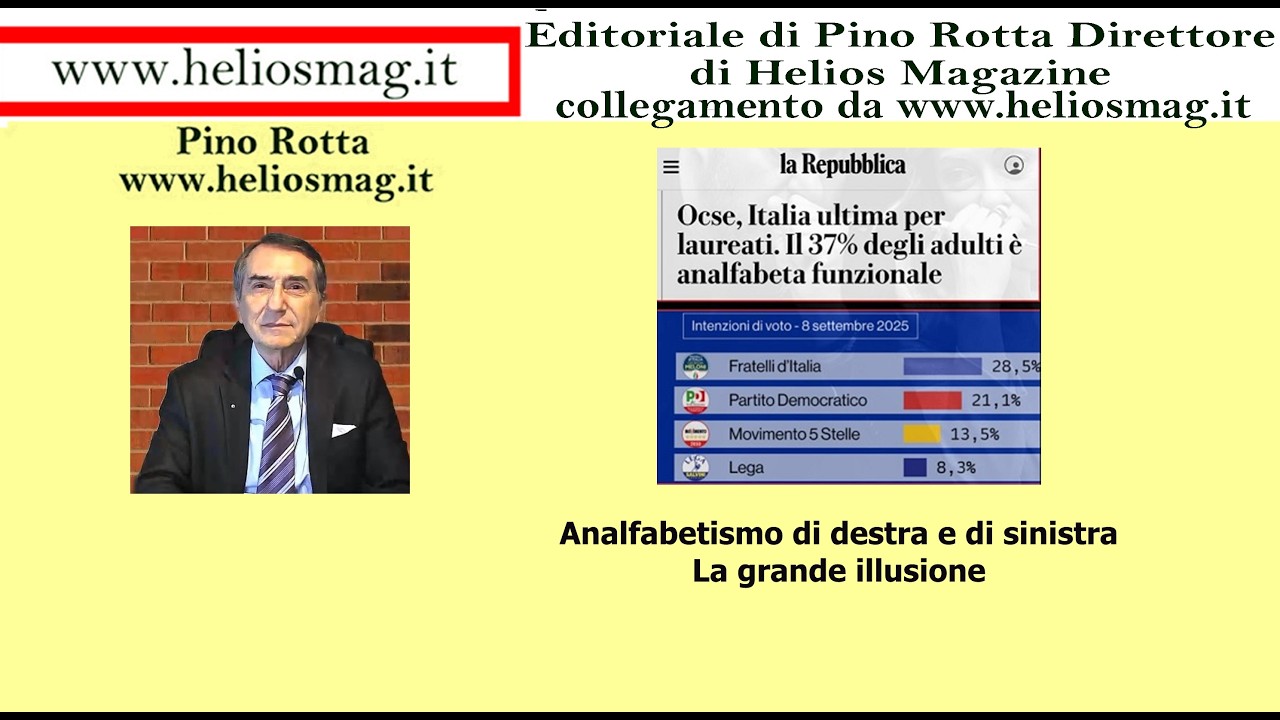
Vannacci e l’AfD gettano la maschera e dietro ci sono i MAGA! Editoriale di Pino Rotta) https://youtu.be/jHWQdH0rKyA?si=bXO6C4QtuAlP8dwN

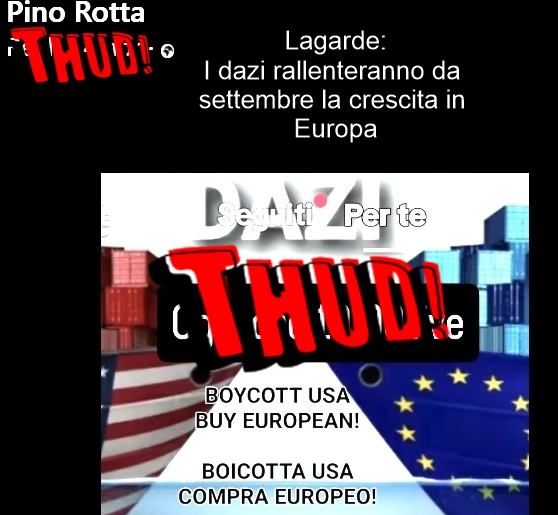
(fonte NYT - 25-8-2026) Aggiornamenti in diretta dall'amministrazione Trump: il Canada annuncia dazi di ritorsione del 50% mentre la guerra commerciale si intensifica. https://www.nytimes.com/live/2026/08/25/us/trump-news-tariffs?campaign_id=60&emc=edit_na_20260825&instance_id=180901&nl=breaking-news®i_id=72282687&segment_id=225383&user_id=4120190362c51ddbf29075630eb50b7a&fbclid=IwY2xjawT6qR9wZG9mBWV4dG4DYWVtAzEwMABzcnRjBmFwcF9pZBAyMjIwMzkxNzg4MjAwODkyAAEeqUqFvxvUAqZv6mNYPmBvTwXOMmsLiqMdZ9Dkew2D7TtDhOV3BbFj1wZe4rI_aem_GoL_qxdzCo0jFi_3Z3Uaew
Moralidad, religión y secularismo (Editorial de Pino Rotta, en español con AI) https://youtu.be/Y3RSc3nsp2c?si=6y4E-570qAq15M3d
Remigrazione alla tedesca! La Germania chiede all'Italia i migranti!! La mossa del cancelliere Merz: Roma dovrà riprendere chi è arrivato nella Ue dal nostro Paese. Così la Germania riavvia le espulsioni ferme dal 2022. Ma con Meloni sono entrati in 340mila (fonte La Repubblica, 9-8-2026) E' la legge della giungla! Dura lex sed lex!

Attacco sul COVID 19. Perché oggi? L'Internazionale Nera e MAGA fa leva su rabbia, paura e disinformazione! Il COVID 19 in USA ha causato migliaia di morti. Le informazioni che si avevano (anche l''ipotesi del laboratorio cinese!) arrivavo sempre dagli USA... quelli che oggi aprono processi mediatici contro chi ha dovuto gestire l'emergenza! Perché oggi? Perché si gioca una partita tra democrazia e neofascismo. https://youtu.be/b1gBsiGeRUo?si=5x47FaHV7nGu4cjH

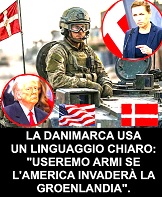
Quando Trump invaderà la Groenlandia la Priemier danese dovrà chiedere aiuto alla Meloni anche se alla prima minaccia fu Pedro Sanchez a dare solidarietà non la Meloni!
Era successo già in Irlanda scatenando un'ondata di violenza da guerra civile! Ma in questo Musk si è superato! E' DISGUSTOSO! https://www.la7.it/intanto/video/ceuta-elon-musk-paragona-i-migranti-agli-zombi-in-un-video-social-31-07-2026-653589?intcmp=Email20260802_Email_la7

Una lettura consigliata per capire la politica italiana!

CEUTA! Lo hanno già fatto in Irlanda, e hanno creato giudizi falsi contro la moglie di Sanchez (nessuna prova e trattata con un boss della mafia!), e contro Starmer costretto a dimettersi! Bisogna aspettarsi uno scontro armato tra Algeria e Marocco! Questi sciacalli impongono i loro interessi fascisti con la forza!

Il megalomane miliardario! Elon Musk, il nuovo Conte Dracula assetato di sangue, ogni tanto esce dalla sua tomba dorata!
Pino Rotta
@pinorotta
·
Jul 25

Tra i truffatori c'è anche il governo italiano!!!!!!

Potere. Governare con la paura (di Pino Rotta)

Mentre la Terra brucia si continua a fare solo polemiche https://www.heliosmag.it/?p=1607
Italiani: vecchi, collusi e ovviamente arrabbiati! https://www.instagram.com/reel/DRN1FFwiCR-/?igsh=MThyMmN5OGduZHFpaw==
Claim it. Contact us at [email protected]