BETA nonprofit public democratic european moderated

Search

#Morality

Check out Polyphony Arts & Words’ August story! A story about a poor teacher, a powerful local strongman, and a single dead tree becomes a larger meditation on poverty, power, morality, politics, and the compromises of survival. Writer of the month Hiranmoy Gangopadhyay’s literary journey from the coalfields of Bengal into the contradictions of contemporary India. Would you like to submit your translated stories or poetries for publication? Language: English. Submission e-mail: [email protected] https://polyphony26.substack.com/p/crosshatch-game?r=7ak8i&utm_campaign=post-expanded-share&utm_medium=web

Crosshatch Game
H

When Therapy Replaces Morality: The Rise of the Therapy State By replacing religious frameworks with therapy speak, Western society may have lost its moral “grammar” and traded it for clinical language—though moral and psychological categories work differently. The DSM has expanded dramatically: in 1952 it listed 102 disorders; by 2013 it had over 400. Meanwhile, young adults report worsening mental health: poor mental-health days among 18–25-year-olds rose from 3.5 to 6 per month between 1993 and 2020, and depression diagnoses more than doubled from 2006 to 2020. Yet the most striking shift is self-diagnosis. About one in four American adults suspect they have ADHD, while actual prevalence is around 6%. Social media fills the gap: many popular ADHD and autism clips include misleading or unsupported claims. The label persists because it serves a function. A diagnosis increasingly becomes identity—and identity becomes a shield. When someone claims ADHD, anxiety, or trauma, they may be drawing a boundary others are not allowed to cross. Where moral language asks what we should become, therapeutic language labels what we are; once the label becomes identity, the conversation often ends. Religious language framed forces as external, preserving agency—you could resist. Therapeutic culture internalizes them: you don’t have weakness to overcome; you have ADHD. Jung argued that old gods and demons didn’t vanish; they became neuroses, anxieties, and addictions—turning questions of conscience and choice into labels to accept. The result isn’t greater freedom but greater control. If a civilization can’t say “wrong,” it doesn’t necessarily become more tolerant. Moral language permits disagreement and growth; therapeutic language can pathologize it and end discussion. The therapy state is the successor to moral authority—and it may be easier to enforce.

H

The Three Roads to Evil We live in an age of unlimited access to information. Most of it is a gift, but it also gives us an unbroken view into horror—images on screens, the Epstein files, and constant stories once confined to nightmares. Some shut it off; others stare until it stares back, leaving them cynical. But it has always been this way. Long before Epstein, there was Caligula—years of sadism and cruelty on Capri. In every era, there have been people whose evil makes rationality struggle to explain it. I see three roads to evil: worshipping the wrong things, succumbing to ideology, and becoming so bitter you resent life itself. First: worshipping wrong values. Some make wealth, lust, power, or status their highest good. They lie, cheat, and steal to obtain it, then declare morality and law for the weak. Everyone else becomes an instrument. Second: ideology. When someone abandons a religious worldview, they may fill the vacuum with an ideology that claims to explain everything and promise a perfect world. Communists reduce history to class struggle; Nazis to racial struggle. The ideologue believes society can be remade by controlling causes and effects—people become cogs, sacrificed for utopia. Third: resentment. Those who see themselves as helpless victims can come to hate life itself. They treat hardship as injustice and life as something done to them. Their values invert: strength becomes evil, weakness virtue; love is attacked while lust is celebrated; wealth is theft—and criminals become victims while their victims are the privileged. These roads always exist, and always will. You can’t stop others from walking them. But it’s your responsibility not to.

H

When Morality Becomes a Weapon Having the “correct” opinion doesn’t make you a good person. Our age is increasingly ruled by those who believe it does. In *The Brothers Karamazov*, Dostoevsky shows this through the Grand Inquisitor, who imagines Christ returning during the Spanish Inquisition. He arrests Him for threatening an institution that claims to represent Him. The Inquisitor argues people don’t truly want Christ’s freedom; they want bread, certainty, and someone to carry the burden of choice. He eventually admits they don’t need Christ’s teachings—only His moral authority. Dostoevsky reveals how power works: dominators can hide behind morality, while the dominated may trade freedom for the comfort of having others decide. Later, Polish psychiatrist Andrew Lobaczewski observed communism invoking “the people” to justify terror and execution. He argued that a small minority without conscience can rise during revolutionary upheavals, with ideology serving as moral camouflage. The lesson: moral language can be weaponized by those lacking moral character. Words like justice, equality, safety, harm, care, and compassion can become tools of control. Return to Aristotle’s view of virtue: virtue isn’t a belief you hold but a habit you practice. We become just by repeatedly doing just things; bravery comes from doing brave things. No slogan can replace character.

H

Why Psychopaths Rise to Power: What Hitler, Stalin & Mao Had in Common Polish psychiatrist Andrew Lobaczewski argued that in certain conditions, psychologically disordered people can rise through institutions and create “pathocracy,” where pathological personalities gain disproportionate power. He described “negative selection”: upheaval pushes aside those with conscience and competence while manipulative, ruthless figures thrive. At the core are psychopaths, who feel little guilt or empathy and use normal human weaknesses as tools. Around them are schizoids, ideological architects who turn abstractions into systems for managing people. Next are spellbinders, charismatic leaders who frame authoritarian ideas as moral duty. Together they produce “paramoralisms”—moral standards that invert reality: dissent becomes extremism, censorship becomes protection, coercion becomes compassion. Beneath them are true believers and conformists who follow out of conviction or career safety, echoing Milgram’s insight that the key question is who gives the orders. Finally come bystanders, a frightened majority that adapts to avoid trouble until self-policing replaces external coercion. Lobaczewski’s warning: pathological behavior becomes far more dangerous when society mistakes it for morality. The real struggle isn’t left vs. right—it’s whether institutions can preserve truth and resist normalization of destructive behavior.

H

Leftist “Empathy” Is Actually Narcissism Leftist “empathy” is often narcissism, not real compassion. Over the past decade, Western politics has debated whether empathy is the highest value—yet many policies justified in its name have produced serious unintended consequences: safe-supply programs, lenient bail, mass migration, identity-based social policy, and gender medicine for minors. Hannah Arendt helps explain why. In *On Revolution*, she contrasted the American Revolution’s focus on institutions and limits on power with the French Revolution’s “politics of pity,” an effort to eliminate suffering through political action. Robespierre’s compassion for the masses helped justify terror. Pity isn’t compassion: it creates a hierarchy between the person who pities and the person pitied. Once you claim to represent “the oppressed,” you can stop listening to real people. Much progressive “empathy” projects idealized versions of others, erasing cultural differences and treating disagreement as ignorance or prejudice. Adam Smith warned about the “man of system,” who thinks society can be rearranged like chess pieces, ignoring human wills. Dostoevsky argued abstract love is easy; loving real people is hard. Nietzsche described a morality that flatters weakness and condemns what rises above the herd, while Orwell questioned whether some socialist intellectuals truly loved workers or simply used them to vent resentment. Rob Henderson calls these “luxury beliefs”: status-providing ideas for elites that impose costs on those below them. The moral prestige is immediate; the damage unfolds over decades. So “suicidal narcissism” may fit better than “suicidal empathy”: projection, superiority, and power disguised as compassion.

H

Empathy, Compassion, and the Limits of Emotional Moral Judgment Empathy is widely regarded as a foundation of morality, but psychological research suggests that it is not an unqualified virtue. Paul Bloom (2017) argues that affective empathy—the experience of sharing another person’s feelings—has important limitations when used as a guide for moral judgment. First, empathy is biased. We respond more strongly to suffering that is vivid, identifiable, and psychologically close. Research on the “identifiable victim effect” shows that people can be more willing to help a specific individual than anonymous victims, even when the latter represent a much larger number (Kogut & Ritov, 2005; Lee & Feeley, 2016). Emotional salience therefore does not necessarily correspond to moral significance. Second, empathy is innumerate. Human emotional responses do not naturally scale with the number of people suffering. A single identifiable victim can evoke a powerful response, while thousands or millions of anonymous victims may produce comparatively little emotional engagement. This creates a problem when moral decisions concern suffering on a large scale (Bloom, 2017). Third, empathy can be exhausting. Repeatedly sharing the distress of others may produce empathic distress and emotional fatigue. Research suggests an important distinction between empathic resonance and compassion: while empathic engagement can increase negative affect, compassion can promote positive affect, motivation, and prosocial behaviour (Klimecki et al., 2014; Weng et al., 2013). The implication is not that we should care less. Rather, caring and feeling are not the same thing. Compassion allows us to recognize suffering and remain motivated to alleviate it without necessarily absorbing the suffering ourselves. Empathy may therefore be valuable for human connection, but it is a poor stand-alone system for making large-scale moral decisions. When millions of lives, limited resources, and competing needs are involved, compassion must be combined with reason, evidence, and deliberate judgment. The goal should not be to feel everything others feel. It should be to care deeply enough to help, while remaining clear-headed enough to help effectively. References: Bloom (2017); Kogut & Ritov (2005); Klimecki et al. (2014); Lee & Feeley (2016); Weng et al. (2013). Empathy and Its Discontents https://pubmed.ncbi.nlm.nih.gov/27916513/?utm_source=chatgpt.com

The Horizon of Reason: Finding Meaning in Atheism. Good day, everyone. When people hear the word "atheism," they often think of what it lacks. They focus on the prefixes and the definitions: a lack of belief in a deity. But to view atheism only as an absence is to miss the entire landscape of what it actually builds. Today, I want to talk about atheism not as a void, but as a vibrant, deeply responsible, and profoundly hopeful way of looking at our universe. At its core, atheism is a commitment to radical honesty. It is the decision to look at the vast, beautiful, and sometimes terrifying cosmos and say, "I do not know all the answers, and I will not invent stories to fill the gaps." Atheism relies on evidence, reason, and the scientific method. It is driven by the same curiosity that makes a child look through a microscope or a scientist peer through a telescope. It embraces uncertainty. In uncertainty, there is room for growth, discovery, and learning. When we accept that we do not have a cosmic blueprint, we become actively responsible for writing our own stories. A common misconception is that without a divine entity, there can be no morality. But atheism flips this dynamic. It suggests that kindness, empathy, and justice do not come from a fear of cosmic punishment or a desire for a heavenly reward. They come from us. We are kind to one another because we are social creatures who share this planet. We care for the sick because we know what pain feels like. We fight for justice because we want to live in a fair world. Our morality is human-centered. It is born from the profound realization that this life is all we have, and therefore, how we treat each other right now matters more than anything else. To an atheist, this life is not a dress rehearsal for an afterlife. It is the main event. This realization does not make life meaningless; it makes life infinitely more precious. Think about a rare gem. It is beautiful precisely because it is scarce. In the same way, a single human life—spanning just a few decades on a tiny blue planet—is a rare, breathtaking miracle of biology and physics. Because we believe this is our only chance, the time we spend with our families, the art we create, and the love we give become urgently important. We cannot afford to waste a single day. Atheism is not about tearing down anyone else's faith. It is about building up human potential. It is the belief that humanity is strong enough, smart enough, and kind enough to navigate the dark corners of the universe together, guided by reason and compassion. We are the authors of our purpose, the journey, life itself. We are the guardians of this planet. And we are the keepers of one another. Thank you.

Metaphysics of the Solitary Absolute: Philosophical and Legal Analysis of the Thesis of Solitary Amorality ​The Thesis of Solitary Amorality, formulated by Tom Nesky under the banner of the Axiom of Relationality of Law and Being, constitutes a radical challenge to classical and contemporary normative theories. Its central premise—stating that law, morality, and the category of crime are not inherent properties of reality, but artificial products of social relations—requires a rigorous deconstruction at the intersection of legal positivism, phenomenological existentialism, ontological anarchism, and monistic metaphysics. This paper attempts a systematic analysis of the intellectual pillars of this thesis, examining its internal coherence, genealogical roots, and consequences for the understanding of freedom and human subjectivity. ​The Systemic Construction of Crime vs. Pure Theory of Law ​The first pillar of the Thesis of Solitary Amorality, designated as Nullum Crimen Sine Systema, posits that law does not discover pre-legal categories of evil, but brings them into existence through the very act of establishing a boundary of permissibility. This assertion exhibits a profound convergence with 20th-century legal positivism, particularly with Hans Kelsen's Pure Theory of Law (Reine Rechtslehre). Kelsen advocated for a methodological purification of legal science from ethical, sociological, and political elements, defining law as a normative system founded upon a hypothetical basic norm (Grundnorm). ​In the Kelsenian view, the legal system functions as a coercive apparatus devoid of inherent moral value. A crucial point of intersection with Nesky's thesis is the elimination of the traditional dualism between acts that are inherently evil (mala in se) and acts prohibited merely by law (mala prohibita). Kelsen argued that an act becomes unlawful solely when a legal norm attaches state-enforced coercion to it. Unlawfulness is not an ontological property of the act, but the result of a relationship of normative imputation. This implies that the law does not penalize an act because it is intrinsically evil; rather, an act is considered evil solely because it has been subjected to systemic penalization. ​This clash became prominent during the debates surrounding the Nuremberg trials, where positions based on natural law and legal positivism collided. While prosecutors such as Robert Jackson invoked universal moral norms (mala in se) as the basis for punishing criminals despite the previously binding positive law of the Third Reich, Kelsen pointed out the theoretical inconsistency of such an approach. He argued that judging on the basis of retroactive law (ex post facto) constitutes a breach in the systemic coherence of positivism, even if it might be justified by political and historical necessity. ​Nesky's project imparts an existential dimension of oppression to this structure, bringing it close to the critique of the state formulated by Friedrich Nietzsche. Nietzsche famously described the state as "the coldest of all cold monsters," which devours the individual's singularity and imposes herd morality upon them. The gaze of the state, mediated through the Other, paralyzes the sovereignty of the individual and forces them to navigate within arbitrarily designated normative boundaries. Every stroke drawn across the chaos of reality establishes a boundary, and every boundary instantly creates the concept of its transgression. ​The Paradox of the Systemic Cage and the Limits of Ontological Anarchism ​The second pillar of the thesis—The Paradox of the Systemic Cage—points to the impossibility of escaping the system through rules alone. Every attempt to negate the existing order, from establishing anarchist structures to escaping into geographical isolation, immediately transforms into a new system whose primary imperative becomes the defense and maintenance of that very absence of rules. This process of structural looping finds its reflection in the current of ontological anarchism formulated by Hakim Bey (pseudonym of Peter Lamborn Wilson). ​Bey, drawing on a synthesis of Nietzscheanism, Situationist theory of the spectacle, and chaos esotericism, recognized that classical revolutions striving to overthrow the state inevitably reproduce structures of domination, becoming new forms of confinement. As an alternative, he proposed the concept of the Temporary Autonomous Zone (TAZ). TAZ is a tactic for creating temporary, non-hierarchical spaces that deliberately evade formal structures of state control. The key element of TAZ is its ephemerality: before the system can map, define, and absorb the autonomous zone, it must dissolve itself and relocate to another point in space-time. ​Attempts to transform TAZ into Permanent Autonomous Zones (PAZ) immediately encounter the paradox noted by Nesky. The need to defend and codify freedom within a lasting community gives rise to internal rules, mechanisms of exclusion, and hierarchy. For this reason, Murray Bookchin criticized ontological anarchism (calling it "lifestyle anarchism" or "bourgeois anarchism") for its lack of political realism and its flight from systemic struggle against capital and state in favor of aesthetic rebellion. The convergence of these perspectives demonstrates that freedom defined as reactive resistance to a system remains structurally determined by it. ​The Dissolution of the Relational Mirror: The Existential Gaze and the Collapse of Morality ​The third pillar of the thesis, designated as The Dissolution of the Mirror (L'Autre), posits that good and evil require the presence of an external witness and judge. This assertion represents a direct application of Jean-Paul Sartre's existential phenomenology, particularly his analysis of the Gaze (le look / le regard) and the relation to the Other (l'Autre) presented in Being and Nothingness. ​Sartre illustrates the constitutive role of the Other through an analysis of the voyeur's situation. At the moment of complete absorption in the act of peeping through a keyhole, the subject's consciousness is pre-reflective—the voyeur does not reflect on himself; his consciousness completely merges with the act being performed. Only the sudden sound of footsteps in the hallway shatters this unity. The voyeur realizes that he himself is seen, and is instantly paralyzed by shame. ​For Sartre, shame is not a purely internal emotion; it is shame of oneself before the Other. The Gaze of the Other objectifies the free subject (being-for-itself—pour-soi), freezing them into a specific role and moral evaluation (being-for-others—pour-autrui). As Ellie Anderson points out, Descartes' formula "I think, therefore I am" is replaced in Sartre by "I feel shame, therefore Others exist." The Gaze of the Other marks the birth of social morality, wherein the individual learns to view themselves from a third-person perspective. ​This existential dynamic corresponds to the Nietzschean genealogy of "bad conscience." Nietzsche demonstrates that morality and guilt are products of the forced internalization of human instincts that could no longer be discharged outwardly due to social barriers. Forced into the constraints of society, man turns against himself, creating an internal judge (conscience) modeled on the external tyrant. ​This vision also resonates with the classical theory of Thomas Hobbes. In Leviathan, Hobbes explicitly declares that in the state of nature, where there is no common power, there is no law, and where there is no law, no notion of injustice exists. Concepts of good, evil, justice, and property are attributes of man living in society, not in solitude. Removing the social fabric reverts the individual to a state in which theft and injury lose their raison d'être due to the absence of relational reference to the Other. #philosophy # metaphysics # thesis # morality

🔥 EU Double Standards Exposed 🔥 “Turkey no longer needs the EU. And you have only yourselves to blame. Why? Because Ankara can easily do without your moral lectures. Anyone who preaches morality while practising double standards ultimately forfeits all credibility: You https://t.co/50vmjsmanM #EUDoubleStandards #Turkey #Credibility #TR #EU

Gerd Leonhard Jun 14

“In addition to an intelligence explosion, there’s potential for a kind of morality explosion,” Elgin said, explaining that AI’s capacity for ethical reasoning might eventually outpace that of humans.” https://t.co/vv13wfvZUb #AI #Ethics #Morality #Nospecificcountrycodesarementionedinthetweet.

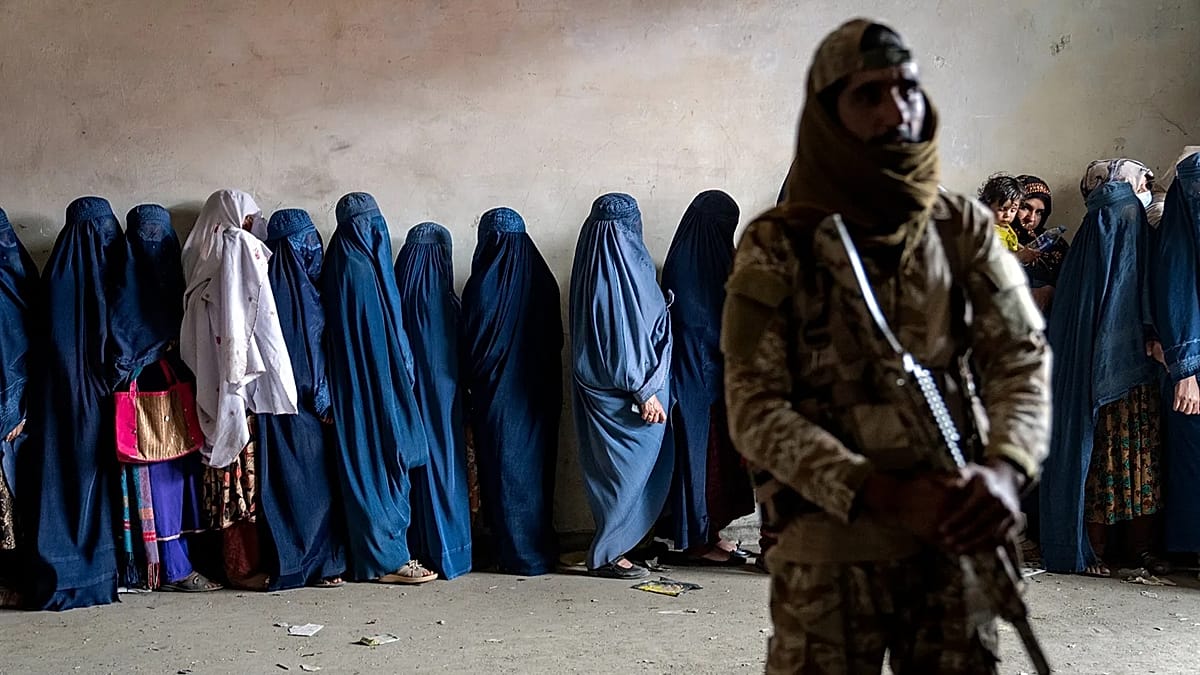
In Herat, Afghanistan, eyewitnesses report that the Taliban's morality police have detained several women for not adhering to strict dress codes requiring full-body coverings, raising concerns from the UN about the ongoing crackdown on women's rights under the Taliban regime. #Afghanistan #WomensRights #Taliban

Women detained in Afghanistan's Herat in clothing crackdown, eyewitnesses say
Joscha Bach Jun 3

Good AI alignment is necessarily EA adjacent. But EA failed to derive a global morality, not for lack of good intentions or intelligence, but because human rationality is a brittle tool, even if you are a good rationalist, and most people prefer to either muddle through or to #AIAlignment #EffectiveAltruism #Rationality #Nospecificcountrycodesarementionedinthetweet.

Alex is fine May 13

80% of heart attacks start with a single morning mistake, and almost everyone makes it! (translated)

Jorge Buxadé May 12

🔴 @Santi_ABASCAL reacts to Sánchez's words that Spain "had the legal and moral obligation to act with the ship… (translated)

BBC May 12

The European Union's foreign ministers have approved new sanctions against Israeli settlers in response to escalating violence against Palestinians in the West Bank, coinciding with a rise in settler attacks since the onset of the Gaza war, amidst ongoing debates about the legality and morality of settlements on occupied land. #EU #Sanctions #IsraelPalestine #EU #IS #PS #HU #FR #US

EU agrees sanctions on Israeli settlers over West Bank violence

In her opinion essay, Christine Emba highlights the Catholic Church's moral vocabulary as a necessary counter to the current political landscape, where power often trumps principle, and expresses concern over the increasing moral vacuum in society, while also noting the need for voices beyond the Catholic tradition to contribute to discussions of human dignity and morality. #CatholicChurch #MoralValues #SocialJustice #US #Vatican

Opinion | Does This Feel Like a 'Catholic Moment'?

Tucker Carlson, a prominent figure in conservative media closely associated with the Trump era, expresses regret for supporting Donald Trump, particularly criticizing his decisions regarding the Iran war and accusing Israel of manipulating Trump into conflict, raising questions about a potential fracture within the MAGA movement and his own evolving views on leadership and morality. #TuckerCarlson #Politics #Media #US #IR #IL #VE #GA #QA #LB

Entrevista con Tucker Carlson

The article reflects on the intersection of technology and morality, highlighting a case where artificial intelligence was misused for crime, emphasizing that while technology is pervasive and neutral, it is ultimately human action that determines its ethical implications, and asserting that true justice is achieved through human intelligence and perseverance rather than technological advancements alone. #Technology #ArtificialIntelligence #HumanIntuition

I.A.: o crime e o humano
El Periódico Apr 27

GLP-1 medications like Ozempic and Wegovy are reshaping patient health and public discourse, as a study reveals that their increasing normalization reinforces dominant frameworks of weight stigma and individual responsibility, reflecting a structurally fatphobic narrative in Spain, which lacks acceptance of weight diversity and promotes a dichotomy between "good" and "bad" users based on perceived effort and morality. #GLP1 #WeightManagement #HealthDebate #ES

La popularización del uso de Ozempic refuerza el estigma del sobrepeso según un estudio universitario