WRLD

Search

#based
Scott Horton 3h

Reports of artificial intelligence being used to sexually exploit children have risen by more than 8,400% in two years, research has found. A report by the Edinburgh-based Childlight – Global Child Safety Institute says AI-related child abuse material, including deepfakes using “nudify apps”, had

www.theguardian.com
Reports of AI-related child sexual abuse material rise 8,400% in two years, data shows
1667
Scott Horton 2d

The most important part of this narrative is that two nominal representatives of the US, both of whom have built business empires based on dark money received from the Kremlin and other foreign interests, advance not the interests of the US, but of the Kremlin.

www.nytimes.com
Russia Revives Demand That NATO Retrench to Secure Ukraine Deal
2918
We Don't Have Time 2d
CEO and founder of We Don't Have Time. Official Eco-warrior according to The Sun, Mark ZuckerVert according to FranceTV2

The post said Iceland’s energy security had been driven by necessity rather than efforts to reduce emissions. It said Jóhanna Auðunsdóttir of Landsvirkjun spoke at COP31 about how geothermal and hydro power had built the country’s resilience, and directed readers to more coverage from Türkiye COP31 on We Don’t Have Time. https://t.co/SHskafW7lB #EnergySecurity #GeothermalEnergy #COP31 #IS #TR

2829
ryan cooper 3d

the filibuster is based on a clerical error, was exclusively the tool of white supremacy for 150 years, and is strangling American democracy to death. and yet even Bernie gets all hand wringy about ending it. Senate Brain is truly a thing talkingpointsmemo.com/edblog/the-f...

talkingpointsmemo.com
The Filibuster Runs Deep. Very Deep.
2230
Joel S. 3d

It wouldn't be right to ask random American Jewish candidates for office if they denounce Chabad based on this statement, but it's about as justified as asking American Muslim candidates if they denounce the Muslim Brotherhood. www.haaretz.com/jewish/2026-...

www.haaretz.com
Chabad rabbi endorses killing Jewish politicians cooperating with Arab parties
2453
Maria Drutska 3d

During the 10 years of the USSR's war in Afghanistan, 14,453 soldiers were lost. During the past 7 DAYS of Putin's war in Ukraine, 17,090 soldiers were lost. Despite all the bluster and fantasy-based "root causes" BS, the bunker midget is definitely not winning this war.

2454
Scott Horton 3d

Musk and Trump throttle Ukraine's Starlink based defenses, and Putin uses the opening to demolish the country's leading hospital. A war crime perfectly coordinated between Trump and Putin. www.theguardian.com/world/2026/n...

www.theguardian.com
Russia strikes hospital in central Kyiv after SpaceX system falters again
3235
Luciano Magaldi Sardella (PhD) 3d

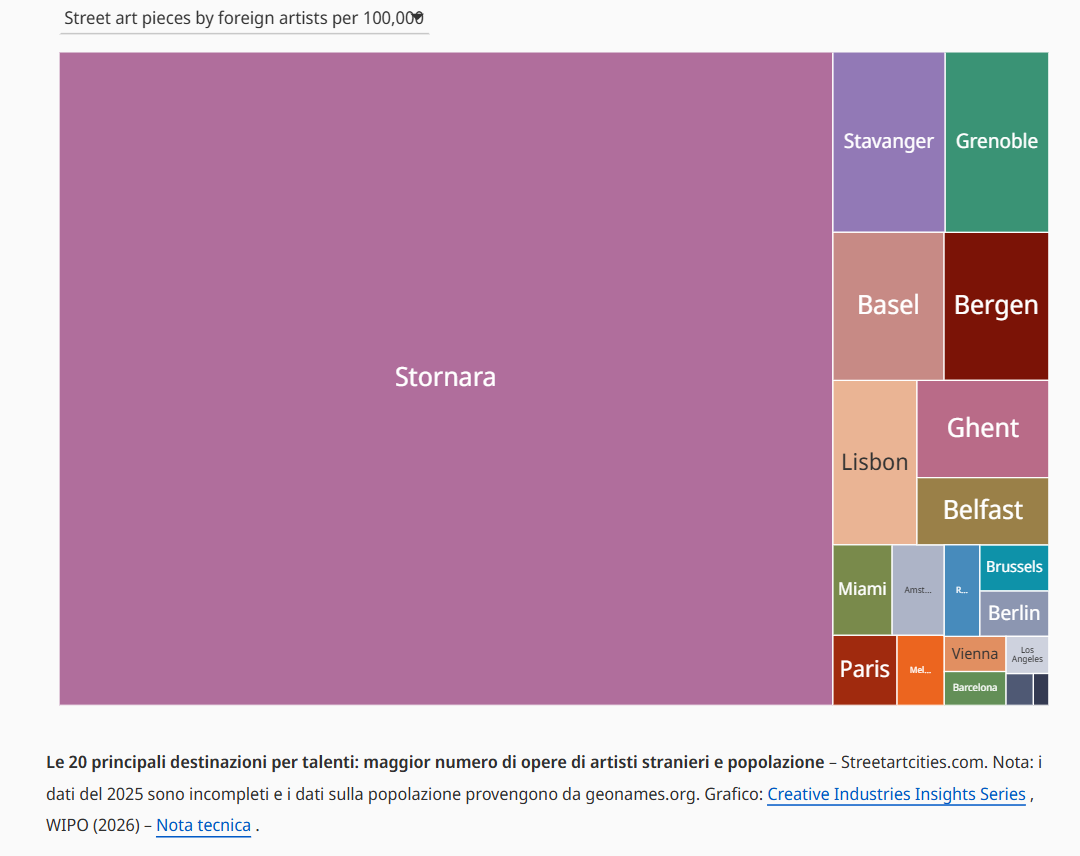
"VIVERE PUGLIA": STRAMURALES: STORNARA IN THE “GLOBAL TOP 20” OF THE REPORT BY THE UNITED NATIONS AGENCY IN EUROPE” From “ghost town” to global model cited in Geneva: the cultural gamble of Stornara Life APS wins the attention of WIPO There is a southern Italy that is making quite a noise. It lies among the wheat fields and rural roads of the Capitanata, far from the great routes of mass tourism. Until a few years ago Stornara, in the province of Foggia, was the typical town that statistics dismiss with a cruel adjective: “peripheral”. Today its name appears in an analysis by WIPO, the “World Intellectual Property Organization”, a United Nations agency in Europe based in Geneva. So Stornara alongside Berlin, New York, Los Angeles, Paris, and Melbourne. A report that looks at the walls of the world The text is entitled “From Local Scenes to Global Recognition: Talent Mobility in Street Art. It is signed by three WIPO economists, Egbert Amoncio, Alexander Cuntz, and Alessio Muscarnera, and was published in the “Creative Industries Insights” series. To construct it, the authors started from data from the “Street Art Cities” platform. The technical note speaks of about 74,000 geolocated works, collected and shared by street art enthusiasts around the world. The underlying questions are simple. Where is street art born? Who travels to paint it? Which cities succeed in attracting talent from outside? The first answer dismantles a commonplace. Street art is a profoundly local phenomenon. About one artist in five also works abroad, while the great majority paint in their own city or in nearby ones. Among the few who cross borders, almost 40 per cent are “highly mobile”: they build an international artistic brand without severing their roots. These are the cases of Banksy, Os Gemeos, and Invader, whose walls appear on several continents. The authors use an effective term: street art is “glocal”, rooted in its own territory but capable of generating global circuits of talent and recognition. The magnets of the world When one asks which cities most attract foreign artists, the map is fascinating. North America weighs in by size, with New York, Los Angeles, and Miami. Western Europe offers a dense network of opportunities, from Berlin to Amsterdam, from Vienna to Ghent, from Basel to Rotterdam, favoured by the festival circuit and by freedom of movement in the Schengen area. Lisbon and Barcelona have focused on supportive municipal policies. Melbourne is the sole representative of Oceania, and Northern Europe relies on Bergen, London, Belfast, and Stavanger. In this scenario of capitals and metropolises, the report inserts an Italian, Apulian, Foggia exception: Stornara, a small agricultural town of about 6,000 souls, has since 2018 been a destination for mural talent. It shows how street art can trigger the rebirth of a community: thanks to the annual festival “Stramurales International Street Art Festival”, born in 2017 from the iron will to combat urban and socio-economic decline on the part of the founders of the social promotion association Stornara Life APS, Lino Lombardi and his Stornara-based Banda dei Fischietti, it has accumulated more than 173 murals. About fifty of them are works by high-level international artists, with Google Trends data since 2017 having shown remarkable interest in the tourist-mural destination, a sign that the international festival has now captured national and international attention. Having also become the world’s first single-case academic study on a street art festival, “Street Art as Public Health Infrastructure”, published in the prestigious world-level academic journal, the “Harvard Health and Human Rights Journal” of Harvard University, by the researcher Luciano Magaldi Sardella from Orta Nova and Professor Matteo Mantuano from Lucera, all this amounts to proof that an idea, an association, and the willingness of a community can change the identity of a place “forgotten by God”. Those who have followed the story from outside tell it too: the town, once little accustomed to visitors, today welcomes international tourists, individuals, groups, and school parties who have come to see its more than 173 murals. The secret lies in density The figure that has ignited Stornara pride is this: volume does not count, proportion does. The organizers propose a simple indicator: works by foreign artists divided by inhabitants, multiplied by 100,000. With more than 50 international works and a population of a few thousand residents, Stornara reaches several hundred foreign works per 100,000 inhabitants. It is a value that metropolises, with millions of residents, cannot approach. The meaning must be read precisely, and precisely here lies the beauty of the thing. Nobody claims that Stornara has more foreign murals than New York. The point is that, in relation to its scale, few places in the world concentrate so much international art per inhabitant. The impact is not dispersed in a megalopolis: it settles in every street, on every façade, in the daily life of those who live there. The most interesting part of the report is the one that looks beyond the ranking. The authors write that the value of street art extends far beyond painted surfaces. Cities like Stornara show how urban art attracts tourism, generates media coverage, and can stimulate local commercial activities, strengthening the sense of community and restoring psychosocial well-being that would drive away the perennial southern decline. The report adds, however, a valuable warning: success depends on careful implementation and on the involvement of artistic communities. Top-down initiatives risk being perceived as “predatory” by artists who care about street credibility. The global Stramurales model seems to have avoided the pitfall. Field studies tell of walls donated by residents, week-long artist residencies, and public discussion of the themes to be addressed. The lesson of a town The report closes with an idea that holds for Stornara as much as for Berlin: the vitality of street art is rooted in local roots. It is born from communities, speaks of their problems, and is made by artists immersed in their urban contexts. The artistic family of Stornara Life APS understood this before many regional and local politicians, making its own walls an open-air museum, a promise, and opening them to the world without ceasing to be itself. In this official report by the Geneva-based United Nations agency in Europe that measures the capacity to attract talent, this turns out to be, probably, the most precious result: to be cited alongside the great capitals of urban art and to remain, after all, a rural provincial town in which every wall tells a colourful world of glocal stories. (translated)

447
K
Kronen Zeitung 3d

The discussion around the race in Sölden reinforces the statement: "We are definitely not supplicants!" (translated)

Diskussion um Rennen - Sölden: „Wir sind definitiv keine Bittsteller!“
2573
Euronews English 4d

Thailand is a “geopolitically safe zone” “in a world where we see the rules based international order breaking down,” Thailand’s Deputy Prime Minister and Foreign Minister tells Euronews in a wide-ranging interview in Bangkok. #InternationalRelations #ASEAN #Diplomacy

www.euronews.com
“The rules-based international order is breaking down,” Thailand’s Foreign Minister warns
3028
Nicholas Grossman 4d

DOJ threatens Congress with prosecutions if Congress uses its legal authority to carry out its Constitutional responsibility. The same corrupted DOJ that utterly failed in lie-based attempts to prosecute James Comey, Letitia James, Lisa Cool, sandwich guy, Reflecting Pool guy, and more? Oh no.

www.ms.now
Todd Blanche threatens to prosecute lawmakers planning oversight probes
2693
Luciano Magaldi Sardella (PhD) 4d

"MY PUGLIA": STORNARA IN THE WORLD TOP 20 FOR STREET ART: THE 'STRAMURALES' MODEL CONQUERS THE UN AGENCY IN GENEVA SOURCE: https://lamia-puglia.com/stornara-nella-top-20-mondiale-della-street-art-il-modello-stramurales-conquista-lagenzia-onu-di-ginevra/ From a small agricultural centre in the Capitanata, often relegated to the margins of the major tourist flows, to an international case study cited in Geneva alongside the world's cultural capitals. Stornara, a municipality of around 6,000 inhabitants in the province of Foggia, officially enters the global élite of urban art thanks to an analysis by the World Intellectual Property Organization (WIPO), the United Nations agency based in Switzerland. ------------------------------------------------------------------- The International Study and the Data The recognition comes via the report From Local Scenes to Global Recognition: Talent Mobility in Street Art, authored by economists Egbert Amoncio, Alexander Cuntz, and Alessio Muscarnera and published in the "Creative Industries Insights" series. Analyzing around 74,000 geolocated works on the "Street Art Cities" platform, the scholars mapped the migratory flows of mural talent around the world. The study highlights how street art is a 'glocal' phenomenon: although only one artist in five works outside national borders, centres capable of attracting international creatives become genuine hubs of regeneration. Alongside metropolises such as New York, Los Angeles, Berlin, Paris, London, and Melbourne, the document singles out Stornara as the sole Italian rural exception. ------------------------------------------------------------------- The Success of Stramurales and Its Academic Impact The turning point for the Puglian village bears the signature of the social promotion association Stornara Life APS, led by Lino Lombardi and the local 'Banda dei Fischietti'. Since 2017, through the annual Stramurales festival, the community has transformed the town's façades into an open-air museum that today counts more than 173 murals, around fifty of which were created by internationally renowned foreign artists. A path of social redemption that had already attracted the attention of the global scientific community: the festival was indeed the subject of the monographic study "Street Art as Public Health Infrastructure", authored by Apulian researchers Luciano Magaldi Sardella and Matteo Mantuano and published in the "Harvard Health and Human Rights Journal" of the prestigious American university. ------------------------------------------------------------------ The Density Factor and the Bottom-Up Lesson According to the WIPO analysis, Stornara's primacy does not lie in absolute numbers, but in proportion: relating the more than fifty international works to the resident population, the Foggia municipality achieves a density of foreign art per 100,000 inhabitants that is unattainable for the great megalopolises. In this way, art is not dispersed but becomes an integral part of daily life. The Geneva economists further emphasize how the Stornara model has succeeded in avoiding the risk of top-down initiatives perceived as artificial. The direct involvement of residents, who spontaneously make the walls of their own homes available, combined with artist residencies and open dialogue on social themes, demonstrates how culture can trigger tourism, economic spillover, and psychosocial well-being, offering a concrete response to the depopulation of the inland areas of the Mezzogiorno. (translated)

561
Prof Bill McGuire 4d

Based on current policies, we will reach 2.7C in 2100? We have to bin this nonsense 1.5C permanently crossed in 2028, planet heating at 0.4C/decade It is no longer about policies. It is about feedbacks and the Earth's rapidly rising energy imbalance www.theguardian.com/environment/...

www.theguardian.com
World heading for ‘irrevocable overshoot’ of global temperature thresholds, analysis warns
3256
Luciano Magaldi Sardella (PhD) 4d

"IL SIPONTINO": STRAMURALES: STORNARA IN THE 'GLOBAL TOP 20' OF THE REPORT OF THE UNITED NATIONS AGENCY IN EUROPE. SOURCE: https://www.lagazzettadisansevero.it/stramurales-stornara-nella-global-top-20-del-rapporto-dellagenzia-delle-nazioni-unite-deuropa/?fbclid=IwY2xjawVibZVleHRuA2FlbQIxMABwZG9mAWJyaWQRMHE3R3FDUWVMVnBtN1NiRGRzcnRjBmFwcF9pZBAyMjIwMzkxNzg4MjAwODkyAAEfJpk9OBrbzNPPuzmmZTsbvjf1RRRRwgltWvqpPTryHt2mv-Z5rTEy1ifxBXU_aem_ciFpxVBzVKZmCZU0twovqQ From 'ghost town' to global model cited in Geneva: the cultural gamble of Stornara Life APS wins the attention of WIPO. There is a Southern Italy that is making quite a noise. It lies among the wheat fields and the rural roads of the Capitanata, far from the great routes of mass tourism. Until a few years ago Stornara, in the province of Foggia, was the typical town that statistics dismiss with a cruel adjective: 'peripheral'. Today its name appears in an analysis by WIPO, the World Intellectual Property Organization, the United Nations agency in Europe based in Geneva, alongside Berlin, New York, Los Angeles, Paris, and Melbourne. A report that looks at the walls of the world The text is entitled From Local Scenes to Global Recognition: Talent Mobility in Street Art. It is signed by three WIPO economists, Egbert Amoncio, Alexander Cuntz, and Alessio Muscarnera, and was published at the end of May 2026 in the Creative Industries Insights series. To build it, the authors started from the data of the Street Art Cities platform. The technical note speaks of around 74,000 geolocated works, collected and shared by street art enthusiasts all over the world. The underlying questions are simple. Where is street art born? Who travels to paint it? Which cities manage to attract talent from outside? The first answer dismantles a commonplace. Street art is a profoundly local phenomenon. Around one artist in five also works abroad, while the great majority paint in their own city or in those nearby. Among the few who cross borders, almost 40 per cent are 'highly mobile': they build an international artistic brand without severing their roots. Such are the cases of Banksy, Os Gemeos, and Invader, whose walls appear on several continents. The authors use an effective term: street art is 'glocal', rooted in its own territory but capable of generating global circuits of talent and recognition. The magnets of the world When one asks which cities attract foreign artists most, the map is fascinating. North America weighs in by size, with New York, Los Angeles, and Miami. Western Europe offers a dense network of opportunities, from Berlin to Amsterdam, from Vienna to Ghent, from Basel to Rotterdam, favoured by the festival circuit and by freedom of movement in the Schengen area. Lisbon and Barcelona have bet on supportive municipal policies. Melbourne is the only representative of Oceania, and Northern Europe relies on Bergen, London, Belfast, and Stavanger. In this scenario of capitals and metropolises, the report inserts an Italian, Apulian, Foggian exception: Stornara, a small agricultural town of around 6,000 souls, since 2018 a destination for mural talents. It shows how street art can trigger the rebirth of a community: thanks to the annual Stramurales International Street Art Festival, born in 2017 from the iron will to fight urban and socio-economic decline on the part of the founders of the social promotion association Stornara Life APS, Lino Lombardi and his Stornara Banda dei Fischietti, it has accumulated more than 173 murals. Around fifty of them are works by high-level international artists, with Google Trends data that since 2017 have shown considerable interest in the tourist-mural destination, a sign that the international festival has now captured national and international attention. Having also become the world's first monographic academic case study on a street art festival, 'Street Art as Public Health Infrastructure', published in the prestigious world-level academic journal, the 'Harvard Health and Human Rights Journal' of Harvard University, by the researcher Luciano Magaldi Sardella from Orta Nova and Professor Matteo Mantuano from Lucera, all this amounts to proof that an idea, an association, and the willingness of a community can change the identity of a place 'forgotten by God'. Those who have followed the story from outside also tell it: the town, once little accustomed to visitors, today welcomes international tourists, individuals, groups, and school parties who have come to see its more than 173 murals. The secret lies in density The figure that has ignited Stornara pride is this: volume does not count, proportion counts. The organizers propose a simple indicator: works by foreign artists divided by inhabitants, multiplied by 100,000. With around more than 50 international works and a population of a few thousand residents, in Stornara one reaches several hundred foreign works per 100,000 inhabitants. It is a value that metropolises, with millions of residents, cannot approach. The meaning must be read precisely, and precisely here lies the beauty of it. Nobody claims that Stornara has more foreign murals than New York. The point is that, relative to its scale, few places in the world concentrate so much international art per inhabitant. The impact is not dispersed in a megalopolis: it settles in every street, on every façade, in the daily life of those who live there. The most interesting part of the report is the one that looks beyond the ranking. The authors write that the value of street art extends far beyond the painted surfaces. Towns like Stornara demonstrate how urban art attracts tourism, generates media coverage, and can stimulate local commercial activities, strengthening the sense of community and restoring the psychosocial well-being that would drive away the perpetual southern decline. The report adds, however, a valuable warning: success depends on careful implementation and on the involvement of artistic communities. Top-down initiatives risk being perceived as 'predatory' by artists who care about street credibility. The global Stramurales model seems to have avoided the pitfall. Field studies tell of walls donated by residents, one-week artist residencies, and public discussion of the themes to be addressed. The lesson of a town The report closes with an idea that holds for Stornara as much as for Berlin: the vitality of street art is rooted in local roots. It is born from communities, speaks of their problems, and is made by artists immersed in their urban contexts. The artistic family of Stornara Life APS understood this before many regional and local politicians, making its own walls an open-air museum, a promise, and opening them to the world without ceasing to be itself. In this official report of the Geneva agency of the United Nations in Europe that measures the capacity to attract talent, this turns out to be, probably, the most precious result: to be cited alongside the great capitals of urban art and to remain, after all, a rural provincial town in which every wall tells a colourful world of glocal stories. (translated)

www.lagazzettadisansevero.it
Stramurales: Stornara nella “Global Top 20” del Rapporto dell’Agenzia delle Nazioni Unite d’Europa - La Gazzetta di San Severo - News di Capitanata
225
Luciano Magaldi Sardella (PhD) 4d

“LA GAZZETTA DI SAN SEVERO”: STRAMURALES: STORNARA IN THE ‘GLOBAL TOP 20’ OF THE REPORT OF THE UNITED NATIONS AGENCY IN EUROPE SOURCE: https://www.lagazzettadisansevero.it/stramurales-stornara-nella-global-top-20-del-rapporto-dellagenzia-delle-nazioni-unite-deuropa/?fbclid=IwY2xjawVibZVleHRuA2FlbQIxMABwZG9mAWJyaWQRMHE3R3FDUWVMVnBtN1NiRGRzcnRjBmFwcF9pZBAyMjIwMzkxNzg4MjAwODkyAAEfJpk9OBrbzNPPuzmmZTsbvjf1RRRRwgltWvqpPTryHt2mv-Z5rTEy1ifxBXU_aem_ciFpxVBzVKZmCZU0twovqQ From ‘ghost town’ to global model cited in Geneva: the cultural gamble of Stornara Life APS wins the attention of WIPO. There is a Southern Italy that is making quite a noise. It lies among the wheat fields and the rural roads of the Capitanata, far from the great routes of mass tourism. Until a few years ago Stornara, in the province of Foggia, was the typical town that statistics dismiss with a cruel adjective: ‘peripheral’. Today its name appears in an analysis by WIPO, the World Intellectual Property Organization, the United Nations agency in Europe based in Geneva, alongside Berlin, New York, Los Angeles, Paris, and Melbourne. A report that looks at the walls of the world The text is entitled From Local Scenes to Global Recognition: Talent Mobility in Street Art. It is signed by three WIPO economists, Egbert Amoncio, Alexander Cuntz, and Alessio Muscarnera, and was published at the end of May 2026 in the Creative Industries Insights series. To build it, the authors started from the data of the Street Art Cities platform. The technical note speaks of around 74,000 geolocated works, collected and shared by street art enthusiasts all over the world. The underlying questions are simple. Where is street art born? Who travels to paint it? Which cities manage to attract talent from outside? The first answer dismantles a commonplace. Street art is a profoundly local phenomenon. Around one artist in five also works abroad, while the great majority paint in their own city or in those nearby. Among the few who cross borders, almost 40 per cent are ‘highly mobile’: they build an international artistic brand without severing their roots. Such are the cases of Banksy, Os Gemeos, and Invader, whose walls appear on several continents. The authors use an effective term: street art is ‘glocal’, rooted in its own territory but capable of generating global circuits of talent and recognition. The magnets of the world When one asks which cities attract foreign artists most, the map is fascinating. North America weighs in by size, with New York, Los Angeles, and Miami. Western Europe offers a dense network of opportunities, from Berlin to Amsterdam, from Vienna to Ghent, from Basel to Rotterdam, favoured by the festival circuit and by freedom of movement in the Schengen area. Lisbon and Barcelona have bet on supportive municipal policies. Melbourne is the only representative of Oceania, and Northern Europe relies on Bergen, London, Belfast, and Stavanger. In this scenario of capitals and metropolises, the report inserts an Italian, Apulian, Foggian exception: Stornara, a small agricultural town of around 6,000 souls, since 2018 a destination for mural talents. It shows how street art can trigger the rebirth of a community: thanks to the annual Stramurales International Street Art Festival, born in 2017 from the iron will to fight urban and socio-economic decline on the part of the founders of the social promotion association Stornara Life APS, Lino Lombardi and his Stornara Banda dei Fischietti, it has accumulated more than 173 murals. Around fifty of them are works by high-level international artists, with Google Trends data that since 2017 have shown considerable interest in the tourist-mural destination, a sign that the international festival has now captured national and international attention. Having also become the world’s first monographic academic case study on a street art festival, ‘Street Art as Public Health Infrastructure’, published in the prestigious world-level academic journal, the ‘Harvard Health and Human Rights Journal’ of Harvard University, by the researcher Luciano Magaldi Sardella from Orta Nova and Professor Matteo Mantuano from Lucera, all this amounts to proof that an idea, an association, and the willingness of a community can change the identity of a place ‘forgotten by God’. Those who have followed the story from outside also tell it: the town, once little accustomed to visitors, today welcomes international tourists, individuals, groups, and school parties who have come to see its more than 173 murals. The secret lies in density The figure that has ignited Stornara pride is this: volume does not count, proportion counts. The organizers propose a simple indicator: works by foreign artists divided by inhabitants, multiplied by 100,000. With around more than 50 international works and a population of a few thousand residents, in Stornara one reaches several hundred foreign works per 100,000 inhabitants. It is a value that metropolises, with millions of residents, cannot approach. The meaning must be read precisely, and precisely here lies the beauty of it. Nobody claims that Stornara has more foreign murals than New York. The point is that, relative to its scale, few places in the world concentrate so much international art per inhabitant. The impact is not dispersed in a megalopolis: it settles in every street, on every façade, in the daily life of those who live there. The most interesting part of the report is the one that looks beyond the ranking. The authors write that the value of street art extends far beyond the painted surfaces. Towns like Stornara demonstrate how urban art attracts tourism, generates media coverage, and can stimulate local commercial activities, strengthening the sense of community and restoring the psychosocial well-being that would drive away the perpetual southern decline. The report adds, however, a valuable warning: success depends on careful implementation and on the involvement of artistic communities. Top-down initiatives risk being perceived as ‘predatory’ by artists who care about street credibility. The global Stramurales model seems to have avoided the pitfall. Field studies tell of walls donated by residents, one-week artist residencies, and public discussion of the themes to be addressed. The lesson of a town The report closes with an idea that holds for Stornara as much as for Berlin: the vitality of street art is rooted in local roots. It is born from communities, speaks of their problems, and is made by artists immersed in their urban contexts. The artistic family of Stornara Life APS understood this before many regional and local politicians, making its own walls an open-air museum, a promise, and opening them to the world without ceasing to be itself. In this official report of the Geneva agency of the United Nations in Europe that measures the capacity to attract talent, this turns out to be, probably, the most precious result: to be cited alongside the great capitals of urban art and to remain, after all, a rural provincial town in which every wall tells a colourful world of glocal stories.

www.lagazzettadisansevero.it
Stramurales: Stornara nella “Global Top 20” del Rapporto dell’Agenzia delle Nazioni Unite d’Europa - La Gazzetta di San Severo - News di Capitanata
337
György Hölvényi 5d
Hungarian politician

The author said faith-based organisations provided 40% of education and healthcare services in Sub-Saharan Africa and urged the EU to recognise their role. https://t.co/9YNOff4Xo0 #SubSaharanAfrica #Education #Healthcare #AF #EU

3379
Luciano Magaldi Sardella (PhD) 5d

"FROM A “GHOST TOWN” TO GENEVA "EUROPEAN UNITED NATIONS" CASE STUDY: LINO LOMBARDI’S STRAMURALES AND “STORNARA LIFE APS” CONQUER THE UNITED NATIONS OF EUROPE" ----------------------------------------------------------------- SOURCE: https://www.upov.int/en/web/economics/w/blogs/from-local-scenes-to-global-recognition-talent-mobility-in-street-art By virtue of the Stramurales of Lino Lombardi (Stornara Life APS), Stornara now ranks FIRST IN THE WORLD for intensity of foreign murals per inhabitant. Original title: “From Local Scenes to Global Recognition: Talent Mobility in Street Art (Dalle Scene Globali al Riconoscimento: La Mobilità dei Talenti nella Street Art).” ----------------------------------------------------------------- SOURCE 1: https://www.wipo.int/en/web/about-wipo SOURCE 2: https://www.upov.int/.../from-local-scenes-to-global... SOURCE 3: https://www.linkedin.com/.../the-world-intellectual.../ By Egbert Amoncio, Alexander Cuntz, Alessio Muscarnera. ------------------------------------------------------------------ Dr Egbert Amoncio: Bachelor of Science in Statistics at the University of the Philippines, Diliman, Master of Science in Quantitative Economics, PhD at Goethe University Frankfurt. Dr Alexander Cuntz: PhD in Innovation Economics, Technische Universität Berlin; Head of Creative Economy Section, WIPO at the European United Nations, Geneva. Dr Alessio Muscarnera: PhD in Economics and Finance at Tor Vergata University of Rome, Research Fellow at WIPO, WIPO at the European United Nations, Geneva. — — — — — — — — — — — — — — — — — — — — — — — — — — — — — — — — — — — — — STORNARA (FG), The World Intellectual Property Organization (WIPO) has placed Stornara, through the “Stramurales International Street Art Festival” of the founder, president and artistic director of Stornara Life APS, Lino Lombardi, in the GLOBAL TOP 20 of the first twenty cities most important in the world in the field of street art that attract most strongly the most eminent street artists of the six continents. And it is the FIRST IN THE WORLD for density of murals per inhabitant. This is what their site states: “The World Intellectual Property Organization (WIPO) is the European United Nations Agency, based in Geneva, at the service of innovators and creators throughout the world, which ensures that their ideas reach the market in safety and improve the life of all. We do this by providing services that enable creators, innovators and entrepreneurs to protect and promote their intellectual property (IP) beyond borders and by acting as a forum to address the most pressing questions in matters of IP. Our data and our information on IP guide decision makers throughout the world. And our impact oriented projects and our technical assistance ensure that IP brings benefit to all, everywhere.” WIPO has utilised the data of the international street art platform, “Street Art Cities”, for their extensive research project upon the driving forces that are guiding global street art, based upon the comparison between global talents versus local talents of world street art. While the cities of the whole world promote themselves ever more as attractive tourist destinations and places with an elevated quality of life, the competition and the race to secure the finest global talents and the most celebrated artists, who shall embellish the streets and the urban aspect, intensify. It is therefore fundamental to choose where itinerant artists decide to operate and to find the favourable conditions for creating new works. An analysis of the data upon street art conducted by WIPO reveals a picture of an art form fundamentally “glocal”, that is to say, a crossroads between the global and the local: predominantly local in practice, but capable of generating global circuits of talent, influence and recognition. To comprehend this duality is essential in order to understand where street art flourishes and why. ------------------------------------------------------------------ LOCAL STREET ART: MY HOME IS MY CASTLE The majority of street artists create their own works in their native city or in the place in which they live. More than 80 per cent of artists create in one or more cities within a single country, without ever realising works abroad. This means that only about 20 per cent of street artists have created one or more works abroad. Almost 40 per cent of this group of itinerant artists may be considered highly “mobile”, practising their art in diverse countries and building their global digital credibility and their artistic brand, besides their local roots. This pattern is consistent with that of international street artists of high profile such as Banksy, Os Gemeos or Invader, whose celebrated works appear upon the walls of many continents. ------------------------------------------------------------------ GLOBAL POLES OF ATTRACTION: THE CITIES THAT ATTRACT INTERNATIONAL STREET ARTISTS Global flows of talent depend upon geographical, cultural and linguistic proximity between the countries of origin and of destination. Countries that share borders, culture or language are more easily accessible and less costly for artists, and for this reason they often register a greater influx of talent. Moreover, individual artists may seek opportunities abroad and obtain support from city festivals, cultural exchange programmes, international galleries, or rely upon their own personal networks and upon the community of reference when they transfer. For artists who cross national borders, certain cities reveal themselves as powerful poles of attraction for international street art. The analysis of the 20 global cities with the greatest number of street art works realised by foreign artists reveals a fascinating geography of creative centres that transcend the confines of their national artistic scenes to become global destinations. North America dominates in terms of magnitude, with New York, Los Angeles and Miami representing important poles of attraction for foreign street artists. The combination of art market infrastructures, cultural diversity and the role of cradle of the street art movement in these cities attracts international artists desirous of leaving their mark upon the American urban panorama. Western Europe offers a dense network of opportunities, with Berlin standing forth as one of the principal destinations, together with Paris, Amsterdam, Vienna, Ghent, Brussels, Basel, Grenoble and Rotterdam. This concentration reflects the vibrant European circuit of street art festivals and the ease of movement within the Schengen area, which permits artists to visit several cities contemporaneously. Lisbon, capital of Portugal, together with Barcelona, in Spain, have strategically positioned themselves as destinations for street art thanks to supportive municipal policies and festivals of high profile. ON THE CONTRARY, STORNARA, A SMALLER TOWN AND A POLE OF TALENT, EXEMPLIFIES HOW STREET ART MAY CATALYSE THE REBIRTH OF THE COMMUNITY. THANKS TO ITS ANNUAL “STRAMURALES” FESTIVAL, LAUNCHED IN 2017, THIS PUGLIESE TOWN IN DIFFICULTY HAS ACCUMULATED MORE THAN 150 MURALS, OF WHICH APPROXIMATELY 50 WERE REALISED BY INTERNATIONAL ARTISTS. THE DATA OF GOOGLE TRENDS REVEAL A REMARKABLE INTEREST FOR STORNARA, IN DEMONSTRATION OF THE SUCCESS OF THE FESTIVAL IN CAPTURING ATTENTION BOTH NATIONAL AND INTERNATIONAL. THIS FURNISHES ANECDOTAL PROOF OF THE FACT THAT STREET ART INITIATIVES MAY GENERATE A MEASURABLE CULTURAL AND TOURISTIC IMPACT EVEN IN PERIPHERAL AND ECONOMICALLY DISADVANTAGED PLACES. Meanwhile, Melbourne distinguishes itself as the sole representative of Oceania, in testimony to the vibrant culture of Australian street art and to the reputation of the city as one of the most favourable destinations in the world for street artists. Northern Europe contributes Bergen, London, Belfast and Stavanger, in demonstration of how cities of diverse dimensions may attract international artists thanks to the right mixture of policies and favourable conditions. ------------------------------------------------------------------ BUT WHAT DOES THIS SIGNIFY FOR THE “STRAMURALES INTERNATIONAL STREET ART FESTIVAL”? IT MEANS THAT STORNARA IS NOT FIRST FOR TOTAL NUMBER OF FOREIGN MURALS, BUT IT IS FIRST IN THE WORLD FOR DENSITY. AND THIS DIFFERENCE IS EVERYTHING. THE FORMULA, THE INDICATOR IS THIS: (WORKS BY FOREIGN ARTISTS IN A CITY / INHABITANTS OF THAT CITY) X 100,000. IT SERVES TO COMPARE CITIES THAT ARE NOT COMPARABLE IN ABSOLUTE TERMS: NEW YORK WITH 8 MILLION INHABITANTS AND STORNARA WITH APPROXIMATELY 6,000. WHY STORNARA PREVAILS THUS: IN THE WIPO TEXT STORNARA IS CITED WITH MORE THAN 150 TOTAL MURALS, OF WHICH APPROXIMATELY 50 BY INTERNATIONAL ARTISTS, THANKS TO THE ANNUAL STRAMURALES FESTIVAL. IF ONE MAKES THE CALCULATION WITH THOSE NUMBERS: 50 FOREIGN WORKS / 6,000 INHABITANTS X 100,000 = APPROXIMATELY 833 FOREIGN WORKS PER 100,000 INHABITANTS. THE GREAT GLOBAL CITIES OF THE TOP 20, SUCH AS NEW YORK, LOS ANGELES, MIAMI, BERLIN, PARIS, AMSTERDAM, IN ABSOLUTE TERMS HAVE MANY MORE FOREIGN WORKS, BUT DIVIDED BY MILLIONS OF INHABITANTS THEIR VALUE PER 100,000 INHABITANTS COLLAPSES TO A FEW POINTS. IN PRACTICE, IN STORNARA EVERY RESIDENT “SHARES” MANY MORE FOREIGN WORKS THAN IN ANY OTHER CITY OF THE CLASSIFICATION. IT DOES NOT MEAN: “STORNARA HAS MORE FOREIGN MURALS THAN NEW YORK” BUT IT SIGNIFIES THAT, IN PROPORTION TO ITS DIMENSIONS, NO CITY IN THE WORLD IN THE TOP 20 ATTRACTS SO MANY FOREIGN ARTISTS AS STORNARA. IT IS AN INDICATOR OF INTENSITY AND OF RELATIVE CAPACITY OF ATTRACTION, NOT OF VOLUME. AND IT IS MOST POWERFUL FOR A SMALL RURAL TOWN, BECAUSE IT DEMONSTRATES THAT THE IMPACT OF STREET ART THERE IS NOT DILUTED IN A METROPOLIS, BUT IS CONCENTRATED IN EVERY STREET, IN EVERY INHABITANT. --------------------------------------------------------------- GLOBAL STREET ART Street art remains profoundly rooted in local communities and territories. Although approximately one artist in five is itinerant and has realised works abroad, the overwhelming majority creates in their native city or in neighbouring cities. Yet, for those who cross borders, clear patterns emerge in the global race for artistic talent: certain cities attract many creators, regional networks facilitate movements and personal bonds connect artistic communities across continents. To comprehend global flows of talent is fundamental, since their impact extends well beyond painted surfaces. Street art generates potential multiplier effects, catalysing broader economic, social and cultural transformations. CITIES SUCH AS STORNARA DEMONSTRATE HOW STREET ART ATTRACTS TOURISM, GENERATES MEDIA COVERAGE AND MAY STIMULATE LOCAL COMMERCIAL ACTIVITIES. THIS EXPLAINS WHY MUNICIPAL ADMINISTRATIONS INCREASINGLY CONSIDER STREET ART AS A STRATEGIC CULTURAL INFRASTRUCTURE AND AN INVESTMENT, WHOSE BENEFITS MANIFEST THEMSELVES IN AN IMPROVEMENT OF THE IMAGE OF THE CITY AND IN THE REVITALISATION OF NEIGHBOURHOODS. However, success depends upon careful implementation and upon greater involvement of the artistic communities, since otherwise public initiatives might be perceived as “predatory” by artists who privilege credibility in the urban context. The predominantly local nature of global street art reflects the essential character of this art form: it is born from local communities, addresses local problematics and is created by artists profoundly rooted in their urban contexts. International mobility may reveal the global bonds between street artists and the capacity of places to attract talent, but the true vitality of this art form resides in its local roots. -------------------------------------------------------------------- SOURCE: World Intellectual Property Organization (WIPO),EUROPEAN UNITED NATIONS AGENCY, Geneva, Switzerland. “From local scenes to global recognition: Talent mobility in street art: https://www.upov.int/.../from-local-scenes-to-global...

www.upov.int
From Local Scenes to Global Recognition: Talent Mobility in Street Art
563
Costas Kadis 5d
Cypriot politician

The author said the ocean was central to climate, food security, economic prosperity and global security, and argued that protecting it required effective international governance, multilateral cooperation and science-based decision-making. The remarks were made at the Organisation of African, Caribbean and Pacific States. https://t.co/aEl3nW3Vxx #OceanConservation #ClimateAction #InternationalCooperation #AC #CAR #PAC

3380
Delectatum Condimente 5d

EnzymMeat explores koji biotechnology for the proteins of tomorrow Koji — the traditional mold Aspergillus oryzae used for centuries in miso, soy sauce, and sake — is emerging as a compelling platform for next-generation food. Through fermentation and enzymes, it can transform starches and plant proteins into ingredients with umami depth, appealing texture, and meaningful nutritional value. At EnzymMeat, we see koji not only as a culinary tradition, but as a biotechnology platform. Its enzymes can break down proteins and starches, creating savory notes and textures that bring plant-based foods closer to the experience of meat — with simpler processes and less reliance on highly processed ingredients. Recent research shows that koji strains can be optimized to produce more heme and ergothioneine, opening the door to meat alternatives with improved color, flavor, and nutritional profiles. Our question: can an ancient fermentation tradition become the foundation for a better generation of alternative proteins — tastier, more accessible, and more sustainable? #EnzymMeat #Koji #Biotechnology #FoodTech #AlternativeProtein #Fermentation #Sustainability #FoodInnovation

789
Peter Steinberger 🦞 5d
Austrian AI developer and entrepreneur

The author wrote that a company found 10,500 vulnerabilities while running diagnostics on about 700 systems, held an emergency press conference on June 16 and applied fixes over three months. The author also began describing a new diagnostic run using GPT-6 Astra, which they identified as the latest model released by US-based OpenAI. #ciberseguridad #tecnología #IA #US

3843