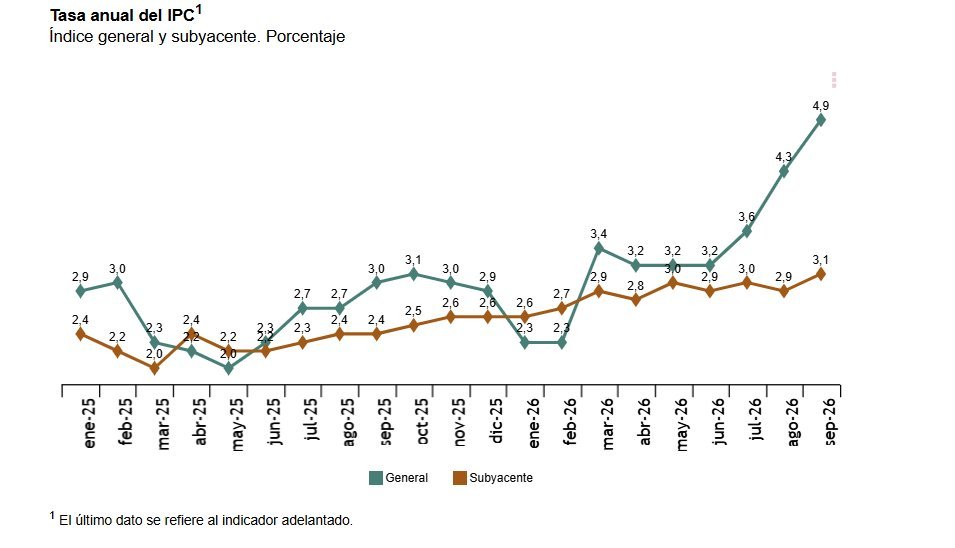
Inflation in the eurozone reached 3.3% in August, its highest level in three years, creating expectations of an interest rate hike by the European Central Bank. (translated)

Prices in the Eurozone reached 3.3% in August, their highest level in three years, with Spain leading the increase due to energy costs amid a context of war in the Middle East. (translated)

Inflation in the Eurozone reached 3.3% in August, driven by rising energy prices, which could allow the ECB to raise interest rates in September. (translated)

Inflation in the eurozone rose to 3.3 percent in August, the highest level in the last three years, with energy prices being the main factor for the increase, and further interest rate hikes by the European Central Bank are anticipated. (translated)

The inflation rate in the eurozone rose in August to 3.3 percent, which is an increase compared to the July rate of 2.9 percent, driven mainly by a 14.3 percent rise in energy prices. (translated)

German inflation rose in August, with an annual increase of 2.9%, while in the Eurozone a general price increase is expected to be 3.3%, and in Italy, an increase is estimated from 2.9% to 3.4%. (translated)

Isabel Schnabel, the German representative on the Executive Board of the European Central Bank, has pointed out the need to raise interest rates in the eurozone due to the risks of rising inflation, caused by factors such as the conflict in the Middle East and the increase in energy costs, warning that inflation could remain above the 2% target for an extended period. (translated)

The Euribor has exceeded 3% for the first time in almost two years, which could result in an increase of up to 1,600 euros annually in the mortgages of households revising their loans, due to instability in the energy market and inflation in the Eurozone. (translated)

Concerns about a new food price crisis are on the rise, both at the European Central Bank and the UN, due to factors such as projected food inflation for next year, the impact of wars in the Middle East and Ukraine, and extreme weather events affecting crops in Europe. (translated)

Inflation in the Eurozone reached 2.9% in July, driven by a 10.3% increase in energy prices, which could lead the ECB to consider a new rate hike to control the economic situation amid geopolitical tensions and weakening growth. (translated)

In July, inflation in the eurozone rose to 2.9% and in the EU to 3%, with the main factor being the increase in energy prices, which led to expectations of an interest rate hike in September. (translated)

Inflation in the Eurozone rose to 2.9% in July, confirming the flash estimate of July 31, while ECB President Christine Lagarde emphasized the need to remove national barriers to capital markets to support internal growth in the European Union, whose traditional foundations have been eroded by current geopolitical tensions. (translated)

The unilateral intervention by the United States to support the yen has destabilized European markets, putting pressure on the euro and government bonds, and raising concerns among the European Central Bank about potential structural and financial consequences for the eurozone. (translated)

The European Central Bank warns that the increase in energy prices due to the war in Iran negatively affects real incomes and household consumption, particularly for low-income families, forcing them to allocate a larger share of their budget to bills and contributing to a general economic contraction in the Eurozone. (translated)

Inflation in the Eurozone and in Italy remained below 3% in July, surprising negative expectations related to the war in the Middle East, thanks to factors such as the impact of oil reserves and the significant reduction in imports from China, while the issue of natural gas remains a concern for the future. (translated)

Inflation in the eurozone has risen to 2.9% in July, driven mainly by a 10% increase in energy prices due to the resumption of the war in Iran, generating expectations of a possible rise in interest rates by the European Central Bank in September. (translated)

Cómo que el euro súper delantero decisivo estrella (que le costó a Boca 8 palos) solo puede jugar por una banda? #Fútbol #BocaJuniors #Eurozona