WRLD

Search

#kiosk
Emmanuel Grégoire 24h

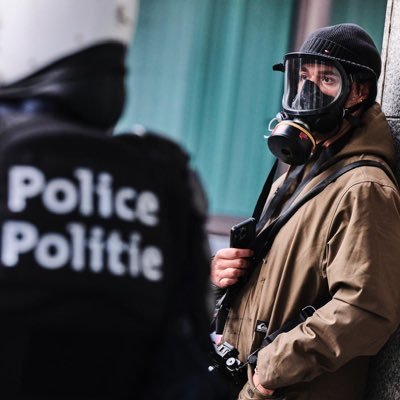
"Entire streets in Paris have been systematically devastated," said Emmanuel Grégoire, deputy to socialist mayor Anne Hidalgo, referring to burned cars, charred newsstands, and attacks on riot police. #Prosvjedi #Vandalizam #Francuska (translated)

Neviđeno uništenje u Francuskoj. Šokirani čak i oni koji su navikli na bijes: ‘Nešto je pošlo po zlu‘
www.jutarnji.hr
2164
tagesschau.de 2d

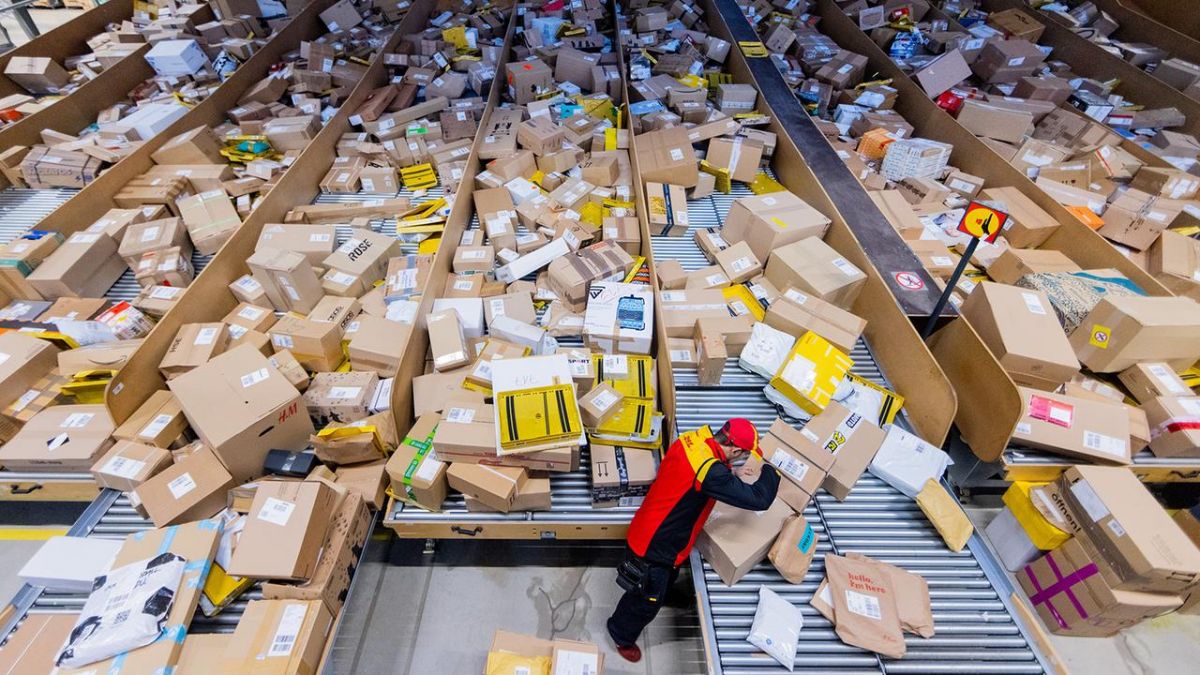
The number of online orders and returns in Germany has reached record levels, which represents a lucrative business for kiosk owners and delivery services, but also leads to criticism from environmentalists. #OnlineHandel #Retouren #Paketdienst (translated)

www.tagesschau.de
Paketversand und Retouren durch Onlinehandel auf Rekordniveau
2776
Owen 2d

Owen wrote that in Paris the water cannon was used at full power. According to him, several officers were injured and a kiosk was set on fire at Place de la République. https://t.co/z4CcUOtGOd #Parijs #protest #veiligheid (translated)

2889
Matti Viren 7d

Matti Viren wrote that one had to wait four weeks for an X-ray examination, even though public expenditure, according to him, was 58 percent of GDP. He also criticized the fact that the country could afford to send over a billion in development aid to the south and pay very high salaries to healthcare leaders, questioning how the country was being managed. https://t.co/f4UZs8v0RW https://t.co/Tys9xHI85z #terveydenhuolto #kehitysapu #poliikka (translated)

2954
Luciano Magaldi Sardella (PhD) 7d

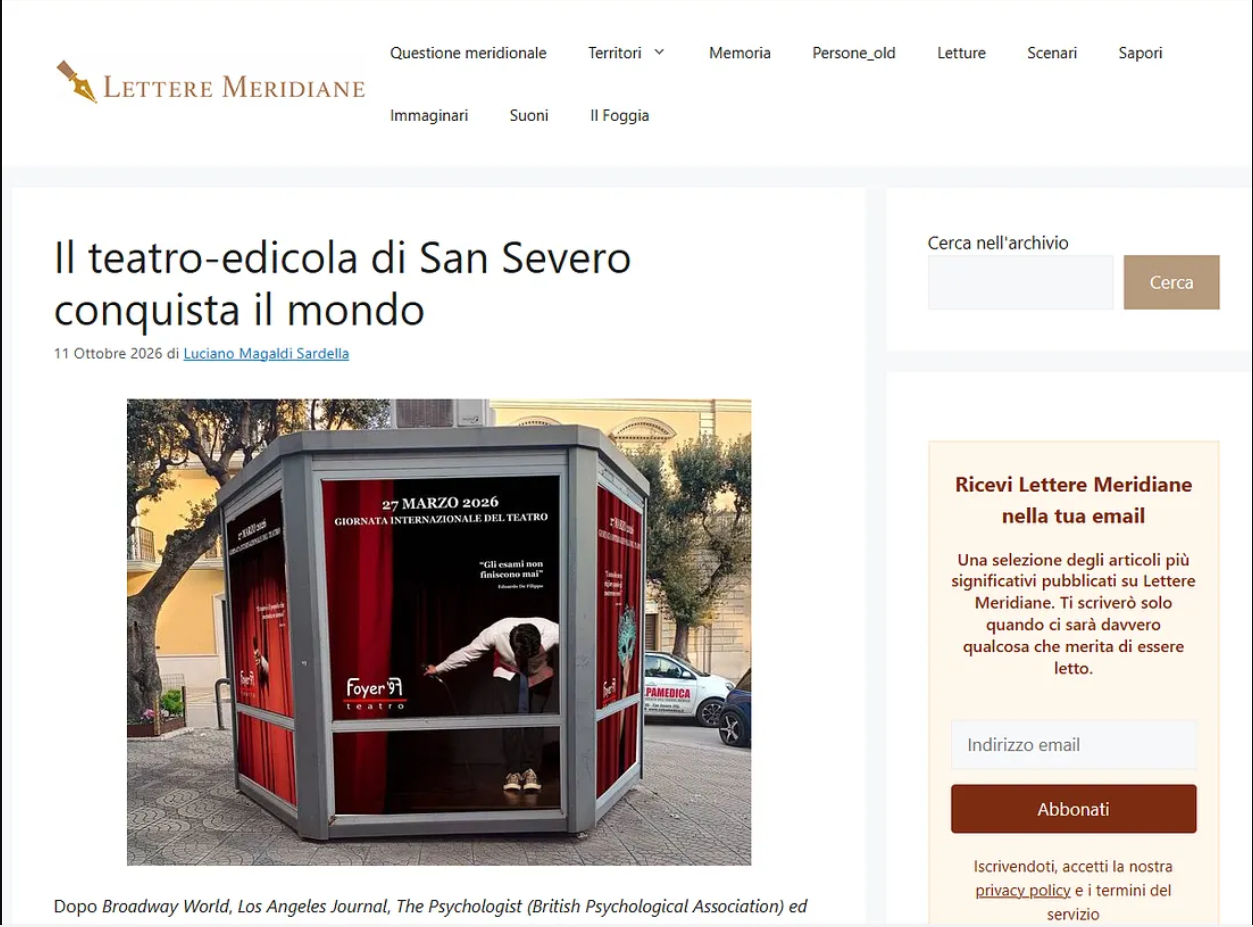
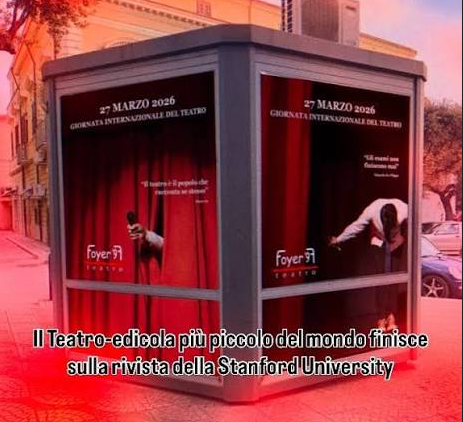
LETTERE MERIDIANE — “TEATRO-EDICOLA” OF SAN SEVERO CONQUERS THE WORLD SOURCE: https://www.letteremeridiane.org/2026/10/il-teatro-edicola-di-san-severo-conquista-il-mondo/?fbclid=IwY2xjawU4oqFleHRuA2FlbQIxMQBwZG9mAXNydGMGYXBwX2lkEDIyMjAzOTE3ODgyMDA4OTIAAR5rVEwYs6UUXg7v-P0SyIQ_DRb_F6ZiY58OcseYoV4J7atcTiERnhWaqKM2pw_aem_Njle1jq1XLzHr93KLBUcVA After “Broadway World”, the “Los Angeles Journal”, “The Psychologist (British Psychological Association)” and Hollywood Beat Magazine, its “academic consecration” has now arrived courtesy of Stanford University. As I have already emphasised in my article on the revival of the GIO Festival in Foggia, celebrated by BroadwayWorld for the world stage premiere of the Giordano’s opera Marina (1888), the province of Foggia has long ceased to be peripheral. It happens when it finds an idea that shifts the coordinates: well, in San Severo, 40 kilometres from Foggia, it has happened again. Only this time an orchestra was not needed; six chairs were enough. The celebrated Teatro-Edicola of San Severo artistic director Francesco Gravino of the theatre company Foyer ’97 has been featured in the academic journal “Stanford Social Innovation Review (SSIR)” as an academic case study. The news, relayed on 19 September 2026 by ANSA Nazionale, looked like a misprint. Then it became clear that it was not. SSIR, an award-winning publication covering multisectoral solutions to global problems, included the project in its Dispatches section with the reportage “The Six-Seat Revolution”. It is the inverse trajectory to that of the GIO Festival: not a forgotten opera returning to a grand historic Italian horseshoe theatre, but an entire theatre reborn inside a disused place, forgotten by man. There are moments when past and future intertwine to create something visionary, innovative, artistically “revolutionary”: San Severo experienced one of those moments on the morning of 27 March 2026, during World Theatre Day, when the shutter of a newsstand closed for six years in Via Matteo Tondi was reopened “not to sell newspapers, but to offer stirring stories”, to quote Gravino’s motto. The idea of the visionary Francesco Gravino, artistic director, stage director and actor of the San Severo company Foyer ’97, active for at least 30 years in Capitanata, centred on the kiosk, hexagonal in metal and glass, granted free of charge by its owner Pino Frau, by now an urban relic created by the publishing crisis of the early 2000s: today in Italy active newsstands have fallen from about 35,000 in 2005 to about 20,000 in 2024, a decline of 42.8%. Gravino and eleven other actors restructured it in two weeks of work, without institutional funding, and transformed it into what is now under examination by the London commission of Guinness World Records as the “world’s smallest theatre”. The formula is deliberately austere: six spectators at a time outside, actors inside at less than a metre’s distance, 15-minute performances, continuous rotation from 11:00 to 20:45, texts ranging from Goldoni to Chekhov, from Ibsen to Dacia Maraini. On the door a QR code with an original theatrical warning: “Warning! This QR code transforms passers-by into actors. Scan only if ready.” The numbers immediately showed that it was no boutade: more than 60 people in a single afternoon, three inaugural days that sold out. But above all a positive echo that went beyond the borders of San Severo. “Broadway World” (just as in the previous case of the GIO Festival), the world’s most influential theatre criticism outlet with over 5.5 million monthly views, devoted exclusive coverage to it on 27 April 2026: “An Abandoned Italian Newsstand Just Became the World’s Smallest Theatre”. Not a mere listing, but an analysis: “There is no foyer, there is no balcony, there is no grid. There is barely a wing. What there is is something almost unrecognisable as an evening at the theatre, and for that very reason it is all the more powerful.” “Broadway World” captured Gravino’s manifesto idea: “This is a theatre of proximity. In an era of digital distance, we are putting human contact back at the centre,” framing it as “More than a clever exercise in site-specific theatre. It is a reappropriation.” All of this, in a Mezzogiorno of Italy often narrated only in terms of organised crime and marginalisation. To that seal of approval was added another, even more disorienting for a newsstand in San Severo: the “Los Angeles Journal”, one of the most influential publications on the West Coast for the performing arts. On 12 May 2026, it headlined thus: “San Severo’s Teatro-Edicola as an Innovative Model for Los Angeles Theaters?” opening as follows: “In a city in southern Italy that Hollywood has never heard of, a theatre director has just built the smallest stage in the world: six seats, fifteen minutes, zero distance. Los Angeles should pay attention.” The “Los Angeles Journal” does not indulge in folklore, but places the kiosk in Via Matteo Tondi alongside the prestigious 1,600-seat Ahmanson Theatre in Los Angeles, the Pantages of Broadway in Hollywood, the 99-seat plan of Rogue Machine, the Odyssey, the Victory Theatre and the Hollywood Fringe. It even recalls Ethan Marks’s Electrical Box Theatre, a veritable electrical box lined with red velvet in downtown Los Angeles, to argue that Gravino has taken to the extreme the question Los Angeles has been asking itself for decades: How small can a stage become before it ceases to be a stage? And it recognizes the San Severo urban model: almost zero cost, two weeks of work and six chairs, in return for immediate provincial, regional and national media coverage, recognition by the San Severo’s Municipal Administration, and a format exportable anywhere. Then, the third American piece came from “Hollywood Beat Magazine” on 20 April 2026: Six seats. Fifteen minutes. One actor. No stage. The magazine recounts the kiosk in Via Tondi left disused for almost six years, the contemporary six-seat cultural outpost, placing Francesco Gravino in a distinguished genealogy: Richard Schechner and environmental theatre, Jerzy Grotowski and poor theatre, Nicolas Bourriaud and relational aesthetics. But it closes with pragmatism: it is not a thesis, it is fixing a street corner, that is, repairing an urban street corner by asking not how large a theatre can become, but how small it must become again to recover its original power. And finally, the celebrated London-based “The Psychologist”, the journal of the “British Psychological Society (BPS)”, the oldest psychological society in the world, transformed the Teatro-Edicola into a scientific case study: on 30 July 2026 it published “The world’s smallest theatre — and Psychologists’ next act”, starting from the same detail, the morning of 27 March when the metal shutter of the hexagonal kiosk in Via Tondi reopened after six years, six people inside, an actor at less than a metre’s distance beginning Chekhov. It describes the formula: six spectators, 15 minutes, 11 actors over 10 hours, from Goldoni to Euripides, inside a kiosk where the fourth wall does not break because architecturally it never existed. But the BPS goes a step further: it cites the 2025 studies by Damien Gabriel in IBRO Neuroscience Reports, that live performance generates measurably stronger emotional and physiological activation than video, and introduces Edward Hall’s proxemics: below one metre is intimate space, reserved for doctors, close friends, lovers. In that one-square-metre space, the actor’s breath is audible, micro-expressions legible, the self-other boundary becomes permeable. The Teatro-Edicola “does not make theatre better, it makes it inevitable”. And it is here that one understands why Stanford is studying it as an academic case study in social innovation, not as a case of artistic originality. In Italy, meanwhile, the national media circuit had already picked up the phenomenon: RaiNews — TG2 Storie brought it to RaiDue at midnight on 19 April. RTL 102.5 devoted space to the format conceived by Gravino and developed by Foyer ’97 in the heart of San Severo in Via Tondi, defining it as a permanent micro-stage capable of bringing theatre into public space. ANSA.it, Gazzetta del Mezzogiorno, La Repubblica, TG2000, Radio Capital, Swiss RSI, ANSA Brazil and many others followed. And for the record: Fiorello praised it in La Pennicanza as an artistic case inspired by his Edicola Fiore, and Biagio Antonacci, on his tour in the Augustan amphitheatre of Lucera, made a “fact-finding” stop at the Teatro-Edicola singing the celebrated and nostalgic Iris in front of an audience certainly larger than the “six seats”. Francesco Gravino’s theatre company Foyer ’97 was not born yesterday: behind it lie the Teatro-Cantina of 2016, the underground theatre, and in 2011 a performance on the bell tower of a church in the centre of San Severo at 45 metres high. The Teatro-Edicola completes, in Gravino’s words, “the entire vertical extension of theatre: underground, street level, rooftop”. And it is preparing for its thirtieth anniversary in 2027 aiming to purchase the kiosk to make it permanent, exporting the “San Severo Model” to Rome, Lucca, and to the festivals of Santarcangelo and Todi. As with the GIO Festival, someone might dare to claim that it is merely a stunt, but when BroadwayWorld places you alongside the Los Angeles Opera House, the “Los Angeles Journa”l proposes you as a model for Hollywood, “Hollywood Beat Magazine” reads you through Grotowski and the “British Psychological Society” uses you to explain mirror neurones, it is no longer a stunt but an excellent artistic and academic positioning. To those who still whisper that Foggia and Capitanata are provincial, the answer is now written on two opposite and complementary fronts: on 5 June in Foggia a 138-year-old opera found the stage again at the Giordano ending up on BroadwayWorld; on 27 March in San Severo a 4-square-metre kiosk invented a stage that did not exist, ending up at Stanford, in Los Angeles, in Hollywood and in London. The periphery, when it has a precise idea, becomes the centre. Even with six chairs. Luciano Magaldi Sardella

www.letteremeridiane.org
Il teatro-edicola di San Severo conquista il mondo
909
Luciano Magaldi Sardella (PhD) 2w

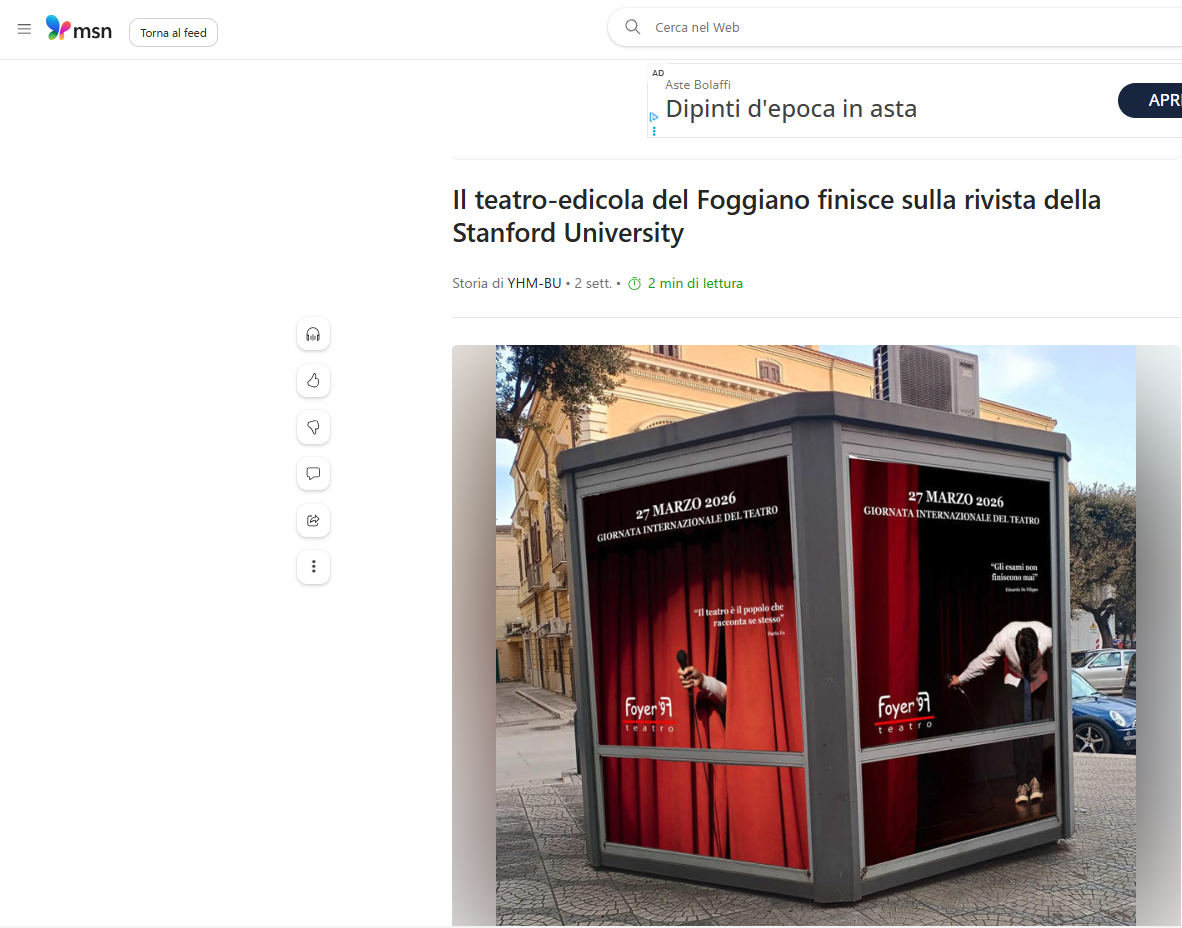
MSN ITALIA - ANSA ITALIA: "THE TEATRO-EDICOLA FEATURED IN STANFORD UNIVERSITY'S REVIEW" SOURCE: https://www.msn.com/.../il-teatro-edicola-del.../ar-AA2cyMWR (ANSA) - FOGGIA, 19 SEPT - The idea of the newspaper-kiosk theatre in San Severo, in the province of Foggia, renamed the smallest theatre in the world, has become a case study for Stanford University. The article "The Six-Seat Revolution" by the Foggian researcher Luciano Magaldi, supervised by editor David V. Johnson, has been published in Ssir (an award-winning publication covering multi-sectoral solutions to global problems). The article is in the "Dispatches" section of the "Stanford Social Innovation Review". "It is a result that rewards our work - emphasises Francesco Gravino, artistic director of the theatre company Foyer 97 - . Requests to replicate the model have come from other areas of Italy, such as Lucca and Rome. We thought of creating a cultural activity from a place that was disused and in a state of abandonment. There ought to be a regional law that allows for the reconversion of these disused places in which numerous activities could be created. Veritable cultural outposts". Gravino and the actors of the company are preparing the new programme. "Next year our company will be 30 years old - he said - , an important milestone which we shall celebrate with some new developments". Six chairs, less than two square metres, performances every 15 minutes and a sold-out audience of young people and adults. An experiment that has aroused curiosity and interest in the world of entertainment as well. Between the end of July and the beginning of August, during the tour in Lucera (Foggia), Biagio Antonacci made a surprise stop at the newspaper-kiosk theatre and sang his Iris. "It was truly a wonderful encounter which captured the attention of passers-by," concludes Gravino. (ANSA). (translated)

1261
Roger García 2w

Roger García described as "new normal" a situation in which, according to his writings, they could attack the homes of small business owners who did not pay extortion fees and shoot at kiosk vendors, street vendors, mototaxi drivers, and markets. He also stated that they extorted public schools and transportation companies; in one case, he said, four gangs demanded payments and a fifth shot at a company to demand money. García added that they killed candidates during the electoral process and journalists. He criticized the Government for asking for "patience" while, according to his writings, a person could be shot for taking a public bus to return home after work. He closed by asking if they should continue waiting. #NuevaNormalidad #Inseguridad #Justicia (translated)

13359
Luciano Magaldi Sardella (PhD) 3w

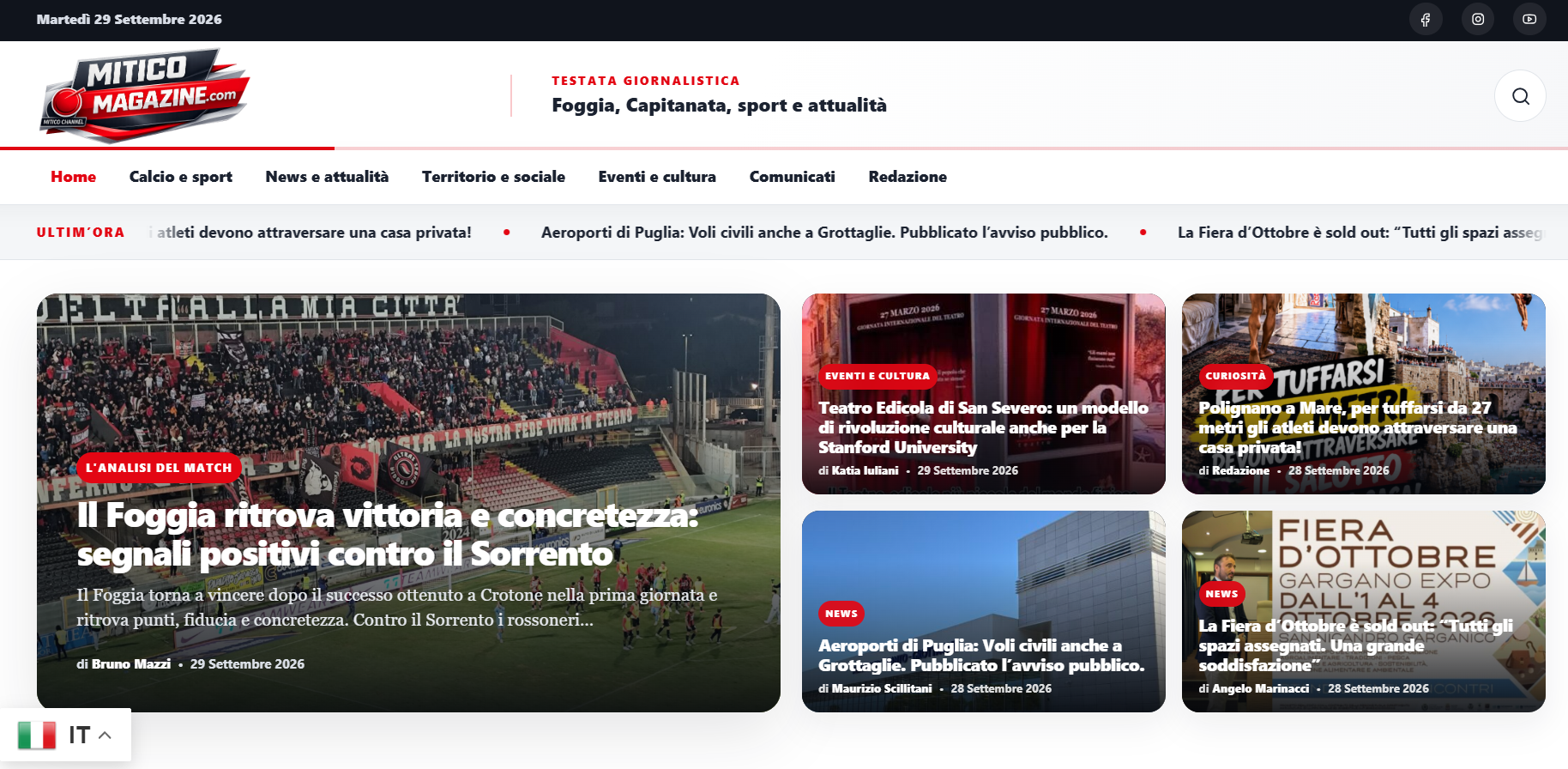
Mitico Magazine - The Teatro Edicola of San Severo: A Model of Cultural Revolution for Stanford University as Well Source: https://www.miticomagazine.com/territorio-e-sociale/teatro-edicola-di-san-severo-un-modello-di-rivoluzione-culturale-anche-per-la-stanford-university/ The Teatro Edicola in Via Tondi In San Severo, a singular metamorphosis has taken place: a newsstand abandoned for at least six years has found a new function and a new identity, transforming into one of the smallest and most unusual theatre stages in the world. An experiment born in the heart of the town which, in just a few months, has moved beyond local boundaries, attracting attention even overseas. It is called Teatro Edicola and it is a project conceived by the company Foyer '97, artistically directed by Francesco Gravino, which has brought the old newsstand in Via Tondi back to life through a formula that is both essential and surprising. Foyer '97 Foyer '97 APS was established as a formally constituted association active in the cultural sector in San Severo in 1997, born from the vocation of a group of actors, directors and theatre enthusiasts, with the aim of building a "living" and accessible theatre in the town. Over the years the company has developed a repertoire that includes texts from the classical tradition, contemporary dramaturgy, comedy and experimental projects, not limiting itself to the mere production of theatre shows, but also organising theatre courses and workshops and educational and cultural projects characterised by a strong inclusive ethos, particularly in schools. Foyer '97 does not always have a fixed artistic ensemble, but works with different performers and collaborators depending on the project; the only indispensable presence is that of Francesco Guido Gravino himself, actor, director and artistic director of the theatre company. The distinctive feature of Foyer '97 is certainly the value of social and cultural promotion attributed to theatre, the extremely close relationship with the audience and the search for a type of theatre outside conventional spaces, with cemeteries, trains, bell towers, and now a newsstand, as its backdrop. Six spectators, a few minutes and a minimal distance between stage and audience The project was launched on 27 March 2026, on the occasion of World Theatre Day, offering a theatrical experience built around a radical reduction of the conventional spaces and times of performance. The idea was born not only from the search for unconventional spaces, but also from "Edicola Fiore", the morning press review with a strongly ironic tone presented by Rosario Fiorello and Stefano Meloccaro, which was broadcast first only on Fiorello's social channels between 2011 and 2014, and then also on radio and television between 2016 and 2018. The review took its name from the diminutive of its founder, Fiore, and from the newsstand of a friend of Fiorello's in Via Flaminia Nuova in Rome, where the showman would meet early in the morning with a group of friends to read the newspapers. The San Severo newsstand was granted free of charge by its owner Pino Frau to the theatre group which, after obtaining temporary authorisation and institutional support from the Municipality of San Severo, refurbished it within two weeks at a cost of less than €3,000. Just six seats, a total surface area of 4 sq m, of which only 2 are for the stage area, less than a metre between actors and audience, a curtain, a lectern, two lights, performances lasting between 5 and 15 minutes, audience rotation every quarter of an hour: apparently minimal elements that end up subverting the usual relationship between stage and auditorium. Spectators, in fact, find themselves immersed in the stage action, in such proximity to the actors that every gesture, expression and word becomes immediately perceptible. In this way, theatre abandons its traditional spaces and insinuates itself into the everyday life of the street, becoming an intimate, concentrated and almost participatory experience. During the inaugural period admission was free with a subsequent voluntary donation from spectators; in the event of a more stable and longer-term concession, which could lead to seasonal theatre performances, the proposed ticket price would be €5. Audiences reward the experiment Foyer '97's gamble met with public interest right from the start: over 60 people attended the shows in a single afternoon, while the three days that inaugurated the season sold out. From a singular local experiment, the Teatro Edicola thus began to arouse curiosity even outside the province of Foggia, gradually transforming into a case of cultural and social interest, until it reached the American continent. From the province of Foggia to the "Stanford Social Innovation Review" The San Severo experience has now come under the international spotlight: in September 2026, the Stanford Social Innovation Review, an international journal and platform dedicated to social innovation published by the Stanford Center on Philanthropy and Civil Society at Stanford University in California, published on its website and in the Fall 2026 print edition the reportage "The Six-Seat Revolution", written by Dr Luciano Magaldi Sardella, independent journalist and researcher affiliated with the European Open University, and editorially supervised by deputy editor David V. Johnson. In the article, it is argued that the Teatro Edicola attracted attention overseas because the project concentrates cultural innovation, urban regeneration and proximity theatre into just a few square metres: starting from a real urban problem, it recovers an abandoned place with a modest investment, brings performance directly into public space and experiments with a much closer relationship between actors and spectators. From the point of view of theatrical representation, it also highlights how the format, based on micro-stories of five to twelve minutes, taken from great classics such as Goldoni, Chekhov, Ibsen, Euripides and Benni, and on audience rotation every fifteen minutes, transforms the physical limitations of the space into a precise dramaturgical choice, proving to be extremely innovative. All of this makes it possible to address some of the main critical issues in the sector: falling audience numbers, an exclusively elderly audience, reduced resources and distance from traditional cultural venues. The journal also highlights, however, the potential problems: economic sustainability, the need for stable institutional support and the difficulty of replicating the model, which is closely linked to the community and territory of San Severo. A model looking beyond San Severo Despite the difficulties, initial requests for information have already arrived from Lucca and Rome, where there is curiosity about the possibility of getting to know the model more closely and the steps needed to replicate it. The replicability formula, in fact, does not seem to require particularly costly infrastructure: an unused space, a targeted intervention, a cultural idea, in-depth knowledge of the surrounding area and a willingness to return that place to the community can be enough to trigger a new urban function. It is precisely in the disproportion between the modesty of the resources employed and the resonance generated by the initiative that perhaps the most original feature of the Teatro Edicola lies, certainly unique of its kind; there are, however, other examples in Italy of newsstands reused for other purposes: "Edicola 518", a twentieth-century kiosk abandoned in the centre of Perugia, now dedicated to independent publishing, art and cultural production; and in Rome itself, the abandoned newsstand in Piazza Testaccio used temporarily as a stage for a show by Fabio Morgan and the Erno newsstand in the Prati district, which almost every month offers a calendar of events, exhibitions, pop-ups and collaborations with artists and creative enterprises. Small revolutions, therefore, that tell stories of the reappropriation of urban spaces, of creativity and social innovation. And which, it is hoped, will take root in order to look ever further afield.

www.miticomagazine.com
Teatro Edicola di San Severo: un modello di rivoluzione culturale anche per la Stanford University
1041
Luciano Magaldi Sardella (PhD) 3w

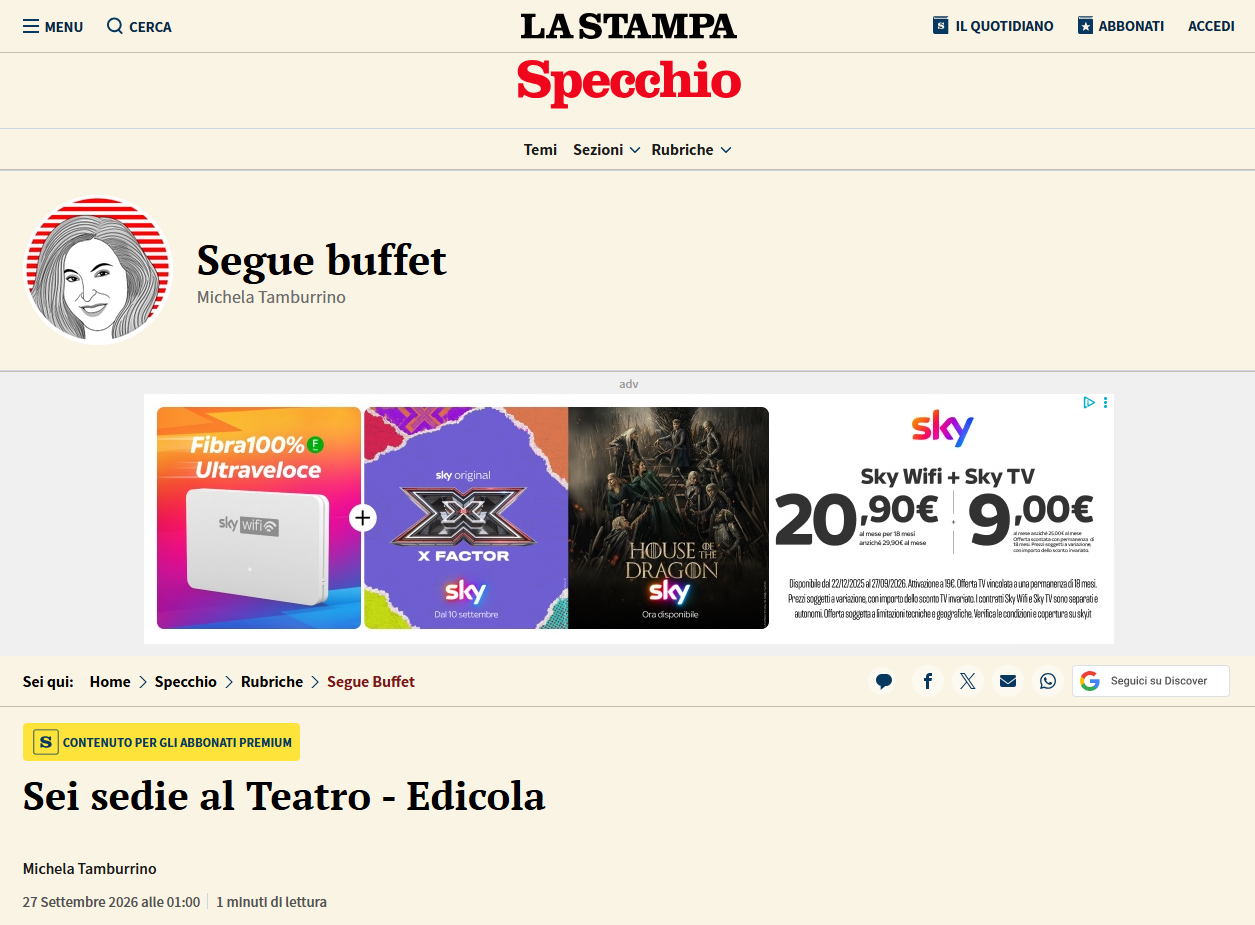
IL TEATRO-EDICOLA (FRANCESCO GRAVINO) SU “LA STAMPA (SPECCHIO)”, “SIX CHAIRS AT THE TEATRO-EDICOLA” by FRANCESCA TAMBURRINO SOURCE: https://www.lastampa.it/specchio/rubriche/segue-buffet/2026/09/27/news/sei_sedie_al_teatro_-_edicola-15748967/ To the delight of lovers of the genre, the news is reassuring: theatres are back in fashion. Perhaps they had never gone out of fashion but were slightly tarnished by interest in other genres considered more contemporary. Wrong, theatre after millennia withstands wear and negativity reinvigorates it. Halls thought lost are reopening and new spaces are flourishing. Because theatre can be made anywhere, in houses, in streets, on the ashes of spaces born for other purposes. For example in newsstands: in many cities these kiosks sell everything except what they were conceived for, newspapers. The ingenious wheeze is to be found in the Foggia area with the Teatro-Edicola, the smallest theatre in the world, six chairs, less than two square metres, careful programming, performances every fifteen minutes and sold-out is easily guaranteed. A happy experiment that has intrigued even the noble journal of the American Stanford University. The wheeze from San Severo in the Foggia area pleased the students of Stanford so much that they made it a case study. The result was published in the “Stanford Social Innovation Review (SSIR)” quarterly journal and award-winning website given its specific specialisation in covering multisectoral solutions to global problems, considered one of the world reference points for social innovation. The article “The Six-Seat Revolution”, that is to say the Revolution of the Six Chairs, was curated by the Foggian (Orta Nova) researcher Luciano Magaldi Sardella, supervised by editor David V. Johnson and can be retrieved in the Dispatches section of the “Stanford Social Innovation Review”. Imagine the satisfaction of the theatre company Foyer 97 which sees itself projected into global fame and planetary interest, matured into a shower of requests for duplication. After all, who does not have a disused space in a state of abandonment to be recovered worthy of rising to a cultural garrison? Meanwhile the meritorious creators of the winning idea will return to the stage in October and are already preparing the thirtieth anniversary of the company which falls next year. On those six chairs, they assure us, young and old have sat in equal albeit meagre measure. An experiment which in the universe of entertainment is followed with attention. So much so that Biagio Antonacci made a surprise stop at the Teatro-Edicola where he sang his “Iris”. Passers-by in a huddle beyond the sold-out.

www.lastampa.it
Sei sedie al Teatro - Edicola
1042
Waldemar Hartmann 3w

Heute vor 48 Jahren wurde die taz erstmals am Kiosk verkauft. Am 17.10 2025 lag zum letzten Mal eine gedruckte taz am Kiosk aus. Sie wurde eingestellt. Vermisst sie jemand? #taz #Medien #Journalismus

13089
Luciano Magaldi Sardella (PhD) 4w

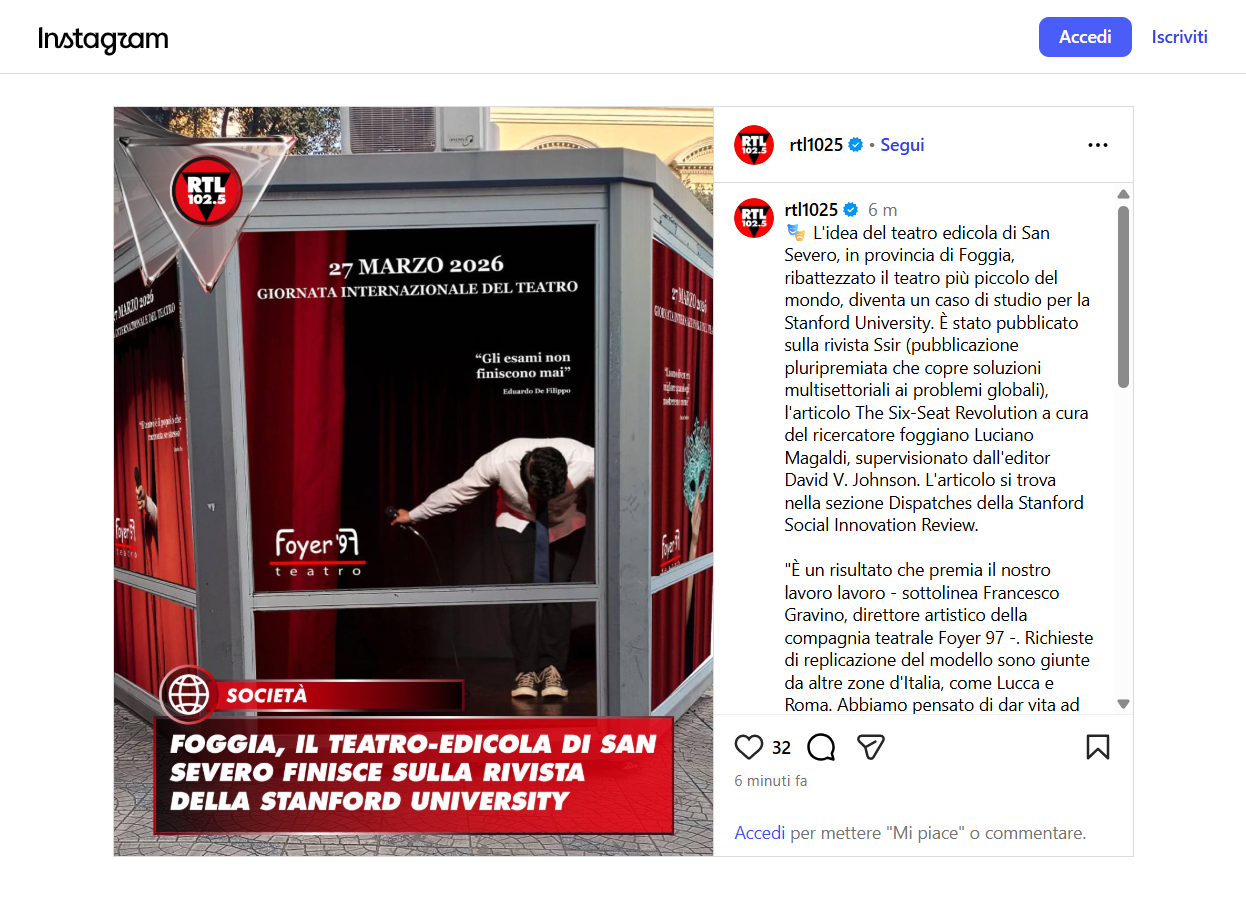
"RTL 102.5": THE KIOSK-THEATRE FEATURED IN STANFORD UNIVERSITY'S REVIEW SOURCE: https://l.facebook.com/l.php?u=https%3A%2F%2Fwww.instagram.com%2Fp%2FDdeEUnXiKMT%2F%3Ffbclid%3DIwcGRvZgFleHRuA2FlbQIxMABicmlkETB1OU02c2NZUzNkeWVpb2ZJc3J0YwZhcHBfaWQQMjIyMDM5MTc4ODIwMDg5MgABHhWTgrXrSOqSpbqd0NlmkWW4gNxVEDa-2BmQGWsVUhQQoqC4_J55glcV6Fzu_aem_zWbIIMpp66X9FxYrdVcTmg&h=AUDX8FniZvleWSVlN4ngwxrSLu1IeEzRJGb1DHFgsznthttLc9QR-ahTowPSBcj7rf_yYePu1vaPUXc34NqwzN3m-FtFuy-KM33ftfPsEeZaaYwWOXktve-A-NW0TY9CLHcritIH__2rbzUD5w&__tn__=-UK-R&c[0]=AUCpozNMTPma15kUqGpGsKv6GwFtuWcQmfK3Oj0VtFFsM0cj9rhdH6l9Y-6SLIz8vG2VBro_6pSGTiplv6br8YJx7ZZQnAPeuivIBI0eX8NPUol4JadoLFkhbxd949RZixQc7l2aWhHEkWT6kEVC92069Lsd2AymBya1pXHVw4UabsmzYz1s SAN SEVERO (FG) - The concept of the kiosk-theatre of San Severo, in the province of Foggia, dubbed the smallest theatre in the world, has become a case study for Stanford University. The article The "Six-Seat Revolution", by the Foggia-born researcher Luciano Magaldi Sardella, supervised by Deputy Editor David V. Johnson, has been published in "Stanford Social Innovation Review (SSIR)" - the multi-award-winning publication covering cross-sector solutions to global problems. The article appears in the "Dispatches" section of the "Stanford Social Innovation Review". "This is an achievement that rewards our work," emphasizes Francesco Gravino, Artistic Director of the theatre company Foyer 97. "Requests to replicate the model have come from other parts of Italy, such as Lucca and Rome. We thought of creating a cultural activity from a place that was disused and in a state of abandonment. There ought to be a regional law that makes it possible to convert these disused premises into places where numerous activities can be brought to life. Genuine cultural outposts." Gravino and the company's actors are preparing the new programme. "Next year our company will be 30 years old," he said, "an important milestone that we shall celebrate with a number of new developments." Six chairs, less than two square metres, performances repeated every 15 minutes, and sold-out audiences of young people and adults. An experiment that has aroused curiosity and interest in the world of entertainment as well. Between late July and early August, during his tour in Lucera (Foggia), Biagio Antonacci made a surprise stop at the kiosk-theatre and sang his Iris. "It was truly a wonderful encounter that attracted the attention of passers-by," Gravino concludes.

1164
Luciano Magaldi Sardella (PhD) 4w

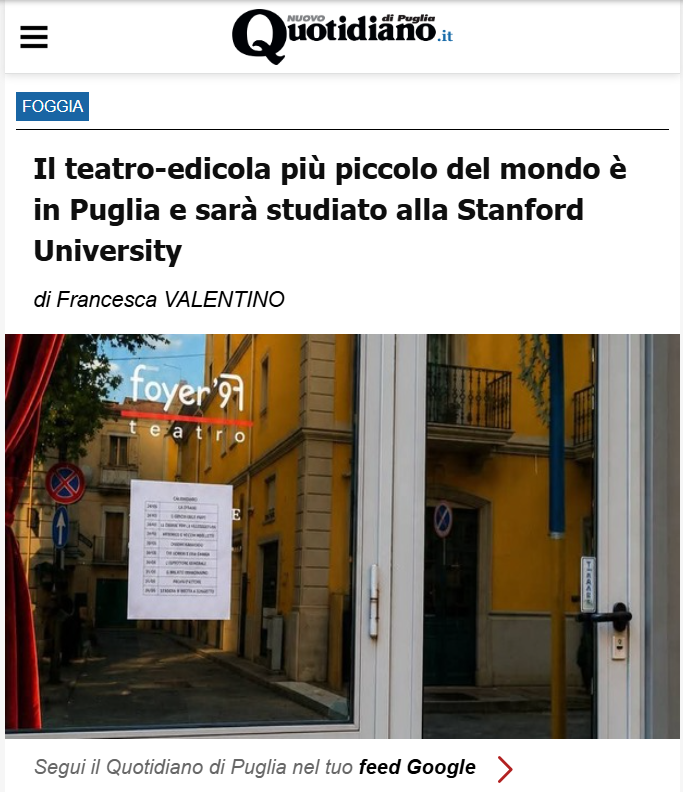
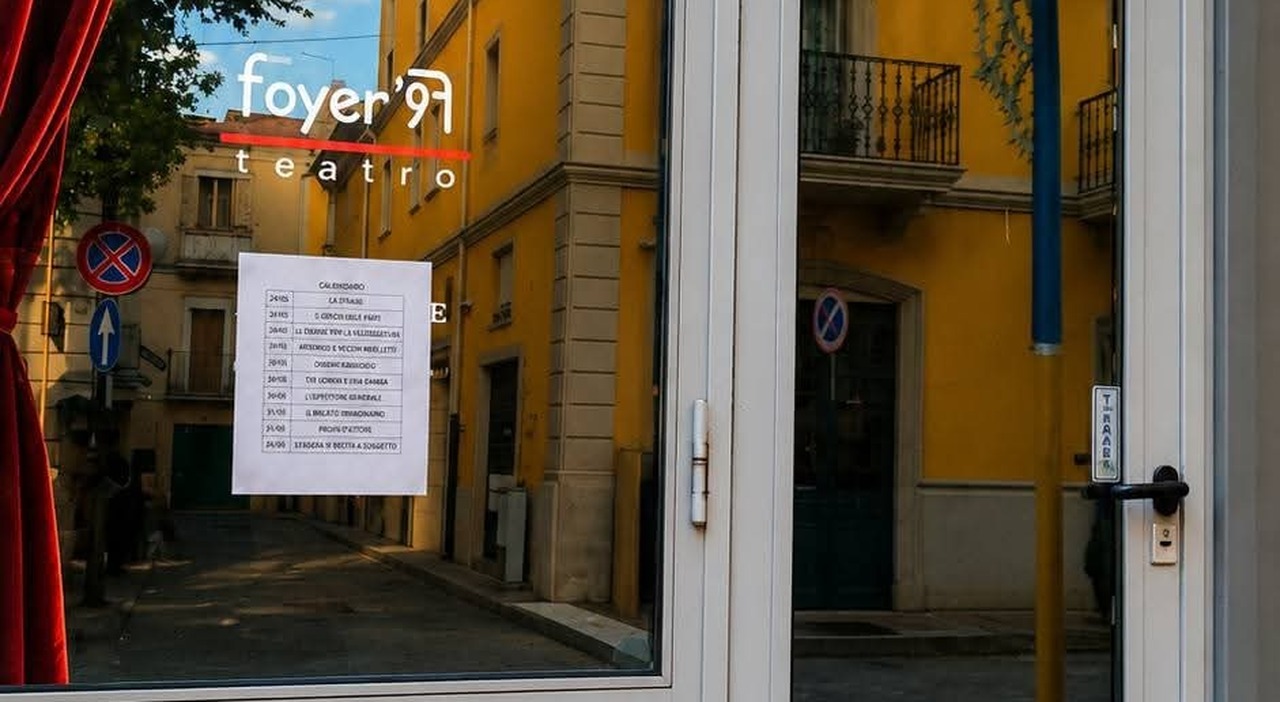
"QUOTIDIANO DI PUGLIA": THE WORLD'S SMALLEST KIOSK-THEATRE IS IN PUGLIA AND WILL BE STUDIED AT STANFORD UNIVERSITY SOURCE: https://www.quotidianodipuglia.it/AMP/foggia/san_severo_teatro_edicola_puglia_stanford_university-9773347.html SAN SEVERO (FG) - On the eve of the new season, worldwide recognition has come for the kiosk-theatre, the smallest theatre in the world, built in San Severo, in the Province of Foggia: it is to become a case study at Stanford University. The concept of the kiosk-theatre was published in SSIR - the multi-award-winning publication covering cross-sector solutions to global problems - in the article 'The Six-Seat Revolution' by the Foggian researcher Luciano Magaldi Sardella, supervised by editor David V. Johnson. The article appears in the 'Dispatches' section of the Stanford Social Innovation Review. 'It is an achievement that rewards our work,' said Francesco Gravino, artistic director of the theatre company Foyer 97, with pride. In the meantime, he announced that requests have been made to replicate the model in other Italian cities. 'Requests to replicate our theatre model have come from Lucca and Rome. We thought of creating a cultural activity from a place that had been decommissioned and abandoned. What is needed is a regional law that allows for the reconversion of these disused places, in which numerous activities could be brought to life. Genuine cultural outposts.' The new programme, which Francesco Gravino and the actors of the company are preparing, is already in the pipeline. 'Next year our company will celebrate its 30th anniversary,' he said, 'an important milestone that we shall mark with some new developments.' Six chairs, less than two square metres, performances repeated every 15 minutes, and sold-out audiences of young people and adults. An experiment that has aroused curiosity and interest even in the world of show business. Amongst the curious theatre enthusiasts, last summer they also welcomed Biagio Antonacci as a guest. In Lucera, in the Province of Foggia, with his new tour between July and August, during his travels he made a surprise stop at the kiosk-theatre and sang 'Iris'. 'It was truly a wonderful encounter that captivated the attention of passers-by,' Gravino concluded.

www.quotidianodipuglia.it
Il teatro-edicola più piccolo del mondo è in Puglia e sarà studiato alla Stanford University
1047
Luciano Magaldi Sardella (PhD) 4w

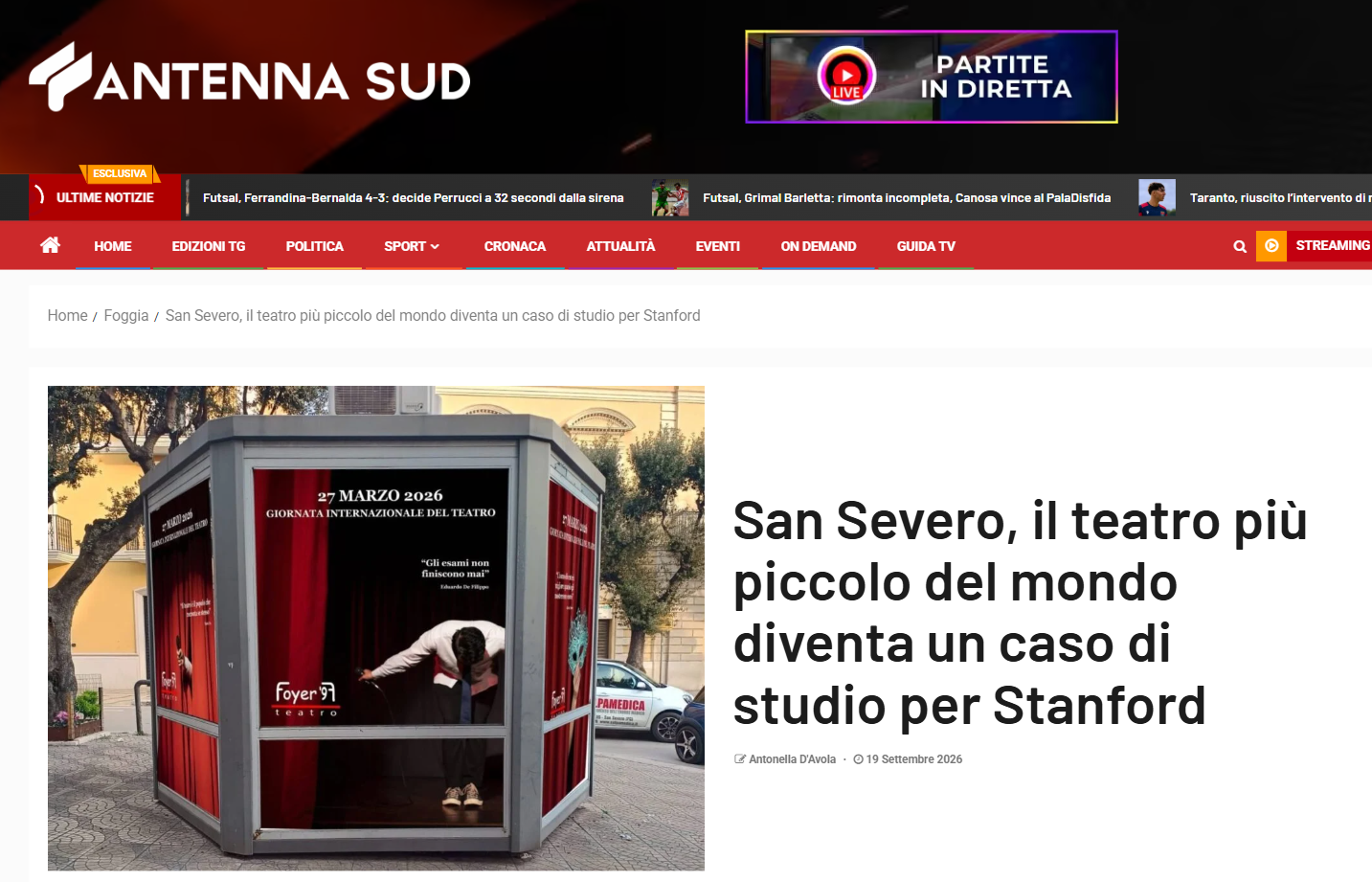
"ANTENNA SUD": SAN SEVERO - THE WORLD'S SMALLEST THEATRE BECOMES A STANFORD CASE STUDY SOURCE: https://www.antennasud.com/san-severo-il-teatro-piu-piccolo-del-mondo-diventa-un-caso-di-studio-per-stanford/ SAN SEVERO (FG) - Six chairs, fewer than two square metres, and performances reprised at intervals of fifteen minutes. It was upon such unassuming premises that there came into being, at San Severo, in the province of Foggia, the teatro edicola - the "kiosk theatre" - a diminutive cultural space wrought from a disused and long-abandoned news-stand, which today draws audiences, curiosity, and attention far beyond Italy's borders. The enterprise has been elevated to the dignity of a case study by Stanford University. In the "Stanford Social Innovation Review (SSIR)", the international journal dedicated to innovative solutions to social problems, there has been published the article "The Six-Seat Revolution", authored by the Foggia-based researcher Luciano Magaldi and supervised by editor David V. Johnson. The contribution is featured in the journal's Dispatches section. "It is an achievement which rewards our labour," emphasises Francesco Gravino, artistic director of the theatrical company Foyer 97, the protagonist of the undertaking. The idea is as simple as it is original: to transform a space fallen into disuse into a cultural outpost capable of accommodating petite spectacles and of forging an immediate rapport with the public. The format has already excited interest in other Italian cities. "Requests to replicate the model have reached us from other parts of Italy, such as Lucca and Rome," Gravino recounts. Hence also the appeal for intervention upon disused spaces: "What is required is a regional law affording the possibility of reconverting these places, wherein one might give life to manifold activities. Veritable cultural garrisons." In the kiosk theatre, performances endure but a few minutes, and the public is admitted in small parties. Six seats are available, performances follow one another in close succession, and an audience composed of the young and the adult has responded with constancy, frequently to the extent of being sold out. An experiment which has attracted the attention of the world of entertainment itself. Between the end of July and the first days of August, during his tour in Lucera, even Biagio Antonacci paid a surprise visit to the kiosk theatre. The singer-songwriter tarried within the space and sang Iris, drawing the attention of passers-by. "It was truly a most beautiful encounter which captivated the attention of all," Gravino recalls. Foyer 97 is now preparing its forthcoming programme. Next year, indeed, the company shall celebrate a significant milestone: "It shall attain its thirtieth anniversary, and it is an occasion we shall mark with sundry novelties," Gravino announces.

www.antennasud.com
San Severo, il teatro più piccolo del mondo diventa un caso di studio per Stanford
1281
Luciano Magaldi Sardella (PhD) 4w

"FOGGIATODAY": SAN SEVERO'S KIOSK THEATRE FEATURED IN THE "STANFORD SOCIAL INNOVATION REVIEW": THE MODEL WAS A CASE STUDY AT STANFORD UNIVERSITY SOURCE: https://www.foggiatoday.it/attualita/teatro-edicola-san-severo-rivista-stanford-university.html SAN SEVERO (FG) - An article authored by the researcher Luciano Magaldi Sardella in the Stanford Social Innovation Review analyseth the experience of the company 'Foyer 97'. The Artistic Director, Gravino: "Requests for replication have been received from Lucca and Rome; a regional statute for the reconversion of abandoned sites is required." The initiative of the kiosk theatre of San Severo, situated in the Province of Foggia and renowned as the smallest theatre in the world, hath become the object of scholarly analysis at Stanford University. In SSIR - an award-winning periodical devoted to innovative solutions to global problems - there had indeed been published the article The Six-Seat Revolution, written by the Foggia-based researcher Luciano Magaldi under the supervision of the editor David V. Johnson. The article appeareth in the Dispatches section of the "Stanford Social Innovation Review". "It is an achievement that crowneth our labour upon labour," emphasised to ANSA Francesco Gravino, artistic director of the theatre company Foyer 97. "Requests to replicate the model have reached us from other parts of Italy, such as Lucca and Rome. We conceived the idea of engendering a cultural enterprise from a place hitherto disused and in a state of dereliction. What is requisite is a regional law that affordeth the possibility of reconverting these disused places, wherein one might engender a multitude of activities. Veritable cultural outposts." Gravino and the actors of the company are preparing the new programme. "Next year our company shall attain its thirtieth anniversary," he said, "a momentous occasion which we shall celebrate with sundry novelties." Six chairs assembled in less than two square metres, performances repeated every quarter of an hour, and audiences at full capacity, amongst both the young and the adult. An experiment that hath attracted attention and curiosity even within the profession of the stage. Between the end of July and the beginning of August, during the engagement at Lucera (Foggia), Biagio Antonacci paid a surprise visit to the kiosk theatre and performed his Iris. "It was truly a most beautiful encounter that captivated the attention of passers-by," Gravino concluded.

www.foggiatoday.it
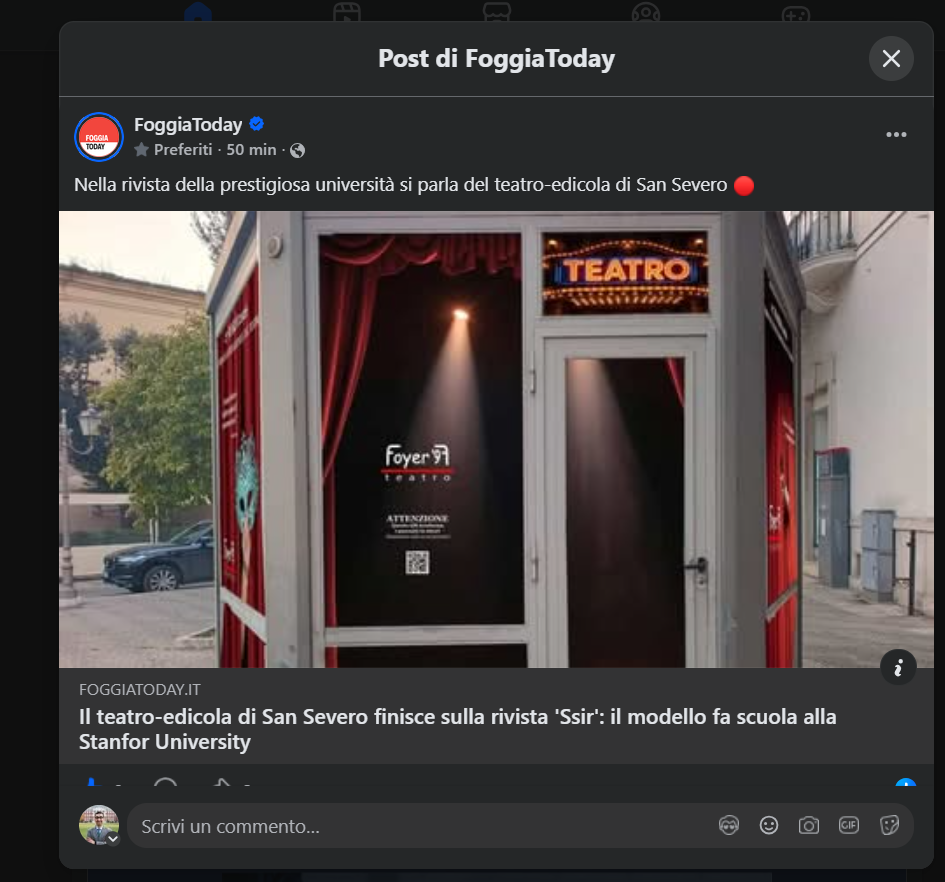
Il teatro-edicola di San Severo finisce sulla rivista 'Ssir': il modello fa scuola alla Stanfor University
698
Luciano Magaldi Sardella (PhD) 4w

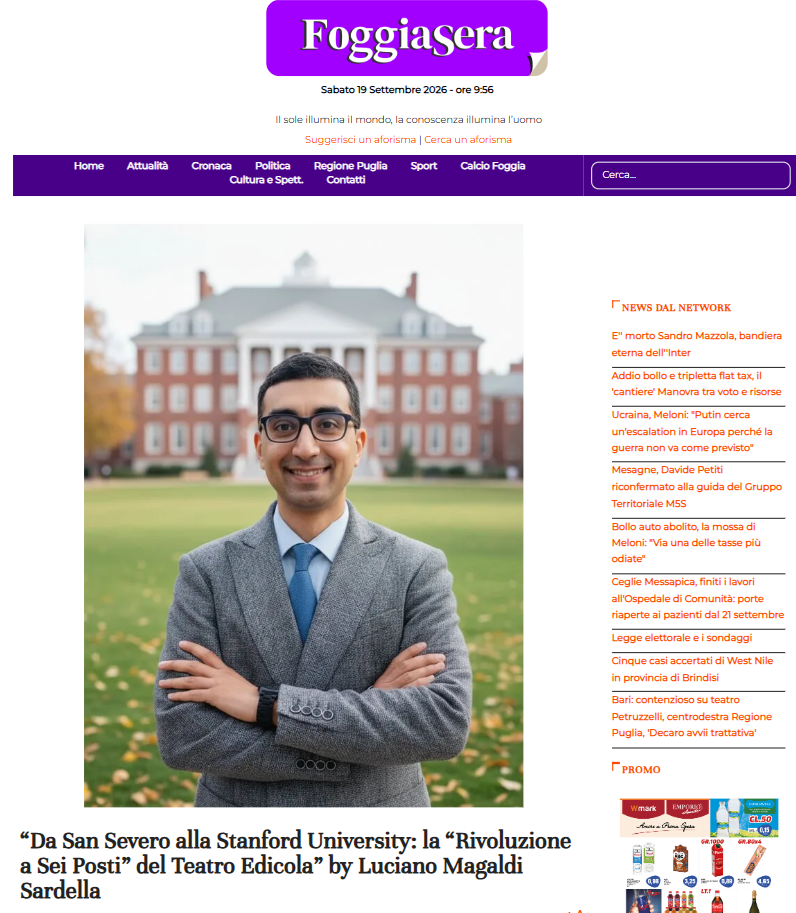
"FOGGIA SERA": FROM SAN SEVERO TO STANFORD UNIVERSITY: THE "SIX-SEAT REVOLUTION" OF THE TEATRO EDICOLA SOURCE: https://foggiasera.it/2026/09/19/da-san-severo-alla-stanford-university-la-rivoluzione-a-sei-posti-del-teatro-edicola-by-luciano-magaldi-sardella/ SAN SEVERO (FG) - The Stanford Social Innovation Review (SSIR), the scholarly journal published by the Stanford Center on Philanthropy and Civil Society of the prestigious Stanford University - ranked second in the world in the Shanghai Ranking of World Universities - and recognised as the pre-eminent global reference for researchers, policy-makers, and practitioners of innovative entrepreneurship and philanthropy, hath published the reportage "The Six-Seat Revolution" upon the Teatro Edicola of San Severo, the smallest theatre in the world by dimension and capacity, born of the intuition of Francesco Gravino, Artistic Director of the Foyer '97 company. Its author is Luciano Magaldi Sardella, independent researcher and international journalist, native of Orta Nova and of maternal Sanseverese extraction, hitherto author of studies published in international academic journals. The piece appeared in the September (Fall 2026) edition of the academic review, within the section devoted to Arts & Culture. A presence that projects San Severo, and more broadly the Capitanata, into the international élite of research upon cultural and urban innovation. The Theatre Is Born of a Disused Newsstand It all commenced on 27 March 2026, World Theatre Day, in Piazza Municipio at San Severo. A news-kiosk, disused for years in Via Matteo Tondi, raised its shutter to reveal, in lieu of newspapers and cigarettes, an actor upon the stage. Within: six chairs. At intervals of fifteen minutes, a new audience took its place. Drawing inspiration from the televisual format of Edicola Fiore by the noted Sicilian presenter of radio and television, there was born the Teatro Edicola, a structure now recognised in the media as the smallest theatre in the world for dimensions and capacity: four square metres in aggregate, with a scenic space of less than two metres. Gravino hath led Foyer '97 for nigh on thirty years, forging a most exacting artistic trajectory in a context - that of southern Italy - historically penalised in respect of public financing for culture. And yet, upon beholding that vacant kiosk, he elected the path of provocation: to transfigure the bare minimum into a manifesto concerning the very meaning of theatre. The Model and its Measurable Effects The inaugural season endured for three days. All performances were sold out. In a single afternoon, upwards of sixty persons attended the representations. The cost of the entire pilot operation was less than three thousand dollars. The formula is radical in its constitutive elements: performances of five to twelve minutes' duration, conceived expressly for the space; rotation of the audience every fifteen minutes; direct and inescapable visual contact betwixt actor and spectator; no architectural or psychological distance betwixt stage and auditorium; ticket proposed at five euros per person, within a hybrid economic model comprising municipal support, local sponsorship, and box-office receipts. According to the analysis published in the Stanford Social Innovation Review, the Teatro Edicola represents a replicable model of low-cost, high-impact urban regeneration, capable of reactivating abandoned commercial spaces (newsstands, tobacconists, telephone kiosks) without recourse to large infrastructural investment. The Voice of Him who Built it All Francesco Gravino entertaineth no doubt as to the import of the enterprise: "Grand theatres are not requisite to transform a fragment of a city. What is requisite is a sound idea and the courage to restore to the collectivity a space that hath lost its function." And upon the import of international recognition: "Teatro Edicola was born to demonstrate that a place of encounter and culture may arise wheresoever, even within two square metres. That this work should today be studied at an international level and that enquiries should arrive from cities such as Lucca and Rome is confirmation that the path pursued is the right one." The director hath further explicated the symbolic choice of place: the newsstand was the locus wherein each morn one paused, informed oneself, and recognised oneself as a community. Its disappearance rent a precise social fabric. To restore unto it a cultural function is to re-stitch that tissue at the very point wherefrom it was torn. The Challenges: Scalability, Institutional Recognition, Entrenchment The SSIR reportage doth not confine itself to celebration of the project but analyseth also the critical junctures. The first is sustainability over time: an activation of three days, howsoever successful, doth not yet constitute a stable programme, a veritable seasonal repertory (weekends from spring to autumn) with a rotating roster of local and regional companies. The second juncture concerneth replicability without loss of identity: the Teatro Edicola functioneth also by virtue of the profound roots of Foyer '97 in the Sanseverese territory. To transplant the model elsewhere requireth not merely a physical kit, but an entire process of community-building. The third obstacle is institutional: in a system of public funding that rewardeth organisations with consolidated premises and predictable output metrics, a project deliberately experimental, hyperlocalist, and by its very nature impermanent strugglest to gain access to the ordinary channels of the Fondo Nazionale per lo Spettacolo dal Vivo (FNSV) of the Ministry of Culture. A Lesson that Travels beyond Puglia In the Stanford Social Innovation Review the author concludeth that the intuitions of the Teatro Edicola transcend the Sanseverese context: in any community wherein cultural institutions struggle to reach youthful, diverse, or economically marginal publics, the principle of proximity proveth disruptive: to encounter people where they already find themselves, in the spaces they inhabit quotidianly. From the populous centre of Daunia to the pages of Stanford University: San Severo and its kiosk demonstrate that six chairs, four square metres, and a vision suffice to alter the manner in which a city conceiveth of itself. And to offer unto the world a model that costeth less than one might credit, yet is worth far more than one might imagine.

1164
Luciano Magaldi Sardella (PhD) 4w

"PUGLIA IN": FROM SAN SEVERO TO STANFORD UNIVERSITY: THE 'SIX-SEAT REVOLUTION' OF TEATRO EDICOLA SOURCE: https://www.pugliain.net/301723-san-severo-teatro-edicola/ SAN SEVERO (FG) - The "Stanford Social Innovation Review (SSIR)", the scholarly quarterly published by the "Stanford Center on Philanthropy and Civil Society" at the prestigious Stanford University — ranked second in the world in the Shanghai Ranking of World Universities — and universally regarded as the pre-eminent global point of reference for scholars, policy-makers and practitioners in the fields of innovative enterprise and philanthropy, hath published the reportage “The Six-Seat Revolution” concerning the Teatro Edicola of San Severo, the smallest theatre in the world, born of the intuition of Francesco Gravino, Artistic Director of the Foyer ’97 company. Its author is Luciano Magaldi Sardella, independent researcher and international journalist, a native of Orta Nova with maternal lineage rooted in San Severo, and erstwhile contributor of studies published in international academic journals. The piece appeared in the Septembertide (Fall 2026) edition of the academic review, within the section consecrated to Arts and Culture. A presence which projecteth San Severo, and more broadly the entirety of Capitanata, into the international élite of research on cultural and urban innovation. The theatre is born from a disused newsstand It all commenceth upon 27 March 2026, World Theatre Day, in the Piazza Municipio at San Severo. A newsstand long disused in Via Matteo Tondi raiseth its shutter to reveal, in lieu of newspapers and cigarettes, an actor upon the stage. Within: six chairs. At intervals of fifteen minutes, a new audience taketh its place. Drawing inspiration from the televisual format of "Edicola Fiore" of the celebrated Sicilian radio and television presenter, there was born Teatro Edicola, a structure now recognised in the media as the smallest theatre in the world by both dimension and capacity: four square metres in total, with a scenic space of less than two metres. Gravino hath led Foyer ’97 for nigh on thirty years, forging an exacting artistic trajectory in a context — that of Southern Italy — historically penalised with respect to public funding for culture. And yet, when he beheld that vacant kiosk, he chose the path of provocation: to transmute the bare minimum into a manifesto concerning the very signification of theatre. The model and its measurable effects The inaugural season endured for three days. All performances were sold out. In a single afternoon, upwards of sixty persons attended the representations. The cost of the entire pilot operation was less than three thousand dollars. The formula is radical in its constitutive elements: performances of five to twelve minutes' duration, conceived expressly for the space rotation of the audience every fifteen minutes direct and ineluctable visual contact betwixt actor and spectator no architectural or psychological distance betwixt stage and stalls ticket proffered at five euros per person, with a hybrid economic model envisaging municipal support, local sponsors and box-office receipts According to the analysis published in the "Stanford Social Innovation Review", Teatro Edicola representeth a replicable paradigm of low-cost, high-impact urban regeneration, capable of reactivating abandoned commercial spaces — newsstands, tobacconists, telephone kiosks — without the necessity of substantial infrastructural investment. The voice of him who built it all Francesco Gravino entertaineth no doubt as to the significance of the undertaking: “One doth not require grand theatres to transform a portion of a city. One requireth a sound idea and the courage to restore to the collectivity a space that hath lost its function.” And concerning the import of international recognition: “Teatro Edicola was born to demonstrate that a locus of encounter and culture may arise wheresoever, even within two square metres. That today this labour should be studied at an international level and that enquiries should arrive from cities such as Lucca and Rome is confirmation that the path is the right one.” The director hath also explicated the symbolic choice of place: the newsstand was the point at which, each morn, one paused, one apprised oneself, one recognised oneself as a community. Its disappearance lacerated a precise social fabric. To restore unto it a cultural function signifieth to re-stitch that fabric from the very point at which it was rent. Challenges: scalability, institutional recognition, rootedness The SSIR reportage doth not merely celebrate the project but analyseth also its critical nodes. The first is sustainability over time: an activation of three days, howsoever successful, doth not yet constitute a stable programme, a veritable seasonal programmation (weekends from springtide to autumn) with a rotating roster of local and regional companies. The second node concerneth replicability without loss of identity: Teatro Edicola functioneth also by virtue of the profound roots of Foyer ’97 within the San Severo territory. To transplant the model elsewhere requireth not merely a physical kit, but an entire process of community building. The third obstacle is institutional: in a system of public funding which rewardeth organisations possessed of consolidated premises and predictable output metrics, a project deliberately experimental, hyper-localist and by its very nature impermanent struggleth to gain access to the ordinary channels of the Fondo Nazionale per lo Spettacolo dal Vivo (FNSV) of the Ministry of Culture. A lesson which travelled beyond Puglia In the Stanford Social Innovation Review the author concludeth that the intuitions of Teatro Edicola transcend the San Severo context: in any community wherein cultural institutions struggle to reach youthful, diverse, or economically marginal publics, the principle of proximity proveth disruptive: to meet people where they already are, in the spaces they inhabit quotidianly. From the populous centre of Daunia to the pages of Stanford University: San Severo and its diminutive kiosk demonstrate that six chairs, four square metres, and a vision sufficeth to alter the manner in which a city conceiveth itself. And to proffer unto the world a model which costeth less than one might suppose yet is worth far more than one might imagine.

www.pugliain.net
Da San Severo alla Stanford University: la “Rivoluzione a Sei Posti” del Teatro Edicola
931
Jose Ignacio García ۞ 4w

"El Moreno Bonilla que ha cogido la catedral para hacer una fiesta de la élite de ellos" Escuchado a un señor mayor en un Kiosko de Sevilla esta mañana. #Sevilla #Catedral #Fiesta

13391
Luciano Magaldi Sardella (PhD) 4w

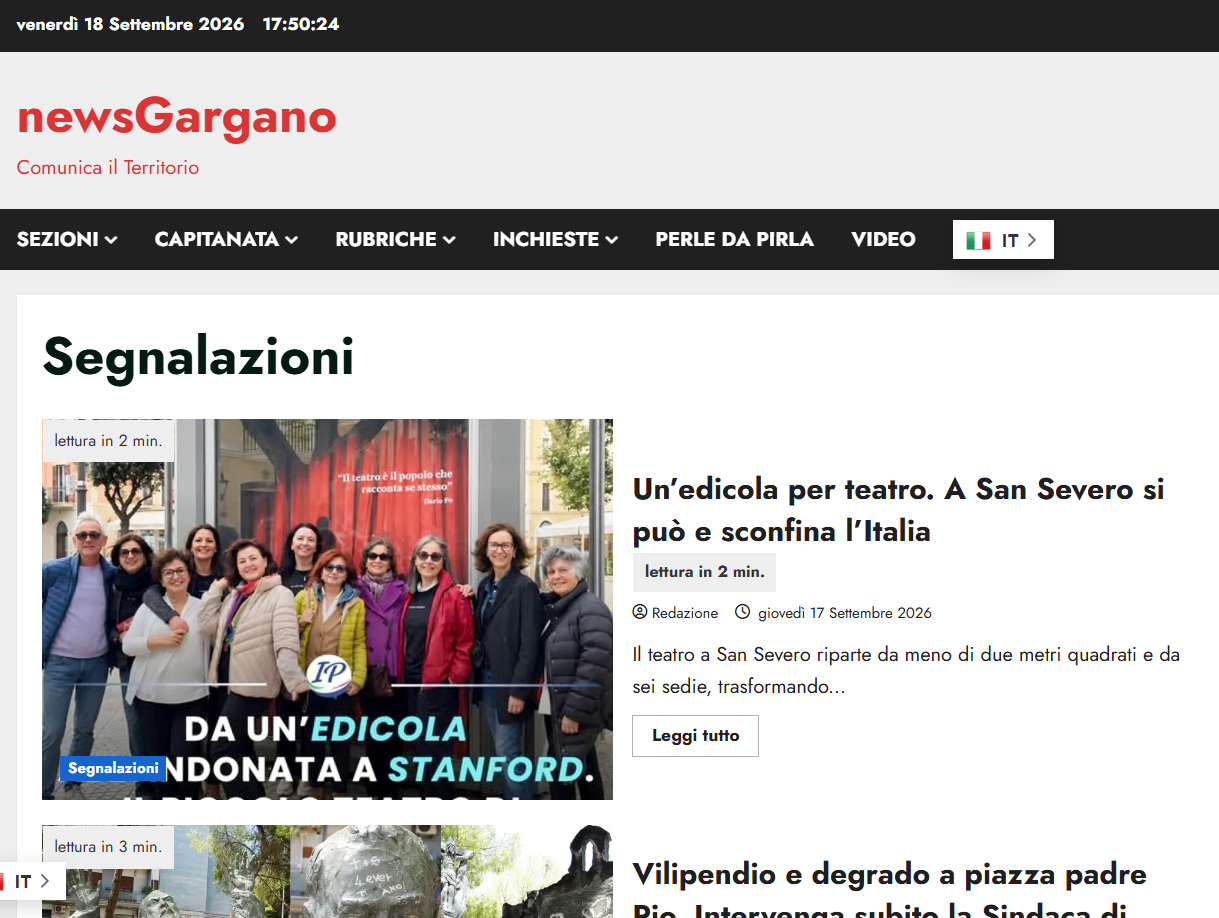
"NEWS GARGANO": A KIOSK FOR A THEATRE: IN SAN SEVERO IT CAN BE DONE, AND ITS ECHO EXTENDS BEYOND ITALY SOURCE: https://www.newsgargano.com/unedicola-per-teatro-a-san-severo-si-puo-e-sconfina-litalia/ SAN SEVERO (FG) - Theatre in San Severo is reborn from less than two square metres and six chairs, transmuting a symbol of urban blight into a small international cause célèbre. The virtuous enterprise has been revived by the company Foyer '97, under the artistic direction of Francesco Gravino, protagonist of a project of cultural regeneration that is now transcending the confines of the Province of Foggia. At the heart of the intervention lies the reclamation of an abandoned newsstand in Via Tondi, for years a disused space and now restored to the city in an unprecedented guise. Where once there was a lowered shutter, theatre is now made: but six spectators at a time, actors at but a few paces from their audience, and performances of brief duration, in a direct and radical commerce between stage and city. The experiment, inaugurated on 27th March, has yielded figures that bespeak a tangible cultural need. More than sixty persons attended the performances in a single afternoon, and the three days of the inaugural season were sold out, demonstrating that proximity and quality may yet generate community even in the most residual of spaces. Yet the story of San Severo has swiftly outgrown its local boundaries. In September 2026, the Stanford Social Innovation Review dedicates to the project the reportage "The Six-Seat Revolution", authored by Luciano Magaldi Sardella, researcher, academic and international journalist from Orta Nova of Sanseverese maternal lineage. The work is described by SSIR as: "A theater director transformed an abandoned newsstand into a radically new theatrical experience that is helping to revive the historic center of a Southern Italian town." The Apulian experience is observed not merely for its theatrical originality, but as a replicable paradigm of low-cost social innovation and urban regeneration, capable of activating cultural capital without recourse to grand structures or lavish investment. "One does not require grand theatres to transform a quarter of a city. What is required is a sound idea and the courage to restore to the collectivity a space that has lost its function," emphasised the artistic director Francesco Gravino. "Teatro Edicola was conceived to demonstrate that a locus of encounter and culture may arise anywhere, even within two square metres. That this endeavour should now be studied at an international level, and that enquiries should arrive from cities such as Lucca and Rome, is confirmation that we are upon the right path." The valorisation and preservation of the urban and cultural fabric must inevitably proceed through the creative reclamation of forsaken places. From a derelict newsstand with scarcely six seats to a project capable of commanding international attention: sometimes, to regenerate a city, one need not build, but re-inhabit.

www.newsgargano.com
Un'edicola per teatro. A San Severo si può e sconfina l'Italia
699
El Oráculo de Trenque Lauquen Sep 18

No paran las buenas noticias. De golpe vemos por primera vez algo asi en decadas y empiezan a salir kioskitos... de golpe noa dimos cuenta que hasta en la armada los kukas montaron cocinas de ñoquis? Ahora sale? No van a poder. #buenasnoticias #cocina #sorpresas

14566