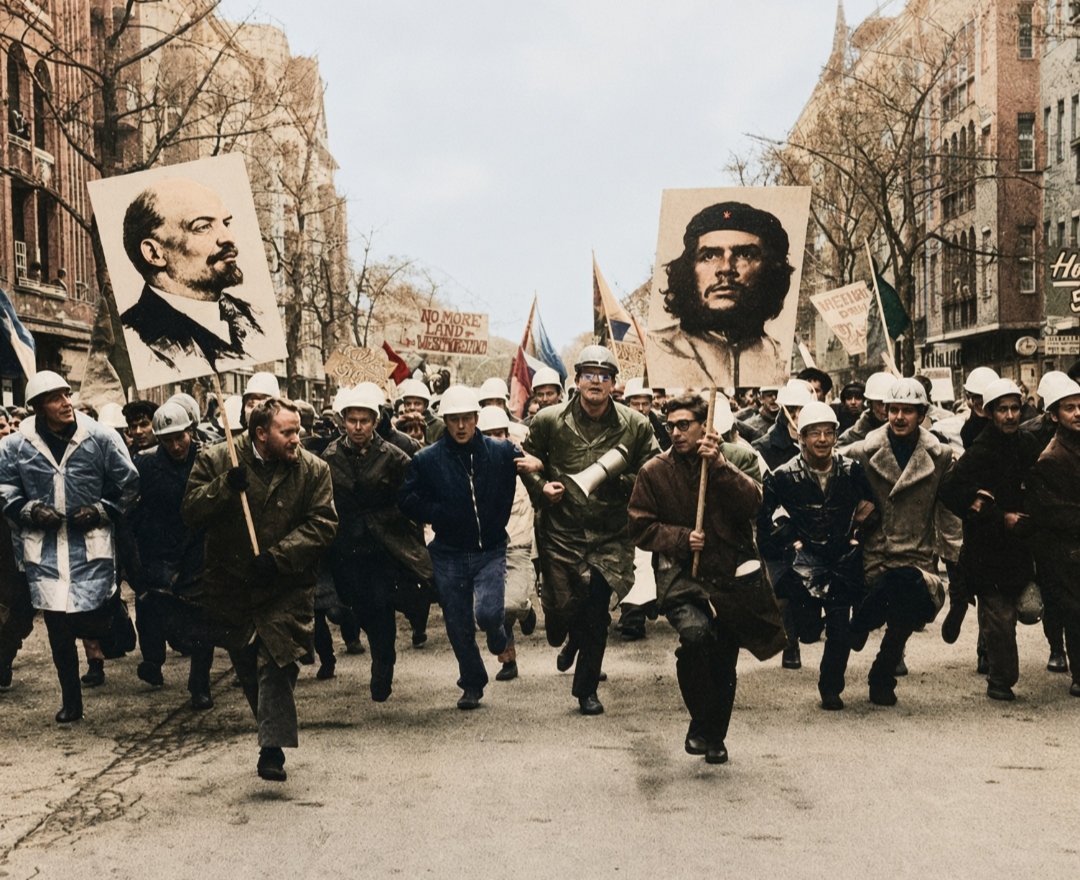
Amalia compared the events that, as she wrote, were happening during those days in France with the "Red May" of 1968. She argued that there were similarities in the demands and images of conflicts with the police, arsons, and vandalism. She presented the leftists as the main actors of the mobilizations at that time and, in a secondary role, their descendants, while stating that the leading role was now taken by people of French origin from Africa. According to her narrative, the unrest of 1968 began on March 22 with an occupation at the University of Nanterre. After its closure on May 2, the clashes spread to the Sorbonne and the streets of Paris. Amalia stated that on May 6 there were about 500 injured, and that the tension peaked on May 10, during the "Night of the Barricades," when Daniel Cohn-Bendit, known as "Red Dani," emerged. Amalia wrote that on May 13, unions controlled by the Socialist and Communist Parties declared a 24-hour strike and participated in the demonstrations. In the following days, according to her, factory occupations and strikes in various sectors paralyzed production, with the country being, as she claimed, on the brink of a civil war by May 20. She mentioned that on May 22, Cohn-Bendit went to Germany and the Netherlands, but the French government revoked his residence permit and did not allow him to return. According to Amalia, this development led to new incidents, while the leftists were left without guidance. Amalia said that General Charles de Gaulle ultimately chose to address the people instead of deploying the army on the streets. On May 30, he announced the dissolution of the National Assembly and elections within 22 days, while, as she wrote, about 500,000 people demonstrated in Paris in support of him. She added that in the elections on June 23 and 30, the Right won 358 out of 485 seats. She also noted that leftists later accused the French Communist Party of abandoning the revolution under orders from Moscow. She cited Mattei Dogan's work "How Civil War Was Avoided in France" as a source. #Γαλλία #ΚόκκινοςΜάης #Ιστορία (translated)