Antonio Narciso, a young Italian on Erasmus in Córdoba, recounts the trauma of witnessing the train accident in Spain, just 300 meters from the disaster, while trying to help the injured. #Erasmus #IncidenteFerroviario #Cordova (translated)
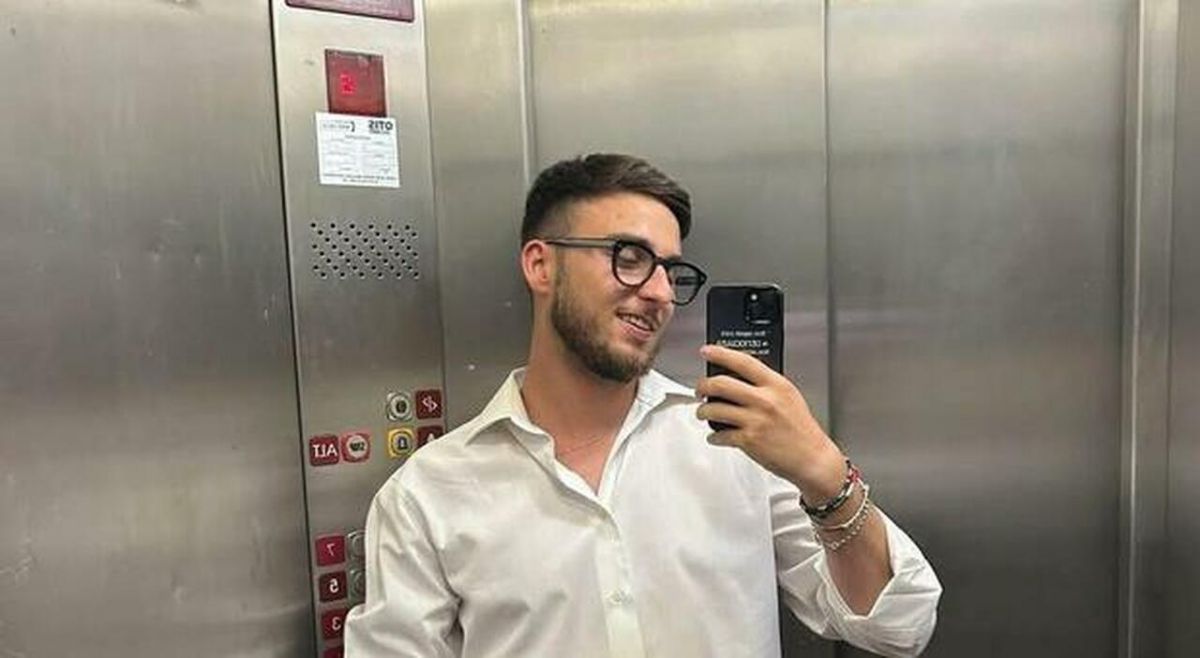
Antonio Narciso, a young Italian on Erasmus in Córdoba, recounts the trauma of witnessing the train accident in Spain, just 300 meters from the disaster, while trying to help the injured. #Erasmus #IncidenteFerroviario #Cordova (translated)

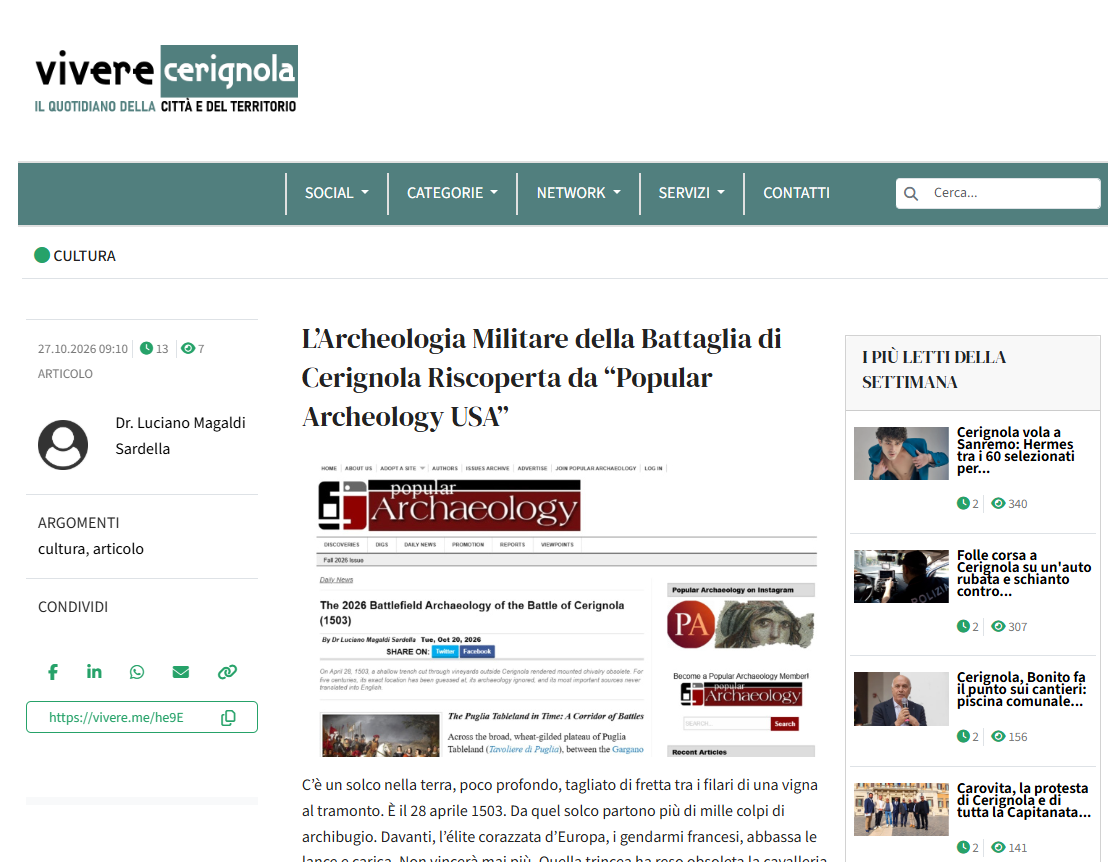
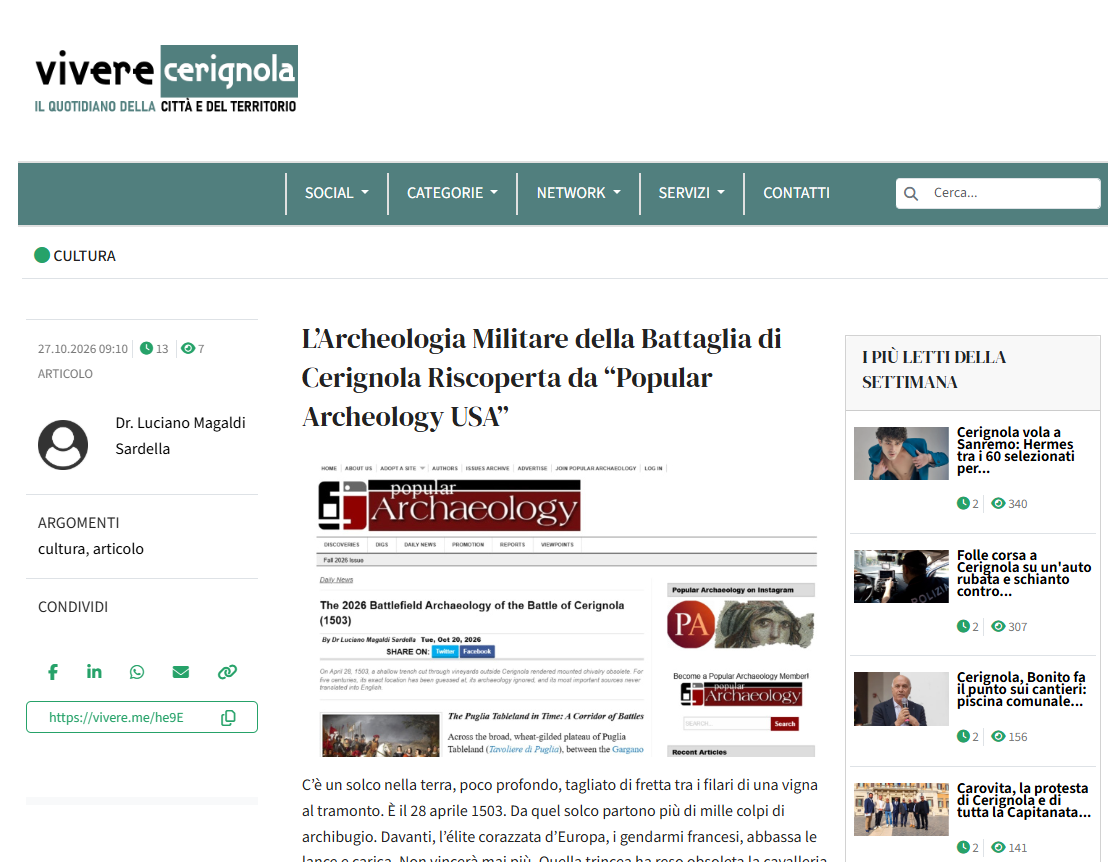
LIVING CERIGNOLA: THE MILITARY ARCHAEOLOGY OF THE BATTLE OF CERIGNOLA ARRIVES ON "POPULAR ARCHAEOLOGY USA" CERIGNOLA (FG) - The Battle of Cerignola on April 28, 1503, returns to the center of international debate. The prestigious American magazine Popular Archaeology has dedicated an extensive in-depth article to the battle that changed European military history: the first in which over 1,000 Spanish arquebusiers under Gonzalo Fernández de Córdoba, sheltered behind a trench reinforced with vineyard posts, stopped the charge of the elite heavy cavalry of the Duke of Nemours. A trench that, in fact, rendered cavalry obsolete and inaugurated the era of infantry armed with fire, determining control of the Mediterranean for the next 160 years. The article highlights the decades-long microhistorical research work of the Torre Alemanna Study and Research Center in Cerignola led by Dr. Matteo Stuppiello: from the letter of Consalvo de Cordoba to the Kings of Spain (April 29, 1503), to the graffiti of 1503 in the Church of Santa Maria delle Grazie, to the land registries of the State Archive of Naples that explain the agrarian origin of that trench. A battlefield still lacking a map and protection, but scientifically rediscoverable thanks to technologies such as LiDAR ISPRA, magnetometry, and ground-penetrating radar. An important recognition for Cerignola, for the Tavoliere, and for all historical research in Puglia, which today deserves a systematic project for the archaeology of battlefields. (translated)
VIVERE CERIGNOLA: THE MILITARY ARCHAEOLOGY OF THE BATTLE OF CERIGNOLA FEATURED IN “POPULAR ARCHAEOLOGY USA” SOURCE: https://www.viverecerignola.it/2026/10/27/larcheologia-militare-della-battaglia-di-cerignola-riscoperta-da-popular-archeology-usa/194456/?utm_medium=Link&utm_campaign=Facebook&utm_source=Social __________________________________________________________________ CERIGNOLA (FG) - The Battle of Cerignola of 28 April 1503 has returned to the centre of the international debate. The prestigious American journal Popular Archeology has devoted an extensive in-depth analysis to the battle that changed the course of European military history: the first in which more than 1,000 Spanish arquebusiers under Gonzalo Fernández de Córdoba, entrenched behind a ditch reinforced with vine stakes, halted the charge of the élite of the French heavy cavalry led by the Duke of Nemours. A ditch that, in effect, rendered cavalry obsolete and inaugurated the era of infantry armed with firearms, determining control of the Mediterranean for the subsequent 160 years. The article highlights the decades-long micro-historical research undertaken by the Centro Studi e Ricerche Torre Alemanna of Cerignola, led by Dr Matteo Stuppiello: from Consalvo da Cordova’s letter to the Catholic Monarchs of Spain (29 April 1503), to the 1503 graffito in the Church of S. Maria delle Grazie, to the land registers of the State Archive of Naples which explain the agrarian origin of that trench. A battlefield still without a map and without legal protection, yet scientifically recoverable through technologies such as ISPRA LiDAR, magnetometry and ground-penetrating radar. An important recognition for Cerignola, for the Tavoliere and for all Apulian historical research, which today deserves a systematic battlefield archaeology project.
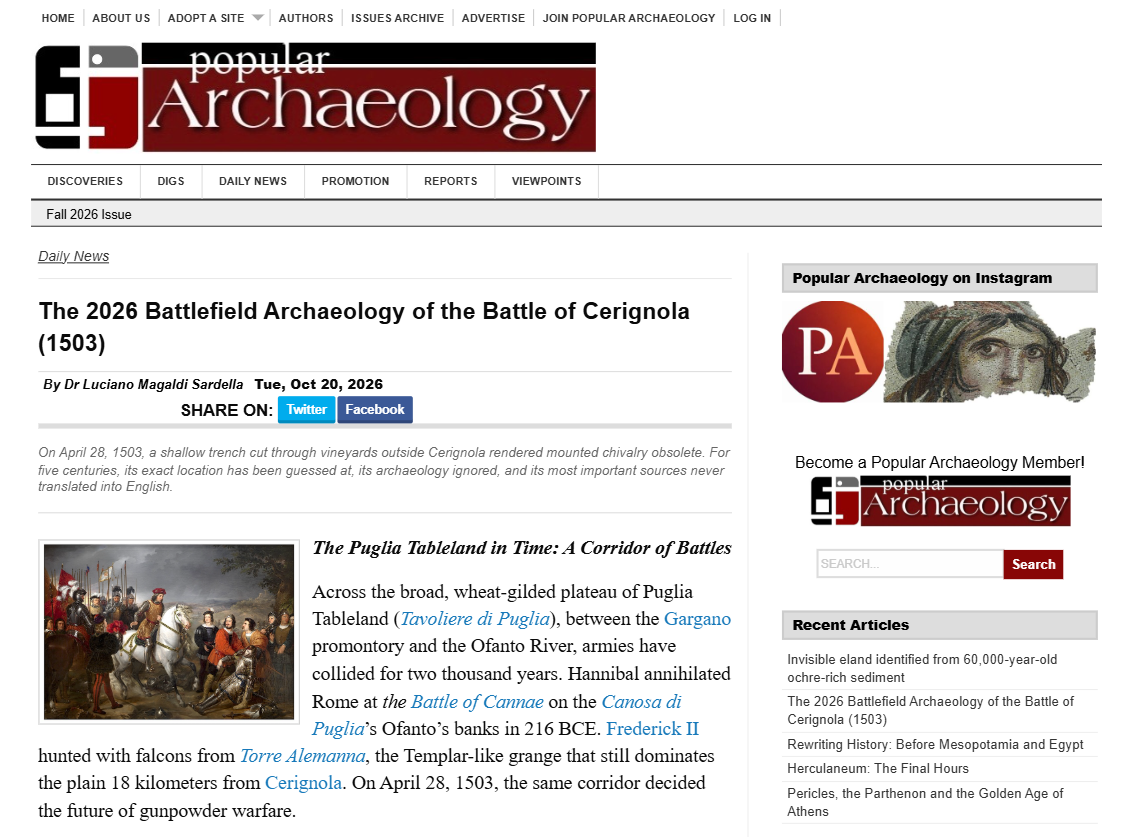
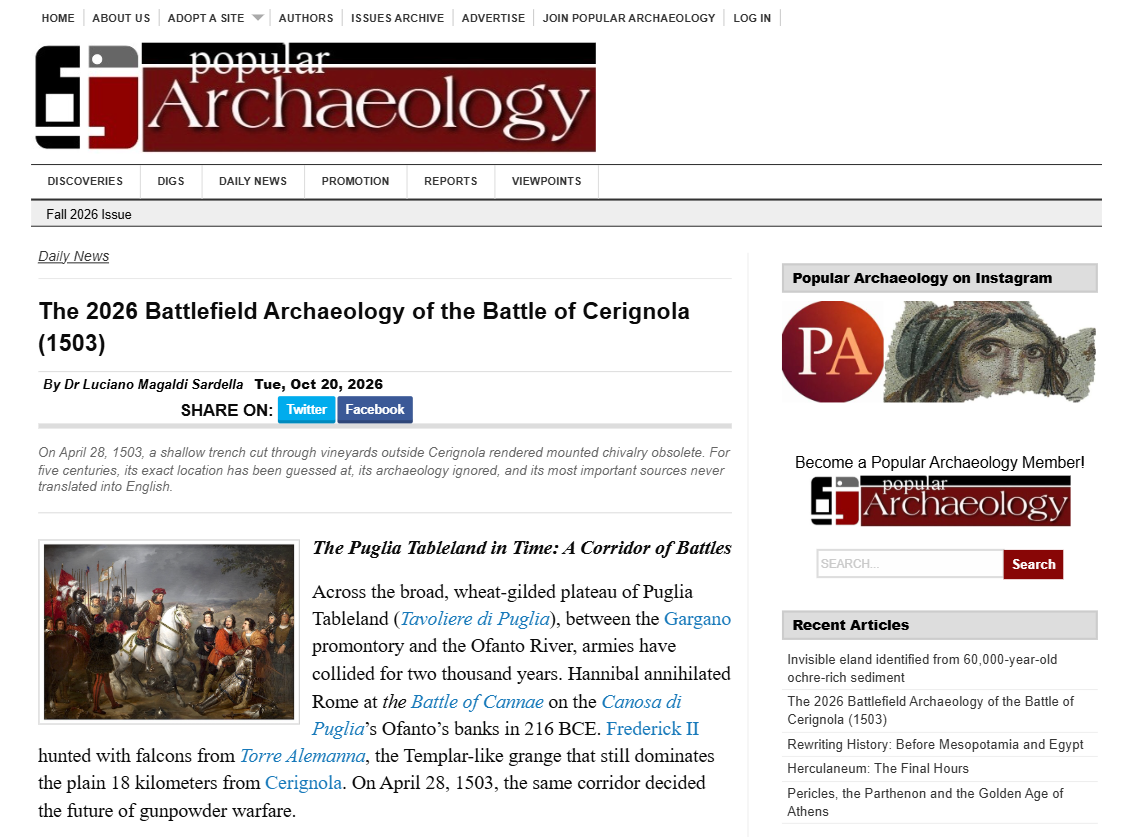
THE "BATTLE OF CERIGNOLA (1503)" ON "POPULAR ARCHAEOLOGY USA" (by LUCIANO MAGALDI SARDELLA) SOURCE 1: https://popular-archaeology.com/author/sardella/ SOURCE 2: https://popular-archaeology.com/article/the-2026-battlefield-archaeology-of-the-battle-of-cerignola-1503/ -------------------------------------------------------------------- CERIGNOLA (FG) — On April 28, 1503, at sunset, a shallow trench cut between the vineyards outside Cerignola rendered heavy cavalry obsolete. For five centuries, its exact location has only been conjectured, its archaeology ignored, its most important sources never translated into English. We are on the Tavoliere of Puglia, a corridor of battles for two thousand years: from Cannae in 216 BC to the falcon hunt of Frederick II from Torre Alemanna. Cerignola, at that time, was not a city but a rural village of 350 families at 120 meters above sea level, custodian of the Mena della Dogana delle Pecore, the great pastoral system of transhumance that financed the Kingdom of Naples. Its possession was fiercely contested. Facing each other were two worlds. Louis d’Armagnac, Duke of Nemours, Viceroy of Naples for Louis XII, in his thirties, splendidly armored, confident of victory. On the other side was Gonzalo Fernández de Córdoba, the Gran Capitán, who on April 27-28 marched from Barletta with about 9,000 exhausted men and decided to settle on a low ridge. He deepened what was already there: not an invention, but an agricultural ditch. The French gendarmes, the last heirs of the medieval knight, lowered their lances and never reached the line. From behind a parapet reinforced with vine stakes, over 1,000 Spanish arquebusiers opened fire. Nemours fell, almost certainly the first European army commander to die from a portable firearm. With him, the charge of cavalry as a dominant tactic died. And here is the scandal denounced by the article: no cartographer of the 17th-18th centuries ever mapped the battlefield. No monument commemorates it. It is not protected as a cultural landscape under the Code of Cultural Heritage. Every deep plowing of the Tavoliere, standard practice since the Bourbon reforms, destroys an archaeology never recorded. Yet the perimeter can be reconstructed. By cross-referencing the 16th-century descriptions of "vine-covered slopes fifteen miles north of the Ofanto" with the Via Traiana, the engagement area is a rectangle of 3-4 square kilometers northeast of the current settlement. With the 1m LiDAR DTM from ISPRA, it could reveal anomalous linear depressions, and the lower filling of a ditch 2-3 meters deep, under the plowed layer, is still readable with magnetometry and ground radar. Why did we arrive late? Not for lack of sources, but for lack of translation. The Municipality of Cerignola and the Torre Alemanna Research and Study Center of Prof. Matteo Stuppiello, who in 1978 obtained the first monumental protection for Torre Alemanna, have digitized a corpus that has never entered Anglophone historiography. Here are the 3 pillars: 1. The letter that still smells of gunpowder. The “Letter from Consalvo de Córdoba to the Spanish royals dated April 29, 1503,” edited by Stuppiello in 2003 and updated to 2025 on comune.cerignola.fg.it/biblioteche-digitali. A handwritten page written in Cerignola the day after the battle, “rich in flashes, twilight lights, and gunfire.” Not a polished chronicle like that of Giovio, but a field dispatch: the fatigue of the night march, the decision to entrench upon arrival, the recovery and honorable burial of Nemours, the intact capture of the French artillery. 2. The graffiti, a monument inside the monument. In the 14th-century church of Santa Maria delle Grazie, known as the Incoronatella, on the Via Trinitapoli Vecchia, where tradition holds that the body of Nemours was brought. On the triumphal arch, a 1503 graffiti gives, in almost notarized form, the date, sixth indiction, Friday at the hour XXIII-XXIIII. It was indeed Friday, as confirmed by the perpetual calendar of Cappelli. Decoded in 1995 by Prof. Francesco Magistrale, Latin paleographer at the University of Bari, in *The Battle of Cerignola (1993)* and in the municipal monograph *S.M. delle Grazie (1999)*. Today it is fading due to humidity and neglect. 3. The land registry that explains the ditch. The Survey of 1672 preserved at the State Archive of Naples, Pignatelli Aragona Cortes fund, Scanzia 63, fasc.1: “At the time of the battle, thick vineyards covered the hill reaching to the plain, and were distinctly separated from the rest of the countryside by a not very deep ditch.” Córdoba did not improvise; he adapted. This is confirmed by the catasti of the Giustiniani: 277 households in 1532, 699 in 1595. The landscape of 1503 was intensely horticultural, not the deeply plowed monoculture of today. In addition to these, there is the first monograph by Vincenzo Buonassisi, *The Battle of Cerignola* (1908, died in Via Fanfulla 10 on June 27, 1928), and the first modern military analysis by Piero Pieri, “Consalvo de Córdoba and the Battle of Cerignola,” Archivio Storico Pugliese 1952, which 30 years before the Anglophone rediscovery of the “pike-and-shot” defined Cerignola as an engineered killing ground. While Cerignola forgot, others remembered. The “Regimiento de Infantería Cerinola n.42”, later “Fuerteventura n.56”, carried the name of Cerignola until the 20th century. The coat of arms, described in *Heraldica e Historiales del Ejercito, Tomo V” (Madrid, 1981): silver field, dying white swan entangled in a hedge, golden wall crown, with the scroll “Cerignola.” Dossier officially transmitted on April 30, 1986, prot. 4565/509, from the Servicio Histórico Militar of Madrid to the Torre Alemanna Center thanks to Col. Alessio Antonutti and Gen. José Cifuentes. And in Amsterdam, at the Rijksmuseum, the anonymous bronze commemorative medal: Hercules with lion skin and club and Janus with the keys next to an eagle-armed coat of arms, legend “Consalvus Agidarius… Janum clausit,” on the reverse a battle scene “Consalvi Agidari Victoria de Gallis ad Cannas,” an artist's mistake that confuses Cerignola with Cannae. It belonged to Mrs. J.M. van Gelder-Nijhoff, donated in 1885. The author's conclusion is clear: Gonzalo's ditch is the most consequential earthwork in European military history. It inaugurates the infantry armed with firearm and conditions the Mediterranean for 160 years. It may still be there, filled, plowed, invisible to the naked eye but accessible to a magnetometer. It is not a matter of medieval archaeology but of the will to protect. (translated)
THE “BATTLE OF CERIGNOLA (1503)” ON “POPULAR ARCHAEOLOGY USA” (by LUCIANO MAGALDI SARDELLA) SOURCE 1: https://popular-archaeology.com/author/sardella/ SOURCE 2: https://popular-archaeology.com/article/the-2026-battlefield-archaeology-of-the-battle-of-cerignola-1503/ __________________________________________________________________ CERIGNOLA (FG) — On 28 April 1503, at sunset, a shallow trench cut through the vineyards outside Cerignola rendered heavy cavalry obsolete. For five centuries its exact position has been merely conjectured, its archaeology ignored, its most important sources never translated into English. We are on the Puglian Tablelanda, a corridor of battles for two thousand years: from Cannae in 216 BC to Frederick II’s falconry from Torre Alemanna. Cerignola, at that time, was not a town but a rural hamlet of 350 families at 120 metres above sea level, guardian of the Mena of the Dogana delle Pecore, the great customs system of transhumance that financed the Kingdom of Naples. It was for its possession that the battle was fought. Opposed, two worlds. Louis d’Armagnac, Duke of Nemours, Viceroy of Naples for Louis XII, thirty years old, splendidly armed, certain of victory. On the other side, Gonzalo Fernández de Córdoba, the Great Captain, who on 27–28 April marches from Barletta with some 9,000 exhausted men and decides to entrench himself upon a low ridge. In front of it he has deepened what was already there: not an invention, but an agrarian ditch. The French gendarmes, the last heirs of the mediaeval knight, lower their lances and never reach the line. From behind an embankment reinforced with vine stakes, more than 1,000 Spanish arquebusiers open fire. Nemours falls, almost certainly the first European army commander to die by a portable firearm. With him dies the cavalry charge as a dominant tactic. And here lies the scandal denounced by the article: no cartographer of the seventeenth or eighteenth century ever mapped the field. No memorial stone recalls it. It is not protected as a cultural landscape under the Code of Cultural Heritage. Every deep ploughing of the Tavoliere, standard practice since the Bourbon reforms, destroys an archaeology never recorded. Yet the perimeter is reconstructable. By cross-referencing sixteenth-century descriptions of “slopes covered with vineyards fifteen miles north of the Ofanto” with the Via Traiana, the engagement zone is a rectangle of 3–4 sq km to the north-east of the present settlement. With ISPRA’s 1m DTM LiDAR, anomalous linear depressions could be revealed, and the lower fill of a 2–3 metre ditch, beneath the ploughed layer, is still legible by magnetometry and ground-penetrating radar. Why have we arrived so late? Not for lack of sources, but for lack of translation. The Comune di Cerignola and the Centro Studi e Ricerche Torre Alemanna of Prof. Matteo Stuppiello, who in 1978 obtained the first monumental protection for Torre Alemanna, have digitised a corpus that has never entered Anglophone historiography. Here are the 3 pillars: 1. The letter that still smells of powder. The “Letter of Consalvo da Cordova to the Sovereigns of Spain of 29 April 1503,” edited by Stuppiello in 2003 and updated in 2025 on comune.cerignola.fg.it/biblioteche-digitali. A manuscript page written at Cerignola the day after the battle, “rich in flashes, twilight gleams, and gunfire.” Not a polished chronicle à la Giovio, but a field dispatch: the exhaustion of the night march, the decision to entrench upon arrival, the recovery and honourable burial of Nemours, the intact capture of the French artillery. 2. The graffito, a monument within the monument. In the fourteenth-century church of Santa Maria delle Grazie, known as the Incoronatella, on the Via Trinitapoli Vecchia, where tradition holds the body of Nemours was taken. On the triumphal arch, a graffito of 1503 gives in quasi-notarial form the date, sixth indiction, Friday at the twenty-third to twenty-fourth hour. It truly was a Friday, as confirmed by Cappelli’s perpetual calendar. Deciphered in 1995 by Prof. Francesco Magistrale, Latin palaeographer at the University of Bari, in La Battaglia di Cerignola (1993) and in the municipal monograph S.M. delle Grazie (1999). It is now fading through damp and neglect. 3. The cadastre that explains the ditch. The Apprezzo of 1672 preserved in the Archivio di Stato di Napoli, fondo Pignatelli Aragona Cortes, Scanzia 63, fasc.1: “At the time of the battle, dense vineyards covered the hill reaching down to the plain, and were clearly separated from the rest of the countryside by a not very deep ditch”. Córdoba did not improvise; he adapted. This is confirmed by the Giustiniani cadastres: 277 hearths in 1532, 699 in 1595. The landscape of 1503 was one of intensive horticulture, not the deep-ploughed cereal monoculture of today. To these are added the first monograph by Vincenzo Buonassisi, La Battaglia di Cerignola (1908, died at Via Fanfulla 10 on 27 June 1928), and the first modern military analysis by Piero Pieri, “Consalvo di Cordova e la battaglia di Cerignola”, Archivio Storico Pugliese 1952, which 30 years before the Anglophone rediscovery of “pike-and-shot” defined Cerignola as an engineered killing ground. While Cerignola forgot, others remembered. The “Regimiento de Infantería Cerinola n.42”, later “Fuerteventura n.56”, bore the name of Cerignola until the twentieth century. Its coat of arms, described in Heráldica e Historiales del Ejército, Tomo V (Madrid, 1981): argent field, a dying white swan entangled in a hedge, a gold mural crown, with scroll “Cerignola”. Dossier officially transmitted on 30 April 1986, prot. 4565/509, by the Servicio Histórico Militar in Madrid to the Centro Torre Alemanna through Col. Alessio Antonutti and Gen. José Cifuentes. And in Amsterdam, in the Rijksmuseum, the anonymous commemorative bronze medal: Hercules with lion-skin and club and Janus with keys beside an eagled coat of arms, legend “Consalvus Agidarius… Janum clausit”, on the reverse a battle scene “Consalvi Agidari Victoria de Gallis ad Cannas” — an error by the artist who confuses Cerignola with Cannae. It belonged to Mrs J.M. van Gelder-Nijhoff, donated in 1885. The author’s conclusion is unequivocal: Gonzalo’s ditch is the most consequential earthwork in European military history. It inaugurates the infantryman armed with a firearm and conditions the Mediterranean for 160 years. It may still be there, infilled, ploughed over, invisible to the naked eye but accessible to a magnetometer. It is not a question of mediaeval archaeology but of the will to protect.
En la sesión del Consejo General del @INEMexico solicité información histórica y comparable sobre el funcionamiento del Instituto durante el periodo de la presidencia del exconsejero Lorenzo Córdova (@lorenzocordovav): 1. Movimientos de personal durante la presidencia de Lorenzo Córdova, de abril de 2014 a abril de 2023. 2. La misma información del periodo de Marco Antonio Baños y de las áreas encabezadas por Carlos Alberto Ferrer (@FERRERSILVA) Silva y Roberto Heycher Cardiel Soto (@RobertHeycherMx). 3. Quejas y denuncias por acoso y hostigamiento laboral y sexual, así como sus resoluciones y sanciones. 4. Contratos, asesorías, consultorías y honorarios, incluidos montos, observaciones y pendientes. 5. Procedimientos de remoción de consejerías de los OPLE, plazas, programas de retiro y compensaciones. 6. Viáticos, pasajes y comisiones nacionales e internacionales de consejerías y titulares de las principales áreas. 7. Los expedientes de solicitudes de información sobre viajes al extranjero, hospedajes y viáticos durante la gestión de Lorenzo Córdova. #INEMexico #LorenzoCórdova #transparencia
¡Llegaron a GDL! Sin Cesar Huerta, Pumas buscará sumar el día de mañana ante Chivas en el estadio Akron. Tony Leone hizo el viaje con el equipo. Ausentes: Angulo, Calderón, Huerta, Córdova. https://t.co/e9q0u0tluq #Pumas #Chivas #GDL
¡𝗙𝗲𝗹𝗶𝘇 𝗱𝗶́𝗮, 𝗣𝗶𝗲𝗿𝗼! 🪄⚽🎩 Hoy está de cumpleaños Piero Quispe Córdova, mediocampista de nuestro primer equipo y ganador de un título nacional con camiseta crema. 🏆 2023 https://t.co/wb1wMHS1xs #FelizCumpleaños #Fútbol #Deportes
Sebastián Córdova estará fuera aproximadamente nueve meses. Presentó una ruptura completa de ligamento cruzado anterior de la rodilla izquierda. Pumas se queda sin su refuerzo estelar. https://t.co/Ex8TSWlnXy #Lesiones #Fútbol #Pumas
Se acabó la Leagues Cup para Pumas. Dos derrotas y un empate. 6 goles en contra y 1 a favor. Perdieron a Córdova por varios meses. Y falta ver qué tiene Álvaro Angulo. Venían con buena inercia tras sus últimos dos en Liga. Ahora regresan con muchas dudas. #LeaguesCup #Pumas #Fútbol
Acosta Naranjo (@acostanaranjo), no te equivoques. “Somos” (@SomosMxMexico) es el partido político que tiene más integrantes en la cárcel por huachicol fiscal que candidaturas ganadas. Su partido es el reciclaje de lo peor de la política mexicana: Lorenzo Córdova (@lorenzocordovav), clasista y racista, que se decía neutral y resultó ser uno más de la derecha; Enrique de la Madrid (@edelamadrid), un nepo baby que habla de “dictadura” y olvida el daño económico que su padre le dejó a México; y Beatriz Pagés (@PagesBeatriz), priísta de hueso colorado que ahora se dice de “Somos”. No son neutrales ni representan algo nuevo. Y que quede claro: Ruffo Appel no es ningún preso político. Basta de mentiras, basta de engaños. “Somos” tiene más pasado que futuro. #PolíticaMéxicana #Corrupción #Elecciones2024
𝗨𝗡 𝗖𝗔𝗠𝗣𝗘𝗢́𝗡 𝗤𝗨𝗘 𝗗𝗔 𝗟𝗔 𝗩𝗨𝗘𝗟𝗧𝗔 𝗘𝗡 Ⓤ 🤩 Piero Quispe Córdova es nuevo refuerzo de Universitario de Deportes. 🔗 Lee la nota completa aquí: https://t.co/PuQkx1BYvO #UnaHistoriaDeGrandeza https://t.co/B6Oc5fEi0O #Universitario #Deportes #Fútbol
Como sufrió, lo remontó y lo ganó el Club Universidad con la fatídica ley del ex. Pésimo primer tiempo, Cordova se estrenó con un buen gol y Arteaga fue de lo mejorcito. Primera victoria de Solari. ¿Cómo no los voy a querer @PumasMX? 🐾💙 https://t.co/P3zBagxrcE #ClubUniversidad #PumasMX #Fútbol
¡GOOOOOOOOOOOOOOOOOOOOOOOOOOOOOOOOOOOOOOOOOOOOOOOOOOOOOOOOLLLLLLLLLLL DE SEBASTIÁN CÓRDOVAAAAAAAAAAAAAAAA!!!!!! Gran centro del Toti López que cabecea Córdova para hacer la segunda ley del ex de la noche. Pumas 2 - 1 Toluca https://t.co/amCryY7d5Z #Fútbol #Gol #Pumas
PUMAS LE DA LA VUELTA GOLAAAAAZO DE CÓRDOVA QUE SE ESTRENA CON LA AZUL Y ORO Toluca 1-2 PUMAS UNAM https://t.co/w95mKeXPGM #Pumas #LigaMX #Fútbol
SE MOLESTA por un BLOQUEO, SE PONE a AMENAZAR… y le DESCUBREN UNA PISTOLA Así acabó detenido Leonardo Ruiz Córdova. El tipo se topó con una manifestación en @IztacalcoAl y amenazó a una señora. Agentes de @SSC_CDMX fueron a calmarlo, pero lo descubrieron armado. El caso #C4EnAlerta #Seguridad #Justicia #CDMX
🚨 ¡Golpe a la criminalidad transnacional! Tres colombianos con requerimientos judiciales vigentes fueron capturados por tráfico de migrantes, estafa agravada y porte ilegal de armas. Al llegar desde Panamá al José Maria Córdova. En Medellín no hay refugio para quienes le hacen daño a la gente. Seguimos trabajando de la mano con @MigracionCol y las autoridades para que la justicia actúe. #Seguridad #Justicia #Colombia
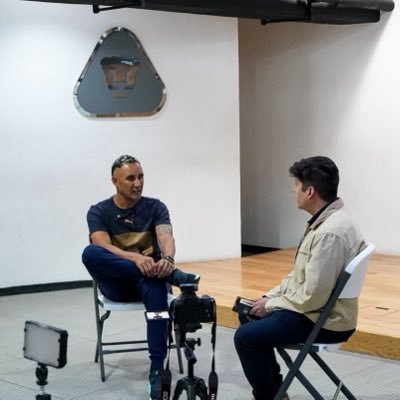
¡Bienvenidos a Pumas, Sebastián y Cristian! 🤝 Ya con sus dorsales puestos, Córdova y "Chicote" Calderón fueron presentados ante los medios de comunicación, en la Cantera. 😮💨 #SiemprePumas https://t.co/N7jJO4WsJS #Pumas #Fútbol #Bienvenida
¡Los dorsales de Córdova y Chicote! Fueron presentados los primeros dos refuerzos de Pumas ante los medios de comunicación. https://t.co/r5fUQqJi87 #Pumas #fútbol #refuerzos