A strange figure resembling a 'jellyfish' was photographed by NASA's Curiosity rover on Mars, generating debate on social media about its origin, although experts suggest it could be the result of a cosmic ray impacting the camera. (translated)

A strange figure resembling a 'jellyfish' was photographed by NASA's Curiosity rover on Mars, generating debate on social media about its origin, although experts suggest it could be the result of a cosmic ray impacting the camera. (translated)

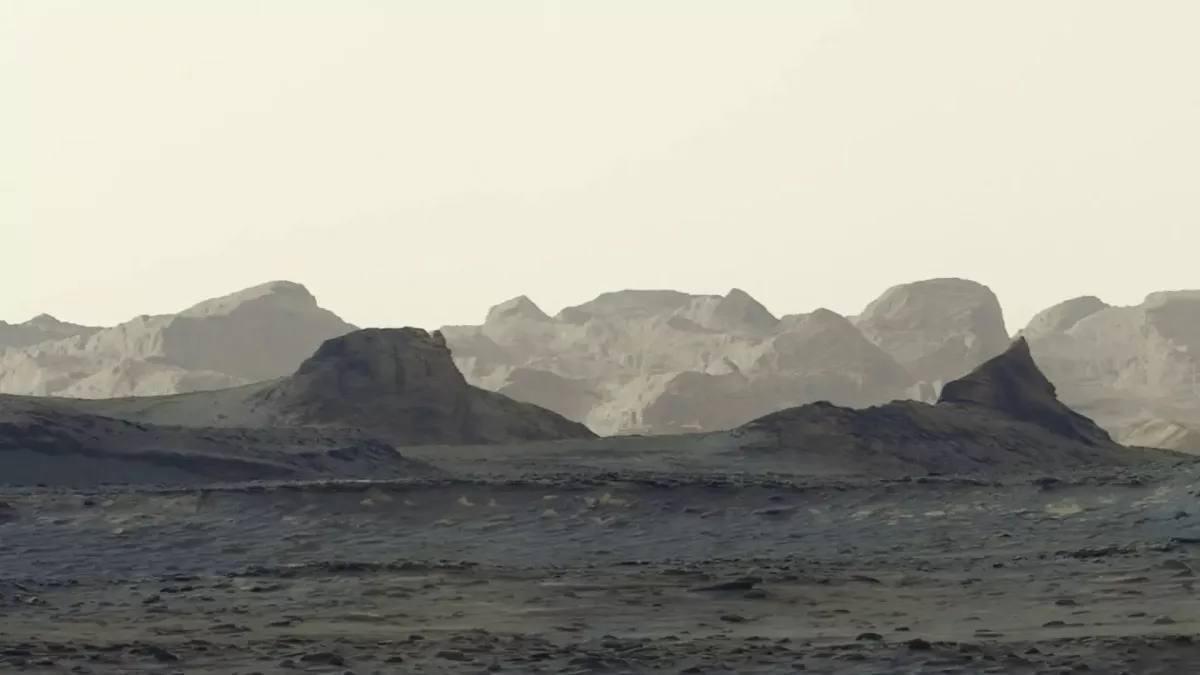
Rover Curiosity celebrated 14 years on Mars, with recent images revealing a fascinating landscape with mysterious polygonal structures and wheel damage, while scientists explore possible ways of their formation and the origin of some dark stones in this area. (translated)

NASA has published the clearest video ever recorded of Mars, providing a detailed view of the Red Planet as the Curiosity rover completed a significant climb in Gale Crater. (translated)
Three years ago, the editor of Time (with the "100 most influential people in AI, fifty of which you have never heard of but number 7 will shock you"™ list) thought that AI was a curiosity https://t.co/pCA4sROWQq #AI #InfluentialPeople #TimeMagazine #Nospecificcountrycodesidentifiedinthetweet.
Could an ant pass a maths exam? 🐜 It’s a funny question, but it hides anither yin: why should maths for bairns aye look like a school textbook? In bairns’ books, numbers can become characters, riddles, journeys and stories too. Whit if bairns met maths first through curiosity? #Maths #Bairns #BairnsBooks #Education #ChildPsychology #LearningMotivation #LearningThroughPlay #MathsStories #20260825 #0039 #MrNumberwise #Scots #UK #GB
Whit if readin Jane Austen wis also a kind o investigation? The reader notices the wee details, compares whit folk say wi how they behave, spots contradictions, an tries tae understand whit isnae said outright. Wha’s tellin the truth? Wha’s hidin somethin? Which wee details turn oot tae matter later? Readin a classic can feel a bit like detective work: watch closely, piece the clues thegither, an draw yer ain conclusions. #0026= #JaneAusten #Literature #Readin #Classics #Detective #Books #ReaderPsychology #Curiosity #CloseReadin #CriticalThinkin #ArthurWren #Scots
Coud an ant pass a maths test? 🐜 It’s a funny question, but there’s anither ane behind it: why should maths for bairns aye look like a schoolbook? In bairns’ books, numbers can become characters, puzzles, journeys and stories an aw. Whit if bairns discovered maths through curiosity first? #Maths #Bairns #BairnsBooks #Education #Learning #Curiosity #20260822 #0028 #MrNumberwise #Scots
What if reading a classic began with a question, not an obligation? Instead of saying, “This is an important novel. Read it carefully,” imagine starting with a mystery: Why did this character stay silent? What is hidden in that letter? Who misunderstood whom — and why? What does money change here? What is never said directly? Suddenly, Jane Austen or Charles Dickens is no longer a monument to admire from a distance. It becomes a world to investigate. Maybe classic literature works better when curiosity comes before reverence. #ClassicLiterature #JaneAusten #CharlesDickens #Reading #LiteraryMystery #Books #Curiosity #ReaderPsychology #ReadingMotivation #CriticalThinking #ExploratoryReading #English #0010= #ArthurWren
What if the graph of a linear function started with ants crossing a beach? 🐜🏖️ Instead of telling children, “Vacation is over. Pay attention — today we start with formulas and graphs,” imagine following the paths of a few ants across the sand. One ant walks steadily in one direction. Another starts farther away. Their trails become lines. Their starting points and directions begin to matter. And suddenly, y=ax+b is no longer just a formula on the board — it describes a journey. Maybe mathematics works better when curiosity comes before notation. #math #LinearFunction #MathForKids #MathEducation #Graphs #Learning #Curiosity #BackToSchool #ChildPsychology #LearningMotivation #EverydayMath #DiscoveryLearning #20260820 #MrNumberwise #20260821 #0013 #MrNumberwise #English
Could an ant pass a math test? 🐜 It’s a funny question, but there’s another one behind it: why should math for kids always look like a school textbook? In children’s books, numbers can become characters, puzzles, journeys and stories too. What if kids discovered math through curiosity first? #math #kids #childrensbooks #education #learning #curiosity #puzzles #ChildPsychology #LearningMotivation #MathStories #DiscoveryLearning #20260820 #0012 #MrNumberwise #English
What if Northanger Abbey is more than a playful Gothic parody — and almost an early literary escape room? Behind the locked doors, imagined dangers and mysterious corridors, Jane Austen is also writing about curiosity, reading, interpretation and the stories we create from incomplete clues. Sometimes the real mystery is not what is hidden in the house — but how we decide what to believe. #NorthangerAbbey #JaneAusten #EscapeRoom #GothicLiterature #ClassicLiterature #reading #ReaderPsychology #CriticalThinking #LiteraryMystery #Interpretation #0005= #English
The Horizon of Reason: Finding Meaning in Atheism. Good day, everyone. When people hear the word "atheism," they often think of what it lacks. They focus on the prefixes and the definitions: a lack of belief in a deity. But to view atheism only as an absence is to miss the entire landscape of what it actually builds. Today, I want to talk about atheism not as a void, but as a vibrant, deeply responsible, and profoundly hopeful way of looking at our universe. At its core, atheism is a commitment to radical honesty. It is the decision to look at the vast, beautiful, and sometimes terrifying cosmos and say, "I do not know all the answers, and I will not invent stories to fill the gaps." Atheism relies on evidence, reason, and the scientific method. It is driven by the same curiosity that makes a child look through a microscope or a scientist peer through a telescope. It embraces uncertainty. In uncertainty, there is room for growth, discovery, and learning. When we accept that we do not have a cosmic blueprint, we become actively responsible for writing our own stories. A common misconception is that without a divine entity, there can be no morality. But atheism flips this dynamic. It suggests that kindness, empathy, and justice do not come from a fear of cosmic punishment or a desire for a heavenly reward. They come from us. We are kind to one another because we are social creatures who share this planet. We care for the sick because we know what pain feels like. We fight for justice because we want to live in a fair world. Our morality is human-centered. It is born from the profound realization that this life is all we have, and therefore, how we treat each other right now matters more than anything else. To an atheist, this life is not a dress rehearsal for an afterlife. It is the main event. This realization does not make life meaningless; it makes life infinitely more precious. Think about a rare gem. It is beautiful precisely because it is scarce. In the same way, a single human life—spanning just a few decades on a tiny blue planet—is a rare, breathtaking miracle of biology and physics. Because we believe this is our only chance, the time we spend with our families, the art we create, and the love we give become urgently important. We cannot afford to waste a single day. Atheism is not about tearing down anyone else's faith. It is about building up human potential. It is the belief that humanity is strong enough, smart enough, and kind enough to navigate the dark corners of the universe together, guided by reason and compassion. We are the authors of our purpose, the journey, life itself. We are the guardians of this planet. And we are the keepers of one another. Thank you.
A Generation That Forgot the Shape of the Square On memory left to die alone By Adham Hasanin Egyptian journalist and political writer, based in the Netherlands In a house near mine, there is a boy of thirteen. Born in 2013 just a few months younger than the July coup itself, younger than the new republic under whose shadow we now live. I asked him once, with no preamble, no test, out of nothing more than passing curiosity: do you know what January was? He answered simply, without hesitation, without any sense that he was missing something: "An old revolution, against Mubarak, right?" Not entirely wrong. But it is everything he knows. The name Tahrir Square means nothing specific to him. The sound of the crowd chanting has no echo in his mind. He does not know that his own family whom he sees every day saying "thank God for stability," who warn him against "chaos" whenever a political headline crosses the screen once, at a moment two years before he was born, went down into the street, betting their entire lives on the possibility that something might change. This article is not about politics. It is about memory, and about who decides what gets told and what is left to die in silence. I. Who Erases the Picture? The first question that comes to mind is the easiest and most deceptive one: who erases this memory? And where do we begin holding them accountable? But the truth is too complex to reduce to a single actor. No one actually erases memory, in the literal sense of the act. There is no ministry called the "Ministry of Forgetting," no presidential decree ordering January struck from the collective consciousness. What happens is simpler than that, and more dangerous at once: the subject is simply never told. School says nothing. The textbook leaps from one period to another without pausing on January for more than two faded lines, composed with deliberate neutrality, devoid of any detail that might make the event feel alive to its young reader. Television no longer has any reason to return to it; the programmes that once hosted witnesses and activists stopped years ago, replaced by an official discourse that mentions January only in passing, as an unfortunate prelude to the "stability" that supposedly followed. And the home the most dangerous link of all has become afraid of the subject. Speech now carries a price, and many families, whether consciously or by sheer survival instinct, have decided that silence is safer than the story. The father who marched fears passing on to his son a curiosity that might one day lead him into trouble the family cannot afford. The mother who lost a friend in the events prefers not to reopen the wound before a child who does not yet grasp the weight of loss. And so, generation after generation, the circle of those who know shrinks, and the circle of those who do not even ask because they do not know there is anything worth asking widens. No one decided to erase the memory through an explicit decision. The memory was simply left to die alone, with no one tending it. And it is precisely this decentralised absence of responsibility that makes this kind of erasure more dangerous than any direct official ban: there is no single decision to challenge, no single body to hold accountable. Responsibility is distributed across thousands of small decisions made by thousands of individuals, each within their own context, each seeming reasonable when viewed in isolation. II. Why This Is More Dangerous Than Direct Repression An objection might be raised: is direct repression arrest, imprisonment, publishing bans not far more lethal than mere gradual forgetting? The answer is complex, and deserves calm unpacking. Direct repression can be seen. It can be documented, and the victim can know they are a victim, can tell their story, and their pain can become a testimony added to the collective memory, even if it never reaches justice. The political prisoner knows he is a political prisoner. The journalist banned from writing knows he is banned, and can tell the world he is banned. Direct repression, for all its cruelty, leaves a trace that can be followed. But a generation that has forgotten something happened at all does not even have a starting point from which to ask. This thirteen-year-old boy will never ask "why were we repressed?" because he does not know there is anything deserving that question in the first place. He feels no absence, because he does not know there is anything absent. He simply lives in a version of reality stripped of an entire chapter of his country’s history, and never for a moment suspects that this void is a void at all. Here lies the essence of the danger: direct repression creates victims who know they are victims. Erasure of memory, when it succeeds, creates a generation that does not even know it has been deprived of anything. And deprivation that is not felt cannot be resisted, because resistance always begins with an awareness of loss. The regime that came after 2013 does not need to convince the new generation that January was a mistake. That would be an arduous, costly task, requiring sustained propaganda and continuous effort to persuade each individual one by one. It is far easier, and strategically far more efficient, simply to ensure they never know it was anything at all. The void requires no defence; it requires only silence, and silence is free and always available. III. The Four Mechanisms of Erasure Four complementary mechanisms can be identified working together to produce this collective void not as an organised conspiracy, but as a system of incentives that pushes each party, consciously or not, to contribute to the same process. The first mechanism: formal education. The curriculum, as currently designed, treats January as a passing footnote rather than a founding event deserving detail and analysis. The student memorises two dates the start of the revolution and its presumed end without understanding why people took to the streets, what they were demanding, or how they felt in that pivotal moment. The second mechanism: broadcast media. The channels that once hosted live discussions on January, featuring varied perspectives, have gradually disappeared, or transformed their discourse entirely. Today’s televised image either ignores the anniversary altogether, or invokes it only to frame it as a prelude to chaos that must be avoided. The third mechanism: the silence of homes. This is the most dangerous of all, precisely because it is the most human and understandable. Parents who lived through the experience protect it with silence, not out of aversion to the story, but out of fear of its price. This silence, however legitimate its motives, achieves exactly the same effect as official censorship: it blocks the transmission of knowledge from one generation to the next. The fourth mechanism: the absence of alternative spaces. Even those among the new generation who wish to know cannot easily find places to look. Archives are scattered, trustworthy websites are blocked or require effort to reach, and personal testimonies are dispersed across corners of the internet that an ordinary student at an ordinary school will never stumble upon. These four mechanisms require no central coordination to work together. Each naturally serves the others, and all converge on a single result: a growing void in the consciousness of every new generation. IV. Memory as an Act of Resistance If erasure operates without a centre, then resisting it must also be decentralised. No one waits for a government decision to restore January to the curriculum, nor for a television programme to revive the testimonies. Resistance here is necessarily individual, happening in small details, in passing conversations, in the simple decision to tell rather than to stay silent. This is exactly what I try to do, without any claim to heroism, without any grand mission. I try, whenever I can, to tell the thirteen-year-old boy and others like him details that are never written in official reports or in schoolbooks: what the voices in the square sounded like, how someone felt the first time they realised change was possible, what that moment of hope was like before everything changed. The goal is not to bring back the past; the past cannot be brought back. The goal is that this boy, when he grows older and asks again and he will ask, because the questions always return at some point finds someone to tell him the full story, not two faded lines in a schoolbook. That he knows the stability he is told is the fruit of "wisdom" has a prior history, that this history carried other possibilities, and that real people bet their lives on those possibilities. V. Why This Matters Now Talking about the memory of a generation not yet aware might seem an intellectual luxury next to more urgent matters: arrests, a collapsing economy, regional wars. But the truth is that this issue is the foundation on which every other issue is built. A people who do not know they once rose up will not understand why they should ever think of rising again. A generation raised to believe "stability" is the only natural state possible will never ask itself what drove its own parents, shortly before it was born, to risk everything for an alternative that was never guaranteed. Memory is not a luxury; it is the reference point by which every generation measures its present, and through which it determines what is possible and what is not. And whoever understands this understands why erasing memory, not direct repression alone, is among the most important tools of any regime seeking to guarantee its permanence: because a people who have forgotten they were once free will not even know they are missing freedom. Memory, like the word, needs someone to tell it in order to survive. And when the tellers stop, memory does not die suddenly; it withers slowly, generation after generation, until the day comes when a boy asks an innocent question, and finds no one to answer him but two faded lines in a schoolbook.
The Curiosity rover, which has been working on Mars for almost 14 years, shows visible wear on its wheels due to the harsh environment, yet it continues to explore the Red Planet and contributes to the understanding of conditions that could be suitable for life. (translated)

NASA has discovered an extraordinary geological formation on Mars, referred to as the "sea of polygons," which resembles a honeycomb and extends to the horizon, surprising researchers during the Curiosity rover's mission in the Valle Grande valley. (translated)

The Curiosity rover discovered extensive structures resembling honeycombs in the Valle Grande valley on Mars, prompting scientists to conduct intensive research into their origin, which may be a remnant of ancient seasonal cycles and a clue about conditions favorable for life on this planet. (translated)

Na základě nedávného objevu vědců na Marsu, kdy rover Curiosity zachytil stopy písečné bouře ze starověkého období, bylo potvrzeno, že planeta kdysi měla hustší atmosféru s silným větrem, což naznačuje, že Mars byl za doby, kdy po něm proudily řeky a jezera, velmi odlišný od současného stavu. #Mars #bouře #Curiosity

V oblasti Marsu byla objevena podivná struktura připomínající včelí plástev, jejíž původ zůstává nejasný, spolu s tmavými kameny, které by mohly být meteority nebo jiným neznámým materiálem. #Mars #Curiosity #meteorit

"No one wanted to hear my story. Few showed much curiosity about Iranian political prisoners. And once it became clear that I would not vilify Israel, denounce the United States, or describe every Western institution as part of a neocolonial, white-supremacist, capitalist #Iran #PoliticalPrisoners #FreeSpeech #IR #IL #US
La NASA ha descubierto en Marte una misteriosa estructura a través del rover Curiosity, que algunos observadores han interpretado como una posible construcción artificial, mientras que la agencia sostiene que las características observadas son explicables por procesos geológicos naturales. #Marte #Curiosity #NASA