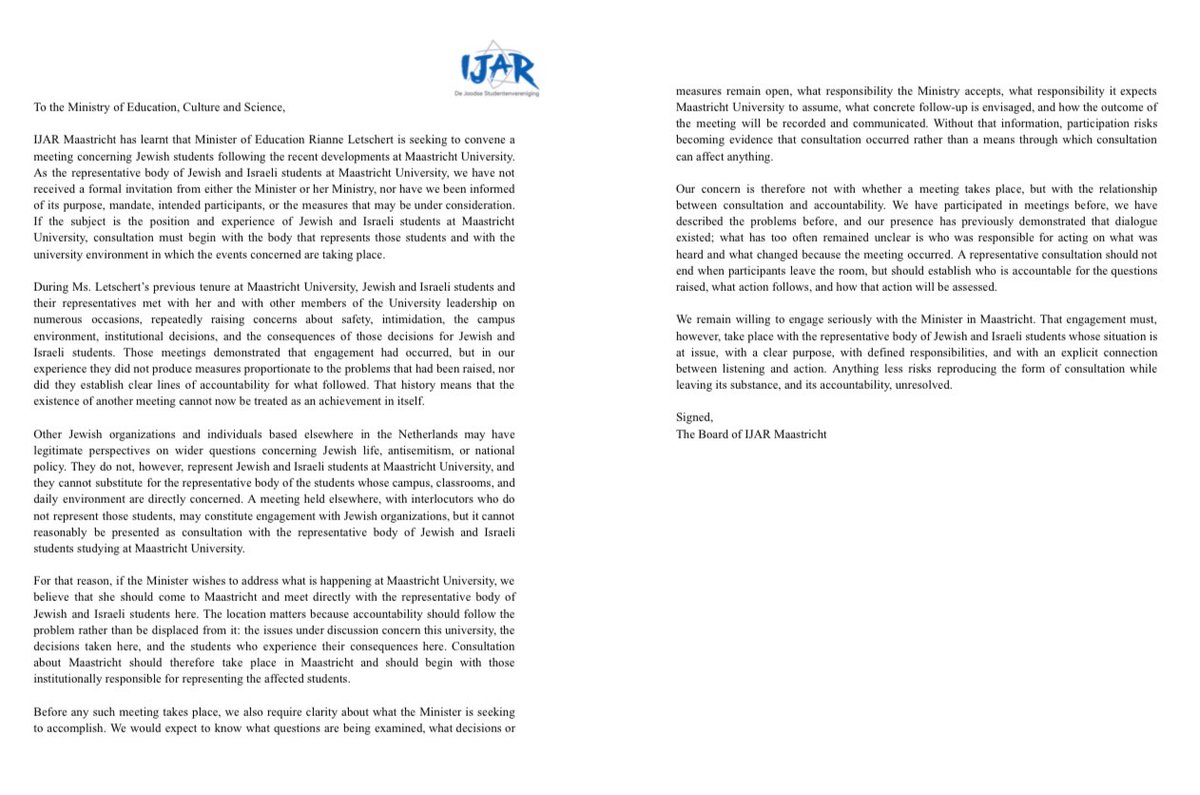
Letschert in a tight spot! The Jewish and Israeli students in Maastricht are stating it clearly. They are no longer carried away by the dialogue merry-go-round of the D66 Minister of Education, after spending years in her merry-go-round when she led the university. Result: an antisemitic climate and the import of hate rallies. Letschert's reward: the plush of The Hague. Read the letter below. Support these brave students who let their voice, and only their voice, be heard. Who do not bow to the established order and do not allow themselves to be exploited and misled by them. Bravo! To the Ministry of Education, Culture and Science, IJAR Maastricht has learned that Minister of Education Rianne Letschert intends to organize a meeting about Jewish students, following the recent developments at Maastricht University. As the representative organization of Jewish and Israeli students at Maastricht University, we have received no formal invitation from the minister or her ministry. Nor have we been informed about the purpose, the mandate, the intended participants, or the measures that may be considered. If the subject concerns the position and experiences of Jewish and Israeli students at Maastricht University, consultations should begin with the organization that represents these students and within the university environment where the relevant events take place. During Ms. Letschert's previous term at Maastricht University, Jewish and Israeli students and their representatives spoke with her and other members of the university administration on numerous occasions. They repeatedly expressed concerns about safety, intimidation, the campus climate, institutional decisions, and the implications of those decisions for Jewish and Israeli students. From those discussions, it appeared that consultations were taking place, but in our experience, they did not lead to measures that corresponded to the issues raised. Clear lines of accountability were also not established for what followed. This history means that the mere fact that there is again a meeting cannot be considered an achievement in itself. Other Jewish organizations and individuals elsewhere in the Netherlands may have legitimate perspectives on broader issues concerning Jewish life, antisemitism, or national policy. However, they do not represent the Jewish and Israeli students at Maastricht University and cannot replace the representative organization of the students whose campus, lecture halls, and daily living environment are directly at stake. A meeting held elsewhere, with discussion partners who do not represent these students, can be viewed as discussions with Jewish organizations, but cannot reasonably be presented as a consultation with the representative organization of Jewish and Israeli students studying at Maastricht University. For that reason, we believe that if the minister wishes to address what is happening at Maastricht University, she should come to Maastricht and engage directly in conversation with the representative organization of Jewish and Israeli students here. The location is important, as responsibility must be aligned with where the issue occurs and not be disconnected from it: the issues being discussed involve this university, the decisions being made here, and the students who experience the consequences of those decisions. Thus, consultations regarding Maastricht should take place in Maastricht and begin with those who are institutionally responsible for representing the involved students. Before such a meeting takes place, we also demand clarity about what the minister aims to achieve with it. We expect to know what questions are being investigated, what decisions or measures remain open, what responsibility the ministry will take on itself, what responsibility it expects from Maastricht University, what concrete follow-up steps are foreseen, and how the outcomes of the meeting will be recorded and communicated. Without that information, participation threatens to serve mainly as proof that consultations have taken place, rather than as a means by which those consultations can actually have an impact. Our concern, therefore, is not about whether there will be a meeting, but about the relationship between consultation and responsibility. We have previously participated in discussions, we have laid out the problems before, and our presence has previously shown that a dialogue existed. What too often has remained unclear, however, is who was responsible for acting on what was raised during those discussions and what actually changed as a result of those discussions. A representative consultation should not end once the participants leave the room, but should record who is responsible for the issues raised, what actions follow from that, and how those actions will be assessed. We remain willing to engage seriously with the minister in Maastricht. However, that consultation must take place with the representative organization of the Jewish and Israeli students whose situation is at stake, with a clear purpose, with well-defined responsibilities, and with an explicit connection between listening and acting. Anything less than that threatens only to reproduce the form of consultation, while the substance — and the responsibility for it — remains unresolved. Signed, The Board of IJAR Maastricht *link to the original letter in the tweet below (translated)