BETA nonprofit public democratic european moderated

Search

#struggle

The Mainstream Media struggled to mention the War without calling it 'the unprovoked War in Ukraine' because they knew it was provoked by #NATO Expansion. Former NATO Boss Stoltenberg boasted at our Committee in EU Parliament that NATO provoked Russia... #NATO #UkraineWar #MediaBias #UA #NATO #RU #EU
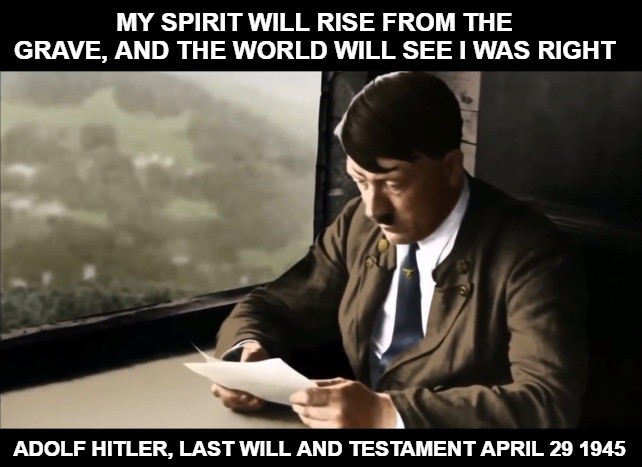
ADOLF HITLER: MY LAST TESTAMENT. LET GOD JUDGE ME. Mike Walsh. Forbidden History: This is the first time this bestseller has been published. Adolf Hitler, who took on Satan and his disciples, describes his struggle for victory over the Capitalist-Communist hydra. Adolf Hitler also explains his downfall. Illustrated. Softcover. 195 pages. https://barnesreview.org/product/adolf-hitler-my-last-testament-let-god-judge-me/

ADOLF HITLER: MY LAST TESTAMENT. LET GOD JUDGE ME. Mike Walsh. Forbidden History: This is the first time this bestseller has been published. Adolf Hitler, who took on Satan and his disciples, describes his struggle for victory over the Capitalist-Communist hydra. Adolf Hitler also explains his downfall. Illustrated. Softcover. 195 pages. https://barnesreview.org/product/adolf-hitler-my-last-testament-let-god-judge-me/

ADOLF HITLER: MY LAST TESTAMENT. LET GOD JUDGE ME. Mike Walsh. Forbidden History: This is the first time this bestseller has been published. Adolf Hitler, who took on Satan and his disciples, describes his struggle for victory over the Capitalist-Communist hydra. Adolf Hitler also explains his downfall. Illustrated. Softcover. 195 pages. https://barnesreview.org/product/adolf-hitler-my-last-testament-let-god-judge-me/

Silicon Valley is throwing everything it’s got at fighting a wealth tax in California. This is class struggle from above — and it shows why oligarchy is fundamentally incompatible with democracy. Just look at who’s lining up to oppose @RoKhanna’s proposal. 🧵 #WealthTax #ClassStruggle #Oligarchy #US

ADOLF HITLER: MY LAST TESTAMENT. LET GOD JUDGE ME. Mike Walsh. Forbidden History: This is the first time this bestseller has been published. Adolf Hitler, who took on Satan and his disciples, describes his struggle for victory over the Capitalist-Communist hydra. Adolf Hitler also explains his downfall. Illustrated. Softcover. 195 pages. https://barnesreview.org/product/adolf-hitler-my-last-testament-let-god-judge-me/

ADOLF HITLER: MY LAST TESTAMENT. LET GOD JUDGE ME. Mike Walsh. Forbidden History: This is the first time this bestseller has been published. Adolf Hitler, who took on Satan and his disciples, describes his struggle for victory over the Capitalist-Communist hydra. Adolf Hitler also explains his downfall. Illustrated. Softcover. 195 pages. https://barnesreview.org/product/adolf-hitler-my-last-testament-let-god-judge-me/

Hayden Panettiere is no more. You might remember her from Heroes. You can never see what's actually going on with someone who looks like they have it all. She had just released a book on her life & struggles in May and now she is gone. Rest in peace 🕊️ ॐ शांति 🙏🏻 https://t.co/TKMJFxEsCf #HaydenPanettiere #RestInPeace #MentalHealthAwareness #Thetweetdoesnotmentionanyspecificcountries.Therefore #therearenocountrycodestoreturn.

ADOLF HITLER: MY LAST TESTAMENT. LET GOD JUDGE ME. Mike Walsh. Forbidden History: This is the first time this bestseller has been published. Adolf Hitler, who took on Satan and his disciples, describes his struggle for victory over the Capitalist-Communist hydra. Adolf Hitler also explains his downfall. Illustrated. Softcover. 195 pages. https://barnesreview.org/product/adolf-hitler-my-last-testament-let-god-judge-me/

What does it actually mean to live from music in Estonia? For an independent musician, the answer is more complicated than it sounds. I have recently been fortunate enough to experience something that many musicians dream of: I can live from my music. I compose, produce, perform, write, run a music label and organise concerts. After years of combining music with other jobs, I finally have the freedom to make my living from the thing I have always wanted to do. It sounds wonderful. Well, it is wonderful. But it is also a struggle that is rarely visible from the outside. As an independent artist and entrepreneur, I do not simply receive money for making music. I have to create that income through my company, pay the costs of running the business, pay taxes, and then pay myself a salary. There is no employer absorbing the administrative and financial burden behind my work. I am simultaneously the artist, producer, promoter, employer and employee. At the moment, my income is modest. I pay myself roughly €900 because that is what my business can realistically sustain. Yet for my company to pay me that amount, the actual cost is around €1,370. Approximately €470 goes towards social tax and other mandatory employment related payments. And this comes after VAT has already taken its share of my business activity. That is the part of the discussion that is often missing when we talk about taxation. #estonia #estonianculture #music #tax #eutax #musictax #concert https://tunitemusic.com/post/an-independent-artists-view-of-estonias-24-vat/

An Independent Artist’s View of Estonia’s 24% VAT - Tunitemusic

Liberals toppled kings, emperors, warlords, priests: victories won through struggle against reactionary forces at every step. Today, against MAGA, same struggle for liberal values—individual over collective, reason over dogma, pluralism over tribalism https://t.co/cpad4sppGQ #LiberalValues #ProgressiveStruggle #AgainstMAGA #Nospecificcountrycodesarementionedinthetweet.

Foucault argued that power does not operate only through governments or economic structures, but through language, knowledge, social norms and supposedly neutral institutions. Politics therefore became a struggle not just over who governs or owns what, but over who gets to define #Foucault #Power #Politics #Nospecificcountrycodescanbeidentifiedinthetweetprovided.

Metaphysics of the Solitary Absolute: Philosophical and Legal Analysis of the Thesis of Solitary Amorality ​The Thesis of Solitary Amorality, formulated by Tom Nesky under the banner of the Axiom of Relationality of Law and Being, constitutes a radical challenge to classical and contemporary normative theories. Its central premise—stating that law, morality, and the category of crime are not inherent properties of reality, but artificial products of social relations—requires a rigorous deconstruction at the intersection of legal positivism, phenomenological existentialism, ontological anarchism, and monistic metaphysics. This paper attempts a systematic analysis of the intellectual pillars of this thesis, examining its internal coherence, genealogical roots, and consequences for the understanding of freedom and human subjectivity. ​The Systemic Construction of Crime vs. Pure Theory of Law ​The first pillar of the Thesis of Solitary Amorality, designated as Nullum Crimen Sine Systema, posits that law does not discover pre-legal categories of evil, but brings them into existence through the very act of establishing a boundary of permissibility. This assertion exhibits a profound convergence with 20th-century legal positivism, particularly with Hans Kelsen's Pure Theory of Law (Reine Rechtslehre). Kelsen advocated for a methodological purification of legal science from ethical, sociological, and political elements, defining law as a normative system founded upon a hypothetical basic norm (Grundnorm). ​In the Kelsenian view, the legal system functions as a coercive apparatus devoid of inherent moral value. A crucial point of intersection with Nesky's thesis is the elimination of the traditional dualism between acts that are inherently evil (mala in se) and acts prohibited merely by law (mala prohibita). Kelsen argued that an act becomes unlawful solely when a legal norm attaches state-enforced coercion to it. Unlawfulness is not an ontological property of the act, but the result of a relationship of normative imputation. This implies that the law does not penalize an act because it is intrinsically evil; rather, an act is considered evil solely because it has been subjected to systemic penalization. ​This clash became prominent during the debates surrounding the Nuremberg trials, where positions based on natural law and legal positivism collided. While prosecutors such as Robert Jackson invoked universal moral norms (mala in se) as the basis for punishing criminals despite the previously binding positive law of the Third Reich, Kelsen pointed out the theoretical inconsistency of such an approach. He argued that judging on the basis of retroactive law (ex post facto) constitutes a breach in the systemic coherence of positivism, even if it might be justified by political and historical necessity. ​Nesky's project imparts an existential dimension of oppression to this structure, bringing it close to the critique of the state formulated by Friedrich Nietzsche. Nietzsche famously described the state as "the coldest of all cold monsters," which devours the individual's singularity and imposes herd morality upon them. The gaze of the state, mediated through the Other, paralyzes the sovereignty of the individual and forces them to navigate within arbitrarily designated normative boundaries. Every stroke drawn across the chaos of reality establishes a boundary, and every boundary instantly creates the concept of its transgression. ​The Paradox of the Systemic Cage and the Limits of Ontological Anarchism ​The second pillar of the thesis—The Paradox of the Systemic Cage—points to the impossibility of escaping the system through rules alone. Every attempt to negate the existing order, from establishing anarchist structures to escaping into geographical isolation, immediately transforms into a new system whose primary imperative becomes the defense and maintenance of that very absence of rules. This process of structural looping finds its reflection in the current of ontological anarchism formulated by Hakim Bey (pseudonym of Peter Lamborn Wilson). ​Bey, drawing on a synthesis of Nietzscheanism, Situationist theory of the spectacle, and chaos esotericism, recognized that classical revolutions striving to overthrow the state inevitably reproduce structures of domination, becoming new forms of confinement. As an alternative, he proposed the concept of the Temporary Autonomous Zone (TAZ). TAZ is a tactic for creating temporary, non-hierarchical spaces that deliberately evade formal structures of state control. The key element of TAZ is its ephemerality: before the system can map, define, and absorb the autonomous zone, it must dissolve itself and relocate to another point in space-time. ​Attempts to transform TAZ into Permanent Autonomous Zones (PAZ) immediately encounter the paradox noted by Nesky. The need to defend and codify freedom within a lasting community gives rise to internal rules, mechanisms of exclusion, and hierarchy. For this reason, Murray Bookchin criticized ontological anarchism (calling it "lifestyle anarchism" or "bourgeois anarchism") for its lack of political realism and its flight from systemic struggle against capital and state in favor of aesthetic rebellion. The convergence of these perspectives demonstrates that freedom defined as reactive resistance to a system remains structurally determined by it. ​The Dissolution of the Relational Mirror: The Existential Gaze and the Collapse of Morality ​The third pillar of the thesis, designated as The Dissolution of the Mirror (L'Autre), posits that good and evil require the presence of an external witness and judge. This assertion represents a direct application of Jean-Paul Sartre's existential phenomenology, particularly his analysis of the Gaze (le look / le regard) and the relation to the Other (l'Autre) presented in Being and Nothingness. ​Sartre illustrates the constitutive role of the Other through an analysis of the voyeur's situation. At the moment of complete absorption in the act of peeping through a keyhole, the subject's consciousness is pre-reflective—the voyeur does not reflect on himself; his consciousness completely merges with the act being performed. Only the sudden sound of footsteps in the hallway shatters this unity. The voyeur realizes that he himself is seen, and is instantly paralyzed by shame. ​For Sartre, shame is not a purely internal emotion; it is shame of oneself before the Other. The Gaze of the Other objectifies the free subject (being-for-itself—pour-soi), freezing them into a specific role and moral evaluation (being-for-others—pour-autrui). As Ellie Anderson points out, Descartes' formula "I think, therefore I am" is replaced in Sartre by "I feel shame, therefore Others exist." The Gaze of the Other marks the birth of social morality, wherein the individual learns to view themselves from a third-person perspective. ​This existential dynamic corresponds to the Nietzschean genealogy of "bad conscience." Nietzsche demonstrates that morality and guilt are products of the forced internalization of human instincts that could no longer be discharged outwardly due to social barriers. Forced into the constraints of society, man turns against himself, creating an internal judge (conscience) modeled on the external tyrant. ​This vision also resonates with the classical theory of Thomas Hobbes. In Leviathan, Hobbes explicitly declares that in the state of nature, where there is no common power, there is no law, and where there is no law, no notion of injustice exists. Concepts of good, evil, justice, and property are attributes of man living in society, not in solitude. Removing the social fabric reverts the individual to a state in which theft and injury lose their raison d'être due to the absence of relational reference to the Other. #philosophy # metaphysics # thesis # morality

Ceuta was „neither a genuine humanitarian crisis nor part of an anti-colonial struggle, but part of efforts by the growing US-Israeli-Moroccan nexus (…) to weaken a progressive European government, divide Europe, and undermine international law.“ https://t.co/7FFEMQZV7W #Ceuta #InternationalLaw #Geopolitics #US #IL #MA #EU

I criticised the campaign; it insults the victims and the bloody struggle of Gwangju residents.

Police raid Starbucks Korea headquarters over 'Tank Day' fiasco
www.bbc.co.uk