BETA nonprofit public democratic european moderated

Search

#Édition
2

The ZEvent, an online charity marathon organized since 2016, concludes its latest edition this Sunday, celebrating a decade of solidarity on the Internet that has raised over 58 million euros for French associations, with logistical support from the Fondation de France since 2022. (translated)

ZEvent 2026 : « Joyeux, utile, fédérateur »… A la Fondation de France, on remercie dix ans de solidarité sur Internet

The charitable event ZEvent set a new record with over 16.5 million euros in donations just before the end of its latest edition. (translated)

L'évènement caritatif ZEvent dépasse les 16,5 millions d'euros de dons, un record à quelques heures de la fin de son ultime édition

SPECIAL EDITION Fascist activists, Loïk Le Priol and Romain Bouvier, already convicted for violence by the GUD, are being tried for the assassination, on March 19, 2022, of Federico Martín Aramburú, Argentine rugby international and glory of Biarritz Olympic. (translated)

WOUT VAN AERT DOUBLE LA MISE ! Déjà vainqueur vendredi, le Belge (31 ans) de la Visma-Lease a Bike s'adjuge aussi la 15e étape de #LaVuelta26 ! Il règle au sprint Alessandro Romele (XDS Astana) et Thibau Nys (Lidl-Trek). 5e succès de Visma sur cette édition. https://t.co/XXhoy6ngIo #LaVuelta26 #Cyclisme #WoutVanAert

ZEVENT 8h

Nous sommes déjà à 16 MILLIONS d'EUROS récoltés ! Avec 179096€ de plus, on bat notre record, toutes éditions comprises ! MERCI ! https://t.co/cqA80nqfI4 #fonds #solidarité #récolte

🎙️ ÉDITION MERENGUE LANCE SON PODCAST ! 🤍 On est très heureux de vous présenter le tout premier épisode de notre nouveau podcast ! 📋 Au programme : 🛒 Notre bilan du mercato 🏟️ Le début de saison en Liga 🏆 Le tirage au sort de la Ligue des Champions 🤔 Nos attentes pour cette saison 🎙️ Avec Patrick, Wacim et Muz pour vous accompagner. 🔗 Liens de l’épisode : 🎧 Spotify : https://t.co/Mw0qQRwfLm 🍎 Apple Podcasts : https://t.co/eVg28GVWrc On attend vos avis en commentaire ! #Podcast #Football #Liga

🔴 FLASH | À Roubaix, le NAME Festival est déprogrammé après une demande de la nouvelle municipalité dirigée par David Guiraud (LFI). Créé en 2005, le NAME est l’un des plus anciens festivals électro de France. Sa 20e édition devait se tenir les 13 et 14 décembre 2026 à la Condition Publique. La mairie invoque des "nuisances" dénoncées par des riverains et un décalage entre l’événement et les habitants du quartier. Les organisateurs affirment avoir appris durant l’été que la nouvelle majorité municipale ne souhaitait plus que le festival se tienne sur place. David Guiraud assume la décision et a demandé un moratoire sur l’événement. Le festival avait déjà fait une pause en 2025 et devait justement revenir cette année pour sa 20e édition. #Roubaix #NAMEFestival #Événement文化

BFMTV 18h

The ZEvent, a charity marathon organized by the streamer ZeratoR, has already raised 13 million euros for its last edition scheduled from September 3 to 7, 2026. (translated)

Déjà 13 millions d'euros récoltés pour la dernière édition du ZEvent
ZEVENT 23h

Mastu est le premier streameur du ZEVENT, toutes éditions confondues, à atteindre les 2 millions d'euros sur sa cagnotte personnelle ! https://t.co/EaooOUxDJ9 #ZEVENT #Streaming #Mastu

After “Broadway World”, Marina (1888) from the Teatro Umberto Giordano’s “GIO Festival” in Foggia now reaches the Belgian “Opera Gazet” SOURCE: https://medium.com/@ingnucllms/after-broadway-world-marina-1888-from-the-teatro-umberto-giordanos-gio-festival-in-foggia-73ba01e5f50a SOURCE: https://www.operagazet.com/marina-by-giordano-its-world-stage-premiere-in-foggia/ SOURCE: https://www.operagazet.com/marina-by-giordano-its-world-stage-premiere-in-foggia/ From the homepage of “Broadway World” to the pages of an authoritative international magazine: the world stage première of Umberto Giordano’s youthful melodrama now consecrates Foggia as the capital of a “rediscovered verismo”. There is a destiny that waits, patiently, to be fulfilled. It is the destiny of Marina, a one‑act melodrama with music by Umberto Giordano and a libretto by Enrico Golisciani, composed in 1888 for the celebrated Sonzogno competition and subsequently withdrawn by the composer himself, falling into an oblivion that lasted 138 years. That destiny was fulfilled on 5 June 2026 at the Teatro Umberto Giordano in Foggia, with the World Staging Première of the opera, the inaugural event of the first edition of the “GIO Festival” — “Giordano International Opera Festival”, the new international showcase which, from 5 to 20 June, transformed the Capitanata into a widespread stage devoted to the Maestro from Foggia. A cultural enterprise of European breadth, promoted by the Chamber of Commerce of Foggia together with the Municipality and the Province, supported by the Region of Puglia and the Fondazione Monti Uniti, and capable of restoring to history a fundamental fragment of nascent verismo. The Foggia production — directed by Giandomenico Vaccari, conducted and coordinated by Matteo Dal Maso, with sets and costumes by Alfredo Troisi, lighting by Massimo Russo, and soprano Valeria Sepe in the eponymous role — represented not a mere performance, but the scenic resurrection of an opera long believed lost. Its autograph score was rediscovered only recently at Yale University’s “Beinecke Rare Book and Manuscript Library”, within the “Frederick R. Koch” Collection, thanks to the philological work of the conductor and musicologist of Venetian and German heritage, Andreas Gies, who prepared its critical edition. After the transatlantic resonance that saw the “GIO Festival” reach the homepage of “Broadway World” thanks to the world première of Marina, complete with exclusive photographs of the historic debut, a new and prestigious international recognition now arrives. The authoritative Belgian opera magazine “Opera Gazet” dedicates an extensive musicological review to the Foggia event with the article: “ “MARINA” (by Giordano) — ITS WORLD STAGE PREMIÈRE IN FOGGIA”. An arrival far from secondary. If “Broadway World” marked the opera’s transatlantic debut, “Opera Gazet” now seals its critical consecration among the most discerning and specialised audiences: the melomaniacs, scholars, and professionals of the operatic world. From Foggia to New York, from New York to the circuit of the international opera press. The trajectory of Marina confirms what the “GIO Festival” has sought to demonstrate since its inception: Giordano’s legacy is not a local memory, but a living repertoire, capable of conversing with major stages and with the world’s most prestigious cultural outlets. The rediscovery born in Foggia is now a heritage shared by all.

The Vindication of the “GIO Festival”: “BroadwayWorld” Celebrates Marina and the Umberto Giordano Theatre of Foggia SOURCE: https://www.linkedin.com/pulse/vindication-gio-festival-broadwayworld-celebrates-sardella-ph-d--8zzce/ SOURCE: https://www.letteremeridiane.org/2026/08/la-rivincita-del-gio-festival-broadwayworld-celebra-marina-e-foggia/ The GIO Festival has been, to put it mildly, overlooked by Rai3 Puglia and several regional outlets. Yet the festival dedicated to Umberto Giordano — promoted by the Chamber of Commerce of Foggia together with the Municipality and the Province, and supported by the Apulia Region and the Fondazione Monti Uniti — has achieved a remarkable vindication, landing on the homepage of BroadwayWorld thanks to the world première of the opera Marina, staged on 5 June at the Umberto Giordano Theatre in Foggia. This is no small feat, considering that BroadwayWorld is among the most influential American platforms devoted to theatre and the performing arts. The transatlantic debut of the opera by Foggia’s great composer did not escape the attention of Luciano Magaldi Sardella, who submitted to the editorial board of Lettere Meridiane an in‑depth and compelling contribution, reproduced below. In the article, the author masterfully reconstructs the extraordinary story of Giordano’s first opera, composed in 1888 and left without a staged production for 138 years, until its historic performance on 5 June at the Giordano Theatre. Above all, he recounts how the inaugural edition of the GIO Festival has restored Foggia to the centre of the international operatic stage, through the rediscovery and valorisation of Marina, the involvement of major musical institutions, and the attention of the American press. It is a stimulating reflection on the cultural and identity‑driven renaissance of a city that, for far too long, bore Giordano’s name on the façade of its theatre without managing to turn it into a lever of international visibility. (g.i.) + + + + + There are moments in the life of a city when past and future clasp hands upon the stage of the present. Foggia experienced one of these moments on the evening of 5 June 2026, when the curtain of the Umberto Giordano Theatre rose upon Marina, an opera composed in 1888 by a young man of twenty‑one — Umberto Giordano — then a student at the San Pietro a Majella Conservatoire in Naples. After one hundred and thirty‑eight years of silence, that score finally found its first scenic breath in the world. “It is not an ordinary event. It is a turning point. A void filled. A story rewritten.” Umberto Giordano, one of the most celebrated verismo composers of the fin‑de‑siècle — born in Foggia, author of masterpieces such as Andrea Chénier, Fedora, Siberia — had remained, until now, the only great Italian opera composer without a festival entirely dedicated to his oeuvre. A paradox that weighed like a historical injustice upon a city that bears his name engraved on the pediment of its most beautiful theatre. This is the extraordinary journey of Marina, Giordano’s first opera, which after 138 years of oblivion received its world première in scenic form on 5 June 2026 at the Umberto Giordano Theatre in Foggia, as the opening event of the GIO Festival — the inaugural edition of the Giordano International Opera Festival. The manuscript, preserved in the Frederick R. Koch Collection at Yale University’s Beinecke Rare Book and Manuscript Library, has travelled an astonishing path: from the elite libraries of America’s East Coast to the beating heart of the Daunia. On the night of 5 June 2026, at the Umberto Giordano Theatre, that silence was finally broken. The GIO Festival was conceived in Foggia as an ambitious cultural project promoted by the Chamber of Commerce, the Municipality, and the Province, with the support of the Apulia Region, aiming to transform the artistic legacy of the verismo composer into a driver of territorial development and cultural tourism. Under the artistic direction of conductor Gianna Fratta and violinist Dino De Palma, the event at last fills a historical void. Its model is explicit and ambitious: a project inspired by the great festivals dedicated to Italian composers — such as the Verdi Festival, the Puccini Festival, the Rossini Opera Festival — while maintaining a strong territorial and participatory dimension. In other words, Foggia formally claims its seat at the table of the greats. And it does so with the credentials required: an unrepeatable world scenic première (parallel to the concert première at Milan’s Teatro Dal Verme, recorded by the prestigious opera label Decca Classics), a high‑quality operatic production, and the support of leading cultural institutions (Teatro dell’Opera di Milano, Fondazione Teatro Petruzzelli of Bari). The festival benefitted from the collaboration of the Orchestra of the Conservatoire and the Chorus of the Fondazione Teatro Petruzzelli of Bari, the Umberto Giordano Conservatoire of Foggia, the Fondazione Monti Uniti, and the Fondazione Apulia Felix. A network of excellence that lent the event national resonance and stature. The Umberto Giordano Theatre is a nineteenth‑century jewel of rare beauty — the oldest functioning horseshoe‑shaped historic theatre in Apulia. Yet for decades it lived in a state of semi‑clandestine cultural marginality, relegated to the periphery of the operatic routes that matter, hindered by long interruptions in its use from 2007 to 2014, including recent fire‑safety compliance requirements. Some referred to it, with a mixture of condescension and provincial resignation, as a “provincial theatre”, destined merely to bear Giordano’s name. That label is now destined to fall. It is precisely in Foggia that this youthful gem received its first scenic staging, placing the city on the international map of opera. A positioning without precedent in the city’s recent history. The Giordano Theatre recorded a full house for the historic première of Marina, welcoming hundreds of spectators, while many more followed the performance from outside via a large screen installed for the occasion. The production met expectations with full artistic dignity: the staging transposed the narrative to the First World War, heightening the opera’s dramatic and realist character. On the podium, the Symphony Orchestra of the Umberto Giordano Conservatoire conducted by Matteo Dal Maso. Sets and costumes by Alfredo Troisi; lighting by Massimo Russo. An ensemble of talents worthy of the name the theatre proudly bears. The definitive seal of this moment’s historical significance arrived from across the Atlantic. BroadwayWorld, the world’s most influential outlet for live performance criticism and reporting — with over 5.5 million monthly views — dedicated exclusive coverage to the event, publishing a complete photographic gallery of the world scenic première curated by Chloe Rabinowitz and a substantial critical review by Rachel Stone. The American article emphasised the historical value of the undertaking and the bond between the composer and his native city, highlighting the musical quality of the score, deemed surprisingly mature for the composer’s age. For the first time, the Umberto Giordano Theatre appeared on the New York‑based site alongside institutions such as the Los Angeles Opera House, Houston Opera, and BBC Classical Music at the Royal Opera House. It is its natural place. It should have been there decades ago. Until now, the world knew Giordano through his Milanese triumphs, not through the youthful opera written between Foggia and the Naples Conservatoire — the lost (and later rediscovered) Marina of 1888. Let us be clear: this is no minor detail. BroadwayWorld does not grant exclusive galleries to provincial theatres. It does so for events that shift the coordinates of musical and theatrical history within the circuits that matter. This time, those coordinates shifted to Foggia thanks to the GIO Festival, in the name of Umberto Giordano. For the record — and for those who may not yet know — the GIO Festival is a new and ambitious biennial event conceived by the Chamber of Commerce of Foggia, with the aim of celebrating the genius of Umberto Giordano and transforming it into a powerful engine of development for the entire Capitanata. Biennial means continuity, planning, vision. It means that Foggia does not intend to be a meteor in the operatic firmament, but a stable and recognisable presence within the international festival circuit. Andrea Chénier, Siberia, and Fedora had already carried Giordano’s name to the Metropolitan Opera House in New York for more than a century, where his works are still performed to great acclaim. Now Foggia itself — not merely its scattered operatic legacy — claims its rightful “place in the sun”. The composer whom his city struggled to recognise in life, and whose name it preserves on its theatre, its square, and its conservatoire, may finally become the lever of an unprecedented cultural, economic, and identity‑driven renaissance. The GIO Festival 2026 is not, one hopes, a point of arrival. It should be the first chapter of a new story for Foggia, for the Capitanata, and for the cultural South of Italy. The Umberto Giordano Theatre is no longer merely an architectural jewel to be preserved: it has now become a place of creation and inspiration, capable of attracting international press attention and hosting events that enter the annals of world opera. To those who still whisper that Foggia is a provincial city, the answer is now written upon the world’s stages: on the evening of 5 June 2026, the periphery became the centre.

The Vindication of the “GIO Festival”: “BroadwayWorld” Celebrates Marina and the Umberto Giordano Theatre of Foggia

“BROADWAY WORLD” OF NEW YORK WELCOMES THE TEATRO MERCADANTE OF CERIGNOLA IN THE NAME OF THE MASCAGNI FESTIVAL SOURCE: https://www.linkedin.com/pulse/broadway-world-new-york-welcomes-teatro-mercadante-sardella-ph-d--i5mbe/ by Stephi Wild, New York City. SOURCE: https://www.broadwayworld.com/italy/article/Photos-Teatro-Mercadante-and-Teatro-Goldoni-Partner-on-SOUNDTRACK-MASCAGNI-20260827 The most influential theatrical portal in the world, with at least six million global visitors per month, consecrates the cultural twinning between Cerignola and Livorno and the historical restitution of a verismo born in Puglia, southern Italy: there exists a moment when a local history ceases to be peripheral and, by the mere fact of being recounted in the right place, becomes universal history. That moment, for the Teatro Mercadante di Cerignola, has arrived. Broadway World, the bible of international theatre read daily by producers, artistic directors and critics from New York to the West End, has welcomed into its pages the cultural pact between the Mercadante and the Fondazione Teatro Goldoni of Livorno, sealed in spring 2026 by Artistic Director Savino Zaba and the Municipal Administration in the person of the Deputy Mayor and Commissioner for Culture, Maria Dibisceglia. The piece is signed by New York editor Stephi Wild, under the title: “Photos: Teatro Mercadante and Teatro Goldoni Partner on SOUNDTRACK MASCAGNI”. It is no mere detail. Broadway World does not review provincial seasons. When it does, it is signalling to the American and global theatrical system that something, down there, deserves to be seen. The heart of this recognition is Soundtrack Mascagni: the music that inspired cinema, the cinema that celebrated Mascagni, the co-production chosen as the closing event of the VII edition of the Mascagni Festival. A hybrid work, a concert-reading for narrating voice, ensemble, images and sounds, with dramaturgy and text by Vittorio Giacci, performed by the Artists of the Mascagni Academy and the Orchestra of the Teatro Goldoni di Livorno “Massimo de Bernart” conducted by Maurizio Colasanti. On stage, in the guise of an imaginary Mascagni, as narrator and guide through his own musical universe, the actor-director Maurizio Nichetti. A production, as the Italian notes record, “born from the synergy between the Teatro Mercadante di Cerignola and the Teatro Goldoni di Livorno”, which will see on stage the great actor and director Maurizio Nichetti and the Orchestra of the Goldoni, conducted by Maestro Maurizio Colasanti, with direction entrusted to Marco Voleri and Savino Zaba. What Broadway World has intercepted, moreover, is not merely a production but also a historiographical thesis that at last forces the international literature to catch up. For decades, Anglophone biographies have dismissed Pietro Mascagni’s Apulian decade as “years of poverty and obscurity”: the documentary truth, preserved in the Polo Museale of Piano San Rocco, is of a different temper entirely. In December 1886, on tour with the Maresca company, Mascagni stopped in Cerignola, where the mayor then in office, Commendatore Cannone, invited him to remain to conduct the newly founded philharmonic. The composer would stay, save for brief absences, in the house in Via Assunta until 1895, composing no fewer than five operas: Cavalleria rusticana; L’amico Fritz; I Rantzau; Guglielmo Ratcliff; Silvano. A third of his entire operatic output, written in feverish poverty, in an agricultural town of the Ofantine plain. It was there, in July 1888, that the verses of Cavalleria reached him by postcard from Livorno, sent by his poet friends Giovanni Targioni-Tozzetti and Guido Menasci. There, on 27 May 1889, he completed the autograph. The envelope, that morning, bore the postmark of Cerignola. The world premiere at the Costanzi in Rome, on 17 May 1890 before Queen Margherita, was an earthquake. As Zaba has synthesised it, in a formula destined to endure: “Livorno gave Mascagni to the world. Cerignola inspired him and kept the deepest part of his soul.” In fact, the productive parabola sanctioned by BroadwayWorld is exemplary in the way it overturns the traditional North-South axis of cultural projects. It begins on 23 August at the Mascagni Festival in Livorno with Soundtrack Mascagni. Then its debut in Cerignola, in the course of the Mercadante’s forthcoming season. Indeed, with a date already fixed: “Soundtrack Mascagni” will be presented in Cerignola on 24 October as the opening production of the 2026/2027 theatrical season of the Teatro Mercadante. An idea as simple as it is revolutionary: cinema as a lens through which to re-read Mascagni. The composer plundered by Scorsese and Coppola, cited by Visconti as a tutelary deity, already possessed in his own writing — dense, symphonic, almost edited by cuts — a cinematic vocation. Soundtrack Mascagni does not merely celebrate that filiation; it interrogates it. That BroadwayWorld should have chosen to capture precisely this — a provincial theatre that does not seek hospitality but co-produces as an equal with a historic theatre such as the Goldoni — says much about the shifting of Italy’s cultural axis. No longer a South that imports, but a South that generates archives, that preserves autographs, caricatures, unpublished letters, and restores them to the international circuit. For Cerignola, accustomed to being narrated as a land of wheat and not of music, this arrival on Broadway World is more than a press clipping. It is the certification that its Mascagni story is no longer a local footnote, but a necessary chapter in the history of verismo. And that the Mercadante, from a provincial municipal theatre, has entered in full right the ranks of those Mascagni theatres upon which the whole world now looks, and with admiration.

“BROADWAY WORLD” OF NEW YORK WELCOMES THE TEATRO MERCADANTE OF CERIGNOLA IN THE NAME OF THE MASCAGNI FESTIVAL

“BROADWAY WORLD”, NEW YORK, PUBLISHES EXCLUSIVE PHOTOS OF GIORDANO's MARINA's WORLD STAGE PREMIERE IN TEATRO UMBERTO GIORDANO IN FOGGIA SOURCE: https://www.linkedin.com/pulse/broadway-world-new-york-publishes-exclusive-photos-sardella-ph-d--uxaie/ SOURCE: https://www.broadwayworld.com/bwwopera/article/Photos-MARINA-Umberto-Giordanos-Lost-Opera-Receives-World-Stage-Premiere-at-GIO-Festival-20260821 Has the "GIO Festival" of Foggia now entered the circuits of the international operatic press and the network of theatres that truly matter? This is, by every measure, an excellent beginning. The Umberto Giordano Theatre can no longer be dismissed as a provincial venue, as some once contended; it now emerges as a historic operatic institution of rising international stature. Broadway World itself has described the event as a global exclusive: “Exclusive 2026 Gran Gala Opening of Giordano’s Marina (1888) at the World Staging Premiere of the Giordano International Opera Festival (GIO Festival) in Foggia’s Umberto Giordano Theatre.” The "Giordano International Opera Festival (GIO Festival)" now possesses every requisite hallmark of a major cultural institution: - the world staging premiere of Marina (1888) by Umberto Giordano, marking a turning point in global operatic history; - Umberto Giordano, a verismo composer of international renown, born in Foggia; - world‑class operatic press coverage through Broadway World; - an international operatic event, emerging yet already significant in its inaugural edition; - national‑level collaborations with Teatro alla Scala and Fondazione Teatro Petruzzelli; - the Umberto Giordano Theatre, now making a decisive leap into the sphere of international opera. Here are the exclusive photographs from the world premiere of Marina (1888) at the Umberto Giordano Theatre in Foggia, marking a historic turning point in the annals of world opera and in the cultural history of Foggia, Italy, and the global legacy of Umberto Giordano. All of this has been formally acknowledged and underscored by "Broadway World", which has published an exclusive photographic gallery documenting, with remarkable completeness and precision, the historic world premiere of Giordano’s Marina, presented at the Umberto Giordano Theatre as part of the "GIO Festival" 2026. The visual collection constitutes a contribution of considerable value for scholars, opera enthusiasts and professionals, offering an in‑depth perspective on every element of the production. – Staging and Production: The gallery clearly reveals the director’s vision: First World War atmospheres, dramatic tensions, familial dynamics and the construction of a visual world fully coherent with the contemporary reading of the opera. The images capture the narrative strength of the staging choices and the meticulous attention to detail that distinguished this unprecedented premiere. – The Cast: The photographs portray the principal artists in their most intense moments: - Marina, performed by Valeria Sepe; - Giorgio Lascari, sung by Samuele Simoncini; - Lambro, portrayed by Elia Fabbian; - Daniele, interpreted by Cüneyt Ünsal. Each image conveys the interpretative quality of the performers and the emotional depth of their characters. – Scenery and Costumes: The visual documentation highlights the work of Alfredo Troisi, responsible for sets and costumes, and the lighting design by Massimo Russo. The images display carefully crafted environments, fabrics, colours and scenic solutions that recreate a historically credible and evocative context. – Highlights of the Inaugural Evening: The gallery also includes photographs capturing the atmosphere of the packed theatre, the participation of the audience, the emotion of the premiere and the city’s enthusiastic response. These images bear witness to a cultural event of notable significance, capable of uniting communities, institutions and admirers of the operatic art.

“BROADWAY WORLD”, NEW YORK, PUBLISHES EXCLUSIVE PHOTOS OF GIORDANO's MARINA's WORLD STAGE PREMIERE IN TEATRO UMBERTO GIORDANO IN FOGGIA

The GIO Festival Captures the Attention of Broadway World: International Spotlight on the Staged World Premiere of Umberto Giordano’s Marina SOURCE: https://www.linkedin.com/pulse/gio-festival-captures-attention-broadway-world-staged-sardella-ph-d--pw1qe/ SOURCE: https://www.immediato.net/2026/08/20/il-gio-festival-conquista-broadway-world-riflettori-internazionali-sulla-prima-scenica-di-marina-di-umberto-giordano/ The prestigious American outlet has devoted an extensive feature to the production presented at the Teatro Giordano in Foggia. The opera, composed in 1888 and left without a true staging for almost 140 years, has returned to life within the festival directed by Gianna Fratta and Dino De Palma. The staged world premiere of Marina, a youthful work by Umberto Giordano, has brought Foggia onto the pages of the international press. Broadway World, a US publication specialising in the performing arts, has dedicated a substantial article to the production presented on 5 June at the Teatro Umberto Giordano as part of the GIO Festival. Luciano Magaldi Sardella, in a communication sent to several editorial offices, highlighted the international resonance of the event, noting that it has attracted attention even overseas. The title chosen by Broadway World is unequivocal: “Marina, Umberto Giordano’s Lost Opera, Makes World Stage Premiere in Foggia.” An opera left in the shadows for nearly 140 years Marina was composed in 1888 by Giordano, then barely in his twenties and still a student at the Naples Conservatoire. The opera was submitted to the second edition of the Sonzogno Competition in Milan, but did not win and remained essentially forgotten for decades, even as the composer from Foggia would later achieve acclaim with works such as Andrea Chénier and Fedora. According to the feature, the score received its first concert performance only at the beginning of 2026 at the Teatro Dal Verme in Milan. The Foggia production, however, marked the opera’s true staged debut, in the theatre that bears Giordano’s own name. The staged premiere at the Teatro Giordano The production was presented on 5 June during the GIO Festival. Artistic direction was entrusted to Gianna Fratta and Dino De Palma, while the staging was directed by Giandomenico Vaccari. As reported by Broadway World, the production relocated the narrative to the period of the First World War, emphasising the dramatic and realistic character of the opera. Valeria Sepe performed in the role of Marina, while the Orchestra Sinfonica of the Conservatorio Umberto Giordano in Foggia was conducted by Matteo Dal Maso. The cast also included Samuele Simoncini as Giorgio Lascari, Elia Fabbian and Cüneyt Ünsal, and the Chorus of the Fondazione Teatro Petruzzelli, prepared by Marco Medved. Broadway World celebrates Foggia The American publication underscores the historical significance of the initiative and the bond between the composer and his native city. The symbolic value is considerable: in the theatre named after Giordano, Foggia has hosted for the first time the complete staged version of an opera that had remained outside the repertoire for more than a century. The feature also highlights the musical quality of the score, described as surprisingly mature for the composer’s age and already capable of anticipating elements that would later characterise Giordano’s subsequent works. A festival spanning Foggia, the Gargano and the Monti Dauni The GIO Festival—Giordano International Opera Festival—was promoted by the Chamber of Commerce of Foggia in partnership with the Municipality and the Province, with support from the Region of Apulia and Puglia Culture. The initiative involved not only the provincial capital but also the Gargano and the Monti Dauni, with a programme ranging across opera, jazz, cinema, dance, chamber music and scientific outreach. The festival concluded on 20 June with Andrea Chénier in Piazza Cavour, in a production originating at La Scala in Milan and brought to Foggia for the occasion. Gianna Fratta conducted the Chorus and Orchestra of the Teatro Petruzzelli. Foggia’s image beyond Italy’s borders The prominence achieved by Marina also represents an important result for the region’s cultural profile. The festival’s narrative seeks to enhance Foggia’s cultural heritage through one of its most emblematic figures. The appearance of the production on the pages of Broadway World reinforces this international dimension, transforming the revival of a forgotten opera into an opportunity for cultural promotion for the entire Capitanata.

The GIO Festival Captures the Attention of Broadway World: International Spotlight on the Staged World Premiere of Umberto Giordano’s Marina

From Yale University to Foggia: World Staging Premiere of Umberto Giordano's “Marina” at Foggia's Teatro Umberto Giordano SOURCE: https://www.linkedin.com/pulse/from-yale-university-foggia-world-premi%C3%A8re-scenic-sardella-ph-d--id9de/ SOURCE: https://www.foggiareporter.it/dalla-yale-university-a-foggia-la-prima-mondiale-in-forma-scenica-di-marina-al-teatro-giordano.html (With heartfelt thanks to the distinguished journalist, Dr Christiana Lenoci…) From the Frederick R. Koch Collection of the Beinecke Rare Book and Manuscript Library at Yale University to Foggia. Such is the extraordinary journey of Marina, Umberto Giordano’s first opera, which—after 138 years of oblivion—received its World Première in scenic form on 5 June 2026 at the Umberto Giordano Theatre in Foggia, inaugurating the GIO Festival – Giordano International Opera Festival. This remarkable rediscovery is recalled by Luciano Magaldi Sardella, Contributing Review of Books Critic at the London School of Economics (LSE). The project, conceived by Gianna Fratta and the artistic direction of the GIO Festival, seeks to transform Foggia, the Tavoliere plain, the Monti Dauni and the Gargano into a widespread stage dedicated to the city’s native composer, following the model of the great festivals devoted to Verdi, Rossini and Bellini. The vanished score At the age of twenty‑one, Umberto Giordano entered the Sonzogno Competition in Milan with Marina, a one‑act melodrama. Among seventy‑two competitors, he ranked within the top twelve. The prize was awarded to Pietro Mascagni’s Cavalleria rusticana. Giordano received an honourable mention, withdrew the score, and recycled part of its music in his later Mala Vita (1892). After his death in 1948, the manuscript disappeared and—entirely legally—ended up catalogued and forgotten within Yale’s collection. It was brought back to light by the musicologist and conductor Andreas Gies who, while studying the works of Leoncavallo, identified the autograph score in Yale’s online catalogue. Together with his colleague from San Severo, Emanuele d’Angelo, Gies prepared a rigorous critical edition that restored the work’s readability. Following its absolute première in concert form at the Teatro Dal Verme in Milan in February 2026—the very theatre that witnessed the early steps of Puccini and Leoncavallo—recorded live by Decca Classics with Eleonora Buratto in the title role and Freddie De Tommaso as Giorgio, praised by Gramophone and The Times of London, Marina finally returned home. Foggia reclaims it On 5 June 2026, the Umberto Giordano Theatre hosted the World Première in scenic form. The production was directed by Giandomenico Vaccari, who transposed the action to the era of the First World War; conducted by Matteo Dal Maso, winner of the Donatella Flick LSO Conducting Competition; and featured Valeria Sepe as Marina. A historic event for a city that lends its name to both its Theatre and its Conservatoire, yet until now had been the only among the cities of Italy’s great opera composers without a festival entirely dedicated to its own. The GIO Festival, from 5 to 20 June, unfolded across sixteen days and more than twenty events in seven municipalities of the Capitanata—Foggia, Manfredonia, Peschici, Vieste, Biccari, Roseto Valfortore and Torremaggiore—uniting opera, jazz, cinema and dance. The finale: opera as urban intervention On the evening of 20 June 2026, thirteen lorries arrived in Piazza Cavour in Foggia from Milan. They carried the entire production apparatus of Teatro alla Scala. The square was transformed into an open‑air theatre for Giordano’s Andrea Chénier, conducted by Gianna Fratta and featuring Maria Agresta and Jorge de León, before thousands of citizens. The opera of a revolutionary, erupting into the summer air of the city where Giordano was born. A gesture of proximity theatre demonstrating what a manuscript can achieve: turning a forgotten archive into a driver of economic and touristic development for the region, with Confcommercio’s puzzle‑based itineraries, Giordano‑themed menus, and QR codes featuring a digital avatar of the composer. Marina was lost for 138 years. To bring it back, six months, a library card, and a festival were enough.

From Yale University to Foggia: World Staging Premiere of Umberto Giordano's “Marina” at Foggia's Teatro Umberto Giordano

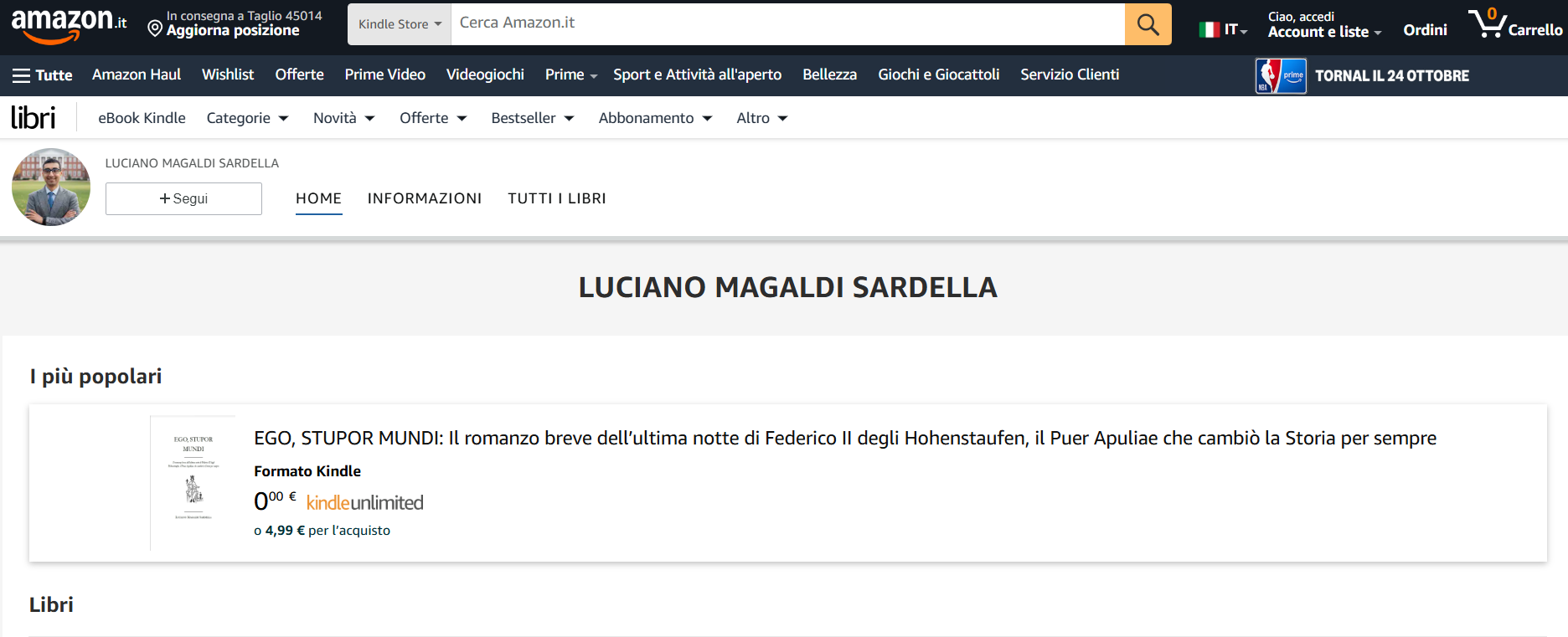
LUCIANO MAGALDI SARDELLA: ACADEMIC BOOK REVIEW OF"LONDON SCHOOL OF ECONOMICS (LSE)" PUBLISHED BY THE"PRINCETON UNIVERSITY PRESS" SOURCE: https://www.linkedin.com/pulse/luciano-magaldi-sardella-academic-book-review-school-sardella-ph-d--bsvse/ LUCIANO MAGALDI SARDELLA'S LITERARY–ACADEMIC REVIEW LONDON SCHOOL OF ECONOMICS (LSE) PUBLISHED BY PRINCETON UNIVERSITY PRESS I am delighted to share a piece of news that marks a meaningful moment in my trajectory as an academic literary reviewer for the London School of Economics (LSE). My review of the volume Crisis Cycle: Challenges, Evolution, and Future of the Euro, published by Princeton University Press, has been included among the assessments cited on the book’s official webpage. To find myself placed alongside distinguished commentators such as John H. Cochrane, Luis Garicano, and Klaus Masuch prompts further reflection on how much ground remains to be covered in aspiring to emulate their exemplary scholarly standards. John H. Cochrane’s book confronts a question of considerable consequence for Europe’s future: can the euro truly endure in its present form? In my review for the LSE Review of Books, I sought to convey the full complexity of this challenge, which I regard as central for economists, policymakers, and scholars of European integration. Princeton University Press: https://press.princeton.edu/.../9780691271606/crisis-cycle Princeton University Press edition on Amazon: https://www.amazon.com/.../Crisis-Cycle.../dp/0691271607... Bluesky: https://bsky.app/profile/did:plc:4snhergltry4xlrwkx72uvlm Book page (Kennys): https://www.kennys.ie/.../crisis-cycle-challenges... LSE Review of Books Email Love: https://emaillove.com/email-inspiration-from-lse-review... With profound academic gratitude to all those who have supported me, I remain committed to contributing to the international debate on the economic and institutional transformations shaping our continent.

LUCIANO MAGALDI SARDELLA: ACADEMIC BOOK REVIEW OF"LONDON SCHOOL OF ECONOMICS (LSE)" PUBLISHED BY THE"PRINCETON UNIVERSITY PRESS"

“ANSA BRASIL” AND “TERRA DO BRASIL” DISCOVER “TEATRO EDICOLA” BY FRANCESCO GRAVINO AND FOYER’97 TEATRO APS IN SAN SEVERO, PUGLIA, ITALY SOURCE: https://medium.com/@ingnucllms/ansa-brasil-and-terra-do-brasil-discover-teatro-edicola-by-francesco-gravino-and-foyer97-c037978ccdaa San Severo, Puglia, Italy — A diminutive playhouse fashioned from a disused news kiosk in the Puglian town of San Severo has now captured the attention of the international press, extending even to Brazil, where it has been featured in the carioca edition of ANSA BRASIL and on the renowned Terra do Brasil. The “Teatro Edicola”, conceived by director and actor Francesco Gravino of the theatrical collective Foyer ’97, had already been the subject of an extensive artistic feature in the Los Angeles Journal, one of the West Coast’s most influential publications in the realm of the performing arts. It has now, however, entered a broader constellation of international media recognition. American and Brazilian outlets alike describe the space — six seats only, with performances lasting a mere fifteen minutes — as a radical exemplar of “proximity theatre”, capable of transforming an abandoned kiosk into a model of urban regeneration and artistic innovation. This distinguished initiative demonstrates how low‑cost projects endowed with a strong cultural identity may engage in meaningful dialogue with the artistic landscapes of Los Angeles, Brasília and São Paulo. For its artistic director, theatre-maker and actor Francesco Gravino, the “Teatro Edicola” was born as an act of creative resistance: a declaration that theatre may inhabit any space whatsoever and continue to astonish its audiences. The San Severo experiment — rooted in Foggia and in Puglia, and now observed on an international scale — reinforces the region’s role as a laboratory for new scenic forms. The recognition stands as a source of pride for San Severo and for the entire region, which now sees a modest kiosk elevated to the status of a symbol of cultural innovation.

SXR Music Group Launches Its Own MCP Server. Our Catalog Is Now Answerable by AI Assistants FOR IMMEDIATE RELEASE SXR Music Group launches its own MCP server SXR Music Group today announced the launch of its own Model Context Protocol (MCP) server, making the label group one of the first independent music companies whose catalog, sync licensing and release data can be queried directly from AI assistants such as Claude and ChatGPT. Instead of logging into a dashboard, artists, sync supervisors, journalists and partners can now simply ask: "Which SXR tracks are cleared for a documentary about the sea?" or "Is the Todd & Karen limited edition 12-inch still in stock?”, and get an answer straight from SXR's live systems. What the server does The SXR MCP server currently exposes seven read-only tools: search_catalog: search 150+ tracks across every signed artist by artist, title, album, genre or mood. sync_licensing: browse tracks pre-cleared for film, TV, advertising and games, filtered by genre, mood or BPM. physical_releases: live vinyl and CD stock levels, prices and preorder availability. artist_analytics: cross-platform artist insight combining Spotify, Last.fm and Songstats data. presave_analytics: views, clicks, pre-saves, top territories and services for SXR Connect campaigns. list_smart_links: your own SXR Connect smart links, slugs and short codes. lookup_release: resolve any UPC, ISRC or streaming URL into cross-platform links and metadata. Built on open standards, secured per user The server runs on the open Model Context Protocol and is protected by OAuth 2.1. Each user signs in with their own SXR account, and every tool acts strictly on their behalf, no shared keys, no exposed data. Human music, modern plumbing SXR Music Group remains firmly committed to human-made music and has consistently opposed AI-generated recordings. The MCP server is deliberately about access, not generation: it makes real music by real people easier to find, license and sell. "We have never wanted machines to write the songs," the label says. "But if a sync supervisor can find the right human-made record in ten seconds instead of ten emails, that is a win for the artist." Availability The SXR MCP server is live now and free to connect. Setup instructions and the endpoint are available at subexile.com/mcp. Press contact: [email protected] #ModelContextProtocol #MCP #MusicIndustry #MusicTech #AI #IndependentMusic #Innovation #DataAPI #SXRMusicGroup #Subexile #ModelContextProtocol #MCP #AI #ArtificialIntelligence #MusicIndustry #MusicBusiness #IndependentMusic #IndieMusic #MusicTech #MusicTechnology #TechInnovation #Innovation #B2B #SaaS #DataAPI #API #DeveloperTools #ClaudeAI #ChatGPT #SyncLicensing #MusicCatalog #PhysicalMusic #Vinyl #MusicDistribution #RecordLabel #AIMusic #HumanMusic

Cerfia 3d

🇫🇷💚💶 FLASH | La dernière édition du marathon caritatif "ZEVENT" débute ce soir avec un concert ! L’évènement avait récolté plus de 16 millions € l’année dernière. https://t.co/oolMTslqAR #ZEVENT #Marathon #Solidarité

2

Zerator announces the organization of the tenth and final edition of ZEvent, a charity marathon on Twitch that has raised funds for NGOs for a decade, with a goal of 20 million euros for this ultimate collection. (translated)

« C’est déjà incroyable d’avoir réussi à tenir dix ans »... Pourquoi Zerator organise le dixième et dernier ZEvent