As We Fall Through Time by Claire North In the beginning, the world will end. This is the story of what happens next. When Cal meets a soldier of the French Revolution, he knows his lover is destined to die. But what is the point of being a time traveller if you can't make a few small tweaks to the course of history? A little paradox here, an alteration there - nothing Cal can't fix, to save the man he loves. When Fadimatu walks into a museum in 2018, she stumbles upon her own mummified corpse, setting her on the path to a betrayal that has already killed her, and a murder that has not yet come to pass. And when a sudden rupture in the fabric of history rips through the lives these travellers have built, breaking both past and future, they must reckon with death foretold, love forsaken, and a secret that will shatter time itself.

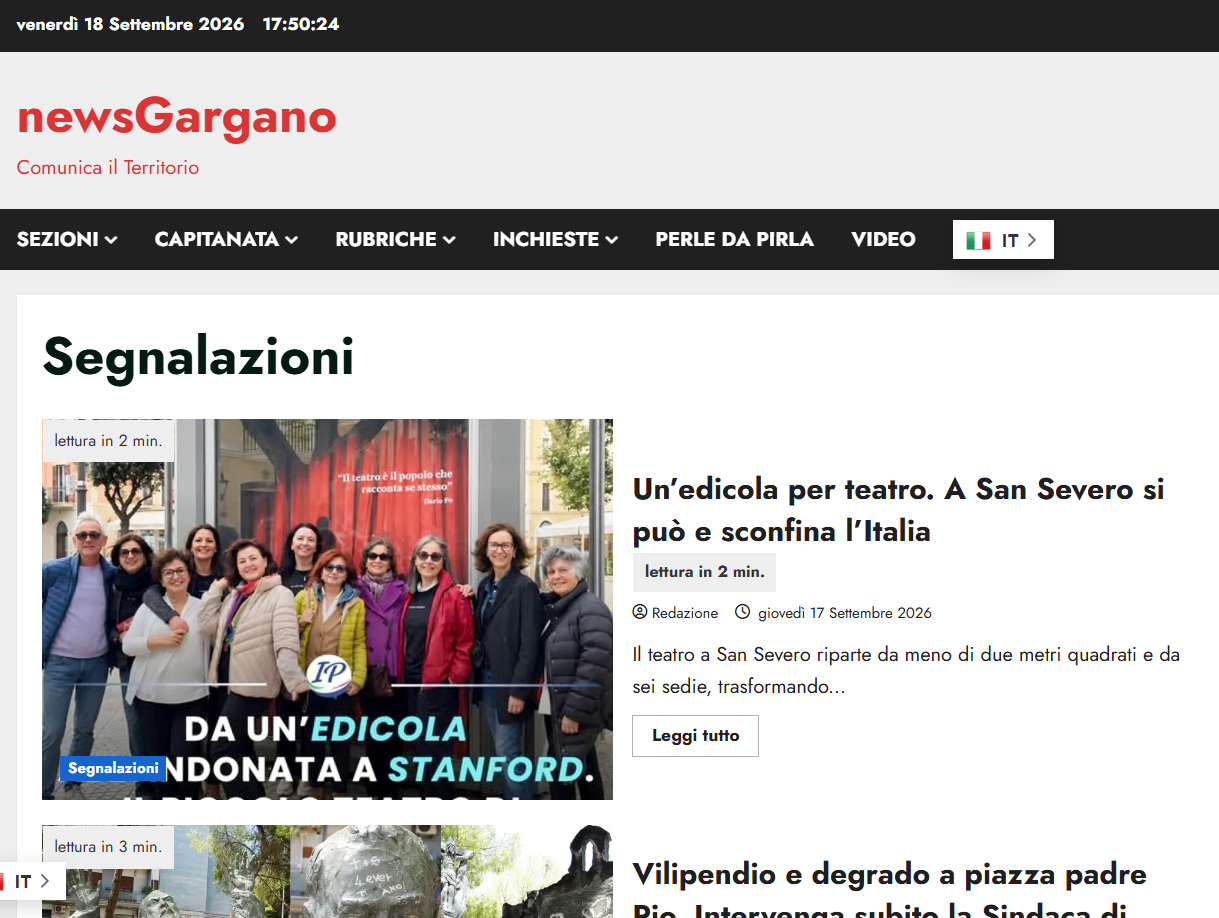
"NEWS GARGANO": A KIOSK FOR A THEATRE: IN SAN SEVERO IT CAN BE DONE, AND ITS ECHO EXTENDS BEYOND ITALY SOURCE: https://www.newsgargano.com/unedicola-per-teatro-a-san-severo-si-puo-e-sconfina-litalia/ SAN SEVERO (FG) - Theatre in San Severo is reborn from less than two square metres and six chairs, transmuting a symbol of urban blight into a small international cause célèbre. The virtuous enterprise has been revived by the company Foyer '97, under the artistic direction of Francesco Gravino, protagonist of a project of cultural regeneration that is now transcending the confines of the Province of Foggia. At the heart of the intervention lies the reclamation of an abandoned newsstand in Via Tondi, for years a disused space and now restored to the city in an unprecedented guise. Where once there was a lowered shutter, theatre is now made: but six spectators at a time, actors at but a few paces from their audience, and performances of brief duration, in a direct and radical commerce between stage and city. The experiment, inaugurated on 27th March, has yielded figures that bespeak a tangible cultural need. More than sixty persons attended the performances in a single afternoon, and the three days of the inaugural season were sold out, demonstrating that proximity and quality may yet generate community even in the most residual of spaces. Yet the story of San Severo has swiftly outgrown its local boundaries. In September 2026, the Stanford Social Innovation Review dedicates to the project the reportage "The Six-Seat Revolution", authored by Luciano Magaldi Sardella, researcher, academic and international journalist from Orta Nova of Sanseverese maternal lineage. The work is described by SSIR as: "A theater director transformed an abandoned newsstand into a radically new theatrical experience that is helping to revive the historic center of a Southern Italian town." The Apulian experience is observed not merely for its theatrical originality, but as a replicable paradigm of low-cost social innovation and urban regeneration, capable of activating cultural capital without recourse to grand structures or lavish investment. "One does not require grand theatres to transform a quarter of a city. What is required is a sound idea and the courage to restore to the collectivity a space that has lost its function," emphasised the artistic director Francesco Gravino. "Teatro Edicola was conceived to demonstrate that a locus of encounter and culture may arise anywhere, even within two square metres. That this endeavour should now be studied at an international level, and that enquiries should arrive from cities such as Lucca and Rome, is confirmation that we are upon the right path." The valorisation and preservation of the urban and cultural fabric must inevitably proceed through the creative reclamation of forsaken places. From a derelict newsstand with scarcely six seats to a project capable of commanding international attention: sometimes, to regenerate a city, one need not build, but re-inhabit.

Dlaczego lewica zyskiwała mimo sukcesów w zwalczaniu zorganiziwanejnprzestepczosci? - https://t.co/nyvecuGsPR. dlatego: „But not everyone is positive. Many of the parties on the left say Sweden has forsaken its values of humanity and solidarity in a push for ever-tougher #lewica #Szwecja #wartości #SE
Cuba’s Economic Failure: Beyond the Embargo For more than six decades, Cuba’s poverty has often been explained by one claim: America’s embargo made the country poor. Repetition, however, is not evidence. A study “The Forsaken Road: Reassessing Living Standards Following the Cuban Revolution and the American Embargo,” by Bastos, Geloso and Bologna Pavlik, published in the Journal of Development Economics challenges this narrative by separating three factors: the Cuban Revolution, the American embargo, and the extensive economic support Cuba received from the Soviet Union. Their findings show a major economic divergence. Correcting weaknesses in Cuba’s GDP statistics makes the gap larger, not smaller. When Soviet assistance is excluded, Cuba’s relative performance looks even worse. For decades, central planning was heavily subsidized by an economic superpower. After the Soviet Union collapsed in 1991, that support largely disappeared, exposing the system’s underlying weaknesses during the “Special Period.” This does not mean the American embargo was harmless. Trade restrictions impose real costs, and a 2026 critique by Francisco Rodríguez argues that the study may underestimate the embargo’s effects. Still, an embargo can make a bad economic system poorer without being the reason the system is dysfunctional. Cuba did not adopt central planning because of the embargo. The Revolution restricted private property, nationalized businesses, displaced markets with political allocation, and transferred economic decisions to the state. Cuba’s history is therefore not merely a story of American sanctions. It is also a demonstration of what happens when a market economy is replaced by political allocation and then subsidized for decades by an external power. The embargo’s costs deserve serious measurement, but it should not become an alibi for an economic system whose institutions produced persistent failure. The central question remains: Why did Cuba remain economically dysfunctional even during decades of extraordinary Soviet support?