BETA nonprofit public democratic european moderated

Search

#Stitch

"FOGGIA SERA": FROM SAN SEVERO TO STANFORD UNIVERSITY: THE "SIX-SEAT REVOLUTION" OF THE TEATRO EDICOLA SOURCE: https://foggiasera.it/2026/09/19/da-san-severo-alla-stanford-university-la-rivoluzione-a-sei-posti-del-teatro-edicola-by-luciano-magaldi-sardella/ SAN SEVERO (FG) - The Stanford Social Innovation Review (SSIR), the scholarly journal published by the Stanford Center on Philanthropy and Civil Society of the prestigious Stanford University - ranked second in the world in the Shanghai Ranking of World Universities - and recognised as the pre-eminent global reference for researchers, policy-makers, and practitioners of innovative entrepreneurship and philanthropy, hath published the reportage "The Six-Seat Revolution" upon the Teatro Edicola of San Severo, the smallest theatre in the world by dimension and capacity, born of the intuition of Francesco Gravino, Artistic Director of the Foyer '97 company. Its author is Luciano Magaldi Sardella, independent researcher and international journalist, native of Orta Nova and of maternal Sanseverese extraction, hitherto author of studies published in international academic journals. The piece appeared in the September (Fall 2026) edition of the academic review, within the section devoted to Arts & Culture. A presence that projects San Severo, and more broadly the Capitanata, into the international élite of research upon cultural and urban innovation. The Theatre Is Born of a Disused Newsstand It all commenced on 27 March 2026, World Theatre Day, in Piazza Municipio at San Severo. A news-kiosk, disused for years in Via Matteo Tondi, raised its shutter to reveal, in lieu of newspapers and cigarettes, an actor upon the stage. Within: six chairs. At intervals of fifteen minutes, a new audience took its place. Drawing inspiration from the televisual format of Edicola Fiore by the noted Sicilian presenter of radio and television, there was born the Teatro Edicola, a structure now recognised in the media as the smallest theatre in the world for dimensions and capacity: four square metres in aggregate, with a scenic space of less than two metres. Gravino hath led Foyer '97 for nigh on thirty years, forging a most exacting artistic trajectory in a context - that of southern Italy - historically penalised in respect of public financing for culture. And yet, upon beholding that vacant kiosk, he elected the path of provocation: to transfigure the bare minimum into a manifesto concerning the very meaning of theatre. The Model and its Measurable Effects The inaugural season endured for three days. All performances were sold out. In a single afternoon, upwards of sixty persons attended the representations. The cost of the entire pilot operation was less than three thousand dollars. The formula is radical in its constitutive elements: performances of five to twelve minutes' duration, conceived expressly for the space; rotation of the audience every fifteen minutes; direct and inescapable visual contact betwixt actor and spectator; no architectural or psychological distance betwixt stage and auditorium; ticket proposed at five euros per person, within a hybrid economic model comprising municipal support, local sponsorship, and box-office receipts. According to the analysis published in the Stanford Social Innovation Review, the Teatro Edicola represents a replicable model of low-cost, high-impact urban regeneration, capable of reactivating abandoned commercial spaces (newsstands, tobacconists, telephone kiosks) without recourse to large infrastructural investment. The Voice of Him who Built it All Francesco Gravino entertaineth no doubt as to the import of the enterprise: "Grand theatres are not requisite to transform a fragment of a city. What is requisite is a sound idea and the courage to restore to the collectivity a space that hath lost its function." And upon the import of international recognition: "Teatro Edicola was born to demonstrate that a place of encounter and culture may arise wheresoever, even within two square metres. That this work should today be studied at an international level and that enquiries should arrive from cities such as Lucca and Rome is confirmation that the path pursued is the right one." The director hath further explicated the symbolic choice of place: the newsstand was the locus wherein each morn one paused, informed oneself, and recognised oneself as a community. Its disappearance rent a precise social fabric. To restore unto it a cultural function is to re-stitch that tissue at the very point wherefrom it was torn. The Challenges: Scalability, Institutional Recognition, Entrenchment The SSIR reportage doth not confine itself to celebration of the project but analyseth also the critical junctures. The first is sustainability over time: an activation of three days, howsoever successful, doth not yet constitute a stable programme, a veritable seasonal repertory (weekends from spring to autumn) with a rotating roster of local and regional companies. The second juncture concerneth replicability without loss of identity: the Teatro Edicola functioneth also by virtue of the profound roots of Foyer '97 in the Sanseverese territory. To transplant the model elsewhere requireth not merely a physical kit, but an entire process of community-building. The third obstacle is institutional: in a system of public funding that rewardeth organisations with consolidated premises and predictable output metrics, a project deliberately experimental, hyperlocalist, and by its very nature impermanent strugglest to gain access to the ordinary channels of the Fondo Nazionale per lo Spettacolo dal Vivo (FNSV) of the Ministry of Culture. A Lesson that Travels beyond Puglia In the Stanford Social Innovation Review the author concludeth that the intuitions of the Teatro Edicola transcend the Sanseverese context: in any community wherein cultural institutions struggle to reach youthful, diverse, or economically marginal publics, the principle of proximity proveth disruptive: to encounter people where they already find themselves, in the spaces they inhabit quotidianly. From the populous centre of Daunia to the pages of Stanford University: San Severo and its kiosk demonstrate that six chairs, four square metres, and a vision suffice to alter the manner in which a city conceiveth of itself. And to offer unto the world a model that costeth less than one might credit, yet is worth far more than one might imagine.
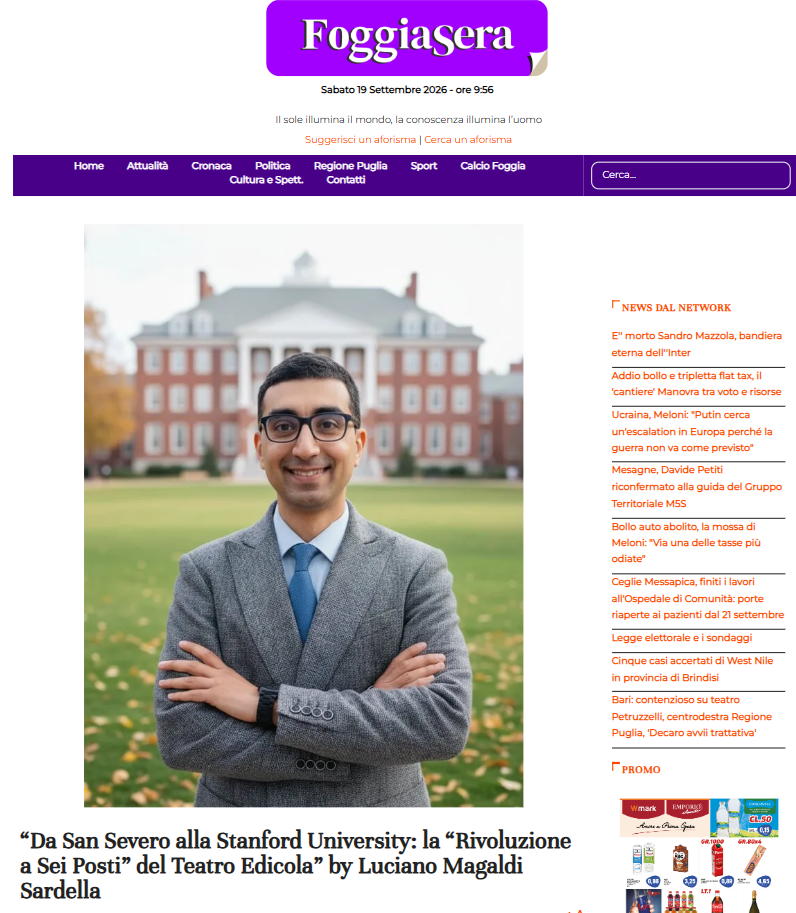
"PUGLIA IN": FROM SAN SEVERO TO STANFORD UNIVERSITY: THE 'SIX-SEAT REVOLUTION' OF TEATRO EDICOLA SOURCE: https://www.pugliain.net/301723-san-severo-teatro-edicola/ SAN SEVERO (FG) - The "Stanford Social Innovation Review (SSIR)", the scholarly quarterly published by the "Stanford Center on Philanthropy and Civil Society" at the prestigious Stanford University — ranked second in the world in the Shanghai Ranking of World Universities — and universally regarded as the pre-eminent global point of reference for scholars, policy-makers and practitioners in the fields of innovative enterprise and philanthropy, hath published the reportage “The Six-Seat Revolution” concerning the Teatro Edicola of San Severo, the smallest theatre in the world, born of the intuition of Francesco Gravino, Artistic Director of the Foyer ’97 company. Its author is Luciano Magaldi Sardella, independent researcher and international journalist, a native of Orta Nova with maternal lineage rooted in San Severo, and erstwhile contributor of studies published in international academic journals. The piece appeared in the Septembertide (Fall 2026) edition of the academic review, within the section consecrated to Arts and Culture. A presence which projecteth San Severo, and more broadly the entirety of Capitanata, into the international élite of research on cultural and urban innovation. The theatre is born from a disused newsstand It all commenceth upon 27 March 2026, World Theatre Day, in the Piazza Municipio at San Severo. A newsstand long disused in Via Matteo Tondi raiseth its shutter to reveal, in lieu of newspapers and cigarettes, an actor upon the stage. Within: six chairs. At intervals of fifteen minutes, a new audience taketh its place. Drawing inspiration from the televisual format of "Edicola Fiore" of the celebrated Sicilian radio and television presenter, there was born Teatro Edicola, a structure now recognised in the media as the smallest theatre in the world by both dimension and capacity: four square metres in total, with a scenic space of less than two metres. Gravino hath led Foyer ’97 for nigh on thirty years, forging an exacting artistic trajectory in a context — that of Southern Italy — historically penalised with respect to public funding for culture. And yet, when he beheld that vacant kiosk, he chose the path of provocation: to transmute the bare minimum into a manifesto concerning the very signification of theatre. The model and its measurable effects The inaugural season endured for three days. All performances were sold out. In a single afternoon, upwards of sixty persons attended the representations. The cost of the entire pilot operation was less than three thousand dollars. The formula is radical in its constitutive elements: performances of five to twelve minutes' duration, conceived expressly for the space rotation of the audience every fifteen minutes direct and ineluctable visual contact betwixt actor and spectator no architectural or psychological distance betwixt stage and stalls ticket proffered at five euros per person, with a hybrid economic model envisaging municipal support, local sponsors and box-office receipts According to the analysis published in the "Stanford Social Innovation Review", Teatro Edicola representeth a replicable paradigm of low-cost, high-impact urban regeneration, capable of reactivating abandoned commercial spaces — newsstands, tobacconists, telephone kiosks — without the necessity of substantial infrastructural investment. The voice of him who built it all Francesco Gravino entertaineth no doubt as to the significance of the undertaking: “One doth not require grand theatres to transform a portion of a city. One requireth a sound idea and the courage to restore to the collectivity a space that hath lost its function.” And concerning the import of international recognition: “Teatro Edicola was born to demonstrate that a locus of encounter and culture may arise wheresoever, even within two square metres. That today this labour should be studied at an international level and that enquiries should arrive from cities such as Lucca and Rome is confirmation that the path is the right one.” The director hath also explicated the symbolic choice of place: the newsstand was the point at which, each morn, one paused, one apprised oneself, one recognised oneself as a community. Its disappearance lacerated a precise social fabric. To restore unto it a cultural function signifieth to re-stitch that fabric from the very point at which it was rent. Challenges: scalability, institutional recognition, rootedness The SSIR reportage doth not merely celebrate the project but analyseth also its critical nodes. The first is sustainability over time: an activation of three days, howsoever successful, doth not yet constitute a stable programme, a veritable seasonal programmation (weekends from springtide to autumn) with a rotating roster of local and regional companies. The second node concerneth replicability without loss of identity: Teatro Edicola functioneth also by virtue of the profound roots of Foyer ’97 within the San Severo territory. To transplant the model elsewhere requireth not merely a physical kit, but an entire process of community building. The third obstacle is institutional: in a system of public funding which rewardeth organisations possessed of consolidated premises and predictable output metrics, a project deliberately experimental, hyper-localist and by its very nature impermanent struggleth to gain access to the ordinary channels of the Fondo Nazionale per lo Spettacolo dal Vivo (FNSV) of the Ministry of Culture. A lesson which travelled beyond Puglia In the Stanford Social Innovation Review the author concludeth that the intuitions of Teatro Edicola transcend the San Severo context: in any community wherein cultural institutions struggle to reach youthful, diverse, or economically marginal publics, the principle of proximity proveth disruptive: to meet people where they already are, in the spaces they inhabit quotidianly. From the populous centre of Daunia to the pages of Stanford University: San Severo and its diminutive kiosk demonstrate that six chairs, four square metres, and a vision sufficeth to alter the manner in which a city conceiveth itself. And to proffer unto the world a model which costeth less than one might suppose yet is worth far more than one might imagine.
Da San Severo alla Stanford University: la “Rivoluzione a Sei Posti” del Teatro Edicola

Despite not being an important holder of US foreign debt, Australia is stitched into the USD system. It too is now coming under strain. Given that most of their trade is with China they may start experimenting with RMB when the smoke clears. 🇦🇺🦘 https://t.co/yL0ulWokiI #Australia #USD #China #AU #CN

Tracklist Aug 19

QUE LINDO! Shawn Mendes e Bruna Marquezine em Angola assistindo o coral da Aldeia Nissi cantar uma música inspirada em "Stitches". ❤️‍🩹 https://t.co/FA6CtIv37J #ShawnMendes #BrunaMarquezine #Angola

QUE AMOR! 🥹❤️ O coral da Aldeia Nissi fez uma apresentação especial de “Stitches”, de Shawn Mendes, para receber o cantor e Bruna Marquezine. https://t.co/48BdviEv9Y #Amor #Música #Celebração

AD Aug 17

2028 VAI SER GIGANTE!!! A Disney oficializou hoje as datas de estreia dos filmes anunciados na D23, e o calendário de 2028 ficou assim: 10/03/28: Ghost Market 31/03/28: Enrolados 05/05/28: X-Men 26/05/28: Lilo & Stitch 2 15/06/28: Os Incríveis 3 28/07/28: Motoqueiro Fantasma 22/11/28: Clay 15/12/28: Pantera Negra III #Disney #Filmes2028 #NovidadesCinematográficas

La secuela de Lilo & Stitch se enstrenará en verano de 2028. Contará con la participación de Ángel. #D23 https://t.co/BzgYXNCfVA #LiloAndStitch #Disney #Películas

Angel aparecerá en el live action de LILO & STITCH 2: anunciado en la D23. https://t.co/3x3sRH9wbx #LiloAndStitch #Disney #LiveAction

Buongiornooo. Oggi mi sono portata Stitch come compagnia. Andate a donare il sangue così vi voglio più bene! 😂😂😂ciao belliiiii https://t.co/lsz36iSERc #Buongiorno #Stitch #DonazioneSangue

Daveigh Chase, l'attrice famosa per i suoi ruoli in The Ring e Lilo & Stitch, è morta a 35 anni per AIDS e uso cronico di droghe, lasciando un'eredità di circa 400.000 dollari, mentre sua madre Cathy Chase ha chiesto di diventare amministratrice del patrimonio, nonostante la mancanza di un testamento e l'assenza di una residenza fissa al momento della sua morte. #AIDS #Attori #Eredità

Daveigh Chase, morta per Aids, lascia un’eredità da 400mila dollari. La madre dell’attrice, Cathy Chase, vuole diventare amministratrice del patrimonio

Farage and Le Pen try Trump's trick of turning scandal to their advantage — The godparents of Europe’s populist far-right have both faced corruption scandal this week. Their response? Hope voters will agree the establishment is conspiring to stitch them up https://t.co/LTqx3jWv12 #Populism #Corruption #FarRight #GB #FR #US

rmf24.pl Jun 30

Daveigh Chase, znana z roli Lilo w „Lilo & Stitch” oraz Samary w „The Ring”, zmarła 17 czerwca w Los Angeles w wieku 35 lat z powodu AIDS i przewlekłego, wielokrotnego używania substancji psychoaktywnych, co potwierdziło biuro koronera w Los Angeles. #DaveighChase #AIDS #przewlekłeużywaniesubstancji

Znamy oficjalną przyczynę śmierci Daveigh Chase. Gwiazda „The Ring” zmarła w wieku 35 lat
24sata Jun 30

Daveigh Chase, poznata kao glumica iz horora 'Krug' i glas Lilo u 'Lilo i Stitchu', preminula je u dobi od 35 godina uslijed posljedica AIDS-a, dok su njeni bliski ljudi izražavali sumnju u namjere njenog dečka, koji je potaknuo spornu kampanju za donacije. #DaveighChase #LiloIStitch #Krug

Objavili su uzrok smrti Daveigh Chase, zvijezde horora 'Krug'
IndexHR Jun 30

Daveigh Chase, bivša dječja zvijezda poznata po ulogama u hororu Krug i animiranom filmu Lilo i Stitch, preminula je u dobi od 35 godina uslijed posljedica AIDS-a, dok su službeni nalazi mrtvozornika također naveli kroničnu zlouporabu supstanci kao značajan faktor, a njezin otac je otkrio da je prije smrti bila beskućnica. #aids #smrt #daveighchase

Otkriven uzrok smrti bivše dječje zvijezde Daveigh Chase

La autopsia de la actriz Daveigh Chase, conocida por su papel en 'The Ring' y como la voz de Lilo en 'Lilo y Stitch', revela que falleció a los 35 años debido al SIDA, agravado por el consumo crónico de múltiples sustancias. #DaveighChase #SIDA #TheRing

La autopsia de la actriz Daveigh Chase, protagonista de 'The Ring', revela que murió de SIDA
AD Jun 24

🚨🚨🚨🚨🚨🚨🚨🚨🚨🚨🚨🚨🚨🚨 SE FOR UM SONHO NÃO ME ACORDEM! Um novo CURTA DE ANIMAÇÃO de ‘Lilo & Stitch’ recebeu classificação indicativa nos EUA, o que significa que está pronto para ser lançado! A Disney ainda não anunciou. https://t.co/0iPFIsksXk #Disney #LiloAndStitch #Animação

Los creadores de LILO & STITCH compartieron este arte en honor a Daveigh Chase, la voz de Lilo. Ella falleció recientemente. https://t.co/Ibec16G7jS #LiloAndStitch #DaveighChase #Tribute

20 minutos Jun 19

Daveigh Chase, conocida por su papel en 'The Ring' y su trabajo de voz en 'Lilo y Stitch', falleció a los 35 años el 16 de junio debido a complicaciones médicas derivadas de una meningitis y una infección de sangre, tras haber luchado en sus últimos años contra la adicción a las drogas y enfrentarse a problemas familiares y legales. #DaveighChase #Adicción #Fallecimiento

De estrella prometedora en 'The Ring' a víctima de su adicción a las drogas: la dura vida de Daveigh Chase
20 minutos Jun 18

La actriz Daveigh Chase, conocida por su papel en 'The Ring' y como la voz de Lilo en 'Lilo y Stitch', falleció a los 35 años por meningitis y una infección en la sangre, dejando a Hollywood con el corazón roto tras la revelación de su desgarradora situación de vida en la indigencia en Skid Row poco antes de su muerte. #DaveighChase #Hollywood #MuerteTrágica

En la calle, desnutrida y casi inconsciente: el desgarrador vídeo de Daveigh Chase antes de morir
eldiario.es Jun 18

Daveigh Chase, conocida por su papel en 'The Ring' y como la voz de Lilo en 'Lilo & Stitch', ha fallecido a los 35 años en un hospital de Los Ángeles debido a complicaciones de una meningitis y sepsis, según ha confirmado su representante. #DaveighChase #Hollywood #Muerte

Muere a los 35 años Daveigh Chase, actriz de 'The Ring' y voz de 'Lilo & Stitch'