BETA nonprofit public democratic european moderated

Search

#Unédic

"NEWS GARGANO": A KIOSK FOR A THEATRE: IN SAN SEVERO IT CAN BE DONE, AND ITS ECHO EXTENDS BEYOND ITALY SOURCE: https://www.newsgargano.com/unedicola-per-teatro-a-san-severo-si-puo-e-sconfina-litalia/ SAN SEVERO (FG) - Theatre in San Severo is reborn from less than two square metres and six chairs, transmuting a symbol of urban blight into a small international cause célèbre. The virtuous enterprise has been revived by the company Foyer '97, under the artistic direction of Francesco Gravino, protagonist of a project of cultural regeneration that is now transcending the confines of the Province of Foggia. At the heart of the intervention lies the reclamation of an abandoned newsstand in Via Tondi, for years a disused space and now restored to the city in an unprecedented guise. Where once there was a lowered shutter, theatre is now made: but six spectators at a time, actors at but a few paces from their audience, and performances of brief duration, in a direct and radical commerce between stage and city. The experiment, inaugurated on 27th March, has yielded figures that bespeak a tangible cultural need. More than sixty persons attended the performances in a single afternoon, and the three days of the inaugural season were sold out, demonstrating that proximity and quality may yet generate community even in the most residual of spaces. Yet the story of San Severo has swiftly outgrown its local boundaries. In September 2026, the Stanford Social Innovation Review dedicates to the project the reportage "The Six-Seat Revolution", authored by Luciano Magaldi Sardella, researcher, academic and international journalist from Orta Nova of Sanseverese maternal lineage. The work is described by SSIR as: "A theater director transformed an abandoned newsstand into a radically new theatrical experience that is helping to revive the historic center of a Southern Italian town." The Apulian experience is observed not merely for its theatrical originality, but as a replicable paradigm of low-cost social innovation and urban regeneration, capable of activating cultural capital without recourse to grand structures or lavish investment. "One does not require grand theatres to transform a quarter of a city. What is required is a sound idea and the courage to restore to the collectivity a space that has lost its function," emphasised the artistic director Francesco Gravino. "Teatro Edicola was conceived to demonstrate that a locus of encounter and culture may arise anywhere, even within two square metres. That this endeavour should now be studied at an international level, and that enquiries should arrive from cities such as Lucca and Rome, is confirmation that we are upon the right path." The valorisation and preservation of the urban and cultural fabric must inevitably proceed through the creative reclamation of forsaken places. From a derelict newsstand with scarcely six seats to a project capable of commanding international attention: sometimes, to regenerate a city, one need not build, but re-inhabit.
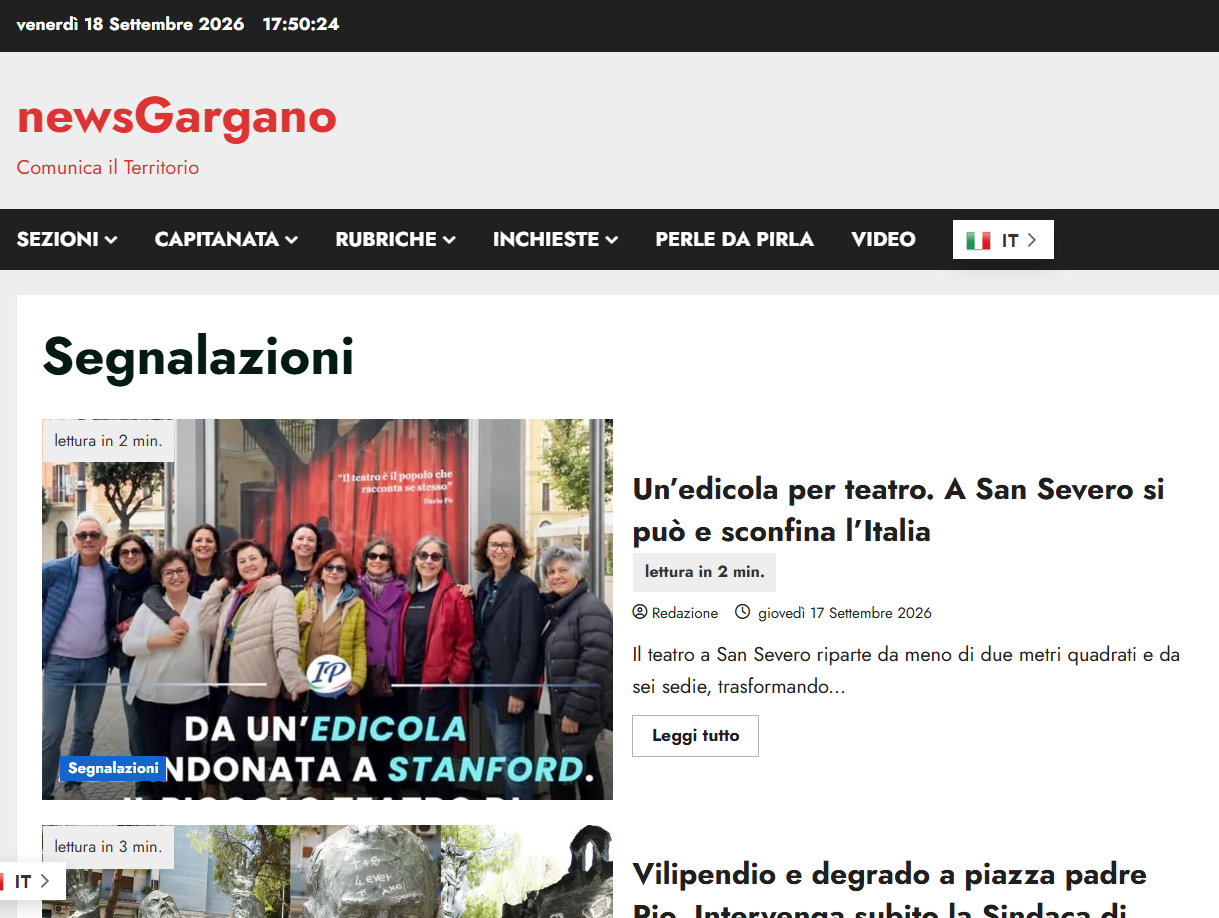
Un'edicola per teatro. A San Severo si può e sconfina l'Italia

"NEWS GARGANO": UN'EDICOLA PER TEATRO: A SAN SEVERO SI PUO' E SCONFINA L'ITALIA SOURCE: https://www.newsgargano.com/unedicola-per-teatro-a-san-severo-si-puo-e-sconfina-litalia/ SAN SEVERO (FG) - Il teatro a San Severo riparte da meno di due metri quadrati e da sei sedie, trasformando un simbolo di degrado urbano in un piccolo caso internazionale. A rilanciare l'esperienza virtuosa è la compagnia Foyer '97, diretta artisticamente da Francesco Gravino, protagonista di un progetto di rigenerazione culturale che sta superando i confini della provincia di Foggia. Al centro dell'intervento c'è il recupero di un'edicola abbandonata in via Tondi, per anni spazio inutilizzato e oggi restituito alla città in una veste inedita. Lì dove prima c'era una saracinesca abbassata, oggi si fa teatro: appena sei spettatori alla volta, attori a pochi passi dal pubblico e spettacoli di breve durata, in un rapporto diretto e radicale tra scena e città. L'esperimento, partito il 27 marzo, ha fatto registrare numeri che descrivono un bisogno culturale concreto. Più di 60 persone hanno assistito agli spettacoli in un solo pomeriggio e le tre giornate della stagione inaugurale hanno registrato il tutto esaurito, a dimostrazione che la prossimità e la qualità possono generare comunità anche negli spazi più residuali. Ma la storia di San Severo ha presto superato i confini locali. A settembre 2026 la Stanford Social Innovation Review dedica al progetto il reportage "The Six-Seat Revolution", firmato da Luciano Magaldi Sardella, ricercatore, accademico e giornalista internazionale di Orta Nova con origini materne sanseveresi. L'esperienza pugliese viene osservata non soltanto per la sua originalità teatrale, ma come modello replicabile di innovazione sociale e di rigenerazione urbana a basso costo, capace di attivare capitale culturale senza grandi strutture e grandi investimenti. "Non servono grandi teatri per cambiare un pezzo di città. Serve una buona idea e il coraggio di restituire alla collettività uno spazio che ha perso la sua funzione, ha sottolineato il direttore artistico Francesco Gravino, Teatro Edicola nasce per dimostrare che un luogo di incontro e cultura può nascere dovunque, anche in due metri quadrati. Che oggi questo lavoro venga studiato a livello internazionale e che arrivino richieste di informazioni da città come Lucca e Roma è la conferma che la strada è quella giusta". La valorizzazione e la tenuta del tessuto urbano e culturale passano inevitabilmente attraverso il recupero creativo dei luoghi abbandonati. Da una vecchia edicola con appena sei posti a un progetto capace di attirare l'attenzione internazionale: a volte per rigenerare una città non serve costruire, ma riabitare.

Un'edicola per teatro. A San Severo si può e sconfina l'Italia
Franceinfo Jul 24

L'Unédic a sollicité l'État pour cesser les prélèvements sur les caisses de l'assurance chômage, soulignant l'urgence de désendetter le régime afin de maintenir son rôle économique et social, face à une dette aggravée par des prélèvements étatiques qui devraient atteindre 61,5 milliards d'euros d'ici fin 2026. #AssuranceChômage #Unédic #Désendettement

L'Unédic demande à l'État de cesser les prélèvements dans les caisses du régime d'assurance chômage
BFMTV Jun 17

Le déficit de l'assurance chômage en France devrait atteindre 2,3 milliards d'euros en 2026, en grande partie à cause des prélèvements de l'État, qui, sans eux, auraient permis d'afficher un excédent de 1,8 milliard d'euros. #AssuranceChômage #Unédic #PrélèvementsÉtat

Le déficit de l'assurance chômage devrait atteindre 2,3 milliards d'euros en 2026 (mais ses comptes auraient été dans le vert sans les prélèvements de l'État qui agacent l'Unédic)
BFMTV Jun 1

Selon une étude de l'Unédic, après quatre mois de chômage, la moitié des allocataires parviennent à retrouver un emploi, souvent à travers des contrats courts ou précaires, bien qu'un sur cinq retourne au travail avant même de recevoir ses indemnités. #Chômage #Emploi #Indemnisation

Après quatre mois de chômage, la moitié des allocataires ont retrouvé un emploi (1 sur 5 retravaille avant même d'avoir touché un centime)