WRLD

Search

#Yesterday
Katarina Mathernova 🇪🇺 12h

The author wrote that Russia was trying to leave Ukraine in cold and darkness ahead of winter, and described the previous day’s attack on energy facilities, many of them in western Ukraine, as one of the largest. #Ukraine #Russia #EnergyCrisis #RU #UA
2586
MadGreek 🧿 1d

I dropped my son off at school this morning knowing there would be extra security on campus because of what happened yesterday in Bend, Oregon. And I’m also angry. I’m exhausted. Nothing gets done! Our children deserve better. Fuck your thoughts & prays. Do something! Video by Andy Neal

1769
Katarina Mathernova 🇪🇺 1d

The author wrote that an important European summit had taken place the previous day and that day, with President Zelenskyy addressing European leaders. They described the European Union as Ukraine’s most reliable partner. https://t.co/AJo7i7GZVw #EU #Zelenskyy #Ukraine #EU #UA

2976
toomas hendrik ilves 2d

The author wrote that they had learned not to rely on the United States to keep its word, or to maintain a policy announced the previous day, and asked what else could be expected. https://t.co/PcNhGuNUn0 #USPolitics #PolicyChange #TrustIssues #US

2761
sven sakkov 2d

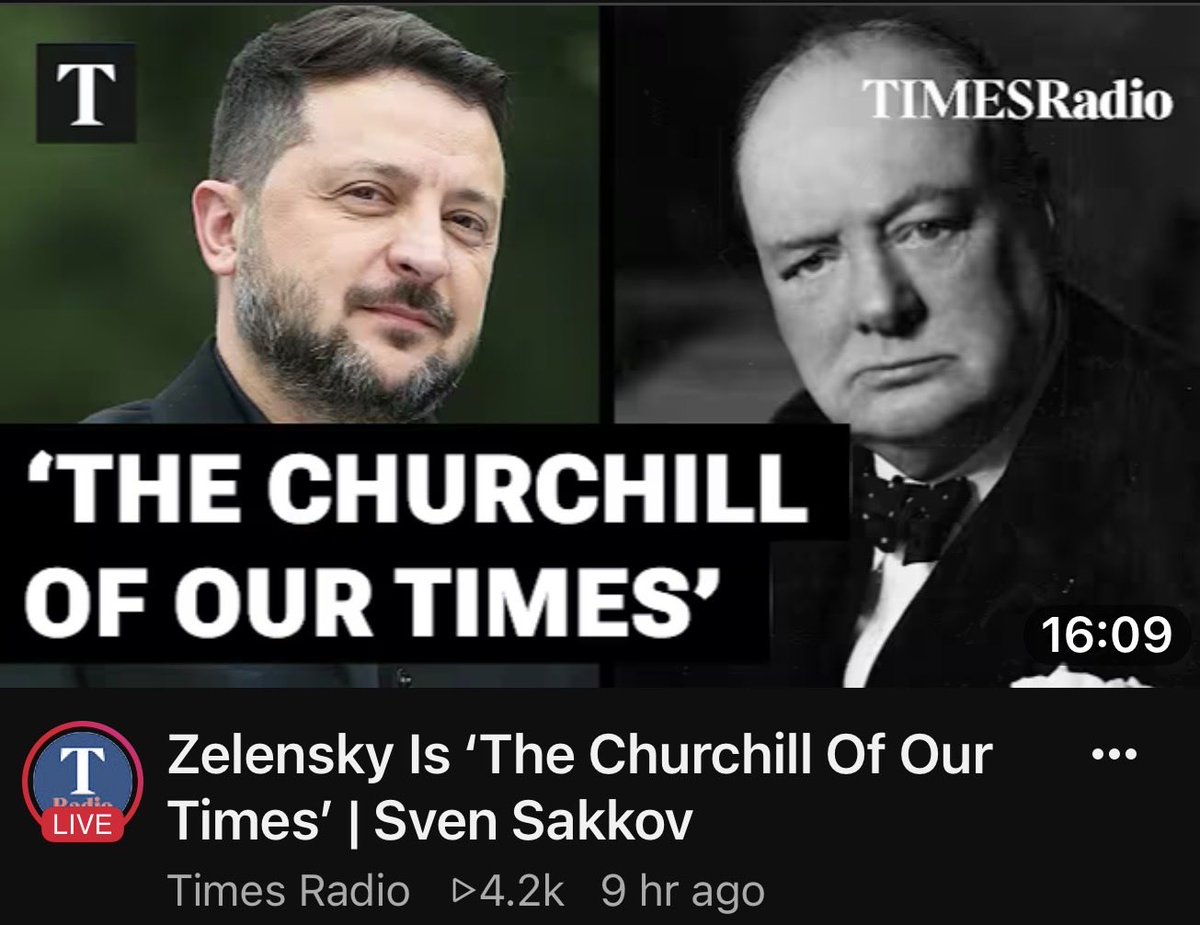
Sven Sakkov shared a link to an interview he had given the previous day to Times Radio’s John Pienaar, titled “Zelensky Is ‘The Churchill Of Our Times’.” https://t.co/3ZXNnMZAKe #Zelensky #Churchill #Interview #UA #GB

2605
Paul Murphy 🇵🇸 2d

The author wrote that yesterday’s strike had shown how workers, particularly those in the public sector, kept society running. They said there had been no weather forecast, Dáil or schools, no street cleaning and greatly reduced hospital services, and urged workers to recognize their power. https://t.co/l5pRE1bVUb #WorkersUnite #PublicSector #PowerToThePeople #IE

2894
WarTranslated (Dmitri) 2d

Zelenskyy: "Since yesterday, Russia has launched nearly 1,000 drones. Russia answered the US president's attempt to de-escalate with new attacks on our energy grid, homes, and infrastructure. We've faced several ballistic waves, with Shaheds in our skies almost non-stop."

3341

The author claimed that Ukraine had destroyed up to six Russian Su-34Ms the previous day. They described the Su-34 as Russia’s main platform for launching glide bombs and said six aircraft would represent about 6% of its operational fleet, calling it a good day. #Ukraine #Russia #Military #UA #RU

2898
Anton Gerashchenko 3d

Yesterday,The Washington Post published an opinion piece by David Ignatius.It’s essentially being called a leak of the American negotiating team's "peace plan."If that is true,I'm having a sense of déjà vu.It feels as though President Trump’s negotiators didn't even bother to come up with anything

2914
Ursula von der Leyen 4d

I want to express my best wishes to Pope Leo following his surgery yesterday. His serenity and strength are an inspiration for all of us. We hope for his full and speedy recovery.

1909
David Lega 4d

The author wrote that Ireland’s Jews were being told to hide their identity and said Maurice Cohen had voiced a similar concern in Dublin the previous day, arguing that no one should have to choose between being Irish and Jewish. The author expressed support for Cohen and said the situation was spreading across Europe. #Ireland #JewishPride #StandTogether #IE #EU

3369
Olga Nesterova 4d

Q: Russia hit 6 energy sites yesterday Trump: Ukraine hit many sites the day before. Follow-up : In your view, Russia has not broken the ceasefire? Trump: I’ll let you know.

3264
Anton Gerashchenko 5d

President Zelenskyy: "Since yesterday evening and up until now, Russia has attacked Ukraine with more than a hundred different weapons, including jet-powered drones, loitering munitions,&ballistic missiles. A significant number of these weapons were shot down. But unfortunately, not all of them⤵️

3380
Mark Chadbourn 6d

Burnham started his much-needed assault on Brexit yesterday by confirming Russian interference in the vote. Now this: “In a statement to MPs, Andy Burnham will argue it is time to "face up to the reality that Brexit has done more harm than good" and "the status quo is not good enough for Britain."”

3054
David Lega 6d

The author said Frankfurt had awarded the first Georg Stefan Troller Prize for reporting on Jewish life the previous day and celebrated journalists covering these stories. They argued that Jewish life deserved attention for its creativity as well as its crises, and that more voices would bring greater visibility to Jewish life. The post tagged JuedischeOnline and n1ckism. #JüdischesLeben #Journalismus #Kultur #DE

3394
Luciano Magaldi Sardella (PhD) 6d

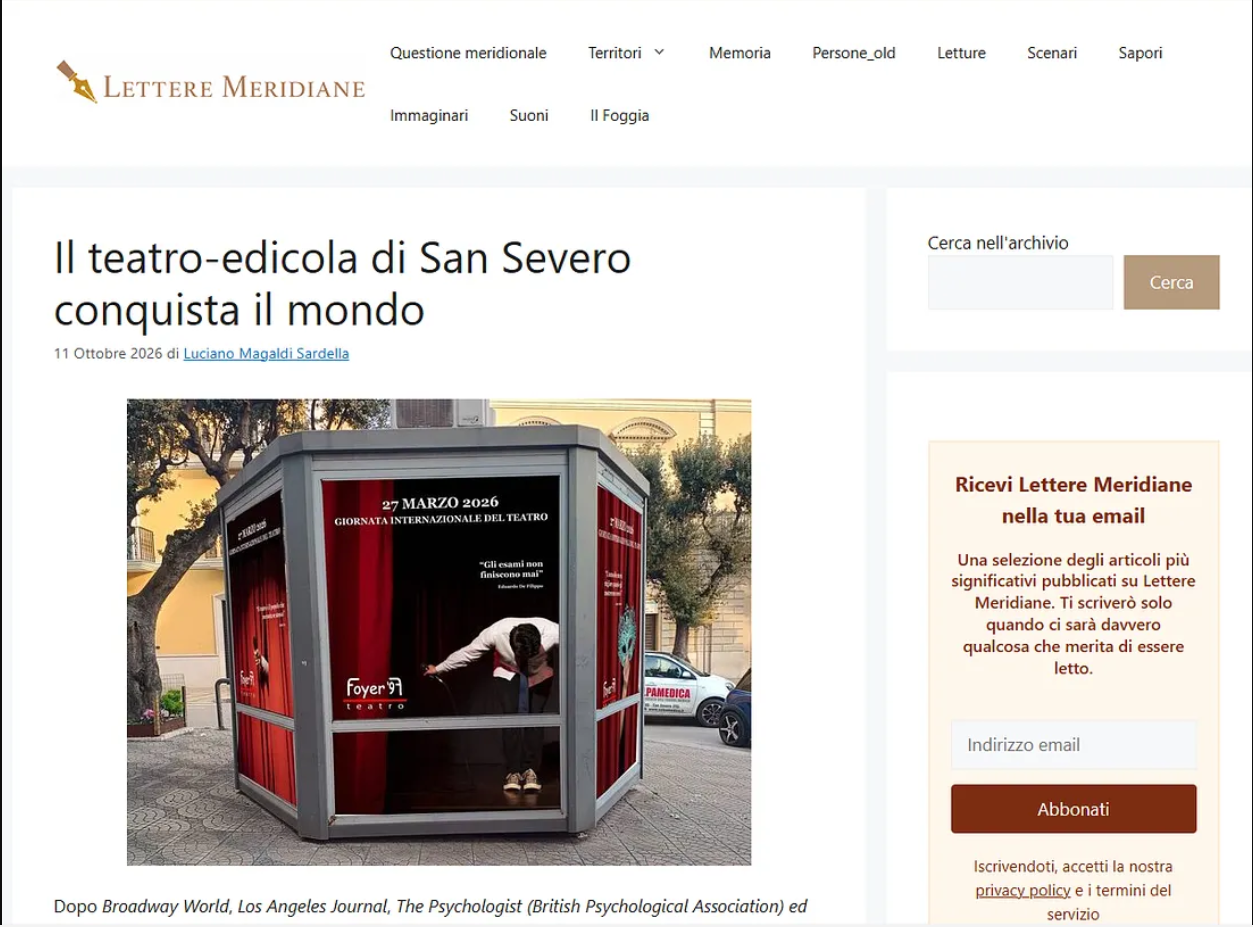
LETTERE MERIDIANE — “TEATRO-EDICOLA” OF SAN SEVERO CONQUERS THE WORLD SOURCE: https://www.letteremeridiane.org/2026/10/il-teatro-edicola-di-san-severo-conquista-il-mondo/?fbclid=IwY2xjawU4oqFleHRuA2FlbQIxMQBwZG9mAXNydGMGYXBwX2lkEDIyMjAzOTE3ODgyMDA4OTIAAR5rVEwYs6UUXg7v-P0SyIQ_DRb_F6ZiY58OcseYoV4J7atcTiERnhWaqKM2pw_aem_Njle1jq1XLzHr93KLBUcVA After “Broadway World”, the “Los Angeles Journal”, “The Psychologist (British Psychological Association)” and Hollywood Beat Magazine, its “academic consecration” has now arrived courtesy of Stanford University. As I have already emphasised in my article on the revival of the GIO Festival in Foggia, celebrated by BroadwayWorld for the world stage premiere of the Giordano’s opera Marina (1888), the province of Foggia has long ceased to be peripheral. It happens when it finds an idea that shifts the coordinates: well, in San Severo, 40 kilometres from Foggia, it has happened again. Only this time an orchestra was not needed; six chairs were enough. The celebrated Teatro-Edicola of San Severo artistic director Francesco Gravino of the theatre company Foyer ’97 has been featured in the academic journal “Stanford Social Innovation Review (SSIR)” as an academic case study. The news, relayed on 19 September 2026 by ANSA Nazionale, looked like a misprint. Then it became clear that it was not. SSIR, an award-winning publication covering multisectoral solutions to global problems, included the project in its Dispatches section with the reportage “The Six-Seat Revolution”. It is the inverse trajectory to that of the GIO Festival: not a forgotten opera returning to a grand historic Italian horseshoe theatre, but an entire theatre reborn inside a disused place, forgotten by man. There are moments when past and future intertwine to create something visionary, innovative, artistically “revolutionary”: San Severo experienced one of those moments on the morning of 27 March 2026, during World Theatre Day, when the shutter of a newsstand closed for six years in Via Matteo Tondi was reopened “not to sell newspapers, but to offer stirring stories”, to quote Gravino’s motto. The idea of the visionary Francesco Gravino, artistic director, stage director and actor of the San Severo company Foyer ’97, active for at least 30 years in Capitanata, centred on the kiosk, hexagonal in metal and glass, granted free of charge by its owner Pino Frau, by now an urban relic created by the publishing crisis of the early 2000s: today in Italy active newsstands have fallen from about 35,000 in 2005 to about 20,000 in 2024, a decline of 42.8%. Gravino and eleven other actors restructured it in two weeks of work, without institutional funding, and transformed it into what is now under examination by the London commission of Guinness World Records as the “world’s smallest theatre”. The formula is deliberately austere: six spectators at a time outside, actors inside at less than a metre’s distance, 15-minute performances, continuous rotation from 11:00 to 20:45, texts ranging from Goldoni to Chekhov, from Ibsen to Dacia Maraini. On the door a QR code with an original theatrical warning: “Warning! This QR code transforms passers-by into actors. Scan only if ready.” The numbers immediately showed that it was no boutade: more than 60 people in a single afternoon, three inaugural days that sold out. But above all a positive echo that went beyond the borders of San Severo. “Broadway World” (just as in the previous case of the GIO Festival), the world’s most influential theatre criticism outlet with over 5.5 million monthly views, devoted exclusive coverage to it on 27 April 2026: “An Abandoned Italian Newsstand Just Became the World’s Smallest Theatre”. Not a mere listing, but an analysis: “There is no foyer, there is no balcony, there is no grid. There is barely a wing. What there is is something almost unrecognisable as an evening at the theatre, and for that very reason it is all the more powerful.” “Broadway World” captured Gravino’s manifesto idea: “This is a theatre of proximity. In an era of digital distance, we are putting human contact back at the centre,” framing it as “More than a clever exercise in site-specific theatre. It is a reappropriation.” All of this, in a Mezzogiorno of Italy often narrated only in terms of organised crime and marginalisation. To that seal of approval was added another, even more disorienting for a newsstand in San Severo: the “Los Angeles Journal”, one of the most influential publications on the West Coast for the performing arts. On 12 May 2026, it headlined thus: “San Severo’s Teatro-Edicola as an Innovative Model for Los Angeles Theaters?” opening as follows: “In a city in southern Italy that Hollywood has never heard of, a theatre director has just built the smallest stage in the world: six seats, fifteen minutes, zero distance. Los Angeles should pay attention.” The “Los Angeles Journal” does not indulge in folklore, but places the kiosk in Via Matteo Tondi alongside the prestigious 1,600-seat Ahmanson Theatre in Los Angeles, the Pantages of Broadway in Hollywood, the 99-seat plan of Rogue Machine, the Odyssey, the Victory Theatre and the Hollywood Fringe. It even recalls Ethan Marks’s Electrical Box Theatre, a veritable electrical box lined with red velvet in downtown Los Angeles, to argue that Gravino has taken to the extreme the question Los Angeles has been asking itself for decades: How small can a stage become before it ceases to be a stage? And it recognizes the San Severo urban model: almost zero cost, two weeks of work and six chairs, in return for immediate provincial, regional and national media coverage, recognition by the San Severo’s Municipal Administration, and a format exportable anywhere. Then, the third American piece came from “Hollywood Beat Magazine” on 20 April 2026: Six seats. Fifteen minutes. One actor. No stage. The magazine recounts the kiosk in Via Tondi left disused for almost six years, the contemporary six-seat cultural outpost, placing Francesco Gravino in a distinguished genealogy: Richard Schechner and environmental theatre, Jerzy Grotowski and poor theatre, Nicolas Bourriaud and relational aesthetics. But it closes with pragmatism: it is not a thesis, it is fixing a street corner, that is, repairing an urban street corner by asking not how large a theatre can become, but how small it must become again to recover its original power. And finally, the celebrated London-based “The Psychologist”, the journal of the “British Psychological Society (BPS)”, the oldest psychological society in the world, transformed the Teatro-Edicola into a scientific case study: on 30 July 2026 it published “The world’s smallest theatre — and Psychologists’ next act”, starting from the same detail, the morning of 27 March when the metal shutter of the hexagonal kiosk in Via Tondi reopened after six years, six people inside, an actor at less than a metre’s distance beginning Chekhov. It describes the formula: six spectators, 15 minutes, 11 actors over 10 hours, from Goldoni to Euripides, inside a kiosk where the fourth wall does not break because architecturally it never existed. But the BPS goes a step further: it cites the 2025 studies by Damien Gabriel in IBRO Neuroscience Reports, that live performance generates measurably stronger emotional and physiological activation than video, and introduces Edward Hall’s proxemics: below one metre is intimate space, reserved for doctors, close friends, lovers. In that one-square-metre space, the actor’s breath is audible, micro-expressions legible, the self-other boundary becomes permeable. The Teatro-Edicola “does not make theatre better, it makes it inevitable”. And it is here that one understands why Stanford is studying it as an academic case study in social innovation, not as a case of artistic originality. In Italy, meanwhile, the national media circuit had already picked up the phenomenon: RaiNews — TG2 Storie brought it to RaiDue at midnight on 19 April. RTL 102.5 devoted space to the format conceived by Gravino and developed by Foyer ’97 in the heart of San Severo in Via Tondi, defining it as a permanent micro-stage capable of bringing theatre into public space. ANSA.it, Gazzetta del Mezzogiorno, La Repubblica, TG2000, Radio Capital, Swiss RSI, ANSA Brazil and many others followed. And for the record: Fiorello praised it in La Pennicanza as an artistic case inspired by his Edicola Fiore, and Biagio Antonacci, on his tour in the Augustan amphitheatre of Lucera, made a “fact-finding” stop at the Teatro-Edicola singing the celebrated and nostalgic Iris in front of an audience certainly larger than the “six seats”. Francesco Gravino’s theatre company Foyer ’97 was not born yesterday: behind it lie the Teatro-Cantina of 2016, the underground theatre, and in 2011 a performance on the bell tower of a church in the centre of San Severo at 45 metres high. The Teatro-Edicola completes, in Gravino’s words, “the entire vertical extension of theatre: underground, street level, rooftop”. And it is preparing for its thirtieth anniversary in 2027 aiming to purchase the kiosk to make it permanent, exporting the “San Severo Model” to Rome, Lucca, and to the festivals of Santarcangelo and Todi. As with the GIO Festival, someone might dare to claim that it is merely a stunt, but when BroadwayWorld places you alongside the Los Angeles Opera House, the “Los Angeles Journa”l proposes you as a model for Hollywood, “Hollywood Beat Magazine” reads you through Grotowski and the “British Psychological Society” uses you to explain mirror neurones, it is no longer a stunt but an excellent artistic and academic positioning. To those who still whisper that Foggia and Capitanata are provincial, the answer is now written on two opposite and complementary fronts: on 5 June in Foggia a 138-year-old opera found the stage again at the Giordano ending up on BroadwayWorld; on 27 March in San Severo a 4-square-metre kiosk invented a stage that did not exist, ending up at Stanford, in Los Angeles, in Hollywood and in London. The periphery, when it has a precise idea, becomes the centre. Even with six chairs. Luciano Magaldi Sardella

www.letteremeridiane.org
Il teatro-edicola di San Severo conquista il mondo
679
Yaroslav Trofimov 6d

The author reported that another Houthi missile strike had hit Riyadh airport, which had been closed after an attack the previous day that the author said killed 12 people and injured hundreds. #Houthi #Riyadh #MissileStrike #SA

3854
Helen McEntee TD 6d

The author condemned what they described as a Houthi attack on King Khalid Airport the previous day, saying it had killed at least 12 people and seriously injured scores more. They said Ireland stood in solidarity with Saudi Arabia and offered condolences to the victims’ families. #Solidarity #Condolences #SaudiArabia #IE #SA

3854
David Lega 7d

The author said a Nazi salute had been made on the streets of London in 2026 and cited JewishChron’s report of an arrest at the previous day’s march. They described the act as hatred rather than activism and called on Europe to protect peaceful protest and confront antisemitism through the full force of the law. #Antisemitism #London #HumanRights #GB

3855
Alexander Stubb 1w

The author said they had spoken with Volodymyr Zelenskyy and identified air defence, energy installations and financial assistance as three urgent priorities. They added that Finland had announced its 35th support package the previous day, with air defence as a key component, and said they were doing everything possible to protect Ukrainian civilians. #StandWithUkraine #AirDefence #SupportUkraine #UA #FI

3865