WRLD

Search

#ChartedOttawa
Oberlé Daniel 7d

Four major names in public health call on the candidates of 2027: 22 priorities to shift from care to prevention, regulate alcohol, tobacco, and gambling, and give back a voice to citizens. Faithful to the Ottawa Charter? Partly. And why aim for only 5% for prevention? Analysis. For the presidential candidates: A manifesto for health: 22 priorities divided into 4 axes, detailed in approximately 110 to 115 recommendations. 4 public health doctors — Bernard Basset (former DGS, INPES, addictions), François Bourdillon (former DG of Santé publique France, InVS, INPES), Serge Hercberg (epidemiologist, former president of the PNNS, creator of the Nutri-Score), Philippe Quénel (epidemiologist, former president of the Scientific Council of SpF, president of AIRPARIF). Audio Capsules of Health Practices. Analysis of Health Practices and link to the source. This manifesto directly concerns you if you work in prevention, health promotion or in social and medico-social fields. It proposes to make prevention a real policy over ten years, to give territories the responsibility for the health of their entire population and to act on food, the environment, work, and addictions. These are your areas of action. Reading it will help you identify what could change for your missions and funding, measure the gap with the Ottawa Charter, and prepare your arguments to engage the candidates of 2027. #SantéPublique #PromotionDeLaSanté #Prévention #ChartedOttawa #Présidentielle2027 #InégalitésDeSanté #DéterminantsDeSanté #AccèsAuxSoins #DémocratieEnSanté #ManifestePourLaSanté (translated)


www.youtube.com
Pour les candidats aux présidentielles : Un manifeste pour la santé : 22 priorités en 4 axes
568
Oberlé Daniel 3w

Forty years ago, the Ottawa Charter invited us to act on living conditions, not just behaviors. This issue shows that this ambition remains relevant, with the plan on endocrine disruptors, the Nutri-Score rejected by a single vote, and the cost of sexist and sexual violence. It also gives a voice to those who are seldom heard: primary school students facing violence, elderly people living on the streets, young people and their body image. On the ground, the signal is worrying: 45% of employers’ associations consider their situation difficult. You will also find concrete tools to announce a damage associated with care, open a third place, or mobilize parents to motivate teenagers, as well as two readings to reflect on the rigor of qualitative studies and the role of the individuals involved in research. Happy reading, and if the Nutri-Score is important to you, sign and circulate the petition: by a single vote, every support counts. #pratiquesensante #PromotionDeLaSanté #ChartedOttawa #NutriScore #PerturbateursEndocriniens #ViolencesSexistesEtSexuelles #ClimatScolaire #SansAbrisme #VieAssociative #SantéDesJeunes (translated)

www.pratiquesensante.com
L'Hebdo N°44-2026 de Pratiques en Santé | pratiquesensante
580
Oberlé Daniel 4w

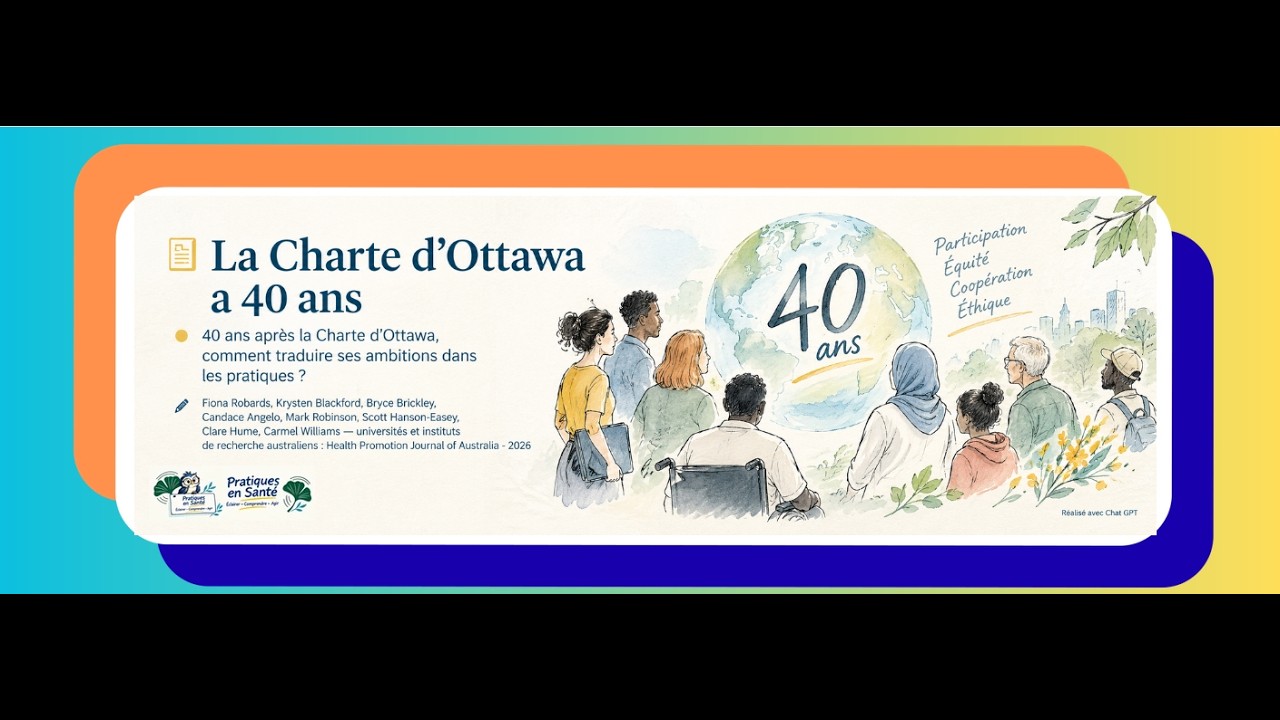
🎂🌏 40 years after the Ottawa Charter, how can we translate its ambitions into practices? A historical perspective and ideas to strengthen participation, equity, cooperation, and ethics within teams. 📒 The Ottawa Charter is 40 years old ✍️ Fiona Robards, Krysten Blackford, Bryce Brickley, Candace Angelo, Mark Robinson, Scott Hanson-Easey, Clare Hume, Carmel Williams — Australian universities and research institutes: Health Promotion Journal of Australia - 2026 Audio Capsules of Health Practices 🎙️🎥 https://www.youtube.com/watch?v=X_M3PtK5bvI Analysis of Health Practices and link to the source ℹ️➕ https://www.pratiquesensante.com/blog/pratiques-15/la-charte-d-ottawa-a-40-ans-6299 📌 Understanding the history of the Ottawa Charter, adopted in 1986, allows us to make sense of current practices: acting on living conditions, building health-promoting policies, and working with communities rather than limiting ourselves to individual behaviors. Forty years later, this editorial questions how to realize this ambition. Using Australian examples, it invites professionals to reflect on their practices: what place should be given to the knowledge and priorities of populations? How to strengthen cooperation between sectors, advocacy, and ethical reflection? A resource to connect the historical foundations of health promotion to the daily choices of teams, without constituting a ready-to-use methodological guide. To extend this reading, the "History of Health Promotion" dossier from Pratiques en Santé gathers foundational texts and testimonies from actors who participated in this history, particularly around the preparation and adoption of the Ottawa Charter. https://www.pratiquesensante.com/1-5-hisoire-promotion-sante 🇬🇧: The Ottawa Charter is 40 years old - https://www.pratiquesensante.com/en/blog/practices-15/the-ottawa-charter-is-40-years-old-6299 #️⃣ #pratiquesensante #ChartedOttawa #Ottawa40 #HealthPromotion #CommercialDeterminants #HealthInAllPolicies #EthicsInHealthPromotion #Reflexivity #pratiquesensante #ChartedOttawa #Ottawa40 #PromotionDeLaSanté #DéterminantsCommerciaux #SantéDansToutesLesPolitiques #ÉthiqueEnPromotionDeLaSanté #Réflexivité (translated)

www.youtube.com
Charte d Ottawa 40 ans
581
Oberlé Daniel Oct 12

🧭 40 ans après la Charte d’Ottawa, Theresa Tam soutient qu’il ne faut pas remplacer les principes de la promotion de la santé, mais les appliquer aux crises actuelles. 📒 La promotion de la santé à l’ère des bouleversements : appliquer des principes durables dans un monde qui change ✍️ Theresa Tam, Agence de la santé publique du Canada, Ottawa Health promotion in an era of disruption: applying enduring principles in a changing world Capsules Audio de Pratiques en Santé 🎙️🎥 https://www.youtube.com/watch?v=JVxNrN_JZ9U Analyse de Pratiques en Santé et lien vers la source ℹ️➕ https://www.pratiquesensante.com/blog/pratiques-15/la-promotion-de-la-sante-a-l-ere-des-bouleversements-appliquer-des-principes-durables-dans-un-monde-qui-change-6252 📌 Pour les acteurs de la promotion de la santé, cet éditorial permet de relire les principes de la Charte d'Ottawa au regard des bouleversements récents décrits par l'autrice : COVID-19, urgences climatiques, crise des drogues toxiques, évolutions démographiques, transformation numérique, défiance et désinformation (p. 1). Il apporte des arguments pour défendre trois idées : investir dans le bien-être renforce aussi la résilience face aux crises (p. 1-2) ; la promotion de la santé gagne à sortir des silos et à s'associer à la gestion des urgences, aux soins, à l'éducation et aux politiques sociales, environnementales, économiques et numériques (p. 2, p. 3-4) ; les espaces numériques, en particulier ceux des enfants et des jeunes, font désormais partie des milieux de vie à prendre en compte (p. 3). Il invite enfin à choisir des mots qui parlent aux décideurs et aux communautés, comme bien-être, résilience communautaire, confiance ou cohésion sociale, sans renoncer au fond de la démarche (p. 3). 🇬🇧: Health promotion in an era of disruption: applying enduring principles in a changing world - https://www.pratiquesensante.com/en/blog/practices-15/health-promotion-in-an-era-of-disruption-applying-enduring-principles-in-a-changing-world-6252 #️⃣ #pratiquesensante #PromotionDeLaSanté #ChartedOttawa #BienÊtre #Résilience #ÉquitéEnSanté #SantéNumérique #Intersectorialité

www.youtube.com
Principes de santé durables : 40 ans après la Charte d’Ottawa,
1055