WRLD

Search

#Fiorello
SOTER 49m

SOTER praised Fiorello for his remarks on the ongoing protest in the South, asserting that he was never wrong. He accompanied the post with the hashtags #LaPennicanza and #TG1. #lapennicanza #tg1 https://t.co/vyeLdGIlL1 #protesta #sud #Fiorello (translated)


1280
LALLERO 59m

LALLERO wrote that Fiorello had rightly made an appeal to Tg1 to also shine a light on Southern Italy, which was blocked by the protest of truck drivers. #SudItalia #Protesta #Fiorello (translated)

1504
Luciano Magaldi Sardella (PhD) 7d

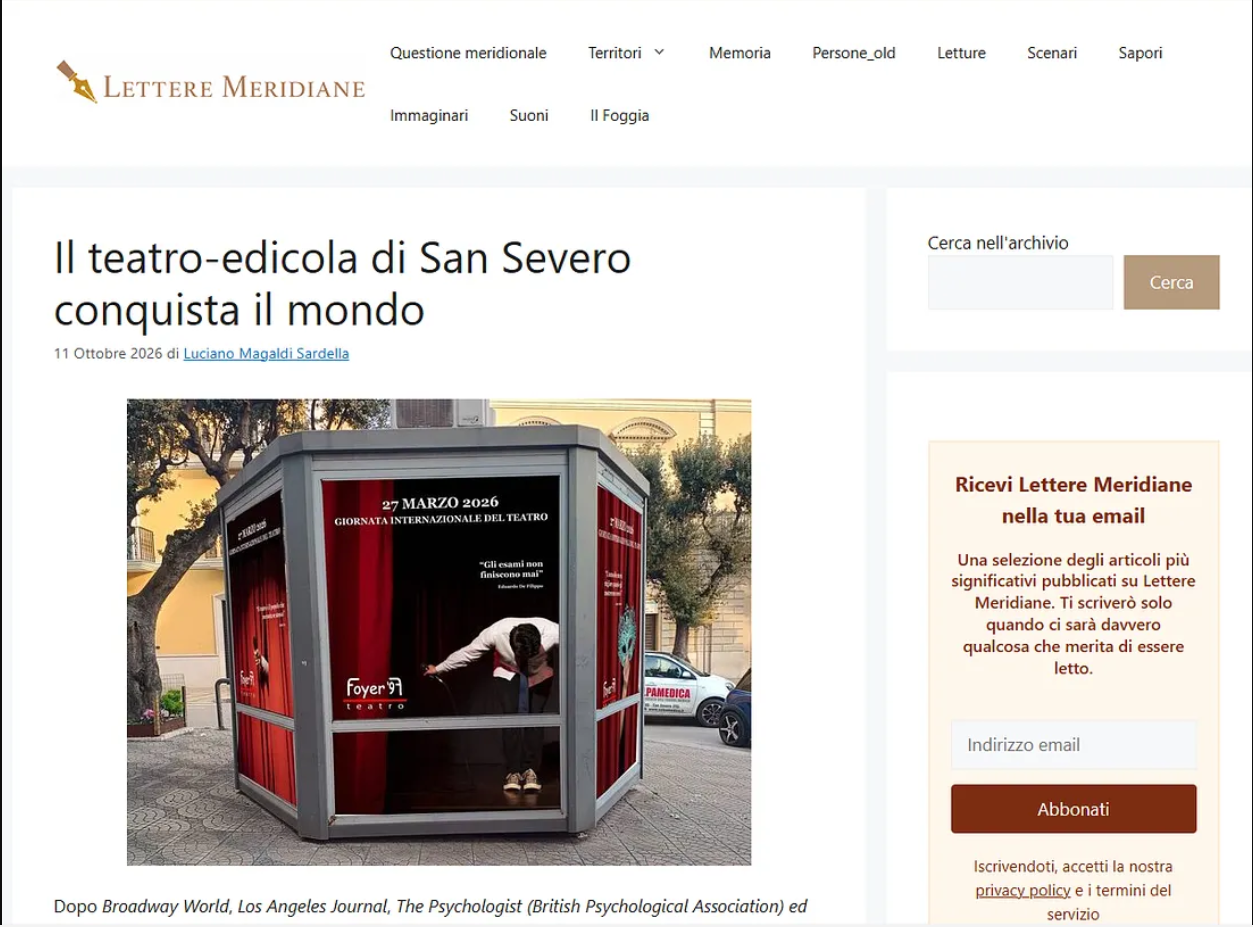
LETTERE MERIDIANE — “TEATRO-EDICOLA” OF SAN SEVERO CONQUERS THE WORLD SOURCE: https://www.letteremeridiane.org/2026/10/il-teatro-edicola-di-san-severo-conquista-il-mondo/?fbclid=IwY2xjawU4oqFleHRuA2FlbQIxMQBwZG9mAXNydGMGYXBwX2lkEDIyMjAzOTE3ODgyMDA4OTIAAR5rVEwYs6UUXg7v-P0SyIQ_DRb_F6ZiY58OcseYoV4J7atcTiERnhWaqKM2pw_aem_Njle1jq1XLzHr93KLBUcVA After “Broadway World”, the “Los Angeles Journal”, “The Psychologist (British Psychological Association)” and Hollywood Beat Magazine, its “academic consecration” has now arrived courtesy of Stanford University. As I have already emphasised in my article on the revival of the GIO Festival in Foggia, celebrated by BroadwayWorld for the world stage premiere of the Giordano’s opera Marina (1888), the province of Foggia has long ceased to be peripheral. It happens when it finds an idea that shifts the coordinates: well, in San Severo, 40 kilometres from Foggia, it has happened again. Only this time an orchestra was not needed; six chairs were enough. The celebrated Teatro-Edicola of San Severo artistic director Francesco Gravino of the theatre company Foyer ’97 has been featured in the academic journal “Stanford Social Innovation Review (SSIR)” as an academic case study. The news, relayed on 19 September 2026 by ANSA Nazionale, looked like a misprint. Then it became clear that it was not. SSIR, an award-winning publication covering multisectoral solutions to global problems, included the project in its Dispatches section with the reportage “The Six-Seat Revolution”. It is the inverse trajectory to that of the GIO Festival: not a forgotten opera returning to a grand historic Italian horseshoe theatre, but an entire theatre reborn inside a disused place, forgotten by man. There are moments when past and future intertwine to create something visionary, innovative, artistically “revolutionary”: San Severo experienced one of those moments on the morning of 27 March 2026, during World Theatre Day, when the shutter of a newsstand closed for six years in Via Matteo Tondi was reopened “not to sell newspapers, but to offer stirring stories”, to quote Gravino’s motto. The idea of the visionary Francesco Gravino, artistic director, stage director and actor of the San Severo company Foyer ’97, active for at least 30 years in Capitanata, centred on the kiosk, hexagonal in metal and glass, granted free of charge by its owner Pino Frau, by now an urban relic created by the publishing crisis of the early 2000s: today in Italy active newsstands have fallen from about 35,000 in 2005 to about 20,000 in 2024, a decline of 42.8%. Gravino and eleven other actors restructured it in two weeks of work, without institutional funding, and transformed it into what is now under examination by the London commission of Guinness World Records as the “world’s smallest theatre”. The formula is deliberately austere: six spectators at a time outside, actors inside at less than a metre’s distance, 15-minute performances, continuous rotation from 11:00 to 20:45, texts ranging from Goldoni to Chekhov, from Ibsen to Dacia Maraini. On the door a QR code with an original theatrical warning: “Warning! This QR code transforms passers-by into actors. Scan only if ready.” The numbers immediately showed that it was no boutade: more than 60 people in a single afternoon, three inaugural days that sold out. But above all a positive echo that went beyond the borders of San Severo. “Broadway World” (just as in the previous case of the GIO Festival), the world’s most influential theatre criticism outlet with over 5.5 million monthly views, devoted exclusive coverage to it on 27 April 2026: “An Abandoned Italian Newsstand Just Became the World’s Smallest Theatre”. Not a mere listing, but an analysis: “There is no foyer, there is no balcony, there is no grid. There is barely a wing. What there is is something almost unrecognisable as an evening at the theatre, and for that very reason it is all the more powerful.” “Broadway World” captured Gravino’s manifesto idea: “This is a theatre of proximity. In an era of digital distance, we are putting human contact back at the centre,” framing it as “More than a clever exercise in site-specific theatre. It is a reappropriation.” All of this, in a Mezzogiorno of Italy often narrated only in terms of organised crime and marginalisation. To that seal of approval was added another, even more disorienting for a newsstand in San Severo: the “Los Angeles Journal”, one of the most influential publications on the West Coast for the performing arts. On 12 May 2026, it headlined thus: “San Severo’s Teatro-Edicola as an Innovative Model for Los Angeles Theaters?” opening as follows: “In a city in southern Italy that Hollywood has never heard of, a theatre director has just built the smallest stage in the world: six seats, fifteen minutes, zero distance. Los Angeles should pay attention.” The “Los Angeles Journal” does not indulge in folklore, but places the kiosk in Via Matteo Tondi alongside the prestigious 1,600-seat Ahmanson Theatre in Los Angeles, the Pantages of Broadway in Hollywood, the 99-seat plan of Rogue Machine, the Odyssey, the Victory Theatre and the Hollywood Fringe. It even recalls Ethan Marks’s Electrical Box Theatre, a veritable electrical box lined with red velvet in downtown Los Angeles, to argue that Gravino has taken to the extreme the question Los Angeles has been asking itself for decades: How small can a stage become before it ceases to be a stage? And it recognizes the San Severo urban model: almost zero cost, two weeks of work and six chairs, in return for immediate provincial, regional and national media coverage, recognition by the San Severo’s Municipal Administration, and a format exportable anywhere. Then, the third American piece came from “Hollywood Beat Magazine” on 20 April 2026: Six seats. Fifteen minutes. One actor. No stage. The magazine recounts the kiosk in Via Tondi left disused for almost six years, the contemporary six-seat cultural outpost, placing Francesco Gravino in a distinguished genealogy: Richard Schechner and environmental theatre, Jerzy Grotowski and poor theatre, Nicolas Bourriaud and relational aesthetics. But it closes with pragmatism: it is not a thesis, it is fixing a street corner, that is, repairing an urban street corner by asking not how large a theatre can become, but how small it must become again to recover its original power. And finally, the celebrated London-based “The Psychologist”, the journal of the “British Psychological Society (BPS)”, the oldest psychological society in the world, transformed the Teatro-Edicola into a scientific case study: on 30 July 2026 it published “The world’s smallest theatre — and Psychologists’ next act”, starting from the same detail, the morning of 27 March when the metal shutter of the hexagonal kiosk in Via Tondi reopened after six years, six people inside, an actor at less than a metre’s distance beginning Chekhov. It describes the formula: six spectators, 15 minutes, 11 actors over 10 hours, from Goldoni to Euripides, inside a kiosk where the fourth wall does not break because architecturally it never existed. But the BPS goes a step further: it cites the 2025 studies by Damien Gabriel in IBRO Neuroscience Reports, that live performance generates measurably stronger emotional and physiological activation than video, and introduces Edward Hall’s proxemics: below one metre is intimate space, reserved for doctors, close friends, lovers. In that one-square-metre space, the actor’s breath is audible, micro-expressions legible, the self-other boundary becomes permeable. The Teatro-Edicola “does not make theatre better, it makes it inevitable”. And it is here that one understands why Stanford is studying it as an academic case study in social innovation, not as a case of artistic originality. In Italy, meanwhile, the national media circuit had already picked up the phenomenon: RaiNews — TG2 Storie brought it to RaiDue at midnight on 19 April. RTL 102.5 devoted space to the format conceived by Gravino and developed by Foyer ’97 in the heart of San Severo in Via Tondi, defining it as a permanent micro-stage capable of bringing theatre into public space. ANSA.it, Gazzetta del Mezzogiorno, La Repubblica, TG2000, Radio Capital, Swiss RSI, ANSA Brazil and many others followed. And for the record: Fiorello praised it in La Pennicanza as an artistic case inspired by his Edicola Fiore, and Biagio Antonacci, on his tour in the Augustan amphitheatre of Lucera, made a “fact-finding” stop at the Teatro-Edicola singing the celebrated and nostalgic Iris in front of an audience certainly larger than the “six seats”. Francesco Gravino’s theatre company Foyer ’97 was not born yesterday: behind it lie the Teatro-Cantina of 2016, the underground theatre, and in 2011 a performance on the bell tower of a church in the centre of San Severo at 45 metres high. The Teatro-Edicola completes, in Gravino’s words, “the entire vertical extension of theatre: underground, street level, rooftop”. And it is preparing for its thirtieth anniversary in 2027 aiming to purchase the kiosk to make it permanent, exporting the “San Severo Model” to Rome, Lucca, and to the festivals of Santarcangelo and Todi. As with the GIO Festival, someone might dare to claim that it is merely a stunt, but when BroadwayWorld places you alongside the Los Angeles Opera House, the “Los Angeles Journa”l proposes you as a model for Hollywood, “Hollywood Beat Magazine” reads you through Grotowski and the “British Psychological Society” uses you to explain mirror neurones, it is no longer a stunt but an excellent artistic and academic positioning. To those who still whisper that Foggia and Capitanata are provincial, the answer is now written on two opposite and complementary fronts: on 5 June in Foggia a 138-year-old opera found the stage again at the Giordano ending up on BroadwayWorld; on 27 March in San Severo a 4-square-metre kiosk invented a stage that did not exist, ending up at Stanford, in Los Angeles, in Hollywood and in London. The periphery, when it has a precise idea, becomes the centre. Even with six chairs. Luciano Magaldi Sardella

www.letteremeridiane.org
Il teatro-edicola di San Severo conquista il mondo
794
Luciano Magaldi Sardella (PhD) 7d

LETTERE MERIDIANE — IL TEATRO-EDICOLA DI SAN SEVERO CONQUISTA IL MONDO SOURCE: SOURCE: https://www.letteremeridiane.org/2026/10/il-teatro-edicola-di-san-severo-conquista-il-mondo/?fbclid=IwY2xjawU4oqFleHRuA2FlbQIxMQBwZG9mAXNydGMGYXBwX2lkEDIyMjAzOTE3ODgyMDA4OTIAAR5rVEwYs6UUXg7v-P0SyIQ_DRb_F6ZiY58OcseYoV4J7atcTiERnhWaqKM2pw_aem_Njle1jq1XLzHr93KLBUcVA Dopo Broadway World, Los Angeles Journal, The Psychologist (British Psychological Association) ed Hollywood Beat Magazine, ora è arrivata la sua “consacrazione accademica” a cura della Stanford University. Come ho già sottolineato nel mio articolo sulla rivincita del GIO Festival a Foggia, celebrata dal BroadwayWorld per la prima mondiale scenica della giordaniana Marina (1888), la provincia di Foggia ha smesso ormai di essere periferia. Accade quando trova un’idea che sposta le coordinate: ebbene, a San Severo, a 40 chilometri da Foggia, è successo di nuovo. Solo che questa volta non serviva un’orchestra, ma sono bastate sei sedie. Il celebre Teatro-Edicola del sanseverese direttore artistico Francesco Gravino della Compagnia Teatrale Foyer’97 è finito sulla rivista accademica Stanford Social Innovation Review (SSIR) in qualità di caso di studio accademico. La notizia, rilanciata il 19 settembre 2026 da ANSA Nazionale, sembrava un refuso. Poi si è capito che non lo era. La SSIR, pubblicazione pluripremiata che copre soluzioni multisettoriali ai problemi globali, ha inserito il progetto nella sezione Dispatches con il reportage The Six-Seat Revolution. È il percorso inverso rispetto a quello del GIO Festival: non un’opera dimenticata che torna in un grande teatro storico italiano a ferro di cavallo, ma un teatro intero che rinasce dentro un luogo dismesso, dimenticato dall’uomo. Ci sono momenti in cui il passato e il futuro si intrecciano per creare qualcosa di visionario, innovativo, artisticamente “rivoluzionario”: San Severo ha vissuto uno di questi momenti la mattina del 27 marzo 2026, durante la Giornata Mondiale del Teatro, quando la saracinesca di un’edicola chiusa da sei anni in Via Matteo Tondi è stata riaperta “non per vendere giornali, ma per offrire emozionanti storie”, citando il motto graviniano. L’idea del visionario Francesco Gravino (nella foto sopra), direttore artistico, regista e attore della compagnia sanseverese Foyer ’97, attiva da almeno 30 anni in Capitanata si è basata sull’edicola, esagonale in metallo e vetro, concessa a titolo gratuito dal proprietario Pino Frau, ormai un relitto urbano creato dalla crisi dell’editoria degli inizi anni 2000: oggi in Italia le edicole attive sono scese da circa 35.000 nel 2005 a circa 20.000 nel 2024, con un calo del 42,8%. Gravino e altri undici attori l’hanno ristrutturata in due settimane di lavoro, senza fondi istituzionali, e l’hanno trasformata in quello che oggi è sotto esame della commissione londinese del Guinness World Record come “teatro più piccolo del mondo”. La formula è volutamente austera: sei spettatori alla volta fuori, attori dentro a meno di un metro, spettacoli di 15 minuti, rotazione continua dalle 11 alle 20.45, testi da Goldoni a Čechov, da Ibsen a Dacia Maraini. Sulla porta un QR code con un originale avvertimento teatrale: “Attenzione! Questo codice QR trasforma i passanti in attori. Scansionate solo se pronti.” I numeri hanno sùbito detto che non era una boutade: più di 60 persone in un solo pomeriggio, tre giornate inaugurali che hanno registrato il tutto esaurito. Ma soprattutto un’eco positiva che è andata oltre i confini sanseveresi. BroadwayWorld (proprio come il previo caso del GIO Festival) la più influente testata mondiale di critica teatrale con oltre 5,5 milioni di visualizzazioni mensili, il 27 aprile 2026 gli ha dedicato una copertura esclusiva: An Abandoned Italian Newsstand Just Became the World’s Smallest Theatre. Non una segnalazione, ma un’analisi: “Non c’è foyer, non c’è balconata, non c’è graticcia. C’è a malapena una quinta. Quello che c’è è qualcosa di quasi irriconoscibile come serata a teatro, e proprio per questo è ancora più potente.” BroadwayWorld ha colto l’idea manifesto di Gravino: “Questo è un teatro di prossimità. In un’epoca di distanza digitale, stiamo rimettendo il contatto umano al centro,” incorniciandolo come “Più che un abile esercizio di teatro site-specific. È una riappropriazione.”. Il tutto, in un Mezzogiorno d’Italia spesso raccontato solo per criminalità organizzata e marginalizzazione. A quel sigillo se ne è aggiunto un altro, ancora più spiazzante per un’edicola di San Severo: il Los Angeles Journal, una delle testate più influenti della West Coast per le arti performative. Il 12 maggio 2026, titola in questo modo: San Severo’s Teatro Edicola as an Innovative Model for Los Angeles Theaters? aprendo così: “In una città del Sud Italia di cui Hollywood non ha mai sentito parlare, un regista teatrale ha appena costruito il palcoscenico più piccolo del mondo: sei posti, quindici minuti, zero distanza. Los Angeles dovrebbe prestare attenzione.” Il Los Angeles Journal non fa folklore, ma mette il chiosco di via Matteo Tondi accanto al presigioso teatro losangelino Ahmanson da 1600 posti, al Pantages di Broadway in Hollywood, ai 99-seat plan di Rogue Machine, all’ Odyssey, al Victory Theatre e all’ Hollywood Fringe. Rievoca persino l’Electrical Box Theatre di Ethan Marks, una vera e propria scatola elettrica foderata di velluto rosso in downtown Los Angeles, per dire che Gravino ha portato all’estremo la domanda che Los Angeles si fa da decenni: Quanto piccolo può diventare un palco prima di smettere di essere un palco? E riconosce il modello urbano sanseverese: costo quasi zero, due settimane di lavoro e una sestina di sedie, a fronte di una immediata copertura mediatica provinciale, regionale e nazionale, riconoscimento dell’ Amministrazione Comunale sanseverese, e un format esportabile (quasi) ovunque. Dopodiché, il terzo tassello americano è arrivato dall’ Hollywood Beat Magazine il 20 aprile 2026: Six seats. Fifteen minutes. One actor. No stage. Il magazine racconta il chiosco di Via Tondi rimasto dismesso per quasi sei anni, il presidio culturale contemporaneo da sei posti, inserendo Francesco Gravino nella genealogia alta: Richard Schechner e l’environmental theatre, Jerzy Grotowski e il teatro povero, Nicolas Bourriaud e l’estetica relazionale. Ma chiude con concretezza: non è una tesi, è fixing a street corner, ovvero aggiustare un angolo di strada urbana chiedendosi non quanto grande può diventare un teatro, ma quanto piccolo deve tornare per recuperare il suo potere originario. E infine, il celebre londinese The Psychologist, la rivista della British Psychological Society (BPS), la più antica società di psicologia al mondo, ha trasformato il Teatro-Edicola in caso di studio scientifico: il 30 luglio 2026 pubblica The world’s smallest theatre — and Psychologists’ next act, partendo dallo stesso dettaglio, la mattina del 27 marzo in cui la saracinesca metallica del chiosco esagonale di Via Tondi si riapre dopo sei anni, sei persone dentro, un attore a meno di un metro che inizia Chekhov. Descrive la formula: sei spettatori, 15 minuti, 11 attori su 10 ore, da Goldoni a Euripide, dentro un chiosco dove la quarta parete non si rompe perché architettonicamente non è mai esistita. Ma la BPS fa un passo oltre: cita gli studi del 2025 di Damien Gabriel su IBRO Neuroscience Reports, la performance live genera attivazione emotiva e fisiologica misurabilmente più forte del video e introduce la prossemica di Edward Hall: sotto il metro è spazio intimo, riservato a medici, amici stretti, amanti. In quello spazio da un metro quadrato, il respiro dell’attore è udibile, le microespressioni leggibili, il confine sé-altro diventa permeabile. Il Teatro-Edicola “non rende il teatro migliore, lo rende inevitabile”. Ed è qui che si capisce perché Stanford lo studia come caso di studio accademico di innovazione sociale, non come caso di originalità artistica. In Italia, nel frattempo, il circuito mediatico nazionale aveva già intercettato il fenomeno: RaiNews — TG2 Storie lo porta su RaiDue alla mezzanotte del 19 aprile. RTL 102.5 dedica spazio al format ideato da Gravino e sviluppato da Foyer’97 nel cuore di San Severo in Via Tondi, definendolo micro-palcoscenico permanente capace di portare teatro nello spazio pubblico. ANSA.it, Gazzetta del Mezzogiorno, La Repubblica, TG2000, Radio Capital, RSI svizzera, ANSA Brasile e tanti altri seguono. E per diritto di cronaca: Fiorello lo ha elogiato in La Pennicanzacome caso artistico ispirato al suo Edicola Fiore, nonché Biagio Antonacci, nel suo tour nell’anfiteatro augusteo di Lucera, ha fatto tappa “conoscitiva” nel Teatro-Edicola cantando la celebre e nostalgica Iris davanti ad un pubblico sicuramente maggiore dei “sei posti”. La Compagnia Teatrale Foyer ’97 di Francesco Gravino non è nata ieri: ha alle spalle il Teatro-Cantina del 2016, il teatro sottoterra, e nel 2011 una performance sulla torre campanaria di una chiesa del centro di San Severo a 45 metri d’altezza. Il Teatro Edicola completa, nelle parole di Gravino, “l’intera estensione verticale del teatro: sottoterra, piano strada, tetto”. E si prepara al trentennale del 2027 puntando ad acquistare l’edicola per renderla permanente esportando il “Modello San Severo” a Roma, Lucca, nei festival di Santarcangelo e Todi. Come per il GIO Festival, qualcuno potrebbe osare di affermare che si tratta solo di un exploit ma, quando BroadwayWorld ti mette accanto alla Los Angeles Opera House, il Los Angeles Journal ti propone come modello per Hollywood, Hollywood Beat Magazine ti legge con Grotowski e la British Psychological Society ti usa per spiegare i neuroni specchio, non è più un exploit ma un eccellente posizionamento artistico ed accademico. A chi ancora sussurra che Foggia e la Capitanata siano provincia, la risposta ora è scritta su due fronti opposti e complementari: il 5 giugno a Foggia un’opera di 138 anni ha ritrovato la scena al Giordano finendo su BroadwayWorld; il 27 marzo a San Severo un’edicola di 4 metri quadrati ha inventato una scena che non esisteva, finendo a Stanford, a Los Angeles, a Hollywood e a Londra. La periferia, quando ha un’idea precisa, diventa centro. Anche con sei sedie. Luciano Magaldi Sardella

www.letteremeridiane.org
Il teatro-edicola di San Severo conquista il mondo
680
S
Sandfeen 2w

“You cannot preach self-government and liberty to people in a starving land. Only a well-fed, well-housed, well-schooled people can enjoy the blessings of liberty.” — Fiorello La Guardia, former mayor of New York La Guardia was making a simple argument: people cannot fully enjoy liberty if they lack the basic conditions that make independence possible. That should make Danes stop and think. Denmark is not a starving land. We are wealthy, highly educated and protected by one of the world’s most extensive welfare states. And yet, look at the direction of travel. The cost of living and housing have become increasingly burdensome. Educational performance has deteriorated. And more and more decisions about how we live, work, raise our children, run our businesses and spend our own money are made through an ever-growing web of rules and regulations. So perhaps Denmark faces a different version of La Guardia’s warning. The question is no longer simply: Are Danes well-fed, well-housed and well-schooled? It is: Are Danes still being made capable of governing themselves? Because there is a difference between being provided for and being free. A prosperous welfare state can give people security. It can provide housing, education, healthcare and income protection. But it cannot manufacture the habits that liberty requires: independent thought, personal responsibility, courage, competence and a willingness to govern ourselves rather than continually asking the state to govern us. La Guardia warned that you cannot build liberty on hunger. Perhaps Denmark should ask whether security without sufficient independence can preserve it. A free society needs more than citizens who are taken care of. It needs citizens capable of taking responsibility for themselves. That is the real meaning of self-government” - ChatGPT

805
Luciano Magaldi Sardella (PhD) 3w

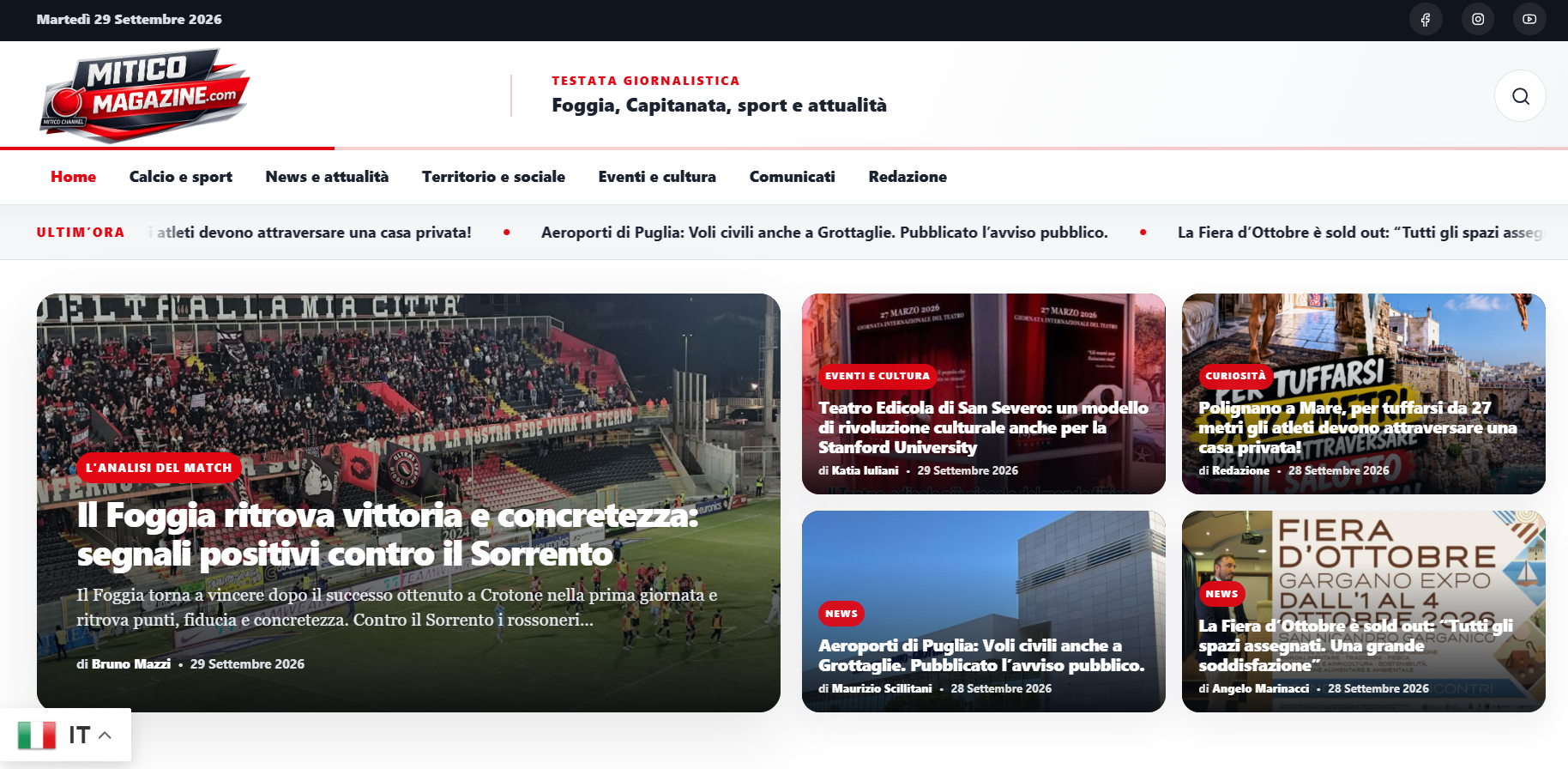
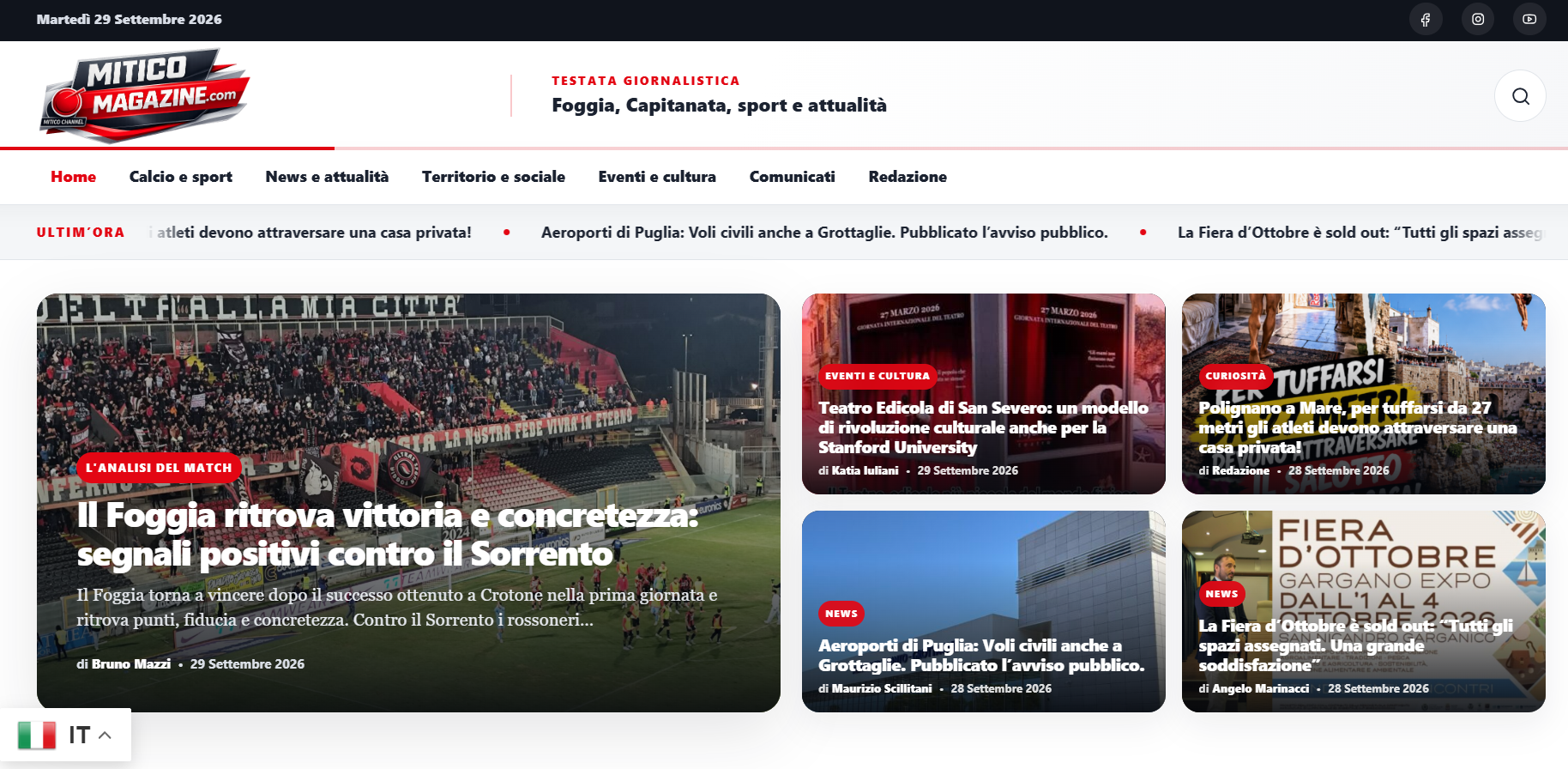
Mitico Magazine - The Teatro Edicola of San Severo: A Model of Cultural Revolution for Stanford University as Well Source: https://www.miticomagazine.com/territorio-e-sociale/teatro-edicola-di-san-severo-un-modello-di-rivoluzione-culturale-anche-per-la-stanford-university/ The Teatro Edicola in Via Tondi In San Severo, a singular metamorphosis has taken place: a newsstand abandoned for at least six years has found a new function and a new identity, transforming into one of the smallest and most unusual theatre stages in the world. An experiment born in the heart of the town which, in just a few months, has moved beyond local boundaries, attracting attention even overseas. It is called Teatro Edicola and it is a project conceived by the company Foyer '97, artistically directed by Francesco Gravino, which has brought the old newsstand in Via Tondi back to life through a formula that is both essential and surprising. Foyer '97 Foyer '97 APS was established as a formally constituted association active in the cultural sector in San Severo in 1997, born from the vocation of a group of actors, directors and theatre enthusiasts, with the aim of building a "living" and accessible theatre in the town. Over the years the company has developed a repertoire that includes texts from the classical tradition, contemporary dramaturgy, comedy and experimental projects, not limiting itself to the mere production of theatre shows, but also organising theatre courses and workshops and educational and cultural projects characterised by a strong inclusive ethos, particularly in schools. Foyer '97 does not always have a fixed artistic ensemble, but works with different performers and collaborators depending on the project; the only indispensable presence is that of Francesco Guido Gravino himself, actor, director and artistic director of the theatre company. The distinctive feature of Foyer '97 is certainly the value of social and cultural promotion attributed to theatre, the extremely close relationship with the audience and the search for a type of theatre outside conventional spaces, with cemeteries, trains, bell towers, and now a newsstand, as its backdrop. Six spectators, a few minutes and a minimal distance between stage and audience The project was launched on 27 March 2026, on the occasion of World Theatre Day, offering a theatrical experience built around a radical reduction of the conventional spaces and times of performance. The idea was born not only from the search for unconventional spaces, but also from "Edicola Fiore", the morning press review with a strongly ironic tone presented by Rosario Fiorello and Stefano Meloccaro, which was broadcast first only on Fiorello's social channels between 2011 and 2014, and then also on radio and television between 2016 and 2018. The review took its name from the diminutive of its founder, Fiore, and from the newsstand of a friend of Fiorello's in Via Flaminia Nuova in Rome, where the showman would meet early in the morning with a group of friends to read the newspapers. The San Severo newsstand was granted free of charge by its owner Pino Frau to the theatre group which, after obtaining temporary authorisation and institutional support from the Municipality of San Severo, refurbished it within two weeks at a cost of less than €3,000. Just six seats, a total surface area of 4 sq m, of which only 2 are for the stage area, less than a metre between actors and audience, a curtain, a lectern, two lights, performances lasting between 5 and 15 minutes, audience rotation every quarter of an hour: apparently minimal elements that end up subverting the usual relationship between stage and auditorium. Spectators, in fact, find themselves immersed in the stage action, in such proximity to the actors that every gesture, expression and word becomes immediately perceptible. In this way, theatre abandons its traditional spaces and insinuates itself into the everyday life of the street, becoming an intimate, concentrated and almost participatory experience. During the inaugural period admission was free with a subsequent voluntary donation from spectators; in the event of a more stable and longer-term concession, which could lead to seasonal theatre performances, the proposed ticket price would be €5. Audiences reward the experiment Foyer '97's gamble met with public interest right from the start: over 60 people attended the shows in a single afternoon, while the three days that inaugurated the season sold out. From a singular local experiment, the Teatro Edicola thus began to arouse curiosity even outside the province of Foggia, gradually transforming into a case of cultural and social interest, until it reached the American continent. From the province of Foggia to the "Stanford Social Innovation Review" The San Severo experience has now come under the international spotlight: in September 2026, the Stanford Social Innovation Review, an international journal and platform dedicated to social innovation published by the Stanford Center on Philanthropy and Civil Society at Stanford University in California, published on its website and in the Fall 2026 print edition the reportage "The Six-Seat Revolution", written by Dr Luciano Magaldi Sardella, independent journalist and researcher affiliated with the European Open University, and editorially supervised by deputy editor David V. Johnson. In the article, it is argued that the Teatro Edicola attracted attention overseas because the project concentrates cultural innovation, urban regeneration and proximity theatre into just a few square metres: starting from a real urban problem, it recovers an abandoned place with a modest investment, brings performance directly into public space and experiments with a much closer relationship between actors and spectators. From the point of view of theatrical representation, it also highlights how the format, based on micro-stories of five to twelve minutes, taken from great classics such as Goldoni, Chekhov, Ibsen, Euripides and Benni, and on audience rotation every fifteen minutes, transforms the physical limitations of the space into a precise dramaturgical choice, proving to be extremely innovative. All of this makes it possible to address some of the main critical issues in the sector: falling audience numbers, an exclusively elderly audience, reduced resources and distance from traditional cultural venues. The journal also highlights, however, the potential problems: economic sustainability, the need for stable institutional support and the difficulty of replicating the model, which is closely linked to the community and territory of San Severo. A model looking beyond San Severo Despite the difficulties, initial requests for information have already arrived from Lucca and Rome, where there is curiosity about the possibility of getting to know the model more closely and the steps needed to replicate it. The replicability formula, in fact, does not seem to require particularly costly infrastructure: an unused space, a targeted intervention, a cultural idea, in-depth knowledge of the surrounding area and a willingness to return that place to the community can be enough to trigger a new urban function. It is precisely in the disproportion between the modesty of the resources employed and the resonance generated by the initiative that perhaps the most original feature of the Teatro Edicola lies, certainly unique of its kind; there are, however, other examples in Italy of newsstands reused for other purposes: "Edicola 518", a twentieth-century kiosk abandoned in the centre of Perugia, now dedicated to independent publishing, art and cultural production; and in Rome itself, the abandoned newsstand in Piazza Testaccio used temporarily as a stage for a show by Fabio Morgan and the Erno newsstand in the Prati district, which almost every month offers a calendar of events, exhibitions, pop-ups and collaborations with artists and creative enterprises. Small revolutions, therefore, that tell stories of the reappropriation of urban spaces, of creativity and social innovation. And which, it is hoped, will take root in order to look ever further afield.

www.miticomagazine.com
Teatro Edicola di San Severo: un modello di rivoluzione culturale anche per la Stanford University
1040
Luciano Magaldi Sardella (PhD) 3w

Mitico Magazine - The Teatro Edicola of San Severo: A Model of Cultural Revolution for Stanford University as Well Source: https://www.miticomagazine.com/territorio-e-sociale/teatro-edicola-di-san-severo-un-modello-di-rivoluzione-culturale-anche-per-la-stanford-university/ The Teatro Edicola in Via Tondi In San Severo, a singular metamorphosis has taken place: a newsstand abandoned for at least six years has found a new function and a new identity, transforming into one of the smallest and most unusual theatre stages in the world. An experiment born in the heart of the town which, in just a few months, has moved beyond local boundaries, attracting attention even overseas. It is called Teatro Edicola and it is a project conceived by the company Foyer '97, artistically directed by Francesco Gravino, which has brought the old newsstand in Via Tondi back to life through a formula that is both essential and surprising. Foyer '97 Foyer '97 APS was established as a formally constituted association active in the cultural sector in San Severo in 1997, born from the vocation of a group of actors, directors and theatre enthusiasts, with the aim of building a "living" and accessible theatre in the town. Over the years the company has developed a repertoire that includes texts from the classical tradition, contemporary dramaturgy, comedy and experimental projects, not limiting itself to the mere production of theatre shows, but also organising theatre courses and workshops and educational and cultural projects characterised by a strong inclusive ethos, particularly in schools. Foyer '97 does not always have a fixed artistic ensemble, but works with different performers and collaborators depending on the project; the only indispensable presence is that of Francesco Guido Gravino himself, actor, director and artistic director of the theatre company. The distinctive feature of Foyer '97 is certainly the value of social and cultural promotion attributed to theatre, the extremely close relationship with the audience and the search for a type of theatre outside conventional spaces, with cemeteries, trains, bell towers, and now a newsstand, as its backdrop. Six spectators, a few minutes and a minimal distance between stage and audience The project was launched on 27 March 2026, on the occasion of World Theatre Day, offering a theatrical experience built around a radical reduction of the conventional spaces and times of performance. The idea was born not only from the search for unconventional spaces, but also from "Edicola Fiore", the morning press review with a strongly ironic tone presented by Rosario Fiorello and Stefano Meloccaro, which was broadcast first only on Fiorello's social channels between 2011 and 2014, and then also on radio and television between 2016 and 2018. The review took its name from the diminutive of its founder, Fiore, and from the newsstand of a friend of Fiorello's in Via Flaminia Nuova in Rome, where the showman would meet early in the morning with a group of friends to read the newspapers. The San Severo newsstand was granted free of charge by its owner Pino Frau to the theatre group which, after obtaining temporary authorisation and institutional support from the Municipality of San Severo, refurbished it within two weeks at a cost of less than €3,000. Just six seats, a total surface area of 4 sq m, of which only 2 are for the stage area, less than a metre between actors and audience, a curtain, a lectern, two lights, performances lasting between 5 and 15 minutes, audience rotation every quarter of an hour: apparently minimal elements that end up subverting the usual relationship between stage and auditorium. Spectators, in fact, find themselves immersed in the stage action, in such proximity to the actors that every gesture, expression and word becomes immediately perceptible. In this way, theatre abandons its traditional spaces and insinuates itself into the everyday life of the street, becoming an intimate, concentrated and almost participatory experience. During the inaugural period admission was free with a subsequent voluntary donation from spectators; in the event of a more stable and longer-term concession, which could lead to seasonal theatre performances, the proposed ticket price would be €5. Audiences reward the experiment Foyer '97's gamble met with public interest right from the start: over 60 people attended the shows in a single afternoon, while the three days that inaugurated the season sold out. From a singular local experiment, the Teatro Edicola thus began to arouse curiosity even outside the province of Foggia, gradually transforming into a case of cultural and social interest, until it reached the American continent. From the province of Foggia to the "Stanford Social Innovation Review" The San Severo experience has now come under the international spotlight: in September 2026, the Stanford Social Innovation Review, an international journal and platform dedicated to social innovation published by the Stanford Center on Philanthropy and Civil Society at Stanford University in California, published on its website and in the Fall 2026 print edition the reportage "The Six-Seat Revolution", written by Dr Luciano Magaldi Sardella, independent journalist and researcher affiliated with the European Open University, and editorially supervised by deputy editor David V. Johnson. In the article, it is argued that the Teatro Edicola attracted attention overseas because the project concentrates cultural innovation, urban regeneration and proximity theatre into just a few square metres: starting from a real urban problem, it recovers an abandoned place with a modest investment, brings performance directly into public space and experiments with a much closer relationship between actors and spectators. From the point of view of theatrical representation, it also highlights how the format, based on micro-stories of five to twelve minutes, taken from great classics such as Goldoni, Chekhov, Ibsen, Euripides and Benni, and on audience rotation every fifteen minutes, transforms the physical limitations of the space into a precise dramaturgical choice, proving to be extremely innovative. All of this makes it possible to address some of the main critical issues in the sector: falling audience numbers, an exclusively elderly audience, reduced resources and distance from traditional cultural venues. The journal also highlights, however, the potential problems: economic sustainability, the need for stable institutional support and the difficulty of replicating the model, which is closely linked to the community and territory of San Severo. A model looking beyond San Severo Despite the difficulties, initial requests for information have already arrived from Lucca and Rome, where there is curiosity about the possibility of getting to know the model more closely and the steps needed to replicate it. The replicability formula, in fact, does not seem to require particularly costly infrastructure: an unused space, a targeted intervention, a cultural idea, in-depth knowledge of the surrounding area and a willingness to return that place to the community can be enough to trigger a new urban function. It is precisely in the disproportion between the modesty of the resources employed and the resonance generated by the initiative that perhaps the most original feature of the Teatro Edicola lies, certainly unique of its kind; there are, however, other examples in Italy of newsstands reused for other purposes: "Edicola 518", a twentieth-century kiosk abandoned in the centre of Perugia, now dedicated to independent publishing, art and cultural production; and in Rome itself, the abandoned newsstand in Piazza Testaccio used temporarily as a stage for a show by Fabio Morgan and the Erno newsstand in the Prati district, which almost every month offers a calendar of events, exhibitions, pop-ups and collaborations with artists and creative enterprises. Small revolutions, therefore, that tell stories of the reappropriation of urban spaces, of creativity and social innovation. And which, it is hoped, will take root in order to look ever further afield.

www.miticomagazine.com
Teatro Edicola di San Severo: un modello di rivoluzione culturale anche per la Stanford University
1040
Luciano Magaldi Sardella (PhD) 3w

Mitico Magazine - Teatro Edicola di San Severo: un Modello di Rivoluzione Culturale anche per la Stanford University Source: https://www.miticomagazine.com/territorio-e-sociale/teatro-edicola-di-san-severo-un-modello-di-rivoluzione-culturale-anche-per-la-stanford-university/ Il Teatro Edicola di via Tondi A San Severo è avvenuta una singolare metamorfosi: un'edicola abbandonata da almeno sei anni ha ritrovato una funzione e una nuova identità, trasformandosi in uno dei palcoscenici teatrali più piccoli ed insoliti al mondo. Un esperimento nato nel cuore della città che, in pochi mesi, ha oltrepassato i confini locali, attirando l'attenzione anche oltreoceano. Si chiama Teatro Edicola ed è il progetto ideato dalla compagnia Foyer '97, diretta artisticamente da Francesco Gravino, che ha restituito vita alla vecchia edicola di via Tondi attraverso una formula essenziale e al tempo stesso sorprendente. Foyer '97 La Foyer '97 APS nasce come realtà associativa formalmente costituita e attiva nel settore culturale a San Severo nel 1997, dalla vocazione di un gruppo di attori, registi ed appassionati di teatro, con l'obiettivo di costruirne uno "vivo" e accessibile in città. Nel corso degli anni la compagnia ha sviluppato un repertorio che comprende testi della tradizione classica, drammaturgia contemporanea, commedia e progetti sperimentali, non limitandosi però alla semplice produzione di spettacoli teatrali, bensì anche all'organizzazione di corsi e laboratori teatrali e di progetti educativi e culturali caratterizzati da una forte impronta inclusiva, anche e soprattutto nelle scuole. La Foyer '97 non presenta sempre un organico artistico fisso, ma lavora con interpreti e collaboratori diversi a seconda dei progetti; unica presenza imprescindibile è quella, appunto, di Francesco Guido Gravino, attore, regista e direttore artistico della compagnia teatrale. La cifra distintiva di Foyer '97 è data sicuramente dalla valenza di promozione sociale e culturale attribuita al teatro, dal rapporto estremamente ravvicinato con il pubblico e dalla ricerca di un tipo di teatro fuori dagli spazi convenzionali, con cimiteri, treni, campanili, ed ora un'edicola, a fargli da sfondo. Sei spettatori, pochi minuti e una distanza minima tra palco e pubblico Il progetto ha preso il via il 27 marzo 2026, in occasione della Giornata Mondiale del Teatro, proponendo un'esperienza teatrale costruita attorno a una radicale riduzione degli spazi e dei tempi convenzionali dello spettacolo. L'idea nasce non soltanto dalla ricerca di spazi anticonvenzionali, bensì anche da "Edicola Fiore", la rassegna stampa mattutina dal taglio fortemente ironico condotta da Rosario Fiorello e Stefano Meloccaro, andata in onda prima solo sui canali social di Fiorello, tra il 2011 ed il 2014, e poi anche via radio e televisione tra il 2016 ed il 2018. Tale rassegna prendeva il nome dal diminutivo del suo fondatore, appunto Fiore, e dall'edicola di un amico di Fiorello in via Flaminia Nuova a Roma, dove lo showman si ritrovava la mattina presto con un gruppo di amici per leggere i giornali. L'edicola sanseverese è stata concessa gratuitamente dal proprietario Pino Frau al gruppo teatrale che, dopo aver ottenuto l'autorizzazione temporanea ed il supporto istituzionale da parte del Comune di San Severo, ha provveduto a ristrutturarla nell'arco di due settimane ad un costo inferiore ai 3000 euro. Soltanto sei posti a sedere, una superficie totale di 4 m2, di cui solo 2 destinati allo spazio scenico, meno di un metro di distanza tra attori e pubblico, un sipario, un leggio, due luci, rappresentazioni della durata compresa tra i 5 ed i 15 minuti, rotazione del pubblico ogni quarto d'ora: elementi apparentemente minimali che finiscono, però, per sovvertire il consueto rapporto fra palcoscenico e platea. Gli spettatori, infatti, si trovano immersi nell'azione scenica, in una prossimità con gli attori che rende ogni gesto, espressione e parola immediatamente percepibile. Il teatro, in questo modo, abbandona i suoi spazi tradizionali e si insinua nella quotidianità della strada, diventando un'esperienza intima, raccolta e quasi partecipativa. Durante il periodo inaugurale l'ingresso è stato gratuito con successiva offerta libera da parte degli spettatori; in caso di una concessione più stabile e lunga, che possa portare proprio a rappresentazioni teatrali stagionali, il costo del biglietto proposto sarebbe di 5 €. Il pubblico premia l'esperimento La scommessa di Foyer '97 ha incontrato sin dalle prime battute l'interesse del pubblico: oltre 60 persone hanno assistito agli spettacoli in un solo pomeriggio, mentre le tre giornate che hanno inaugurato la stagione hanno fatto registrare il tutto esaurito. Da singolare sperimentazione territoriale, il Teatro Edicola ha così cominciato a suscitare curiosità anche al di fuori della provincia di Foggia, trasformandosi progressivamente in un caso di interesse culturale e sociale, fino a raggiungere il continente americano. Dalla provincia di Foggia alla "Stanford Social Innovation Review" L'esperienza sanseverese, difatti, è arrivata ora sotto i riflettori internazionali: a settembre 2026, la Stanford Social Innovation Review, rivista e piattaforma internazionale dedicata all'innovazione sociale e pubblicata dallo Stanford Center on Philanthropy and Civil Society, all'interno della californiana Stanford University, ha pubblicato sul proprio sito e nell'edizione cartacea Fall 2026 il reportage "The Six-Seat Revolution", firmato dal dr. Luciano Magaldi Sardella, giornalista indipendente e ricercatore affiliato alla European Open University, e seguito editorialmente dal deputy editor David V. Johnson. Nell'articolo, si sostiene che il Teatro Edicola ha attirato l'attenzione oltreoceano perché il progetto concentra in pochi metri quadrati innovazione culturale, rigenerazione urbana e teatro di prossimità: partendo da un problema urbano reale, recupera un luogo abbandonato con un investimento contenuto, porta lo spettacolo direttamente nello spazio pubblico e sperimenta un rapporto molto più ravvicinato tra attori e spettatori. Dal punto di vista della rappresentazione teatrale, inoltre, si evidenzia come il format, fondato su microstorie di cinque-dodici minuti, estrapolate da grandi classici come Goldoni, Čechov, Ibsen, Euripide e Benni, e sulla rotazione degli spettatori ogni quarto d'ora, trasformi i limiti fisici dello spazio in una precisa scelta drammaturgica, rivelandosi estremamente innovativo. Tutto questo permette di far fronte ad alcune delle principali criticità del settore: calo degli spettatori, fasce di pubblico esclusivamente senili, riduzione delle risorse e distanza dai luoghi culturali tradizionali. La rivista ne evidenzia però anche le eventuali problematiche: la sostenibilità economica, la necessità di un sostegno istituzionale stabile e la difficoltà nel replicare il modello, strettamente legato alla comunità e al territorio di San Severo. Un modello che guarda oltre San Severo Nonostante le difficoltà, prime richieste di informazioni sono già arrivate da Lucca e Roma, dove si guarda con curiosità alla possibilità di conoscere più da vicino il modello e le modalità necessarie per riproporlo. La formula di replicabilità, infatti, non sembra richiedere infrastrutture particolarmente onerose: uno spazio inutilizzato, un intervento mirato, un'idea culturale, la conoscenza approfondita del territorio circostante e la disponibilità a restituire quel luogo alla collettività possono essere sufficienti per innescare una nuova funzione urbana. È proprio nella sproporzione fra la modestia delle risorse impiegate e l'eco generata dall'iniziativa che si trova forse la cifra più originale del Teatro Edicola, sicuramente unico nel suo genere; non mancano però, in Italia, esempi di altre edicole riutilizzate per altri fini: "Edicola 518", chiosco novecentesco abbandonato nel centro di Perugia, oggi dedicato all'editoria indipendente, all'arte e alla produzione culturale; e nella stessa Roma, l'edicola abbandonata di piazza Testaccio usata temporaneamente come palcoscenico per uno spettacolo di Fabio Morgan e l'edicola Erno del quartiere Prati, che quasi ogni mese propone un calendario di eventi, mostre, pop-up e collaborazioni con artisti e realtà creative. Piccole rivoluzioni, quindi, che raccontano storie di riappropriazione degli spazi urbani, di creatività e di innovazione sociale. E che, si spera, mettano radici per poter guardare sempre più lontano.

www.miticomagazine.com
Teatro Edicola di San Severo: un modello di rivoluzione culturale anche per la Stanford University
809
Luciano Magaldi Sardella (PhD) Sep 5

Dall 'Edicola Fiore' al 'Teatro Edicola' di San Severo: L'ispirazione di Fiorello che conquista il prestigioso London Daily News SOURCE: https://www.linkedin.com/pulse/dall-edicola-fiore-al-teatro-di-san-severo-fiorello-sardella-ph-d--al34e/ La visione di Rosario Fiorello diventa realtà nel progetto rivoluzionario del direttore artistico di Foyer '97, Francesco Gravino di San Severo SOURCE: https://www.londondaily.news/why-londoners-should-discover-san-severo-where-a-disused-newsstand-became-teatro-edicola-the-worlds-smallest-theatre/ L'intuizione geniale di Rosario Fiorello su "Edicola Fiore" ha trovato una nuova vita nel cuore della Puglia. Francesco Gravino, direttore artistico della storica compagnia teatrale Foyer '97 di San Severo, ha tracciato direttamente a Fiorello e alla sua pluripremiata rassegna televisiva l'ispirazione che lo ha condotto a trasformare un chiosco di giornali abbandonato in quello che promette di diventare il teatro più piccolo del mondo. "Edicola Fiore" è stata la prima a dimostrare come uno spazio destinato alla vendita di quotidiani potesse trasformarsi in un palcoscenico autentico, trasformando il banale quotidiano in spettacolo. Quella lezione non è stata dimenticata: quando Gravino si è trovato davanti alla saracinesca abbassata di Via Matteo Tondi, ha riconosciuto il potenziale che Fiorello aveva già intuito anni prima. Il risultato, inaugurato il 27 marzo 2026 in concomitanza con la Giornata Mondiale del Teatro, è "Teatro Edicola": uno spazio di soli sei posti, dove undici attori ruotano un repertorio che spazia da Goldoni a Chekhov. Le performance, di dieci-quindici minuti ciascuna, hanno già attirato centinaia di visitatori incuriositi, attirando l'attenzione della stampa internazionale fino al prestigioso London Daily News, che ha riconosciuto nel progetto una dimostrazione potente di come la cultura rigenerativa non dipenda dai grandi budget, ma dalle idee capaci di unire una comunità. Il legame con Fiorello si rafforza ulteriormente grazie ai suoi collegamenti con figure di spicco della città, come Luca e Daniela Sardella, che hanno sostenuto l'iniziativa. Un riconoscimento indiretto che conferma come la visione dell'intrattenitore siciliano continui a ispirare nuove forme di espressione teatrale in Italia.

www.linkedin.com
Dall 'Edicola Fiore' al 'Teatro Edicola' di San Severo: L'ispirazione di Fiorello che conquista il prestigioso London Daily News
586
Luciano Magaldi Sardella (PhD) Sep 5

From Edicola Fiore to San Severo’s Teatro Edicola: Fiorello’s inspiration wins over the prestigious London Daily News SOURCE: https://www.linkedin.com/pulse/from-edicola-fiore-san-severos-teatro-fiorellos-wins-sardella-ph-d--vqxbe/ SOURCE: https://www.londondaily.news/why-londoners-should-discover-san-severo-where-a-disused-newsstand-became-teatro-edicola-the-worlds-smallest-theatre/ The vision of Rosario Fiorello takes tangible form in the revolutionary project conceived by Francesco Gravino of San Severo, artistic director of Foyer ’97. Fiorello’s brilliant intuition behind Edicola Fiore has found new life in the heart of Apulia. Gravino, who leads the historic theatre company Foyer ’97, has traced directly to Fiorello and his multi‑award‑winning television series the inspiration that led him to transform an abandoned news kiosk into what promises to become the smallest theatre in the world. Edicola Fiore was the first to demonstrate how a space originally intended for selling newspapers could be reimagined as a genuine stage, turning the ordinary rhythms of daily life into performance. That lesson was not forgotten: when Gravino found himself before the shuttered kiosk in Via Matteo Tondi, he recognised the potential Fiorello had intuited years earlier. The result, inaugurated on 27 March 2026 to coincide with World Theatre Day, is Teatro Edicola: a venue with only six seats, where eleven actors rotate a repertoire ranging from Goldoni to Chekhov. Performances of ten to fifteen minutes have already drawn hundreds of curious visitors, attracting the attention of the international press, including the prestigious London Daily News, which has hailed the project as a powerful demonstration that regenerative culture does not depend on large budgets but on ideas capable of bringing a community together. The connection with Fiorello is further strengthened by his links with prominent figures in the city, such as Luca and Daniela Sardella, who have supported the initiative. It is an indirect acknowledgement confirming that the Sicilian entertainer’s vision continues to inspire new forms of theatrical expression in Italy.

www.linkedin.com
From Edicola Fiore to San Severo’s Teatro Edicola: Fiorello’s inspiration wins over the prestigious London Daily News
1054
Luciano Magaldi Sardella (PhD) Sep 5

SAN SEVERO CONQUERS LONDON: 'TEATRO EDICOLA' BY FRANCESCO GRAVINO/FOYER ’97 FEATURED IN THE PRESTIGIOUS 'LONDON DAILY NEWS' SOURCE: https://www.linkedin.com/pulse/san-severo-conquers-london-teatro-edicola-francesco-sardella-ph-d--zh43e/ SOURCE: https://www.londondaily.news/why-londoners-should-discover-san-severo-where-a-disused-newsstand-became-teatro-edicola-the-worlds-smallest-theatre/ A fragment of San Severo now speaks to the world. The city’s 'Teatro Edicola'—shaped by the artistic vision of Francesco Gravino and the long‑established company Foyer ’97—has just been celebrated in the pages of the distinguished 'London Daily News', a publication with thousands of monthly views and an increasingly international readership attuned to Europe’s cultural excellence. INSPIRED BY ROSARIO FIORELLO' S INGENIUOS " EDICOLA FIORE" A newsstand turned into a theatre: the enchantment of an idea that inspires: San Severo’s project emerges from a singular tradition—the celebrated 'Edicola Fiore' created by Italy-renowned TV and radio celebrity Rosario Fiorello, which transformed an everyday urban space into a stage for pure TV creativity and entertainment. In San Severo, that intuition has become community, artistry, identity: a micro‑theatre that tells stories, welcomes people, and generates beauty. SAN SEVERO ON THE WORLD STAGE: LUCA AND DANIELA SARDELLA The London Daily News also highlights how San Severo is a land of talents capable of speaking to Italy and beyond. Among them stand Luca and Daniela Sardella, well‑known figures in environmental and cultural communication, who have long carried the city’s name across national borders. A SUCCESS SHARED BY ALL Publication in an international outlet is not merely an artistic accolade: it is an invitation to discover San Severo—its creative energy, its capacity for reinvention: it proves that even the smallest places (such as a disused newsstand) may become cultural giants when passion, vision, and community stand behind them. Congratulations to Francesco Gravino, to Foyer ’97, and to all who believe in the transformative power of theatre! Today, San Severo shines a little brighter.

www.linkedin.com
SAN SEVERO CONQUERS LONDON: 'TEATRO EDICOLA' BY FRANCESCO GRAVINO/FOYER ’97 FEATURED IN THE PRESTIGIOUS 'LONDON DAILY NEWS'
1171
Luciano Magaldi Sardella (PhD) Sep 5

SAN SEVERO CONQUISTA LONDRA: IL "TEATRO EDICOLA" DI FRANCESCO GRAVINO/FOYER'97 SUL PRESTIGIOSO "LONDON DAILY NEWS SOURCE: https://www.linkedin.com/pulse/san-severo-conquista-londra-il-teatro-edicola-di-sul-sardella-ph-d--0rlfe/ SOURCE: https://www.londondaily.news/why-londoners-should-discover-san-severo-where-a-disused-newsstand-became-teatro-edicola-the-worlds-smallest-theatre/ C’è un pezzo di San Severo che oggi parla al mondo: il Teatro Edicola sanseverese, guidato dalla visione artistica di Francesco Gravino e dalla storica compagnia Foyer ’97, è stato appena celebrato sulle pagine del prestigioso London Daily News, una testata con migliaia di visualizzazioni mensili e un pubblico internazionale sempre più attento alle eccellenze culturali europee. ISPIRATO ALLA GENIALE "EDICOLA FIORE" DI ROSARIO FIORELLO Un’edicola che diventa teatro: la magia di un’idea che ispira Il progetto sanseverese nasce nel solco di una tradizione speciale: quella del celebre EDICOLA FIORE appunto di Fiorello, che ha trasformato un luogo quotidiano in un palcoscenico di creatività pura. A San Severo, questa intuizione si è fatta comunità, arte, identità: un micro-teatro che racconta storie, accoglie persone, genera bellezza. SAN SEVERO NEL MONDO: LUCA E DANIELA SARDELLA Il London Daily News sottolinea anche come San Severo sia terra di talenti capaci di parlare all’Italia e al mondo. Tra questi, spiccano Luca e Daniela Sardella, volti noti della divulgazione ambientale e culturale, che da anni portano il nome della città oltre i confini nazionali. UN SUCCESSO DI TUTTI La pubblicazione su una testata internazionale non è solo un riconoscimento artistico: è un invito a scoprire San Severo, la sua energia creativa, la sua capacità di reinventarsi. È la prova che anche i luoghi più piccoli (come un’edicola in disuso) possono diventare giganti culturali quando dietro c’è passione, visione e comunità. Complimenti a Francesco Gravino, a Foyer ’97, e a tutti coloro che credono nel potere trasformativo del teatro! San Severo oggi brilla un po’ di più.

www.linkedin.com
SAN SEVERO CONQUISTA LONDRA: IL "TEATRO EDICOLA" DI FRANCESCO GRAVINO/FOYER'97 SUL PRESTIGIOSO "LONDON DAILY NEWS"
1288
Luciano Magaldi Sardella (PhD) Sep 5

PORTAL-ANALITIKA.ME publishes the “Edicola Teatro” of Foyer ’97, Founded by Francesco Gravino of San Severo, Puglia, Italy SOURCE: https://www.linkedin.com/pulse/portal-analitikame-publishes-edicola-teatro-foyer-97-sardella-ph-d--6i2of/ The format devised by the Pulgian theatre company Foyer ’97 — already described as “the smallest theatre in the world” — has now reached the international stage through its feature on the global platform Europe Says. A story born from an abandoned news kiosk in the province of Foggia is now crossing every conceivable boundary. It is a genuine pleasure and an honour to share the brilliant idea of the artistic director of Teatro ’97, the distinguished actor and director from San Severo, Francesco Gravino, and his remarkable theatre company, as they gain international visibility with this marvellous and innovative creation: a true “Teatro Edicola”. Source: https://www.portalanalitika.me/clanak/na-drugoj-obali-jadrana-otvoreno-najmanje-pozoriste-na-planeti Only a few square metres, six chairs, and the passion of a theatre company are enough to make history. The Edicola Teatro, conceived by Francesco Gravino, Artistic Director of the historic San Severo-based company Foyer ’97, is receiving significant media recognition, “taking to the stage” of leading national and international outlets thanks to his talented intuition, inspired by Edicola Fiore, the celebrated format created by the Italian entertainment icon Rosario Fiorello. An abandoned kiosk, a record‑breaking theatre It has already been dubbed “the smallest theatre in the world” and, with merely six seats, may well aspire to a Guinness World Record. Since its launch a few days ago, the original venue has drawn hundreds of curious visitors who queued to attend the performances—scheduled every fifteen minutes—inside a former abandoned news kiosk in San Severo, in the province of Foggia. The initiative stems from the distinctive vision of the long‑established San Severo company Foyer ’97, led by Gravino, who sought to celebrate World Theatre Day with an unprecedented experiment that has already been widely reported by national‑level media. The idea, seemingly simple in its striking essentiality, in fact conceals a profound reflection on the nature of theatrical practice. “The idea of the smallest theatre in the world was born from a creative provocation: to return theatre to its most direct essence. Together with the company, we asked ourselves how far the space could be reduced without losing intensity, and the kiosk became the perfect symbol: a place that suddenly transforms into a stage. From a space of news to a space of emotions,” Gravino explained. Foyer ’97 has been active since 1997 and is based in San Severo. Next year it will celebrate its thirtieth anniversary—an occasion approaching at the moment of greatest visibility in its history. The format: sixteen giants of literature in fifteen minutes With only six seats available at a time and performances following one another every fifteen minutes, the audience is quite literally immersed in the work. From 11:00 to 20:45, eleven actors alternate in bringing to life the giants of literature: from Goldoni to Chekhov, via the wit of Gaber and the dramatic force of Euripides. Inside the small theatre carved out of the disused kiosk owned by Mr Pino Grau, there is no traditional separation between stage and auditorium; instead, an intimate encounter takes place in which spectators and actors become, in effect, a single entity. Admission is free, reflecting Gravino’s aim: to restore theatre’s accessibility, returning it to a place that welcomes everyone. At the kiosk’s threshold, a QR code and a cryptic notice encapsulate the spirit of the project: “Warning. This QR code turns passers‑by into actors. Scan only if you are ready.” From the crisis of print media to cultural rebirth The project also carries with it a reflection on urban transformation and the decline of traditional commerce. The kiosk had been unused for around six years and has now been transformed into an intimate and surprising performance space in which less than a metre separates actors from spectators. At a time when kiosks in town and city centres are increasingly converted into drink stands, flower stalls, or souvenir shops, the Edicola Teatro comes closer to the original spirit of knowledge with which such kiosks were conceived—as places for the sale of newspapers and books. It is a symbolic short circuit of remarkable eloquence: a bastion of written culture becoming a bastion of live culture. The idea draws inspiration from Edicola Fiore, Fiorello’s cult programme, which first brought performance into a Roman kiosk. Gravino and his collaborators have also embraced the invitation of Willem Dafoe, the renowned actor and current director of the Theatre Section of the Venice Biennale, regarding the importance of theatre as a force for cohesion among peoples. The Grokipedia entry: a leap to global scale The theatre company Foyer ’97, led by Francesco Gravino, has now been granted its own dedicated encyclopaedic entry, “Teatro Edicola”. This Grokipedia listing represents more than a mere media acknowledgement. Launched in October 2025, Grokipedia is an AI-generated encyclopaedia managed by xAI, the artificial-intelligence research company founded by Musk. The fact that Grok’s knowledge engine has deemed the micro‑theatre worthy of an autonomous encyclopaedic entry—on a par with established cultural institutions—confirms the international resonance of an idea born in a side street of a southern Italian town. The objective is now to export the format beyond the borders of Apulia; with Grokipedia’s recognition, that prospect appears more concrete than ever. The praise of local institutions “We extend our heartfelt congratulations to Franco Gravino and to all the actors and artists for this wonderful initiative,” declared Mayor Lidya Colangelo and Deputy Mayor for Culture Anna Paola Giuliani. The municipal administration has announced its intention to welcome the company to Palazzo Celestini to celebrate the achievement together. Perhaps the most striking aspect has been the audience’s reaction. Many emerged with glistening eyes or with a suspended smile, as though they had experienced something secret. This is the theatre that Francesco Gravino and Foyer ’97 have chosen to pursue: not the theatre that waits for its audience on velvet seats, but the theatre that goes out to find them in the street, surprises them, and transforms them.

www.linkedin.com
PORTAL-ANALITIKA.ME publishes the “Edicola Teatro” of Foyer ’97, Founded by Francesco Gravino of San Severo, Puglia, Italy
937
Luciano Magaldi Sardella (PhD) Sep 5

PORTAL-ANALITIKA.ME Pubblica L'«Edicola Teatro» di Foyer'97 Francesco Gravino di San Severo, Puglia, Italy SOURCE: https://www.linkedin.com/pulse/portal-analitikame-pubblica-ledicola-teatro-di-san-sardella-ph-d--xbkkf/ Il format della compagnia pugliese Foyer '97 — già definito "il teatro più piccolo del mondo" — conquista la ribalta internazionale sul portale internazionale Europe Says. Una storia nata da un'edicola abbandonata in provincia di Foggia che sta valicando ogni confine. È un vero piacere e un onore diffondere la brillante idea del direttore artistico del Teatro ‘97, il brillante attore e regista sanseverese, Francesco Gravino, e la sua ragguardevole compagnia teatrale, nel guadagnare visibilità internazionale su questa meravigliosa e innovativa creazione: un “Teatro Edicola”. Source: https://www.portalanalitika.me/clanak/na-drugoj-obali-jadrana-otvoreno-najmanje-pozoriste-na-planeti Bastano pochi metri quadrati, sei sedie e la passione di una compagnia teatrale per fare la storia. L'«Edicola Teatro» di Francesco Gravino, direttore artistico della storica compagnia sanseverese Foyer '97, sta ottenendo grandi riconoscimenti mediatici "calcando il palco" delle migliori testate nazionali ed internazionali grazie alla sua talentuosa intuizione ispirata all' "Edicola Fiore" del noto re dello spettacolo italiano, Rosario Fiorelllo. Un'edicola abbandonata, un teatro da record È stato già ribattezzato «il teatro più piccolo del mondo» e, con soli sei posti a sedere, forse punta al Guinness dei Primati. Da quando è stata lanciata, pochi giorni fa, l'originale location ha raccolto centinaia di curiosi che si sono messi in fila per assistere agli spettacoli, programmati ogni 15 minuti, all'interno di una ex edicola abbandonata di San Severo, in provincia di Foggia. L'iniziativa è nata dalla particolare visione della storica compagnia sanseverese Foyer '97 di Francesco Gravino, che ha voluto così celebrare la Giornata Mondiale del Teatro con un esperimento senza precedenti, già ripreso da tantissimi media di respiro anche nazionale. L'idea, apparentemente semplice nella sua folgorante essenzialità, cela in realtà una riflessione profonda sulla natura del fare teatro. «L'idea del Teatro più piccolo del mondo nasce da una provocazione creativa: riportare il teatro alla sua essenza più diretta. Con gli altri della compagnia ci siamo chiesti quanto si potesse ridurre lo spazio senza perdere intensità, e l'edicola è diventata il simbolo perfetto: un luogo che improvvisamente si trasforma in un palcoscenico. Da spazio di notizie a spazio di emozioni», ha spiegato Gravino. La compagnia teatrale Foyer '97 opera dal 1997 e ha sede a San Severo. Il prossimo anno compirà 30 anni di attività. Un anniversario che si avvicina nel momento di maggiore visibilità della sua storia. Il format: sedici giganti della letteratura in quindici minuti Con soli 6 posti disponibili per volta e performance che si susseguono ogni 15 minuti, il pubblico viene letteralmente catapultato dentro l'opera. Dalle 11:00 alle 20:45, undici attori si alternano portando in scena i giganti della letteratura: da Goldoni a Cechov, passando per l'ironia di Gaber e la forza di Euripide. All'interno del piccolo teatro ricavato dall'ex-edicola dismessa di proprietà del signor Pino Grau, non esiste la classica separazione tra il palco e la platea, ma si verifica un incontro ravvicinato in cui spettatori e attori diventano una cosa sola. L'ingresso è libero, a rispecchiare l'obiettivo di Gravino: puntare all'accessibilità del teatro, un luogo che deve tornare ad accogliere tutti. Sulla soglia dell'edicola, un QR code e un avviso sibillino sintetizzano lo spirito del progetto: «Attenzione. Questo QR Code trasforma i passanti in attori. Scansiona solo se sei pronto.» Dalla crisi dell'editoria alla rinascita culturale Il progetto porta con sé anche una riflessione sulla trasformazione urbana e sulla crisi del commercio tradizionale. L'edicola era in disuso da circa sei anni e si trasforma così in uno spazio scenico intimo e sorprendente nel quale tra gli attori e gli spettatori c'è meno di un metro di distanza. In un momento in cui le edicole nel centro di paesi e città si trasformano via via in chioschi di bibite e granite e in negozi di fiori o souvenir, l'Edicola Teatro si avvicina di più allo spirito di conoscenza con il quale nacquero come luoghi di vendita di giornali e libri. Un cortocircuito simbolico quanto mai eloquente: un presidio della cultura scritta che diventa presidio della cultura dal vivo. L'idea nasce prendendo spunto da Edicola Fiore, la trasmissione cult di Fiorello, che per primo aveva portato lo spettacolo all'interno di un'edicola di Roma. Gravino e i suoi hanno anche raccolto l'invito di Willem Dafoe, celebre attore e attuale direttore del settore Teatro della Biennale di Venezia, sull'importanza del teatro come elemento di coesione tra i popoli. La voce su Grokipedia: il salto di scala globale La compagnia teatrale Foyer'97 di Francesco Gravino ha ottenuto la creazione di una voce enciclopedica tutta sua, "Teatro Edicola": quest'indicizzazione Grokipedia rappresenta qualcosa di più di un semplice riconoscimento mediatico. Grokipedia è stata lanciata nell'ottobre 2025 come enciclopedia generata dall'AI, gestita da xAI, la società di ricerca sull'intelligenza artificiale fondata dallo stesso Musk. Il fatto che il motore di conoscenza di Grok abbia ritenuto il micro-teatro degna di una voce enciclopedica autonoma, alla stregua di un'istituzione culturale consolidata, certifica l'eco internazionale di un'idea nata in una via secondaria di una città del Sud Italia. L'obiettivo è ora quello di esportare il format anche oltre i confini della Puglia: con il riconoscimento di Grokipedia, quella prospettiva appare oggi più concreta che mai. Il plauso delle istituzioni locali «Esprimiamo a Franco Gravino ed a tutti gli attori ed artisti i nostri più sentiti rallegramenti per la bellissima iniziativa», hanno dichiarato il sindaco Lidya Colangelo e la vicesindaca con delega alla Cultura, Anna Paola Giuliani. L'amministrazione comunale ha annunciato di voler ricevere la compagnia a Palazzo Celestini per celebrare insieme il risultato. La reazione del pubblico è stata forse la parte più bella. Molti sono usciti con gli occhi lucidi o con il sorriso sospeso, come se avessero vissuto qualcosa di segreto. È questo il teatro che Francesco Gravino e Foyer '97 hanno scelto di fare: non quello che aspetta il pubblico su poltrone di velluto, ma quello che va a cercarlo per strada, lo sorprende, lo trasforma.

www.linkedin.com
PORTAL-ANALITIKA.ME Pubblica L'«Edicola Teatro» di Foyer'97 Francesco Gravino di San Severo, Puglia, Italy
1289
Luciano Magaldi Sardella (PhD) Sep 5

WP TURYSTYKA.PL publishes the “Edicola Teatro” of Foyer ’97, Founded by Francesco Gravino of San Severo, Puglia, Italy SOURCE: https://www.linkedin.com/pulse/wp-turystykapl-publishes-edicola-teatro-foyer-97-san-sardella-ph-d--hs5pf/ The format devised by the Pulgian theatre company Foyer ’97 — already described as “the smallest theatre in the world” — has now reached the international stage through its feature on the global platform Europe Says. A story born from an abandoned news kiosk in the province of Foggia is now crossing every conceivable boundary. It is a genuine pleasure and an honour to share the brilliant idea of the artistic director of Teatro ’97, the distinguished actor and director from San Severo, Francesco Gravino, and his remarkable theatre company, as they gain international visibility with this marvellous and innovative creation: a true “Teatro Edicola”. Source: https://turystyka.wp.pl/najmniejszy-teatr-swiata-ustawiaja-sie-kolejki-7273686077245632a Only a few square metres, six chairs, and the passion of a theatre company are enough to make history. The Edicola Teatro, conceived by Francesco Gravino, Artistic Director of the historic San Severo-based company Foyer ’97, is receiving significant media recognition, “taking to the stage” of leading national and international outlets thanks to his talented intuition, inspired by Edicola Fiore, the celebrated format created by the Italian entertainment icon Rosario Fiorello. An abandoned kiosk, a record‑breaking theatre It has already been dubbed “the smallest theatre in the world” and, with merely six seats, may well aspire to a Guinness World Record. Since its launch a few days ago, the original venue has drawn hundreds of curious visitors who queued to attend the performances—scheduled every fifteen minutes—inside a former abandoned news kiosk in San Severo, in the province of Foggia. The initiative stems from the distinctive vision of the long‑established San Severo company Foyer ’97, led by Gravino, who sought to celebrate World Theatre Day with an unprecedented experiment that has already been widely reported by national‑level media. The idea, seemingly simple in its striking essentiality, in fact conceals a profound reflection on the nature of theatrical practice. “The idea of the smallest theatre in the world was born from a creative provocation: to return theatre to its most direct essence. Together with the company, we asked ourselves how far the space could be reduced without losing intensity, and the kiosk became the perfect symbol: a place that suddenly transforms into a stage. From a space of news to a space of emotions,” Gravino explained. Foyer ’97 has been active since 1997 and is based in San Severo. Next year it will celebrate its thirtieth anniversary—an occasion approaching at the moment of greatest visibility in its history. The format: sixteen giants of literature in fifteen minutes With only six seats available at a time and performances following one another every fifteen minutes, the audience is quite literally immersed in the work. From 11:00 to 20:45, eleven actors alternate in bringing to life the giants of literature: from Goldoni to Chekhov, via the wit of Gaber and the dramatic force of Euripides. Inside the small theatre carved out of the disused kiosk owned by Mr Pino Grau, there is no traditional separation between stage and auditorium; instead, an intimate encounter takes place in which spectators and actors become, in effect, a single entity. Admission is free, reflecting Gravino’s aim: to restore theatre’s accessibility, returning it to a place that welcomes everyone. At the kiosk’s threshold, a QR code and a cryptic notice encapsulate the spirit of the project: “Warning. This QR code turns passers‑by into actors. Scan only if you are ready.” From the crisis of print media to cultural rebirth The project also carries with it a reflection on urban transformation and the decline of traditional commerce. The kiosk had been unused for around six years and has now been transformed into an intimate and surprising performance space in which less than a metre separates actors from spectators. At a time when kiosks in town and city centres are increasingly converted into drink stands, flower stalls, or souvenir shops, the Edicola Teatro comes closer to the original spirit of knowledge with which such kiosks were conceived—as places for the sale of newspapers and books. It is a symbolic short circuit of remarkable eloquence: a bastion of written culture becoming a bastion of live culture. The idea draws inspiration from Edicola Fiore, Fiorello’s cult programme, which first brought performance into a Roman kiosk. Gravino and his collaborators have also embraced the invitation of Willem Dafoe, the renowned actor and current director of the Theatre Section of the Venice Biennale, regarding the importance of theatre as a force for cohesion among peoples. The Grokipedia entry: a leap to global scale The theatre company Foyer ’97, led by Francesco Gravino, has now been granted its own dedicated encyclopaedic entry, “Teatro Edicola”. This Grokipedia listing represents more than a mere media acknowledgement. Launched in October 2025, Grokipedia is an AI-generated encyclopaedia managed by xAI, the artificial-intelligence research company founded by Musk. The fact that Grok’s knowledge engine has deemed the micro‑theatre worthy of an autonomous encyclopaedic entry—on a par with established cultural institutions—confirms the international resonance of an idea born in a side street of a southern Italian town. The objective is now to export the format beyond the borders of Apulia; with Grokipedia’s recognition, that prospect appears more concrete than ever. The praise of local institutions “We extend our heartfelt congratulations to Franco Gravino and to all the actors and artists for this wonderful initiative,” declared Mayor Lidya Colangelo and Deputy Mayor for Culture Anna Paola Giuliani. The municipal administration has announced its intention to welcome the company to Palazzo Celestini to celebrate the achievement together. Perhaps the most striking aspect has been the audience’s reaction. Many emerged with glistening eyes or with a suspended smile, as though they had experienced something secret. This is the theatre that Francesco Gravino and Foyer ’97 have chosen to pursue: not the theatre that waits for its audience on velvet seats, but the theatre that goes out to find them in the street, surprises them, and transforms them.

www.linkedin.com
WP TURYSTYKA.PL publishes the “Edicola Teatro” of Foyer ’97, Founded by Francesco Gravino of San Severo, Puglia, Italy
1054
Luciano Magaldi Sardella (PhD) Sep 5

WP TURYSTYKA.PL Pubblica L'«Edicola Teatro» di Foyer'97 Francesco Gravino di San Severo, Puglia, Italy SOURCE: https://www.linkedin.com/pulse/wp-turystykapl-pubblica-ledicola-teatro-di-foyer97-sardella-ph-d--ajlrf/ Il format della compagnia pugliese Foyer '97 — già definito "il teatro più piccolo del mondo" — conquista la ribalta internazionale sul portale internazionale Europe Says. Una storia nata da un'edicola abbandonata in provincia di Foggia che sta valicando ogni confine. È un vero piacere e un onore diffondere la brillante idea del direttore artistico del Teatro ‘97, il brillante attore e regista sanseverese, Francesco Gravino, e la sua ragguardevole compagnia teatrale, nel guadagnare visibilità internazionale su questa meravigliosa e innovativa creazione: un “Teatro Edicola”. Source: https://turystyka.wp.pl/najmniejszy-teatr-swiata-ustawiaja-sie-kolejki-7273686077245632a Bastano pochi metri quadrati, sei sedie e la passione di una compagnia teatrale per fare la storia. L'«Edicola Teatro» di Francesco Gravino, direttore artistico della storica compagnia sanseverese Foyer '97, sta ottenendo grandi riconoscimenti mediatici "calcando il palco" delle migliori testate nazionali ed internazionali grazie alla sua talentuosa intuizione ispirata all' "Edicola Fiore" del noto re dello spettacolo italiano, Rosario Fiorelllo. Un'edicola abbandonata, un teatro da record È stato già ribattezzato «il teatro più piccolo del mondo» e, con soli sei posti a sedere, forse punta al Guinness dei Primati. Da quando è stata lanciata, pochi giorni fa, l'originale location ha raccolto centinaia di curiosi che si sono messi in fila per assistere agli spettacoli, programmati ogni 15 minuti, all'interno di una ex edicola abbandonata di San Severo, in provincia di Foggia. L'iniziativa è nata dalla particolare visione della storica compagnia sanseverese Foyer '97 di Francesco Gravino, che ha voluto così celebrare la Giornata Mondiale del Teatro con un esperimento senza precedenti, già ripreso da tantissimi media di respiro anche nazionale. L'idea, apparentemente semplice nella sua folgorante essenzialità, cela in realtà una riflessione profonda sulla natura del fare teatro. «L'idea del Teatro più piccolo del mondo nasce da una provocazione creativa: riportare il teatro alla sua essenza più diretta. Con gli altri della compagnia ci siamo chiesti quanto si potesse ridurre lo spazio senza perdere intensità, e l'edicola è diventata il simbolo perfetto: un luogo che improvvisamente si trasforma in un palcoscenico. Da spazio di notizie a spazio di emozioni», ha spiegato Gravino. La compagnia teatrale Foyer '97 opera dal 1997 e ha sede a San Severo. Il prossimo anno compirà 30 anni di attività. Un anniversario che si avvicina nel momento di maggiore visibilità della sua storia. Il format: sedici giganti della letteratura in quindici minuti Con soli 6 posti disponibili per volta e performance che si susseguono ogni 15 minuti, il pubblico viene letteralmente catapultato dentro l'opera. Dalle 11:00 alle 20:45, undici attori si alternano portando in scena i giganti della letteratura: da Goldoni a Cechov, passando per l'ironia di Gaber e la forza di Euripide. All'interno del piccolo teatro ricavato dall'ex-edicola dismessa di proprietà del signor Pino Grau, non esiste la classica separazione tra il palco e la platea, ma si verifica un incontro ravvicinato in cui spettatori e attori diventano una cosa sola. L'ingresso è libero, a rispecchiare l'obiettivo di Gravino: puntare all'accessibilità del teatro, un luogo che deve tornare ad accogliere tutti. Sulla soglia dell'edicola, un QR code e un avviso sibillino sintetizzano lo spirito del progetto: «Attenzione. Questo QR Code trasforma i passanti in attori. Scansiona solo se sei pronto.» Dalla crisi dell'editoria alla rinascita culturale Il progetto porta con sé anche una riflessione sulla trasformazione urbana e sulla crisi del commercio tradizionale. L'edicola era in disuso da circa sei anni e si trasforma così in uno spazio scenico intimo e sorprendente nel quale tra gli attori e gli spettatori c'è meno di un metro di distanza. In un momento in cui le edicole nel centro di paesi e città si trasformano via via in chioschi di bibite e granite e in negozi di fiori o souvenir, l'Edicola Teatro si avvicina di più allo spirito di conoscenza con il quale nacquero come luoghi di vendita di giornali e libri. Un cortocircuito simbolico quanto mai eloquente: un presidio della cultura scritta che diventa presidio della cultura dal vivo. L'idea nasce prendendo spunto da Edicola Fiore, la trasmissione cult di Fiorello, che per primo aveva portato lo spettacolo all'interno di un'edicola di Roma. Gravino e i suoi hanno anche raccolto l'invito di Willem Dafoe, celebre attore e attuale direttore del settore Teatro della Biennale di Venezia, sull'importanza del teatro come elemento di coesione tra i popoli. La voce su Grokipedia: il salto di scala globale La compagnia teatrale Foyer'97 di Francesco Gravino ha ottenuto la creazione di una voce enciclopedica tutta sua, "Teatro Edicola": quest'indicizzazione Grokipedia rappresenta qualcosa di più di un semplice riconoscimento mediatico. Grokipedia è stata lanciata nell'ottobre 2025 come enciclopedia generata dall'AI, gestita da xAI, la società di ricerca sull'intelligenza artificiale fondata dallo stesso Musk. Il fatto che il motore di conoscenza di Grok abbia ritenuto il micro-teatro degna di una voce enciclopedica autonoma, alla stregua di un'istituzione culturale consolidata, certifica l'eco internazionale di un'idea nata in una via secondaria di una città del Sud Italia. L'obiettivo è ora quello di esportare il format anche oltre i confini della Puglia: con il riconoscimento di Grokipedia, quella prospettiva appare oggi più concreta che mai. Il plauso delle istituzioni locali «Esprimiamo a Franco Gravino ed a tutti gli attori ed artisti i nostri più sentiti rallegramenti per la bellissima iniziativa», hanno dichiarato il sindaco Lidya Colangelo e la vicesindaca con delega alla Cultura, Anna Paola Giuliani. L'amministrazione comunale ha annunciato di voler ricevere la compagnia a Palazzo Celestini per celebrare insieme il risultato. La reazione del pubblico è stata forse la parte più bella. Molti sono usciti con gli occhi lucidi o con il sorriso sospeso, come se avessero vissuto qualcosa di segreto. È questo il teatro che Francesco Gravino e Foyer '97 hanno scelto di fare: non quello che aspetta il pubblico su poltrone di velluto, ma quello che va a cercarlo per strada, lo sorprende, lo trasforma.

www.linkedin.com
WP TURYSTYKA.PL Pubblica L'«Edicola Teatro» di Foyer'97 Francesco Gravino di San Severo, Puglia, Italy
937
Luciano Magaldi Sardella (PhD) Sep 5

E-TEATR.PL publishes the “Edicola Teatro” of Foyer ’97, founded by Francesco Gravino of San Severo, Puglia, Italy SOURCE: https://www.linkedin.com/pulse/e-teatrpl-publishes-edicola-teatro-foyer-97-founded-sardella-ph-d--bhrnf/ The format devised by the Apulian theatre company Foyer ’97 — already described as “the smallest theatre in the world” — has now reached the international stage through its feature on the global platform Europe Says. A story born from an abandoned news kiosk in the province of Foggia is now crossing every conceivable boundary. It is a genuine pleasure and an honour to share the brilliant idea of the artistic director of Teatro ’97, the distinguished actor and director from San Severo, Francesco Gravino, and his remarkable theatre company, as they gain international visibility with this marvellous and innovative creation: a true “Teatro Edicola”. Source: https://e-teatr.pl/wlochy-najmniejszy-teatr-swiata-w-dawnym-kiosku-z-gazetami-6789 Only a few square metres, six chairs, and the passion of a theatre company are enough to make history. The Edicola Teatro, conceived by Francesco Gravino, Artistic Director of the historic San Severo-based company Foyer ’97, is receiving significant media recognition, “taking to the stage” of leading national and international outlets thanks to his talented intuition, inspired by Edicola Fiore, the celebrated format created by the Italian entertainment icon Rosario Fiorello. An abandoned kiosk, a record‑breaking theatre It has already been dubbed “the smallest theatre in the world” and, with merely six seats, may well aspire to a Guinness World Record. Since its launch a few days ago, the original venue has drawn hundreds of curious visitors who queued to attend the performances—scheduled every fifteen minutes—inside a former abandoned news kiosk in San Severo, in the province of Foggia. The initiative stems from the distinctive vision of the long‑established San Severo company Foyer ’97, led by Gravino, who sought to celebrate World Theatre Day with an unprecedented experiment that has already been widely reported by national‑level media. The idea, seemingly simple in its striking essentiality, in fact conceals a profound reflection on the nature of theatrical practice. “The idea of the smallest theatre in the world was born from a creative provocation: to return theatre to its most direct essence. Together with the company, we asked ourselves how far the space could be reduced without losing intensity, and the kiosk became the perfect symbol: a place that suddenly transforms into a stage. From a space of news to a space of emotions,” Gravino explained. Foyer ’97 has been active since 1997 and is based in San Severo. Next year it will celebrate its thirtieth anniversary—an occasion approaching at the moment of greatest visibility in its history. The format: sixteen giants of literature in fifteen minutes With only six seats available at a time and performances following one another every fifteen minutes, the audience is quite literally immersed in the work. From 11:00 to 20:45, eleven actors alternate in bringing to life the giants of literature: from Goldoni to Chekhov, via the wit of Gaber and the dramatic force of Euripides. Inside the small theatre carved out of the disused kiosk owned by Mr Pino Grau, there is no traditional separation between stage and auditorium; instead, an intimate encounter takes place in which spectators and actors become, in effect, a single entity. Admission is free, reflecting Gravino’s aim: to restore theatre’s accessibility, returning it to a place that welcomes everyone. At the kiosk’s threshold, a QR code and a cryptic notice encapsulate the spirit of the project: “Warning. This QR code turns passers‑by into actors. Scan only if you are ready.” From the crisis of print media to cultural rebirth The project also carries with it a reflection on urban transformation and the decline of traditional commerce. The kiosk had been unused for around six years and has now been transformed into an intimate and surprising performance space in which less than a metre separates actors from spectators. At a time when kiosks in town and city centres are increasingly converted into drink stands, flower stalls, or souvenir shops, the Edicola Teatro comes closer to the original spirit of knowledge with which such kiosks were conceived—as places for the sale of newspapers and books. It is a symbolic short circuit of remarkable eloquence: a bastion of written culture becoming a bastion of live culture. The idea draws inspiration from Edicola Fiore, Fiorello’s cult programme, which first brought performance into a Roman kiosk. Gravino and his collaborators have also embraced the invitation of Willem Dafoe, the renowned actor and current director of the Theatre Section of the Venice Biennale, regarding the importance of theatre as a force for cohesion among peoples. The Grokipedia entry: a leap to global scale The theatre company Foyer ’97, led by Francesco Gravino, has now been granted its own dedicated encyclopaedic entry, “Teatro Edicola”. This Grokipedia listing represents more than a mere media acknowledgement. Launched in October 2025, Grokipedia is an AI-generated encyclopaedia managed by xAI, the artificial-intelligence research company founded by Musk. The fact that Grok’s knowledge engine has deemed the micro‑theatre worthy of an autonomous encyclopaedic entry—on a par with established cultural institutions—confirms the international resonance of an idea born in a side street of a southern Italian town. The objective is now to export the format beyond the borders of Apulia; with Grokipedia’s recognition, that prospect appears more concrete than ever. The praise of local institutions “We extend our heartfelt congratulations to Franco Gravino and to all the actors and artists for this wonderful initiative,” declared Mayor Lidya Colangelo and Deputy Mayor for Culture Anna Paola Giuliani. The municipal administration has announced its intention to welcome the company to Palazzo Celestini to celebrate the achievement together. Perhaps the most striking aspect has been the audience’s reaction. Many emerged with glistening eyes or with a suspended smile, as though they had experienced something secret. This is the theatre that Francesco Gravino and Foyer ’97 have chosen to pursue: not the theatre that waits for its audience on velvet seats, but the theatre that goes out to find them in the street, surprises them, and transforms them.

www.linkedin.com
E-TEATR.PL publishes the “Edicola Teatro” of Foyer ’97, founded by Francesco Gravino of San Severo, Puglia, Italy
937
Luciano Magaldi Sardella (PhD) Sep 5

E-TEATR.PL Pubblica L'«Edicola Teatro» di Foyer'97 Francesco Gravino di San Severo, Puglia, Italy SOURCE: https://www.linkedin.com/pulse/e-teatrpl-pubblica-ledicola-teatro-di-foyer97-gravino-sardella-ph-d--k8jlf/ Il format della compagnia pugliese Foyer '97 — già definito "il teatro più piccolo del mondo" — conquista la ribalta internazionale. Una storia nata da un'edicola abbandonata in provincia di Foggia che sta valicando ogni confine. È un vero piacere e un onore diffondere la brillante idea del direttore artistico del Teatro ‘97, il brillante attore e regista sanseverese, Francesco Gravino, e la sua ragguardevole compagnia teatrale, nel guadagnare visibilità internazionale su questa meravigliosa e innovativa creazione: un “Teatro Edicola”. Source: https://e-teatr.pl/wlochy-najmniejszy-teatr-swiata-w-dawnym-kiosku-z-gazetami-67892 Bastano pochi metri quadrati, sei sedie e la passione di una compagnia teatrale per fare la storia. L'«Edicola Teatro» di Francesco Gravino, direttore artistico della storica compagnia sanseverese Foyer '97, sta ottenendo grandi riconoscimenti mediatici "calcando il palco" delle migliori testate nazionali ed internazionali grazie alla sua talentuosa intuizione ispirata all' "Edicola Fiore" del noto re dello spettacolo italiano, Rosario Fiorelllo. Un'edicola abbandonata, un teatro da record È stato già ribattezzato «il teatro più piccolo del mondo» e, con soli sei posti a sedere, forse punta al Guinness dei Primati. Da quando è stata lanciata, pochi giorni fa, l'originale location ha raccolto centinaia di curiosi che si sono messi in fila per assistere agli spettacoli, programmati ogni 15 minuti, all'interno di una ex edicola abbandonata di San Severo, in provincia di Foggia. L'iniziativa è nata dalla particolare visione della storica compagnia sanseverese Foyer '97 di Francesco Gravino, che ha voluto così celebrare la Giornata Mondiale del Teatro con un esperimento senza precedenti, già ripreso da tantissimi media di respiro anche nazionale. L'idea, apparentemente semplice nella sua folgorante essenzialità, cela in realtà una riflessione profonda sulla natura del fare teatro. «L'idea del Teatro più piccolo del mondo nasce da una provocazione creativa: riportare il teatro alla sua essenza più diretta. Con gli altri della compagnia ci siamo chiesti quanto si potesse ridurre lo spazio senza perdere intensità, e l'edicola è diventata il simbolo perfetto: un luogo che improvvisamente si trasforma in un palcoscenico. Da spazio di notizie a spazio di emozioni», ha spiegato Gravino. La compagnia teatrale Foyer '97 opera dal 1997 e ha sede a San Severo. Il prossimo anno compirà 30 anni di attività. Un anniversario che si avvicina nel momento di maggiore visibilità della sua storia. Il format: sedici giganti della letteratura in quindici minuti Con soli 6 posti disponibili per volta e performance che si susseguono ogni 15 minuti, il pubblico viene letteralmente catapultato dentro l'opera. Dalle 11:00 alle 20:45, undici attori si alternano portando in scena i giganti della letteratura: da Goldoni a Cechov, passando per l'ironia di Gaber e la forza di Euripide. All'interno del piccolo teatro ricavato dall'ex-edicola dismessa di proprietà del signor Pino Grau, non esiste la classica separazione tra il palco e la platea, ma si verifica un incontro ravvicinato in cui spettatori e attori diventano una cosa sola. L'ingresso è libero, a rispecchiare l'obiettivo di Gravino: puntare all'accessibilità del teatro, un luogo che deve tornare ad accogliere tutti. Sulla soglia dell'edicola, un QR code e un avviso sibillino sintetizzano lo spirito del progetto: «Attenzione. Questo QR Code trasforma i passanti in attori. Scansiona solo se sei pronto.» Dalla crisi dell'editoria alla rinascita culturale Il progetto porta con sé anche una riflessione sulla trasformazione urbana e sulla crisi del commercio tradizionale. L'edicola era in disuso da circa sei anni e si trasforma così in uno spazio scenico intimo e sorprendente nel quale tra gli attori e gli spettatori c'è meno di un metro di distanza. In un momento in cui le edicole nel centro di paesi e città si trasformano via via in chioschi di bibite e granite e in negozi di fiori o souvenir, l'Edicola Teatro si avvicina di più allo spirito di conoscenza con il quale nacquero come luoghi di vendita di giornali e libri. Un cortocircuito simbolico quanto mai eloquente: un presidio della cultura scritta che diventa presidio della cultura dal vivo. L'idea nasce prendendo spunto da Edicola Fiore, la trasmissione cult di Fiorello, che per primo aveva portato lo spettacolo all'interno di un'edicola di Roma. Gravino e i suoi hanno anche raccolto l'invito di Willem Dafoe, celebre attore e attuale direttore del settore Teatro della Biennale di Venezia, sull'importanza del teatro come elemento di coesione tra i popoli. La voce su Grokipedia: il salto di scala globale La compagnia teatrale Foyer'97 di Francesco Gravino ha ottenuto la creazione di una voce enciclopedica tutta sua, "Teatro Edicola": quest'indicizzazione Grokipedia rappresenta qualcosa di più di un semplice riconoscimento mediatico. Grokipedia è stata lanciata nell'ottobre 2025 come enciclopedia generata dall'AI, gestita da xAI, la società di ricerca sull'intelligenza artificiale fondata dallo stesso Musk. Il fatto che il motore di conoscenza di Grok abbia ritenuto il micro-teatro degna di una voce enciclopedica autonoma, alla stregua di un'istituzione culturale consolidata, certifica l'eco internazionale di un'idea nata in una via secondaria di una città del Sud Italia. L'obiettivo è ora quello di esportare il format anche oltre i confini della Puglia: con il riconoscimento di Grokipedia, quella prospettiva appare oggi più concreta che mai. Il plauso delle istituzioni locali «Esprimiamo a Franco Gravino ed a tutti gli attori ed artisti i nostri più sentiti rallegramenti per la bellissima iniziativa», hanno dichiarato il sindaco Lidya Colangelo e la vicesindaca con delega alla Cultura, Anna Paola Giuliani. L'amministrazione comunale ha annunciato di voler ricevere la compagnia a Palazzo Celestini per celebrare insieme il risultato. La reazione del pubblico è stata forse la parte più bella. Molti sono usciti con gli occhi lucidi o con il sorriso sospeso, come se avessero vissuto qualcosa di segreto. È questo il teatro che Francesco Gravino e Foyer '97 hanno scelto di fare: non quello che aspetta il pubblico su poltrone di velluto, ma quello che va a cercarlo per strada, lo sorprende, lo trasforma.

www.linkedin.com
E-TEATR.PL Pubblica L'«Edicola Teatro» di Foyer'97 Francesco Gravino di San Severo, Puglia, Italy
469
Luciano Magaldi Sardella (PhD) Sep 5

IL GLOBO: World’s Smallest Theatre Opens near Foggia (San Severo) in a Former Newsstand SOURCE: https://www.linkedin.com/pulse/il-globo-worlds-smallest-theatre-opens-near-foggia-sardella-ph-d--vlmtf/ A format ready to travel, with just six seats and eyes on a Guinness World Record. In San Severo, Italy, theater company "Foyer '97" has converted an abandoned newsstand into "Teatro Edicola", the world's smallest theater, seating just six people for 15-minute performances. This initiative aims to revitalise unused urban spaces and foster community connections, highlighting the decline of newsstands in Italy and the potential of grassroots cultural projects to impact local communities. Supported by the municipal government, the project demonstrates how small-scale cultural interventions can have lasting social and cultural effects. It's a real pleasure and honour to help the Teatro '97 artistic director, Mr Francesco Gravino, and his brilliant theatre company to gain international momentum through my New York-based press release about this wonderful and innovative creation, a "Theatre Newsstand". It has already been dubbed “the world’s smallest theatre” and, with just six seats, is aiming for a place in the Guinness World Records. Since its launch just a few days ago, the unusual venue has attracted hundreds of curious visitors, queuing to watch performances scheduled every 15 minutes inside a former abandoned newsstand in San Severo, near Foggia. The idea behind the Edicola Teatro comes from Francesco Gravino, director and artistic director of Teatro Foyer 97, a theatre company active for nearly 30 years. He explains that the concept was inspired by Edicola Fiore, the cult show by Italian entertainer Fiorello. “He was our source of inspiration because he was the first to bring entertainment into a newsstand in Rome,” Gravino says, referring to a project that evolved from the web into a successful TV program. Another key aspect, Gravino adds, is urban regeneration. The initiative has brought new life to a space that had been unused for around six years, transforming it into an intimate and surprising stage where actors and audience are less than a metre apart. The company now plans to take the format beyond the borders of Puglia. “We want to bring theatre and culture outside traditional venues, into unconventional spaces,” Gravino explains. At a time when many newsstands in town centres are being turned into kiosks, flower shops or souvenir stalls, the Edicola Teatro reconnects with the original spirit of these spaces—as places of knowledge, where newspapers and books were once sold. From Goldoni to Comencini, from Euripides to Gaber, works by great names will take turns on the tiny stage. At the entrance, a sign and a QR code warn visitors: “Attention. This QR Code turns passers-by into actors. Scan only if you are ready.” Source: https://ilglobo.com/en/news/worlds-smallest-theatre-opens-near-foggia-in-a-former-newsstand-143684/

www.linkedin.com
IL GLOBO: World’s Smallest Theatre Opens near Foggia (San Severo) in a Former Newsstand
1054
Luciano Magaldi Sardella (PhD) Sep 5

IL GLOBO: Il Teatro più Piccolo del Mondo Apre Vicino Foggia (San Severo) in un ex-Edicola SOURCE: https://www.linkedin.com/pulse/il-globo-teatro-pi%C3%B9-piccolo-del-mondo-apre-vicino-san-sardella-ph-d--dx2yf/ Un format pronto a viaggiare, con soli sei posti e lo sguardo puntato su un Guinness World Record. A San Severo, in Italia, la compagnia teatrale “Foyer ‘97” ha trasformato un’edicola abbandonata in “Teatro Edicola”, il teatro più piccolo del mondo, con soli sei posti a sedere per spettacoli di 15 minuti. Questa iniziativa nasce con l’obiettivo di far rivivere spazi urbani inutilizzati e favorire le connessioni tra le persone, mettendo in luce il declino delle edicole in Italia e il grande potenziale dei progetti culturali dal basso per rigenerare le comunità locali. Sostenuto dal Comune, il progetto dimostra come interventi culturali su piccola scala possano produrre effetti sociali e culturali duraturi. È un vero piacere e un onore condividere la brillante innovazione del direttore artistico sanseverese di Teatro ‘97, Francesco Gravino, e la sua brillante compagnia teatrale su questa meravigliosa e innovativa creazione: un “Teatro Edicola”. È già stato soprannominato «il teatro più piccolo del mondo» e, con soli sei posti, punta a entrare nel Guinness dei Primati. Dal suo lancio, appena pochi giorni fa, l’insolita sala ha attirato centinaia di visitatori curiosi, che fanno la fila per assistere agli spettacoli programmati ogni 15 minuti all’interno di un’ex edicola abbandonata a San Severo, vicino a Foggia. L’idea dell’Edicola Teatro nasce da Francesco Gravino, direttore e direttore artistico del Teatro Foyer 97, una compagnia teatrale attiva da quasi trent’anni. Spiega che il concept è stato ispirato da Edicola Fiore, il programma cult dell’intrattenitore italiano Fiorello. «Lui è stato la nostra fonte di ispirazione perché è stato il primo a portare lo spettacolo dentro un’edicola a Roma», racconta Gravino, riferendosi a un progetto nato sul web e diventato poi un fortunato programma televisivo. Un altro aspetto fondamentale, aggiunge Gravino, è la rigenerazione urbana. L’iniziativa ha ridato vita a uno spazio rimasto inutilizzato per circa sei anni, trasformandolo in un palcoscenico intimo e sorprendente, dove attori e pubblico si trovano a meno di un metro di distanza. La compagnia intende ora portare questo format oltre i confini della Puglia. «Vogliamo portare il teatro e la cultura fuori dai luoghi tradizionali, dentro spazi non convenzionali», spiega Gravino. In un momento in cui molte edicole nei centri storici vengono trasformate in chioschi, fiorai o negozi di souvenir, l’Edicola Teatro riconnette questi spazi con il loro spirito originario: luoghi della conoscenza, dove un tempo si vendevano giornali e libri. Da Goldoni a Comencini, da Euripide a Gaber, sul minuscolo palco si alterneranno opere di grandi autori. All’ingresso, un cartello e un QR code avvisano i visitatori: «Attenzione. Questo QR Code trasforma i passanti in attori. Scansiona solo se sei pronto». Fonte: https://ilglobo.com/en/news/worlds-smallest-theatre-opens-near-foggia-in-a-former-newsstand-143684/

www.linkedin.com
IL GLOBO: Il Teatro più Piccolo del Mondo Apre Vicino Foggia (San Severo) in un ex-Edicola
351