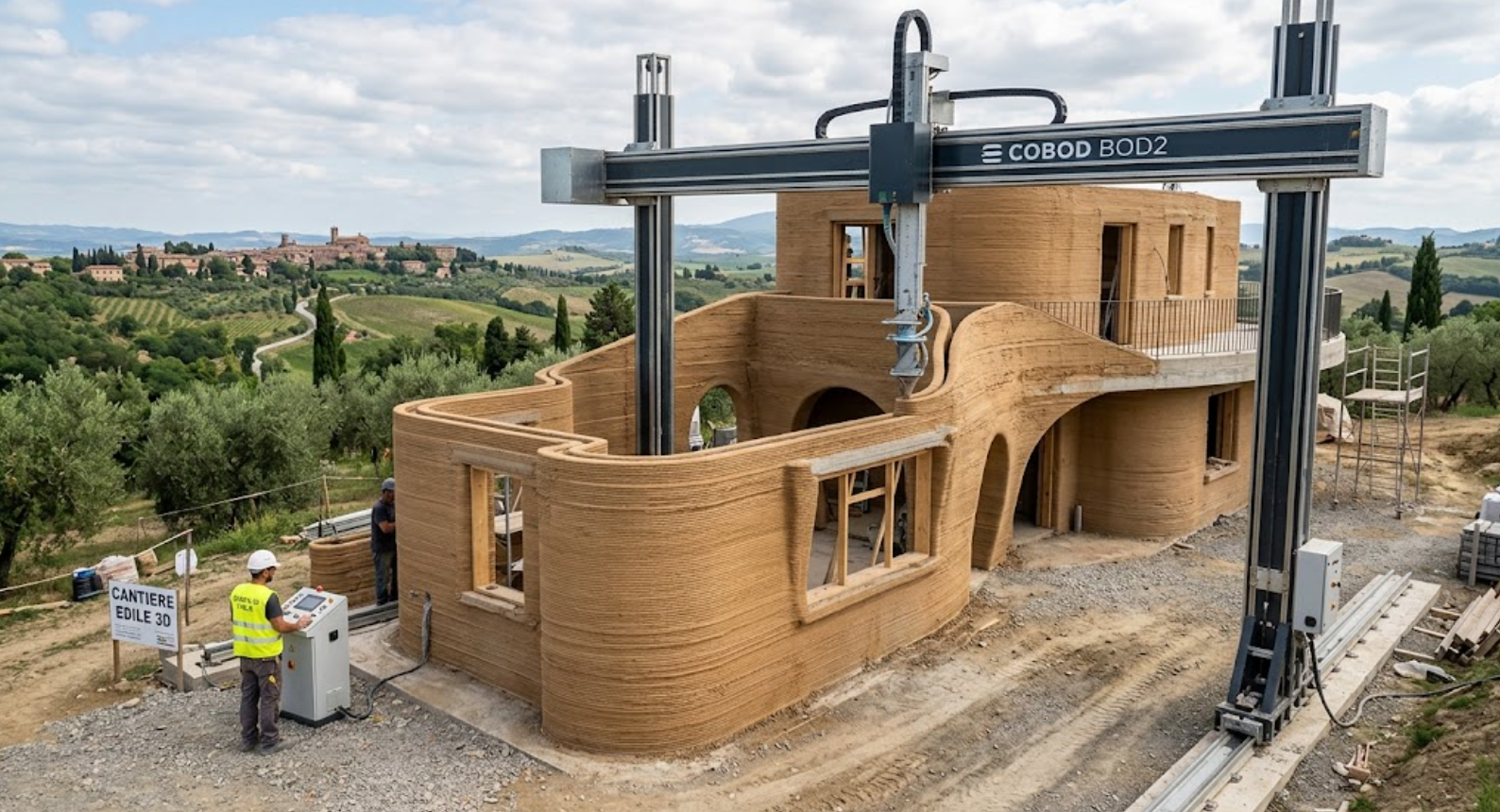
Would you inhabit a 3D-printed house erected in eight days? An affordable / mould-resistant / fire-resistant / seismic-resistant / climate-disaster-resilient house. SOURCE: https://www.facebook.com/reel/1420242892872158 A 3D-printed house that genuinely resolves the global housing crisis!!! What you are viewing in the video is no mere exhibition prototype. It is House Zero — the first luxury 3D-printed residence realised in Austin, Texas, by the American firm ICON in collaboration with the practice Lake|Flato Architects. Two hundred square metres, three bedrooms, a drawing room with exposed beams, a designer kitchen, and an independent casita in the garden. Its iconic undulating walls were extruded in a mere eight to ten days. A project so revolutionary as to have been included in TIME's list of the Best Inventions of 2022. But what does it truly signify to dwell in a 3D-printed house? WHAT A 3D-PRINTED HOUSE IS: No bricks or formwork are employed. An enormous robotic arm — ICON's Vulcan system — deposits, layer upon layer, a proprietary special concrete, Lavacrete, a material engineered to be eminently resistant, insulating, and printable. The entire process is governed by software that adjusts the formula every fifteen minutes according to weather conditions. Plaster and structure become one and the same. WHY IT IS THE FUTURE OF CONSTRUCTION: ALL THE ADVANTAGES 1. Record times: The walls of House Zero were completed in eight days, as opposed to the months required by a traditional building site. The site operates twenty-four hours a day, seven days a week, and never ceases for lack of labour. 2. Less waste and greater sustainability: Additive printing uses only the material that is necessary. Site waste and emissions from material transport are reduced to nigh on zero. Moreover, Lavacrete is designed for superior energy efficiency. 3. Lower costs (potentially): Fewer workmen on site, fewer deaths and injuries at work, less time, fewer errors. According to ICON, the system can substantially curtail construction costs and render housing more accessible. 4. Total architectural liberty: The curves, the fluted walls, the integrated niches you see in the video would be exorbitantly expensive or impossible by traditional methods. With 3D printing, form truly follows function. 5. Resilience and insulation: The walls in printed reinforced concrete are more resistant to fire, water, mould, and extreme atmospheric agents, typical of Texas. The thermal inertia of the material guarantees superior insulation. 6. A solution to the housing crisis: It is the technology that ICON is already employing to build entire neighbourhoods of one hundred houses in Texas and for social housing projects in Mexico. The question now is this: having seen it within, would you live in it?