WRLD

Search

#Vecchi
Il Fatto Quotidiano Just Now

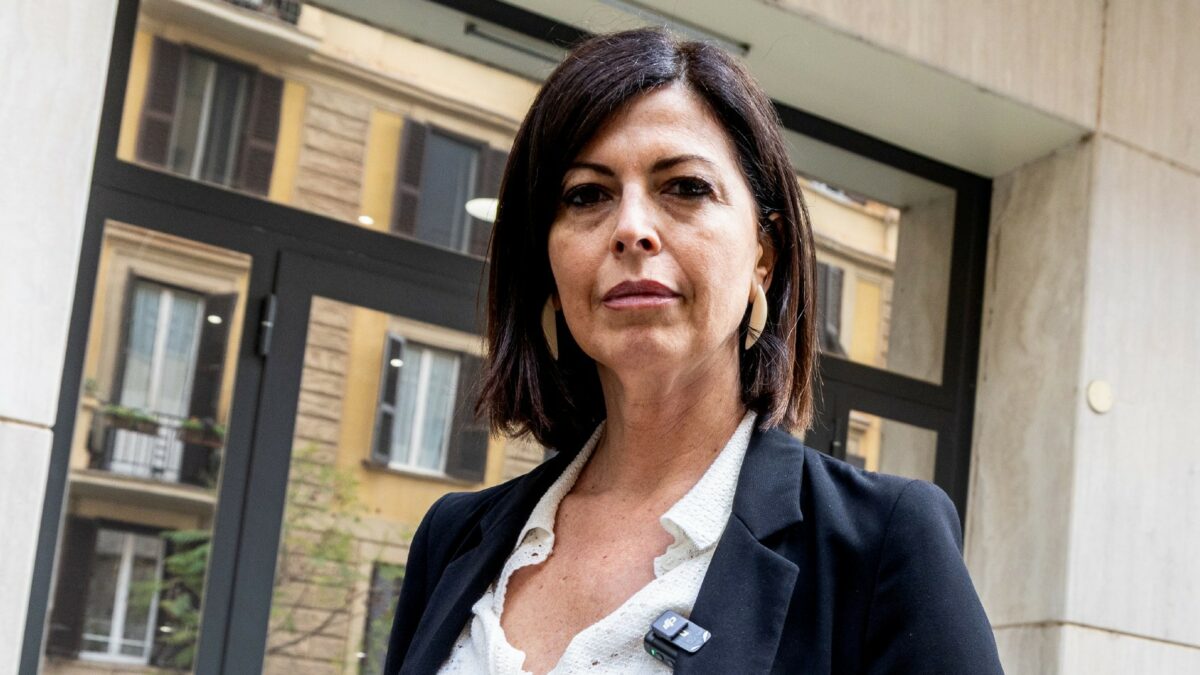
Senator M5s Barbara Floridia defends Il Fatto Quotidiano from the assault of Leonardo Maria Del Vecchio, warning that the concentration of media ownership threatens pluralism and the autonomy of information. #LibertàDiStampa #Pluralismo #Movimento5Stelle (translated)
www.ilfattoquotidiano.it
Floridia (M5s): “L’assalto di Del Vecchio al Fatto? Tutelare la stampa indipendente dai ratti del capitalismo”
1040
Bonifacio Castellane 1h

Bonifacio Castellane argued that elections conferred power only in a formal sense, while in his opinion it was the elites that determined its allocation. He pointed out as instruments of power the loss of an election, the failure to respect human rights in the case of vaccination mandates, and the use of the penal code against enemies, with its suspension for friends. He wrote that elites fell when a new elite took the place of the previous one. #potere #élite #dirittiumani (translated)

1346
L
lastampa.it 22h

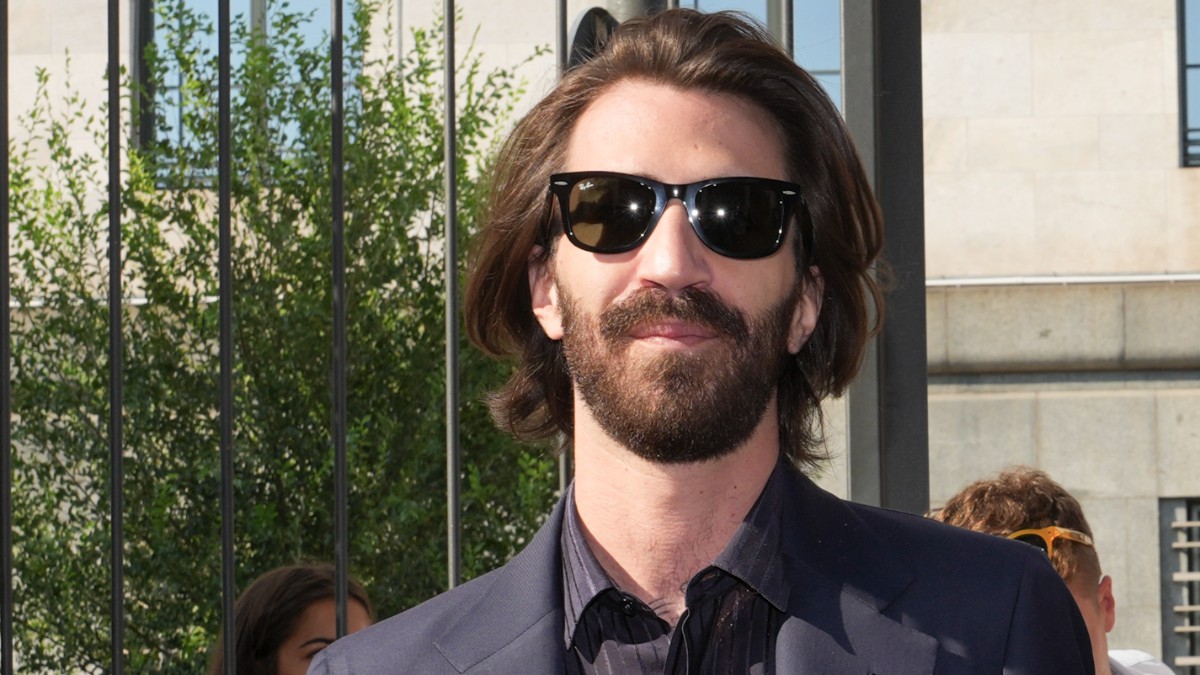
Leonardo Maria Del Vecchio, after the rejection of the founding partners to the public offer on Il Fatto Quotidiano, declares that the newspaper represents a valuable asset of Italian journalism to be preserved, highlighting the importance of Marco Travaglio's leadership and the necessity of ensuring the financial stability of the group. #FattoQuotidiano #LmdvMedia #GiornalismoIndipendente (translated)

www.lastampa.it
Del Vecchio sul Fatto Quotidiano dopo il no dei soci all’Opa: “Patrimonio del giornalismo”
2201
L
lastampa.it 1d

Leonardo Maria Del Vecchio announces due diligence aimed at launching a takeover bid for Fatto Quotidiano, sparking accusations and controversies between the founders of the newspaper and the entrepreneur, who complains of being the subject of negative articles. #delvecchio #giornalismo #inchieste (translated)

www.lastampa.it
Le inchieste, le intercettazioni e Selvaggia Lucarelli: il blitz di Del Vecchio sul Fatto Quotidiano
2273
L
lastampa.it 1d

Leonardo Maria Del Vecchio is studying a public takeover offer for Il Fatto Quotidiano, but the founding partners have already stated their intention not to sell their shares. #Opa #FattoQuotidiano #Media (translated)

www.lastampa.it
Del Vecchio studia l’Opa sul Fatto Quotidiano. I soci fondatori: “Non vendiamo”
2332
Ottobre Rosso 1d

Red October wrote that Luiz Inácio Lula da Silva would be remembered as an old worker who had challenged and defeated, according to the author, the immense media and financial power of Zionism and the United States. He added that history had already made him immortal and that his memory would last for centuries. https://t.co/8mRLHzsnvs #Lula #Storia #Giustizia (translated)

2979
Il Fatto Quotidiano 2d

Leonardo Maria Del Vecchio wishes to acquire Il Fatto, but the founding shareholders have stated that they are not interested in selling their shares. #IlFattoQuotidiano #LeonardoMariaDelVecchio #acquisizione (translated)

www.ilfattoquotidiano.it
Leonardo Maria Del Vecchio vuole comprare Il Fatto. Gli azionisti fondatori: “Non siamo interessati a cedere le nostre quote”
2575
Luciano Magaldi Sardella (PhD) 2d

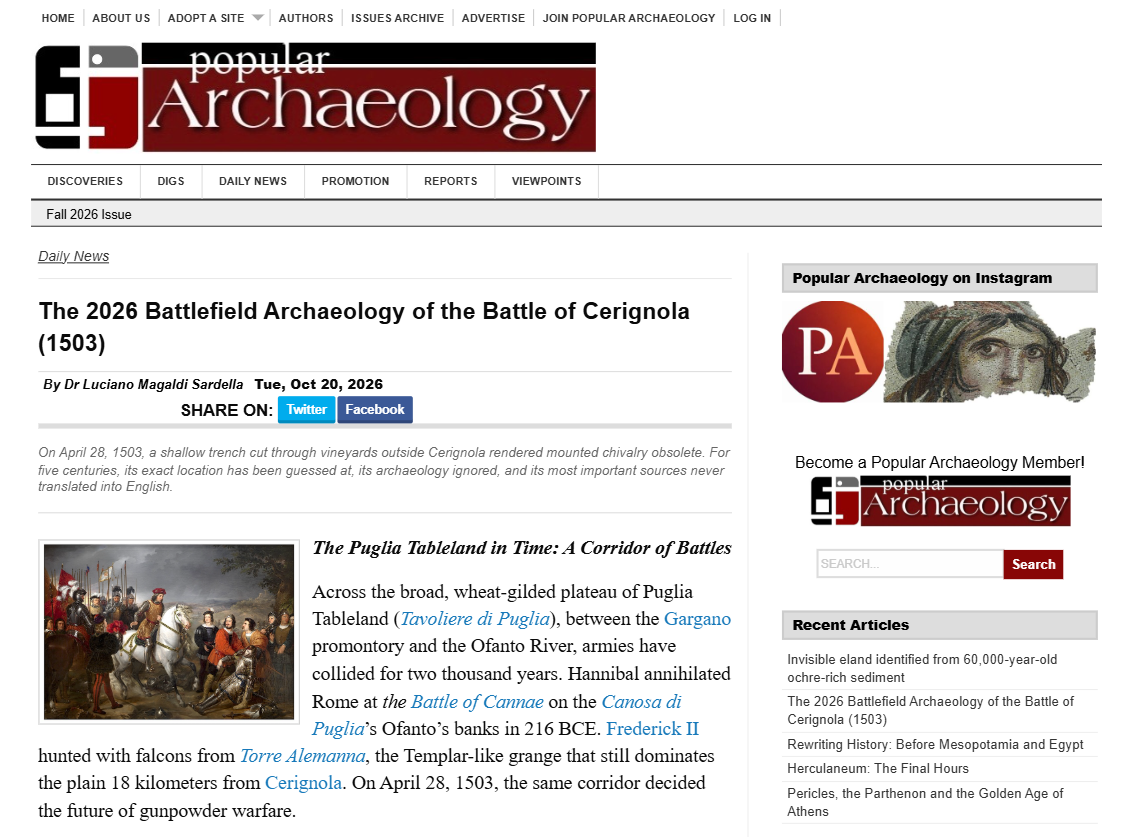
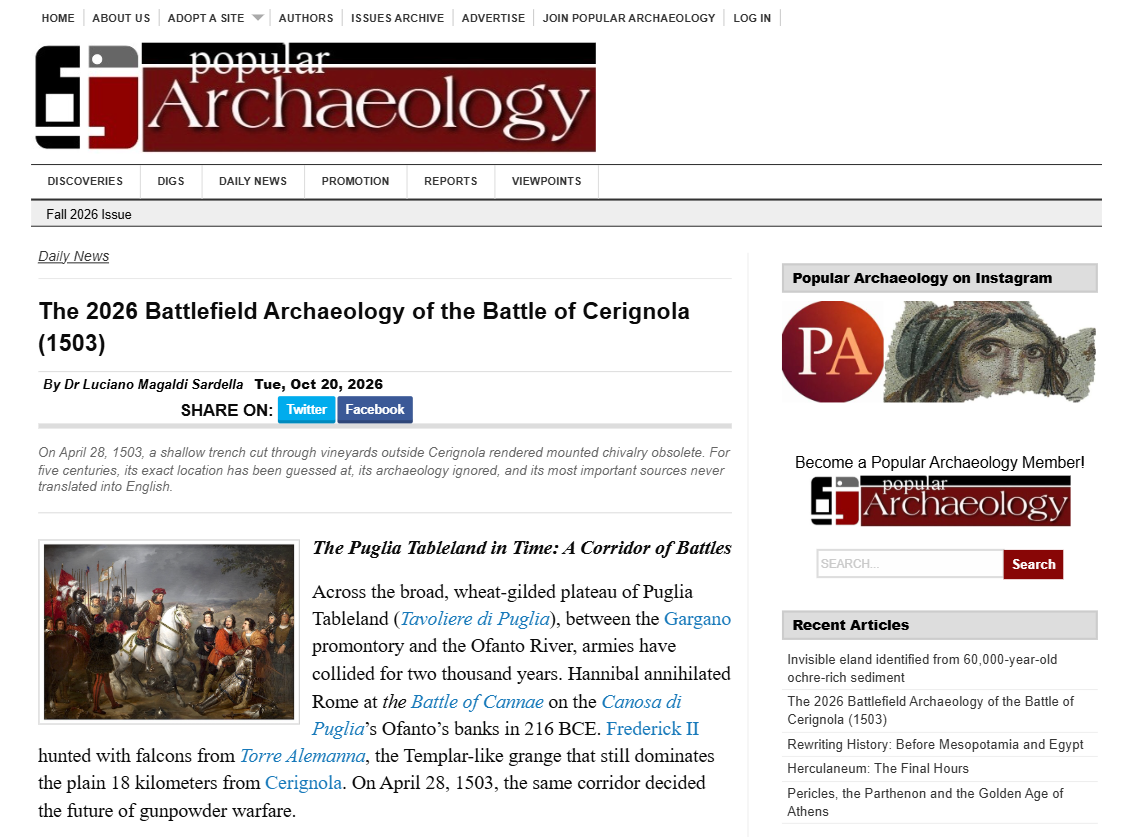
THE "BATTLE OF CERIGNOLA (1503)" ON "POPULAR ARCHAEOLOGY USA" (by LUCIANO MAGALDI SARDELLA) SOURCE 1: https://popular-archaeology.com/author/sardella/ SOURCE 2: https://popular-archaeology.com/article/the-2026-battlefield-archaeology-of-the-battle-of-cerignola-1503/ -------------------------------------------------------------------- CERIGNOLA (FG) — On April 28, 1503, at sunset, a shallow trench cut between the vineyards outside Cerignola rendered heavy cavalry obsolete. For five centuries, its exact location has only been conjectured, its archaeology ignored, its most important sources never translated into English. We are on the Tavoliere of Puglia, a corridor of battles for two thousand years: from Cannae in 216 BC to the falcon hunt of Frederick II from Torre Alemanna. Cerignola, at that time, was not a city but a rural village of 350 families at 120 meters above sea level, custodian of the Mena della Dogana delle Pecore, the great pastoral system of transhumance that financed the Kingdom of Naples. Its possession was fiercely contested. Facing each other were two worlds. Louis d’Armagnac, Duke of Nemours, Viceroy of Naples for Louis XII, in his thirties, splendidly armored, confident of victory. On the other side was Gonzalo Fernández de Córdoba, the Gran Capitán, who on April 27-28 marched from Barletta with about 9,000 exhausted men and decided to settle on a low ridge. He deepened what was already there: not an invention, but an agricultural ditch. The French gendarmes, the last heirs of the medieval knight, lowered their lances and never reached the line. From behind a parapet reinforced with vine stakes, over 1,000 Spanish arquebusiers opened fire. Nemours fell, almost certainly the first European army commander to die from a portable firearm. With him, the charge of cavalry as a dominant tactic died. And here is the scandal denounced by the article: no cartographer of the 17th-18th centuries ever mapped the battlefield. No monument commemorates it. It is not protected as a cultural landscape under the Code of Cultural Heritage. Every deep plowing of the Tavoliere, standard practice since the Bourbon reforms, destroys an archaeology never recorded. Yet the perimeter can be reconstructed. By cross-referencing the 16th-century descriptions of "vine-covered slopes fifteen miles north of the Ofanto" with the Via Traiana, the engagement area is a rectangle of 3-4 square kilometers northeast of the current settlement. With the 1m LiDAR DTM from ISPRA, it could reveal anomalous linear depressions, and the lower filling of a ditch 2-3 meters deep, under the plowed layer, is still readable with magnetometry and ground radar. Why did we arrive late? Not for lack of sources, but for lack of translation. The Municipality of Cerignola and the Torre Alemanna Research and Study Center of Prof. Matteo Stuppiello, who in 1978 obtained the first monumental protection for Torre Alemanna, have digitized a corpus that has never entered Anglophone historiography. Here are the 3 pillars: 1. The letter that still smells of gunpowder. The “Letter from Consalvo de Córdoba to the Spanish royals dated April 29, 1503,” edited by Stuppiello in 2003 and updated to 2025 on comune.cerignola.fg.it/biblioteche-digitali. A handwritten page written in Cerignola the day after the battle, “rich in flashes, twilight lights, and gunfire.” Not a polished chronicle like that of Giovio, but a field dispatch: the fatigue of the night march, the decision to entrench upon arrival, the recovery and honorable burial of Nemours, the intact capture of the French artillery. 2. The graffiti, a monument inside the monument. In the 14th-century church of Santa Maria delle Grazie, known as the Incoronatella, on the Via Trinitapoli Vecchia, where tradition holds that the body of Nemours was brought. On the triumphal arch, a 1503 graffiti gives, in almost notarized form, the date, sixth indiction, Friday at the hour XXIII-XXIIII. It was indeed Friday, as confirmed by the perpetual calendar of Cappelli. Decoded in 1995 by Prof. Francesco Magistrale, Latin paleographer at the University of Bari, in *The Battle of Cerignola (1993)* and in the municipal monograph *S.M. delle Grazie (1999)*. Today it is fading due to humidity and neglect. 3. The land registry that explains the ditch. The Survey of 1672 preserved at the State Archive of Naples, Pignatelli Aragona Cortes fund, Scanzia 63, fasc.1: “At the time of the battle, thick vineyards covered the hill reaching to the plain, and were distinctly separated from the rest of the countryside by a not very deep ditch.” Córdoba did not improvise; he adapted. This is confirmed by the catasti of the Giustiniani: 277 households in 1532, 699 in 1595. The landscape of 1503 was intensely horticultural, not the deeply plowed monoculture of today. In addition to these, there is the first monograph by Vincenzo Buonassisi, *The Battle of Cerignola* (1908, died in Via Fanfulla 10 on June 27, 1928), and the first modern military analysis by Piero Pieri, “Consalvo de Córdoba and the Battle of Cerignola,” Archivio Storico Pugliese 1952, which 30 years before the Anglophone rediscovery of the “pike-and-shot” defined Cerignola as an engineered killing ground. While Cerignola forgot, others remembered. The “Regimiento de Infantería Cerinola n.42”, later “Fuerteventura n.56”, carried the name of Cerignola until the 20th century. The coat of arms, described in *Heraldica e Historiales del Ejercito, Tomo V” (Madrid, 1981): silver field, dying white swan entangled in a hedge, golden wall crown, with the scroll “Cerignola.” Dossier officially transmitted on April 30, 1986, prot. 4565/509, from the Servicio Histórico Militar of Madrid to the Torre Alemanna Center thanks to Col. Alessio Antonutti and Gen. José Cifuentes. And in Amsterdam, at the Rijksmuseum, the anonymous bronze commemorative medal: Hercules with lion skin and club and Janus with the keys next to an eagle-armed coat of arms, legend “Consalvus Agidarius… Janum clausit,” on the reverse a battle scene “Consalvi Agidari Victoria de Gallis ad Cannas,” an artist's mistake that confuses Cerignola with Cannae. It belonged to Mrs. J.M. van Gelder-Nijhoff, donated in 1885. The author's conclusion is clear: Gonzalo's ditch is the most consequential earthwork in European military history. It inaugurates the infantry armed with firearm and conditions the Mediterranean for 160 years. It may still be there, filled, plowed, invisible to the naked eye but accessible to a magnetometer. It is not a matter of medieval archaeology but of the will to protect. (translated)

217
Luciano Magaldi Sardella (PhD) 2d

THE “BATTLE OF CERIGNOLA (1503)” ON “POPULAR ARCHAEOLOGY USA” (by LUCIANO MAGALDI SARDELLA) SOURCE 1: https://popular-archaeology.com/author/sardella/ SOURCE 2: https://popular-archaeology.com/article/the-2026-battlefield-archaeology-of-the-battle-of-cerignola-1503/ __________________________________________________________________ CERIGNOLA (FG) — On 28 April 1503, at sunset, a shallow trench cut through the vineyards outside Cerignola rendered heavy cavalry obsolete. For five centuries its exact position has been merely conjectured, its archaeology ignored, its most important sources never translated into English. We are on the Puglian Tablelanda, a corridor of battles for two thousand years: from Cannae in 216 BC to Frederick II’s falconry from Torre Alemanna. Cerignola, at that time, was not a town but a rural hamlet of 350 families at 120 metres above sea level, guardian of the Mena of the Dogana delle Pecore, the great customs system of transhumance that financed the Kingdom of Naples. It was for its possession that the battle was fought. Opposed, two worlds. Louis d’Armagnac, Duke of Nemours, Viceroy of Naples for Louis XII, thirty years old, splendidly armed, certain of victory. On the other side, Gonzalo Fernández de Córdoba, the Great Captain, who on 27–28 April marches from Barletta with some 9,000 exhausted men and decides to entrench himself upon a low ridge. In front of it he has deepened what was already there: not an invention, but an agrarian ditch. The French gendarmes, the last heirs of the mediaeval knight, lower their lances and never reach the line. From behind an embankment reinforced with vine stakes, more than 1,000 Spanish arquebusiers open fire. Nemours falls, almost certainly the first European army commander to die by a portable firearm. With him dies the cavalry charge as a dominant tactic. And here lies the scandal denounced by the article: no cartographer of the seventeenth or eighteenth century ever mapped the field. No memorial stone recalls it. It is not protected as a cultural landscape under the Code of Cultural Heritage. Every deep ploughing of the Tavoliere, standard practice since the Bourbon reforms, destroys an archaeology never recorded. Yet the perimeter is reconstructable. By cross-referencing sixteenth-century descriptions of “slopes covered with vineyards fifteen miles north of the Ofanto” with the Via Traiana, the engagement zone is a rectangle of 3–4 sq km to the north-east of the present settlement. With ISPRA’s 1m DTM LiDAR, anomalous linear depressions could be revealed, and the lower fill of a 2–3 metre ditch, beneath the ploughed layer, is still legible by magnetometry and ground-penetrating radar. Why have we arrived so late? Not for lack of sources, but for lack of translation. The Comune di Cerignola and the Centro Studi e Ricerche Torre Alemanna of Prof. Matteo Stuppiello, who in 1978 obtained the first monumental protection for Torre Alemanna, have digitised a corpus that has never entered Anglophone historiography. Here are the 3 pillars: 1. The letter that still smells of powder. The “Letter of Consalvo da Cordova to the Sovereigns of Spain of 29 April 1503,” edited by Stuppiello in 2003 and updated in 2025 on comune.cerignola.fg.it/biblioteche-digitali. A manuscript page written at Cerignola the day after the battle, “rich in flashes, twilight gleams, and gunfire.” Not a polished chronicle à la Giovio, but a field dispatch: the exhaustion of the night march, the decision to entrench upon arrival, the recovery and honourable burial of Nemours, the intact capture of the French artillery. 2. The graffito, a monument within the monument. In the fourteenth-century church of Santa Maria delle Grazie, known as the Incoronatella, on the Via Trinitapoli Vecchia, where tradition holds the body of Nemours was taken. On the triumphal arch, a graffito of 1503 gives in quasi-notarial form the date, sixth indiction, Friday at the twenty-third to twenty-fourth hour. It truly was a Friday, as confirmed by Cappelli’s perpetual calendar. Deciphered in 1995 by Prof. Francesco Magistrale, Latin palaeographer at the University of Bari, in La Battaglia di Cerignola (1993) and in the municipal monograph S.M. delle Grazie (1999). It is now fading through damp and neglect. 3. The cadastre that explains the ditch. The Apprezzo of 1672 preserved in the Archivio di Stato di Napoli, fondo Pignatelli Aragona Cortes, Scanzia 63, fasc.1: “At the time of the battle, dense vineyards covered the hill reaching down to the plain, and were clearly separated from the rest of the countryside by a not very deep ditch”. Córdoba did not improvise; he adapted. This is confirmed by the Giustiniani cadastres: 277 hearths in 1532, 699 in 1595. The landscape of 1503 was one of intensive horticulture, not the deep-ploughed cereal monoculture of today. To these are added the first monograph by Vincenzo Buonassisi, La Battaglia di Cerignola (1908, died at Via Fanfulla 10 on 27 June 1928), and the first modern military analysis by Piero Pieri, “Consalvo di Cordova e la battaglia di Cerignola”, Archivio Storico Pugliese 1952, which 30 years before the Anglophone rediscovery of “pike-and-shot” defined Cerignola as an engineered killing ground. While Cerignola forgot, others remembered. The “Regimiento de Infantería Cerinola n.42”, later “Fuerteventura n.56”, bore the name of Cerignola until the twentieth century. Its coat of arms, described in Heráldica e Historiales del Ejército, Tomo V (Madrid, 1981): argent field, a dying white swan entangled in a hedge, a gold mural crown, with scroll “Cerignola”. Dossier officially transmitted on 30 April 1986, prot. 4565/509, by the Servicio Histórico Militar in Madrid to the Centro Torre Alemanna through Col. Alessio Antonutti and Gen. José Cifuentes. And in Amsterdam, in the Rijksmuseum, the anonymous commemorative bronze medal: Hercules with lion-skin and club and Janus with keys beside an eagled coat of arms, legend “Consalvus Agidarius… Janum clausit”, on the reverse a battle scene “Consalvi Agidari Victoria de Gallis ad Cannas” — an error by the artist who confuses Cerignola with Cannae. It belonged to Mrs J.M. van Gelder-Nijhoff, donated in 1885. The author’s conclusion is unequivocal: Gonzalo’s ditch is the most consequential earthwork in European military history. It inaugurates the infantryman armed with a firearm and conditions the Mediterranean for 160 years. It may still be there, infilled, ploughed over, invisible to the naked eye but accessible to a magnetometer. It is not a question of mediaeval archaeology but of the will to protect.

217
Timostene 2d

Timostene argued that after the attacks and coup attempts of the 1970s, Italian democracy was gradually being hollowed out through a more gradual process. In his opinion, Silvio Berlusconi's televisions in the 1980s and later social media had weakened critical and civic consciousness, turning public debate into a clash between fan bases. To support his thesis, he cited a study by three Italian economists published in 2019, which suggested that those who watched those televisions as children grew up with fewer critical tools and civic sense. Timostene also stated that in an increasingly older and frightened country, elections could be easily won and that Parliament had been progressively emptied: he pointed out that there were almost three votes of confidence a month and laws that, in his opinion, were partly declared unconstitutional by the Constitutional Court and then reintroduced by the government. By citing the security decrees, the presence of the military in the streets, and attempts to amend the Constitution by majority vote, he spoke of a plan financed by a black international. He concluded that what the bombs had failed to achieve was being accomplished by a screen. #Democrazia #Libertà #Politica (translated)

3221
Luciano Magaldi Sardella (PhD) 7d

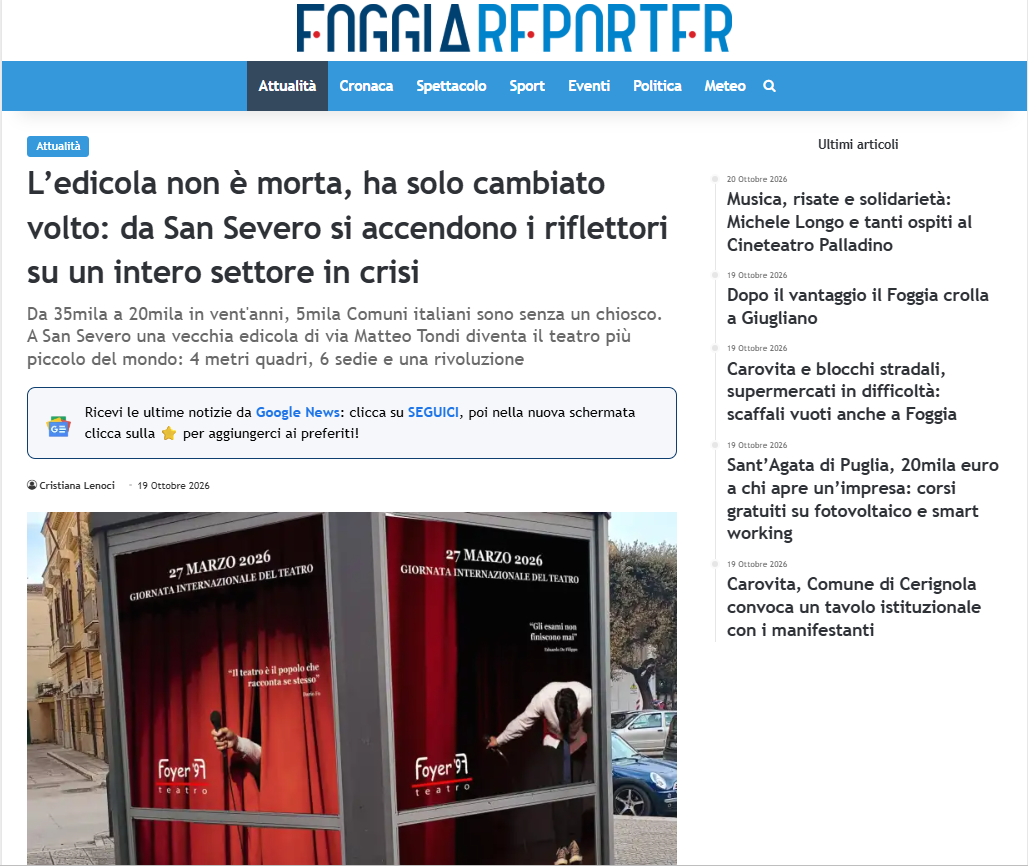
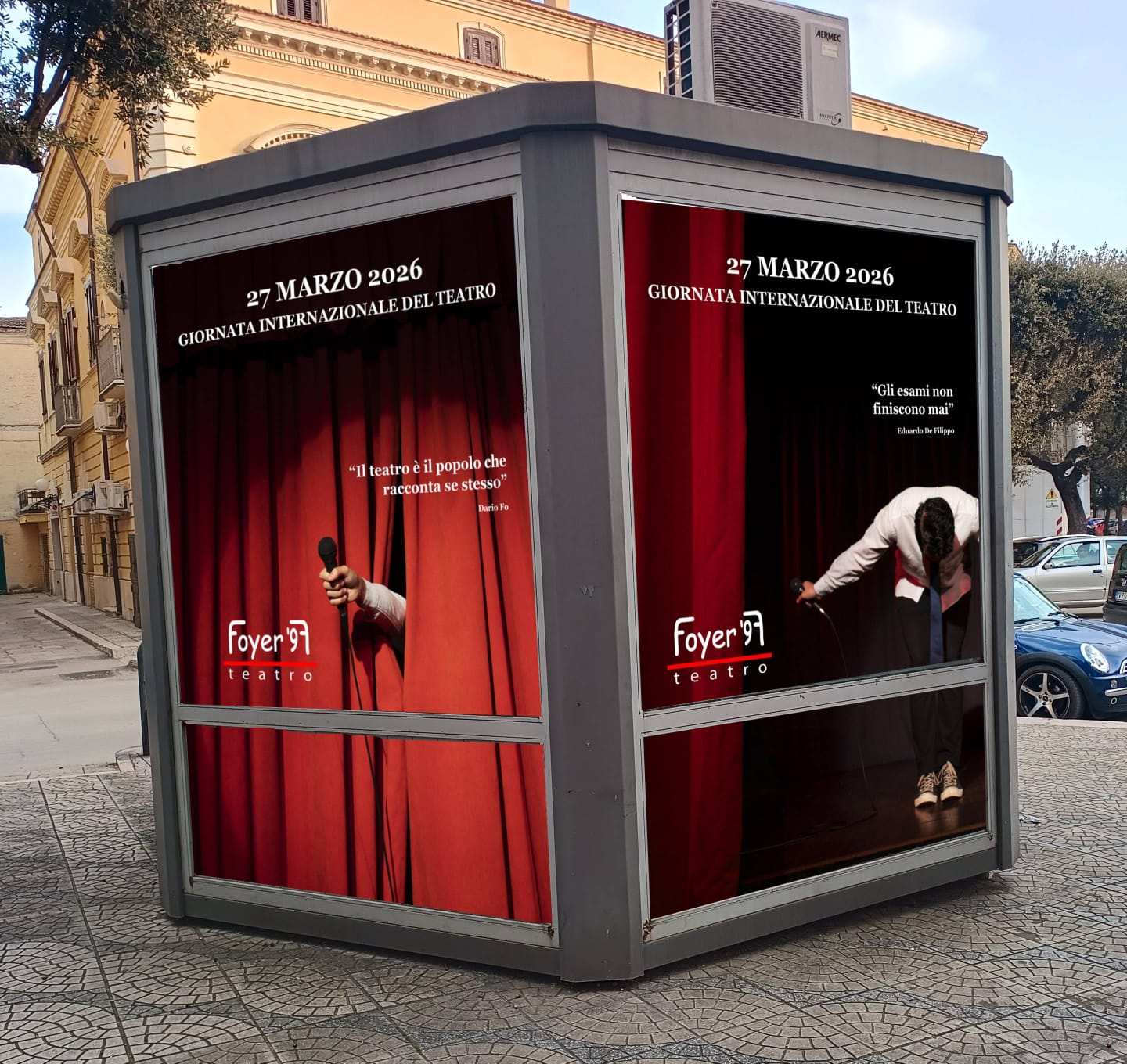
FOGGIA REPORTER: "THE NEWSSTAND IS NOT DEAD, IT HAS ONLY CHANGED ITS FACE: SAN SEVERO SHEDS LIGHT ON AN ENTIRE SECTOR IN CRISIS" by CRISTIANA LENOCI SOURCE: https://www.foggiareporter.it/ledicola-non-e-morta-ha-solo-cambiato-volto-da-san-severo-si-accendono-i-riflettori-su-un-intero-settore-in-crisi.html SAN SEVERO (FG) — From 35,000 to 20,000 in twenty years, 5,000 Italian municipalities are without a newsstand. In San Severo, an old newsstand on via Matteo Tondi becomes the smallest theater in the world: 4 square meters, 6 chairs, and a revolution. For sixty years, it was the place to pick up the newspaper, ask about the results of the game, leave keys with a neighbor. Then the shutter went down, the glass became opaque, the sign faded. This is how newsstands are ending in Italy today. But sometimes, this is how they are reborn. In San Severo, on via Matteo Tondi, an abandoned newsstand for six years became on March 27, 2026, World Theater Day, the Teatro Edicola Foyer ’97. Four square meters, six chairs, fifteen-minute shows. An idea by director and artistic director Francesco Gravino and his company Foyer ’97. They have called it “the smallest theater in the world,” and the news has circulated among international agencies, becoming a case study for the Stanford Social Innovation Review with the report “The Six-Seat Revolution.” An old newsstand that returns to being what it has always been: a place of knowledge, culture, and work. Only now it distributes stories instead of newspapers. A sector at risk of disappearing The story of San Severo sheds light on a silent hemorrhage. We had 35,000 newsstands in 2005, and we have about 20,000 in 2024: -43%. According to FENAGI data released in 2026, the points of sale in 2025 were about 19,500, but only 6,000 were exclusive traditional newsstands. The most painful statistic is geographic: nearly 5,000 Italian municipalities no longer have a newsstand. In two out of three municipalities, there is no longer a point of sale for newspapers and magazines. Other tallies, those from Sinagi, report a collapse from 38,000 exclusive newsstands to about 11,000 still active. In the last four years, from 2019 to 2023, almost 2,700 newsstands have disappeared, of which 2,327 were individual businesses. Rome lost 303, Turin 138, Milan 129. Isernia lost more than a third of its newsstands in four years. Why? Decline in paper sales, digital subscriptions, rising management costs, reduced profitability. In economics, it's called a "falling demand sector." On the street, it is simply called the end of a habit. Not just newspapers Yet the newsstand has never been only about newspapers. In the past, it was an information outpost, a reference point, the guardian of a neighborhood. It was self-employment, often familial, involving early mornings at 4 a.m. to be ready when the city wakes up. Today, those who resist reinvent themselves: local bookstore, service point, package pickup, ticket sales, coffee corner. Those who can't make it, close. The example of Foyer 97 in San Severo tells us one simple and uncomfortable truth: we cannot save all newsstands as newsstands. But we can save their essence. A 4-square-meter kiosk in Puglia becoming a theater reminds us that those few square meters are worth more than the rent they no longer pay. They are valuable because they are already where people pass by. They are already recognized as a public place. They are already culture, even when they no longer sell culture on paper. If newsstands stop selling newspapers, they do not necessarily have to stop selling knowledge. (translated)

www.foggiareporter.it
L'edicola non è morta, ha solo cambiato volto: da San Severo si accendono i riflettori su un intero settore in crisi - Foggia Reporter
681
Il Post 1w

The new publisher of the Monrif group newspapers, Leonardo Maria Del Vecchio, has announced significant investments and improvements for journalists, including business travel and an increase in the sales bonus, bringing the total amount to 800 thousand euros. #giornalismo #Monrif #LeonardoMariaDelVecchio (translated)

www.ilpost.it
Sarà tre volte Natale
2842
Il Fatto Quotidiano 1w

The article presents ten proposals for a progressive program aimed at favoring wages, reducing tax evasion, and restoring the old citizenship income, advocating the need for economically sustainable and fair measures to improve the Italian economy. #Economia #Progressismo #Salari (translated)

www.ilfattoquotidiano.it
Dieci proposte per un programma progressista: salari, tetto al contante e vecchio reddito di cittadinanza
2618
ANSA.it 2w

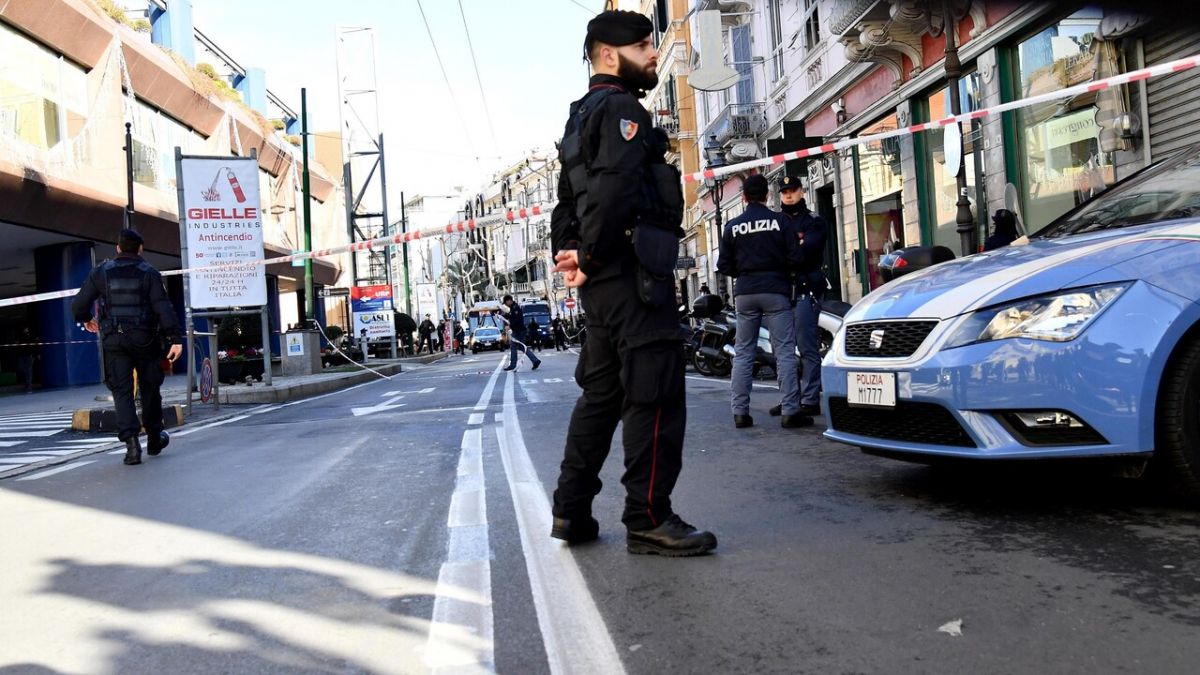
A 13-year-old boy set fire to a homeless man while he was sleeping at the old port of Sanremo, causing burns to his legs, and the carabinieri are currently investigating the incident. #Sanremo #Clochard #Aggressione (translated)

www.ansa.it
Ragazzino dà fuoco a un clochard e gli brucia le gambe
2059
Il Fatto Quotidiano 2w

The investigation into the extortion against Leonardo Maria Del Vecchio is heading toward trial after the conclusion of the investigations involving a former collaborator, a former spy, and a hacker, accused of unauthorized access and of having created a stolen reputational archive. #Giustizia #Estorsione #Luxottica (translated)

www.ilfattoquotidiano.it
Equalize, chiuse le indagini sull’estorsione a Del Vecchio: verso il processo l’ex collaboratore, l’ex spia De Marzio e l’hacker Calamucci
2748
Il Fatto Quotidiano 2w

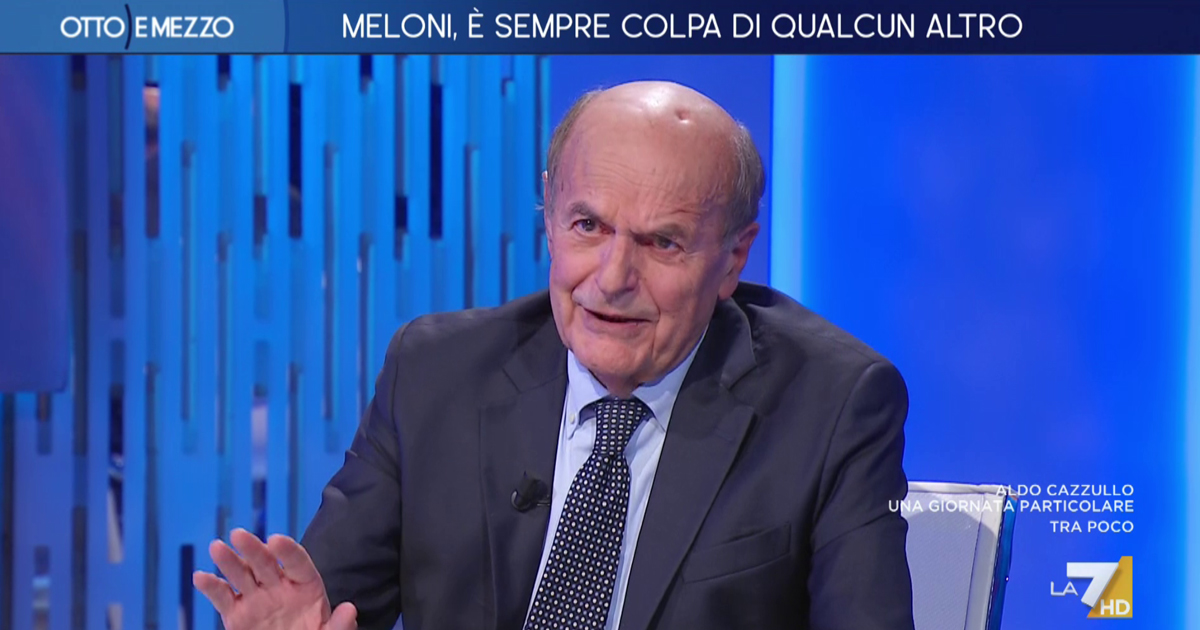
Pier Luigi Bersani, in an interview with La7, rejects the role of unifier of the center-left, emphasizing the importance of giving space to the new generations and the urgency of facing the primaries without reverting to old patterns. #Primarie #Sinistra #Bersani (translated)

www.ilfattoquotidiano.it
Bersani a La7: “Io federatore del centrosinistra? No, bisogna puntare sulle nuove generazioni. Si facciano le primarie in grazia di Dio”
2864
Quintus Poppaedius Silo 2w

Quintus Poppaedius Silo wrote that Italy was beginning to move away from U.S. weapons. He reported that the country would purchase six armed Astore Levante drones, jointly developed by Leonardo and Turkish Baykar based on the Bayraktar TB3. According to Silo, the drones would replace the old American MQ-1 Predators, capable of flying for over 24 hours and carrying a payload of 280 kg. He called the choice a good move for Defense Minister Guido Crosetto and Prime Minister Giorgia Meloni, stating that it would keep both know-how and money in Italy. #Difesa #Droni #Innovazione (translated)

3552
Michele Boldrin 2w

The author wrote that ITA Airways would become part of the Lufthansa group, but would maintain some old habits of Alitalia. #ITAAirways #Alitalia #Lufthansa #IT #DE (translated)

2752
Giorgia Meloni 2w

It is a choice that I consider very risky. Meloni reiterates the necessity for Europe to speak with one voice regarding the conflict in Ukraine, that of an envoy from the Old Continent. #Meloni #Ucraina #Trump (translated)

Meloni contro l'intesa tra Trump e Putin sul gasolio: «È rischiosa e legittima Mosca. Sostegno all'Ucraina, resa non è pace»
www.ilmessaggero.it
3098
Davide Faraone 2w

The author described the scenario of a mob boss who, after twenty or thirty years in prison, returned to the neighborhood he had once commanded and found his role again. According to the post, he would not have needed to present a résumé, participate in a competition, or campaign: it would have been enough for him to return. #mafia #criminalità #ritorno #IT (translated)

3213