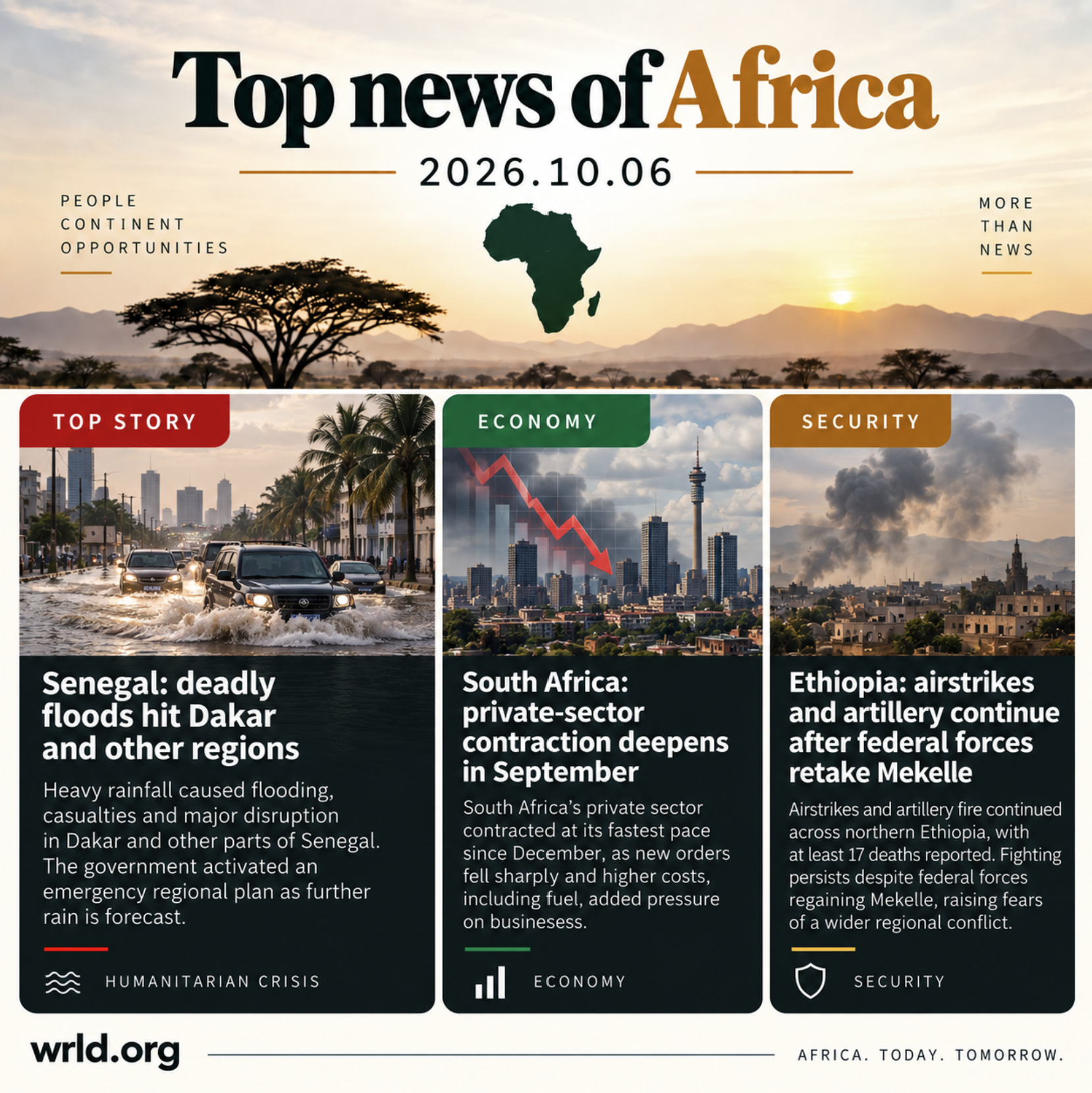
Africa Daily Report — 6 October 2026 Major developments reported during the previous 24 hours. 1. Ethiopia — Airstrikes and artillery continue after federal forces retake Mekelle Airstrikes and artillery fire continued across northern Ethiopia after federal forces regained Mekelle. Reuters reported at least 17 deaths northwest of the Tigrayan capital, with additional casualties reported in Adwa and Sheraro. The renewed fighting is the sharpest escalation since the 2020–2022 war. Ethiopia accuses Eritrea, Sudan and Egypt of supporting the Tigrayan-led rebel alliance; all three deny involvement. Source: https://www.reuters.com/world/africa/airstrikes-artillery-hit-north-ethiopia-after-tigray-capitals-fall-aid-sources-2026-10-05/ 2. Nigeria — Military ATR-42 crashes in Ondo State, killing all 32 aboard Importance: 10/10 — Critical A Nigerian Air Force ATR-42 flying from Benin City toward Lagos crashed near Igbokoda in Ondo State. Reuters reported that all 32 people aboard — 25 passengers and seven crew — were killed. President Bola Tinubu ordered the Air Force to investigate the cause. Source: https://www.reuters.com/world/africa/nigerian-military-helicopter-carrying-32-passengers-crew-members-crashes-2026-10-05/ 3. Senegal — Deadly floods hit Dakar and other regions Importance: 9/10 — Very High Heavy rainfall exceeding 100 mm in several locations caused flooding, casualties, injuries and major disruption in Dakar and other parts of Senegal. Reuters reported deaths and infrastructure damage; Senegal's Interior Ministry confirmed fatalities and injuries, while the government activated an emergency regional plan for Dakar. Further rain was forecast. Source: https://www.reuters.com/business/environment/heavy-rains-lead-to-senegal-floods-government-reports-several-deaths-2026-10-05/ 4. Ethiopia / Red Sea — Abiy reiterates demand for negotiated sea access Prime Minister Abiy Ahmed again said landlocked Ethiopia requires access to the Red Sea and argued that a negotiated, mutually beneficial arrangement is necessary. The statement comes amid deteriorating relations with Eritrea and renewed fighting in Tigray. Eritrea, Egypt, Sudan and Somalia have meanwhile stressed the sovereign role of Red Sea littoral states. Source: https://apnews.com/article/bad74909a59297de524fdf377f0605c2 5. Sudan — US envoy meets army chief Abdel Fattah al-Burhan in Egypt US Senior Advisor for Arab and African Affairs Massad Boulos met Sudanese army chief Abdel Fattah al-Burhan in Egypt. Boulos said Washington would continue working with Egypt and other partners toward a political solution to Sudan's war. The meeting came amid continuing US-backed diplomatic efforts to secure a ceasefire. Source: https://www.aol.com/articles/us-envoy-meets-sudanese-army-224042000.html 6. South Africa — Private-sector contraction deepens in September Importance: 8/10 — High South Africa's private sector contracted at its fastest pace since December, according to September PMI data reported by Reuters. New orders fell sharply while supply-chain disruption and higher costs, particularly fuel costs, added pressure on businesses. Source: https://www.reuters.com/world/africa/south-africa-private-sector-contracts-fastest-pace-since-december-pmi-shows-2026-10-05/ 7. Somalia — IMF cuts 2026 growth forecast to 2.3% Importance: 8/10 — High The IMF expects Somalia's economy to grow by only 2.3% in 2026, citing sharp reductions in foreign aid, recurrent climate shocks, spillovers from the Middle East conflict and domestic uncertainty. Inflation is projected at 6.5%, while growth is expected to recover gradually in 2027 and over the medium term. Source: https://www.channelafrica.co.za/channelafrica/news/imf-cuts-somalias-2026-growth-forecast-to-2-3/ 8. Guinea — Opposition leader Aliou Bah released following presidential pardon Opposition leader Aliou Bah, head of the Liberal Democratic Movement, was released after receiving a presidential pardon. He had been detained since December 2024 and was serving a two-year sentence for offences linked to remarks about President Mamadi Doumbouya. His case had also reached the ECOWAS Court of Justice, which had sought his release. Source: https://www.africanews.com/2026/10/05/guinea-opposition-leader-aliou-bah-freed-after-presidential-pardon/ 9. Uganda / African security — Kampala hosts conference on emerging security threats Importance: 7/10 — High Uganda opened a four-day Conference on Military Operations Other Than War, bringing together defence and security representatives from African states and regional organizations. The agenda covers cybersecurity, AI, unmanned systems, terrorism, disaster response, climate security, maritime and border security, critical infrastructure and pandemics. Source: https://ubc.go.ug/2026/10/05/uganda-hosts-inaugural-conference-on-military-operations-other-than-war/ 10. West Africa — BCEAO authorises 175 institutions for interoperable instant payments Importance: 8/10 — High The Central Bank of West African States has authorised 175 institutions to participate in the region's interoperable instant-payment ecosystem. Participants include banks, electronic-money institutions, fintech companies and microfinance institutions, broadening the infrastructure for cross-provider digital payments across the West African Monetary Union. Source: https://techafricanews.com/2026/10/05/bceao-authorises-175-institutions-interoperable-instant-payments/ #Africa #AfricaNews #TopNewsOfAfrica #Senegal #Dakar #SenegalFloods #Floods #HeavyRain #ExtremeWeather #ClimateRisk #HumanitarianCrisis #SouthAfrica #SouthAfricaEconomy #PMI #PrivateSector #EconomicContraction #AfricanEconomy #Business #Ethiopia #Tigray #Mekelle #EthiopiaConflict #Airstrikes #Artillery #FederalForces #RegionalSecurity #HornOfAfrica #AfricanSecurity #Geopolitics #wrldorg
The author said they were challenging what they described as Russian lies about territorial control in Ukraine and analyzing what a freeze along the contact line could mean if a ceasefire were agreed. They also shared a link to their video analyses of Russia’s war in Ukraine, available in AI-supported English. https://t.co/XjX22teutS #Ukraine #Russia #Ceasefire #RU #UA #GB
The post said the latest edition of Proximities covered Israel’s killing of eight people in Gaza, which it described as a breach of the “ceasefire”; the possibility that a U.S. peace plan could lead to the de facto partitioning of Sudan; and Iraqis celebrating the withdrawal of U.S. anti-ISIS forces. It said the edition could be read in under two minutes. https://t.co/Ve3VrFBjUQ #Gaza #Sudan #Iraq #IL #US #SD #IQ
The post’s author said Israel had killed another journalist, identified as Mohammed al-Naijar, and called Israel the most prolific killer of journalists in history. The author also claimed there had never been a ceasefire in Gaza. #Gaza #Journalism #HumanRights #IL #PS
🇸🇩🇺🇸 USA zpochybnily legitimitu armádou vedené vlády v Súdánu a zvyšují tlak na generála Abdala Fattáha Burhána, aby přijal americký návrh příměří, který v červenci odmítl. Chartúm to odmítl a trvá na tom, že jakákoli mírová iniciativa musí respektovat „legitimní národní #Sudan #USForeignPolicy #Ceasefire #SD #US
What is Putin’s response to 51 UN Member States calling on Russia to accept a full, immediate and unconditional ceasefire? More ballistic missile strikes on Ukraine. In Kyiv and Odesa, missiles hit a maternity hospital, residential buildings, schools and other civilian #Putin #Ceasefire #UkraineWar #UA #RU #UN
I have seen the destruction in Gaza. Children need more than just survival. They need a real ceasefire. And they need a future. My message at the Call to Action for Palestinian Children in Gaza and the West Bank 👇 #UNGA https://t.co/bKkPDK8PrV #Gaza #Ceasefire #PalestinianChildren #PS #PS
Ukraine agreed to a full, unconditional ceasefire in March 2025. Russia has yet to do the same. Ahead of today’s #UNSC meeting, I joined @andrii_sybiha, @kajakallas, @jnbarrot and fellow foreign ministers in a clear call backed by 51 UN member states. Russia must stop its #UkraineCeasefire #UNSecurityCouncil #RussiaStopAggression #UA #RU
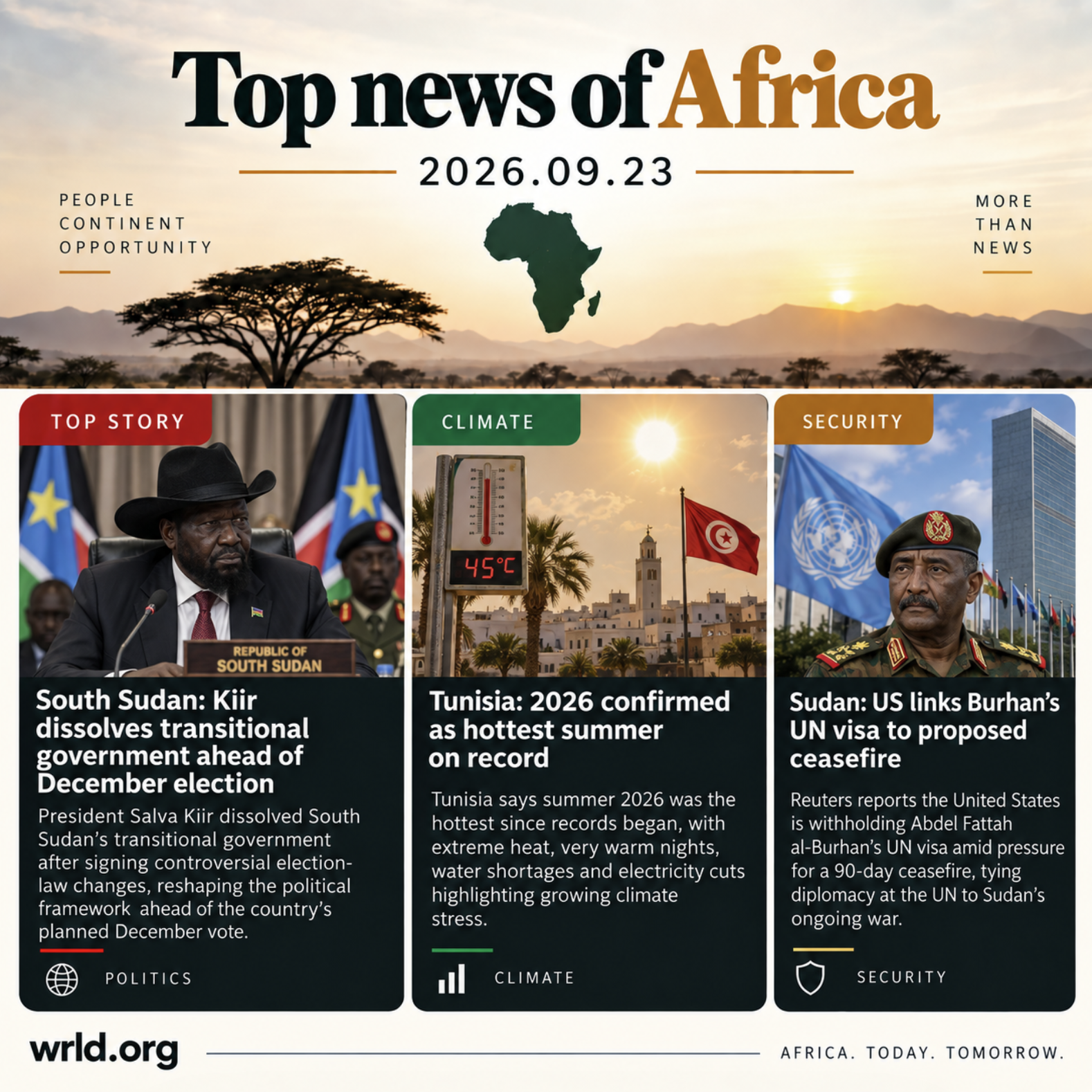
AFRICA DAILY REPORT — 23 SEPTEMBER 2026 Major developments reported during the previous 24 hours 1. SOUTH SUDAN — Kiir dissolves transitional government ahead of December election Importance: 10/10 — Critical President Salva Kiir dissolved South Sudan’s transitional government after signing amendments that remove requirements to complete a permanent constitution and census before the long-delayed national election. The opposition has challenged the changes, while the move fundamentally reshapes the political framework ahead of what is intended to be the country’s first national election since independence. Source: Reuters — https://www.reuters.com/world/africa/south-sudans-president-signs-election-law-changes-ahead-december-vote-2026-09-22/ Additional source: Africanews — https://www.africanews.com/2026/09/22/south-sudan-president-dissolves-govt-as-controversy-engulfs-december-poll/ 2. SUDAN — US links Burhan’s UN visa to proposed ceasefire Importance: 9.5/10 — Very High The United States is withholding a visa for Sudanese army chief Abdel Fattah al-Burhan ahead of the UN General Assembly, according to Reuters sources, in connection with a US-backed proposal for a 90-day ceasefire that Khartoum has resisted. Sudan has asked the UN to intervene, and its foreign minister is expected to address the General Assembly instead if the dispute is not resolved. Source: Reuters — https://www.reuters.com/world/africa/us-withholding-sudanese-leaders-visa-over-ceasefire-plan-sources-say-2026-09-22/ 3. SUDAN — Currency collapse deepens civilian economic crisis Importance: 9/10 — Very High Sudan’s pound has lost nearly half its value in army-controlled territory since May, trading at around 7,500 pounds to the dollar on the black market versus about 4,100 in May. Reuters links the collapse to the economic fragmentation created by the war, reduced state revenues and wartime spending. The depreciation is driving up the cost of basic goods and worsening hardship for civilians and returning refugees. Source: Reuters — https://www.reuters.com/world/africa/currency-collapse-heaps-more-pain-civilians-divided-sudan-2026-09-22/ 4. DR CONGO — Government orders investigation into violence at anti-government protest Importance: 8.5/10 — Very High DR Congo’s justice minister ordered a judicial investigation into violence during the September 15 opposition protest in Kinshasa, including reports of injuries, arrests, property destruction and a death. The demonstration opposed a proposed constitutional change that could allow President Félix Tshisekedi to seek another term. Police used tear gas, while clashes were also reported between opposition demonstrators and pro-government groups. Source: Africanews — https://www.africanews.com/2026/09/22/dr-congo-to-probe-violence-death-of-protestor-at-anti-govt-rally/ 5. RWANDA / BELGIUM — Diplomatic relations restored after 18-month rupture Importance: 8/10 — High Belgium and Rwanda have resumed diplomatic relations 18 months after breaking ties amid their dispute over the conflict in eastern DR Congo. The restoration is diplomatically significant because Belgium has been a prominent European actor in the Great Lakes region and relations deteriorated sharply over allegations concerning Rwanda’s role in the Congolese conflict. Source: Reuters — https://www.reuters.com/world/africa/belgium-rwanda-resume-diplomatic-relations-after-drc-conflict-dispute-2026-09-22/ 6. LIBYA — Armed group shuts pipeline valve, reducing Sharara oil production Importance: 8/10 — High An unidentified armed group closed a valve on the pipeline connecting Libya’s major Al-Sharara oil field with Zawiya, reducing production. The National Oil Corporation warned that a prolonged shutdown could force it to declare force majeure and could also affect the Zawiya refinery. The disruption again demonstrates the vulnerability of Libya’s oil-dependent economy to armed-group pressure and political fragmentation. Source: Africanews — https://www.africanews.com/2026/09/22/libya-oil-production-hit-after-armed-group-shuts-pipeline-valve/ 7. MOROCCO — Parliamentary election puts youth participation and social pressures in focus Importance: 7.5/10 — High Nearly 16 million registered voters are eligible to elect Morocco’s 395-member House of Representatives today. Youth disengagement is a major issue: Africanews/AFP reports that only around 4% of registered voters are aged 18–24. Employment, housing, public services and the legacy of the Gen Z-led protests are central themes surrounding the vote. Source: Africanews — https://www.africanews.com/2026/09/23/i-expect-nothing-morocco-elections-test-young-peoples-faith-in-politics/ 8. TUNISIA — 2026 confirmed as hottest summer on record Importance: 7.5/10 — High Tunisia’s National Meteorological Institute says summer 2026 was the country’s hottest since records began in 1950. Average temperatures were about 2.9°C above the previous record, with prolonged heatwaves, exceptionally warm nights, water shortages and electricity cuts. Kairouan reached 49.7°C in July. Source: AFP via FMT — https://www.freemalaysiatoday.com/category/world/2026/09/22/tunisia-says-2026-summer-hottest-on-record 9. GUINEA — Exiled opposition leader says authorities revoked his passport Importance: 7/10 — Significant Guinean opposition figure Cellou Dalein Diallo says his passport was revoked as he prepared to travel from Abidjan to New York for meetings on the sidelines of the UN General Assembly. Diallo has lived in exile since 2022. His UFDG party was dissolved in March along with other opposition parties, adding the passport case to wider concerns about political restrictions under President Mamady Doumbouya. Source: Africanews — https://www.africanews.com/2026/09/22/exiled-guinean-opposition-leader-says-his-passport-has-been-revoked/ 10. KENYA / AFRICA AT UNGA — Ruto presses for reform of global financial architecture Importance: 7/10 — Significant At the Partners for Multilateralism summit during UN General Assembly High-Level Week, Kenyan President William Ruto argued that international financial institutions should act more as catalysts for African capital rather than simply as lenders. The intervention forms part of a broader African push at UNGA for reforms to global financial governance and greater representation in multilateral institutions. Source: Africanews / AP — https://www.africanews.com/2026/09/22/ruto-pushes-for-global-finance-reforms-at-summit-for-multilateralism/ #Africa #AfricaNews #TopNewsOfAfrica #SouthSudan #SalvaKiir #SouthSudanElections #PoliticalTransition #TransitionalGovernment #ElectoralReform #AfricanPolitics #Tunisia #NorthAfrica #ClimateChange #ClimateCrisis #RecordHeat #ExtremeHeat #Heatwave #GlobalWarming #WaterScarcity #ClimateSecurity #Sudan #SudanConflict #AbdelFattahAlBurhan #UnitedStates #Ceasefire #PeaceNegotiations #Diplomacy #UnitedNations #UNGA2026 #AfricanSecurity #RegionalStability #Geopolitics #AfricaToday #wrldorg
The talks are the first since a ceasefire collapsed in June, with the sides exchanging fire intermittently. #IranUSTalks #MiddleEastConflict #TrumpForeignPolicy

The Return to Feudalism in 21st Century Garb A simple observer's viewpoint, with no claim to hold any absolute truth. The Veneer Cracks There is something strangely archaic about the world unfolding before our eyes, despite its satellites, artificial intelligence, and promises of infinite progress. Here and there, we witness heads of state behaving like feudal lords of another age, patiently nibbling away at the neighboring territory, redrawing borders through force rather than law, as if governing a nation mattered less than expanding one's fiefdom. No names need be mentioned here: current events provide plenty of illustration, and each reader will recognize, according to their own geography and moment of reading, the faces that embody this observation. But this return to the archaic is not confined to grand geopolitical stages. It also permeates the most ordinary daily life—that of social media, where anyone can pour out venom against another without filter, without form, and often without the slightest argument. The verbal jousting of yesteryear, with its codes, its rhetoric, its tacit limits, has given way to raw invective, snap judgment, instant condemnation. We no longer debate: we execute, verbally—and sometimes it doesn't stop at words. The Vanished Inhibition What strikes one, in this dual observation—macro-political and micro-social—is the lifting of an inhibition we thought firmly anchored. Centuries of cultural construction, education, philosophy, sometimes religion, had patiently shaped mechanisms of restraint: politeness as social ritual, argumentation as a mode of resolving disagreement, respect for one's opponent as the very foundation of democratic debate. This civilizational veneer, however fragile it always was, seemed to hold. Today it is cracking, and the question—which for me remains a simple hypothesis, not a certainty—is why. A convenient explanation would blame social media: anonymity, the distance of the screen, the instantaneousness of publication would favor verbal acting-out without the usual mediation of reflection. This is probably true, but likely insufficient. For technology here is only an accelerant, an amplifier—not necessarily a root cause. A Poorly Formatted Neocortex? The more unsettling hypothesis—and I frame it explicitly as hypothesis, not scientifically established fact—is that of a failure in the formation of moral judgment and tolerance toward otherness. The human brain possesses the neural structures enabling empathy, the distancing of impulsive reaction, the acceptance of difference—but these capacities are not innate in their full exercise: they must be built, educated, cultivated, like a muscle that needs patient training from childhood onward. If this education in otherness, nuance, and tolerance of disagreement erodes—for multiple and undoubtedly complex reasons that are not mine to settle here—then older reflexes resurface: instinctive distrust of the stranger outside the clan, the law of the strongest, the logic of territorial or symbolic predation. The other ceases to be a possible interlocutor and becomes once again a potential threat, unless they belong to my tribe, my clan, my party, my digital bubble. Two Scales, One Logic What is striking, in this deliberately provocative reading, is the structural similarity between these two scales. The leader who invades a neighbor in the name of a rediscovered greatness or a reinvented historical right, and the anonymous internet user who insults a stranger in the name of an unnegotiable conviction, may obey the same underlying grammar: that of territory to defend, clan to protect, the other to subdue or exclude rather than understand. The form has changed—satellites instead of horses, tweets instead of heralds—but the substance, in this reading that remains mine alone and commits no one else, seems strangely identical to that of feudal rivalries: the absence of a recognized third party, of an accepted common rule, of a respected arbitrating authority. Everyone becomes judge and party, lord of their own digital or territorial fiefdom. A Civilization on a Knife's Edge Norbert Elias, in his Civilizing Process, showed how Western societies had historically built, with remarkable slowness, an increasing control over impulses and direct violence, in favor of more sublimated forms of social regulation. What we may be observing today—and I stress again the conditional—is a form of regression in this process, or at least a fragilization of the veneer it had patiently laid down. Should we see this as an effect of great technological accelerations, which shake up our cognitive rhythms without leaving education time to adapt? A deeper crisis of the institutions tasked with transmitting these values of tolerance—school, family, religion, the rule of law? Or simply a cyclical movement of human history, where phases of policed civilization alternate with darker backlashes? I have no certain answer, and I would be wary of anyone claiming to hold one. In Conclusion, a Shared Concern This text is only a viewpoint, necessarily partial and subjective, on a world that sometimes seems to replay ancient logics in new clothing. Perhaps I am wrong to perceive a continuity between the feudal lord and the contemporary dictator, between the anonymous online insult and the absence of education in nuance. Perhaps these phenomena are unrelated, or too complex to be thus summarized. But if this reading, even partially, hits the mark, then the question that arises is less one of technological regulation—though necessary—than the far more arduous question of how to rebuild, generation after generation, this capacity to accept the other in their difference, to debate without destroying, to coexist without necessarily dominating. This undertaking, if it exists, will not be resolved by an algorithm nor by an international treaty. It plays out, patiently, in the most elementary education—the one that teaches a child that the other is not a threat, but a possibility. Bibliography Elias, N. (1939). Über den Prozess der Zivilisation [The Civilizing Process]. Oxford: Blackwell (Eng. trans. 1978-1982). Lorenz, K. (1963). Das sogenannte Böse [On Aggression]. London: Methuen (Eng. trans. 1966). Arendt, H. (1970). On Violence. New York: Harcourt, Brace & World. Han, B.-C. (2013). Im Schwarm [In the Swarm: Digital Prospects]. Cambridge, MA: MIT Press (Eng. trans. 2017).
Across the Middle East, conflicts are cascading. So-called ceasefires have amounted to little more than “lesser fires” – with civilians continuing to pay the price. Enough is enough. I appeal to leaders to maximize their efforts during #UNGA for de-escalation & dialogue. #MiddleEast #Ceasefire #Peace #IL #SY #QA #SA #YE #IQ #JO #AE #PS
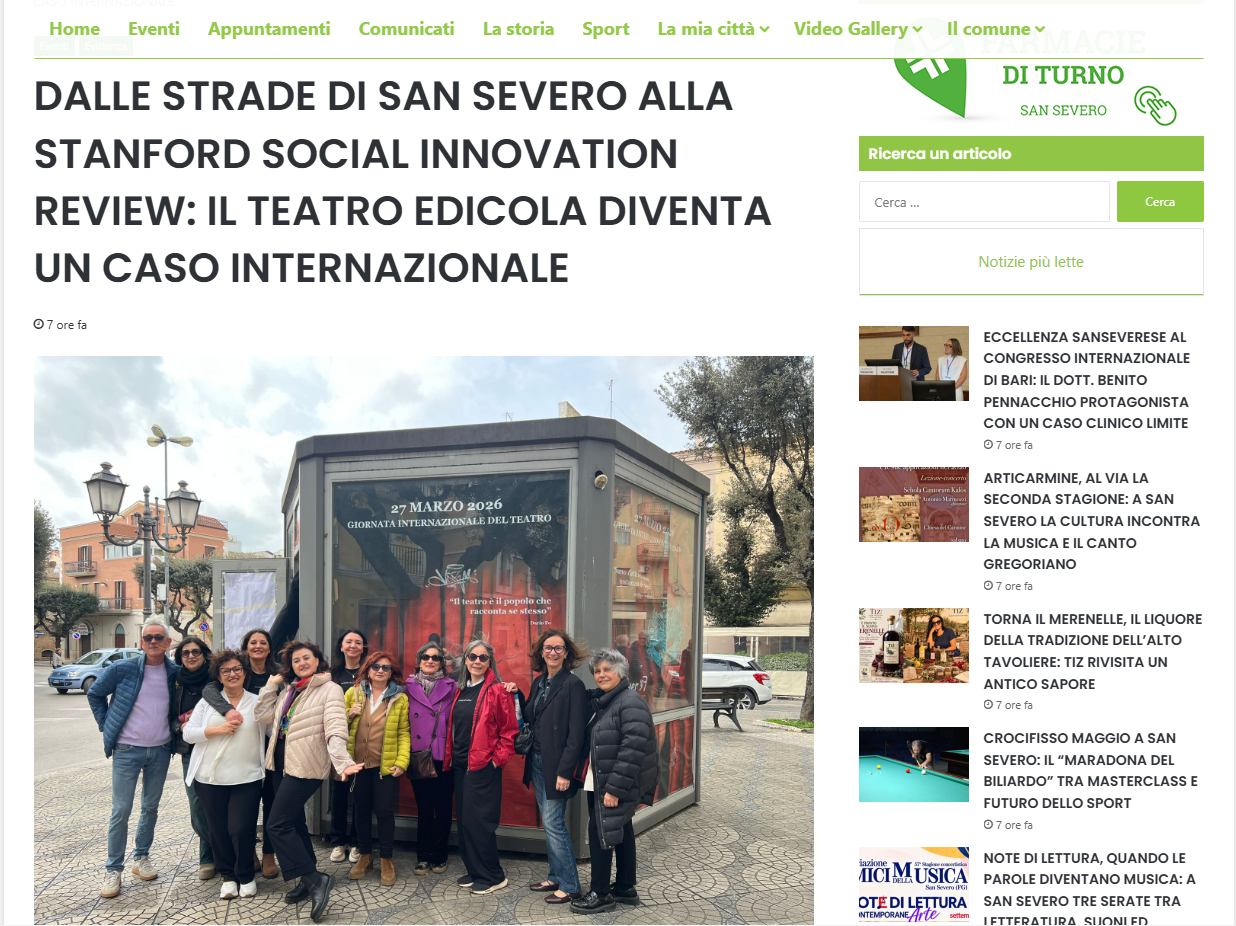
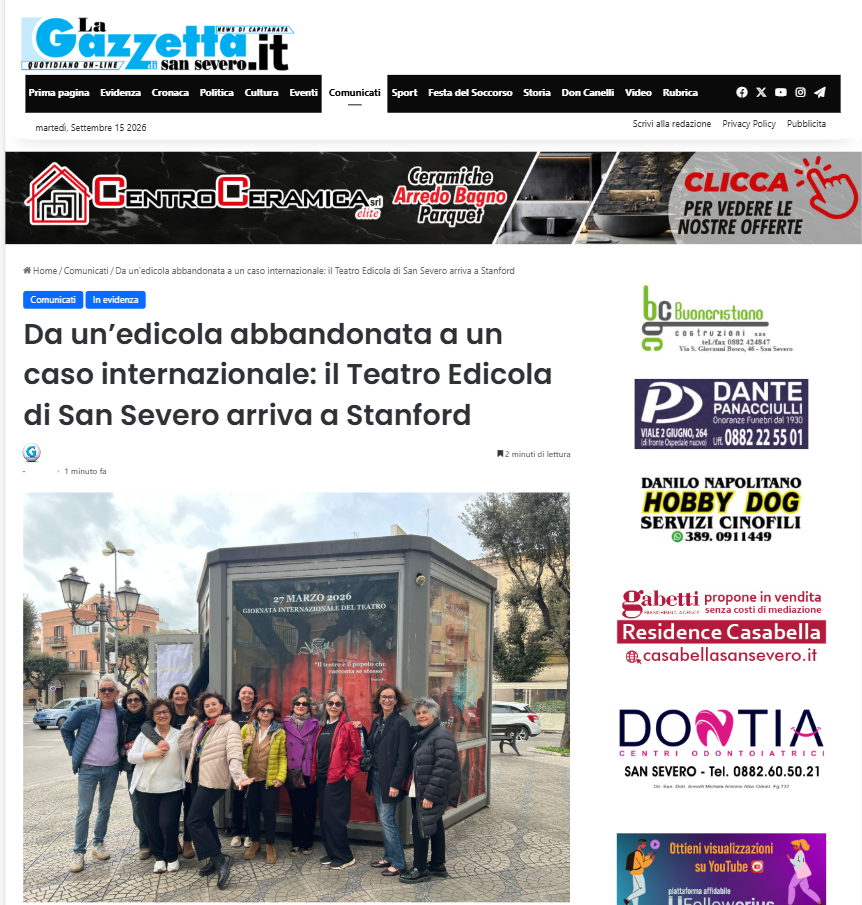
FROM THE STREETS OF SAN SEVERO TO THE "STANFORD SOCIAL INNOVATION REVIEW": "TEATRO EDICOLA" BECOMES AN INTERNATIONAL CASE STUDY SOURCE: https://www.sanseverocitta.it/dalle-strade-di-san-severo.../ SAN SEVERO (FG) - Six persons enter a newsstand. Before them there are no newspapers, periodicals, or tobacco, but rather a theatrical stage of less than two square metres. The actors stand but a few paces from the spectators, with scarcely any separation betwixt performer and beholder. It is thus that a place abandoned for years in San Severo hath been restored to life. And today that modest theatrical experiment hath come under the glare of international attention. This is the history of the Teatro Edicola, the project realised by the company Foyer '97, under the artistic direction of Francesco Gravino, which hath transformed a former newsstand in Via Tondi into one of the smallest stages hitherto conceived. The project commenced on 27th March last with a formula at once simple and singularly original: six seats, a most circumscribed scenic space, and performances of but a few minutes' duration. A minimal distance betwixt public and interpreters that doth wholly transfigure the traditional relation between spectator and theatre. The wager, however, was immediately rewarded by the public. More than sixty persons attended the performances in a single afternoon, and the three days of the inaugural season recorded a complete sold-out. From a local experiment, the Teatro Edicola hath thus become a case capable of attracting attention far beyond the confines of the Province of Foggia. In September 2026, the Stanford Social Innovation Review, the journal of Stanford University, shall publish upon its website and in its Fall 2026 print edition the reportage "The Six-Seat Revolution", authored by Dr Luciano Magaldi Sardella and overseen editorially by Deputy Editor David V. Johnson. The interest of the American review doth not concern merely the originality of the theatrical proposition. The Teatro Edicola is, indeed, observed as a potential exemplar of low-cost social innovation and urban regeneration. The notion is particularly compelling in a country such as Italy, wherein numerous newsstands have ceased their activity and risk becoming vacant interstices within the urban fabric. The question, at bottom, is simple: may a place born to vend newspapers become anew a locus of encounter? In San Severo the answer hath been entrusted to the theatre. The newsstand hath not been merely restored in corporeal terms. It hath changed its function, transmuting itself into a place wherein artists encounter the public directly and wherein the performance becometh part of the quotidian life of the street. "The theatre cometh into the street wherein thou walkest every day," explained Francesco Gravino, thereby synthesising the philosophy underpinning the project. And it is precisely this aspect which hath rendered the experiment compelling also upon the plane of its possible replicability. Initial requests for information have already arrived from other cities, amongst them Lucca and Rome, desirous of apprehending the model and the modalities for its realisation. The strength of the Teatro Edicola resideth also in its apparent disproportion: a minimal investment and space to produce a far greater cultural effect. There is no need for a grand theatre, an auditorium of hundreds of seats, or complex structures. An unused space, an idea, and the will to restore it to the community suffice. That former newsstand in Via Tondi, therefore, narrateth something that transcendeth theatre itself. It narrateth the possibility of reconceiving the spaces of our cities, restoring a social function to places that seemed to have lost it definitively.

This is false, but anyway what is this horrible man's point? Do the grooming cases cease being an outrage after a decade? Do the victims "get over it"? Do they cease caring about the failure to protect them and pursue justice? #JusticeForVictims #GroomingAbuse #Accountability #Thetweetdoesnotmentionanyspecificcountries.Therefore #therearenocountrycodestoreturn.
Miliband is spot on here. There is no ceasefire in Gaza and the genocide continues. So how about you impose real sanctions, stop all arms exports and expel the ambassador? For starters. #Gaza #Ceasefire #Sanctions #IL
50 children trapped under rubble in Gaza today. More than 20,000 kids have already been killed by Israel, and more bodies are already undiscovered under rubble. Israel has also continued slaughtering them since it agreed bogus ceasefire it never intended to abide by last October. #Gaza #ChildrenInConflict #StopTheViolence #PS #IL
“TEATRO EDICOLA” OF SAN SEVERO BECOMES AN INTERNATIONAL CASE STUDY IN THE “STANFORD SOCIAL INNOVATION REVIEW (SSIR)” — STANFORD UNIVERSITY SOURCE: https://l1nq.com/rruntbb LA GAZZETTA DI SAN SEVERO SAN SEVERO (FG) — Six persons enter a news kiosk. Before them lie no newspapers, magazines, or tobacco, but a theatrical stage measuring less than two square metres. The actors stand but a few paces from the spectators, with scarce any separation betwixt those who perform and those who behold. It is in this manner that in San Severo a place abandoned for years hath begun to live anew. And today that diminutive theatrical experiment hath fallen beneath the glare of international attention. It is the story of the “Teatro Edicola”, the project realised by the company Foyer ’97, under the artistic direction of Francesco Gravino, which hath transformed an old news kiosk in Via Tondi into one of the smallest stages ever conceived. The project commenced on 27th March last, with a formula as simple as it is original: six seats, a stage of most exiguous dimensions, and performances lasting but a few minutes. A minimal distance betwixt public and performers that doth wholly alter the traditional relationship betwixt spectator and theatre. The wager, however, was forthwith rewarded by the public. More than 60 persons attended the performances in a single afternoon, and the three days of the inaugural season registered a complete sold-out. From a local experiment, the “Teatro Edicola” hath thus become a case capable of attracting attention far beyond the confines of the Province of Foggia. In September 2026, the Stanford Social Innovation Review (SSIR), the journal of Stanford University, shall publish upon its website and in its Fall 2026 print edition the reportage “The Six-Seat Revolution”, authored by Dr Luciano Magaldi Sardella and edited by Deputy Editor David V. Johnson. The interest of the American review concerneth not merely the originality of the theatrical proposition. The Teatro Edicola is, in fact, observed as a potential paradigm of social innovation and low-cost urban regeneration. Become a Medium member The idea is particularly compelling in a country such as Italy, wherein numerous news kiosks have ceased their activity and risk becoming vacant interstices within the urban fabric. The question, at bottom, is simple: can a place born to sell newspapers become once more a locus of encounter? In San Severo, the answer hath been entrusted to the theatre. The kiosk hath not been merely restored in a physical sense. It hath changed its function, transforming itself into a place where artists encounter the public directly and where the performance becometh part of the quotidian life of the street. “The theatre cometh into the street wherein thou walkest every day,” Francesco Gravino hath explained, thus synthesising the philosophy underpinning the project. And it is precisely this aspect that hath rendered the experience interesting also upon the plane of its potential replicability. Initial requests for information have already arrived from other cities, amongst them Lucca and Rome, interested in learning of the model and the modalities for its realisation. The strength of the Teatro Edicola resideth also in its apparent disproportion: a minimal investment and space to produce a cultural effect far greater. There is no need for a grand theatre, an auditorium of hundreds of seats, or complex structures. An unused space sufficeth, together with an idea and the will to restore it to the community. That old kiosk in Via Tondi, therefore, recounteth something that goeth beyond the theatre. It recounteth the possibility of rethinking the spaces of our cities, restoring a social function to places that seemed to have definitively lost it.