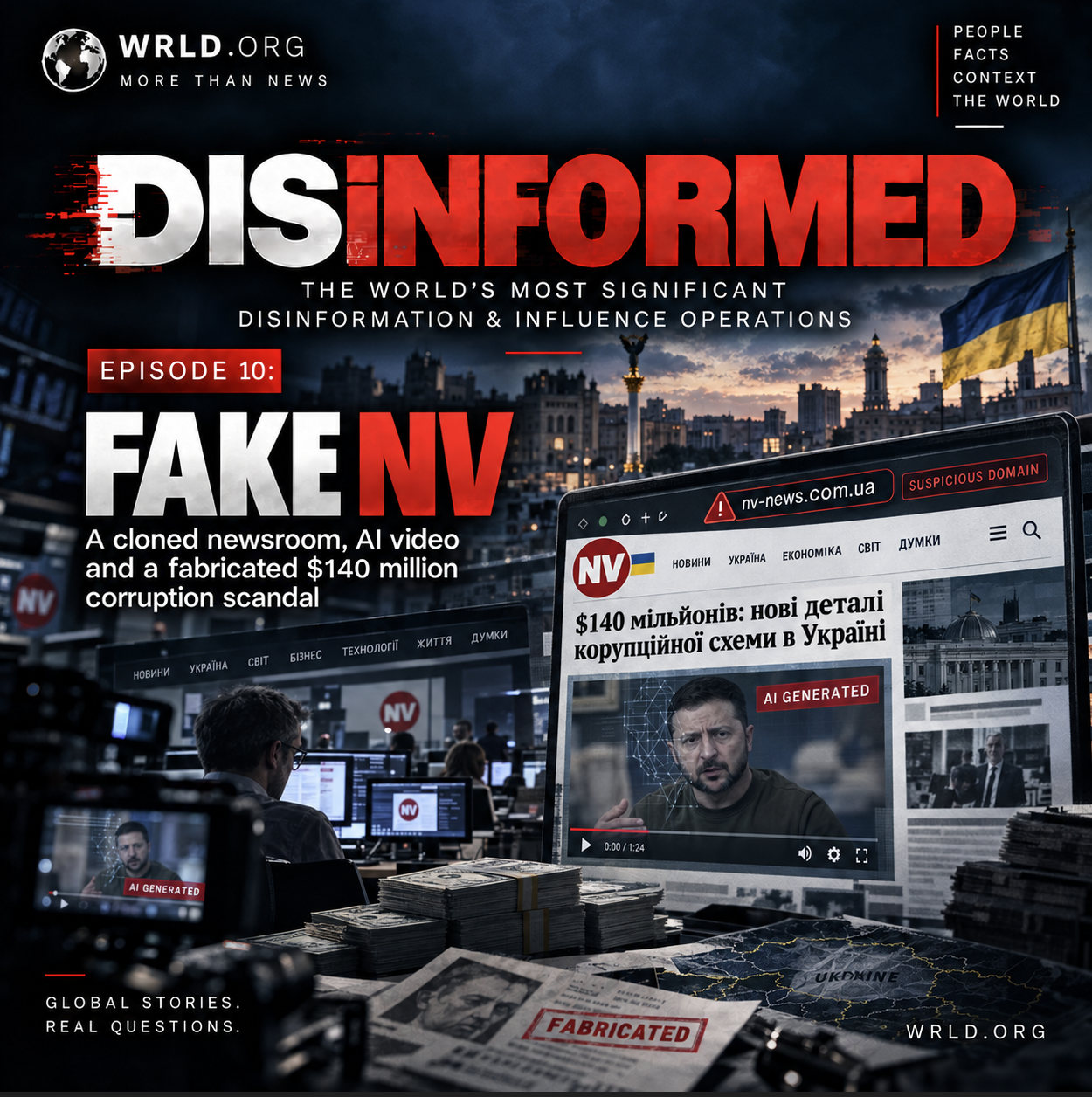
Fake NV – how a cloned newsroom turned an AI video into a $140 million corruption scandal For two days in September, a website that looked almost indistinguishable from one of Ukraine’s best-known news organisations carried an extraordinary corruption story. It claimed that Ukraine’s National Anti-Corruption Bureau had raided former defence procurement chief Arsen Zhumadilov and discovered more than $140 million in cash packed inside refrigerator boxes. One box supposedly carried the words “For the Servant of the People” – an apparent reference to President Volodymyr Zelenskyy’s political party. The raid never happened. The photographs and video presented as evidence were fabricated, and the news organisation reporting the story was not the New Voice of Ukraine but a cloned version of it. The episode is a compact example of an increasingly effective disinformation technique. Rather than inventing a new propaganda outlet and trying to build its credibility from scratch, an operator can simply steal the identity of an established newsroom and place fabricated material inside an otherwise convincing copy of its editorial environment. A newsroom copied almost in full The counterfeit site appeared at nvukraine.com, while the authentic New Voice of Ukraine operates at nv.ua and english.nv.ua. Registration records examined by fact-checkers show that the false domain was created on 21 September 2026, two days before the fabricated article appeared. According to NV’s own investigation, the imitation went much further than copying a logo: the operators reproduced the site’s visual design, sections, branding, contact information and genuine editorial material. A snapshot of legitimate NV content from 23 September appears to have been copied onto the counterfeit site, into which the operators inserted a single false article. That article claimed that NABU had searched premises connected to Zhumadilov, who had headed Ukraine’s Defence Procurement Agency until August, and seized $140 million in cash. The story was published in several languages, including Ukrainian and English, suggesting that the operation was intended not only for Ukraine’s domestic information space but also for foreign audiences following the war and Western support for Kyiv. AI supplied the supposed evidence The false article was supported by a video purportedly showing the money discovered during the raid. NABU said no such search or procedural action had taken place and identified the footage as fabricated using artificial intelligence. Independent fact-checker Lead Stories found no credible Ukrainian or international reporting confirming either the raid or the alleged seizure, while searches of NABU’s own published material produced no evidence supporting the claim. The operation therefore combined two separate forms of synthetic credibility. The AI-generated footage supplied what looked like visual proof, while the cloned NV website supplied institutional proof: an apparently reputable Ukrainian newsroom supposedly confirming that the event had happened. Neither element needed to withstand close scrutiny for long. Together, they only needed to appear credible enough to be copied, quoted and redistributed before the deception was exposed. From a fake Ukrainian source into the Russian information ecosystem On 24 September, the story began moving through large pro-Russian Telegram channels. Ukraine’s Center for Strategic Communications traced early amplification to Golos Mordora, with roughly 149,000 subscribers, and Militarist, with around 277,000. Within less than an hour, other channels including VOBLA, Rossiya Seychas and Ostashko! Vazhnoye were circulating versions of the same claim. It subsequently appeared on X and on Russian-language websites including e-news.su and pressa24.ru. Babel calculated that posts carrying the fabrication had accumulated approximately 370,000 views by the morning of 25 September. The story also moved beyond the Russian-language ecosystem. English-language versions appeared in online communities including Lemmy and Hexbear, while accounts on X shared direct links to the counterfeit NV article. NV later reported that larger Russian media and propaganda outlets, including RIA Novosti, Life, Vesti, Ukraina.ru and Mail.ru, had reproduced or discussed the claim. Kirill Dmitriev, head of the Russian Direct Investment Fund and a Kremlin representative involved in contacts with the United States, also shared it on 25 September. This amplification is significant, but it should not be confused with proof of authorship. Publicly available evidence shows how the false story entered and spread through a Russian and pro-Russian information ecosystem. It does not establish which organisation registered the cloned domain, generated the video or directed the operation from the outset. Why copy NV? The operation relied on source laundering. A claim originating directly from a Russian Telegram channel that Ukraine’s defence procurement system had concealed $140 million would immediately carry an obvious political context. A claim apparently uncovered by an established Ukrainian newsroom looks very different. Once the fabricated NV article existed, subsequent accounts could cite what appeared to be an independent Ukrainian source rather than present the allegation as their own. Each repost moved the story another step away from its manufactured origin. The use of an English-language version strengthened that mechanism for audiences outside Ukraine. The underlying narrative was also carefully chosen. Corruption in Ukrainian defence procurement is a genuine subject of public scrutiny and investigative reporting, so the fabricated story did not require audiences to accept an entirely unfamiliar premise. It inserted a false event into a real area of political concern. That mixture of authentic context and fabricated evidence can be more persuasive than a completely invented story because much of the surrounding information feels recognisable. What can – and cannot – be attributed Ukrainian authorities and NV describe the episode as a Russian information operation, and its distribution can be documented extensively across pro-Russian and Russian media channels. The available public evidence, however, does not identify the organisation that created the counterfeit website, nor does it link the operation forensically to a named Russian intelligence service, military unit or state contractor. The most precise description is therefore a Russian-aligned disinformation operation whose fabricated material was systematically amplified through the Russian information ecosystem. That distinction matters. Distribution can be observed directly; command-and-control is harder to establish and should not be inferred without evidence. The newsroom itself becomes the deepfake The most important feature of the operation was not the $140 million figure or even the AI-generated video. It was the counterfeit newsroom surrounding them. The operators copied a real publication, populated it largely with genuine material and inserted a single false story, allowing the fabrication to borrow the accumulated credibility of journalists who had nothing to do with it. This points to a broader evolution in synthetic media. AI can fabricate an image, a voice or a video, but an influence operation can now fabricate something larger: the source that supposedly verified the evidence. In the Fake NV operation, the article, the video and the website reinforced one another, creating not simply a false story but a manufactured chain of credibility. Sources The New Voice of Ukraine — investigation into the cloned website https://english.nv.ua/nation/nv-discovers-fake-copy-of-website-with-planted-story-cites-russian-links-50644601.html The New Voice of Ukraine — Russian amplification of the $140 million fabrication https://english.nv.ua/russia-spreads-fake-140-million-ukraine-corruption-story-during-dmitriev-u-s-talks-50644647.html Lead Stories — independent fact-check https://leadstories.com/hoax-alert/2026/09/fact-check-fake-story-claims-140-million-found-at-home-of-ukraines-zhumadilov-marked-servant-of-the-people-nv-website-originated-it.html Babel — AI video and distribution analysis https://babel.ua/en/news/130469-a-video-is-sharing-online-about-140-million-found-in-the-possession-of-the-ex-head-of-the-defense-procurement-agency-this-is-an-ai-video-distributed-by-a-clone-of-ukrainian-media Center for Strategic Communications and Information Security — initial debunk https://spravdi.org/en/ai-fake-about-140-million-amid-us-talks-how-russians-impose-the-image-of-corrupt-ukraine-on-the-west/ Center for Strategic Communications and Information Security — NABU confirmation https://spravdi.org/u-merezhi-poshyryuyut-shi-fejk-pro-nibyto-obshuky-nabu-v-eksgolovy-agencziyi-oboronnyh-zakupivel/ Detector Media — distribution and NABU response https://detector.media/infospace/article/252806/2026-09-25-u-merezhi-pidrobyly-sayt-nv-dlya-poshyrennya-feyku-pro-obshuky-v-eksochilnyka-agentsii-oboronnykh-zakupivel/ Keywords #DISINFORMED #Episode10 #FakeNV #NewVoiceOfUkraine #Ukraine #Russia #RussianDisinformation #RussianInfluence #Disinformation #InformationWarfare #InfluenceOperations #ForeignInterference #FIMI #MediaImpersonation #ClonedMedia #FakeMedia #FakeNews #ArtificialIntelligence #AI #AIGeneratedContent #SyntheticMedia #AIVideo #SourceLaundering #NarrativeLaundering #CorruptionNarrative #UkraineCorruption #DefenceProcurement #NABU #ArsenZhumadilov #Telegram #SocialMediaManipulation #DigitalInfluence #Propaganda #OSINT #MediaManipulation #WRLD