BETA nonprofit public democratic european moderated

Search

#Incentives

The strategy of disguising fighters as journalists—and thereby endangering the lives of genuine journalists—is not simply a matter of Hamas’s depravity. The terrorist group is just responding rationally to incentives and encouragement from deluded Westerners: “If you wear a press #Journalism #Hamas #Terrorism #IL #PS #US

Kindergeld tot 25 jaar... Tot 18 jaar is normaal, studiefinanciering zou een ander systeem moeten zijn. Dit land heeft nooit geleerd zuinig met geld om te gaan. En het creëert verkeerde incentives. https://t.co/uGWGIO9CAe #Kindergeld #Studiefinanciering #Financiën

H

The Death of the Insult There was a time when being called an idiot was not a public-health emergency. You were called an idiot. You called the other person an idiot. Perhaps you argued, perhaps you fought, perhaps you laughed, had a beer and forgot about it. That may sound primitive. It was also a social technology. In traditional honor culture, an insult was a challenge: if someone attacked your status, you were expected to answer. Men in particular developed cultures of teasing, mockery and competitive abuse in which the ability to give and take an insult could itself demonstrate confidence. Then came dignity culture, with a liberating idea: you don’t have to care what everyone thinks of you. An insult does not necessarily diminish you. Someone else’s contempt does not become your inferiority simply because they express it. Now something else is emerging. Sociologists Bradley Campbell and Jason Manning describe victimhood culture, in which interpersonal offences increasingly become public grievances. The offended party seeks recognition, an audience and sometimes institutional intervention. The old question was: “Are you going to say that to my face?” The dignity question was: “Why should I care what you think?” The new question increasingly seems to be: “Who can I report this to?” This may illuminate an uncomfortable gender difference. Men have historically been more permitted to insult and confront one another directly, while women have often had greater incentives to avoid direct confrontation and use social pressure, criticism and complaint. Neither pattern is exclusively male or female, but cultural habits matter. The danger is a society so determined to protect people from offence that it forgets to teach them how to withstand it. There is a difference between being harmed and being insulted, between injustice and discomfort, and between demanding justice and demanding that nobody make you uncomfortable. We may have travelled from honor, to dignity, to grievance. And perhaps the most subversive sentence left is also the simplest: “Yes, he insulted you. So what?”

H

The Death of the Insult There was a time when being called an idiot was not a public-health emergency. You were called an idiot. You called the other person an idiot. Perhaps you argued, perhaps you fought, perhaps you laughed, had a beer and forgot about it. That may sound primitive. It was also a social technology. In traditional honor culture, an insult was a challenge: if someone attacked your status, you were expected to answer. Men in particular developed cultures of teasing, mockery and competitive abuse in which the ability to give and take an insult could itself demonstrate confidence. Then came dignity culture, with a liberating idea: you don’t have to care what everyone thinks of you. An insult does not necessarily diminish you. Someone else’s contempt does not become your inferiority simply because they express it. Now something else is emerging. Sociologists Bradley Campbell and Jason Manning describe victimhood culture, in which interpersonal offences increasingly become public grievances. The offended party seeks recognition, an audience and sometimes institutional intervention. The old question was: “Are you going to say that to my face?” The dignity question was: “Why should I care what you think?” The new question increasingly seems to be: “Who can I report this to?” This may illuminate an uncomfortable gender difference. Men have historically been more permitted to insult and confront one another directly, while women have often had greater incentives to avoid direct confrontation and use social pressure, criticism and complaint. Neither pattern is exclusively male or female, but cultural habits matter. The danger is a society so determined to protect people from offence that it forgets to teach them how to withstand it. There is a difference between being harmed and being insulted, between injustice and discomfort, and between demanding justice and demanding that nobody make you uncomfortable. We may have travelled from honor, to dignity, to grievance. And perhaps the most subversive sentence left is also the simplest: “Yes, he insulted you. So what?”

During this winter, our government needs to provide massive incentives to re-invigorate investments into our peat usage in energy production. We have as much primary energy tied to our peat than there are proven reserves in the North Sea. Still, our governments ever since #PeatEnergy #SustainableInvestments #RenewableResources #Nospecificcountrycodescanbeidentifiedinthetweet.

Such voluntary export restrains lead of course to higher import prices, while at the same time give incentives to Chinese producers to relocate production to Europe. The end effect is the same. VERs did not save US automotive industry from Japanese competition, neither will do #TradePolicy #Economics #AutomotiveIndustry #CN #EU #US #JP

BBC 4w

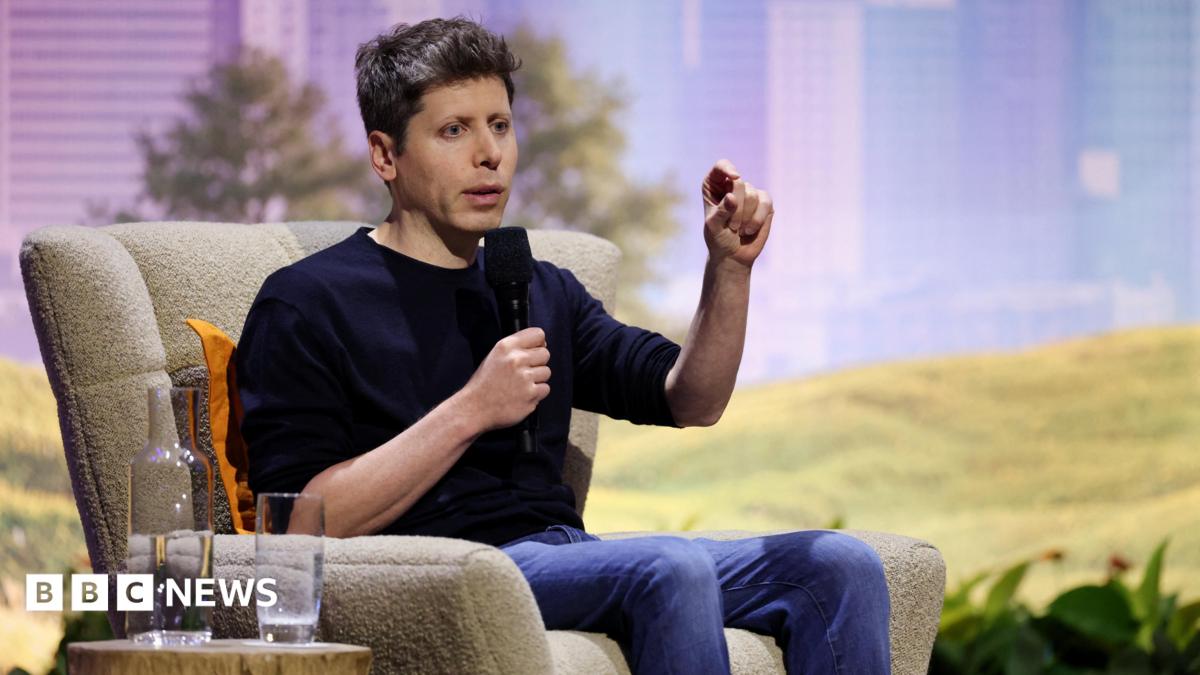
Sam Altman and other tech CEOs say there are incentives to limit advancements in AI, as fears grow over the threats it poses to humanity. #AIRegulation #TrustInTech #AIConcerns

OpenAI boss says world 'right to be afraid' but should trust AI firms

Paulson/Rubin: We managed financial crises. AI is a risk of a different kind. https://t.co/DdP25AvUrc "We worry that perverse financial incentives are making it difficult to protect humanity from the dangers of AI" That has got to be the Understatement of the Day:) #aiemergency #AI #FinancialCrisis #RiskManagement #Thetweetdoesnotspecificallymentionanycountries.Therefore #therearenocountrycodestoreturn.

H

When Emotion Takes the Reins A remarkable study published in Proceedings of the National Academy of Sciencesexamined millions of books covering almost 170 years and tracked language associated with rationality—facts, conclusions, analysis and determination—against language associated with sentiment—feeling, belief and emotion. The pattern was striking. From roughly 1850 to 1980, rationality-related language steadily increased while sentiment-related language declined. Then the trend reversed. By around 2007, sentiment-related language had overtaken rationality-related language and continued rising (Scheffer et al., 2021). This does not prove that people have become less rational, nor does the study establish a single cause. But it raises an important question: what happens when trust in the institutions associated with knowledge and expertise begins to collapse? If people believe governments, experts, universities and media are corrupt or captured, “look at the data” can sound less like an appeal to reason and more like an appeal to authority. And when institutional trust declines, emotion becomes politically powerful. Anger supplies an enemy. Fear supplies urgency. Hope supplies a future. Identity supplies belonging. Could this help explain why socialism and even communism have regained some appeal among young people despite the historical record? The study cannot establish that causal link. But it is a plausible hypothesis: when politics becomes increasingly emotional, an ideology can be judged by what it promises rather than by what it has historically produced. Benjamin Franklin captured the necessary balance: “If passion drives, let reason hold the reins.” Passion is not the enemy. It is the engine of human action. The danger comes when we surrender the steering wheel. Today, algorithms, political campaigns and media incentives are exceptionally good at exploiting emotion. Outrage spreads faster than nuance. A soundbite can provoke a reaction before we have checked whether it is true.

H

The Daycare Governance Model Something sinister is lurking behind the curtain of compassion. We have told ourselves that caring for others is the highest good, but there is a pathological side to it that we refuse to acknowledge. There is a phenomenon known as Munchausen syndrome by proxy. It is a form of child abuse in which a caregiver—typically the mother—fabricates or induces illness in someone under her care in order to gain attention or sympathy. The mother is not indifferent to the child’s well-being, and that is the most disturbing part. She is devoted to the child. Around the clock, she visibly tends to the infant’s needs. This is depicted in *The Sixth Sense*. A young boy who can see and speak to the dead is brought to the wake of a girl named Kyra. She leads him to a box containing a videotape. The tape shows Kyra’s mother quietly lacing her daughter’s food with poison, only to play the role of a saint at her bedside for the gathered relatives—absorbing their pity and praise for how selflessly she cared for her dying daughter. The town saw a devoted mother, but the reality was manufactured sickness. We have scaled this pathology up to the level of civilization. The will to care is one of the most powerful drives in women. Properly channeled, it is deeply necessary and virtuous. But as social institutions—therapy, academia, law, NGOs, and bureaucracies—are increasingly comprised of women, this instinct is redirected from individual children, where it can be extremely beneficial, toward society at large, where it becomes disastrous. I call this the daycare governance model. It has only three roles: infants to be protected, or the oppressed; caregivers to administer care, or the dissenters. The caretaking class, or its allies, gains power and influence by managing human suffering. They are rewarded with prestige, funding, and greater authority—all of which increase in proportion to the number of victims under their care. Those incentives resemble the logic of Munchausen syndrome by proxy: increasing the number of sick people under their supervision will, in the end, produce more sick people.

Gerd Leonhard Sep 10

“There is no LA-602 for superintelligence. In its place sit estimates from people who concede they are only guessing, in a climate where skepticism about AI hype reigns because of the financial incentives involved.” AI's Oppenheimer Dilemma - Newsweek https://t.co/xDgsWQgJL9 #Superintelligence #AI #Skepticism #Nospecificcountrycodesarementionedinthetweet.

H
Sandfeen Sep 9

€800 Billion of Central Planning Europe’s defence problem illustrates a lesson politicians repeatedly refuse to learn: You cannot spend your way out of a supply problem. Ursula von der Leyen’s Commission has announced an €800 billion rearmament programme with the confidence of a central planner who has discovered that shortages can be eliminated by increasing the budget. The European Court of Auditors appears considerably less impressed. Its warning is devastating: insufficient coordination, fragmented funding, bottlenecks in materials and critical components, shortages of skilled personnel and serious difficulties in achieving readiness by 2030. Notice what is missing from the solution: more bureaucracy. The fundamental error is confusing financial resources with real resources. Governments can create euros with a stroke of a pen. They cannot create factories, engineers, semiconductors, explosives, machine tools, rare materials or production capacity by decree. Worse, the EU is attempting to coordinate what politicians cannot possibly know well enough to coordinate from Brussels: which technologies should be developed, which weapons should be produced, where capacity should be expanded, and how scarce resources should be allocated. That is precisely the information problem identified by Friedrich Hayek. Knowledge is dispersed throughout millions of individual decisions. Prices communicate that knowledge. Central planners replace those signals with political priorities, committees and funding programmes. The result is predictable: fragmentation, duplication, lobbying, distorted incentives and expensive procurement. Europe does need to rearm. But that does not prove that Europe needs an €800 billion bureaucratic spending programme. In fact, the opposite may be true. If defence is genuinely urgent, Europe should remove the obstacles preventing private capital, competition and production from responding to demand. Let companies compete. Let governments buy what actually works. Let prices reveal scarcity. Let inefficient producers fail. The question is not whether Europe can spend €800 billion. Of course it can. The question is whether Brussels can transform €800 billion of political spending into €800 billion of actual military capability. The Court of Auditors has just reminded us that money is not knowledge, bureaucracy is not coordination, and spending is not production. And history has never been kind to economies that confuse the three.

H
Sandfeen Sep 8

When Emotion Takes the Reins A remarkable study published in Proceedings of the National Academy of Sciencesexamined millions of books covering almost 170 years and tracked language associated with rationality—facts, conclusions, analysis and determination—against language associated with sentiment—feeling, belief and emotion. The pattern was striking. From roughly 1850 to 1980, rationality-related language steadily increased while sentiment-related language declined. Then the trend reversed. By around 2007, sentiment-related language had overtaken rationality-related language and continued rising (Scheffer et al., 2021). This does not prove that people have become less rational, nor does the study establish a single cause. But it raises an important question: what happens when trust in the institutions associated with knowledge and expertise begins to collapse? If people believe governments, experts, universities and media are corrupt or captured, “look at the data” can sound less like an appeal to reason and more like an appeal to authority. And when institutional trust declines, emotion becomes politically powerful. Anger supplies an enemy. Fear supplies urgency. Hope supplies a future. Identity supplies belonging. Could this help explain why socialism and even communism have regained some appeal among young people despite the historical record? The study cannot establish that causal link. But it is a plausible hypothesis: when politics becomes increasingly emotional, an ideology can be judged by what it promises rather than by what it has historically produced. Benjamin Franklin captured the necessary balance: “If passion drives, let reason hold the reins.” Passion is not the enemy. It is the engine of human action. The danger comes when we surrender the steering wheel. Today, algorithms, political campaigns and media incentives are exceptionally good at exploiting emotion. Outrage spreads faster than nuance. A soundbite can provoke a reaction before we have checked whether it is true. Reference: Scheffer, M., van de Leemput, I., Weinans, E., & Bollen, J. (2021). The rise and fall of rationality in language. PNAS, 118(51), e2107848118. https://doi.org/10.1073/pnas.2107848118

🇪🇺 produces 21% of the world’s leading biotech publications, but our share of global clinical trials fell from 18% to 9%. The #BiotechAct is our answer: faster trials, more investment, clearer rules, stronger incentives for 🇪🇺 manufacturing & better use of health data and AI. #BiotechAct #ClinicalTrials #HealthData #EU

In #Pakistan, electric motorcycles are booming due to high petrol prices, government incentives & increased solar power. 🛵 Sales of electric 2-wheelers tripled to around 90,000 in 2025, & this year they have exceeded 10% of monthly motorcycle sales 💚 https://t.co/FjLbFVdNp3 https://t.co/hKvA0Bfc5B #ElectricMotorcycles #Pakistan #SustainableTransport #PK

The Inflation Reduction Act’s regional incentives promoted green investment, but did not create jobs https://t.co/BQIkZwMdWx #InflationReductionAct #GreenInvestment #JobCreation

H
Sandfeen Aug 29

Hvor højt tror du staten er parat til at lade topskatten stige til? The Kennedy Tax Cuts of 1963–1964 In early 1963, the top marginal individual income tax rate in the United States stood at an extraordinary 91 percent—a legacy of the exceptionally high tax rates established during and after World War II. President John F. Kennedy proposed a sweeping tax overhaul, arguing that excessively high marginal rates were holding back private investment, risk-taking, employment, and economic growth. His original proposal would have reduced individual income tax rates across the board, lowering them from a range of 20–91 percent to 14–65 percent. It also called for reductions in corporate tax rates and stronger incentives for investment. Kennedy’s administration explicitly argued that lower tax rates would stimulate private economic activity, increase investment, and expand production and employment. The goal was not simply to reduce taxes, but to remove what Kennedy called the “heavy drag” that the existing tax system placed on private initiative. (Fraser) The proposal faced substantial opposition in Congress, particularly because of concerns about its fiscal implications and accompanying tax reforms. Nevertheless, the business community and many economic organizations strongly supported the central idea of substantial rate reductions. (Fraser) Kennedy did not live to see his proposal enacted. After his assassination in November 1963, President Lyndon B. Johnson made passage of the legislation a priority. The final measure, the Revenue Act of 1964, reduced the top marginal tax rate from 91 percent to 70 percent and substantially lowered individual and corporate tax rates. (Fraser) The economy subsequently entered a powerful and sustained expansion. Contemporary economic analyses attributed a significant portion of the improvement in production, employment, investment, and tax revenues to the cuts, although monetary policy and other factors also contributed. (Judiciary Committee)

H
Sandfeen Aug 28

Compassion as a Weapon Western civilization is increasingly trapped in a culture of entitlement, where victimhood can become a route to status, privilege, and power. Some elite universities report unusually high disability registrations—e.g., 20%+ at Brown and Harvard and around 40% at Stanford—far above community colleges. Whatever the causes, it raises a troubling question: when systems meant to protect the truly vulnerable become incentives, what happens to everyone else? Rob Henderson describes how accommodations can turn into “status games.” Extra time, special housing, and exemptions can make diagnosis feel like the logical choice, and the lesson travels outward: tomorrow’s leaders in journalism, HR, law, academia, and politics may learn that displaying weakness is rewarded. Research links habitual victimhood displays with traits associated with the Dark Triad (narcissism, Machiavellianism, psychopathy). That doesn’t mean genuine victims are manipulative—it means rewarding victimhood gives manipulators an incentive to enter. In the “virtue game,” grievance becomes currency. Pity can also function as covert power: the weak person gains leverage, while the giver gains moral superiority. When compassion is treated like a currency, it can become a mutually reinforcing racket. The danger isn’t helping the weak. It’s teaching that appearing weak is the surest way to gain power.

H
Sandfeen Aug 28

The Pathology Behind Compassion Something sinister can lurk behind compassion. Caring for others is noble, but when institutions are rewarded not for reducing suffering—only for managing it—care can become pathological. Munchausen syndrome by proxy shows the logic: a caregiver fabricates or induces illness in someone dependent on them to gain sympathy and attention. The caregiver looks devoted; the “sickness” is manufactured. In that sense, devotion can hide control. I call this the Daycare Governance model: society splits into infants to be protected (oppressed), caregivers who provide protection (allies), and predators to be removed (dissenters). Caretakers gain prestige, funding, and moral authority by managing suffering. Many may believe sincerely, yet incentives can overpower intentions—if status and resources grow with the number of “vulnerable” people, the system has reason to expand the victim class. It does so via concept creep (“trauma” broadens until ordinary difficulty counts), and by creating the perpetual patient, where normal sadness becomes pathology and struggle is rebranded as dysfunction. Care institutions and “victims” then reinforce each other. Dependency costs competence. True care prepares people to stand alone; pathological care keeps them dependent. Endless expansion of victimhood risks producing more dependency. We call it compassion—but compassion without boundaries can become control.

H
Sandfeen Aug 28

The Fracture That Kills the Family The West’s deepest divide may not be left versus right, but whether young men and women still share a vision of the good life. The nuclear family is society’s foundation, yet households struggle to form when the sexes view each other as opponents. Many women see marriage as patriarchal; many men see women as manipulative or exploitative. Relationships shift from mutual union to zero-sum power struggles. Christianity framed marriage as union—two people becoming one. Nietzsche warned the death of God would remove a shared moral foundation, leaving society vulnerable to nihilism and fragmentation. We are living that fragmentation. Young men often retreat into pornography, gaming, and prolonged adolescence. Young women increasingly frame sexual liberation as empowerment. Both chase proximate pleasures while losing ultimate purposes: family, responsibility, continuity, and creating life. Dating data reflects the fracture: among unmarried Americans aged 22–35, only 26% of women and 36% of men are actively dating. Ideology filters matches too—Gen Z and young millennials cite political compatibility far more than Boomers. Research also finds a mismatch: only 0.6 single liberal men per single liberal woman, and only 0.5 single conservative women per conservative man. Cross-ideological pairing has risen from 6% in the 1970s to 22% today. The consequences extend beyond dating: fertility has fallen below replacement across much of the West, and 42% of American adults were unpartnered in 2023. Policy responses—tax incentives, parental leave, baby bonuses—miss the deeper cultural and spiritual problem: you can debate taxes, but it’s hard to build a family when you disagree on masculinity, whether marriage is oppressive, or whether family is worth sacrificing for. The values gap is the disease. The political divide is the symptom. The household is the casualty—and when it cracks, everything built above it loses stability. The question is whether a civilization can survive when the two people it most needs to unite can no longer agree why they should.