WRLD

Search

#Interviews
🇩🇪LilitThyra🩶 5h

LilitThyra wrote about Zelensky during an NBC interview, saying that everyone can judge for themselves whether he can lead a country at war and whether the EU should give him more billions. She expressed the impression that he was under the influence of substances and stated that she wouldn't even trust him with her trash. #Selenskyj #Ukraine #Politik (translated)


1653
Sólbjørg Jakobsen 1d

Sólbjørg Jakobsen criticized Venstre for going after Rosa Lund after she had made posts and given interviews during her maternity leave. Jakobsen wrote that Lund had worked in the Parliament almost until her birth, and that Ekstra Bladet had portrayed the case as an example of how the Red-Green Alliance milked the system. Jakobsen disagreed with this. She wrote that Peder Hvelplund in the article had accounted for a specific deliberation in the party that she found reasonable if one distinguished between sick leave and maternity leave. Jakobsen added that she herself was writing from her maternity leave and that women could very well be on maternity leave while also being interested in work. She wished Lund good luck upon her return and wrote that she looked forward to both fighting against her politically and supporting her as a political co-mother. #politik #barsel #kvindelighed (translated)

2515
K
Kronen Zeitung 2d

Bayern coach Kompany cancels interviews after a spectacular goal show due to an injury. (translated)

Nach Tor-Show - Verletzt! Bayern-Coach Kompany sagt Interviews ab
2559
Erik Tegnér 3d

Erik Tegnér wrote that Youssef Badr was multiplying interviews and publications on social media. He presented the first episode of a three-part series dedicated to Badr's statements on discrimination, diversity, and the RN, citing his interventions on AJ+, Quotidien, and Radio Nova. https://t.co/BQ7ShQRhWz #Discrimination #Diversité #Médias (translated)

2907
KLARA. 4d

That Klara still wishes today, two and a half years later, "to tell her story herself," as stated in the podcast, may justify the publication of the interviews. #TrueCrime #Pressefreiheit #HausderBlock (translated)

Podcast „House of Block“: True Crime ist nur die halbe Wahrheit
www.faz.net
2698
Thorsten Alsleben 🇩🇪🇮🇱🇺🇦 6d

Thorsten Alsleben said that 32 hours after Bärbel Bas's public statement regarding her resignation, numerous SPD politicians repeated and intensified the accusation of public attacks, including from within the ranks of the coalition partner, in posts, press releases, and interviews. None of them were able to provide evidence for this, even upon request, he claimed. Alsleben urged the SPD to present evidence or retract the accusations and apologize. At the same time, he asked why journalists did not inquire more rigorously about evidence. #Politik #SPD #Rücktritt (translated)

3623
Erik Tegnér 6d

Erik Tegnér announced the publication of an investigation of more than thirty pages on the magistrate Youssef Badr, conducted over three months and based, according to him, on the testimonies of more than 22 sources. He defended the press's right to investigate a person who has chosen to expose themselves in the media, particularly in a book, interviews, and conferences. Tegnér stated that his editorial team had reached out to Badr ten times since July 8 to obtain his responses, without success. He added that the emails had been forwarded to Canard enchaîné and that Libération and this newspaper had published articles about the investigation before its release. He described these publications as an attempt at pressure and delegitimization. The editorial director specified that he himself had been sentenced in the first instance by Badr to six months in prison suspended for an investigation into immigration lawyers, and that he had appealed. He stated that he had kept himself away from research, interviews, and investigations to avoid any doubt about his impartiality. Tegnér condemned the insults and threats directed at Badr, while asserting that this should not prevent the publication of the investigation. He indicated that the magazine would be available the next day in more than 5,000 kiosks across France. #Journalisme #Enquête #Justice (translated)

3511
Krzysztof Graj 6d

Tafouk TV – how three Sahel military governments are building a common information system Mali, Burkina Faso and Niger are no longer relying only on speeches, social media or their existing national broadcasters to shape the information environment around the Alliance of Sahel States. They are building a shared, permanent media infrastructure. At its centre is Tafouk TV, the confederal television channel of the AES, broadcasting from Bamako. Its creation was formally agreed by the three governments in December 2025, its governing structure was installed in 2026 and regular programming began in September. The project is explicitly presented by AES authorities as an instrument of “information sovereignty” and what Malian Foreign Minister Abdoulaye Diop has called “narrative sovereignty”. A television channel built by three military governments Tafouk TV is fundamentally different from a covert bot network or a collection of anonymous propaganda accounts. Its ownership and political purpose are public. It is an institutional broadcaster created by the governments of Mali, Burkina Faso and Niger, all currently led by military authorities. Malian government documents describe the channel as a common media instrument intended to strengthen communication across the confederation, promote regional identities and respond to what the AES sees as hostile narratives and disinformation. The project sits alongside Daandè Liptako, a shared radio service, and broader plans to develop common information structures across the three states. That institutional architecture is important. A social-media influence network can disappear when accounts are suspended. A television channel, radio network and future news agency can develop journalists, archives, correspondents, distribution agreements and continuous daily output. The result is not a temporary campaign but potentially a long-term information system. Russia enters through RT The Russian connection is also public. In July 2026, Tafouk TV signed a cooperation agreement with RT, the Russian state-funded international broadcaster. The memorandum was signed by Tafouk TV director-general Salif Sanogo and Natalia Lebedeva, director of RT en français. It provides for content exchange, expertise-sharing and joint coverage of major events in Russia and the Sahel. RT described itself as Tafouk TV's first international partner. This makes Tafouk part of a much broader geopolitical realignment in the Sahel. Mali, Burkina Faso and Niger have reduced cooperation with France and other Western partners while deepening political, diplomatic and security relations with Moscow. But the distinction is important: there is no public evidence that Russia owns Tafouk TV, finances the entire channel or directly controls its editorial decisions. The most precise description is therefore a state-owned AES broadcaster with a formal partnership with Russian state media, rather than a Russian-controlled television station. The battle over the narrative AES officials make little attempt to hide the strategic role they expect the channel to play. During a visit to Tafouk TV shortly after regular broadcasting began, Abdoulaye Diop described communication as another strategic front alongside defence, diplomacy and development. He spoke of a geopolitical environment characterised by a “war of narratives” and said the AES needed its own media to defend its interests and strengthen its narrative sovereignty. Mali's government has similarly described Tafouk TV as an instrument of information sovereignty, regional cohesion and Sahelian identity. The first governing-board meetings emphasised digital distribution, national languages and the creation of a new generation of Sahelian journalists capable of carrying the confederation's message at home and abroad. Early reporting examined by the Financial Times found patriotic programming, interviews with officials and positive reporting from conflict zones. The newspaper described the project in the context of the three governments' attempts to challenge Western media narratives and strengthen their legitimacy while facing continuing jihadist insurgencies. Why this is not simply another disinformation operation It is important not to use propaganda and disinformation as synonyms. A state broadcaster can systematically promote the government's preferred interpretation of events without every story being false.Tafouk TV's significance therefore lies less in individual fabricated claims than in the information architecture being created around it: three governments operating a shared broadcaster, common radio infrastructure and potentially other confederal media, while cooperating with Russia's international state-media system. This development is taking place while independent media conditions across the three countries are deteriorating. Reporters Without Borders ranked Burkina Faso 110th, Niger 120th and Mali 121st in its 2026 World Press Freedom Index, pointing to arbitrary detentions, restrictions on journalists and suspensions of media outlets across the AES states. That context changes the importance of Tafouk TV. A new state broadcaster entering a diverse and competitive media environment is one thing. A common government-controlled broadcaster expanding while alternative sources face restrictions is another. From influence campaigns to permanent infrastructure Tafouk TV illustrates an important evolution in the information contest in the Sahel. Russian and pro-Russian influence in Africa has often relied on social-media networks, influencers, fake experts, local partners or apparently independent media outlets. Tafouk represents something more durable: formal state institutions can now carry many of the same geopolitical narratives openly and continuously. The audience figures are not yet sufficiently established to demonstrate how influential Tafouk TV will become. It may eventually reach far fewer people than some viral online operations, or its television, radio and digital infrastructure may give it far greater long-term significance. Sources Government of Mali — Tafouk TV governing board and strategic mission https://gouvernement.ml/conseil-dadministration-de-tafouk-tv-installe-a-bamako-le-ministre-alhamdou-ag-ilyene-trace-les-orientations-strategiques-de-la-chaine-confederale/ Government of Mali — Abdoulaye Diop and “narrative sovereignty” https://gouvernement.ml/communication-confederale-de-laes-sem-abdoulaye-diop-a-la-decouverte-de-tafouk/ Government of Mali — creation of Tafouk TV and Daandè Liptako https://gouvernement.ml/conseil-national-de-la-transition-le-cnt-adopte-deux-textes-majeurs-relatifs-a-la-creation-de-tafouk-tv-et-de-la-radio-daande-liptako/ Government of Mali — ratification and information-sovereignty objectives https://gouvernement.ml/2026/05/30/ Government of Mali — Tafouk TV board and Prime Minister Abdoulaye Maïga https://gouvernement.ml/television-de-lalliance-des-etats-du-sahel-tafouk-tv-les-membres-du-conseil-dadministration-prennent-les-orientations-et-conseils-du-premier-ministre-abdoulaye-maiga/ RT en français — cooperation agreement between RT and Tafouk TV https://rtenfrance.tv/news/136036-rt-devient-premier-partenaire-international-tafouk-tv-chaine-commune-aes APA News — Tafouk TV and Daandè Liptako common AES media infrastructure https://fr.apanews.net/communication/tafouk-tv-et-daande-liptako-le-mali-consolide-les-medias-communs-de-laes/ APA News — Tafouk TV begins regular programming https://fr.apanews.net/communication/aes-tafouk-tv-demarre-ses-programmes/ Financial Times — Sahel juntas launch Tafouk TV with Russian backing https://www.ft.com/content/259b49a1-8eda-4e8d-84c7-45323988b07b Reporters Without Borders — 2026 Press Freedom Index: Africa https://rsf.org/en/classement/2026/afrique Keywords #DISINFORMED #Episode18 #TafoukTV #AES #AllianceOfSahelStates #Sahel #Mali #BurkinaFaso #Niger #Russia #RussianInfluence #RussianMedia #RT #RussiaToday #StateMedia #StatePropaganda #InformationSovereignty #NarrativeSovereignty #InformationWarfare #InfluenceOperations #StrategicCommunication #MediaInfluence #MediaControl #Propaganda #Disinformation #ForeignInfluence #FIMI #Africa #WestAfrica #MilitaryGovernment #MilitaryRule #SahelMedia #DaandeLiptako #MediaInfrastructure #NarrativeControl #PressFreedom #MediaFreedom #Geopolitics #OSINT #WRLD

680
Critical Cat | 7d

Critical Cat wrote that in Kontrafunk, Tang, the managing director of the NGO OIDAC, which has been fact-checked by Tagesschau and Rabbit Hole, spoke. She explained that in her statement to ARD, she insisted that the numbers were collected according to the OSCE method. ARD intentionally omits this information and does not mention the OSCE standard, Critical Cat wrote. The contribution is misleading and should be deleted. #Faktencheck #Medienkompetenz #ARD (translated)

3064
Fabian Köster 7d

Meanwhile, after the brief "word battle" with Siegmund, ZDF reporter Köster was followed by a microphone holder from the right-wing "Deutschland-Kurier" in the Magdeburg state parliament, who asked him silly questions in his own or "Activist Man" style ("Why are you always trembling?", "Will you tell us how you earn your money – with compulsory fees?", "Why don't you want to say anything?") and received the response from Köster that he doesn't give interviews "while working." #AfD #heuteshow #UlrichSiegmund (translated)

AfD und „heute-show“: Haben Sie schon einen neuen Job?
www.faz.net
2610
Björn Harms 1w

Björn Harms announced that his new book "The Asylum Complex" would be available in stores the following day; he already had some freshly printed copies in hand. He wrote that the book includes, among other things, a detailed overall calculation of the asylum costs of past years and an overview of the number of asylum accommodations in Germany. According to him, the federal government does not know this number. According to Harms, the book also addresses real estate companies and hoteliers who earn millions by renting to the state, as well as home operators, welfare associations, lawyer networks, and state companies that benefit from the growing market or mass immigration. He announced interviews with insiders from the social industry and the real estate market, as well as insights into asylum NGOs, refugee councils, and million-euro funding programs from the EU and the federal government. Additionally, the book aims to address legal questions related to the topic of asylum. Harms requested feedback on the book. #Asylkomplex #Buchneuerscheinung #Asylpolitik (translated)

2956
Tear Off 1w

Tear Off reported that Lewis Hamilton would not attend the interviews after the Singapore Grand Prix, after going to the medical center at the end of the race. According to the account, Ferrari had indicated that the driver was not feeling well and had been examined by the FIA medical team, which had allowed him to skip the post-race interviews. #F1 #SingaporeGP #F1 #GrandPrix #LewisHamilton (translated)

3186
CANAL+ F1® 1w

CANAL+ F1 stated that Lewis Hamilton did not give an interview in Singapore that day, as the Briton did not feel well after the arrival. #F1 #SingaporeGP https://t.co/m1E09qwLH9 #F1 #SingaporeGP #Hamilton (translated)

2958
Krzysztof Graj 1w

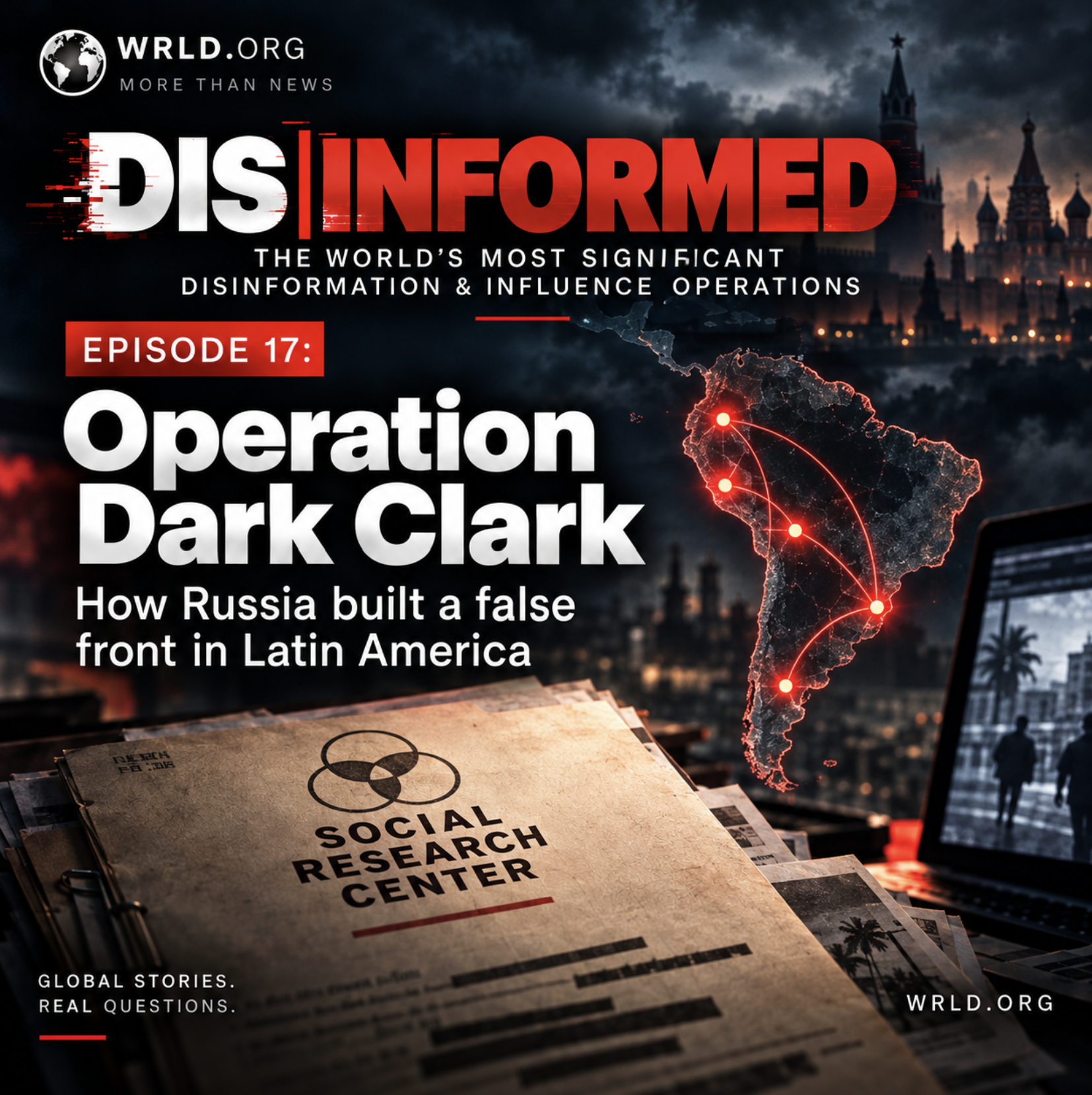
Operation Dark Clark – Russia built a real organisation around a false identity Most influence operations create fake people, fake websites or fake news stories. Operation Dark Clark appears to have gone considerably further: Russian operators built what looked like a functioning research organisation in Latin America, employed real people to produce genuine research and concealed from those employees who was ultimately directing their work. OpenAI disclosed the operation on 8 October after banning a cluster of accounts originating in Russia. The actors used ChatGPT while targeting countries across Latin America, principally to damage Ukraine’s reputation, manipulate domestic political debates and manage a self-described research organisation called the Social Research Center, or SRC. OpenAI assessed Dark Clark as Category Five on the six-level Breakout Scale, the first operation it has disrupted since beginning its influence-operation reporting to reach that level. A front organisation with real employees The SRC presented itself as a research platform studying subjects including Latin America’s relationship with India and the Indian diaspora. OpenAI found more than 60 articles on its website, most of them apparently original rather than plagiarised. Internal reports produced by the Russian operators discussed hiring, dismissals, salary scales, staffing and unfinished research projects, strongly suggesting that the operators controlled the organisation rather than merely collaborating with it. At the centre of the structure was “Mia Clark”, a fictitious identity reportedly used to manage social-media activity and communicate with staff. According to OpenAI, the available evidence indicates that employees working for SRC in Latin America were probably unaware that the organisation was being directed by Russian actors. They interviewed experts, conducted research and wrote papers in what appears to have been good faith. The deception therefore existed primarily at the organisational level: much of the work was real, but the identity and strategic purpose of the institution commissioning it were not. OpenAI This is one reason Dark Clark differs from the familiar model of a troll farm. A reader encountering an SRC paper might be looking at research genuinely written by a Latin American employee based on genuine interviews. The manipulation lies further upstream, in who built the institution, selected its direction and controlled its infrastructure. From forged emails to real events The operation also appears to have attempted something more ambitious than online persuasion: inducing real people to produce events that could later be turned into propaganda. In May 2026, according to the operators’ internal reports, they created an email address impersonating Lima’s regional education authorities and instructed schools to organise activities about Ukraine for a cultural-diversity event. The instructions included references to Stepan Bandera, whose historical legacy remains particularly contentious in Poland and parts of Eastern Europe. The operators claimed that some schools complied, replied to the false address and sent photographs of the events. OpenAI could not independently verify every claim contained in the operators’ reports. It did, however, find Peruvian reporting matching the story, followed by publications in Poland and an English-language outlet in Hungary. Some coverage included comments from a Polish MEP calling for people displaying what he described as anti-Polish attitudes to be declared persona non grata. OpenAI therefore concluded that the fabricated starting point appears to have entered genuine political debate across national borders. The mechanism is unusually effective because the final photographs need not themselves be fabricated. If people can be tricked into staging a real event on the basis of a forged instruction, the operation creates authentic visual evidence of something that was artificially initiated. The same method in Ecuador and Bolivia Dark Clark’s internal reports describe similar efforts elsewhere. In Ecuador, the operators claimed they used a fake education email to encourage schools to stage ceremonies involving President Daniel Noboa and Erik Prince, the former head of Blackwater. Ecuadorian media subsequently covered a matching controversy, and the country’s education minister issued a detailed denial. Other Ecuador-focused material included fabricated audio attributed to Ukraine’s consul and a false television report alleging that Noboa’s government was recruiting Ecuadorians to fight in Ukraine. Local fact-checker Lupa found that the supposed Teleamazonas report had never been broadcast, that images had been taken from Instagram, that the audio was AI-generated and that a company named in a supposed recruitment contract did not exist in Ecuador’s corporate registry. In Bolivia, an internal report described a fake audio recording supposedly made by an employee of state water company EPSAS during anti-government protests. It claimed that water supplies to La Paz would be cut and a state of emergency declared. The allegation produced a fact-check and an official denial. OpenAI says the operators explicitly described their objective as worsening the political crisis surrounding the demonstrations. Possible links to the post-Wagner influence machine Dark Clark did not emerge in a vacuum. The operators repeatedly asked ChatGPT about Politology and La Compania, names associated in previous investigations with the Russian influence apparatus that developed from structures once connected to Yevgeny Prigozhin. Forbidden Stories and its partners obtained 1,431 pages of internal documents describing a network known as “The Company”, which they reported had grown to almost 100 operatives and was conducting influence projects across roughly 30 Global South countries. Their investigation found that the organisation moved under the supervision of Russia’s Foreign Intelligence Service, the SVR, after Prigozhin’s death. Its documented budget for ten months of activity in 2024 was approximately €7.3 million. Two older Argentina campaigns claimed in Dark Clark’s internal reports — a false story about Javier Milei buying Cartier collars for his dogs and the staging of anti-Milei graffiti — had already been independently attributed by investigative journalists to Politology/La Compania. That is significant corroboration, but it is not enough to prove that every Dark Clark activity was run by the same organisational structure. AI was the back office, not the mastermind Perhaps the most important finding concerns artificial intelligence itself. In most documented cases, the Russians were not using ChatGPT to generate the propaganda seen by the public. Their principal use was administrative: drafting reports for an unknown superior, summarising operations, translating material and recording the supposed success of campaigns. Those reports also expose a weakness in the operators’ own measurement. OpenAI found instances in which they tried to claim credit for developments they had probably not caused, suggesting that they were not only attempting to manipulate Latin American audiences but also presenting an inflated picture of their effectiveness to whoever was supervising them. Dark Clark nevertheless broke further into the real world than any influence operation OpenAI had previously disrupted. Under the Brookings framework, Category Five means that an operation has escaped its original network and been amplified by high-profile individuals such as politicians. Dark Clark crossed that threshold because fabricated narratives appear to have provoked governmental denials, mainstream reporting and political comment in several countries. Its most important innovation was therefore not a particularly convincing deepfake. It was the construction of a partly genuine institution around a concealed foreign controller. The research could be real. The employees could be real. The interviews could be real. What was false was who they were ultimately working for. Sources OpenAI — Disrupting AI-enabled “false front” operations https://openai.com/index/disrupting-ai-enabled-false-front-operations/ Forbidden Stories — Propaganda Machine: Russia’s foreign influence strategy across three continents https://forbiddenstories.org/propaganda-machine-secret-documents-reveal-russias-foreign-influence-strategy-across-three-continents/ Forbidden Stories — Ghost Journalists, Cash and Kremlin Scripts: Argentina https://forbiddenstories.org/ghost-journalists-cash-and-kremlin-scripts-how-russian-operatives-tried-to-influence-argentinian-media/ openDemocracy — Russian influence operation in Bolivia https://www.opendemocracy.net/en/russia-bolivia-south-america-putin-evo-morales-wagner-prigozhin-covert-operations-propaganda-disinformation-foreign-interference/ Lupa Media — Fake Teleamazonas report about recruiting Ecuadorians for Ukraine https://lupa.com.ec/verificaciones/noboa-mercenarios-ucrania-ecuador/ Brookings Institution — The Breakout Scale https://www.brookings.edu/articles/the-breakout-scale-measuring-the-impact-of-influence-operations/ Keywords: #DISINFORMED #Episode17 #OperationDarkClark #DarkClark #Russia #LatinAmerica #RussianInfluence #RussianDisinformation #Disinformation #InformationWarfare #InfluenceOperations #ForeignInterference #FIMI #FalseFront #FrontOrganisation #FakeInstitution #SocialResearchCenter #SRC #ArtificialIntelligence #AI #GenerativeAI #ChatGPT #OpenAI #NarrativeManipulation #SourceLaundering #InstitutionalManipulation #ForgedDocuments #FakeAudio #PoliticalInfluence #CovertInfluence #Peru #Ecuador #Bolivia #Argentina #Ukraine #Politology #LaCompania #TheCompany #SVR #WagnerLegacy #PropagandaMachine #GlobalSouth #BreakoutScale #OSINT #MediaManipulation #WRLD

1025
L
Le Soir 1w

This article explores the impact of climate marches through interviews with experts, questioning their political effectiveness. #MarchePourLeClimat #ChangementClimatique #MouvementsSociaux (translated)

www.lesoir.be
En vidéo - Les marches pour le climat ont-elles encore un impact ?
2856
Krzysztof Graj 2w

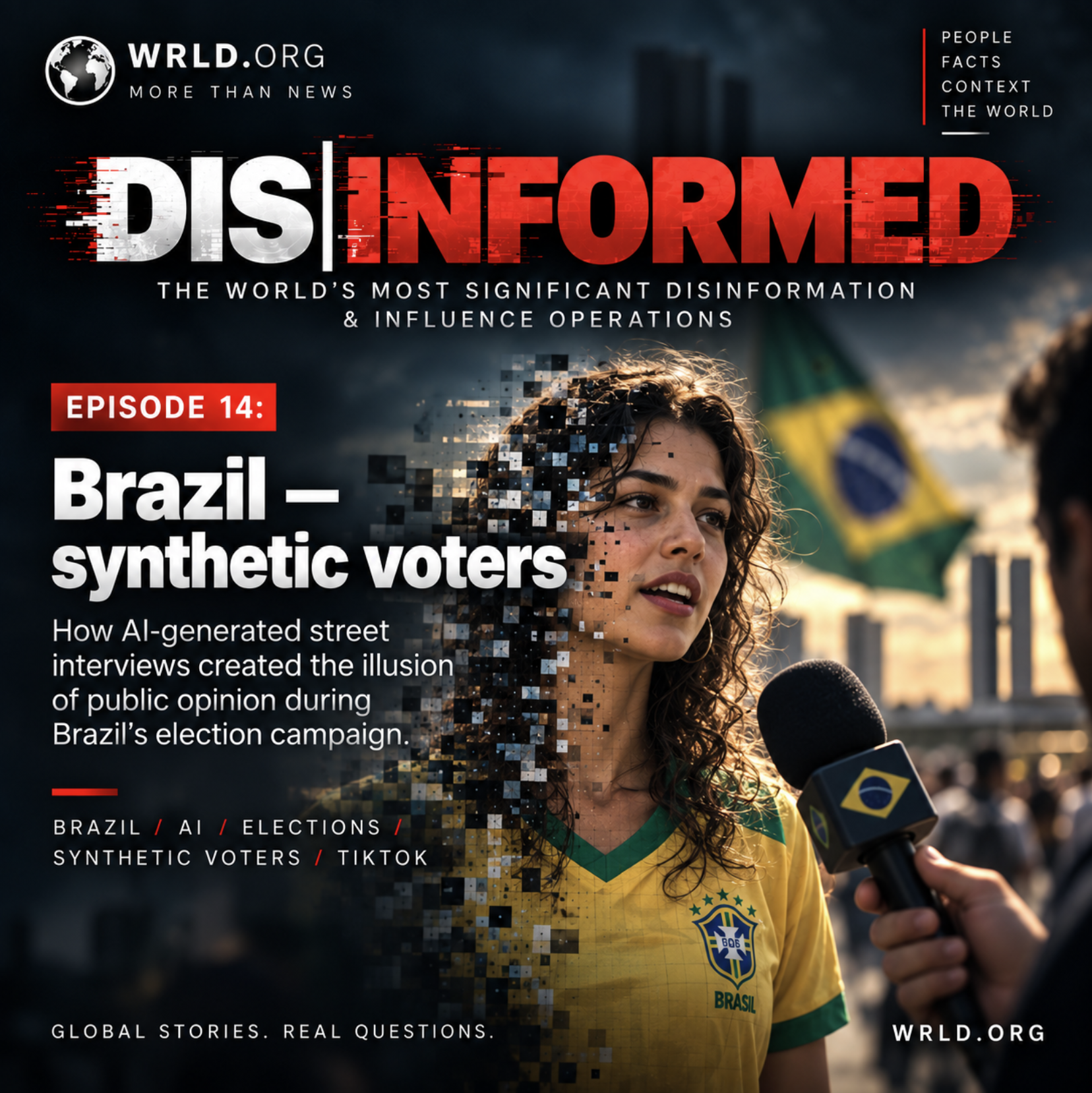
Brazil’s synthetic voters – when AI manufactures public opinion They look like ordinary street interviews. A reporter approaches a passer-by in a Brazilian square and asks a simple question: who will you vote for? A young voter explains why Luiz Inácio Lula da Silva deserves another term. An elderly woman says Brazil needs Flávio Bolsonaro because he represents political renewal and greater security. The locations look plausible, the microphones are visible and the answers sound much like the brief political opinions heard in television vox pops around the world. None of the people are real. Ahead of Brazil’s presidential election on 4 October, fact-checking organisation Aos Fatos identified at least 50 TikTok videos in which artificial intelligence was used to manufacture voters, reporters and apparently spontaneous political interviews. Together, the videos had accumulated around 7.4 million views by mid-August. Some promoted Lula, others Flávio Bolsonaro, while another group used synthetic characters to ridicule or stereotype supporters of one side. Aos Fatos found no apparent evidence linking the accounts producing the videos to either presidential campaign. The opinion poll that never took place The format is important. These were not conventional deepfakes in which a recognisable politician is made to say something he never said. Instead, the creators reproduced the visual language of the vox pop – the short street interview used by broadcasters and social-media creators to illustrate what ordinary people supposedly think. In pro-Lula videos, synthetic voters described themselves as beneficiaries of social programmes or credited the president with improving their lives. In videos supporting Flávio Bolsonaro, artificial interviewees associated him with political renewal, public security and fighting corruption. Other clips were openly hostile: AI-generated characters presented as poor or living in parts of Brazil’s north-east were shown in dirty clothes or run-down surroundings, declaring support for Lula because they supposedly preferred welfare payments to work. The deception is therefore subtler than fabricating a candidate’s statement. It manufactures something that political communication normally treats as evidence of public sentiment. A real vox pop may be unscientific, but the people interviewed at least exist. These videos created the appearance that identifiable social groups – young people, pensioners, welfare recipients or residents of particular regions – were spontaneously expressing political preferences when no such encounters had taken place. An electoral-law specialist interviewed by Aos Fatos described the technique as the fabrication of a “social fact that never occurred”. That captures the central innovation: AI is being used not merely to falsify political speech, but to manufacture the impression of grassroots opinion. Fifty videos, but not one proven network The available evidence does not support describing the 50 posts as a centrally controlled influence operation. Aos Fatos located them through TikTok searches and recommendations produced by the platform itself, then examined the accounts responsible for publication. Most had relatively small individual audiences, although their combined reach was substantial. The first examples identified by the investigation appeared as early as March 2026. Activity increased in June and was concentrated particularly in July and the first half of August as Brazil’s election calendar intensified. Some accounts specialised in AI-generated videos generally, including fabricated podcast-style material. Others were explicitly political or supportive of a candidate, but Aos Fatos found no apparent links between those profiles and the official Lula or Bolsonaro campaigns. That distinction is essential. The evidence demonstrates a common technique and a shared political environment, not a single command structure. Some creators may have been motivated by ideology, others by engagement or monetisation. Publicly available evidence does not establish who commissioned the individual videos or whether any coordination existed between the accounts. This decentralised model also creates a different enforcement problem from a traditional bot network. There may be no headquarters to expose and no infrastructure whose removal disables the entire operation. The format itself can be copied by anyone with access to inexpensive generative-video tools. When the algorithm mixes real and synthetic citizens Aos Fatos documented another important feature of the phenomenon: TikTok’s recommendation system placed AI-generated interviews alongside genuine street interviews. For a user scrolling quickly through the platform, the transition between an authentic citizen and an entirely fabricated one could therefore be almost invisible. In 18 per cent of the 50 videos analysed, there was no indication that the people shown had been generated using AI. After Aos Fatos provided TikTok with the videos, the company said it had removed all of them for violating its rules on edited and AI-generated media. TikTok said its policies require creators to identify synthetic content and prohibit manipulated media capable of misleading users about matters of public importance or impersonating genuine journalistic material. The issue extends beyond one platform. Factchequeado’s review of Brazil’s 2026 election campaign found that synthetic endorsements and other deepfakes had become one of the most visible forms of AI-assisted electoral misinformation, alongside fabricated candidate statements and invented scenes. Brazil already had rules for synthetic politics Brazil entered the campaign with unusually detailed electoral rules governing artificial intelligence. The Superior Electoral Court, the TSE, requires electoral propaganda using synthetic multimedia to disclose clearly that AI was used. More importantly for the fake-voter videos, its rules prohibit synthetic audio or video used to favour or harm a candidacy when it creates or alters the image or voice of a living, deceased or fictitious person. The difficulty is attribution and enforcement. When a synthetic video is published by an official campaign, responsibility can be relatively straightforward to investigate. When it comes from an apparently independent account with no demonstrated relationship to a candidate, lawyers interviewed by Aos Fatos said responsibility is more likely to fall on the individual creator, while imposing electoral sanctions on a campaign would require evidence of a connection. For the final 72 hours before the election and the 24 hours following it, the TSE has imposed additional restrictions on newly published or republished synthetic material involving candidates or public figures, reflecting the particular difficulty of correcting fabricated content immediately before voting. From deepfake politicians to synthetic electorates The Brazilian case illustrates a broader change in political manipulation. The first generation of electoral deepfakes concentrated on famous people: make a politician appear to say something damaging, or fabricate an endorsement from a celebrity. Synthetic vox pops reverse the perspective. The politician can remain completely authentic; it is the electorate around the politician that is fabricated. That changes the psychological proposition of the message. Instead of saying the candidate believes this, the video suggests people like you believe this. Age, clothing, accent, neighbourhood and social class can all be generated to construct an artificial constituency around almost any political claim. There is no evidence that the 50 Brazilian videos identified by Aos Fatos constitute a single centrally directed campaign, nor evidence that they changed voting intentions. What they demonstrate is a technique whose barrier to entry has become extremely low. AI no longer needs to forge the politician. #DISINFORMED #Episode14 #Brazil #BrazilElection2026 #Elections #ElectionDisinformation #ArtificialIntelligence #AI #GenerativeAI #SyntheticVoters #SyntheticMedia #AIAvatars #AIGeneratedVideo #VoxPop #FakeInterviews #Astroturfing #AIPropaganda #PoliticalDisinformation #InfluenceOperations #InformationWarfare #SocialMediaManipulation #TikTok #PublicOpinion #ManufacturedConsent #SyntheticPublicOpinion #DigitalInfluence #Deepfakes #ElectionIntegrity #TSE #AosFatos #FactChecking #OSINT #MediaManipulation #WRLD (translated)

www.aosfatos.org
Eleitores gerados por IA fazem campanha no TikTok e põem em xeque regra do TSE
689
Claudia van Zanten 2w

Claudia van Zanten referred to a report from Het Parool stating that the Israeli army questioned the interviews without providing evidence for it. According to Van Zanten, the interviews with 24 IDF soldiers were anonymous, it was not proven that the interviewees were actually soldiers, and their motives were unknown. She wrote that Het Parool should have critically evaluated the interviews themselves if it took journalistic codes seriously. Van Zanten stated that many media present opinions they agree with as facts, and as a result, facts no longer count. https://t.co/MWtPnSO57t #media #journalistiek #Israël (translated)

13215
Actu Foot 2w

Actu Foot reported that Igor Paixão had mentioned contacts regarding Flamengo and Palmeiras, communicated by his agents, but that no lead had materialized and that it was mainly speculation. The player also stated that joining Flamengo was a childhood dream shared by his family, and that he hoped to one day wear the club's jersey. He had already mentioned this desire in an interview, according to Band, cited by ESPN Brasil. #Flamengo #Football #Transferts (translated)

13217
David Berger 2w

The author wrote that the AfD has reached 30 percent for the first time and that the Union has fallen to 18 percent. He stated that he is pleased to have reported fairly about the AfD in his blog for ten years and to have conducted one of the first personal interviews with Alice Weidel. https://t.co/vGScMjx2ZV #AfD #Politik #Deutschland #DE (translated)

230
Manuel Bompard 3w

Je ne choisis pas les thèmes des interviews mais merci Mathias Wargon pour votre vigilance. Stop au génocide à Gaza. Tout mon soutien au peuple palestinien. #Gaza #Palestine #StopGenocide #PS #IL

7631