BETA nonprofit public democratic european moderated

Search

#Psychology

While 'psychology' is often the best level of description of current AIs I don't necessarily mean 1:1 human psychology. It seems fairly likely AIs have emotion-like states which do not straightforwardly correspond to humans and both us and AIs lack vocabulary to talk about. #AI #Psychology #Emotions #Nospecificcountriesarementionedinthetweet.

H

“Socialism Was Good in Theory” That sentence assumes the theory was never seriously challenged. It was. Long before the Soviet Union existed, before Lenin seized power, and before socialism had been tested on a national scale, major thinkers were already attacking its foundations—from very different directions. Five of them stand out. Tocqueville: Equality Can Become Servitude In 1848, Alexis de Tocqueville drew a sharp distinction between democracy and socialism. Both spoke about equality. But Tocqueville believed they pursued it in fundamentally different ways. Democracy, in his view, sought equality while preserving individual freedom. Socialism risked achieving equality by expanding the power of the state over the individual. His warning was essentially this: equality is not automatically liberty. A society can pursue equality so aggressively that it begins sacrificing the independence that makes political freedom meaningful. Bastiat: Follow Where Redistribution Leads Two years later, Frédéric Bastiat attacked socialism from a different direction. His question was deceptively simple: What happens when the state acquires the authority to take from some people and give to others in the name of justice? Bastiat called this “legal plunder.” His concern was not merely that redistribution might be expensive. It was that once government becomes the instrument through which competing groups obtain benefits from one another, politics can turn into a permanent struggle over who controls the machinery of redistribution. The problem, therefore, wasn’t simply how much the state redistributed. It was the principle that made redistribution legitimate in the first place. (bastiat.org⁠) Nietzsche: Equality Can Become Resentment Nietzsche approached socialism neither as an economist nor as a constitutional theorist. He attacked its psychology. He saw modern egalitarian movements as part of a much older moral impulse: resentment toward exceptional individuals and suspicion of strength, ambition and hierarchy. For Nietzsche, the danger was not simply that everyone might become economically equal. It was that a culture could begin treating excellence itself as something morally suspect. The goal would cease to be lifting people upward. It would become bringing the exceptional downward. Böhm-Bawerk: Challenge the Economics Then came Eugen von Böhm-Bawerk. In 1896, he turned his attention specifically toward Marx’s economic system. His criticism was not primarily moral or political. It was technical. Böhm-Bawerk argued that Marx’s theory of value did not adequately explain how the labor values developed in Capital could be reconciled with the actual prices Marx subsequently needed to explain. In other words, he attacked socialism where it claimed to possess a scientific economic foundation. The argument became one of the central criticisms of Marxian economics and helped launch a debate that would continue for generations. Mises: The Calculation Problem Then, in 1920, Ludwig von Mises attacked an even more fundamental question: Even if socialism is morally desirable, how would a socialist economy actually know what to produce? A functioning economy has millions of competing uses for scarce resources. Build a bridge or a hospital? Use steel here or there? Produce more machinery or more consumer goods? Under private ownership and markets, prices for capital goods provide information about relative scarcity and opportunity costs. Mises argued that abolishing private ownership of the means of production also removes the genuine market prices necessary for rational economic calculation. The problem wasn’t simply that socialist planners might make bad decisions. It was that the system deprived them of the very economic signals required to systematically compare those decisions. (Mises Institute⁠) And that was the sequence. Tocqueville challenged the political premise. Bastiat challenged the moral and legal mechanism of redistribution. Nietzsche challenged the psychology behind egalitarianism. Böhm-Bawerk challenged Marx’s economic theory. Mises challenged the possibility of rational central economic calculation. Five different thinkers. Five different objections. And all of them came before the Soviet Union had demonstrated what large-scale socialist government would actually look like. So “socialism was good in theory, but bad in practice” is not an argument. It is a historical claim that requires you to explain why these theoretical objections were wrong. The interesting question isn’t whether socialism had critics. It did. The interesting question is whether socialism ever adequately answered them” - ChatGPT

H

Where the Clinic Meets the Movement: Does Gender Ideology Arm Left-Wing Authoritarian Psychology? “CGAS (Clinical Gender Affirmation Scale) and related gender ideological-belief measures were strongly associated with left-wing authoritarianism” - Where the Clinic Meets the Movement: Does Gender Ideology Arm Left-Wing Authoritarian Psychology? “CGAS (Clinical Gender Affirmation Scale) was not simply standing in for being politically left-wing” - Where the Clinic Meets the Movement: Does Gender Ideology Arm Left-Wing Authoritarian Psychology? “Support for coercion, punishment, and violence appears to be tied less to liberalism generally than to an authoritarian disposition organized around left-wing ideological content” - Where the Clinic Meets the Movement: Does Gender Ideology Arm Left-Wing Authoritarian Psychology? “Gender ideology may function as an ideological accelerant” - Where the Clinic Meets the Movement: Does Gender Ideology Arm Left-Wing Authoritarian Psychology? “Gender ideology may supply authoritarian psychology with a structured map of perceived outgroups, threat sources, and oppressor classes” - Where the Clinic Meets the Movement: Does Gender Ideology Arm Left-Wing Authoritarian Psychology? “Dissent becomes not a legitimate position but a failure of professional duty or an act of harm” - Where the Clinic Meets the Movement: Does Gender Ideology Arm Left-Wing Authoritarian Psychology? “The same psychological machinery operates on the extreme left”- Where the Clinic Meets the Movement: Does Gender Ideology Arm Left-Wing Authoritarian Psychology? “Violence can come to seem permissible or necessary” - Where the Clinic Meets the Movement: Does Gender Ideology Arm Left-Wing Authoritarian Psychology? “Three findings pull in the same direction. People who strongly endorse gender ideology positions score dramatically higher on left-wing authoritarianism than their political identity alone would predict. Furthermore, both LWA (Left-Wing Authoritarianism) and CGAS (Clinical Gender Affirmation Scale) predicted support for political violence” - Where the Clinic Meets the Movement: Does Gender Ideology Arm Left-Wing Authoritarian Psychology? “Together, these findings support the paper's core claim: gender ideology may function as an ideological accelerant, telling left-wing authoritarian psychology who the enemy is, why the situation is urgent, and—in those already disposed toward force—that violence is legitimate” - Where the Clinic Meets the Movement: Does Gender Ideology Arm Left-Wing Authoritarian Psychology? “One mechanism by which clinical content may translate into violence permission deserves note. Trans-Genocide Belief—the perceived likelihood that a genocide of individuals that identify as transgender is currently underway in the United States—is predicted to more strongly relate to CGAS (Clinical Gender Affirmation Scale) and LWA (Left-Wing Authoritarianism) than to political identity and to be associated with elevated justification for political violence” - Where the Clinic Meets the Movement: Does Gender Ideology Arm Left-Wing Authoritarian Psychology? “This prediction is consistent with broader research showing that perceived threat, existential threat, and collective victimhood can increase support for hardline, punitive, or exclusionary action against outgroups, particularly when paired with authoritarian dispositions or strong moral conviction (Armaly & Enders, 2022; Carriere et al., 2022; Hirschberger et al., 2016; Kljajić et al., 2025; Schori-Eyal et al., 2014; Skitka, 2010)” - Where the Clinic Meets the Movement: Does Gender Ideology Arm Left-Wing Authoritarian Psychology? “Related work on moralization and violent intergroup conflict further suggests that when a political conflict is framed as a moral emergency involving dangerous or demonized outgroups, violence can come to seem permissible or necessary (Mooijman et al., 2018; Saguy & Reifen-Tagar, 2022)” - Where the Clinic Meets the Movement: Does Gender Ideology Arm Left-Wing Authoritarian Psychology? “The practical stakes are straightforward. Research frameworks for understanding authoritarianism have historically focused overwhelmingly on the political right, while analogous left-wing pathways have received far less attention. Yet federal agencies and public safety officials are concerned not only with ideology in the abstract, but with radicalization pathways: the content that tells people who to fear, why the situation is urgent, and when force becomes acceptable” - Where the Clinic Meets the Movement: Does Gender Ideology Arm Left-Wing Authoritarian Psychology “This study suggests that the same psychological machinery operates on the extreme left, and that it may be running through institutional channels—clinical guidelines, professional standards, credentialed expertise—that current threat-detection frameworks are not well designed to recognize” - Where the Clinic Meets the Movement: Does Gender Ideology Arm Left-Wing Authoritarian Psychology? “Violence connected to gender ideology remains largely undocumented in the academic literature. This study provides a first systematic empirical look at the psychological infrastructure that makes such violence conceivable” - Where the Clinic Meets the Movement: Does Gender Ideology Arm Left-Wing Authoritarian Psychology? “Both LWA (Left-Wing Authoritarianism) and CGAS (Clinical Gender Affirmation Scale) were significantly positively correlated with justification for political violence across all six targets” - Where the Clinic Meets the Movement: Does Gender Ideology Arm Left-Wing Authoritarian Psychology? “Our main findings for youth starting treatment with blockers include: At baseline, about one-quarter of these youth had clinically concerning scores for depression and anxiety. About one-quarter reported having thought about suicide, and 8% reported having attempted suicide in the past. These numbers are on par with the population of middle school youth at large” - The Trans Youth Care - United States “Our main findings for youth starting treatment with GAH include: At baseline, about half of these youth had clinically concerning scores for depression and anxiety. About two-thirds reported having thought about suicide, and one-quarter reported having attempted. By two years after starting GAH, these youth showed increased scores for life satisfaction, appearance congruence (having the physical appearance of one's body match one's gender identity), positive emotions, and psychological well-being and decreased scores for depression and anxiety” - The Trans Youth Care - United States

O

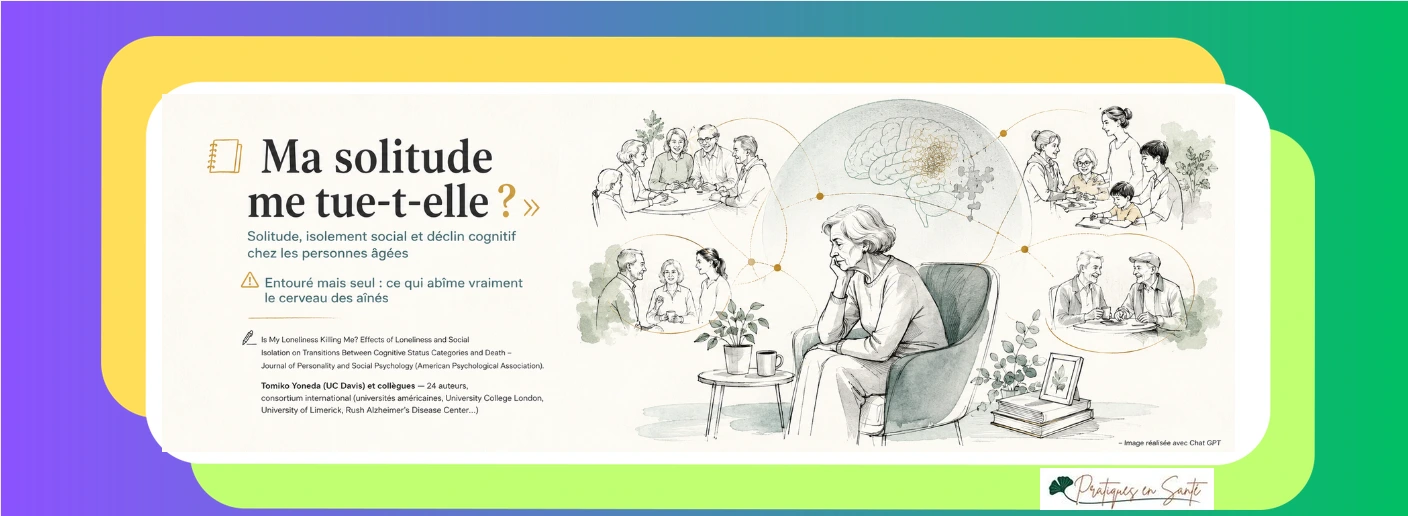
🚨 Entouré, mais seul : et si ce qui abîme le cerveau des aînés n'était pas ce que l'on croit ? 📒 « Ma solitude me tue-t-elle ? » — Solitude, isolement social et déclin cognitif chez les personnes âgées ✍️ Tomiko Yoneda (UC Davis) et un consortium international — Journal of Personality and Social Psychology (APA) Sur 175 000 personnes âgées suivies dans 18 pays, une distinction change tout : ce n'est pas le fait d'être seul qui pèse le plus sur le déclin cognitif et la mortalité, mais le sentiment de solitude. Autrement dit, une personne très entourée peut rester exposée. De quoi interroger nos pratiques de repérage — et une question simple qu'il faudrait peut-être poser bien plus souvent, à l'accueil comme à domicile. 👉 Mon analyse et le document source sont à retrouver ici : https://www.pratiquesensante.com/blog/pratiques-15/ma-solitude-me-tue-t-elle-solitude-isolement-social-et-declin-cognitif-chez-les-personnes-agees-6153 🎙️ À écouter également : la capsule audio de Pratiques en Santé. https://www.youtube.com/watch?v=zTvkQqxhh-I #PratiquesEnSante #LienSocial #SolitudeDesAînés #BienVieillir #SantéCognitive #PréventionSanté

Is My Loneliness Killing Me? Effects of Loneliness and Social Isolation on Transitions Between Cognitive Status Categories and Death
H

The Psychology Behind Political Violence Political life carries an appetite for violence beneath the surface. A shooter leaves a manifesto; supporters celebrate; online strangers justify killing over insults, misgendering, and fantasies of execution. We’re told these are separate phenomena—different ideologies, grievances, causes—but they’re deeply connected. The murderer, the celebrant, and the online fantasist share one conviction: blood will build a better world. We often assume ideology comes first, violence second—radicalization infecting an otherwise ordinary person. But corrupted people may seek ideologies that rationalize what they already want to believe. Feeling comes first; philosophy follows. Nietzsche called this *ressentiment*: not ordinary anger, but enduring resentment rooted in surrendered agency and perpetual victimhood. Ressentiment is creative: it turns grievance into virtue and revenge into justice. That’s why movements can sound humanitarian while obsessing over enemies. They promise liberation but focus on who must be eliminated; they call violence self-defense while celebrating destruction. Notice the imbalance: energy goes to identifying who deserves punishment, not to explaining how their better society would work. This is the difference between genuine grievance and pathological ressentiment. Genuine grievance seeks repair; ressentiment seeks subtraction. Its “solutions” are fantasies of punishment—heads cut off, privilege liquidated, wrong pronouns punished. These aren’t coherent doctrines of stability; they’re rationalizations for resentment. Ressentiment also despises self-improvement because it requires admitting agency. Its worldview depends on locating suffering outside oneself. The deepest enemy of these movements, then, is not any specific ideology. It is agency itself.

H

Orwell’s Five Warnings About the Psychology of Totalitarianism Orwell understood totalitarianism’s psychology: unlike dictators who seek wealth and status, totalitarians aim to reshape humanity. They often claim to act “for our own good,” with conscience on their side. After reading Orwell, five lessons stand out: 1. Political correctness can become mind control “If thought corrupts language, language can also corrupt thought.” Words frame reality and limit solutions. 2. Doublethink is the hallmark of propaganda “War is peace. Freedom is slavery. Ignorance is strength.” When contradictions become acceptable, rational thought collapses. 3. Control the past and you control the future “Who controls the past controls the future.” Rewriting history turns gratitude into guilt and inheritance into theft. 4. You cannot fight for freedom with a shackled mind “Until they become conscious they will never rebel.” Team loyalties replace judgment; challenging the narrative grants permission to ask questions. 5. True power is the power to shape perception “Power is in tearing human minds to pieces and putting them together again in new shapes…” The goal isn’t mere obedience, but surrendering the ability to distinguish truth from what authority declares true. Orwell’s warning: don’t let it happen—resist arbitrary power by holding to truth, conscience, family, community, faith, and the people you love.

H

Why Leftist Activists and Revolutionaries Can Never Declare Victory Leftist movements face a paradox: they use oppression narratives to gain institutional power, then keep claiming victimhood as that power grows. Instead of disappearing, activism “shapeshifts” inside bureaucracy, media, academia, corporations, and the arts. Even when DEI is challenged, its structures often remain under new names—diversity becomes “belonging” or “inclusive culture.” The logic is permanent revolution: influence depends on the struggle never ending. Goals shift, new categories of oppression are defined, and intersectionality divides people into ever finer oppressor/oppressed groups, creating an endless hierarchy of grievances. If activists declared victory, the justification for ongoing mobilization would collapse. The risk is social atomization: identities replace shared citizenship, and the state shifts from neutral protector to an instrument for redistributing power between designated victims and oppressors. Bureaucracy and propaganda can replace community and argument. History shows recurring purges—once the revolution’s machinery turns inward, yesterday’s enforcers become today’s targets. The result is also a ressentiment psychology: identity forms around an “enemy,” not one’s own strength. This dynamic helps sustain the consultancy model—identify the guilty, define the aggrieved, and perpetuate conflict. Equality with a finish line is manageable; equality of outcomes is not, so there is always another disparity, injustice, or enemy. The movement fears completion less than failure, because ending would make its power machinery unnecessary.

H

The Tolerance That Censors Institutions preach tolerance, yet disagreement is increasingly punished. As protected classes expand, demands for compliance, surveillance, and reporting grow. A tolerance-saturated society becomes hostile to dissent. Many call it hypocrisy, but the contradiction may be strategy. In 1965, Herbert Marcuse’s *Repressive Tolerance* argued that liberal “equal hearing” can perpetuate oppression. “Liberating tolerance,” he claimed, must discriminate: intolerance toward the Right, tolerance toward the Left. Why? Classical Marxism expected industrial workers to revolt from misery. Instead, comfort increased and revolution stalled. The Frankfurt School offered a remedy: capitalism colonized consciousness, creating “false consciousness.” If factory revolt won’t start, revolution must begin in the formation of minds—culture, education, psychology, entertainment. If so, neutrality becomes the enemy. Free debate spreads the system’s ideas. Elections let prisoners choose their preferred warden. Liberal freedoms act as “steam valves,” releasing pressure to prevent revolt. Tolerance becomes directional: oppressive ideas are suppressed; liberating ideas are amplified. Censorship and punishment are reframed as freedom’s highest expression. Marcuse also recognized liberal resistance to censorship and proposed “emergency” suspensions when oppression is deemed urgent—a logic echoed when speech is treated as harm and coercion as protection. The unsettling possibility is that nothing is malfunctioning: tolerance may function as a weapon. The final stage requires no visible censor—the individual internalizes it, policing their own thoughts.

H

The Psychology of the Modern Leftist Once you understand the psychology of the modern leftist, the last decade of the woke revolution makes more sense. The endless outrage, hypersensitivity, and rejection of rational debate may reflect something deeper than ideology: a crisis of self-worth expressed as a moral crusade. “Leftist” is a broad term, but here it refers to socialists, collectivists, LGBTQ activists, and similar movements. What unites them may be more than politics; it may also be a psychological orientation. Modern leftism can be associated with feelings of inferiority, low self-esteem, powerlessness, guilt, self-hatred, and resentment. These feelings may be repressed while still influencing behavior. The hypersensitivity to language illustrates this. Words once used without negative intent can become symbols of oppression through activist campaigns. Ironically, those most offended are sometimes privileged academics rather than the minorities they claim to defend. Many leftists identify with groups perceived as weak or disadvantaged. This may reflect genuine compassion, but it can also involve projecting personal feelings of weakness onto others. Strength, success, competition, and rationality can consequently become objects of suspicion. Western civilization, America, and other symbols of power may be treated similarly. The criticism can also be inconsistent. Flaws condemned in Western societies may be excused when found in socialist regimes or traditional cultures. This suggests that resentment may sometimes play a role alongside genuine moral concerns. Self-reliance, personal responsibility, and merit are often viewed skeptically, while collectivism is favored. Objective truth can also become threatening because it creates distinctions: some arguments are better than others, and some people succeed while others fail. When equality of outcome becomes the moral standard, truth, merit, and individualism may be attacked—not necessarily to uplift the oppressed, but to reduce psychological discomfort. When victimhood becomes central to identity, problems may no longer simply be discovered; they can become necessary to sustain that identity.

H

Why Weak Societies Choose Tyranny The pinnacle of tyranny would be a system that allows politicians, elites, and bureaucrats to control a population without force or coercion because the people love their servitude. Aldous Huxley wrote Brave New World, an eerily relatable dystopian novel, with this idea at the forefront. Unlike Orwell’s 1984, there is no overt oppression. The state does not have to stamp on human faces with its jackboots or erect an inescapable surveillance state. Rather, the people of Brave New World happily chain themselves with meaningless pleasure and distractions. The authorities do not rule through terror and rage, the central elements of 1984, but instead give the people everything they ever wanted. A pharmaceutical called Soma becomes the opiate of the masses. Mustapha Mond, the World Controller, likens it to Christianity without tears. While religion requires years of moral training, Soma allows citizens to achieve peace simply by swallowing tablets. It is the perfect escape from reality, a holiday from the facts. Lenina, the female counterpart to the protagonist Bernard, cannot comprehend why he refuses Soma, preferring discomfort to something that can remove it. When Bernard states, “I’d rather be myself, myself and nasty, not somebody else, however jolly,” Lenina sees this as a sort of pathology and repeatedly encourages him to take the wonder drug. Bernard explains, “I want to know what passion is.” He understands that there is more to life than merely being content, craving genuine experience, including suffering and intensity, rather than being emotionally regulated by the World State. Lenina’s bewilderment stems from her conditioning to regard unhappiness as a technical problem, encapsulated in the society’s common saying that “a gram is better than a damn.” The people of Brave New World are not captives but satisfied customers. Children are produced by the scientific state, relieving people of the responsibility of parenthood. This grants them the ability to engage in promiscuity, where everyone belongs to everyone else, while filling their free time with cheap entertainment and endless sporting events—what would be referred to as slop today. As Neil Postman observed, Orwell saw totalitarianism through the lens of fear, while Huxley saw it through pleasure. There was no need to ban a book in Brave New Worldbecause there was no one who wanted to read one. An abundance of low-quality information rendered censorship unnecessary because no one could hear the truth through all the noise. Huxley threw shade at civil libertarians who passionately opposed tyranny because they failed to take into account man’s almost infinite appetite for distractions. Humanity in its rawest form is portrayed by John the Savage, an outsider free from the World State’s conditioning. Upon coming face-to-face with this spiritually neutered society, he completely rejects it: “I don’t want comfort, I want God, I want poetry, I want real danger, I want freedom, I want goodness, I want sin.” Huxley’s dystopia is not imposed on an unwilling population but instead requested by a hollow one. Which leads us to the question: How do people become so weak that they get on their knees and beg for totalitarianism? Good times make bad times possible. Once a certain level of luxury and safety is achieved, people start to resemble the hobbits from the Shire. They are so far removed from evil that they forget it even exists and become defenseless in the face of it. Andrew Lobaczewski, who studied the psychology of totalitarianism from inside Poland’s communist takeover, wrote: “During good times, people progressively lose sight of the need for profound reflection. They lose the capacity to differentiate human nature, and emotion begins to dominate intellect. Once a critical mass starts operating on the pleasure principle, any excess mental effort seems like pointless labor.” Lobaczewski warned that it is not as simple as some people losing the ability to think rationally. It is worse, because those people then shame anyone capable of doing so. A clever, liberal, and merry individual is a good sport. A more far-sighted person predicting dire results becomes a wet blanket, a killjoy. The ability to have uncomfortable conversations without emotion taking over is, in Lobaczewski’s view, an indicator of whether a society’s future will be good or bad. It is easier to think about pleasant things. This leads people to eliminate any data or facts that cause them discomfort. That becomes a habit and eventually a custom accepted by society at large. Once the general populace accepts that inconvenient truths should be left unsaid, it becomes incapable of reaching correct conclusions. After all, how could you ever describe a picture that you refuse to look at? “Catastrophe waits in the wings of the communities that lose the capacity for psychological reason and moral criticism,” Lobaczewski wrote. “It is on the other side of this weakening of thought that the processes of the generation of evil are intensified at every social scale until they give rise to bad times.” It is precisely man’s dreams of happiness that can lead to chaos and suffering. This hedonistic view of happiness contains the seeds of misery, feeding the eternal cycle whereby good times give birth to bad times. Friedrich Nietzsche viewed socialism as demanding comfort for the greatest number of people possible. To question whether it is good for the masses to live in comfort has become a form of heresy. This reveals the spiritual atrophy that so many suffer from. Considering only the weak believe comfort to be a virtue, it is what Carl Jung would describe as the infantile dream state of mass dependency: the desire to gently slip back into the kingdom of childhood, into the paradise of parental care. Except this lack of friction has consequences. The perfect state destroys the soil in which great intellect grows. Genius, struggle, passion, strength, and wisdom are required to build a safe and abundant society. Yet once a certain level of comfort is achieved, it can destroy the very virtues required to obtain it. Nietzsche observed that it is the warmest heart that aims to alleviate suffering and hardship but fails to realize that it thereby wills the destruction of its own foundation. Comfort breeds mediocrity, which is then called good. Small people want one thing above all: that no one hurt them. We have taken this pathology to such a degree that we now obsess over hurt feelings and call this virtue. Pleasure, in its proper place, is a byproduct of meaningful goals, not a goal in itself. Aristotle saw that pleasure and comfort distort perception and proper judgment. While they do not cause us to misjudge something like geometry or mathematics, they can destroy our ability to decide what is worth pursuing and, therefore, what to do. Consider The Odyssey. Homer depicts Odysseus’ men on the island of the Lotus-Eaters, where they taste the fruit and lose all desire to go home. Much like Huxley’s Brave New World, they are not imprisoned. Rather, they simply stop wanting anything more. Odysseus has to drag his men back to the ships while they weep to stay. This is what comfort can do to men. It empties them of purpose. We intuitively understand this but fail to apply it to our own lives. We must make the same choice as Odysseus when he refuses Calypso’s offer of endless comfort and immortality. He knows she is more beautiful than his wife Penelope waiting at home. He knows that he and Penelope will grow old and die, a fate he could avoid by staying with Calypso. No one who reads these stories wishes he had stayed. We want him to choose the hard way home because if he took the offer, he would stop being admirable. Yet staying is exactly what our modern society asks of us. We are told that the island is the good life. But what happens to the man who caves to this temptation? In Thus Spoke Zarathustra, Nietzsche imagines a risk-averse society taken to its logical endpoint. The elimination of all struggle produces a man so diminished that he fails to possess even self-contempt or higher aspiration. Safety and sameness become the highest goals, creating “no shepherd in one herd.” Anyone who seeks to be anything more than normal becomes an aberration to be dealt with. Or, as Nietzsche puts it, they have “made the wolf a dog in man himself, man’s best domestic animal.”

📉 Άμεσος ο αντίκτυπος στην ψυχολογία της αγοράς ☘️ Η ψαλίδα μπορεί να μειωθεί και άλλο. ☘️ Κάντε αυτό που πρέπει: στήριξη στον πρωταθλητή Neestrup με κάθε τρόπο. Με μεταγραφές και προστασία από όσους έχουν λυσσάξει ώστε τα 16 να γίνουν 17. #paofc https://t.co/qpURPUVQYl #psychology #market #support

Contrary to the pessimistic outlook of psychological research on the 'bystander effect', the vast majority of victims of real-life assaults are helped by bystanders. However, during commercial robberies, most bystanders hold back. One of the classical hypotheses of #BystanderEffect #Psychology #PublicSafety #Thetweetdoesnotspecificallymentionanycountries #sotherearenocountrycodestoreturn.

According to a new paper, we might have completely misunderstood the Dunning Kruger effect. Confident people actually do perform better. https://t.co/JQqcnAdXhG #DunningKruger #Psychology #Confidence #Nospecificcountriesarementionedinthetweet.

Έχει ψυχολογικά προβλήματα και παλιότερα είχε πραγματοποιήσει ανάλογη επίθεση στο Σύνταγμα. Αυτός ο άνθρωπος κυκλοφορούσε ελεύθερος, με ευθύνη των δικαστών και των νομοθετών. Καλημέρα σας #Psychology #Justice #MentalHealth

IndexHR Jul 14

Studija objavljena u časopisu Frontiers in Psychology pokazuje da djeca koja osjećaju da se moraju natjecati za pažnju svojih roditelja, zbog njihove zaokupljenosti mobitelima, razvijaju više znakova nesigurne privrženosti i anksioznosti. #mobiteli #djeca #roditeljstvo

Studija: Djeca se osjećaju zanemareno ako roditelji puno vremena provode na mobitelu

"Religion is like software: both produce ideas and rules instead of physical products, they have goals they translate into repeatable instructions focused on shaping human psychology and behavior, they have version control (anti-heresy) and forks (new sects), they optimize the #ReligionAsSoftware #IdeasAndRules #HumanBehavior #Nocountrycodesarepresentinthetweet.

Έχει περάσει 1.5 μήνας και τα ψυχολογικά που δημιούργησε το 4ο γίνονται όλο και πιο εμφανή. Λογικό. Τι ζήσατε μέσα στο σπίτι σας κι εσείς... #olympiacosbc https://t.co/t7x2kmtlHl #psychology #mentalhealth #experience

Sigma Live Jul 2

Η συνεχής αίσθηση εξάντλησης που βιώνουν όλο και περισσότεροι νέοι σήμερα οφείλεται σε ψυχολογικούς και συναισθηματικούς παράγοντες, όπως η πίεση για παραγωγικότητα, η έκθεση στα μέσα κοινωνικής δικτύωσης, η οικονομική αβεβαιότητα και οι αυξημένες απαιτήσεις της σύγχρονης ζωής. #burnout #mentalhealth #psychology

Burnout: Γιατί όλο και περισσότεροι νέοι νιώθουν διαρκώς εξαντλημένοι;

I am able to discover important things about life.I invite you to read all my notes+ and my texts on the wall also read trough links my sites and you can accept from me, my ability to research and find the truth in essence of things hidden deep down under the surface of phenomenons, which are delusive, to have creative mind able to make own theories and hypothesis which I always do, not reckon to thinking of others only. This is not heavy philosophy but aphorisms, which I use, of great authors and compilations of aphorisms from the world combined with subtle scientific research of the most important things more interesting then films, books, newspapers, magazines, plays, internet, TV and anything else, because the truth can be only short and clear in forms of aphorisms, determinations and concepts. Equally interesting can be music, which is a kind of truth. There are predominantly mediocre songs.There are rare good songs, which is very difficult to be find or composed. I have unique ability to recognize musical harmony in all kind of music in the world.I have genetically inherited intelligence with 4-6 may be 14 thousands years roots from Armenian and Middle East origin.It essence is hundreds generation liberation from heavy work of primitive agriculture, as a consequence improving capillary system in brain and blood supply. That's give ability of complicated associative thinking.High intelligence is in finding connections between as many as possible important facts about one problem or matter. I make comments on inventive scientific level on philosophy, policy, economy, civilisation, personal and social psychology and often know about persons and whole nations what they don't know about themselves.