BETA nonprofit public democratic european moderated

Search

#Vantagem

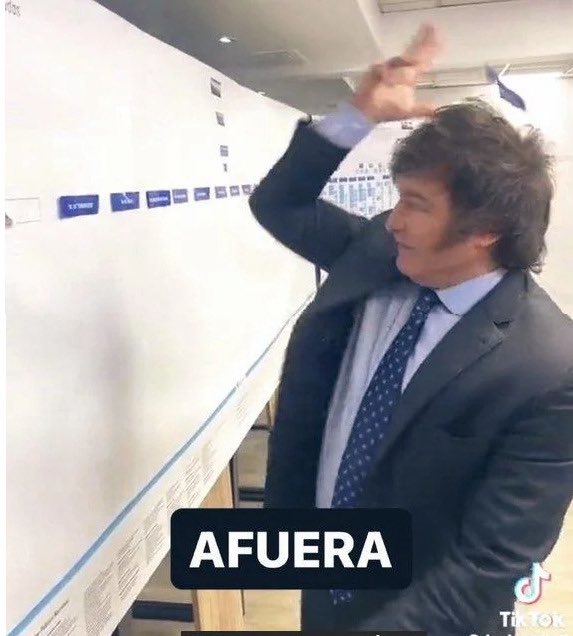
Felipe Leme stated that B3 had a historic day, with an increase of more than 7% in the Bovespa index and a drop of more than 20 cents in the dollar. He attributed the movement to the hope that Flávio could defeat Lula in the second round and interpreted the optimism as a sign of investor support for economic freedom. Leme argued that Flávio should present proposals for tax cuts and public spending reductions, citing the style of Javier Milei, who, according to him, yelled "AFUERA!" when announcing cuts in ministries. Among the measures he suggested were to end split payment and the fee on blouses, reduce ministries, and reconsider the oversight of the Income Tax. The author added that many Brazilians would be suffocated by taxes and that some of them had not even voted but could mobilize in the face of the prospect of paying less. He urged Flávio to quickly present a cuts plan and accelerate the campaign. #B3 #Bovespa #Eleições2024 (translated)

Felipe Leme stated that five states where Flávio won recorded abstention rates above the average. According to the numbers he presented, in Mato Grosso do Sul the abstention was 23.9%, with 58.6% of the votes for Flávio and 34.7% for Lula; in Rio de Janeiro, 23.3%, 53% and 39.4%, respectively; in Minas Gerais, 22.8%, 48.2% and 43.3%; in São Paulo, 22.5%, 51.9% and 38.2%; and in Mato Grosso, 22.2%, 65.2% and 29.2%. Leme argued that supporters in these states should seek out people who did not vote, investigate the reasons for their absence, and offer help when necessary. He assessed that it would be easier to win rejection votes against Lula's government among abstainers than among voters who chose another candidate. The author also said that, after Sunday’s results, the left had already mobilized, while Flávio’s supporters were limited to celebrating. Leme stated that the dispute involved the PT, the STF, and the PL itself, and accused the PT of distributing false material and news and of dominating social media. For him, it was time to broaden the lead in the first round. #Eleições2023 #Voto #Flávio (translated)

Vinicios Betiol stated that Lula could win the second round if the campaign addressed, among other factors, the political influence of mayors. According to him, this influence contributed to the right's advantage in the first round: mayors benefitted by the secret budget mobilized voters in support of congressional candidates. Betiol assessed that this effort could diminish in the second round, after the election of deputies and senators, and advocated that the PT combat what he called "voto de cabresto" (coerced voting), even involving the Federal Police if crimes occurred. Betiol also criticized the campaign's communication and said that Sidônio Palmeira should have been removed after the first round. In his assessment, highlighting the government's actions would not be enough in the face of the spread of false news and manipulations by big techs; the campaign needed an active legal team and more direct communication. He further advocated that the campaign dismantle Flávio's image. The author stated that abstention had been high and that the campaign should mobilize voters disenchanted with politics. According to Betiol, the fear of a Flávio victory could lead them to vote, and the grassroots needed to intensify the search for votes. He concluded that the following days could define the future of democracy, the country's sovereignty, the fight against organized crime, and food security. #Eleições2023 #Lula #Democracia (translated)

Renato Souza stated that Flávio Bolsonaro and Luiz Inácio Lula da Silva would face each other in the second round of the presidential election and said that Flávio would have an advantage. #Eleições2022 #Brasil #Política (translated)

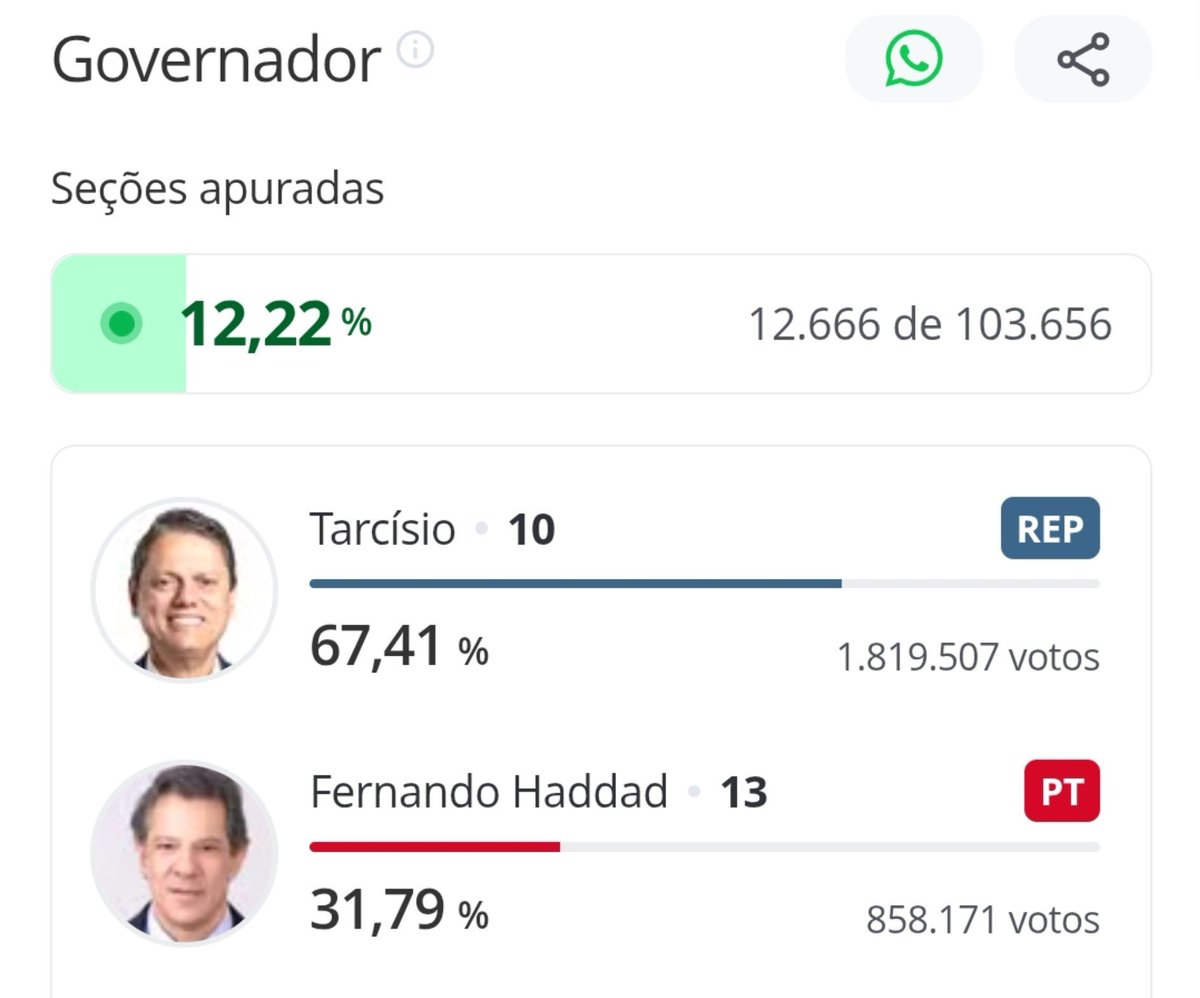
PATRlOTAS stated that Tarcísio would win in the first round by a wide margin and said that Haddad had, once again, a shameful performance. https://t.co/u4cvwEhveu #Eleições2024 #Tarcísio #PolíticaBrasil (translated)

thomaz 2d

Thomaz stated that he couldn't stand seeing Flávio Bolsonaro with a 10% lead over Lula in the counting and asked for something to happen soon. https://t.co/u1OFOaPci9 #Eleições2023 #PolíticaBR #Bolsonaro (translated)

Xyksper 2d

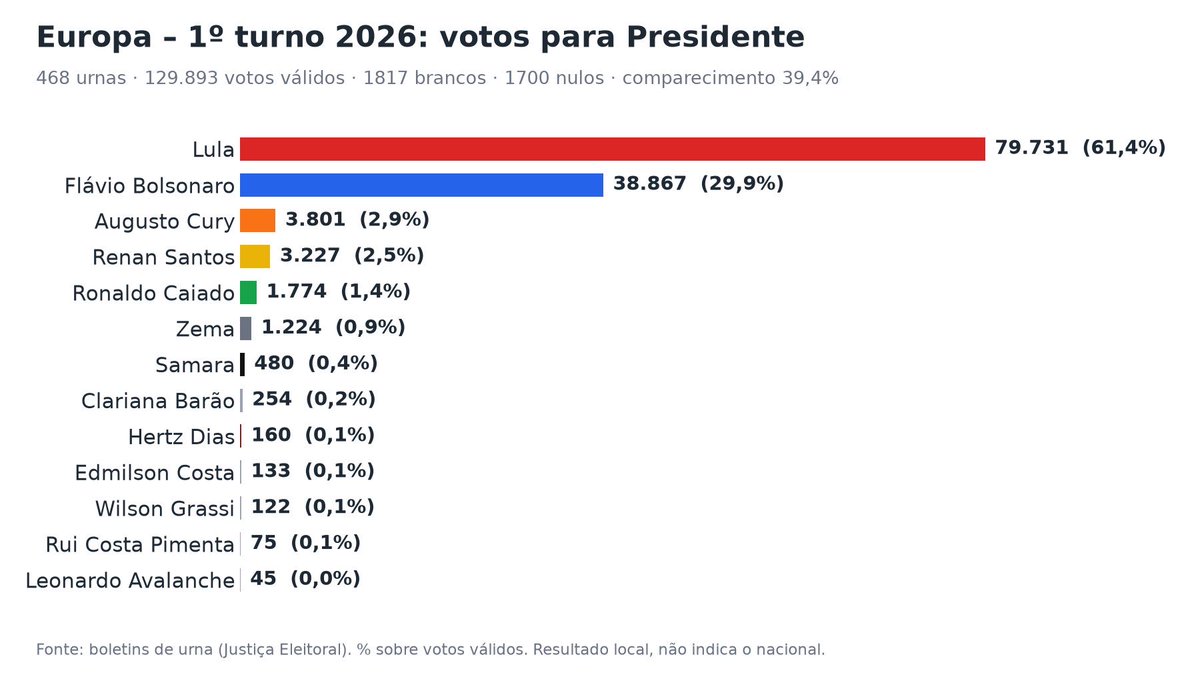
Xyksper reported that, with 468 ballots counted in Europe, Lula had 79,731 votes (61.4%), against 38,867 (29.9%) for Flávio Bolsonaro. Augusto Cury totaled 3,801 votes (2.9%), Renan Santos, 3,227 (2.5%), Caiado, 1,774 (1.4%), and Zema, 1,224 (0.9%). The author stated that Lula had a lead of 40,864 votes over Flávio Bolsonaro and described Europe as the main lulista stronghold abroad. #Lula #Eleições2023 #Europa (translated)

Xyksper 2d

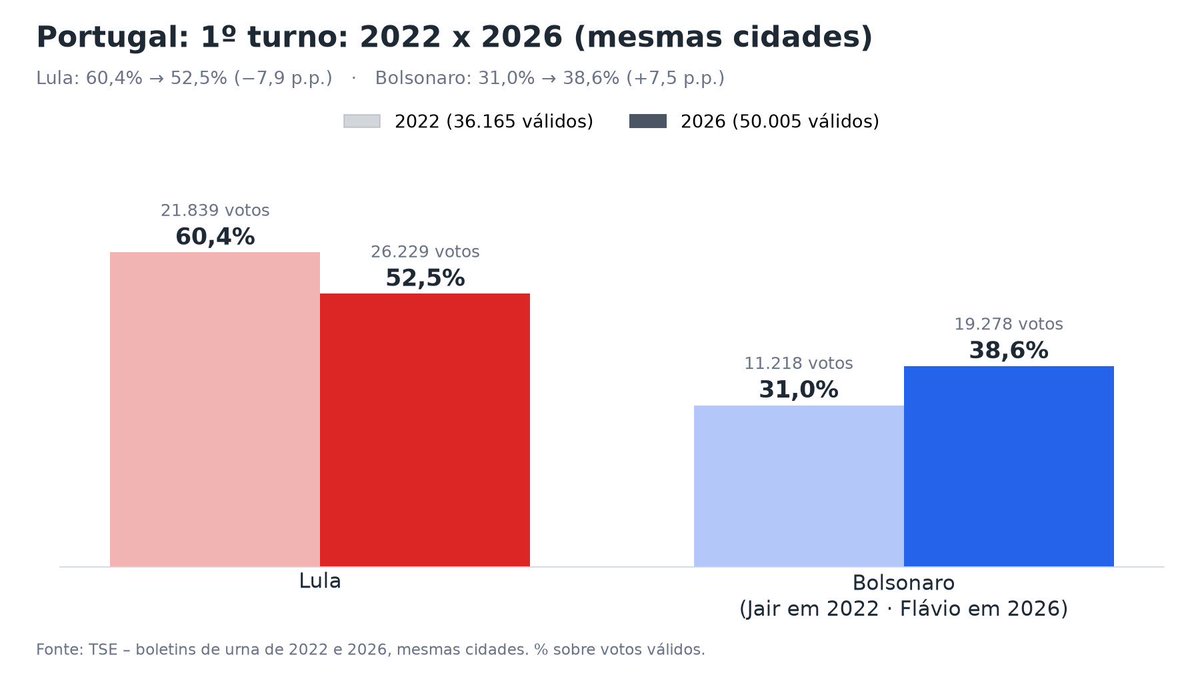
Xyksper reported that 175 of the 176 voting machines in Portugal had been tallied, with one section in Porto still pending. Lula had 26,229 votes (52.5%), against 19,278 (38.6%) for Flávio Bolsonaro. Augusto Cury had 1,671 (3.3%), Renan Santos, 1,566 (3.1%), Caiado, 583 (1.2%), Zema, 289 (0.6%), and other candidates, 389 (0.8%). The author stated that Lula had won by almost 7,000 votes, but that Portugal had registered the largest comeback in favor of Flávio in Europe until then. Comparing the results with the first round of 2022 — Lula with 60.4% and Jair Bolsonaro with 31.0% — he said that Flávio was 7.6 percentage points above his father and Lula was 7.9 points below. Xyksper also commented that "Bahia has turned into Minas." #Eleições2026 #Lula #Bolsonaro #RenanSantosMBL #Apuração #Eleições2026 #Lula #Bolsonaro (translated)

The profile RESEARCHES AND ANALYSES ELECTIONS stated that, in a new update of the counting in the same 61 cities, Lula's (PT-SP) lead over Senator Flávio Bolsonaro (PL-RJ) had increased by 0.5 percentage points. The profile added that Lula had 48.4% at the same stage of counting in 2022. https://t.co/NmgpXNqaUI #Lula #Eleições2024 #Brasil (translated)

Clarke de Souza stated that the counting in Japan had finished and that Flávio outperformed Bolsonaro's results in Tokyo. In the 43 precincts of the capital, Flávio received 67.9%, or 8,423 votes, against 18.8% and 2,328 votes for Lula. According to de Souza, Bolsonaro had achieved 66.9% in 2022, one percentage point less than Flávio. Throughout Japan, with 119 out of 119 precincts counted, Flávio had 71.7% and Lula, 15.3%, a result that de Souza described as almost identical to that of 2022. He also reported that in Bangkok, Flávio was recording 51.5% and Lula, 40.4%. In the total from abroad, with 164 out of 1,351 precincts counted, de Souza pointed out a 38-point advantage for Flávio: 62.6%, or 27,829 votes, against 24.5% and 10,897 votes for Lula. He said that the counting in Asia was practically concluded and that the next big batch would come from Europe, with completion expected between 12 PM and 1 PM. #Japão #Eleições2023 #Flávio (translated)

Max Cardoso reported that, in the accumulated counting of the elections abroad, Flávio Bolsonaro was ahead, with 61.1% of the votes, against 26.1% for Lula. According to him, Flávio's lead was 35 points. #Eleições2023 #Política #Brasil (translated)

Clarke de Souza reported that the count in Nagoya ended with Flávio ahead of Lula by 74.4% to 13.1%, equivalent to 11,480 votes against 2,022. According to him, the result was almost the same as Bolsonaro's in the city in 2022, just 1 point lower. According to the author, Flávio also won in Taipei, Taiwan, by 48.9% to 35.2%. In total from abroad, with 146 of the 1,351 sections counted, Flávio had a 35-point lead, with 61.1% against 26.1%, Clarke de Souza wrote. He added that there were still 26 of the 43 sections in Tokyo left to count and that the counting had not yet finished in Europe and the Americas. #Eleições2023 #Brasil #Política (translated)

Clarke de Souza reported that, after including Tokyo in the tally, Flávio had 60.4% of the votes abroad, compared to 26.7% for Lula, in 134 out of 1,351 sections. According to him, the difference had increased from 29.6 to 33.7 points, and Flávio had a total of 20,606 votes, against 9,112 for Lula. Europe and the Americas had not yet completed their counts, he added. In Tokyo, with 26 out of 43 sections counted, Flávio had 63.8% and Lula, 23.0% — 3,941 votes against 1,418. De Souza stated that Flávio's result was 3 points below that obtained by Bolsonaro in 2022. In Japan, the partial score, with 94 out of 119 sections counted, was 71.0% for Flávio and 15.9% for Lula. In Nagoya, with 50 out of 58 sections counted, Flávio had 73.7% and Lula, 13.7%. The author also reported that Flávio had won in Hong Kong, with 43.0% against 40.6% for Lula, and that Manila recorded 53.2% for Flávio and 41.9% for Lula. Regarding Hong Kong, he noted that Lula had been winning in the city. #Eleições2023 #Flávio #Lula (translated)

Clarke de Souza wrote that 11 more sections had been counted in Asia and that Flávio maintained an advantage among overseas voters, with 58.4% against 28.8%, in 98 of the 1,351 sections. According to him, the difference had decreased after the inclusion of results from China, Malaysia, and Singapore, where Lula was leading. De Souza reported that in Nagoya, Flávio had 73.7% of the votes and Lula 13.6%, with 7,368 votes against 1,356 in 42 of the 58 sections. In China, Lula was ahead in Beijing, with 77.6% against 16.4%; in Shanghai, with 63.7% against 22.5%; and in Canton, with 52.2% against 38.0%. The author estimated that these locations accounted for about 360 votes. He also pointed out Lula's lead in Singapore, with 54.6% against 26.4%, and in Kuala Lumpur, with 53.7% against 32.9%. In Japan, where 60 of the 119 sections had been counted, Flávio had 73.2% and Lula 13.6%. De Souza said that Flávio's result was one point above what Bolsonaro obtained in 2022. He added that Tokyo, the largest electoral college in Japan, still had no ballots published, although voting had already ended and there was a long queue. #Eleições2023 #Brasil #Política (translated)

RESEARCH AND ANALYSES ELECTIONS stated that the first results of the Brazilian presidential election in New Zealand indicated Lula (PT) with 70.1% and Flávio Bolsonaro (PL) with 20.6%, a 50 percentage point lead for Lula. The publication also mentioned Lucas1418. https://t.co/f0jHvMUEBi #Eleições2023 #Lula #Brasil (translated)

CarlosPRJ said he was going to sleep and stated that if Lula reached a four-point lead — as, according to him, all spontaneous polls that day showed — the election would be practically decided. He also expressed confidence in Lula and said that the next day would be the 13th. #Lula #Eleições2022 #Fé (translated)

Dawisson Belém Lopes wrote that someone might be underestimating or overestimating Flávio Bolsonaro. He said he preferred to believe in the polls from MDA and Datafolha, which, according to him, indicated an advantage of approximately 5 million votes for Lula in the first round. Lopes added that the alternative would be unpleasant and stated that it was not yet time to talk about the second round. #FlávioBolsonaro #Lula #Eleições2024 (translated)

Julio Freiress stated that research from Datafolha and Quaest commissioned by Globo pointed to a reduction in Lula's lead over Flávio Bolsonaro one day before the vote. He attributed the result to the cancellation of a Globo debate and Lula's street events, which, he wrote, gathered thousands of people. Freiress said that the next day it would be possible to see whether the streets or the polls were correct. #Lula #Eleições2023 #PolíticaBrasil (translated)

Barbara 13 stated that the surveys from CNT, Quaest, and Datafolha pointed to the same scenario: Lula was leading the first round with a five-point advantage and would win the second round. She concluded with a statement of support for number 13. #Lula #Eleições2024 #Brasil (translated)

Julio Freiress wrote that the CNT/MDA survey indicated that Lula was 2.2% short of winning the election in the first round, scheduled for the following day. He also stated that, in a possible second round, Lula had a 5-point lead over Flávio Bolsonaro and was close to securing a fourth term. #Eleições2022 #Lula #Brasil (translated)