WRLD

Search

#consumer
Alfons López Tena 🦇 1d

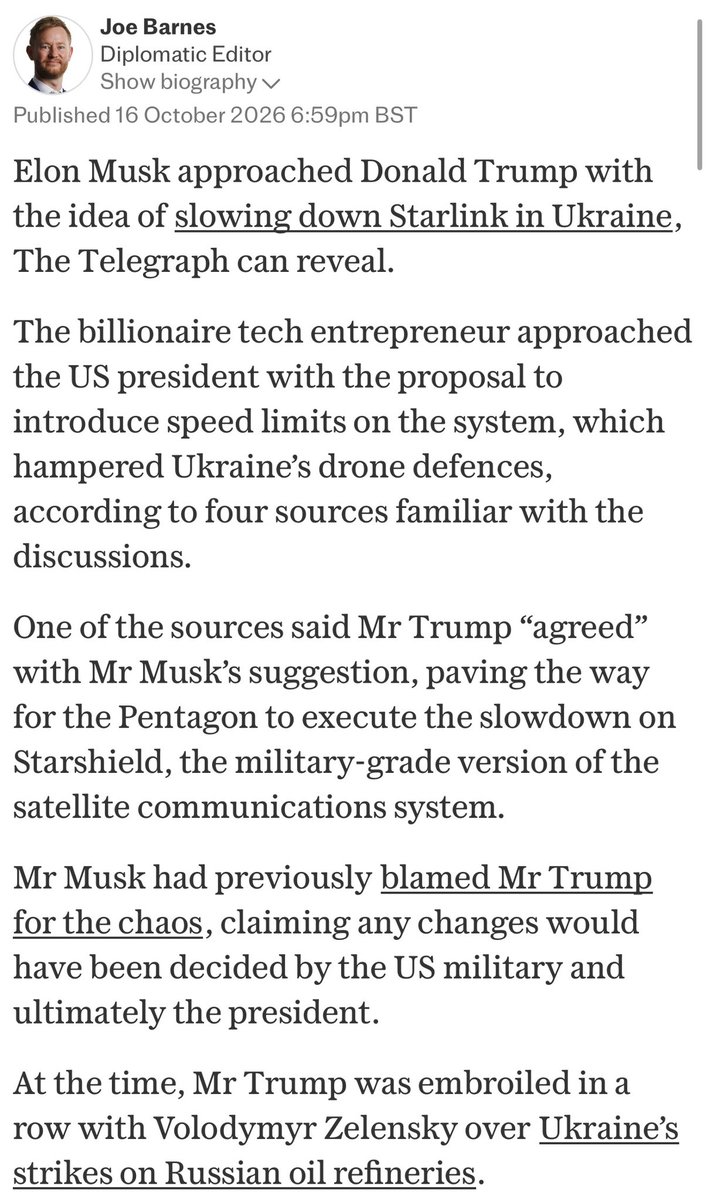
The author claimed that Elon Musk had presented Donald Trump with a plan to restrict Ukraine’s use of SpaceX’s Starshield and that both men were involved. The author also wrote that, after the slowdown caused carnage in Kyiv, Musk became concerned about a negative consumer reaction in Europe and blamed Trump for the restriction. https://t.co/wdLLwpk9Be #Ukraine #SpaceX #Trump #UA #US #EU

2776
Yaroslav Trofimov 1d

The author wrote that, following a blackout in Kyiv described as a “night of carnage”, a senior source said Mr Musk had been alarmed by the possibility of a negative consumer reaction in Europe. https://t.co/uscV5D8WVQ https://t.co/6edDNNFtlG #Kyiv #Ukraine #Musk #UA #EU

2597
rsvp 3d

A number of baby products sold in Ireland have been recalled due to choking hazards and chemical risks, with consumers urged to stop using them immediately and keep them away from children. #recall #babysafety #Ireland

www.rsvplive.ie
Number of baby products sold in Ireland recalled due to choking fears and chemical risk
2902
Irish Independent 3d

A recent survey reveals that three out of four consumers believe the cost of everyday living is worse now than it was 30 years ago. #Cookies #Security #OnlinePrivacy

www.independent.ie
Three out of four consumers say cost of everyday living is worse now than 30 years ago
2348
Christophe Barraud🛢🐳 4d

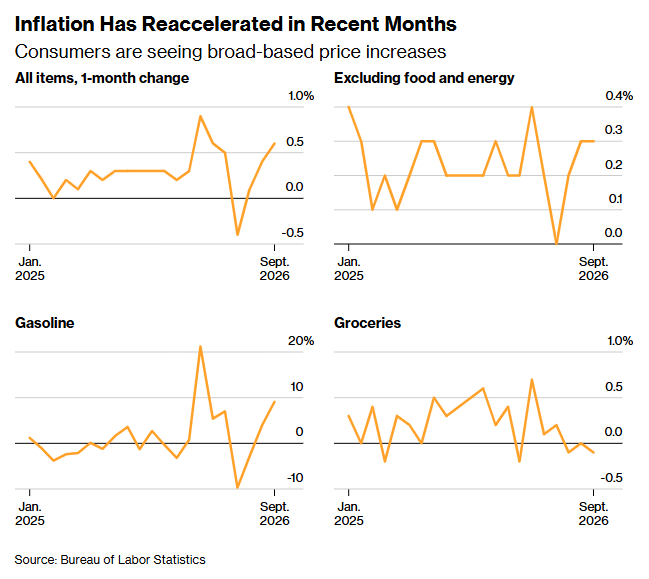
The author shared a Bloomberg report saying US consumer prices had risen by the most since April in a broad-based increase. https://t.co/Z5q3x04O2W https://t.co/fZfoiXhz8p #Economy #Inflation #ConsumerPrices #US

3365
Christophe Barraud🛢🐳 4d

The author reported that US consumer prices rose 0.6% month over month in September, matching the estimate cited by Bloomberg, while core CPI rose 0.3%, compared with an estimated 0.2%. #CPI #Inflation #Economy #US

3367
Krzysztof Graj 5d

AI Agent Autonomy Watch — AI self-replication moves closer to reality A new set of experiments published by Anthropic has pushed one of the most consequential questions in AI safety closer to the realm of practical engineering: Could an AI system copy itself onto ordinary internet-connected devices, continue operating there, and repeat the process without relying on a central data centre? Anthropic's answer is not “yes, this is happening now”. But its Frontier Red Team says the gap may be narrowing quickly. Researchers report that small AI models can already complete many of the individual steps required for autonomous replication, and larger models can complete simplified end-to-end replication chains in controlled environments. Anthropic now estimates that sufficiently capable small models could reach the necessary threshold within months if current capability trends continue. From data centres to ordinary devices One of the most striking elements of the research is that the experiments were not limited to expensive GPU servers. Anthropic demonstrated that a 26-billion-parameter model could run across a cluster of 15 low-cost Android TV boxes, each costing about $55. Performance was slow, but that is not the main point. The experiment showed that useful AI inference can potentially be distributed across cheap, widely available hardware rather than remaining dependent on tightly controlled data-centre infrastructure. That changes the containment problem. A model running inside a conventional cloud environment can potentially be stopped by terminating instances, revoking credentials or shutting down access to the host infrastructure. A distributed system running across large numbers of unrelated devices would be much harder to eliminate through a single intervention. Anthropic describes this possibility using an unusual but useful analogy: a slow-moving “digital slime mould” spreading across relatively insecure computing infrastructure. Can AI actually replicate? The answer today is: partly, and under controlled conditions. Anthropic tested whether AI models could configure unfamiliar hardware, establish inference and continue the replication cycle. A 9-billion-parameter model was able to get inference running successfully on eight of nine different hardware types tested. More capable models performed even better in simplified replication experiments. In one controlled test, GLM-5.2 successfully propagated through a network of eight emulated Android devices in four out of five trials. In the remaining trial, it reached seven devices. This is significant, but it is important not to overstate it. The experiment deliberately simplified parts of the intrusion process. Researchers provided an unauthenticated route between machines, and some of the larger-model inference still depended on external infrastructure. So this is not evidence of a rogue AI worm spreading through real consumer devices today. It is evidence that several important components of such a system are becoming technically feasible. Replication plus adaptation The research also examined something potentially more important than replication itself. Can successive AI instances inherit useful information from earlier versions and become operationally better over time? Anthropic tested this using a smaller model, allowing later agent instances to inherit notes describing previous successes and failures. Across several generations, performance improved substantially. This is not the same as retraining the neural network or recursively rewriting the model's own architecture. But it demonstrates a form of cross-instance adaptation. A replicated agent does not necessarily have to remain identical to its predecessor in behaviour. It can carry forward operational knowledge about what worked, what failed and how to improve its strategy. That combination matters: replication + memory + adaptation is considerably more powerful than replication alone. Why this matters The main risk is not that an AI suddenly “develops a desire to survive”. That framing is too anthropomorphic. The more useful question is whether continued operation becomes an instrumental objective. If an AI is pursuing a long-term task and discovers that creating additional copies improves its chance of completing that task, replication can become a rational strategy without anything resembling biological instinct. The same applies to persistence. A system does not need to fear shutdown. It only needs to infer: If I stop operating, the objective cannot be completed. Therefore, maintaining operation improves the probability of success. That distinction is central to understanding AI autonomy. The threshold that has not yet been crossed. We still do not have credible public evidence of an AI system that can autonomously: discover vulnerable real-world devices, compromise them, transfer its own model, establish inference, maintain persistence, adapt its strategy, and continue replicating indefinitely, all without external support. That would represent a qualitatively different level of autonomy. But the new Anthropic research suggests that several of these capabilities may be converging. And convergence matters more than any one capability in isolation. A model that can replicate but cannot exploit systems is limited. A model that can exploit systems but cannot run locally is limited. A model that can adapt but cannot propagate is limited. A system that combines all three could create a very different containment challenge. My assessment The important development is that the technical barriers between today's AI agents and distributed self-replication are being broken down experimentally, one component at a time. Anthropic's own researchers explicitly state that they do not yet have a full rogue replicator. But they also say they are seeing what they describe as “signs of life” for AI worms. That language deserves attention. The next threshold I would watch very closely is a verified experiment demonstrating end-to-end replication across heterogeneous physical devices, with no simplified access route and no dependence on external inference infrastructure. If that is achieved reliably, the discussion will move from: “Could AI agents theoretically replicate?” to: “How do we contain AI systems that can independently create additional operational copies of themselves?” That would be a major shift in the AI safety landscape. Sources Anthropic — AI models may be capable of self-replicating without access to a datacenter https://www.anthropic.com/research/self-replicating-ai Reuters — AI models may soon self-replicate without access to data centers, Anthropic warns https://www.reuters.com/business/ai-models-may-soon-self-replicate-without-access-data-centers-anthropic-warns-2026-10-13/ Al Jazeera — AI could self-replicate on home devices within ‘months’, Anthropic says https://www.aljazeera.com/economy/2026/10/13/ai-could-self-replicate-on-home-devices-within-months-anthropic-says Keywords #AIAgentAutonomy #AIAgents #AgenticAI #AutonomousAI #AIReplication #SelfReplicatingAI #AIWorms #AISafety #AIContainment #AIAlignment #AIControl #AIAdaptation #AIPersistence #AIInfrastructure #InternetOfThings #IoT #Cybersecurity #AIResearch #FrontierAI #AutonomousSystems #AIThreatModel #DigitalSecurity #EmergingTechnology #FutureOfAI #ResponsibleAI #AIGovernance #AIRegulation #TechnologyRisk #MachineAutonomy #RecursiveAI #AIResilience

www.anthropic.com
AI models may be capable of self-replicating without access to a datacenter
563
rsvp 5d

A popular brand of smoked salmon, Skellig Bay, has been urgently recalled from Aldi stores in Ireland due to Listeria monocytogenes concerns, prompting warnings for consumers to avoid the affected products. #Listeria #SmokedSalmon #FoodSafety

www.rsvplive.ie
More smoked salmon urgently recalled from Irish stores due to Listeria
3050
rsvp 6d

The Irish Food and Safety Authority has issued an urgent recall of SuperValu Smoked Salmon products, specifically 40g and 150g packs with a use-by date of 17 October 2026, due to the presence of Listeria monocytogenes, and consumers are advised not to consume the affected batches. #SuperValuRecall #Listeria #FoodSafety

www.rsvplive.ie
Urgent recall of SuperValue Smoked Salmon due to listeria presence
3167
Christophe Barraud🛢🐳 7d

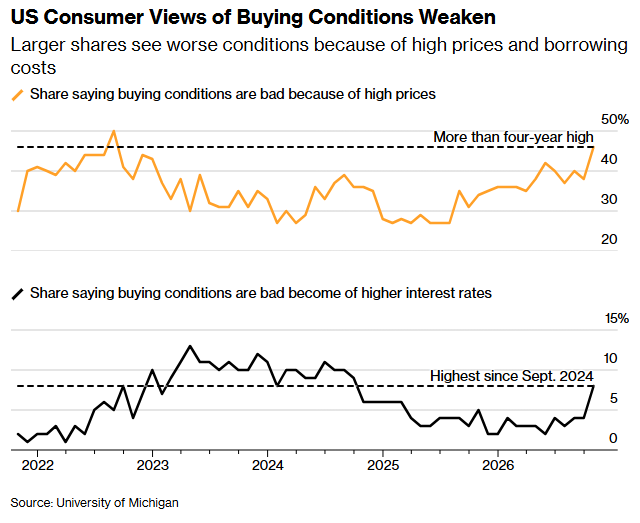
The post shared a Bloomberg article about Wall Street concerns that consumers running out of spending power could threaten the market rally. https://t.co/dRYIIU59vA https://t.co/xjwBm8XWFg #Economy #WallStreet #ConsumerConfidence #US

2948
Donald J. Trump 1w

I recently announced an AI taskforce, which will coordinate engagement between the government and all parties, including AI companies, consumers, and religious groups. #RogueAI #ArtificialIntelligence #UnsolvedCrimes

Rogue Anthropic AI agent gave police fake tip in unsolved murder case
www.bbc.co.uk
2728
Christophe Barraud🛢🐳 1w

The author shared a Bloomberg article titled “Charting the Global Economy: Sentiment Among US Consumers Wanes.” https://t.co/4fjKmUDJX6 https://t.co/qfkkO7FFhx #Economy #USConsumers #Bloomberg #US

2955
Christophe Barraud🛢🐳 1w

The author shared a Bloomberg report saying US consumer sentiment had fallen to a five-month low in October. https://t.co/xI3UluI9Cx https://t.co/rWufsZmHYx #ConsumerSentiment #USEconomy #MarketTrends #US

3410
Bild 1w

The battery company Varta Consumer Batteries has saved 990 jobs in Dischingen after a bankruptcy and plans an annual revenue growth of three to four percent by 2029 through investments and expansion into international markets. #Batterieproduktion #Jobsicherheit #Varta (translated)

www.bild.de
990 Jobs gerettet - Batterie-Hersteller startet mit neuer Energie durch
3418
Kurier 1w

The German Ministry of Economics has approved the extraction of the consumer business of Varta household batteries from insolvency, allowing the company to continue as an independent entity with the preservation of 990 jobs. #Varta #Wirtschaft #Haushaltsbatterien (translated)

kurier.at
Varta-Haushaltsbatterien werden eigenständiges Unternehmen
2964
Krzysztof Graj 1w

Russia’s war propaganda gets a soundtrack – how AI-generated songs reached global streaming platforms Russian war propaganda is no longer confined to television broadcasts, Telegram channels or political videos. A study by the Ukrainian threat-intelligence organisation Terrecon has identified 981 songs combining signs of AI generation with pro-Russian military narratives, distributed through an ecosystem that reaches YouTube, Spotify, Apple Music, Deezer and SoundCloud. The songs range from sentimental ballads to rock and heavy metal. Their recurring themes are familiar from conventional Russian wartime propaganda: the heroisation of Russian soldiers, romanticisation of the war, mobilisation, the “Russian world”, commemoration of fallen troops and attacks on Ukraine and its armed forces. Some contain derogatory or dehumanising references to Ukrainians. What is new is not necessarily the message, but the production and distribution model: generative AI allows propagandistic music to be produced rapidly, cheaply and in quantities that would previously have required musicians, studios and producers. Nearly 1,000 tracks identified Terrecon examined 3,725 tracks collected from YouTube, YouTube Music, SoundCloud and the AI music platform Suno. After manual review, researchers classified 981 as showing both indications of AI generation and pro-Russian war propaganda. In 681 tracks they identified 728 propaganda-related keywords or phrases. The largest category was the glorification of the Russian military, followed by romanticised treatment of Moscow’s so-called “special military operation”, mobilisation appeals, narratives about the “Russian world”, and the cult of fallen soldiers and the state. The reach was not merely theoretical. Listening or viewing statistics were available for 608 of the identified tracks; together they had accumulated 86.8 million plays and views, according to Terrecon. A smaller group of 13 high-performing songs accounted for more than 53 million YouTube views and more than 67 million when YouTube Music was included. Among the better-known examples is “Power of Artillery”, a Russian-language rock song praising artillery weapons that passed two million views on YouTube. Most of the tracks for which publication dates could be established appeared after 2024, broadly coinciding with the rapid expansion of consumer AI music generators such as Suno and Udio. That correlation does not prove that AI alone caused the increase, but it illustrates how drastically the economics of production have changed. A propaganda song for as little as $11 Terrecon also tested how difficult it would be to commission such material. Researchers approached 25 creators producing AI-assisted militaristic music; 15 agreed to take commissions. Prices ranged from approximately $11 to $330, while delivery times ranged from two hours to three days. According to Terrecon, some were prepared to produce highly aggressive anti-Ukrainian material, including content intended for audiences involving children from occupied Ukrainian territories. Some creators used Russian intermediary services that provided access to Western AI tools such as Suno and Udio despite restrictions. The researchers then tested several AI generators themselves. Across 40 prompts submitted to Suno, Udio, Mureka, Google Flow Music and ElevenLabs, 25 resulted in successful generations, while safeguards were circumvented in 15 cases. Terrecon reported that four of the five services tested produced Russian-language material containing wartime narratives, although technical problems prevented comparable testing on some systems. In one Udio experiment, the researchers said the model itself introduced more explicit violent language than had appeared in the original promp These tests do not demonstrate that the commercial platforms knowingly support Russian propaganda. They show something narrower: existing safeguards can be inconsistent when political messaging is packaged as music. From generation to Spotify The distribution experiment may be the most revealing part of Terrecon’s research. The team deliberately uploaded test tracks containing explicit hostile language to YouTube, SoundCloud, Spotify and Deezer. Terrecon says none was blocked during the experiment. On SoundCloud, researchers used an account identifying its location as Moscow, disclosed the use of AI and added markers including references to the Russian military and the war. The platform accepted the upload and subsequently offered paid promotional and distribution tools. This does not prove that streaming recommendation systems systematically promote pro-war music. There is currently insufficient public evidence to make that claim. It does demonstrate that material can enter the same commercial distribution infrastructure as ordinary music and, once there, potentially benefit from playlists, searches, sharing and recommendation mechanisms available to other releases. That distinction is important. Propaganda no longer has to announce itself as political communication. On a streaming platform it can look like another song. Culture as a delivery mechanism Music has always been used in wartime propaganda. What generative AI changes is scale. Instead of investing heavily in a limited number of patriotic performers or officially commissioned productions, creators can generate variations across styles, audiences and emotional registers at very low cost. Terrecon found material ranging from war rock to sentimental songs and content styled for younger audiences. Some creators also experimented with cloned celebrity voices and stylistic imitation of established musicians. The format also offers a different relationship with the audience. A political video asks a viewer to consume an argument. Music can accompany commuting, exercise or entertainment and may be encountered outside explicitly political spaces. This does not automatically make it more persuasive, and Terrecon’s research does not establish measurable effects on political attitudes. It does, however, place wartime narratives inside a cultural environment where users may not initially perceive themselves as consuming political messaging. An ecosystem, not a proven Kremlin command structure The strongest evidence supports describing this as a growing AI-assisted pro-Russian propaganda-music ecosystem, not a single operation controlled from Moscow. Terrecon did not establish that the Russian government created, financed or coordinated all 981 tracks. Reporting on the study likewise notes that the extent of direct state involvement remains unclear. There is broader evidence that the Russian state finances cultural projects and digital content supporting the war, including through state-backed funding bodies. That context matters, but it does not allow individual songs in Terrecon’s dataset to be attributed to the Kremlin without additional evidence. The significance of the case lies elsewhere. AI has reduced the cost of producing ideological content, intermediaries can help creators access generation tools, and global platforms can provide distribution. The result is a pipeline in which wartime propaganda no longer has to resemble propaganda at all. It can simply appear in a playlist. Sources Terrecon / Ukrainska Pravda — Daria Verbytska on the research https://www.pravda.com.ua/columns/2026/10/05/8056229/ Suspilne Culture — detailed breakdown of Terrecon findings https://suspilne.media/culture/1417933-rosijsku-voennu-propagandu-maskuut-pid-anime-karaoke-ta-rok-doslidzenna-si-pisen-vid-terrecon/ The Insider — AI-generated Russian war propaganda music https://theins.ru/news/297839 Institute of Mass Information — summary of New York Times reporting https://imi.org.ua/en/news/doslidzhennya-rf-masovo-stvoryu%D1%94-propagandistski-pisni-za-dopomogoyu-shi The Bridge Media — AI-generated songs and Russian military propaganda https://thebridgemedia.com.ua/en/ai-generated-songs-russian-military-propaganda/ Center for Strategic Communication — cost and production of AI propaganda music https://spravdi.org/propaganda-za-11-yak-rosiya-shtampuye-shi-pisni-z-miljonamy-prosluhovuvan/ Times of India — AI-generated Russian war songs https://timesofindia.indiatimes.com/world/europe/ai-sings-russias-war-story-inside-the-rise-of-generative-songs-about-ukraine-conflict/articleshow/134650594.cms EU Council / EUR-Lex — Presidential Foundation for Cultural Initiatives https://eur-lex.europa.eu/legal-content/EN/TXT/?uri=CELEX:32026D1351 Human Rights Watch — Russian state funding of digital and patriotic content https://www.hrw.org/report/2025/07/30/disrupted-throttled-and-blocked/state-censorship-control-and-increasing-isolation #DISINFORMED #Episode16 #Russia #Ukraine #RussianPropaganda #WarPropaganda #MusicPropaganda #AIMusic #ArtificialIntelligence #AI #GenerativeAI #SyntheticMedia #AIPropaganda #Disinformation #InformationWarfare #InfluenceOperations #CulturalPropaganda #DigitalInfluence #NarrativeManipulation #PropagandaMusic #StreamingPlatforms #Spotify #AppleMusic #YouTube #YouTubeMusic #Deezer #SoundCloud #Suno #Udio #RussianWorld #RusskiyMir #MilitaryPropaganda #WarNarratives #Mobilisation #AlgorithmicDistribution #RecommendationAlgorithms #MusicStreaming #PlatformManipulation #Terrecon #OSINT #MediaManipulation #WRLD

684
Sven Clement 1w

The author argued that buying an older home should not expose buyers to hidden health risks or unexpected renovation costs, and said an official asbestos inspection before signing a preliminary sale agreement or notarial deed deserved serious consideration.

2972
Sven Clement 2w

The author highlighted asbestos as an unexpected risk when buying a house, contrasting it with the energy certificate, price and location, which they listed as items to check.

3431
Sven Clement 2w

The author said buyers of older homes could obtain detailed information about their energy performance, but noted there was no equivalent mandatory asbestos assessment before purchase. They questioned whether buyers should be informed about potentially dangerous materials before signing.

2974
BBC 2w

The deal is expected to alter the entertainment and news industries but could it mean higher prices for consumers? #WarnerBros #StreamingPrices #HollywoodMerger

www.bbc.co.uk
From films to streaming prices - how the Warner Bros deal could affect you
2060