BETA nonprofit public democratic european moderated

Search

#heroism
Focus 6h

🇫🇷🥇 FLASH INFO | À Roubaix, de jeunes habitants ont reçu la médaille de la Ville des mains du maire (LFI) David Guiraud, en hommage à leur courage. Ils s’étaient illustrés en luttant contre un incendie dans une école, en attendant l’arrivée des sapeurs-pompiers. https://t.co/mSReFHY8A5 #Héroïsme #Roubaix #Courage

A Generation That Forgot the Shape of the Square On memory left to die alone By Adham Hasanin Egyptian journalist and political writer, based in the Netherlands In a house near mine, there is a boy of thirteen. Born in 2013 just a few months younger than the July coup itself, younger than the new republic under whose shadow we now live. I asked him once, with no preamble, no test, out of nothing more than passing curiosity: do you know what January was? He answered simply, without hesitation, without any sense that he was missing something: "An old revolution, against Mubarak, right?" Not entirely wrong. But it is everything he knows. The name Tahrir Square means nothing specific to him. The sound of the crowd chanting has no echo in his mind. He does not know that his own family whom he sees every day saying "thank God for stability," who warn him against "chaos" whenever a political headline crosses the screen once, at a moment two years before he was born, went down into the street, betting their entire lives on the possibility that something might change. This article is not about politics. It is about memory, and about who decides what gets told and what is left to die in silence. I. Who Erases the Picture? The first question that comes to mind is the easiest and most deceptive one: who erases this memory? And where do we begin holding them accountable? But the truth is too complex to reduce to a single actor. No one actually erases memory, in the literal sense of the act. There is no ministry called the "Ministry of Forgetting," no presidential decree ordering January struck from the collective consciousness. What happens is simpler than that, and more dangerous at once: the subject is simply never told. School says nothing. The textbook leaps from one period to another without pausing on January for more than two faded lines, composed with deliberate neutrality, devoid of any detail that might make the event feel alive to its young reader. Television no longer has any reason to return to it; the programmes that once hosted witnesses and activists stopped years ago, replaced by an official discourse that mentions January only in passing, as an unfortunate prelude to the "stability" that supposedly followed. And the home the most dangerous link of all has become afraid of the subject. Speech now carries a price, and many families, whether consciously or by sheer survival instinct, have decided that silence is safer than the story. The father who marched fears passing on to his son a curiosity that might one day lead him into trouble the family cannot afford. The mother who lost a friend in the events prefers not to reopen the wound before a child who does not yet grasp the weight of loss. And so, generation after generation, the circle of those who know shrinks, and the circle of those who do not even ask because they do not know there is anything worth asking widens. No one decided to erase the memory through an explicit decision. The memory was simply left to die alone, with no one tending it. And it is precisely this decentralised absence of responsibility that makes this kind of erasure more dangerous than any direct official ban: there is no single decision to challenge, no single body to hold accountable. Responsibility is distributed across thousands of small decisions made by thousands of individuals, each within their own context, each seeming reasonable when viewed in isolation. II. Why This Is More Dangerous Than Direct Repression An objection might be raised: is direct repression arrest, imprisonment, publishing bans not far more lethal than mere gradual forgetting? The answer is complex, and deserves calm unpacking. Direct repression can be seen. It can be documented, and the victim can know they are a victim, can tell their story, and their pain can become a testimony added to the collective memory, even if it never reaches justice. The political prisoner knows he is a political prisoner. The journalist banned from writing knows he is banned, and can tell the world he is banned. Direct repression, for all its cruelty, leaves a trace that can be followed. But a generation that has forgotten something happened at all does not even have a starting point from which to ask. This thirteen-year-old boy will never ask "why were we repressed?" because he does not know there is anything deserving that question in the first place. He feels no absence, because he does not know there is anything absent. He simply lives in a version of reality stripped of an entire chapter of his country’s history, and never for a moment suspects that this void is a void at all. Here lies the essence of the danger: direct repression creates victims who know they are victims. Erasure of memory, when it succeeds, creates a generation that does not even know it has been deprived of anything. And deprivation that is not felt cannot be resisted, because resistance always begins with an awareness of loss. The regime that came after 2013 does not need to convince the new generation that January was a mistake. That would be an arduous, costly task, requiring sustained propaganda and continuous effort to persuade each individual one by one. It is far easier, and strategically far more efficient, simply to ensure they never know it was anything at all. The void requires no defence; it requires only silence, and silence is free and always available. III. The Four Mechanisms of Erasure Four complementary mechanisms can be identified working together to produce this collective void not as an organised conspiracy, but as a system of incentives that pushes each party, consciously or not, to contribute to the same process. The first mechanism: formal education. The curriculum, as currently designed, treats January as a passing footnote rather than a founding event deserving detail and analysis. The student memorises two dates the start of the revolution and its presumed end without understanding why people took to the streets, what they were demanding, or how they felt in that pivotal moment. The second mechanism: broadcast media. The channels that once hosted live discussions on January, featuring varied perspectives, have gradually disappeared, or transformed their discourse entirely. Today’s televised image either ignores the anniversary altogether, or invokes it only to frame it as a prelude to chaos that must be avoided. The third mechanism: the silence of homes. This is the most dangerous of all, precisely because it is the most human and understandable. Parents who lived through the experience protect it with silence, not out of aversion to the story, but out of fear of its price. This silence, however legitimate its motives, achieves exactly the same effect as official censorship: it blocks the transmission of knowledge from one generation to the next. The fourth mechanism: the absence of alternative spaces. Even those among the new generation who wish to know cannot easily find places to look. Archives are scattered, trustworthy websites are blocked or require effort to reach, and personal testimonies are dispersed across corners of the internet that an ordinary student at an ordinary school will never stumble upon. These four mechanisms require no central coordination to work together. Each naturally serves the others, and all converge on a single result: a growing void in the consciousness of every new generation. IV. Memory as an Act of Resistance If erasure operates without a centre, then resisting it must also be decentralised. No one waits for a government decision to restore January to the curriculum, nor for a television programme to revive the testimonies. Resistance here is necessarily individual, happening in small details, in passing conversations, in the simple decision to tell rather than to stay silent. This is exactly what I try to do, without any claim to heroism, without any grand mission. I try, whenever I can, to tell the thirteen-year-old boy and others like him details that are never written in official reports or in schoolbooks: what the voices in the square sounded like, how someone felt the first time they realised change was possible, what that moment of hope was like before everything changed. The goal is not to bring back the past; the past cannot be brought back. The goal is that this boy, when he grows older and asks again and he will ask, because the questions always return at some point finds someone to tell him the full story, not two faded lines in a schoolbook. That he knows the stability he is told is the fruit of "wisdom" has a prior history, that this history carried other possibilities, and that real people bet their lives on those possibilities. V. Why This Matters Now Talking about the memory of a generation not yet aware might seem an intellectual luxury next to more urgent matters: arrests, a collapsing economy, regional wars. But the truth is that this issue is the foundation on which every other issue is built. A people who do not know they once rose up will not understand why they should ever think of rising again. A generation raised to believe "stability" is the only natural state possible will never ask itself what drove its own parents, shortly before it was born, to risk everything for an alternative that was never guaranteed. Memory is not a luxury; it is the reference point by which every generation measures its present, and through which it determines what is possible and what is not. And whoever understands this understands why erasing memory, not direct repression alone, is among the most important tools of any regime seeking to guarantee its permanence: because a people who have forgotten they were once free will not even know they are missing freedom. Memory, like the word, needs someone to tell it in order to survive. And when the tellers stop, memory does not die suddenly; it withers slowly, generation after generation, until the day comes when a boy asks an innocent question, and finds no one to answer him but two faded lines in a schoolbook.

Kierownik pociągu próbuje spacyfikować dwóch pijanych typków, lżących Ukraińca. W którymś momencie jeden z nich uderza kierownika W obronie kierownika pociągu staje dwóch pasażerów - szybka plomba i młody wylatuje przez drzwi pociągu na peron. I jeszcze w tle "co ty, kurwa, kierownika ruszasz?" Taka brygada to mi się podoba! Szacun dla obydwu panów. #heroism #support #standtogether

POPTime 1w

🚨 SENSÍVEL: Mulher arrisca a própria vida para salvar amiga de ser estr*ngulada por um homem. https://t.co/CES2lwnh7l #Heroísmo #ViolênciaContraMulheres #Solidariedade

Thank you to our firefighters who face the flames with exemplary courage all over France. Our heartfelt thoughts are with the families of the two firefighters who lost their lives in the fires in Gironde. Their courage and dedication command respect and (translated)

While the advantageous political cinema continues, men risk their lives for a pittance, tribute! (translated)

Un periodista estaba retransmitiendo en directo tras unas inundaciones y acabó salvándole la vida a una mujer que estaba atrapada https://t.co/Of1cbjIhED #periodismo #inundaciones #heroísmo

Στιγμιότυπο από τη χθεσινή αναγκαστική προσγείωση του F-16 της ΠΑ στο αεροδρόμιο Ζακύνθου, από βίντεο που κυκλοφορεί στο διαδίκτυο. Διακρίνεται το αλεξίπτωτο επιβράδυνσης (drag chute) που ανέπτυξε ο χειριστής, καθώς και οι φλόγες από την τριβή με το διάδρομο (πιθανώς σε συνδυασμό με διαρροή καυσίμου). Το γεγονός ότι ο χειριστής έμεινε στο αεροσκάφος μέχρι τέλους (αντί να εκτιναχθεί) μαρτυρά, πέρα από την ψυχραιμία και την επιδεξιότητά του, τεράστια γενναιότητα. Και πάλι ένα μεγάλο ΕΥΓΕ. #F16 #Aviation #Heroism

The keynote speaker of the event, was the legendary lead pilot of the mission, Brig Gen (Retd) Joshua Shani. The rescue operation on the ground, Operation (Mivtza) Yonatan barely lasted for 90 minutes, but left a forever legacy that terrorism can actually be defeated, if the #Heroism #OperationYonatan #TerrorismDefeated #IL

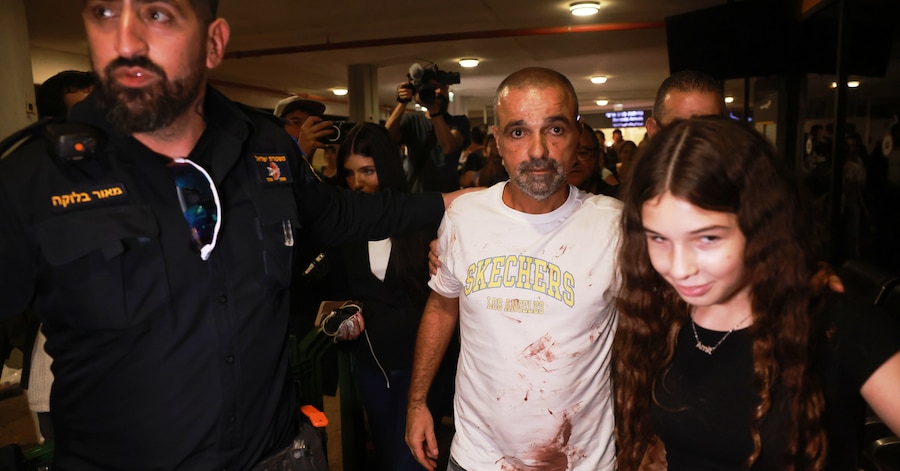
Mijn familielid heeft op 7 oktober een meisje uit de achterbak van een hamasterrorist gered. Toen hij daarna baby’s en kinderen probeerde te redden, zijn zijn vrienden vermoord, en hij, een kogel in z’n buik gekregen. Klein verschil met degenen die die mensen kwamen vermoorden. Hij is een held. Het Franse meisje die hij en zijn vrienden redde, en haar ouders, zullen altijd dankbaar zijn. #DeOmgedraaideWereld #Held #Redden #Heroïsme

Wolf 🐺 Jul 4

🍀 🇫🇷 À seulement 17 ans, Robin Caput a sauvé une infirmière victime d’un AVC à Pont-Audemer. En entendant un klaxon continu, il n’a pas hésité : il a brisé la vitre de la voiture avec une boule de pétanque, ouvert les portes et aidé à sortir la victime pour lui prodiguer les premiers gestes. Grâce à son sang-froid et sa réactivité, la femme a pu être prise en charge rapidement. Un bel exemple de courage et de solidarité ! Un ❤️ pour Robin‼️ #Courage #Solidarité #Héroïsme

République Jul 2

🎖️ 🌟 Aroldo Medina, anunciado por Renan Santos como vice em sua chapa, presenteou o presidenciável com a Medalha Estrela de Reconhecimento por Ato de Bravura, honraria recebida em 2015 após negociar a libertação de uma refém usada como escudo humano; na ocasião, arriscou a própria vida ao se oferecer para ocupar o lugar da vítima, ficando com uma arma apontada para a cabeça, até convencer o criminoso a libertá-la e, ao final, a se entregar. #Heroísmo #Coragem #Reconhecimento

Torcedor vira herói ao enfrentar atirador durante jogo da Copa nos Estados Unidos e sobrevive após ação de policial. Luis Romero foi baleado na perna ao enfrentar e tentar impedir um ataque a tiros de um homem armado, durante uma festa nos EUA para acompanhar o jogo entre México e Coreia do Sul. Ele teve a vida salva após uma rápida intervenção de uma policial, que aplicou um torniquete para conter a hemorragia. “Havia muito sangue. Na hora, eu soube que aquele homem precisava de ajuda. O treinamento entrou em ação. Ele é um senhor mais velho que me lembrou muito o meu pai. Ele estava ali com o filho, então fiquei muito feliz por ele ter conseguido sobreviver”, disse a policial Helen Zhang à emissora ABC7. Ainda internado, Romero agradeceu à policial: “Obrigado por salvar minha vida e por me ajudar”. 🗞️ @OGlobo_Esportes 📸 Reprodução #Heroísmo #Copa #EUA

BFMTV Jun 29

Après le crash dramatique d'un avion en Meurthe-et-Moselle qui a coûté la vie à 11 personnes, le président de l'aéropôle Grand Nancy Tomblaine, François Pélissier, a évoqué la possibilité qu'il s'agisse d'un acte d'héroïsme du pilote, qui aurait tenté de diriger l'appareil vers une zone herbeuse pour éviter des victimes au sol, tout en soulignant la position un peu surprenante de l'avion. #AccidentAérien #MeurtheEtMoselle #Héroïsme

"Un signe du destin ou un acte d'héroïsme": après le crash mortel en Meurthe-et-Moselle, le président de l'aéropôle évoque la position "un peu surprenante" de l'avion tombé au sol

🚨‼️🆘 “Qué tu familia sea parte de los valientes, que se atreven a arriesgar su vida por salvarla a los demás, no tiene precio, de admirar. Aún cuando hay una alerta de tsunami falsa, ellos decidieron quedarse y seguir por los gritos de socorro, que aún se oyen de gente que está tapada y desesperada, aferrada a la esperanza de vivir🇻🇪” ¡Viva #Venezuela! #Venezuela #Solidaridad #Heroísmo

Ayuden a Westcol a llegar a Venezuela y ser testigo tanto de la tragedia como de la heroicidad del venezolano. #Venezuela #Heroísmo #Solidaridad

Observador Jun 26

Após os sismos devastadores de magnitude 7,2 e 7,5 na Venezuela, que deixaram 188 mortos e mais de 40 mil desaparecidos, momentos de esperança surgem com o resgate de um bebé e três crianças dos escombros, destacando o heroísmo de cidadãos e voluntários que se uniram para salvar vítimas antes da chegada de equipes oficiais. #Venezuela #sismos #resgate

Sismos. Resgate permite retirar bebé dos escombros

A lot of strength to the firefighters and security forces in Madrid at this moment. Climbing to dozens of floors with 30 or 40kg of equipment requires heroism. (translated)

22 juin 1944. Un convoi de blessés du maquis du Mont Mouchet. Une pharmacienne a tenu à en être, elle qui veille sur eux depuis des mois. Soudain l'ennemi. Arme au poing Marinette Menut défend ses camarades qui sont tous achevés. Blessée, torturée, elle mourra en juillet. 30 ans. https://t.co/Ke4xZIWg9C #Histoire #Résistance #Héroïsme

Zlatan anoche, tras la heroica victoria que logró nuestro país: "Todos están hablando del arbitraje y dejando de lado el completo milagro. Paraguay perdió a Almirón por esta ridícula regla y tuvo que jugar todo el segundo tiempo con uno menos, ante un equipo turco lleno de talento. ¿Se rindieron? NO. Defendieron como lo que son, absolutos leones. Se pueden crear todas las reglas que se quieran, pero nunca subestimar el corazón. Un león en desventaja, sigue siendo un león y Paraguay le demostró al mundo lo que significa ser un guerrero". 🔥🇵🇾 Tremendo. #Paraguay #Fútbol #Heroísmo