WRLD

Search

#ricchezza
Paolo Becchi Wrld summary 2d
Italian philosopher

The author wrote that Olivier Blanchard, former chief economist of the International Monetary Fund and a highly respected professor, considered neoliberal, had argued for the need to redistribute wealth, particularly that of Western oligarchs and billionaires. The post ended at the beginning of a subsequent quotation. #Economia #Redistribuzione #Ricchezza #IT #US (translated)
3326
P
Pedro Sánchez 3d

We propose a tax on fortunes over 100 million euros to finance, for example, a contribution for child growth, housing, and better public services. Although we have reduced income inequality to historic lows, the wealthiest 0.1% concentrates over 10% of the wealth. And its weight has continued to grow since 2010. #TassaZucman #Patrimoniale #GiustiziaFiscale (translated)

La proposta di Sanchez: “Tassare i patrimoni oltre i 100 milioni per finanziare assegno per i figli, casa e servizi pubblici”
www.ilfattoquotidiano.it
3025
Stefano Fassina Wrld summary 5d
Italian politician

The author has questioned how to counteract the concentration of wealth and oligarchy. He described the tax on large estates as a convincing solution in terms of theoretical rationality, but in contrast with practical reality, and referred to the lower-income districts in the recent referendum in California. https://t.co/bUHs6pNLYj #Ricchezza #Oligarchia #GiustiziaEconomica #US (translated)

2928
Marmitta Wrld summary 2w

Marmitta had hypothesized the scenario, presented as a conspiracy theory, of a global cyber attack that the following day would target the bank accounts of billionaires to redistribute their wealth. He had asked his followers what their first purchase would be, inviting them to respond on impulse. #complotti #ricchezza #hacker (translated)

2975
Il Fatto Quotidiano 2w

The article by Ferdinando Boero analyzes how billionaires manage to gain democratic consent despite being a minority, exploiting money and strategic narratives, while political power and wealth continue to concentrate to the detriment of the majority. #Democrazia #Miliardari #Consenso (translated)

www.ilfattoquotidiano.it
Perché continuiamo a farci del male ovvero come i miliardari conquistano il consenso democratico
2634
Il Sole 24 ORE 2w

The new Italian tax system must focus on the actual and available wealth of social economy entities, allowing them to contribute to public expenditures and give back to the community, as highlighted during the Festival of Social Economy. #EconomiaSociale #Fisco #Cooperative (translated)

www.ilsole24ore.com
Il nuovo fisco deve puntare sulla ricchezza effettiva e disponibile
2982
Leo XIV 2w
267th Pope of the Catholic Church (2025–)

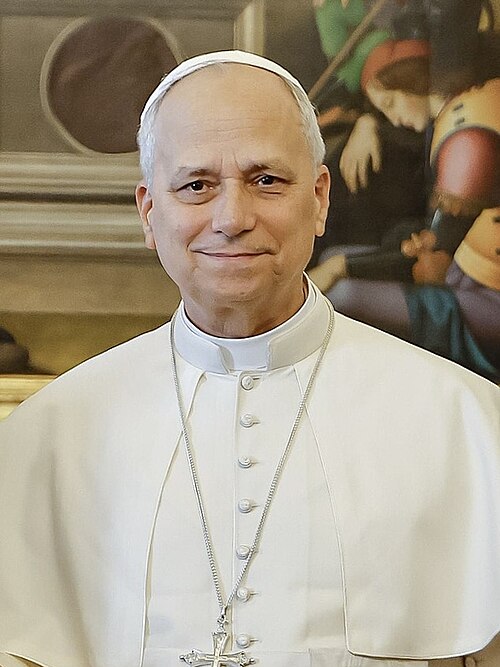
"I was able to see the wealth of Argentina, not only in its geography but also in its people, in each of the encounters, in the squares and in the streets, in the creativity, in the spontaneity, and in the life that overflows at every step," said Leone XIV during the Mass at the Marian sanctuary beloved by Pope Bergoglio. #PapaLeoneXIV #Perù #ChiesaCattolica (translated)

3451
Il Fatto Quotidiano 2w

The article analyzes the new exit tax introduced by the Meloni government and the debate on the wealth tax in Italy, highlighting the different forms of wealth taxation and the need to distinguish between fiscal instruments and objectives, emphasizing that the issue is not whether to tax wealth but which aspects of it to consider. #Fisco #Patrimoniale #ExitTax (translated)

www.ilfattoquotidiano.it
La exit tax del governo Meloni e il dibattito sulla patrimoniale nel campo largo: cosa si può tassare e perché – L’analisi
2996
Pino Rotta 3w

Coordinated solitude, author Claudio Aloisio Written by Pino Rotta, November 8, 2026 Claudio Aloisio is a communication and marketing professional, a field in which he has worked for many years. When his first essay "Coordinated Solitude" (Ed. Ideacoop Media Service, 2026) was released, sharing the same field of activity and interests (albeit with different directions and experiences), I found it interesting to read it, especially since we share the same city but have not met, which was already a good reason to find the essay interesting and its title stimulating. "Coordinated solitude" is an essay that analyzes, with a wealth of documentation and bibliography, the phenomena of the formation of convergences or exclusions among groups and individuals through the study of media languages and, in particular, those of the digital domain. A field that has already been widely investigated for several years. My first approach to these new linguistic proposals dates back, among other readings, to a 1994 essay "Collective Intelligence" by Pierre Levy. In that essay, Levy, at the dawn of the web era, launched the idea that the network, which collected the contributions of millions of users, contained them all without controlling their paths, interactions, or effects. Stimulating concepts that today help us understand how much conflict can arise between theory and its application considering time and technological development. However, Aloisio surprises the reader with suggestions from the very first pages of the essay. In fact, despite addressing the analysis of digital languages with an epistemological line rooted in Anglo-Saxon studies, particularly American ones, from the outset the author seems to suggest that this is not a “technical” essay but is entirely political in the higher sense of the term. The first reference is found in the citation of an author who was among the fathers of European sociology in the early years of the last century: Emile Durkheim, one of the first sociologists and philosophers who analyzed social phenomena with enormous meticulousness and rigor, linking religion with social structure. This opening will be found in the subsequent pages of "Coordinated Solitude," but it will not be the only surprise in Aloisio's analytical developments. In the essay, the author describes how people who may share spaces, interests, and common values, by finding them in the digital world, can at a certain point recognize themselves in different affiliations and even come to see in others a “us” that makes them akin to their own story or a “them” that indicates a distance, exclusion, and even a threat in relation to it. The causes of these dynamics are very well structured in the essay, as is the well-structured context in which individual stories are born, meet, and ultimately find different outcomes. Outcomes that can lead to reinforcing one's affiliations, which, however, are discovered at the end of the interaction process and that, throughout the journey, rarely reach a state of awareness. Outcomes that are influenced by pre-existing value structures that do not necessarily coincide with those of the members of the groups with which one identifies or clashes. This path is analyzed by Aloisio by considering the social dynamics of the West, examining and contrasting similar but not necessarily overlapping social realities, such as American and Italian society. In the identification processes that coexist in these social realities, the belonging to social class, religious group, ethnicity, sexual orientation, and sense of nation enters strongly. Everyone has their own experiences, but at the end of a journey of interaction, now almost exclusively digital, one finds oneself sharing a sense of belonging with other multitudes of people who have completely different experiences. And in this sense of belonging, fears of the future, frustrations of the past and present are downloaded, and one is enveloped by fears and anger that must find an enemy to blame. An enemy that is often suggested by the discovery of affinities among the groups that are created, much more often than not created, on digital platforms. Addressing the current nature of the algorithms governed by Artificial Intelligence, the author suggests the method through which these affiliations arise, which can be irrational but are entirely real and influence individual and social daily life. The individual in the digital dimension, which becomes the everyday reality of social action, is called to take responsibility for maintaining their conviction and belonging or risk feeling excluded, isolated, alone. The weight of a choice that often becomes distressing and paralyzing. But how is it possible to read and interpret these “Coordinated Solitudes”? Aloisio's essay provides a reading and suggests a methodology to identify the path that sometimes, but not always, leads to the awareness of how certain choices are made and what elements need to be questioned to verify if the reading of these languages withstands the law of contradiction and thus can be used to ascribe scientific value to it. But at the end of this journey of understanding languages, forms of aggregation, and the proof of the compatibility of individual choices, Aloisio presents us with another surprise that speaks volumes about his educational journey. The discourse of education and the reading of digital languages is ultimately a discourse on democracy, on social structure, and these factors cannot be disregarded without risking losing the ability to give meaning to one’s social action as well as one’s communicative action. It is my view that the surprise that is the coherence of the entire analysis of the essay comes with the reference that the author makes at the end to the work of Jürgen Habermas. The most important philosopher, sociologist of language, heir of the Frankfurt School who passed away at the age of 97 in March 2026, is the foremost interpreter of the theory of democracy and of the criticism of oppressive authority, which does not exclude conflict but determines its progressive outcome through the mediation of communicative action. Communicative action that questions institutions not to destroy them but to avoid remaining subjected to authoritarianism and, in the form of linguistic mediation, to be active subjects, not subdued by a system that, due to the nature of formal institutions, can always degenerate into authoritarianism. Coordinated solitudes thus find themselves with a positive perspective, with outcomes that are never guaranteed or predetermined, but feasible for reconstructing trust in the future realized through the recognition of the other as part of a common living and not as a threat to be feared, excluded, or even suppressed. Lastly, it should be noted that, although not explicitly considered, Aloisio does not prioritize simplification in the reading of contexts, evading complexity as a fundamental element of contemporary society's reality (perhaps it would have been useful to refer to Edgard Morin's theories), but it is evident that complexity must be confronted with different analytical methodologies and that the appeal to the work of Zygmunt Bauman leads us to presume this. https://www.heliosmag.it/?p=1659 (translated)

808
Il Fatto Quotidiano 3w

Walter Veltroni emphasized the importance for the broad left to develop ten credible and courageous ideas, focusing on issues such as security and wealth redistribution, in order to counter the support for Giorgia Meloni. #SinistraItaliano #Sicurezza #RedistribuzioneRicchezze (translated)

www.ilfattoquotidiano.it
Veltroni sul Nove: “Al campo largo servono dieci idee credibili e coraggiose. Puntare su sicurezza e patrimoniale”
2886
Mariolinus 3w

"You cannot serve God and wealth." The Pharisees, who were attached to money, listened to all these things and mocked Jesus. Sometimes we too think that wealth is more important... Have a good day 😇 (translated)

1271
Heather Parisi 🤐 Wrld summary 3w

Heather Parisi questioned the representations of China spread on X as a dictatorship that violates citizens' rights and wondered if those promoting it had visited the country. She argued that about a billion people had risen out of poverty in China over the past thirty years and described the five-year plans as operational tools where universities and private businesses collaborated on goals set by the government. Parisi stated that, in her opinion, there were no similar mechanisms in the West and that in China public administrators who did not achieve the required results could lose their jobs, with consequences for future appointments and career prospects. She also cited the case of Jack Ma, founder of Alibaba, arguing that the state had imposed a $2.8 billion fine on him and three years of oversight for monopolistic practices. According to Parisi, in China the accumulation of wealth transformed into power contrary to the public interest was stopped, while in the West Peter Thiel bought elections and George Soros funded others. She concluded by inviting people to visit China and talk to its residents to understand whether they were truly unhappy and if they would choose to live in the democratic West. #Cina #DirittiUmani #Economia (translated)

3238
A
Amina 3w

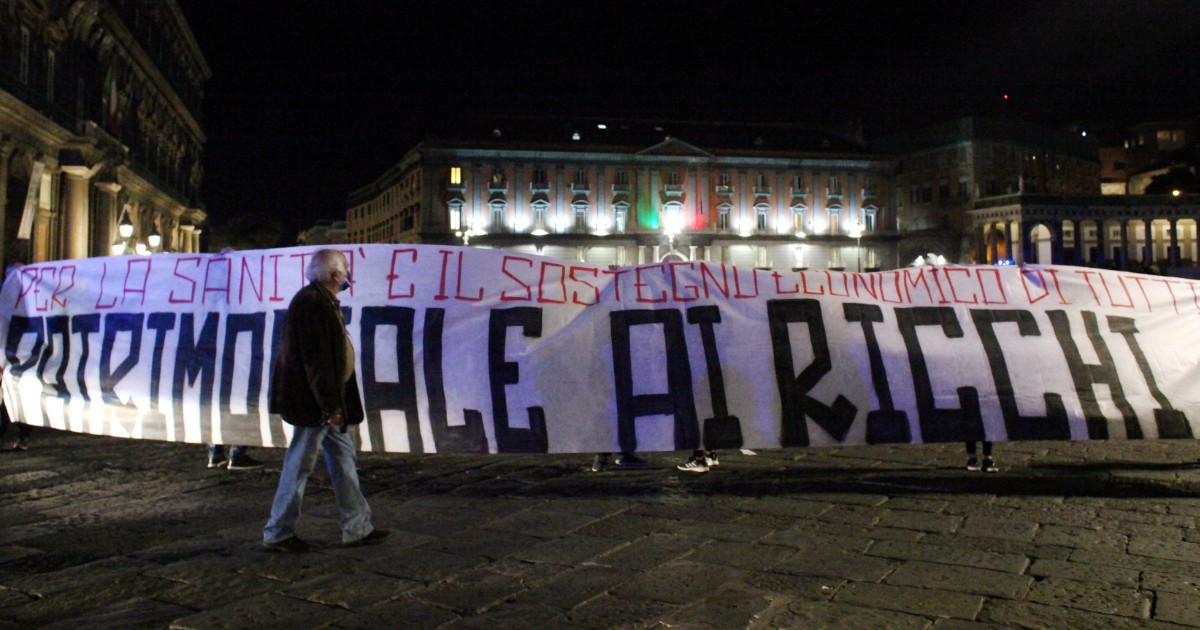
"Wealth should be shared." #Protesta #Disuguaglianza #SanitàPubblica (translated)

3355
Il Fatto Quotidiano 3w

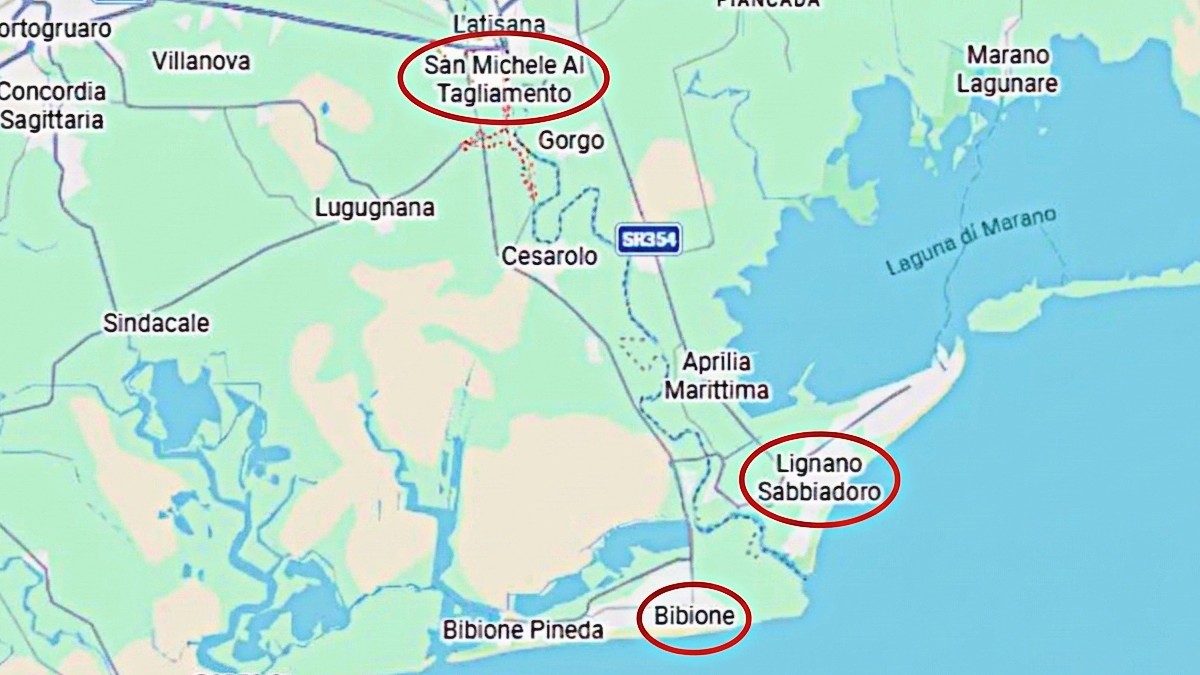
The border municipalities of Veneto, including San Michele al Tagliamento and Bibione, are trying to change region to join Friuli Venezia Giulia, attracted by the wealth of the beaches and the economic and administrative benefits that this would entail. #FriuliVeneziaGiulia #Veneto #Referendum (translated)

www.ilfattoquotidiano.it
Dal Veneto al Friuli, i Comuni di confine ci riprovano: San Michele al Tagliamento (con Bibione) vuole cambiare Regione. In ballo la ricchezza delle spiagge
2781
ANSA.it 3w

The article explores how the phenomenon of underconsumption is emerging as a cultural and economic response to the challenges of hyperconsumption and the difficult accessibility to wealth for new generations, as a reaction to current social and economic difficulties. #sottoconsumo #iperconsumismo #riutilizzo (translated)

www.ansa.it
Sottoconsumo, non spreco e posseggo meno, tra stile di vita e necessità
2782
Il Sole 24 ORE 4w

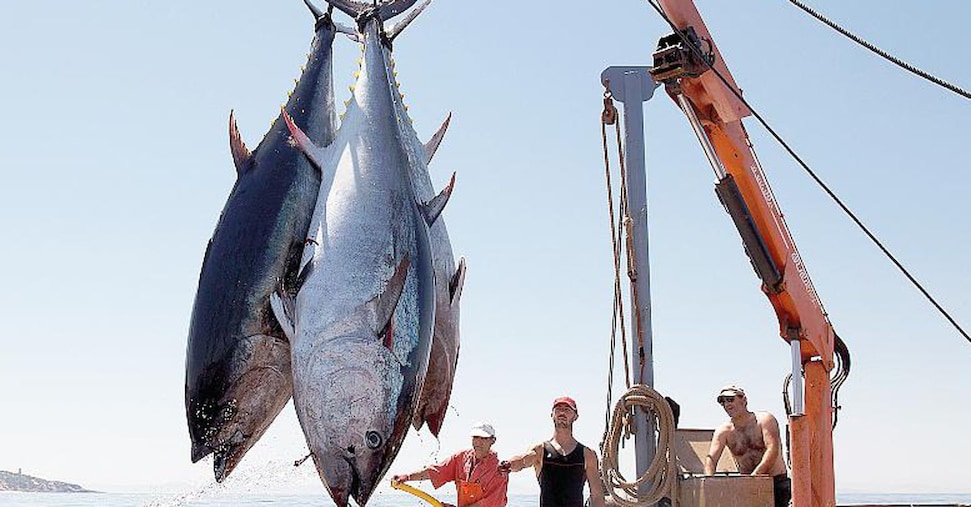
Coldiretti proposes supply chain agreements and the development of farms for fattening in order to enhance red tuna, retain a greater share of the wealth generated in Italy, and ensure greater employment opportunities and profitability for businesses. #TonnoRosso #FilieraItaliana #InnovazioneAgricola (translated)

www.ilsole24ore.com
Per valorizzare il tonno rosso accordi di filiera, allevamenti per l’ingrasso e più controlli
3017
L
lastampa.it Oct 18

Zagrebelsky warns that excess wealth threatens democracy, while the wealth tax generates social conflicts and hatred. #Democrazia #Patrimoniale #Economia (translated)

www.lastampa.it
Zagrebelsky: “Troppa ricchezza uccide la democrazia ma la patrimoniale eccita l’odio sociale”
2924
Il Fatto Quotidiano Oct 15

The economist Thomas Piketty has proposed a referendum in France to introduce a national solidarity tax on the super-rich, arguing that the revenues from this tax could help redistribute wealth and finance public investments. #Piketty #Tasse #Ridistribuzione (translated)

www.ilfattoquotidiano.it
Francia, l’economista Piketty lancia il referendum sulla “tassa per i super-ricchi”
3279
Paolo Becchi Wrld summary Oct 13
Italian philosopher

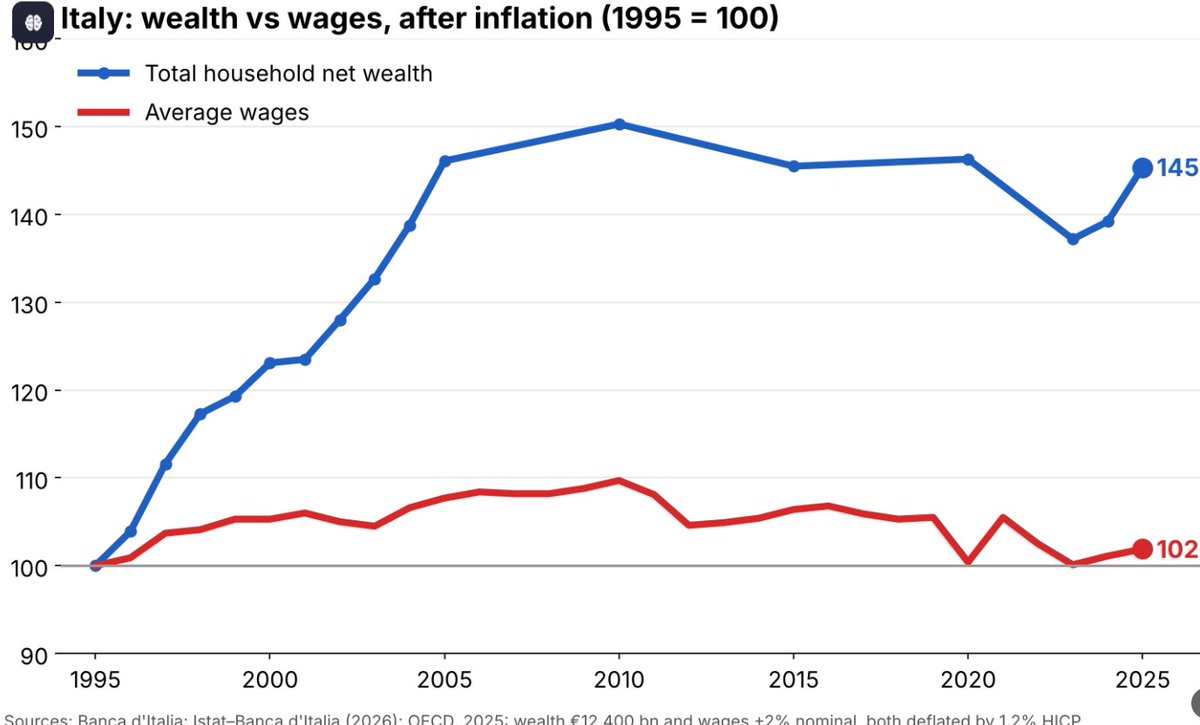
The author of the post argued that in Italy, wealth, including real estate and financial wealth, had increased by 45% over 30 years, while salaries had remained unchanged. He indicated that the data, adjusted for inflation, covered the period from 1995 to today and lamented that the focus was always on wages without noticing the trend in wealth. https://t.co/ocKBh5s9kO #Italia #Economia #Stipendi #IT (translated)

3047
Il Fatto Quotidiano Oct 13

The 2026 Report of the Leone Moressa Foundation highlights how migrants in Italy, creating 796,000 businesses and generating 196 billion euros of wealth, face obstacles in entering and utilizing their skills, significantly contributing to the national economy. #Immigrazione #Lavoro #Economia (translated)

www.ilfattoquotidiano.it
Immigrati in Italia, 796mila imprenditori e 196 miliardi di ricchezza prodotta: tra ostacoli e competenze sprecate
3164