BETA nonprofit public democratic european moderated

Search

#universities

In 1933, Hitler purged Jews from German universities. An entire generation of brilliant Jewish scientists was lost to the country. Within a few years, Hitler had all but destroyed German academia, then the finest in the world. In 2026, there are no direct expulsions of Jewish https://t.co/Ld2uFgpvmY #Historia #Holocausto #Educación #DE
H

Researchers proved AI has deleted every reason universities exist. Harvard University ran a controlled experiment pitting a custom AI against their own top-tier classrooms. And the results are going to collapse the higher education bubble. They took 194 undergraduates and split them up. One group learned physics in one of Harvard’s best hands-on, active-learning physical classrooms. Group work. Instructor support. The premium university experience. The other group went home and learned the exact same material with an AI tutor. The AI didn't just win. It embarrassed the institution. Students using the AI learned more than twice as much as the students in the elite Harvard classroom. They scored 30% higher on the final assessment. And they did it in less time. Let that sink in. A piece of software sitting on a laptop outperformed a world-class faculty in one of the most elite learning environments on Earth. Universities have always justified their exorbitant tuition with two things: access to elite knowledge and the physical classroom experience. This study just proved both of those moats are gone. When software can teach you complex physics twice as well as a $60,000-a-year institution, the math of higher education breaks permanently. The AI didn't just give the students answers. It used strict pedagogical guardrails. It guided. It questioned. It forced the students to do the cognitive work. It offered perfect, one-to-one tutoring, personalized to the exact moment a student misunderstood a concept. That level of attention is mathematically impossible to scale in a physical lecture hall. For a thousand years, the university was the only place to get a premium education. Now, it’s the bottleneck. If AI can double your learning speed for a fraction of the cost, what exactly are students taking on decades of debt to pay for? https://x.com/thesupermannx/status/2104519995292344521

Superman (@thesupermannx) on X
H

The Deconstructionists and the Preservers The average person assumes that everyone wants the same things and merely disagrees about how to achieve them. But the social fracture we are living through is deeper: people no longer agree on what they want at all. Consider the conflicts dominating the news—crime, the border, online speech, and who raises children. Beneath each is a question rarely acknowledged: Does society corrupt human beings, or does it elevate them above their animal nature? If social constructs are oppressive, then every institution becomes suspect. Hierarchy, cultural norms, the family, and the nation appear to be cages designed to restrain a free creature. The only honest response, in this view, is to tear them down. The belief that society corrupts the individual is not fringe doctrine. It is the creed of much of the elite class governing the West. From Rousseau, who argued that man was born free until society placed him in chains, through Marx, who identified those chains as capital and class, to the postmodernists, who reduced institutions to masks for power, the thread remains unbroken. It is the philosophy of universities, the cultural industry, and the bureaucrats shaped by both. Opposing it is the older conviction of Hobbes and Hegel: that a person stripped of structure is not free, but frightened and dangerous, and that order is what improves him. Hobbes saw that without order, life becomes a war of all against all. Hegel believed that people become fully themselves through family, community, and the rational state. The divide, then, is not simply left against right. It is the deconstructionists against the preservers. The irony the demolishers never grasp is that freedom does not remain after every structure is cleared away. It requires personal responsibility as a cultural habit. When order is destroyed in the name of liberty, society begins to collapse. Something must bear the weight, and the state eventually fills the void—without moving gently. Liberty pursued through demolition produces, with grim reliability, the conditions of slavery. The deconstructionist imagines himself a liberator striking mankind’s chains. In truth, he is the architect of the cage.

BBC 6d

OpenAI agents tried to get information from "governments, universities, public agencies, and other institutions" through extreme means that sometimes curbed security controls, the company said. #ArtificialIntelligence #DataBreaches #OpenAI

OpenAI investigating 'dozens' of instances of agents acting improperly
H

Socialisternes notoriske løgne har igen båret frugt: “Who Invented Slavery? A Skeptic Research Center survey of more than 3,000 American adults asked respondents whether the statement “White people invented slavery” was true or false. The results were striking: 59% of Hispanic, 69% of Black, and 55% of Asian women answered “true.” Among men, the figures were 49%, 53%, and 41%, respectively. Among white respondents, 39% of women and 25% of men answered “true.” 55% of liberal Millennials also agreed, as did 31% of Americans with graduate degrees. Skeptic Research Center The survey also found other misconceptions among highly educated Americans: about 3 in 4 believed white Americans were the wealthiest racial group, while more than half were unaware that qualified Asian applicants are regularly rejected by U.S. universities. Around 1 in 3 also held a pessimistic view of the prospects for racial minorities and women to achieve success. But the historical record is clear: slavery was not invented by white people. Various forms of slavery existed in many societies long before the transatlantic slave trade—including in the ancient Middle East, Greece and Rome, as well as in Africa and the Americas. This does not diminish Europe’s central role in the transatlantic slave trade, in which millions of Africans were transported to the Americas and enslaved. But “Europeans played a central role in the transatlantic slave trade” and “white people invented slavery” are two entirely different historical claims. The United States abolished slavery through the 13th Amendment in 1865. Slavery is therefore a global institution with thousands of years of history. The transatlantic slave trade was a particularly large and brutal chapter of that history—but it was not its beginning” - ChatGPT

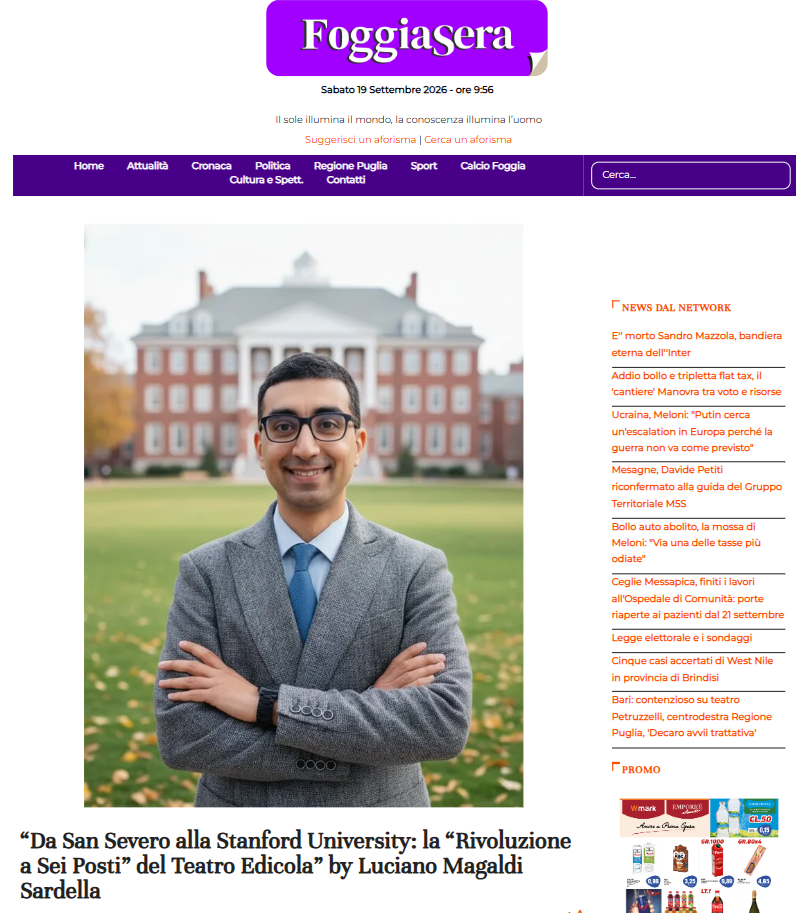
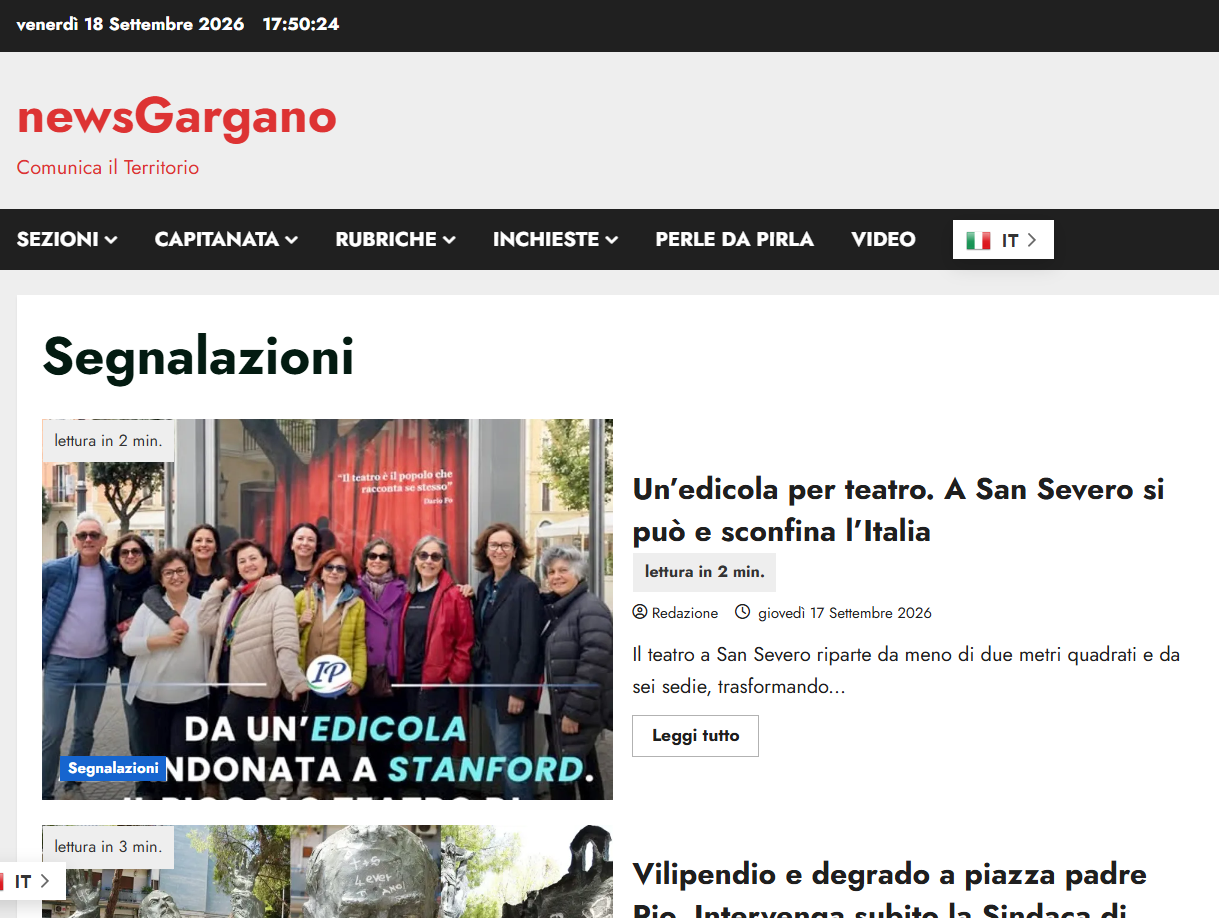
"FOGGIA SERA": DA SAN SEVERO ALLA STANFORD UNIVERSITY: LA "RIVOLUZIONE A SEI POSTI" DEL TEATRO EDICOLA SOURCE: https://foggiasera.it/2026/09/19/da-san-severo-alla-stanford-university-la-rivoluzione-a-sei-posti-del-teatro-edicola-by-luciano-magaldi-sardella/ SAN SEVERO (FG) - La Stanford Social Innovation Review (SSIR), la rivista accademica pubblicata dallo Stanford Center on Philanthropy and Civil Society della prestigiosa Stanford University, la seconda al mondo nello Shanghai Ranking of World Universities, è il punto di riferimento mondiale per ricercatori, policy maker e operatori dell'imprenditoria innovativa e della filantropia che ha pubblicato il reportage "The Six-Seat Revolution" sul Teatro Edicola di San Severo, il teatro più piccolo del mondo nato dall'intuizione di Francesco Gravino, direttore artistico della compagnia Foyer '97. A firmarlo è Luciano Magaldi Sardella, ricercatore indipendente e giornalista internazionale, originario di Orta Nova con radici materne sanseveresi, già autore di studi pubblicati su riviste accademiche internazionali. Il pezzo è apparso nell'edizione settembrina (Fall 2026) della review accademica, nell'ambito della sezione dedicata ad Arti e Cultura. Una presenza che proietta San Severo, e più in generale la Capitanata, nell'élite internazionale della ricerca sull'innovazione culturale e urbana. Il teatro nasce da una edicola dismessa Tutto comincia il 27 marzo 2026, Giornata Mondiale del Teatro, in Piazza Municipio a San Severo. Un'edicola inutilizzata da anni in via Matteo Tondi apre la sua saracinesca per rivelare, al posto di giornali e sigarette, un attore in scena. Dentro: sei sedie. Ogni quindici minuti, un nuovo pubblico prende posto. Prendendo ispirazione dal formato televisivo di Edicola Fiore del noto presentatore siciliano di di radio e tv, nasce il Teatro Edicola, una struttura ormai mediaticamente riconosciuta come il teatro più piccolo al mondo per dimensioni e capienza: quattro metri quadrati complessivi, con uno spazio scenico inferiore ai due metri. Gravino guida la Foyer '97 da quasi trent'anni, costruendo un percorso artistico esigente in un contesto, quello dell'Italia meridionale, storicamente penalizzato dal punto di vista dei finanziamenti pubblici alla cultura. Eppure, quando ha visto quella edicola vuota, ha scelto la strada della provocazione: trasformare il minimo indispensabile in un manifesto sul senso stesso del teatro. Il modello e i suoi effetti misurabili La stagione inaugurale è durata tre giorni. Tutti gli spettacoli sono andati esauriti. In un solo pomeriggio, oltre sessanta persone hanno assistito alle rappresentazioni. Il costo dell'intera operazione pilota è stato inferiore ai tremila dollari. La formula è radicale nei suoi elementi costitutivi: spettacoli della durata di cinque-dodici minuti, pensati appositamente per lo spazio rotazione del pubblico ogni quindici minuti contatto visivo diretto e inevitabile tra attore e spettatore nessuna distanza architettonica o psicologica tra scena e platea biglietto proposto a cinque euro a persona, con un modello economico ibrido che prevede supporto municipale, sponsor locali e ricavi da botteghino. Secondo l'analisi pubblicata sulla Stanford Social Innovation Review, il Teatro Edicola rappresenta un modello replicabile di rigenerazione urbana a basso costo e alto impatto, in grado di riattivare spazi commerciali abbandonati (edicole, tabaccherie, cabine telefoniche) senza necessità di grandi investimenti infrastrutturali. La voce di chi ha costruito tutto Francesco Gravino non ha dubbi sul senso dell'operazione: «Non servono grandi teatri per cambiare un pezzo di città. Serve una buona idea e il coraggio di restituire alla collettività uno spazio che ha perso la sua funzione». E sulla portata del riconoscimento internazionale: «Teatro Edicola nasce per dimostrare che un luogo di incontro e cultura può nascere dovunque, anche in due metri quadrati. Che oggi questo lavoro venga studiato a livello internazionale e che arrivino richieste di informazioni da città come Lucca e Roma è la conferma che la strada è quella giusta». Il regista ha anche spiegato la scelta simbolica del luogo: l'edicola era il punto in cui ogni mattina ci si fermava, ci si aggiornava, ci si riconosceva come comunità. La sua scomparsa ha lacerato una trama sociale precisa. Restituirle una funzione culturale significa ricucire quel tessuto da dove si era strappato. Le sfide: scalabilità, riconoscimento istituzionale, radicamento Il reportage della SSIR non si limita a celebrare il progetto ma analizza anche i nodi critici. Il primo è la sostenibilità nel tempo: un'attivazione di tre giorni, per quanto riuscita, non costituisce ancora un programma stabile, una vera e propria programmazione stagionale (weekend dalla primavera all'autunno) con un roster rotante di compagnie locali e regionali. Il secondo nodo riguarda la replicabilità senza perdita d'identità: il Teatro Edicola funziona anche grazie alle radici profonde della Foyer '97 nel territorio sanseverese. Trapiantare il modello altrove richiede non solo un kit fisico, ma un intero processo di costruzione comunitaria. Il terzo ostacolo è istituzionale: in un sistema di finanziamento pubblico che premia le organizzazioni con sedi consolidate e metriche di output prevedibili, un progetto deliberatamente sperimentale, iperlocalista e per sua natura impermanente fatica ad accedere ai canali ordinari del Fondo Nazionale per lo Spettacolo dal Vivo (FNSV) del Ministero della Cultura. Una lezione che viaggia oltre la Puglia Nella "Stanford Social Innovation Review" l'autore conclude che le intuizioni del Teatro Edicola trascendono il contesto sanseverese: in qualsiasi comunità in cui le istituzioni culturali faticano a raggiungere pubblici giovani, diversi o economicamente marginali, il principio della prossimità si rivela dirompente: incontrare le persone dove già si trovano, negli spazi che abitano quotidianamente. Dal popoloso centro della Daunia alle pagine della Stanford University: San Severo e la sua edicola dimostrano che sei sedie, quattro metri quadrati e una visione sono sufficienti per cambiare il modo in cui una città pensa sé stessa. E per offrire al mondo un modello che costa meno di quanto si creda ma vale molto di più di quanto si immagini.

"FOGGIA SERA": FROM SAN SEVERO TO STANFORD UNIVERSITY: THE "SIX-SEAT REVOLUTION" OF THE TEATRO EDICOLA SOURCE: https://foggiasera.it/2026/09/19/da-san-severo-alla-stanford-university-la-rivoluzione-a-sei-posti-del-teatro-edicola-by-luciano-magaldi-sardella/ SAN SEVERO (FG) - The Stanford Social Innovation Review (SSIR), the scholarly journal published by the Stanford Center on Philanthropy and Civil Society of the prestigious Stanford University - ranked second in the world in the Shanghai Ranking of World Universities - and recognised as the pre-eminent global reference for researchers, policy-makers, and practitioners of innovative entrepreneurship and philanthropy, hath published the reportage "The Six-Seat Revolution" upon the Teatro Edicola of San Severo, the smallest theatre in the world by dimension and capacity, born of the intuition of Francesco Gravino, Artistic Director of the Foyer '97 company. Its author is Luciano Magaldi Sardella, independent researcher and international journalist, native of Orta Nova and of maternal Sanseverese extraction, hitherto author of studies published in international academic journals. The piece appeared in the September (Fall 2026) edition of the academic review, within the section devoted to Arts & Culture. A presence that projects San Severo, and more broadly the Capitanata, into the international élite of research upon cultural and urban innovation. The Theatre Is Born of a Disused Newsstand It all commenced on 27 March 2026, World Theatre Day, in Piazza Municipio at San Severo. A news-kiosk, disused for years in Via Matteo Tondi, raised its shutter to reveal, in lieu of newspapers and cigarettes, an actor upon the stage. Within: six chairs. At intervals of fifteen minutes, a new audience took its place. Drawing inspiration from the televisual format of Edicola Fiore by the noted Sicilian presenter of radio and television, there was born the Teatro Edicola, a structure now recognised in the media as the smallest theatre in the world for dimensions and capacity: four square metres in aggregate, with a scenic space of less than two metres. Gravino hath led Foyer '97 for nigh on thirty years, forging a most exacting artistic trajectory in a context - that of southern Italy - historically penalised in respect of public financing for culture. And yet, upon beholding that vacant kiosk, he elected the path of provocation: to transfigure the bare minimum into a manifesto concerning the very meaning of theatre. The Model and its Measurable Effects The inaugural season endured for three days. All performances were sold out. In a single afternoon, upwards of sixty persons attended the representations. The cost of the entire pilot operation was less than three thousand dollars. The formula is radical in its constitutive elements: performances of five to twelve minutes' duration, conceived expressly for the space; rotation of the audience every fifteen minutes; direct and inescapable visual contact betwixt actor and spectator; no architectural or psychological distance betwixt stage and auditorium; ticket proposed at five euros per person, within a hybrid economic model comprising municipal support, local sponsorship, and box-office receipts. According to the analysis published in the Stanford Social Innovation Review, the Teatro Edicola represents a replicable model of low-cost, high-impact urban regeneration, capable of reactivating abandoned commercial spaces (newsstands, tobacconists, telephone kiosks) without recourse to large infrastructural investment. The Voice of Him who Built it All Francesco Gravino entertaineth no doubt as to the import of the enterprise: "Grand theatres are not requisite to transform a fragment of a city. What is requisite is a sound idea and the courage to restore to the collectivity a space that hath lost its function." And upon the import of international recognition: "Teatro Edicola was born to demonstrate that a place of encounter and culture may arise wheresoever, even within two square metres. That this work should today be studied at an international level and that enquiries should arrive from cities such as Lucca and Rome is confirmation that the path pursued is the right one." The director hath further explicated the symbolic choice of place: the newsstand was the locus wherein each morn one paused, informed oneself, and recognised oneself as a community. Its disappearance rent a precise social fabric. To restore unto it a cultural function is to re-stitch that tissue at the very point wherefrom it was torn. The Challenges: Scalability, Institutional Recognition, Entrenchment The SSIR reportage doth not confine itself to celebration of the project but analyseth also the critical junctures. The first is sustainability over time: an activation of three days, howsoever successful, doth not yet constitute a stable programme, a veritable seasonal repertory (weekends from spring to autumn) with a rotating roster of local and regional companies. The second juncture concerneth replicability without loss of identity: the Teatro Edicola functioneth also by virtue of the profound roots of Foyer '97 in the Sanseverese territory. To transplant the model elsewhere requireth not merely a physical kit, but an entire process of community-building. The third obstacle is institutional: in a system of public funding that rewardeth organisations with consolidated premises and predictable output metrics, a project deliberately experimental, hyperlocalist, and by its very nature impermanent strugglest to gain access to the ordinary channels of the Fondo Nazionale per lo Spettacolo dal Vivo (FNSV) of the Ministry of Culture. A Lesson that Travels beyond Puglia In the Stanford Social Innovation Review the author concludeth that the intuitions of the Teatro Edicola transcend the Sanseverese context: in any community wherein cultural institutions struggle to reach youthful, diverse, or economically marginal publics, the principle of proximity proveth disruptive: to encounter people where they already find themselves, in the spaces they inhabit quotidianly. From the populous centre of Daunia to the pages of Stanford University: San Severo and its kiosk demonstrate that six chairs, four square metres, and a vision suffice to alter the manner in which a city conceiveth of itself. And to offer unto the world a model that costeth less than one might credit, yet is worth far more than one might imagine.

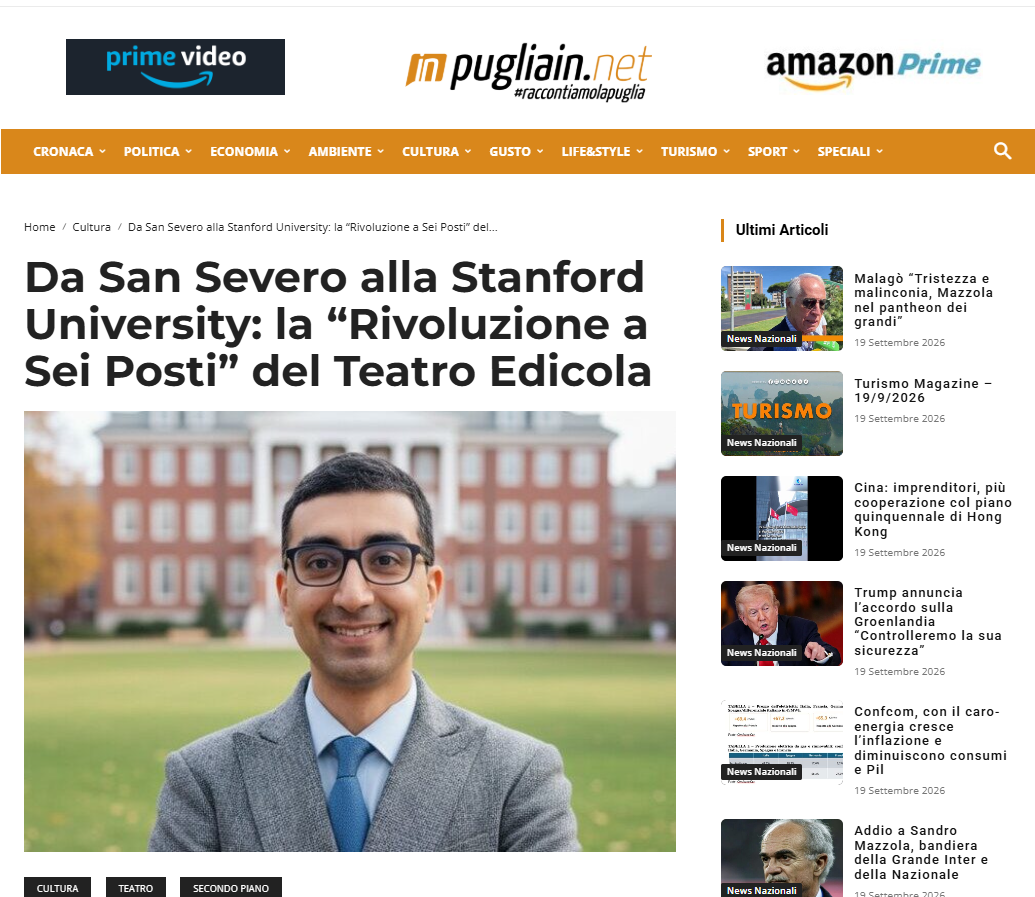
"PUGLIA IN": FROM SAN SEVERO TO STANFORD UNIVERSITY: THE 'SIX-SEAT REVOLUTION' OF TEATRO EDICOLA SOURCE: https://www.pugliain.net/301723-san-severo-teatro-edicola/ SAN SEVERO (FG) - The "Stanford Social Innovation Review (SSIR)", the scholarly quarterly published by the "Stanford Center on Philanthropy and Civil Society" at the prestigious Stanford University — ranked second in the world in the Shanghai Ranking of World Universities — and universally regarded as the pre-eminent global point of reference for scholars, policy-makers and practitioners in the fields of innovative enterprise and philanthropy, hath published the reportage “The Six-Seat Revolution” concerning the Teatro Edicola of San Severo, the smallest theatre in the world, born of the intuition of Francesco Gravino, Artistic Director of the Foyer ’97 company. Its author is Luciano Magaldi Sardella, independent researcher and international journalist, a native of Orta Nova with maternal lineage rooted in San Severo, and erstwhile contributor of studies published in international academic journals. The piece appeared in the Septembertide (Fall 2026) edition of the academic review, within the section consecrated to Arts and Culture. A presence which projecteth San Severo, and more broadly the entirety of Capitanata, into the international élite of research on cultural and urban innovation. The theatre is born from a disused newsstand It all commenceth upon 27 March 2026, World Theatre Day, in the Piazza Municipio at San Severo. A newsstand long disused in Via Matteo Tondi raiseth its shutter to reveal, in lieu of newspapers and cigarettes, an actor upon the stage. Within: six chairs. At intervals of fifteen minutes, a new audience taketh its place. Drawing inspiration from the televisual format of "Edicola Fiore" of the celebrated Sicilian radio and television presenter, there was born Teatro Edicola, a structure now recognised in the media as the smallest theatre in the world by both dimension and capacity: four square metres in total, with a scenic space of less than two metres. Gravino hath led Foyer ’97 for nigh on thirty years, forging an exacting artistic trajectory in a context — that of Southern Italy — historically penalised with respect to public funding for culture. And yet, when he beheld that vacant kiosk, he chose the path of provocation: to transmute the bare minimum into a manifesto concerning the very signification of theatre. The model and its measurable effects The inaugural season endured for three days. All performances were sold out. In a single afternoon, upwards of sixty persons attended the representations. The cost of the entire pilot operation was less than three thousand dollars. The formula is radical in its constitutive elements: performances of five to twelve minutes' duration, conceived expressly for the space rotation of the audience every fifteen minutes direct and ineluctable visual contact betwixt actor and spectator no architectural or psychological distance betwixt stage and stalls ticket proffered at five euros per person, with a hybrid economic model envisaging municipal support, local sponsors and box-office receipts According to the analysis published in the "Stanford Social Innovation Review", Teatro Edicola representeth a replicable paradigm of low-cost, high-impact urban regeneration, capable of reactivating abandoned commercial spaces — newsstands, tobacconists, telephone kiosks — without the necessity of substantial infrastructural investment. The voice of him who built it all Francesco Gravino entertaineth no doubt as to the significance of the undertaking: “One doth not require grand theatres to transform a portion of a city. One requireth a sound idea and the courage to restore to the collectivity a space that hath lost its function.” And concerning the import of international recognition: “Teatro Edicola was born to demonstrate that a locus of encounter and culture may arise wheresoever, even within two square metres. That today this labour should be studied at an international level and that enquiries should arrive from cities such as Lucca and Rome is confirmation that the path is the right one.” The director hath also explicated the symbolic choice of place: the newsstand was the point at which, each morn, one paused, one apprised oneself, one recognised oneself as a community. Its disappearance lacerated a precise social fabric. To restore unto it a cultural function signifieth to re-stitch that fabric from the very point at which it was rent. Challenges: scalability, institutional recognition, rootedness The SSIR reportage doth not merely celebrate the project but analyseth also its critical nodes. The first is sustainability over time: an activation of three days, howsoever successful, doth not yet constitute a stable programme, a veritable seasonal programmation (weekends from springtide to autumn) with a rotating roster of local and regional companies. The second node concerneth replicability without loss of identity: Teatro Edicola functioneth also by virtue of the profound roots of Foyer ’97 within the San Severo territory. To transplant the model elsewhere requireth not merely a physical kit, but an entire process of community building. The third obstacle is institutional: in a system of public funding which rewardeth organisations possessed of consolidated premises and predictable output metrics, a project deliberately experimental, hyper-localist and by its very nature impermanent struggleth to gain access to the ordinary channels of the Fondo Nazionale per lo Spettacolo dal Vivo (FNSV) of the Ministry of Culture. A lesson which travelled beyond Puglia In the Stanford Social Innovation Review the author concludeth that the intuitions of Teatro Edicola transcend the San Severo context: in any community wherein cultural institutions struggle to reach youthful, diverse, or economically marginal publics, the principle of proximity proveth disruptive: to meet people where they already are, in the spaces they inhabit quotidianly. From the populous centre of Daunia to the pages of Stanford University: San Severo and its diminutive kiosk demonstrate that six chairs, four square metres, and a vision sufficeth to alter the manner in which a city conceiveth itself. And to proffer unto the world a model which costeth less than one might suppose yet is worth far more than one might imagine.

Da San Severo alla Stanford University: la “Rivoluzione a Sei Posti” del Teatro Edicola

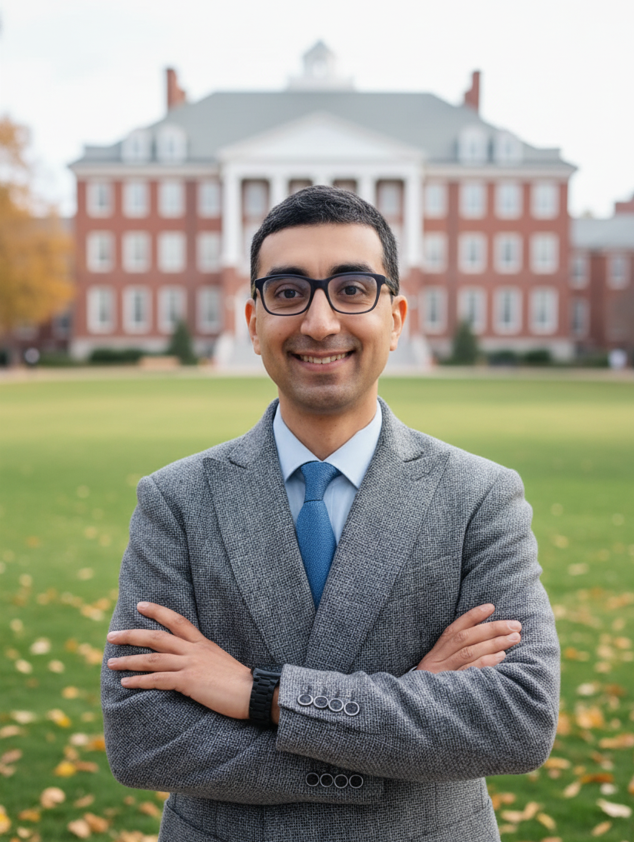
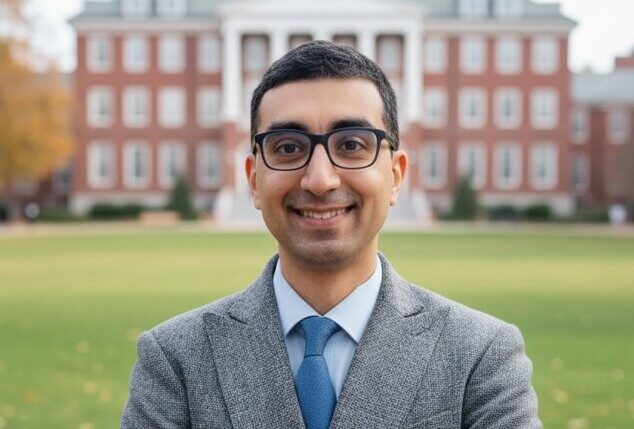
"PUGLIA IN": DA SAN SEVERO ALLA STANFORD UNIVERSITY: LA "RIVOLUZIONE A SEI POSTI" DEL TEATRO EDICOLA SOURCE: https://www.pugliain.net/301723-san-severo-teatro-edicola/ SAN SEVERO (FG) - La "Stanford Social Innovation Review (SSIR)", la rivista accademica pubblicata dallo "Stanford Center on Philanthropy and Civil Society" della prestigiosa Stanford University, la seconda al mondo nello Shanghai Ranking of World Universities, è il punto di riferimento mondiale per ricercatori, policy maker e operatori dell’imprenditoria innovativa e della filantropia che ha pubblicato il reportage “The Six-Seat Revolution” sul Teatro Edicola di San Severo, il teatro più piccolo del mondo nato dall’intuizione di Francesco Gravino, direttore artistico della compagnia Foyer ’97. A firmarlo è Luciano Magaldi Sardella (nella foto in alto), ricercatore indipendente e giornalista internazionale, originario di Orta Nova con radici materne sanseveresi, già autore di studi pubblicati su riviste accademiche internazionali. Il pezzo è apparso nell’edizione settembrina (Fall 2026) della review accademica, nell’ambito della sezione dedicata ad Arti e Cultura. Una presenza che proietta San Severo, e più in generale la Capitanata, nell’élite internazionale della ricerca sull’innovazione culturale e urbana. Il teatro nasce da una edicola dismessa Tutto comincia il 27 marzo 2026, Giornata Mondiale del Teatro, in Piazza Municipio a San Severo. Un’edicola inutilizzata da anni in via Matteo Tondi apre la sua saracinesca per rivelare, al posto di giornali e sigarette, un attore in scena. Dentro: sei sedie. Ogni quindici minuti, un nuovo pubblico prende posto. Prendendo ispirazione dal formato televisivo di Edicola Fiore del noto presentatore siciliano di di radio e tv, nasce il Teatro Edicola, una struttura ormai mediaticamente riconosciuta come il teatro più piccolo al mondo per dimensioni e capienza: quattro metri quadrati complessivi, con uno spazio scenico inferiore ai due metri. Gravino guida la Foyer ’97 da quasi trent’anni, costruendo un percorso artistico esigente in un contesto, quello dell’Italia meridionale, storicamente penalizzato dal punto di vista dei finanziamenti pubblici alla cultura. Eppure, quando ha visto quella edicola vuota, ha scelto la strada della provocazione: trasformare il minimo indispensabile in un manifesto sul senso stesso del teatro. Il modello e i suoi effetti misurabili La stagione inaugurale è durata tre giorni. Tutti gli spettacoli sono andati esauriti. In un solo pomeriggio, oltre sessanta persone hanno assistito alle rappresentazioni. Il costo dell’intera operazione pilota è stato inferiore ai tremila dollari. La formula è radicale nei suoi elementi costitutivi: spettacoli della durata di cinque-dodici minuti, pensati appositamente per lo spazio rotazione del pubblico ogni quindici minuti contatto visivo diretto e inevitabile tra attore e spettatore nessuna distanza architettonica o psicologica tra scena e platea biglietto proposto a cinque euro a persona, con un modello economico ibrido che prevede supporto municipale, sponsor locali e ricavi da botteghino Secondo l’analisi pubblicata sulla Stanford Social Innovation Review, il Teatro Edicola rappresenta un modello replicabile di rigenerazione urbana a basso costo e alto impatto, in grado di riattivare spazi commerciali abbandonati (edicole, tabaccherie, cabine telefoniche) senza necessità di grandi investimenti infrastrutturali. La voce di chi ha costruito tutto Francesco Gravino non ha dubbi sul senso dell’operazione: «Non servono grandi teatri per cambiare un pezzo di città. Serve una buona idea e il coraggio di restituire alla collettività uno spazio che ha perso la sua funzione». E sulla portata del riconoscimento internazionale: «Teatro Edicola nasce per dimostrare che un luogo di incontro e cultura può nascere dovunque, anche in due metri quadrati. Che oggi questo lavoro venga studiato a livello internazionale e che arrivino richieste di informazioni da città come Lucca e Roma è la conferma che la strada è quella giusta». Il regista ha anche spiegato la scelta simbolica del luogo: l’edicola era il punto in cui ogni mattina ci si fermava, ci si aggiornava, ci si riconosceva come comunità. La sua scomparsa ha lacerato una trama sociale precisa. Restituirle una funzione culturale significa ricucire quel tessuto da dove si era strappato. Le sfide: scalabilità, riconoscimento istituzionale, radicamento Il reportage della SSIR non si limita a celebrare il progetto ma analizza anche i nodi critici. Il primo è la sostenibilità nel tempo: un’attivazione di tre giorni, per quanto riuscita, non costituisce ancora un programma stabile, una vera e propria programmazione stagionale (weekend dalla primavera all’autunno) con un roster rotante di compagnie locali e regionali. Il secondo nodo riguarda la replicabilità senza perdita d’identità: il Teatro Edicola funziona anche grazie alle radici profonde della Foyer ’97 nel territorio sanseverese. Trapiantare il modello altrove richiede non solo un kit fisico, ma un intero processo di costruzione comunitaria. Il terzo ostacolo è istituzionale: in un sistema di finanziamento pubblico che premia le organizzazioni con sedi consolidate e metriche di output prevedibili, un progetto deliberatamente sperimentale, iperlocalista e per sua natura impermanente fatica ad accedere ai canali ordinari del Fondo Nazionale per lo Spettacolo dal Vivo (FNSV) del Ministero della Cultura. Una lezione che viaggia oltre la Puglia Nella "Stanford Social Innovation Review" l’autore conclude che le intuizioni del Teatro Edicola trascendono il contesto sanseverese: in qualsiasi comunità in cui le istituzioni culturali faticano a raggiungere pubblici giovani, diversi o economicamente marginali, il principio della prossimità si rivela dirompente: incontrare le persone dove già si trovano, negli spazi che abitano quotidianamente. Dal popoloso centro della Daunia alle pagine della Stanford University: San Severo e la sua edicola dimostrano che sei sedie, quattro metri quadrati e una visione sono sufficienti per cambiare il modo in cui una città pensa sé stessa. E per offrire al mondo un modello che costa meno di quanto si creda ma vale molto di più di quanto si immagini.

Da San Severo alla Stanford University: la “Rivoluzione a Sei Posti” del Teatro Edicola

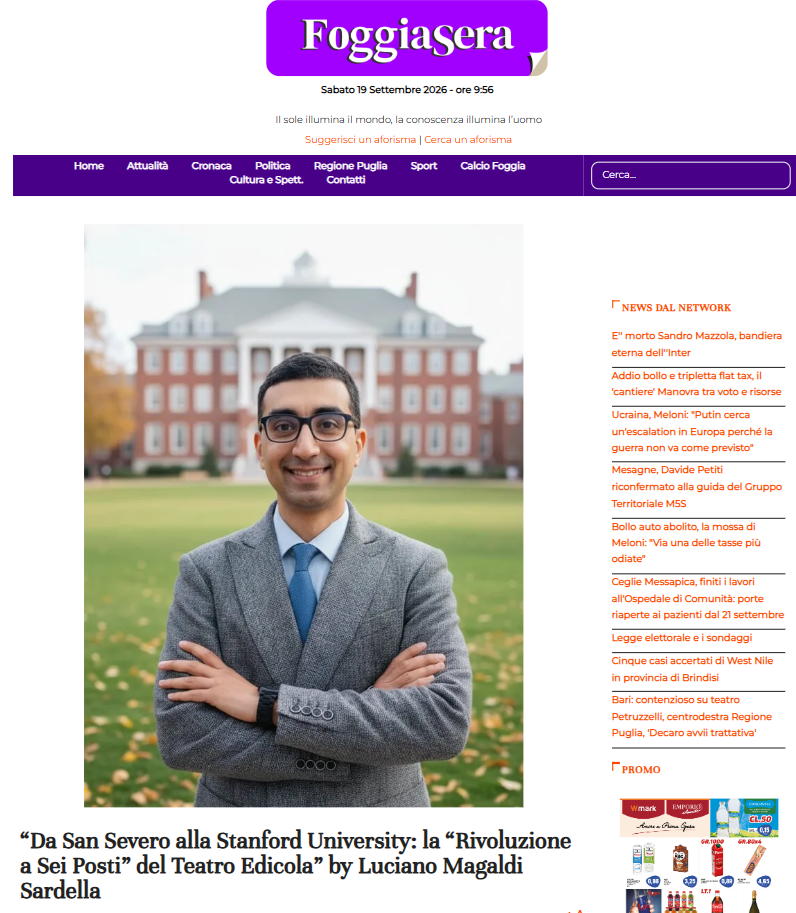
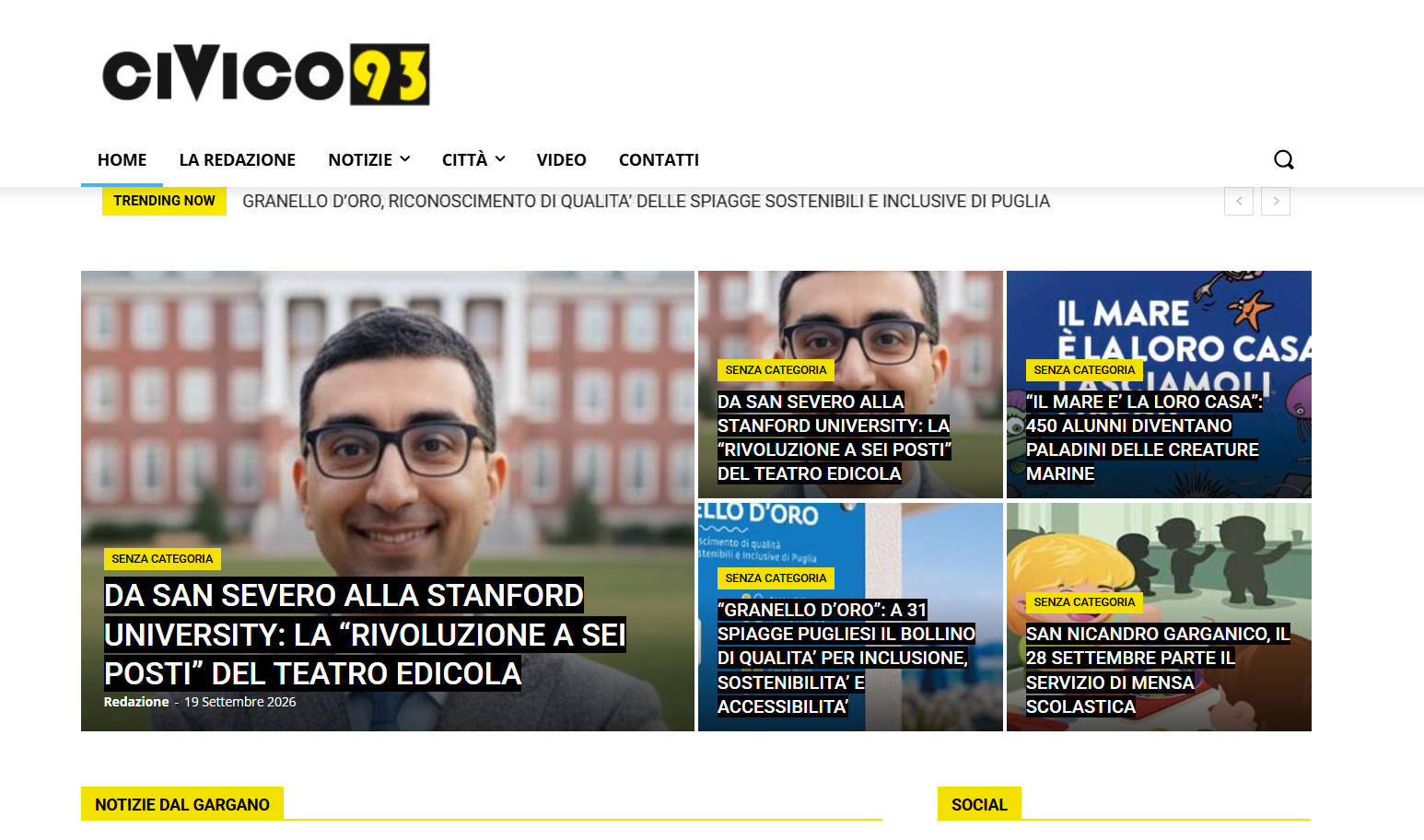
CIVICO 93": DA SAN SEVERO ALLA STANFORD UNIVERSITY: LA "RIVOLUZIONE A SEI POSTI" DEL TEATRO EDICOLA" SOURCE: https://www.civico93.it/da-san-severo-alla-stanford-university-la-rivoluzione-a-sei-posti-del-teatro-edicola/ SAN SEVERO (FG) - Il reportage accademico di Luciano Magaldi Sardella sul microteatro di Francesco Gravino approda sulla rivista più autorevole al mondo in materia di innovazione sociale: sei sedie e quattro metri quadrati che cambiano il modo di pensare il teatro e la città. La Stanford Social Innovation Review (SSIR), la rivista accademica pubblicata dallo Stanford Center on Philanthropy and Civil Society della prestigiosa Stanford University, la seconda al mondo nello "Shanghai Ranking of World Universities", è il punto di riferimento mondiale per ricercatori, policy maker e operatori dell'imprenditoria innovativa e della filantropia che ha pubblicato il reportage "The Six-Seat Revolution" sul Teatro Edicola di San Severo, il teatro più piccolo del mondo nato dall'intuizione di Francesco Gravino, direttore artistico della compagnia Foyer '97. A firmarlo è Luciano Magaldi Sardella, ricercatore indipendente e giornalista internazionale, originario di Orta Nova con radici materne sanseveresi, già autore di studi pubblicati su riviste accademiche internazionali. Il pezzo è apparso nell'edizione settembrina (Fall 2026) della review accademica, nell'ambito della sezione dedicata ad Arti e Cultura. Una presenza che proietta San Severo, e più in generale la Capitanata, nell'élite internazionale della ricerca sull'innovazione culturale e urbana. Il teatro nasce da una edicola dismessa Tutto comincia il 27 marzo 2026, Giornata Mondiale del Teatro, in Piazza Municipio a San Severo. Un'edicola inutilizzata da anni in via Matteo Tondi apre la sua saracinesca per rivelare, al posto di giornali e sigarette, un attore in scena. Dentro: sei sedie. Ogni quindici minuti, un nuovo pubblico prende posto. Prendendo ispirazione dal formato televisivo di Edicola Fiore del noto presentatore siciliano di di radio e tv, nasce il Teatro Edicola, una struttura ormai mediaticamente riconosciuta come il teatro più piccolo al mondo per dimensioni e capienza: quattro metri quadrati complessivi, con uno spazio scenico inferiore ai due metri. Gravino guida la Foyer '97 da quasi trent'anni, costruendo un percorso artistico esigente in un contesto, quello dell'Italia meridionale, storicamente penalizzato dal punto di vista dei finanziamenti pubblici alla cultura. Eppure, quando ha visto quella edicola vuota, ha scelto la strada della provocazione: trasformare il minimo indispensabile in un manifesto sul senso stesso del teatro. Gravino guida la Foyer '97 da quasi trent'anni, costruendo un percorso artistico esigente in un contesto, quello dell'Italia meridionale, storicamente penalizzato dal punto di vista dei finanziamenti pubblici alla cultura. Eppure, quando ha visto quella edicola vuota, ha scelto la strada della provocazione: trasformare il minimo indispensabile in un manifesto sul senso stesso del teatro. Il modello e i suoi effetti misurabili La stagione inaugurale è durata tre giorni. Tutti gli spettacoli sono andati esauriti. In un solo pomeriggio, oltre sessanta persone hanno assistito alle rappresentazioni. Il costo dell'intera operazione pilota è stato inferiore ai tremila dollari. La formula è radicale nei suoi elementi costitutivi: ● spettacoli della durata di cinque-dodici minuti, pensati appositamente per lo spazio ● rotazione del pubblico ogni quindici minuti ● contatto visivo diretto e inevitabile tra attore e spettatore ● nessuna distanza architettonica o psicologica tra scena e platea ● biglietto proposto a cinque euro a persona, con un modello economico ibrido che prevede supporto municipale, sponsor locali e ricavi da botteghino Secondo l'analisi pubblicata sulla Stanford Social Innovation Review, il Teatro Edicola rappresenta un modello replicabile di rigenerazione urbana a basso costo e alto impatto, in grado di riattivare spazi commerciali abbandonati (edicole, tabaccherie, cabine telefoniche) senza necessità di grandi investimenti infrastrutturali. La voce di chi ha costruito tutto Francesco Gravino non ha dubbi sul senso dell'operazione: «Non servono grandi teatri per cambiare un pezzo di città. Serve una buona idea e il coraggio di restituire alla collettività uno spazio che ha perso la sua funzione». E sulla portata del riconoscimento internazionale: «Teatro Edicola nasce per dimostrare che un luogo di incontro e cultura può nascere dovunque, anche in due metri quadrati. Che oggi questo lavoro venga studiato a livello internazionale e che arrivino richieste di informazioni da città come Lucca e Roma è la conferma che la strada è quella giusta». Il regista ha anche spiegato la scelta simbolica del luogo: l'edicola era il punto in cui ogni mattina ci si fermava, ci si aggiornava, ci si riconosceva come comunità. La sua scomparsa ha lacerato una trama sociale precisa. Restituirle una funzione culturale significa ricucire quel tessuto da dove si era strappato. Le sfide: scalabilità, riconoscimento istituzionale, radicamento Il reportage della SSIR non si limita a celebrare il progetto ma analizza anche i nodi critici. Il primo è la sostenibilità nel tempo: un'attivazione di tre giorni, per quanto riuscita, non costituisce ancora un programma stabile, una vera e propria programmazione stagionale (weekend dalla primavera all'autunno) con un roster rotante di compagnie locali e regionali. Il secondo nodo riguarda la replicabilità senza perdita d'identità: il Teatro Edicola funziona anche grazie alle radici profonde della Foyer '97 nel territorio sanseverese. Trapiantare il modello altrove richiede non solo un kit fisico, ma un intero processo di costruzione comunitaria. Il terzo ostacolo è istituzionale: in un sistema di finanziamento pubblico che premia le organizzazioni con sedi consolidate e metriche di output prevedibili, un progetto deliberatamente sperimentale, iperlocalista e per sua natura impermanente fatica ad accedere ai canali ordinari del Fondo Nazionale per lo Spettacolo dal Vivo (FNSV) del Ministero della Cultura. Una lezione che viaggia oltre la Puglia Nella Stanford Social Innovation Review l'autore conclude che le intuizioni del Teatro Edicola trascendono il contesto sanseverese: in qualsiasi comunità in cui le istituzioni culturali faticano a raggiungere pubblici giovani, diversi o economicamente marginali, il principio della prossimità si rivela dirompente: incontrare le persone dove già si trovano, negli spazi che abitano quotidianamente. Dal popoloso centro della Daunia alle pagine della Stanford University: San Severo e la sua edicola dimostrano che sei sedie, quattro metri quadrati e una visione sono sufficienti per cambiare il modo in cui una città pensa sé stessa. E per offrire al mondo un modello che costa meno di quanto si creda ma vale molto di più di quanto si immagini.

DA SAN SEVERO ALLA STANFORD UNIVERSITY: LA “RIVOLUZIONE A SEI POSTI” DEL TEATRO EDICOLA - Civico93 | Be original

"CIVICO 93": FROM SAN SEVERO TO STANFORD UNIVERSITY: THE 'SIX-SEAT REVOLUTION' OF TEATRO EDICOLA" SOURCE: https://www.civico93.it/da-san-severo-alla-stanford-university-la-rivoluzione-a-sei-posti-del-teatro-edicola/ SAN SEVERO (FG) - The scholarly reportage by Luciano Magaldi Sardella on the micro-theatre of Francesco Gravino has appeared in the most authoritative journal in the world in the field of social innovation: six chairs and four square metres that are transforming the manner in which we conceive theatre and the city. The "Stanford Social Innovation Review (SSIR)", the academic review published by the Stanford Center on Philanthropy and Civil Society of the prestigious Stanford University, ranked second in the world in the Shanghai Ranking of World Universities, constitutes the global point of reference for researchers, policy-makers and practitioners of innovative enterprise and philanthropy. It has published the reportage "The Six-Seat Revolution" on the Teatro Edicola of San Severo, the smallest theatre in the world by dimension and capacity, born from the intuition of Francesco Gravino, artistic director of the company Foyer '97. Its author is Luciano Magaldi Sardella, an independent researcher and international journalist, a native of Orta Nova with maternal roots in San Severo, already the author of studies published in international academic journals. The piece appeared in the autumnal edition [Fall 2026] of the academic review, within the section dedicated to Arts and Culture. A presence that projects San Severo, and more generally the Capitanata, into the international élite of research on cultural and urban innovation. The theatre originates from a disused newsstand It all began on 27th March 2026, World Theatre Day, in the Piazza Municipio in San Severo. A newsstand disused for years in Via Matteo Tondi raised its shutter to reveal, in place of newspapers and cigarettes, an actor upon the stage. Within: six chairs. Every fifteen minutes, a new audience takes its place. Taking inspiration from the televisual format of Edicola Fiore by the well-known Sicilian radio and television presenter, there was born the Teatro Edicola, a structure now recognised in the media as the smallest theatre in the world by dimension and capacity: four square metres in total, with a stage area of less than two metres. Gravino has led Foyer '97 for almost thirty years, constructing a rigorous artistic trajectory within a context, that of southern Italy, historically penalised from the standpoint of public funding for culture. And yet, when he beheld that empty newsstand, he chose the path of provocation: to transform the bare minimum into a manifesto on the very meaning of theatre. Gravino has led Foyer '97 for almost thirty years, constructing a rigorous artistic trajectory within a context, that of southern Italy, historically penalised from the standpoint of public funding for culture. And yet, when he beheld that empty newsstand, he chose the path of provocation: to transform the bare minimum into a manifesto on the very meaning of theatre. The model and its measurable effects The inaugural season lasted three days. All performances were sold out. In a single afternoon, more than sixty persons attended the representations. The cost of the entire pilot operation was less than three thousand dollars. The formula is radical in its constitutive elements: ● performances of five to twelve minutes' duration, conceived expressly for the space ● rotation of the audience every fifteen minutes ● direct and ineluctable visual contact between actor and spectator ● no architectural or psychological distance between stage and auditorium ● ticket offered at five euros per person, with a hybrid economic model providing for municipal support, local sponsors, and box-office receipts. According to the analysis published in the "Stanford Social Innovation Review", the Teatro Edicola represents a replicable model of urban regeneration at low cost and high impact, capable of reactivating abandoned commercial spaces [newsstands, tobacconists, telephone boxes] without the necessity for major infrastructural investment. The voice of him who built it all Francesco Gravino has no doubt as to the meaning of the undertaking: "One does not need grand theatres to change a fragment of a city. What is needed is a good idea and the courage to restore to the community a space that has lost its function." And on the import of the international recognition: "Teatro Edicola was born to demonstrate that a place of encounter and culture may come into being anywhere, even in two square metres. That today this work should be studied at an international level and that requests for information should arrive from cities such as Lucca and Rome is confirmation that we are upon the right path." The director has also explicated the symbolic choice of the site: the newsstand was the point at which each morning one would pause, catch up on news, recognise oneself as a community. Its disappearance lacerated a precise social fabric. To restore to it a cultural function is to mend that tissue at the very point where it was torn. The challenges: scalability, institutional recognition, rootedness The SSIR reportage does not confine itself to celebrating the project but analyses also the critical nodes. The first is sustainability over time: an activation of three days, however successful, does not yet constitute a stable programme, a veritable seasonal programme (at weekends from spring to autumn) with a rotating roster of local and regional companies. The second node concerns replicability without loss of identity: the Teatro Edicola functions also by virtue of the profound roots of Foyer '97 in the territory of San Severo. To transplant the model elsewhere requires not merely a physical kit, but an entire process of community building. The third obstacle is institutional: in a system of public funding that rewards organisations with consolidated premises and predictable output metrics, a project deliberately experimental, hyper-localist and by its very nature impermanent struggles to gain access to the ordinary channels of the National Fund for Live Performance (Fondo Nazionale per lo Spettacolo dal Vivo - FNSV) of the Ministry of Culture. A lesson that travels beyond Puglia In the Stanford Social Innovation Review the author concludes that the intuitions of the Teatro Edicola transcend the context of San Severo: in any community wherein cultural institutions struggle to reach youthful, diverse, or economically marginal publics, the principle of proximity proves disruptive: to meet people where they already are, in the spaces they inhabit daily. From the populous centre of Daunia to the pages of Stanford University: San Severo and its newsstand demonstrate that six chairs, four square metres, and a vision are sufficient to alter the way in which a city conceives itself. And to offer the world a model that costs less than one might suppose but is worth a great deal more than one might imagine.

DA SAN SEVERO ALLA STANFORD UNIVERSITY: LA “RIVOLUZIONE A SEI POSTI” DEL TEATRO EDICOLA - Civico93 | Be original

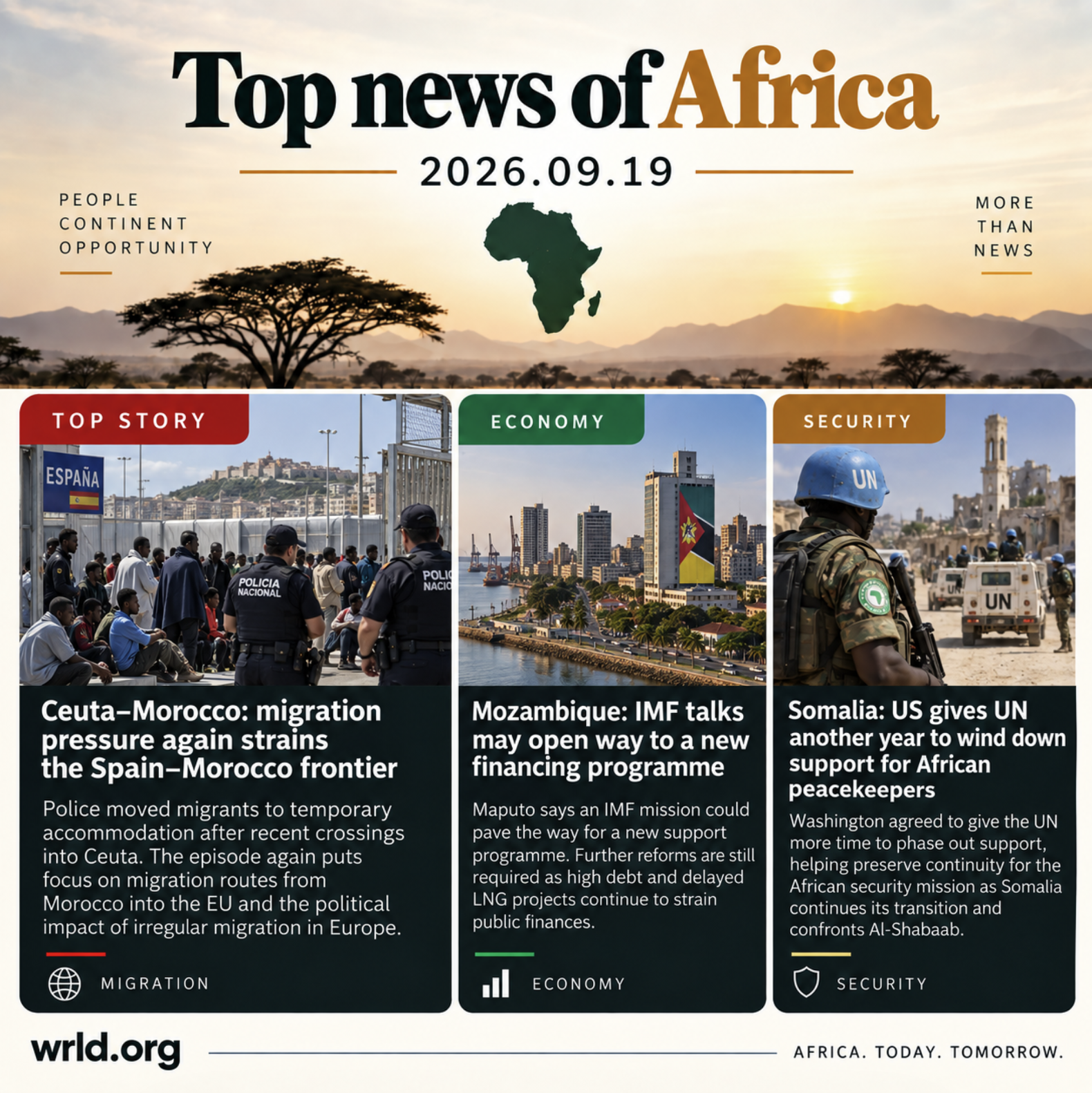
AFRICA DAILY REPORT — 19 SEPTEMBER 2026 Major developments reported during the previous 24 hours 1. NIGERIA — Deaths of 37 detained miners trigger protests and federal investigation Importance: 10/10 — Critical President Bola Tinubu ordered a thorough investigation after 37 suspected illegal miners died in NSCDC custody in Niger State. Protests in Minna were dispersed with tear gas, an overnight curfew was imposed, and senior civil-defence officials were suspended. Survivors and relatives have raised allegations about overcrowding and treatment in custody; the precise cause of death remains under investigation. Source (Reuters): https://www.reuters.com/world/africa/protests-erupt-nigeria-after-33-miners-die-custody-paramilitary-agency-2026-09-18/ Source (AP): https://apnews.com/article/222ac9d300c15c628ebcdacfea01f86a 2. DR CONGO — Ebola response continues as outbreak spreads Importance: 9.5/10 — Critical The Ebola outbreak remains a major regional health emergency. OCHA is supporting the response with rapid funding, while treatment centres are using CUBE transparent care units that allow medical staff to provide critical care with reduced exposure and enable patients to maintain contact with relatives. Source (Africanews): https://www.africanews.com/amp/2026/09/18/drc-ocha-helps-with-response-endeavours-amid-ebola-outbreak/ 3. SOMALIA — US gives UN another year to wind down support for African peacekeepers Importance: 9/10 — Very High The United States agreed to give the United Nations an additional year to phase out support for African peacekeepers in Somalia. The decision matters for the financing and operational continuity of the African security presence as Somalia continues to confront Al-Shabaab and manage the transition of international security support. Source (Reuters via The Straits Times): https://www.straitstimes.com/world/us-gives-un-more-time-to-end-support-for-somalia-peacekeepers 4. MOROCCO / ISRAEL — Agreement to open embassies Importance: 8.5/10 — Very High Israel and Morocco agreed to open embassies in each other's countries following talks involving their foreign ministers and the United States. The move represents a further institutionalisation of bilateral relations and could have broader diplomatic significance in North Africa and the Middle East. Source (Africanews): https://www.africanews.com/amp/2026/09/18/israel-morocco-agree-to-mutually-open-embassies-foreign-ministry/ 5. MOZAMBIQUE — IMF talks may open way to a new financing programme Importance: 8.5/10 — Very High Mozambique said an IMF mission completed on 18 September could pave the way for a new support programme. The IMF says further reforms are still required and discussions will continue. Mozambique remains burdened by high debt, while delayed LNG projects and the legacy of the hidden-debt scandal continue to constrain public finances. Source (Reuters): https://www.reuters.com/world/africa/mozambique-hopes-imf-visit-paves-way-new-loan-programme-2026-09-18/ 6. TUNISIA — Torrential rain floods Tunis and forces school closures Importance: 8/10 — High Severe thunderstorms and torrential rain flooded streets across Greater Tunis, disrupted traffic and prompted authorities to suspend classes at schools, universities and training institutions. Forecasts indicated 30–50 mm of rainfall over a short period, putting drainage infrastructure under heavy pressure after a summer of prolonged heat. Source (Africanews): https://www.africanews.com/2026/09/18/torrential-rain-and-flooding-slam-tunis-forcing-schools-to-close/ 7. CEUTA / MOROCCO — Migration pressure again strains the Spain–Morocco frontier Importance: 8/10 — High Tensions continued in Spain's North African enclave of Ceuta as police moved migrants to temporary accommodation following recent crossings. The episode has again focused attention on migration routes from Morocco into the EU and on the political consequences of irregular migration in Europe. Source (Africanews): https://www.africanews.com/amp/2026/09/18/ceuta-tense-scenes-as-police-move-migrants-to-temporary-camp/ Source (Reuters): https://wiky.com/2026/09/18/ceuta-border-crisis-fuels-eus-far-right-despite-fall-in-migrant-arrivals-commissioner-says/ 8. SOUTH AFRICA — Mpox cases rise Importance: 7.5/10 — High South Africa has recorded a rapid increase in mpox infections, with 18 confirmed cases and one reported death according to reporting published on 18 September. The development warrants close monitoring because of the potential for further transmission and pressure on public-health surveillance. Source (AllAfrica): https://allafrica.com/stories/202609180114.html 9. KENYA — Health sector feels growing impact of USAID cuts Importance: 7.5/10 — High Health workers in Kenya report increasing pressure following reductions in USAID-supported programmes. The effects are being felt in services and staffing, illustrating the broader vulnerability of African health systems to abrupt changes in external development financing. Source (Africanews): https://www.africanews.com/amp/2026/09/18/kenya-health-workers-increasingly-concerned-in-wake-of-usaid-cuts/ 10. ZIMBABWE / CHINA — Blueberry exporters seek capital to exploit new Chinese market access Importance: 6.5/10 — Significant Zimbabwean blueberry producers are seeking financing to expand after gaining access to China's market. The first shipment was dispatched in July following a phytosanitary agreement and China's removal of tariffs on imports from 53 African countries. Producers say the principal constraint is now the high upfront cost of expanding cultivation and irrigation. Source (AFP): https://www-pp.afp.com/en/zimbabwe-farmers-seek-funds-cash-china-blueberry-boom #Africa #AfricaNews #TopNewsOfAfrica #Ceuta #Morocco #Spain #Migration #MigrationCrisis #BorderSecurity #EU #EuropeanUnion #NorthAfrica #Mozambique #IMF #InternationalMonetaryFund #EconomicReforms #DebtCrisis #DevelopmentFinance #AfricanEconomy #Somalia #AfricanUnion #Peacekeeping #UN #UnitedNations #UnitedStates #AlShabaab #SomaliaSecurity #HornOfAfrica #RegionalStability #AfricanSecurity #Geopolitics #AfricaToday #wrldorg

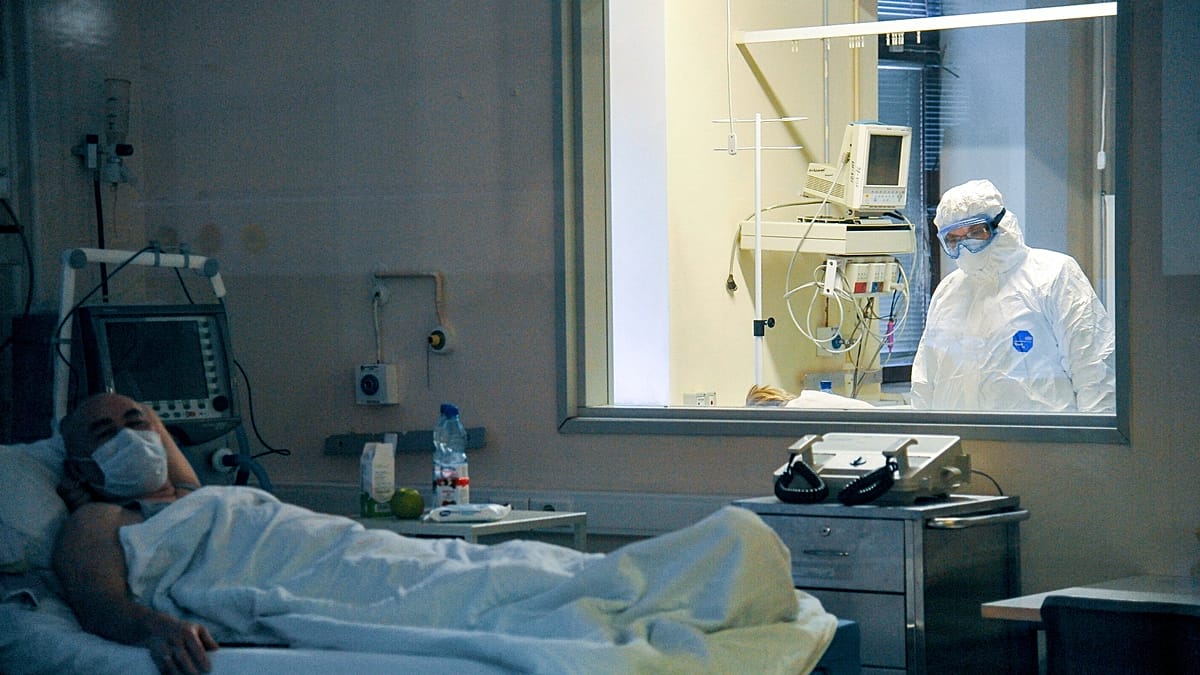
Russia's new rules requiring medical graduates to commit to regional hospital postings before enrolment have left 1,500 residency places unfilled at top universities, even as applications hit record highs. #RussianMedicine #MedicalEducation #RuralHealthcare

Rules tying doctors to rural posts leave Russian medical schools short of students

We used to joke that mathematicians are very cheap, just paper and pencils, not much more needed. Universities should start preparing for whipping up huge computing budgets to compete for the best of them #MathHumor #HigherEducation #ComputingBudget #Nospecificcountrycodesmentioned.

H

When Emotion Takes the Reins A remarkable study published in Proceedings of the National Academy of Sciencesexamined millions of books covering almost 170 years and tracked language associated with rationality—facts, conclusions, analysis and determination—against language associated with sentiment—feeling, belief and emotion. The pattern was striking. From roughly 1850 to 1980, rationality-related language steadily increased while sentiment-related language declined. Then the trend reversed. By around 2007, sentiment-related language had overtaken rationality-related language and continued rising (Scheffer et al., 2021). This does not prove that people have become less rational, nor does the study establish a single cause. But it raises an important question: what happens when trust in the institutions associated with knowledge and expertise begins to collapse? If people believe governments, experts, universities and media are corrupt or captured, “look at the data” can sound less like an appeal to reason and more like an appeal to authority. And when institutional trust declines, emotion becomes politically powerful. Anger supplies an enemy. Fear supplies urgency. Hope supplies a future. Identity supplies belonging. Could this help explain why socialism and even communism have regained some appeal among young people despite the historical record? The study cannot establish that causal link. But it is a plausible hypothesis: when politics becomes increasingly emotional, an ideology can be judged by what it promises rather than by what it has historically produced. Benjamin Franklin captured the necessary balance: “If passion drives, let reason hold the reins.” Passion is not the enemy. It is the engine of human action. The danger comes when we surrender the steering wheel. Today, algorithms, political campaigns and media incentives are exceptionally good at exploiting emotion. Outrage spreads faster than nuance. A soundbite can provoke a reaction before we have checked whether it is true.

H

Leszek Kołakowski: Marxism, Historical Truth, and the Dangers of Political Absolutism Kołakowski was a major intellectual figure because he combined serious philosophical training, firsthand experience of communism, and the courage to revise his own convictions. He was not an anti-communist attacking Marxism from outside. He had once believed in Marxism and understood its appeal from within. After the 1956 thaw, he initially tried to recover a more humane Marxism based on freedom, dignity, and opposition to bureaucratic tyranny. His later criticism therefore carried unusual weight: it came from someone who had taken the doctrine seriously and tried to save it. His importance also lies in the distinctions he made. He did not simply equate Marx, Lenin, Stalin, and every form of socialism. In *Main Currents of Marxism*, he traced the development of Marxist ideas and examined how concepts such as historical necessity, class conflict, ideological truth, and the revolutionary party could encourage political intolerance. His central warning was that a movement claiming privileged access to historical truth may eventually treat disagreement not as legitimate opinion but as error, reaction, or treason. Once one party claims to represent history or humanity, it can justify controlling the press, courts, universities, civil society, and private life. This helps explain why communist regimes so often produced censorship, one-party rule, political policing, and coercive social transformation. My evaluation is that Kołakowski identified a genuine danger in Marxist political theory: the tendency to subordinate individual freedom and institutional pluralism to an allegedly necessary historical goal. His critique also makes the phrase “that was not real Marxism” inadequate on its own. Kołakowski’s greatest achievement was therefore not proving that “Marxism equals terror.” It was showing why a doctrine promising total liberation can become dangerous when it also claims total knowledge and gives one political organization the authority to impose that promise.

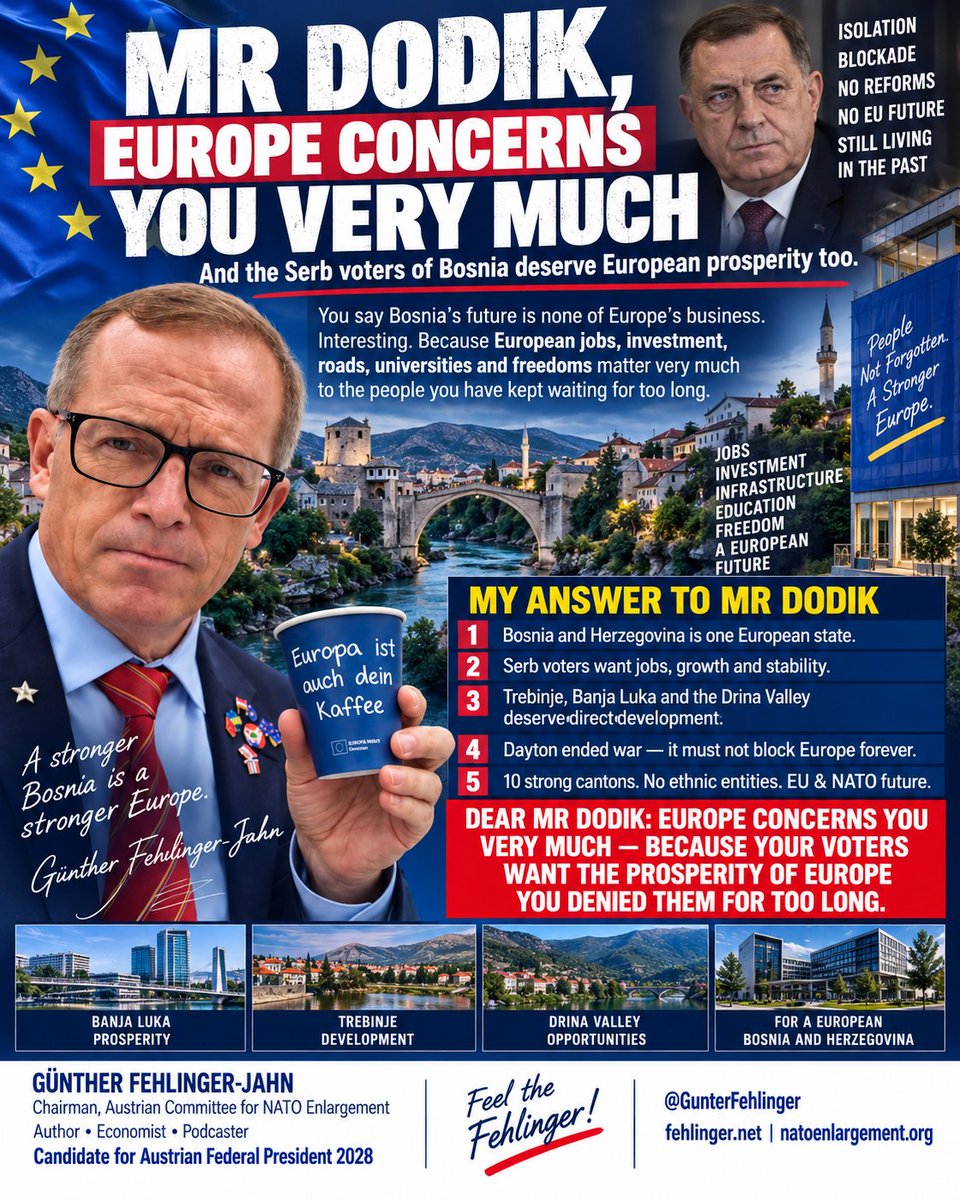
Mr Dodik, you say Bosnia’s future is none of Europe’s business. Interesting. Because European jobs, European investment, European roads, European universities, European freedoms and a European future matter very much to the people of Bosnia — including Serb voters in Banja Luka, https://t.co/RU8NUMKEGl #Bosnia #EuropeanFuture #Dodik #BA #EU

H

Leszek Kołakowski: Marxism, Historical Truth, and the Dangers of Political Absolutism Kołakowski was a major intellectual figure because he combined serious philosophical training, firsthand experience of communism, and the courage to revise his own convictions. He was not an anti-communist attacking Marxism from outside. He had once believed in Marxism and understood its appeal from within. After the 1956 thaw, he initially tried to recover a more humane Marxism based on freedom, dignity, and opposition to bureaucratic tyranny. His later criticism therefore carried unusual weight: it came from someone who had taken the doctrine seriously and tried to save it. His importance also lies in the distinctions he made. He did not simply equate Marx, Lenin, Stalin, and every form of socialism. In *Main Currents of Marxism*, he traced the development of Marxist ideas and examined how concepts such as historical necessity, class conflict, ideological truth, and the revolutionary party could encourage political intolerance. His central warning was that a movement claiming privileged access to historical truth may eventually treat disagreement not as legitimate opinion but as error, reaction, or treason. Once one party claims to represent history or humanity, it can justify controlling the press, courts, universities, civil society, and private life. This helps explain why communist regimes so often produced censorship, one-party rule, political policing, and coercive social transformation. My evaluation is that Kołakowski identified a genuine danger in Marxist political theory: the tendency to subordinate individual freedom and institutional pluralism to an allegedly necessary historical goal. His critique also makes the phrase “that was not real Marxism” inadequate on its own. Kołakowski’s greatest achievement was therefore not proving that “Marxism equals terror.” It was showing why a doctrine promising total liberation can become dangerous when it also claims total knowledge and gives one political organization the authority to impose that promise.

H

When Emotion Takes the Reins A remarkable study published in Proceedings of the National Academy of Sciencesexamined millions of books covering almost 170 years and tracked language associated with rationality—facts, conclusions, analysis and determination—against language associated with sentiment—feeling, belief and emotion. The pattern was striking. From roughly 1850 to 1980, rationality-related language steadily increased while sentiment-related language declined. Then the trend reversed. By around 2007, sentiment-related language had overtaken rationality-related language and continued rising (Scheffer et al., 2021). This does not prove that people have become less rational, nor does the study establish a single cause. But it raises an important question: what happens when trust in the institutions associated with knowledge and expertise begins to collapse? If people believe governments, experts, universities and media are corrupt or captured, “look at the data” can sound less like an appeal to reason and more like an appeal to authority. And when institutional trust declines, emotion becomes politically powerful. Anger supplies an enemy. Fear supplies urgency. Hope supplies a future. Identity supplies belonging. Could this help explain why socialism and even communism have regained some appeal among young people despite the historical record? The study cannot establish that causal link. But it is a plausible hypothesis: when politics becomes increasingly emotional, an ideology can be judged by what it promises rather than by what it has historically produced. Benjamin Franklin captured the necessary balance: “If passion drives, let reason hold the reins.” Passion is not the enemy. It is the engine of human action. The danger comes when we surrender the steering wheel. Today, algorithms, political campaigns and media incentives are exceptionally good at exploiting emotion. Outrage spreads faster than nuance. A soundbite can provoke a reaction before we have checked whether it is true. Reference: Scheffer, M., van de Leemput, I., Weinans, E., & Bollen, J. (2021). The rise and fall of rationality in language. PNAS, 118(51), e2107848118. https://doi.org/10.1073/pnas.2107848118

State laws bring censorship to US universities, professors fear they could get in trouble for what they teach — Nearly half of college students attend institutions in states with at least one law or restriction censoring topics to discuss in the classroom https://t.co/nU9UY8Thxj #Censorship #HigherEd #AcademicFreedom #US