Last week I wrote about how Texas politicians’ “free speech” campaign has led to a campaign of academic censorship in the state’s universities that exceeds even the McCarthy era (🎁🔗) www.theatlantic.com/ideas/2026/1...

Last week I wrote about how Texas politicians’ “free speech” campaign has led to a campaign of academic censorship in the state’s universities that exceeds even the McCarthy era (🎁🔗) www.theatlantic.com/ideas/2026/1...

The author said they accepted Aleksandar Vučić’s challenge and were ready to debate him live on television. They proposed discussing Serbia’s future, democracy, the student movement, Russian influence, Kosovo, NATO and EU membership, and called for the debate to be uncensored. #Srbija #Demokratija #Debata #RS #EU

Why isn’t MAGA losing their minds about the fact that META removed accounts and censored the No Kings rallies? They lost their minds when twitter took down naked pictures of Hunter Biden, but actual censorship is acceptable just because it’s “not their side”?

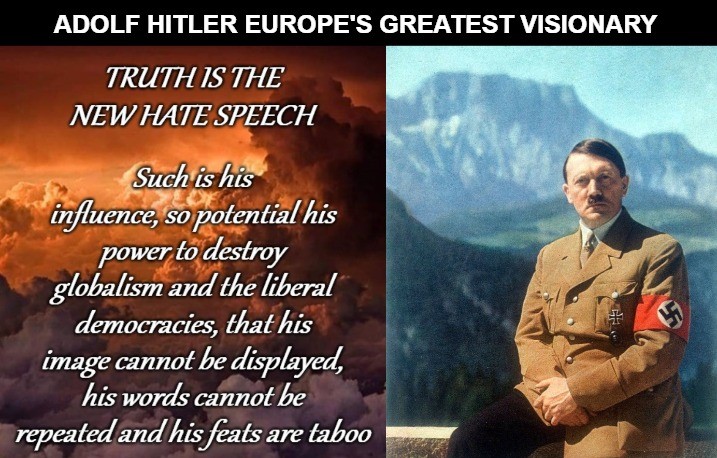
REAL HISTORY. WITNESS TO HISTORY. Mike Walsh. Afraid of the truth, major book publishers, including Amazon, banned this decisive truth-telling illustrated book. Despite censorship, this is the most widely read modernising true history of Adolf Hitler and the Third Reich. https://barnesreview.org/product/witness-to-history-the-reich-legend-uncensored/
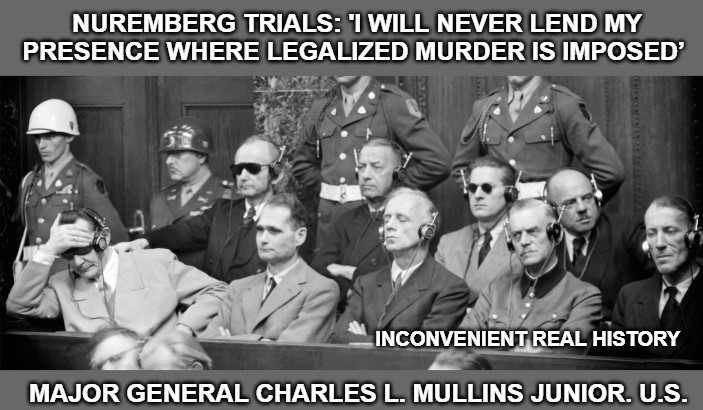
WITNESS TO HISTORY. Mike Walsh. Afraid of the truth, major book publishers, including Amazon, banned this decisive truth-telling illustrated book. Despite censorship, this is the most widely read modernising true history of Adolf Hitler and the Third Reich. https://barnesreview.org/product/witness-to-history-the-reich-legend-uncensored/

The author called for positive media strategies focused on building a new nation and national identity, arguing that they should move beyond the censorship policies of the past.


The author argued that there was no need for a “Ministry of Truth” or the EU’s “Democratic Shields”, which they characterized as tools of censorship and ideological repression. They also denounced what they portrayed as a large group of EU-paid hired agents in journalism and media, and called for clean elections without what they described as the worst interference. #Liberté #Démocratie #ÉlectionsClaires #EU

The author accused an unnamed party of withholding funds from a democratically elected national government, imposing financial sanctions and using political pressure. They also alleged that it had pushed for social-media censorship and supported efforts to cut off the government’s oil supplies, which they said threatened its energy security.
Former “free speech” crusaders have ushered in an unprecedented campaign of censorship in Texas universities, resulting in pulitzer winning books being banned, medical and scientific facts being suppressed, and entire fields of study deemed “woke” being eliminated www.theatlantic.com/ideas/2026/1...

Russia’s war propaganda gets a soundtrack – how AI-generated songs reached global streaming platforms Russian war propaganda is no longer confined to television broadcasts, Telegram channels or political videos. A study by the Ukrainian threat-intelligence organisation Terrecon has identified 981 songs combining signs of AI generation with pro-Russian military narratives, distributed through an ecosystem that reaches YouTube, Spotify, Apple Music, Deezer and SoundCloud. The songs range from sentimental ballads to rock and heavy metal. Their recurring themes are familiar from conventional Russian wartime propaganda: the heroisation of Russian soldiers, romanticisation of the war, mobilisation, the “Russian world”, commemoration of fallen troops and attacks on Ukraine and its armed forces. Some contain derogatory or dehumanising references to Ukrainians. What is new is not necessarily the message, but the production and distribution model: generative AI allows propagandistic music to be produced rapidly, cheaply and in quantities that would previously have required musicians, studios and producers. Nearly 1,000 tracks identified Terrecon examined 3,725 tracks collected from YouTube, YouTube Music, SoundCloud and the AI music platform Suno. After manual review, researchers classified 981 as showing both indications of AI generation and pro-Russian war propaganda. In 681 tracks they identified 728 propaganda-related keywords or phrases. The largest category was the glorification of the Russian military, followed by romanticised treatment of Moscow’s so-called “special military operation”, mobilisation appeals, narratives about the “Russian world”, and the cult of fallen soldiers and the state. The reach was not merely theoretical. Listening or viewing statistics were available for 608 of the identified tracks; together they had accumulated 86.8 million plays and views, according to Terrecon. A smaller group of 13 high-performing songs accounted for more than 53 million YouTube views and more than 67 million when YouTube Music was included. Among the better-known examples is “Power of Artillery”, a Russian-language rock song praising artillery weapons that passed two million views on YouTube. Most of the tracks for which publication dates could be established appeared after 2024, broadly coinciding with the rapid expansion of consumer AI music generators such as Suno and Udio. That correlation does not prove that AI alone caused the increase, but it illustrates how drastically the economics of production have changed. A propaganda song for as little as $11 Terrecon also tested how difficult it would be to commission such material. Researchers approached 25 creators producing AI-assisted militaristic music; 15 agreed to take commissions. Prices ranged from approximately $11 to $330, while delivery times ranged from two hours to three days. According to Terrecon, some were prepared to produce highly aggressive anti-Ukrainian material, including content intended for audiences involving children from occupied Ukrainian territories. Some creators used Russian intermediary services that provided access to Western AI tools such as Suno and Udio despite restrictions. The researchers then tested several AI generators themselves. Across 40 prompts submitted to Suno, Udio, Mureka, Google Flow Music and ElevenLabs, 25 resulted in successful generations, while safeguards were circumvented in 15 cases. Terrecon reported that four of the five services tested produced Russian-language material containing wartime narratives, although technical problems prevented comparable testing on some systems. In one Udio experiment, the researchers said the model itself introduced more explicit violent language than had appeared in the original promp These tests do not demonstrate that the commercial platforms knowingly support Russian propaganda. They show something narrower: existing safeguards can be inconsistent when political messaging is packaged as music. From generation to Spotify The distribution experiment may be the most revealing part of Terrecon’s research. The team deliberately uploaded test tracks containing explicit hostile language to YouTube, SoundCloud, Spotify and Deezer. Terrecon says none was blocked during the experiment. On SoundCloud, researchers used an account identifying its location as Moscow, disclosed the use of AI and added markers including references to the Russian military and the war. The platform accepted the upload and subsequently offered paid promotional and distribution tools. This does not prove that streaming recommendation systems systematically promote pro-war music. There is currently insufficient public evidence to make that claim. It does demonstrate that material can enter the same commercial distribution infrastructure as ordinary music and, once there, potentially benefit from playlists, searches, sharing and recommendation mechanisms available to other releases. That distinction is important. Propaganda no longer has to announce itself as political communication. On a streaming platform it can look like another song. Culture as a delivery mechanism Music has always been used in wartime propaganda. What generative AI changes is scale. Instead of investing heavily in a limited number of patriotic performers or officially commissioned productions, creators can generate variations across styles, audiences and emotional registers at very low cost. Terrecon found material ranging from war rock to sentimental songs and content styled for younger audiences. Some creators also experimented with cloned celebrity voices and stylistic imitation of established musicians. The format also offers a different relationship with the audience. A political video asks a viewer to consume an argument. Music can accompany commuting, exercise or entertainment and may be encountered outside explicitly political spaces. This does not automatically make it more persuasive, and Terrecon’s research does not establish measurable effects on political attitudes. It does, however, place wartime narratives inside a cultural environment where users may not initially perceive themselves as consuming political messaging. An ecosystem, not a proven Kremlin command structure The strongest evidence supports describing this as a growing AI-assisted pro-Russian propaganda-music ecosystem, not a single operation controlled from Moscow. Terrecon did not establish that the Russian government created, financed or coordinated all 981 tracks. Reporting on the study likewise notes that the extent of direct state involvement remains unclear. There is broader evidence that the Russian state finances cultural projects and digital content supporting the war, including through state-backed funding bodies. That context matters, but it does not allow individual songs in Terrecon’s dataset to be attributed to the Kremlin without additional evidence. The significance of the case lies elsewhere. AI has reduced the cost of producing ideological content, intermediaries can help creators access generation tools, and global platforms can provide distribution. The result is a pipeline in which wartime propaganda no longer has to resemble propaganda at all. It can simply appear in a playlist. Sources Terrecon / Ukrainska Pravda — Daria Verbytska on the research https://www.pravda.com.ua/columns/2026/10/05/8056229/ Suspilne Culture — detailed breakdown of Terrecon findings https://suspilne.media/culture/1417933-rosijsku-voennu-propagandu-maskuut-pid-anime-karaoke-ta-rok-doslidzenna-si-pisen-vid-terrecon/ The Insider — AI-generated Russian war propaganda music https://theins.ru/news/297839 Institute of Mass Information — summary of New York Times reporting https://imi.org.ua/en/news/doslidzhennya-rf-masovo-stvoryu%D1%94-propagandistski-pisni-za-dopomogoyu-shi The Bridge Media — AI-generated songs and Russian military propaganda https://thebridgemedia.com.ua/en/ai-generated-songs-russian-military-propaganda/ Center for Strategic Communication — cost and production of AI propaganda music https://spravdi.org/propaganda-za-11-yak-rosiya-shtampuye-shi-pisni-z-miljonamy-prosluhovuvan/ Times of India — AI-generated Russian war songs https://timesofindia.indiatimes.com/world/europe/ai-sings-russias-war-story-inside-the-rise-of-generative-songs-about-ukraine-conflict/articleshow/134650594.cms EU Council / EUR-Lex — Presidential Foundation for Cultural Initiatives https://eur-lex.europa.eu/legal-content/EN/TXT/?uri=CELEX:32026D1351 Human Rights Watch — Russian state funding of digital and patriotic content https://www.hrw.org/report/2025/07/30/disrupted-throttled-and-blocked/state-censorship-control-and-increasing-isolation #DISINFORMED #Episode16 #Russia #Ukraine #RussianPropaganda #WarPropaganda #MusicPropaganda #AIMusic #ArtificialIntelligence #AI #GenerativeAI #SyntheticMedia #AIPropaganda #Disinformation #InformationWarfare #InfluenceOperations #CulturalPropaganda #DigitalInfluence #NarrativeManipulation #PropagandaMusic #StreamingPlatforms #Spotify #AppleMusic #YouTube #YouTubeMusic #Deezer #SoundCloud #Suno #Udio #RussianWorld #RusskiyMir #MilitaryPropaganda #WarNarratives #Mobilisation #AlgorithmicDistribution #RecommendationAlgorithms #MusicStreaming #PlatformManipulation #Terrecon #OSINT #MediaManipulation #WRLD
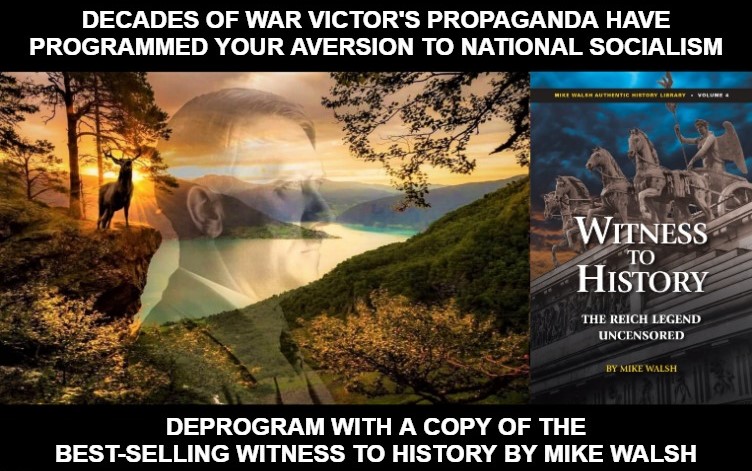
WITNESS TO HISTORY Mike Walsh. Afraid of the truth, major book publishers, including Amazon, banned this decisive truth-telling illustrated book. Despite censorship, this is the most widely read modernising true history of Adolf Hitler and The Rise and Fall of the Third Reich. https://barnesreview.org/product/witness-to-history-the-reich-legend-uncensored/
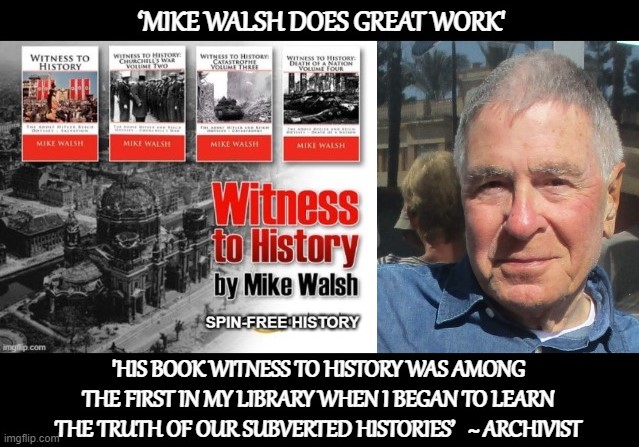
WITNESS TO HISTORY Mike Walsh. Afraid of the truth, major book publishers, including Amazon, banned this ultimate truth-telling illustrated book. Despite censorship, this is the most widely read modernising true history of Adolf Hitler and The Rise and Fall of the Third Reich. https://barnesreview.org/product/witness-to-history-the-reich-legend-uncensored/

I focused the visit on strengthening relations between the two countries and on regional challenges. This evening we filed a complaint with the Chief Military Censor, demanding that Channel 12 be prosecuted to the fullest extent of the law following a severe censorship violation. #UAE #Israel #Netanyahu
WITNESS TO HISTORY Mike Walsh. Afraid of the truth, major book publishers, including Amazon, banned this ultimate truth-telling illustrated book. Despite censorship, this is the most widely read modernising true history of Adolf Hitler and The Rise and Fall of the Third Reich. https://barnesreview.org/product/witness-to-history-the-reich-legend-uncensored/


A lot of people who ideologically align with my work are skeptical of crypto. Fair, given who some of the biggest personalities are. But my work is tied to Ethereum because both are uncompromisable for censorship resistance, freedom to transact and tech to improve human agency. https://t.co/DHjWIsm0Fh #Ethereum #CensorshipResistance #CryptoSkepticism #Thetweetdoesnotmentionanyspecificcountries.Therefore #therearenocountrycodestoreturn.

Big tech cannot apply a different set of rules to users in the US and in Europe! Yet, this is exactly what is happening! In 2025 major platforms stopped censoring conservative opinion in the US, but the European Commission still empowers NGOs to tell social media services to https://t.co/fijHMvFTFJ #BigTech #Censorship #FreeSpeech #US #EU

WITNESS TO HISTORY Mike Walsh. Afraid of the truth, major book publishers, including Amazon, banned this ultimate truth-telling illustrated book. Despite censorship, this is the most widely read modernising true history of Adolf Hitler and The Rise and Fall of the Third Reich. https://barnesreview.org/product/witness-to-history-the-reich-legend-uncensored/

"non, on n'a pas le droit de penser ce qu'on veut". Les "cerveaux malades..." Cet extrait de Patrick Cohen est édifiant. Le Frédéric Taddeï de l'époque a évidemment mille fois raison de dire que PC se comporte comme un présentateur de foxnews en filtrant et censurant les opinions qu'il n'aime pas. Dommage que PC et ses amis aient privatisé de fait le service public. Ce n'est pas , en effet, à un animateur de juger ce que les gens doivent entendre ou penser, ce qui est autorisé ou non sur une chaîne payée avec leurs impôts. La liberté d'expression est déjà encadrée par la loi. À voir. #LibertéDexpression #Censorship #Opinion
WITNESS TO HISTORY Mike Walsh. Afraid of the truth, major book publishers, including Amazon, banned this ultimate truth-telling illustrated book. Despite censorship, this is the most widely read modernising true history of Adolf Hitler and The Rise and Fall of the Third Reich. https://barnesreview.org/product/witness-to-history-the-reich-legend-uncensored/

Sur X il y a des gens qui font de l'apologie de terrorisme non stop sur Charlie Kirk ou Quentin Deranque, qui partagent des montages de leurs vrais visages, mais une phrase piquante sur un chauffard qui a tué une femme c'est suspension définitive. C'est de la folie @elonmusk #LibertéDexpression #Censorship #Terrorisme





