WRLD

Search

#Cadastre
Luciano Magaldi Sardella (PhD) 2d

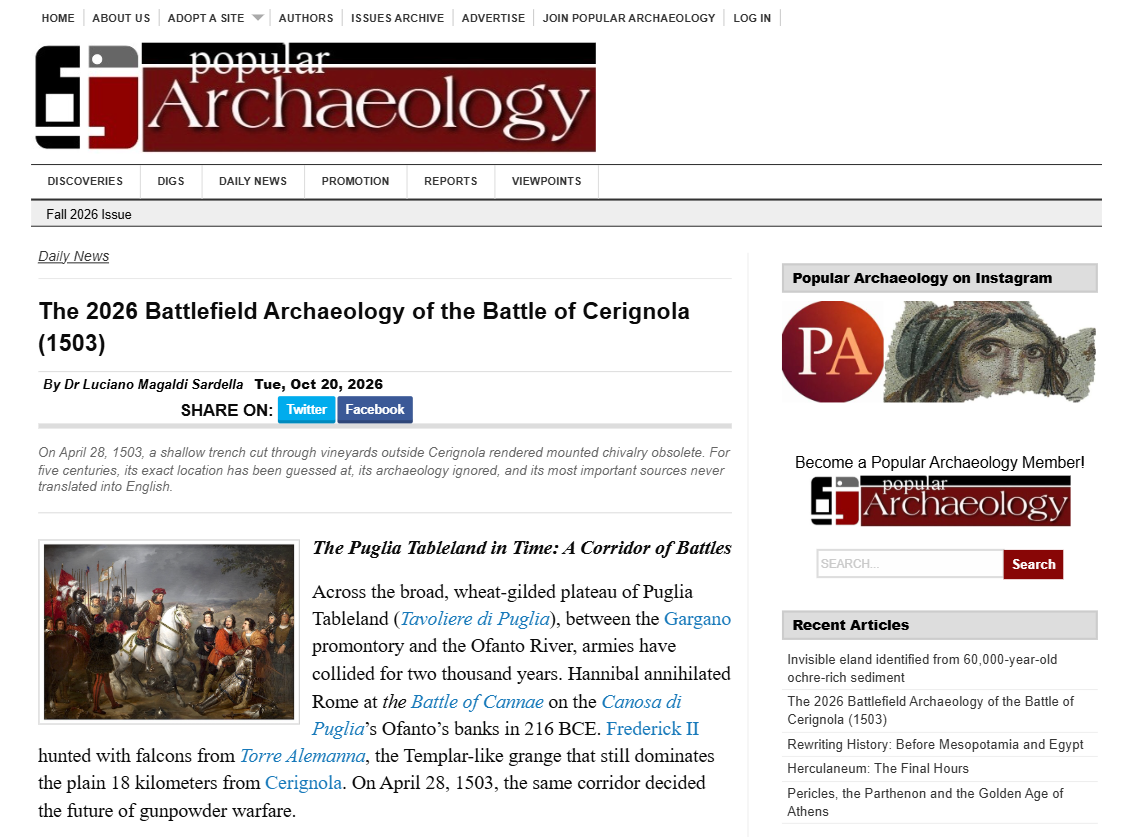
THE “BATTLE OF CERIGNOLA (1503)” ON “POPULAR ARCHAEOLOGY USA” (by LUCIANO MAGALDI SARDELLA) SOURCE 1: https://popular-archaeology.com/author/sardella/ SOURCE 2: https://popular-archaeology.com/article/the-2026-battlefield-archaeology-of-the-battle-of-cerignola-1503/ __________________________________________________________________ CERIGNOLA (FG) — On 28 April 1503, at sunset, a shallow trench cut through the vineyards outside Cerignola rendered heavy cavalry obsolete. For five centuries its exact position has been merely conjectured, its archaeology ignored, its most important sources never translated into English. We are on the Puglian Tablelanda, a corridor of battles for two thousand years: from Cannae in 216 BC to Frederick II’s falconry from Torre Alemanna. Cerignola, at that time, was not a town but a rural hamlet of 350 families at 120 metres above sea level, guardian of the Mena of the Dogana delle Pecore, the great customs system of transhumance that financed the Kingdom of Naples. It was for its possession that the battle was fought. Opposed, two worlds. Louis d’Armagnac, Duke of Nemours, Viceroy of Naples for Louis XII, thirty years old, splendidly armed, certain of victory. On the other side, Gonzalo Fernández de Córdoba, the Great Captain, who on 27–28 April marches from Barletta with some 9,000 exhausted men and decides to entrench himself upon a low ridge. In front of it he has deepened what was already there: not an invention, but an agrarian ditch. The French gendarmes, the last heirs of the mediaeval knight, lower their lances and never reach the line. From behind an embankment reinforced with vine stakes, more than 1,000 Spanish arquebusiers open fire. Nemours falls, almost certainly the first European army commander to die by a portable firearm. With him dies the cavalry charge as a dominant tactic. And here lies the scandal denounced by the article: no cartographer of the seventeenth or eighteenth century ever mapped the field. No memorial stone recalls it. It is not protected as a cultural landscape under the Code of Cultural Heritage. Every deep ploughing of the Tavoliere, standard practice since the Bourbon reforms, destroys an archaeology never recorded. Yet the perimeter is reconstructable. By cross-referencing sixteenth-century descriptions of “slopes covered with vineyards fifteen miles north of the Ofanto” with the Via Traiana, the engagement zone is a rectangle of 3–4 sq km to the north-east of the present settlement. With ISPRA’s 1m DTM LiDAR, anomalous linear depressions could be revealed, and the lower fill of a 2–3 metre ditch, beneath the ploughed layer, is still legible by magnetometry and ground-penetrating radar. Why have we arrived so late? Not for lack of sources, but for lack of translation. The Comune di Cerignola and the Centro Studi e Ricerche Torre Alemanna of Prof. Matteo Stuppiello, who in 1978 obtained the first monumental protection for Torre Alemanna, have digitised a corpus that has never entered Anglophone historiography. Here are the 3 pillars: 1. The letter that still smells of powder. The “Letter of Consalvo da Cordova to the Sovereigns of Spain of 29 April 1503,” edited by Stuppiello in 2003 and updated in 2025 on comune.cerignola.fg.it/biblioteche-digitali. A manuscript page written at Cerignola the day after the battle, “rich in flashes, twilight gleams, and gunfire.” Not a polished chronicle à la Giovio, but a field dispatch: the exhaustion of the night march, the decision to entrench upon arrival, the recovery and honourable burial of Nemours, the intact capture of the French artillery. 2. The graffito, a monument within the monument. In the fourteenth-century church of Santa Maria delle Grazie, known as the Incoronatella, on the Via Trinitapoli Vecchia, where tradition holds the body of Nemours was taken. On the triumphal arch, a graffito of 1503 gives in quasi-notarial form the date, sixth indiction, Friday at the twenty-third to twenty-fourth hour. It truly was a Friday, as confirmed by Cappelli’s perpetual calendar. Deciphered in 1995 by Prof. Francesco Magistrale, Latin palaeographer at the University of Bari, in La Battaglia di Cerignola (1993) and in the municipal monograph S.M. delle Grazie (1999). It is now fading through damp and neglect. 3. The cadastre that explains the ditch. The Apprezzo of 1672 preserved in the Archivio di Stato di Napoli, fondo Pignatelli Aragona Cortes, Scanzia 63, fasc.1: “At the time of the battle, dense vineyards covered the hill reaching down to the plain, and were clearly separated from the rest of the countryside by a not very deep ditch”. Córdoba did not improvise; he adapted. This is confirmed by the Giustiniani cadastres: 277 hearths in 1532, 699 in 1595. The landscape of 1503 was one of intensive horticulture, not the deep-ploughed cereal monoculture of today. To these are added the first monograph by Vincenzo Buonassisi, La Battaglia di Cerignola (1908, died at Via Fanfulla 10 on 27 June 1928), and the first modern military analysis by Piero Pieri, “Consalvo di Cordova e la battaglia di Cerignola”, Archivio Storico Pugliese 1952, which 30 years before the Anglophone rediscovery of “pike-and-shot” defined Cerignola as an engineered killing ground. While Cerignola forgot, others remembered. The “Regimiento de Infantería Cerinola n.42”, later “Fuerteventura n.56”, bore the name of Cerignola until the twentieth century. Its coat of arms, described in Heráldica e Historiales del Ejército, Tomo V (Madrid, 1981): argent field, a dying white swan entangled in a hedge, a gold mural crown, with scroll “Cerignola”. Dossier officially transmitted on 30 April 1986, prot. 4565/509, by the Servicio Histórico Militar in Madrid to the Centro Torre Alemanna through Col. Alessio Antonutti and Gen. José Cifuentes. And in Amsterdam, in the Rijksmuseum, the anonymous commemorative bronze medal: Hercules with lion-skin and club and Janus with keys beside an eagled coat of arms, legend “Consalvus Agidarius… Janum clausit”, on the reverse a battle scene “Consalvi Agidari Victoria de Gallis ad Cannas” — an error by the artist who confuses Cerignola with Cannae. It belonged to Mrs J.M. van Gelder-Nijhoff, donated in 1885. The author’s conclusion is unequivocal: Gonzalo’s ditch is the most consequential earthwork in European military history. It inaugurates the infantryman armed with a firearm and conditions the Mediterranean for 160 years. It may still be there, infilled, ploughed over, invisible to the naked eye but accessible to a magnetometer. It is not a question of mediaeval archaeology but of the will to protect.

215
Cerfia 2w

Cerfia, citing French breaches, listed the administrations, state services, and French public operators that may have been targeted by cyberattacks or data leaks over the past year. In the employment and social benefits sector, Cerfia reported data concerning up to 12 million employees in the URSSAF/DPAE system: names, dates of birth, employers, and hire dates. For URSSAF/Pajemploi, the figure was 1.2 million employees, with identities, addresses, social security numbers, and bank names. The census also mentioned 1.6 million young people linked to France Travail and local missions, whose identities, addresses, phone numbers, and social security numbers may have been affected. For Pass'Sport and the Ministry of Sports, it mentioned 3.5 million households along with their names, contact details, phone numbers, and addresses. It also reported nearly 1.2 million CAF/CNAF/Vacaf files claimed, without confirmation from CNAF, regarding family information, beneficiaries, and vacation stays. Cerfia also reported that Bloctel/DGCCRF had about 3 million phone numbers extracted, including 600,000 registered on Bloctel. The Agency for Services and Payment and the Coup de pouce énergie scheme may have involved 108,555 beneficiaries, with their identities, addresses, amounts of assistance, and IBANs. A link mentioned in the post referred to a service that may have affected 550,000 accounts, with names, emails, phones, dates of birth, and engagement histories. France Travail may also have been affected by agent data held by an HR service provider, while France VAE may have seen candidate data targeted. In education and training, the census reported 5.8 million DELF-DALF candidates associated with France Éducation International and GAEL, whose identities, nationalities, dates, and places of birth may have been exposed. For the Ministry of National Education, it mentioned up to 4.35 million teachers potentially affected by identity, assignment, grade, and compensation data, as well as one million students from Créteil whose personal and family data may have been exfiltrated. The COMPAS system may have involved 243,000 agents, with their names, personal addresses, and initial assignments. Up to 200,000 candidates for Ev@lang may have been affected by personal data related to language tests. Cerfia also cited ÉduConnect. The post mentioned 705,000 Parcoursup candidates in the academic region of Occitanie, whose identities, contact details, school information, scholarship status, and family data may have been affected. The intrusion was dated to October 2025. For the Ministry of Sports and FORÔMES, it advanced 450,000 candidates and identity, address, phone number, date of birth, and diploma level data. The Compte Asso was also among the mentioned services. Cerfia further reported at least 30 affected sports federations — notably in football, shooting, tennis, gymnastics, swimming, sailing, skiing, and handball — with data from license holders, including minors. At least eight public higher education institutions were cited: Angers, Lille, UMLP, Alfort, Bordeaux Sciences Agro, AgroParisTech, CNAM, and ésam. The post also mentioned the training platform of the Agency for Civic Service and the application platforms of Campus France. Among financial and administrative organizations, Cerfia reported that about 1.2 million bank accounts linked to DGFiP/FICOBA may have been affected, with identities, addresses, RIBs, and IBANs. Up to 433,485 individuals may have been impacted through the DGFiP property register, with addresses and characteristics of real estate. More than 350,000 individuals may have been affected by tax data — reference tax income, family quotients, and withholding rates — and the portal for vacant inheritances was also listed. For DGAFP/Choosing Public Service, the figure mentioned was 377,418 candidates, with their identities, contact details, diplomas, and professional backgrounds. The post also cited the Ministry of the Interior and the TAJ, FPR, SIA, and SIV files. The census mentioned 774,000 people linked to Cnous/CROUS, with identities, emails, and appointments. It also reported 329,000 extracted documents concerning 139,000 individuals, including identity and income verification documents. ANFR/Radiomaritime may have concerned 330,000 users and their identities, addresses, emails, phones, and dates of birth. For INSEE, Cerfia reported 12,800 agents and former agents, with identities and professional contact details. The Institute for Research and Development may have involved about 7,500 individuals, with identity, address, and professional data along with, for some, social security numbers; exfiltration was not confirmed. The post also cited CNRS and personnel data. Cerfia indicated that Public Health France and a service provider may have been involved for about 80,000 contacts: names, emails, addresses, and professional phones, without any reported medical data. For Tracfin and a support provider, it mentioned 136 professionals, their identities and contact details, as well as 213 assistance requests; according to ANSSI, no suspicion declarations were reported. ANSSI and its innovation laboratory were also listed, with 118 Metabase accounts potentially affected by a compromise. The post further cited 70,000 files and 160,000 administrative documents that may have been exfiltrated from DINUM/HubEE, some containing personal data, as well as the State Cloud. More than 30,000 individuals may have been affected by directory, identity, and professional contact data related to AEFE/Orion. At the Ministry of Ecological Transition, 22,000 agents and accredited organizations may have been involved with access to personal data, and over 300 email accounts may have been compromised. Cerfia also mentioned messaging services and a server from the General Directorate of Customs and Indirect Rights, as well as Tchap, the secure messaging service of the State. Finally, the census reported 14 SDIS targeted, with personal and professional data, internal documents, and medical data. At least five hospital establishments may have been affected: AP-HP, Hospices Civils de Lyon, as well as the establishments in Perpignan, Chaumont, and Haute-Comté. The list also included the French Office for Biodiversity and hunting permits, the National Library of France, and the Center for National Monuments through a ticketing service provider, regional health agencies and vaccination data, as well as the French Office for Immigration and Integration and an IT service provider. #Cyberattaques #ProtectionDesDonnées #SécuritéInformatique (translated)

3672
Ordem Updates Sep 7

SEJA UM DOS PRIMEIROS. A ORDO está chegando. Cadastre-se para receber informações exclusivas sobre o lançamento e descubra tudo em primeira mão. Entre para a lista em: https://t.co/8WdGhxLKnP https://t.co/XAsSxX3arS #Ordo #Lançamento #InformaçõesExclusivas

23835
Babel TV Aug 20

🇫🇷Feux de Gironde : le président de la DFCI avoue que les pompiers sont allés protéger les villas des stars au Cap-Ferret Lors des incendies au Porge, le président de la DFCI a raconté qu’il était content de voir arriver des colonnes de pompiers au port. Elles n’ont finalement pas aidé là-bas : elles sont parties protéger le prestige du Cap-Ferret et les maisons des stars. Le gouvernement traite ça de complotisme. Laurent Nunès s’est fait piéger en parlant de « posture politique ». Le Premier ministre a été hué dès son arrivée en Gironde. Les citoyens commencent à comprendre : l’État n’est pas forcément là pour nous sauver, mais pour gérer des extraits de cadastre et ensuite aménager comme bon lui semble. Les complots ont toujours raison. #Feux #Gironde #CapFerret #Porge #DFCI #Incendies #Pompiers #Gouvernement #Complotisme #Cadastre #Amenagement #incendie #france #actu #info #Feux #Gironde #Incendies

12984
SaxX ¯\_(ツ)_/¯ Aug 18

En 6 mois, Bercy a subi 4 cyberattaques... 👉🏾 Ficoba (FIchier des COordonnées BAncaires) - 1.2M de comptes 👉🏾 Les impôts - 678 000 comptes 👉🏾 Le cadastre - 2M de comptes 👉🏾 Les successions vacantes Voilà voilà... #Cyberattaque #SécuritéInformatique #ProtectionDesDonnées

17242

🚨 ATENÇÃO! 🚨 O maior site de encontros do mundo já está disponível! 🔥 Conheça novas pessoas, faça conexões e descubra quem está procurando alguém como você. 🆓 Cadastre-se gratuitamente: https://t.co/M7twyp3Qec Quem chega primeiro, aproveita primeiro. 😉 https://t.co/xVEIi8ihKc #Amor #Encontros #Conexões

18107