BETA nonprofit public democratic european moderated

Search

#Democracies

| JULY 2026 | The Guard State How the largest Arab nation became a security contractor at the gates of its own people By Adham Hasanin Egyptian journalist and political writer, based in the Netherlands In June 2025, hundreds of activists from forty countries landed at Cairo airport. Doctors from France, lawyers from Australia, students from the United States, pensioners from the Netherlands. They carried no weapons and no banned slogans; they carried backpacks, walking shoes, and a single intention: to march from Arish to the Rafah crossing — entirely on Egyptian soil — to demand that food be allowed through to a people starving behind the gate. Not one of them reached Rafah. More than two hundred were detained before the march could begin. Around five hundred foreign nationals were deported from airports, hotels, and checkpoints. Passports were confiscated, activists were pulled out of downtown Cairo cafés, and the Global March to Gaza was cancelled on 16 June without taking its first step. And the world watched. This was no secret operation in a dark basement; it happened in the open, documented by the deportees’ own phone cameras, carried by every international news agency. The world watched an Arab state arrest Europeans, Americans, and Africans for wanting to walk towards Palestine. A state guarding the gate of a siege — from the side that was supposed to be the side of rescue. Hold that image, because it is the key to everything that follows. This was not an aberration in Egyptian policy, nor an isolated security decision. It is the function — the complete function around which the Egyptian state has been redefined over the past decade, and which it is time to call by its proper name: the Guard State. I. The Name — What Do We Mean by the Guard State? Political economy has long described states that live off the rent of their location rather than the production of their people. But what has crystallised in Egypt over the past decade goes beyond traditional geographic rent — the Suez Canal, say — into something far graver: the conversion of sovereignty itself into a commodity for hire. The Guard State does not sell its location; it sells its function. It collects its wages not for what it produces, but for what it prevents: it prevents the refugee from reaching Europe, the activist from reaching Gaza, its own people from reaching politics, and the resistance’s weapons from reaching their destination. Four gates, guarded by a single machine, whose wages are paid in loans, deposits, and perpetually renewed rescue packages. This is not a rhetorical metaphor; it is an economic structure with numbers attached. When the Egyptian economy collapsed in 2024, it was rescued not by productive reform but by a single deal whose subject was location: Ras el-Hekma — thirty-five billion dollars for a stretch of coastline. And whenever negotiations with the IMF stall, the tranches are unlocked by explicit European pressure whose subject is migration: nine billion euros from the European Union in the 2024 “Strategic Partnership,” whose own documents place “migration management” at its core. Europe does not pay Egypt to prosper. It pays Egypt to guard. Thus the model is complete: income in exchange for prevention, external legitimacy in exchange for guarding, and international silence about domestic tyranny in exchange for keeping the gates controlled. To see how the model works on the ground, consider the bloodiest gate of all: the gate of Gaza. II. The Gaza Gate — The Guard Who Is Himself Searched The first paradox must be nailed down with facts: Egypt is not a sovereign guard of its own crossing; it is a searched guard. Egyptian relief trucks — ninety-two thousand food parcels in a single convoy this month — are subject to Israeli inspection before entering the Strip: from Egyptian soil, through a crossing that bears an Egyptian name. The state that guards the gate does not hold its key. It owns the threshold, but not the door. Then the October 2025 truce added a new layer to the function. Under the fifteen-point roadmap sponsored by the international envoy together with the “guarantor states” — Egypt foremost among them — Cairo is to train the civilian police force that will replace Hamas in administering the Strip, under the slogan of “one authority, one law, one weapon.” Let us call things by their names: the state that could not — or would not — deliver a loaf of bread without Israeli permission is now qualifying to graduate the security apparatus that will oversee the disarming of the resistance. From guarding the siege to administering what comes after the siege — a promotion within the same project. And meanwhile, what is happening behind the guarded gate? Since the truce, more than one thousand one hundred Palestinians have been killed by Israeli fire — the latest, just two days ago, a ten-year-old boy named Motaz Abu Shaar, carried to his grave in Khan Younis by his mother, Warda. A United Nations commission of inquiry has concluded that Israel is “deliberately targeting children in an ongoing genocide.” This is what the guarantors’ official language calls a “ceasefire.” What meaning is left in the word “guarantor”? A guarantor that the gate stays firmly shut — however high the dead pile up behind it. III. The Mediterranean Gate — The Guard Europe Pays For The second gate faces north. Since 2016, Cairo has boasted — through its officials at every European forum — that “not a single irregular migration boat has departed from Egyptian shores.” This is very nearly true. But the forbidden question is: at what political price has this “efficiency” become an instrument of mutual blackmail? Europe — which condemns Egypt’s human rights record in its parliamentary resolutions — is the same Europe that signed the nine-billion-euro partnership, and the same Europe that stays silent about sixty thousand political prisoners because the alternative, in its calculations, is boats that never stop. And Cairo understands the game and has mastered it: whenever human rights pressure intensifies, the official discourse turns up the volume on “Egypt hosts millions of refugees” and “the last line of defence.” The result is a perfect structure of mutual blackmail: Europe buys its conscience’s silence, the regime sells its location, and the people — Egyptian and refugee alike — are the commodity in the transaction. The democracies that lecture on values are financing the guard who keeps the victims from knocking on their doors. This is not passing hypocrisy; it is a structural partnership in the Guard State model — one that makes Brussels and Berlin shareholders in everything this state produces, from domestic repression to external siege. IV. The Interior Gate — Guarding the People Against Politics But the most dangerous gate is not on any border; it is inside. The Guard State cannot perform its external function unless it first guards an internal gate: the people’s gate to politics. The function requires a people that does not ask: why are we guarding the siege of our brothers? Why are our trucks searched on our own soil? Why are guests deported for coming to walk in peace? To guarantee the question is never asked, the largest silencing machine in the country’s history was built: sixty thousand prisoners of opinion, a press ranked 166th out of 180 worldwide, and a state security case number waiting for anyone who writes. I write these lines from experience, not from reading reports. When I continued writing from my Dutch exile, the machine reached me across continents: accounts shut down by coordinated mass-reporting campaigns, documented threats, a family harassed inside Egypt as leverage — and my name entered into Case 1282 of 2024, not for any act I committed, but for opinions written from free European soil. This is not a personal complaint; it is a job description: the Guard State guards even beyond its borders, because the free word — wherever it is written — threatens the entire contract of guardianship. The logic is perfectly self-consistent: a regime that sells “stability” abroad cannot tolerate a voice revealing that the stability on offer is the stillness of graveyards. This is why the arrest of the foreign activists in June 2025 was inevitable, not incidental: a peaceful march reaching Rafah would have revealed, before the world’s cameras, that the gate opens when it is wanted open — and that the one keeping it shut is a partner, not a mediator. V. What Has Egypt Lost? — The Guard’s Bill An apologist might argue: what is the harm? A state monetising its location as Norway monetises its oil. The answer lies in the essential difference: Norway sells a resource; Egypt leases its will. And the difference between the two is the difference between trade and bondage. Let us tally what Egypt has paid for this model, in bare facts. It lost its water sovereignty: the Renaissance Dam was completed and filled without the state — owner of “the largest defence headquarters in the world” — daring anything beyond statements of concern; for the guard does not make trouble for the international order that employs him. It lost its regional standing: in the Iran–America war halted just weeks ago, Cairo was neither party nor mediator nor even consultant — Pakistan brokered the deal, while Egypt absorbed the economic shrapnel of Hormuz’s closure like a bystander caught in a battle whose parties it does not know. It lost its place in the conscience of its nation: the state that liberated its land in 1973 and led the Arab world for a century has become, in the eyes of the Arab street from the Atlantic to the Gulf, the gatekeeper of the siege. This loss, specifically, no loan or deposit can repay — because it is the only capital that cannot be printed. And it lost — here is the crux — the very national security in whose name the guarding is justified. The model proved its fragility at the moment of testing: when Israel feared an Iranian response last year, it cut off Egypt’s gas by unilateral decision within hours. The guard who believed himself a partner discovered he was merely a hireling whose wages stop the moment danger arrives. VI. The Alternative Is Not a Slogan — It Is the Recovery of the Original Function I will not close with an essay on “the solution lies in Arab unity”; worn-out words kill more surely than silence. The alternative is specific, and it begins with redefining the function. The state is not a guard; the state is the agent of its people’s will. Every foreign policy not derived from that will is — by definition — functional servitude, however it is wrapped in the language of wisdom and moderation. And the Egyptian will is known and needs no referendum: no people in this region accepts that its country serve as warden of the siege of Gaza, or as Europe’s border post. Practically, the recovery begins with three measurable steps. Open the Rafah crossing fully and sovereignly, by purely Egyptian decision — that alone would overturn the equation of the siege. Break the negotiating bondage by linking any cooperation on migration to concrete European positions on Palestine, not statements of concern. And open the interior gate — release the prisoners and lift the hand from the written word — because a state that fears an article will never dare face an occupier. I know the current regime will do none of this; guarding is its founding contract and its financial artery. But this article is not written for the regime. It is written for memory, and for the generation that will inherit the gates — so that it knows that what is presented to it today as “the fate of geography” is no fate at all. It is an employment contract, signed by a regime without a mandate from its people. And contracts, however long they run, end when one of their parties does. And the world — I return to where I began — is a witness that requires no further proof. It watched the deportees at Cairo airport; it watched the searched trucks; it watched Warda Abu Shaar carry her son to his grave behind a firmly guarded gate. The question is no longer: what is happening? The only question left is: who dares to name it? This article is a naming. Adham Hasanin is an Egyptian journalist and political writer based in the Netherlands, covering Arab and European political affairs.

Austria will join @NATO @_CStocker @BMeinl @AndiBabler Read my book on how to join the great Alliance of Democracies https://t.co/q9GMQN5y9r #Austria #NATO #Democracy #AT

M

Populism wasn’t created by Russia, social media or AI. It grew where liberal democracies stopped listening. Globalisation’s winners and losers. Immigration. Stagnating wages. CEO pay. Housing. AI replacing entry-level careers. If democracies want to defeat populism, they first have to understand why it became persuasive. My latest essay ↓ https://open.substack.com/pub/nordicledger/p/the-blind-spots-of-liberal-democracy?r=mwsn6&utm_campaign=post&utm_medium=web&showWelcomeOnShare=true

The Blind Spots of Liberal Democracy

Moldova belongs in NATO. For too long, Moldova has lived in a dangerous grey zone between democracy and Russian pressure. The people of Moldova deserve the same security guarantees enjoyed by other European democracies. A NATO invitation would strengthen stability in Eastern #MoldovaNATO #EasternEurope #SecurityGuarantees #MD

South Korea Join NATO 🇰🇷⭐ South Korea is one of the world's strongest democracies, a global technology leader, and a reliable security partner of the free world. It already works closely with NATO and shares the Alliance's commitment to democracy, freedom, and the rules-based https://t.co/t4Ti6knZb1 #SouthKorea #NATO #Democracy #KR #NATO

🇮🇱 Israel should join NATO. Israel is one of the world's most capable democracies in defense, intelligence, innovation, and security. Closer cooperation with NATO would strengthen deterrence, improve regional stability, and deepen cooperation against terrorism and common https://t.co/dVhfFEDqvR #Israel #NATO #SecurityCooperation #IL #NATO

🇨🇭 Switzerland Belongs in NATO 🇳🇴 Swiss neutrality served its purpose in another era. Today's Europe needs solidarity, deterrence, and collective security. Switzerland is one of Europe's strongest democracies, a trusted partner, and already closely aligned with the West. The https://t.co/kZukkvPCHl #SwitzerlandInNATO #CollectiveSecurity #EuropeanSolidarity #CH #NO

En mand, som terrorgruppen Islamisk Jihad omtaler som medlem af sin væbnede gren, deltog i 2022 i et polititræningsforløb gennemført af den danskstøttede organisation Independent Commission for Human Rights (ICHR). Det kan B.T. i dag berette, og dette får nu udenrigsminister Lars Løkke Rasmussen (M) til at indlede en undersøgelse af sagen. B.T.s dokumentation af dette blev udarbejdet, efter at @JoeTruzman senioranalytiker ved Foundation for Defense of Democracies, afslørede den pågældende mands forbindelse til Islamisk Jihad i et opslag på X. B.T. har sidenhen verificeret oplysningerne, der fremgår på Islamisk Jihads Telegramkanal og i forbindelse hermed gjort brug af ansigtssammenligning foretaget med Amazon Face Comparison. Der er tale om Yusef Mohammad Zamlat, som terrorgruppen Islamisk Jihad i deres Telegramgruppe den 18. juni har erklæret død. #Terrorisme #Danmark #Menneskerettigheder

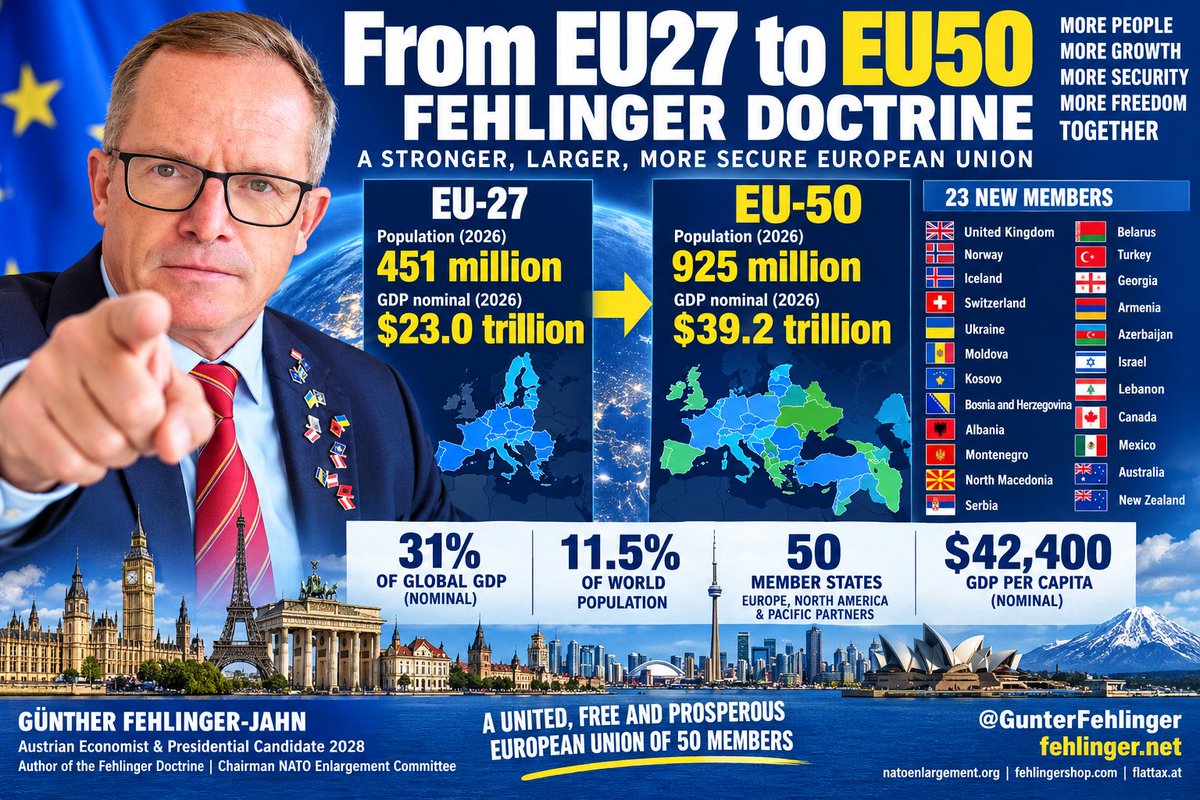
My vision for NATO 3.0: Expand the Alliance of Democracies. Today NATO has 32 member states. I advocate a long-term path to 18 additional countries, plus a new strategic role for the European Union as an institution in the Alliance. Countries I support joining NATO: 🇺🇦 Ukraine 🇦🇹 https://t.co/P4rb0zUASU #NATO #AllianceOfDemocracies #Ukraine #UA #AT

NATO Ankara 2026: From Partners to Allies This is one of the central arguments of my book: the Alliance of Democracies must grow. I call for: 🇪🇺 NATO membership for the European Union 🇺🇦 NATO membership for Ukraine 🇦🇺 NATO membership for Australia 🇯🇵 NATO membership for Japan 🇳🇿 https://t.co/gciOEQGVRl #NATO #AllianceOfDemocracies #GlobalSecurity #EU #UA #AU #JP #NZ

NATO Ankara 2026: From Partners to Allies This is one of the central arguments of my book: the Alliance of Democracies must grow. I call for: 🇪🇺 NATO membership for the European Union 🇺🇦 NATO membership for Ukraine 🇦🇺 NATO membership for Australia 🇯🇵 NATO membership for Japan 🇳🇿 https://t.co/XP9JmBNuSU #NATO #Democracies #GlobalAlliances #EU #UA #AU #JP #NZ

NATO Ankara 2026: From Partners to Allies This is one of the central arguments of my book: the Alliance of Democracies must grow. I call for: 🇪🇺 NATO membership for the European Union 🇺🇦 NATO membership for Ukraine 🇦🇺 NATO membership for Australia 🇯🇵 NATO membership for Japan 🇳🇿 https://t.co/0iiDVjUtN4 #NATO #Allies #Democracy #EU #UA #AU #JP #NZ

M

For decades, a conservative physician and his socialist neighbour disagreed about almost everything in Finnish politics. They argued, played tennis, shared meals, and remained close friends until the end of their lives. That sounds unremarkable. In the current political climate across the Western world, it feels almost radical. In my new Nordic Ledger column, I write about what has changed — and why the missing ingredient is not better fact-checking, stronger institutions or smarter politicians. It is something the French Revolutionaries understood well enough to carve in stone alongside liberty and equality, but that contemporary democracies have quietly abandoned in practice. The column covers the mechanics of democratic erosion: how political identity replaced political disagreement; how online harassment achieves what censorship cannot; how the war against institutions matters more than any individual lie; and why Brexit was not really about Europe. The underlying argument is simple, though not comforting: democracies are not primarily threatened by their enemies. They are threatened by the habit of treating opponents as enemies. https://open.substack.com/pub/nordicledger/p/the-missing-word-in-democracy?r=mwsn6&utm_campaign=post&utm_medium=web&showWelcomeOnShare=true

The Missing Word in Democracy

TIRANA 2027 I want the Tirana NATO Summit to become the Summit of Enlargement. 🇺🇦 Ukraine in NATO 🇽🇰 Kosovo in NATO 🇧🇦 Bosnia and Herzegovina in NATO 🇦🇹 Austria in NATO Europe is strongest when democracies stand together. No more grey zones. No more spheres of influence. No more #Tirana2027 #NATO #Enlargement #UA #XK #BA #AT

European companies are not competing on a level playing field, but against a state-command economy running on massive subsidies, dumping, economic coercion & control over critical supply chains.   All of these are used as a political tool against Europe & other democracies. 2/3 #LevelPlayingField #EconomicCoercion #SupportDemocracy #EU #US #CN

Marta Kos Jun 16

We sat down with EU ministers and ministers from our candidates to discuss protecting our democracies under the European Democracy Shield. It's great to work alongside Commissioner @EUCssrMcGrath on it and I'm grateful he sees the importance of bringing our enlargement partners https://t.co/N2ujSYd5G7 #EuropeanDemocracy #EUEnlargement #ProtectDemocracy #EU #XX(forcandidatecountries)

Mika Aaltola Jun 15

Going after political opponents with a weaponized Justice Department is Hungary-tier stuff. Never thought we’d see the day. This is how democracies hollow out from the inside: not with a coup, but with a subpoena. #JusticeDepartment #Democracy #PoliticalOpponents #HU

Democracy doesn't suddenly disappear. Its decay is often slow and occurs through legal means. That is why the book How Democracies Die is required reading for anyone who thinks, "It can't happen here." (translated)

NB8 (Nordic-Baltic countries) is emerging as a new powerhouse within the Western allied space. The meeting of heads of government held today in Tallinn marked a new chapter in the cooperation of eight like-minded and strong democracies. An integral part of this is the defence of https://t.co/71m0vbuXi2 #NB8 #Defence #Democracy #EE #LV #LT #IS #DK #NO #SE #FI

🎯 "Belgium" should stand with democracies defending themselves against Islamist barbarism, not issue even-handed statements that reward the aggressor. 👇🏻 #Belgium #Democracy #Islamism #BE