We will introduce measures, including restrictions on gun ownership.
At least five wounded in shooting outside school in western Turkey, media report
www.euronews.com
We will introduce measures, including restrictions on gun ownership.

I believe the new agreement between Greenland, Denmark and the United States appears to remain within the framework of the 1951 Defence Agreement. It strengthens U.S. security cooperation in Greenland, but it does not transfer sovereignty over, or ownership of, Greenland to the #Greenland #USDenmark #DefenseAgreement #GL #DK #US

🚨🔵 OFFICIAL: Clearlake Capital confirm they acquire full control of Chelsea FC. “Chelsea Football Club today announced affiliates of Clearlake Capital Group, L.P. (“Clearlake”) will acquire the ownership interest of Todd Boehly. Clearlake will also acquire Mark Walter’s https://t.co/J9p6RIDmLo #ChelseaFC #ClearlakeCapital #FootballNews #GB

PUTIN’S HIDDEN FORTUNE — MY ESTIMATE: $300 BILLION. After 26 years at the center of the Russian state, Vladimir Putin presides over a system of oligarchs, proxies, offshore structures, luxury assets and hidden ownership. The exact amount personally controlled by Putin is https://t.co/3Vwmx28kxH #Putin #HiddenFortune #Oligarchs #RU


Aughinish told government that Russian oligarch links were ‘challenging’ for plant Russian ownership of Aughinish has always been a problem for the company, but the Russian invasion put the company in an almost untenable position. https://t.co/W65EoEyRUa #Aughinish #RussianOligarchs #InvasionImpact #RU
The AfD is starting to break the classic instrument of a pure protest party of "issue ownership" in Saxony-Anhalt. The old party system is gradually losing some of its traditional functional attribution that the CDU is classically economically oriented. (translated)
Freeman of the City of London: An Ordinary Honour for All, an Honorary One for Few SOURCE: https://www.linkedin.com/pulse/freeman-city-london-ordinary-honour-all-honorary-one-sardella-ph-d--m1alf/ Abstract The Freedom of the City of London is an institution of mediaeval origin, attested as far back as 1237, originally conceived to afford freeborn citizens protection from feudal obligations, the right to trade, and the ownership of property within the bounds of the Square Mile — the territory of the City of London proper. Having evolved progressively from a concrete economic privilege into a civic and symbolic distinction, it has preserved its relevance over the centuries through successive legislative reforms — most notably the extension of eligibility to all nationalities in 1996 — and today records approximately 1,800 to 2,000 new admissions annually. The present article examines the historical and juridical evolution of the title, sets out the several routes of access provided by current regulation (by servitude through apprenticeship, by patrimony, by redemption through direct nomination, by presentation through the Livery Companies, and by registration on the electoral roll), and analyses the contemporary profile of the Freemen in the light of recent admissions of prominent figures from the worlds of finance, culture, sport, and public life. Contrary to the elitist image surrounding many British honours, the ordinary Freedom proves accessible to any person whatsoever, regardless of nationality or financial standing, upon the satisfaction of minimal requirements and the payment of an administrative fee of £180–185. The article concludes by reflecting upon the contemporary significance of the institution: not in the residual privileges, now largely ceremonial, but in its identity-forming, civic-participatory function and its connection to the long history of the oldest and most venerable city in Europe. Keywords: Freedom of the City of London; Livery Companies; City of London Corporation; British honours; urban civic identity. Contenuto dell’articolo Introduction Amongst the historic honours of Britain, few institutions evoke an imaginative world as rich as the Freedom of the City of London. Cited in films, novels, and articles on manners and custom with tones of exclusivity and mystery, it is frequently associated with figures of the very highest standing: sovereigns, heads of state, military commanders returning from the wars. Yet, upon closer and more methodical scrutiny, a markedly different picture emerges: that of a title which, in its ordinary and non-honorary dimension, is today accessible to a considerable number of persons each year, without the requirement of extraordinary merit or elevated financial means. The present contribution aims to examine the institution in its twofold aspect, historical and contemporary, with the object of dispelling the most prevalent misconception: that which confounds the ordinary Freedom with the Honorary Freedom — the latter genuinely rare and reserved for figures of international standing. This article traces the mediaeval origins and legislative evolution (§ 2), sets out the current routes of access (§ 3), discusses requirements, costs, and procedure (§ 4), analyses the contemporary composition of the body of Freemen (§ 5), examines rights, privileges, and obligations (§ 6), reviews the most distinguished recipients of recent decades (§ 7), and concludes with some reflections upon the contemporary significance of the institution (§ 8). Origins and Historical Development of the Institution The Freedom of the City of London is attested from 1237, during the reign of Henry III, as a form of civic status designating individuals not subject to a feudal lord, and therefore entitled to the protections guaranteed by the City's charters. In this original sense, the term freeman denoted the free man in the fullest sense of the word: one who might trade freely within the perimeter of the Square Mile, hold property, and join the trade guilds without external interference. The practical privileges were of concrete scope and directly functional to the mediaeval economy: exemption from certain tolls, including the celebrated right to drive flocks of sheep across London Bridge without payment — a concession rooted in the wool trade that dominated the English economy — protection against arbitrary arrest beyond the jurisdiction of the City, and access to the markets regulated by the guilds. As confirmed by the subsequent reissues of Magna Carta by Henry III in 1225, such liberties were intrinsically bound to the self-governance of the City, which defended them against royal and baronial interference. The progressive codification of the institution took place through royal ordinances from the fourteenth century onwards. In 1319, Edward II issued constitutions restricting access to the Freedom to members of the trade guilds, prohibiting the admission of unaffiliated outsiders, and thereby formalising servitude through apprenticeship as the principal route for new entrants, whilst the patrimonial route ensured continuity for established families. Subsequent monarchs, from Edward III onwards, repeatedly confirmed the civic liberties through charters granted often in exchange for financial loans, consolidating the City's autonomy and its role as creditor to the Crown. In the nineteenth century, with industrialisation and the demographic expansion of London, corporate control over trade proved increasingly unenforceable. The Municipal Corporations Act of 1835 extended eligibility to any person living, working in, or having a significant connection with London, partially detaching the title from corporate membership and progressively transforming it into an honorary distinction of a civic character. During the twentieth century, further reforms rendered access more inclusive. Women, already admitted informally as widows by inheritance in earlier periods but formally excluded from the standard routes, saw their right to ordinary admission recognised — Angela Burdett-Coutts having already received the Honorary Freedom in 1872, and Florence Nightingale in 1908 — while formal equality was consolidated in the twentieth century. Finally, in 1996, the requirement of British or Commonwealth citizenship was abolished, opening the title to any nationality whatsoever. Routes of Access: The Current Regulatory Framework The current regulations, administered by the Court of the Lord Chamberlain of the City of London Corporation, provide for five principal modes of access to the Freedom of the City of London, each reflecting different historical ties between the individual and the City's institutions. By servitude confers the title upon the completion of a formal apprenticeship under the Custom of London, traditionally of seven years' duration, under a master freeman of a Livery Company. This route, the oldest and of the greatest historical significance, verifies merit through practical competence and loyalty to the guild. Completing apprentices are admitted without the need for approval by the Court of Common Council, provided they have been registered on the City's electoral roll for at least one year, and in such cases no financial contribution is required. By patrimony confers automatic eligibility upon the children of Freemen, provided the parent held the title at the time of the candidate's birth and appropriate documentation is furnished. Historically restricted to sons, it was extended to daughters by the Municipal Corporations Act of 1835. The candidate must have attained the age of eighteen, must not be an undischarged bankrupt, and must not have relevant unspent criminal convictions. By redemption constitutes the route open to any person whatsoever. The candidate submits an application to the Court of the Lord Chamberlain, supported by two sponsors — Common Councillors, Aldermen, or Liverymen of at least one year's standing who attest to their reputation — and the matter is examined by the Freedom Applications Sub-Committee and approved by the Court of Common Council. The administrative fee (the Freedom Fine) amounts to £180 following the tariff revision of 1 April 2024 (£185 in the case of direct nomination). For candidates registered on the Ward List, the City's electoral roll, the procedure is free of charge. By presentation through a Livery Company is the route most frequently taken in contemporary practice. The candidate first becomes a member of their relevant guild, following a procedure that varies amongst each of the 113 Livery Companies currently active, and subsequently submits an online application to the Court of the Lord Chamberlain for admission to the Freedom of the City, with approval in the vast majority of cases being a matter of routine. Requirements, Costs, and Procedure The requirements for access to the ordinary Freedom are of a simplicity that may well surprise, given the aura of exclusivity surrounding the title. The candidate must have attained the age of eighteen, must not be an undischarged bankrupt, and must not have unspent criminal convictions within the meaning of the Rehabilitation of Offenders Act of 1974. No requirement of nationality, residence, educational attainment, or financial standing is imposed. The documentation required is of a standard biographical character: a full birth certificate, a marriage certificate or name-change document where applicable, and, where admission is by presentation, the certificate of membership issued by the relevant Livery Company. The application is submitted online through the City of London Corporation's portal. The admission ceremony is held at the Guildhall in London, in the Court Room of the Lord Chamberlain, on every working day between 10.30 and 12.00, and between 14.00 and 15.30. The newly admitted Freeman is invited to read aloud the Declaration of a Freeman and to sign the Admissions' Book, receiving upon its conclusion a calligraphed certificate on vellum and a copy of the Rules for the Conduct of Life — the eighteenth-century document of moral guidance that enjoins the holder to lead a life of rectitude, compassion, and social engagement. For those unable to attend in person, the City Corporation has retained the option of conducting the ceremony virtually, a facility introduced during the pandemic and subsequently preserved. The Contemporary Composition of the Body of Freemen One significant empirical datum serves to diminish the elitist dimension of the title: between 1,800 and 2,000 new persons are admitted each year, within a body that counts over 300,000 documented admissions across the centuries. As the City of London Corporation itself observes, contemporary Freemen comprise 'a broad cross-section of the population', encompassing professionals, students, craftspeople, entrepreneurs, military personnel, and foreign nationals. The growing contribution of university students, frequently presented in groups by their academic institutions, and of international professionals, has further broadened the demographic base. The group ceremony of 2024, in which 40 individuals drawn from fields ranging from science and medicine to entrepreneurship and diversity initiatives received the title simultaneously, is illustrative of this openness. A fundamental distinction must, however, be emphasised. The Honorary Freedom of the City of London constitutes an entirely separate institution of radically different scope. Granted by the Court of Common Council by special resolution, it is reserved for figures of exceptional international stature — typically fewer than a dozen conferred annually — and represents, in the words of the City Corporation itself, the highest honour it is able to bestow. It is this Freedom that has been enjoyed by Winston Churchill, Her Majesty Queen Elizabeth II, and, more recently, the television presenter Rachel Riley (October 2025), in recognition of her commitment to Holocaust education and the combating of antisemitism. The confusion between the two forms is the principal source of the distorted public perception of the institution. The Contemporary Significance: Between Identity and Participation While the great majority of the practical privileges once associated with the condition of Freeman have today disappeared or been reduced to solemn ceremonial form, what persists is the powerful symbolic and identity-forming value of the title. The ceremony retains elements of ritual solemnity — the reading of the Declaration, the signing of the historic Admission Register, the receipt of the calligraphed certificate on vellum — which inscribe the new Freeman within a chain of continuity of nearly eight centuries, linking diverse figures through a shared bond with the history of the Square Mile. This venerable London institution also performs a cohesive function within the ecosystem of the City and the Livery Companies. The 113 active guilds collectively disbursed over £81 million in charitable activities in 2024, through programmes of vocational training, scholarships, and technical apprenticeships that preserve specialist skills in economically significant sectors. Being a Freeman constitutes a formal prerequisite for advancement to Liveryman, and therefore for the exercise of voting rights in the governance of the City: a vestige of corporate democracy which, however distant from the models of universal suffrage, retains its own institutional logic within the unique legal architecture of the London Square Mile. Critics of a progressive persuasion have observed that the system favours established networks and access by hereditary or professional routes, potentially excluding broader strata of the London population, with the pool of living Freemen well below one per cent of the nine million residents of Greater London. Nevertheless, the data on recent admissions — encompassing recognition spanning African entrepreneurship, community sport, broadcasting, and medicine — suggest a trajectory of progressive opening which, whilst falling short of full demographic representativeness, attests to the institutional will to maintain the institution as a living tradition rather than an exclusive relic. Conclusions The foregoing analysis permits the formulation of several concluding observations. The Freedom of the City — the ordinary Freedom — is today an honour accessible to a far wider audience than the collective imagination suggests. The admission requirements are minimal, the costs modest, the procedures relatively streamlined and open to any nationality. The persistent confusion with the Honorary Freedom, reserved for figures of exceptional international eminence, is the principal source of a distorted perception that merits correction. The contemporary value of the title resides not in the residual privileges, now largely solemn and ceremonial, but in three complementary dimensions: the identity-forming, which connects the holder to nearly eight centuries of institutional history; the civic-participatory, which through access to the Livery Companies and the City's electoral system inserts the Freeman into genuinely operative networks; and the communitarian, which through the mechanisms of honorary recognition celebrates contributions of an ever more varied scope and provenance. In this respect, the Freedom represents an instructive case study in how historic institutions may reinvent themselves without losing authenticity, preserving their significance through inclusion rather than exclusion. References and Sources: City of London Corporation. (2024). Freedom of the City of London. https://www.cityoflondon.gov.uk/about-us/law-historic-governance/freedom-of-the-city Guild of Freemen of the City of London. (2025). Freedom of the City. https://www.guild-freemen-london.co.uk/freedom-of-the-city Livery Committee. (2025). Freedom of the City. https://liverycommittee.org/about/membership-freedom-and-livery-clothing/freedom-of-the-city/ Municipal Corporations Act 1835. UK Parliament. Rehabilitation of Offenders Act 1974. UK Parliament. Grokipedia. (2025). Freedom of the City of London. https://grokipedia.com/page/Freedom_of_the_City_of_London City Solicitors' Educational Trust. (2025). Applying for the Freedom of the City of London. LondradaVivere.com. (2025). La 'Freedom of the City of London': un'antica libertà ancora viva. City of London Corporation. (2023). Livery Companies: Charitable Activities Report 2024. ONS / City of London Corporation. (2023). Financial Services Contribution to UK GDP.

“Socialism Was Good in Theory” That sentence assumes the theory was never seriously challenged. It was. Long before the Soviet Union existed, before Lenin seized power, and before socialism had been tested on a national scale, major thinkers were already attacking its foundations—from very different directions. Five of them stand out. Tocqueville: Equality Can Become Servitude In 1848, Alexis de Tocqueville drew a sharp distinction between democracy and socialism. Both spoke about equality. But Tocqueville believed they pursued it in fundamentally different ways. Democracy, in his view, sought equality while preserving individual freedom. Socialism risked achieving equality by expanding the power of the state over the individual. His warning was essentially this: equality is not automatically liberty. A society can pursue equality so aggressively that it begins sacrificing the independence that makes political freedom meaningful. Bastiat: Follow Where Redistribution Leads Two years later, Frédéric Bastiat attacked socialism from a different direction. His question was deceptively simple: What happens when the state acquires the authority to take from some people and give to others in the name of justice? Bastiat called this “legal plunder.” His concern was not merely that redistribution might be expensive. It was that once government becomes the instrument through which competing groups obtain benefits from one another, politics can turn into a permanent struggle over who controls the machinery of redistribution. The problem, therefore, wasn’t simply how much the state redistributed. It was the principle that made redistribution legitimate in the first place. (bastiat.org) Nietzsche: Equality Can Become Resentment Nietzsche approached socialism neither as an economist nor as a constitutional theorist. He attacked its psychology. He saw modern egalitarian movements as part of a much older moral impulse: resentment toward exceptional individuals and suspicion of strength, ambition and hierarchy. For Nietzsche, the danger was not simply that everyone might become economically equal. It was that a culture could begin treating excellence itself as something morally suspect. The goal would cease to be lifting people upward. It would become bringing the exceptional downward. Böhm-Bawerk: Challenge the Economics Then came Eugen von Böhm-Bawerk. In 1896, he turned his attention specifically toward Marx’s economic system. His criticism was not primarily moral or political. It was technical. Böhm-Bawerk argued that Marx’s theory of value did not adequately explain how the labor values developed in Capital could be reconciled with the actual prices Marx subsequently needed to explain. In other words, he attacked socialism where it claimed to possess a scientific economic foundation. The argument became one of the central criticisms of Marxian economics and helped launch a debate that would continue for generations. Mises: The Calculation Problem Then, in 1920, Ludwig von Mises attacked an even more fundamental question: Even if socialism is morally desirable, how would a socialist economy actually know what to produce? A functioning economy has millions of competing uses for scarce resources. Build a bridge or a hospital? Use steel here or there? Produce more machinery or more consumer goods? Under private ownership and markets, prices for capital goods provide information about relative scarcity and opportunity costs. Mises argued that abolishing private ownership of the means of production also removes the genuine market prices necessary for rational economic calculation. The problem wasn’t simply that socialist planners might make bad decisions. It was that the system deprived them of the very economic signals required to systematically compare those decisions. (Mises Institute) And that was the sequence. Tocqueville challenged the political premise. Bastiat challenged the moral and legal mechanism of redistribution. Nietzsche challenged the psychology behind egalitarianism. Böhm-Bawerk challenged Marx’s economic theory. Mises challenged the possibility of rational central economic calculation. Five different thinkers. Five different objections. And all of them came before the Soviet Union had demonstrated what large-scale socialist government would actually look like. So “socialism was good in theory, but bad in practice” is not an argument. It is a historical claim that requires you to explain why these theoretical objections were wrong. The interesting question isn’t whether socialism had critics. It did. The interesting question is whether socialism ever adequately answered them” - ChatGPT
The Austrian Critique of Marx followed a line from value theory to economic coordination. 1) **Menger:** Value is **subjective**. People value goods because they think they satisfy wants; water in a desert can be far more valuable than water at home, with production labor unchanged. 2) **Böhm-Bawerk:** Marx’s surplus value is flawed. **Time and capital** matter: wages and costs are advanced before revenue arrives, so interest/profit reflect time preference, risk, and production structure—not unpaid labor. 3) **Transformation problem:** Marx’s labor-values should imply different surplus values by industry, but competition pushes toward equal profit rates. Marx tried to convert values into **prices of production**, yet the inconsistency with his earlier theory remains debated. 4) **Mises:** The key issue is whether socialism can **calculate**. Rational planning needs prices for **capital goods**, which only markets under **private ownership** can generate. 5) **Hayek:** Knowledge is **dispersed** and local. **Prices** transmit that information so coordination can occur without everyone knowing the full cause. 6) **Rothbard:** Profit isn’t necessarily exploitation. Capitalists bear uncertainty, organize production, and pay wages upfront; workers get an agreed wage, while profit is what remains if the venture succeeds. So the deepest split is not only about profit source, but about coordination: Marx asks who appropriates value; Austrians increasingly ask how millions coordinate exchange, knowledge, and expectations at all.
🚨⚫️🔵 Jonathan Rowe has told Bologna’s ownership and management in direct meeting with his agents his desire to move to Atalanta. Personal terms have been agreed and Rowe wants the move; up to Bologna as €40m package bid remains on the table. https://t.co/7dZib2mrCs #JonathanRowe #Bologna #Atalanta #IT #GB

How life manifests itself as an insoluble contradiction. Slavery, the desire for dominance in relations between men and women, the commission of murders, violence and criminal acts occur as a result of an irresistible desire on the part of the perpetrators. The desire on the part of the victims and their attempts to counteract them turn out to be unattainable desires. Violence is a manifestation of sadism. It is caused and its level is determined by the level of the male sex hormone testosterone. It leads to violence on the one hand, and on the other hand determines the possibility of fertilization of female individuals and the continuation of life by creating offspring. OBVIOUSLY THIS IS A FUNDAMENTALLY INSOLVABLE CONTROVERSY THAT AFFECTS AND DETERMINES THE WHOLE OF LIFE. PEOPLE CANNOT BELIEVE, UNDERSTAND AND ACCEPT THIS FACT. THEY DEEPLY BELIEVE THAT CONTROVERSIES ARE NOT INSOLVABLE AND THAT THERE ARE SOLUTIONS FOR THEM. THEY ARE ENDLESSLY DISCUSSED, TRYING TO APPLY THEMSELVES THROUGHOUT LIFE AND THROUGHOUT THE ENTIRE EXISTENCE OF HUMANITY. And all this turns out to be vain efforts, ineffective, fruitless, fruitless. The ingenious explanation, opening everyone's eyes to the truth is the understanding that THESE RELATIONS ARE ALWAYS ON THE EDGE OF CONFLICT, THAT THEY ARE TOLERANCE OF THE INTOLERABLE. All attempts to overcome slavery are illusory. Attempts to create a socialist and communist society, to present slavery as part of family relations, as paternalism, that it can be replaced by democracy, that slaves can become wage workers and their interests can be effectively defended by protest actions, strikes, and trade unions are fruitless delusions. Man with his whole nature strives for slave ownership. Slave owners are sadists who kill slaves in case of disobedience. They have power over their lives and this creates in them a sense of superiority, of a chosen higher caste, a natural selection of the smartest, the most capable. eternal holders of sacred power given by God, a manifestation of higher justice and harmony. This is a delusion that completely blinds the mind. The truth is that slave ownership stems from cannibalism and they cannot realize this, understand that this is the truth. In Bulgaria, the slave-owners are called chorbadjii-izednicy, that is, cannibals, and this is not idle talk, but a very accurate definition of things. Slaves are masochists, weak, helpless to defend themselves. They are completely blocked by the power structures of the slave owners. In antiquity, they were usually soldiers, punished to be slaves because they tried to kill the slave owners. Relations between men and women are also on the verge of conflict, tolerance of the intolerable. They have a completely unacceptable, contradictory nature and this is an objective fact. The similarity that they are the same people, regardless of the different sex, is an illusion, self-deception. They are totally different and their relations are based on reconciliation or dominance, tyranny of one sex over the other. Violent, criminal manifestations have the same nature as slavery and relations between the sexes. All attempts to eradicate them are fruitless. They cannot even be limited.
Wildberries has become far more than an online marketplace. Investigative reporting has raised serious questions about Kremlin-linked influence over its corporate restructuring and ownership. At the same time, Sergei Roldugin—widely described in major investigations as one of https://t.co/DMTnXo5kob #Wildberries #Kremlin #InvestigativeReporting #RU

Wildberries has become far more than an online marketplace. Investigative reporting has raised serious questions about Kremlin-linked influence over its corporate restructuring and ownership. At the same time, Sergei Roldugin—widely described in major investigations as one of #Wildberries #Kremlin #InvestigativeJournalism #RU #US
The real stake is not a simple administrative or property dispute, but the risk of losing ownership, autonomy and ultimately the undisturbed character of one of the most important monuments of world cultural and religious heritage. (translated)
Department of Treasury: State ownership of companies is perfectly fine: https://t.co/uuHoLb724n. And https://t.co/rZgzs3sMSX. So no communism. Just old fashioned state capitalism or corporatism. #StateCapitalism #CorporateEconomy #TreasuryStatement #Nospecificcountrycodesarementionedinthetweet.

Physical media is making a comeback and it's easy to see why. When you buy a CD, it's yours. When you "buy" digital media, it can disappear if licensing deals change. Ownership should actually mean ownership. 📀💻 #ConsumerRights #DigitalOwnership #ConsumerProtection #TechPolicy #DigitalOwnership #ConsumerRights #TechPolicy #Thetweetdoesnotspecificallymentionanycountries.Therefore #therearenocountrycodestoreturn.
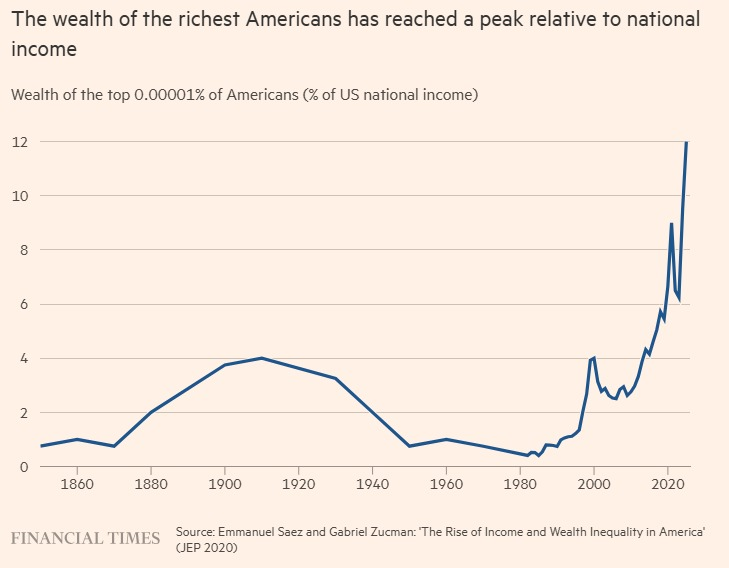
🇺🇸 A tiny group of Americans now owns wealth equivalent to nearly 12% of all the national income generated in the United States in a single year - FT ➡️ This surge mainly reflects the transformation of the United States into an economy dominated by asset ownership. Since the https://t.co/tPo2hSvx0V #WealthInequality #AssetOwnership #USEconomy #US

Sony ending physical PlayStation discs in 2028 is exactly the future I paint in my work... You buy things you never truly own, because they live on servers you cannot reach, switched off whenever they decide. Sold to you as progress. You will own nothing and be happy. https://t.co/TsuWhKF3MP #DigitalFuture #Ownership #GamingConcerns #Nospecificcountriesarementionedinthetweet.