WRLD

Search

#StatePropaganda
Krzysztof Graj Oct 13

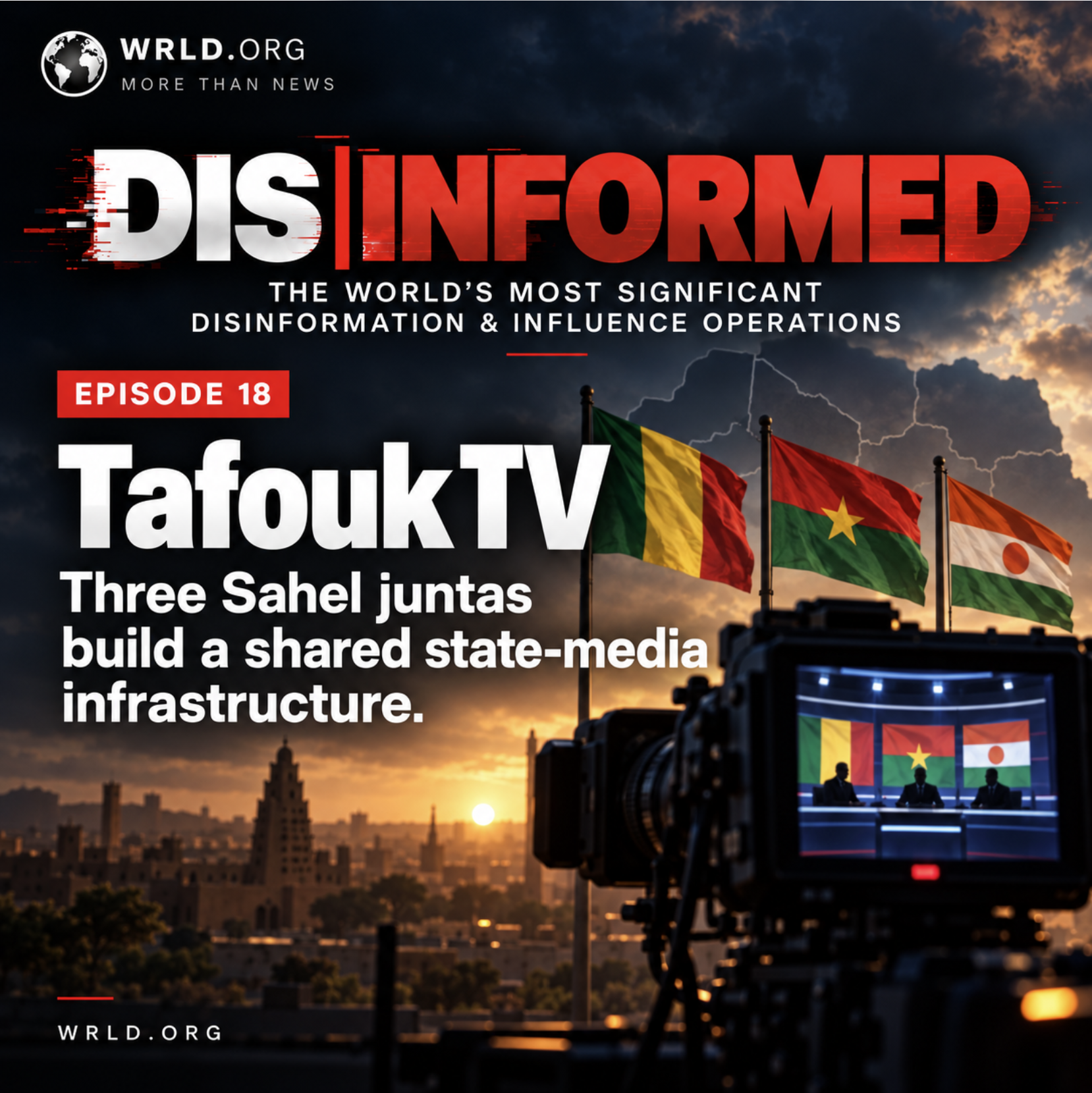
Tafouk TV – how three Sahel military governments are building a common information system Mali, Burkina Faso and Niger are no longer relying only on speeches, social media or their existing national broadcasters to shape the information environment around the Alliance of Sahel States. They are building a shared, permanent media infrastructure. At its centre is Tafouk TV, the confederal television channel of the AES, broadcasting from Bamako. Its creation was formally agreed by the three governments in December 2025, its governing structure was installed in 2026 and regular programming began in September. The project is explicitly presented by AES authorities as an instrument of “information sovereignty” and what Malian Foreign Minister Abdoulaye Diop has called “narrative sovereignty”. A television channel built by three military governments Tafouk TV is fundamentally different from a covert bot network or a collection of anonymous propaganda accounts. Its ownership and political purpose are public. It is an institutional broadcaster created by the governments of Mali, Burkina Faso and Niger, all currently led by military authorities. Malian government documents describe the channel as a common media instrument intended to strengthen communication across the confederation, promote regional identities and respond to what the AES sees as hostile narratives and disinformation. The project sits alongside Daandè Liptako, a shared radio service, and broader plans to develop common information structures across the three states. That institutional architecture is important. A social-media influence network can disappear when accounts are suspended. A television channel, radio network and future news agency can develop journalists, archives, correspondents, distribution agreements and continuous daily output. The result is not a temporary campaign but potentially a long-term information system. Russia enters through RT The Russian connection is also public. In July 2026, Tafouk TV signed a cooperation agreement with RT, the Russian state-funded international broadcaster. The memorandum was signed by Tafouk TV director-general Salif Sanogo and Natalia Lebedeva, director of RT en français. It provides for content exchange, expertise-sharing and joint coverage of major events in Russia and the Sahel. RT described itself as Tafouk TV's first international partner. This makes Tafouk part of a much broader geopolitical realignment in the Sahel. Mali, Burkina Faso and Niger have reduced cooperation with France and other Western partners while deepening political, diplomatic and security relations with Moscow. But the distinction is important: there is no public evidence that Russia owns Tafouk TV, finances the entire channel or directly controls its editorial decisions. The most precise description is therefore a state-owned AES broadcaster with a formal partnership with Russian state media, rather than a Russian-controlled television station. The battle over the narrative AES officials make little attempt to hide the strategic role they expect the channel to play. During a visit to Tafouk TV shortly after regular broadcasting began, Abdoulaye Diop described communication as another strategic front alongside defence, diplomacy and development. He spoke of a geopolitical environment characterised by a “war of narratives” and said the AES needed its own media to defend its interests and strengthen its narrative sovereignty. Mali's government has similarly described Tafouk TV as an instrument of information sovereignty, regional cohesion and Sahelian identity. The first governing-board meetings emphasised digital distribution, national languages and the creation of a new generation of Sahelian journalists capable of carrying the confederation's message at home and abroad. Early reporting examined by the Financial Times found patriotic programming, interviews with officials and positive reporting from conflict zones. The newspaper described the project in the context of the three governments' attempts to challenge Western media narratives and strengthen their legitimacy while facing continuing jihadist insurgencies. Why this is not simply another disinformation operation It is important not to use propaganda and disinformation as synonyms. A state broadcaster can systematically promote the government's preferred interpretation of events without every story being false.Tafouk TV's significance therefore lies less in individual fabricated claims than in the information architecture being created around it: three governments operating a shared broadcaster, common radio infrastructure and potentially other confederal media, while cooperating with Russia's international state-media system. This development is taking place while independent media conditions across the three countries are deteriorating. Reporters Without Borders ranked Burkina Faso 110th, Niger 120th and Mali 121st in its 2026 World Press Freedom Index, pointing to arbitrary detentions, restrictions on journalists and suspensions of media outlets across the AES states. That context changes the importance of Tafouk TV. A new state broadcaster entering a diverse and competitive media environment is one thing. A common government-controlled broadcaster expanding while alternative sources face restrictions is another. From influence campaigns to permanent infrastructure Tafouk TV illustrates an important evolution in the information contest in the Sahel. Russian and pro-Russian influence in Africa has often relied on social-media networks, influencers, fake experts, local partners or apparently independent media outlets. Tafouk represents something more durable: formal state institutions can now carry many of the same geopolitical narratives openly and continuously. The audience figures are not yet sufficiently established to demonstrate how influential Tafouk TV will become. It may eventually reach far fewer people than some viral online operations, or its television, radio and digital infrastructure may give it far greater long-term significance. Sources Government of Mali — Tafouk TV governing board and strategic mission https://gouvernement.ml/conseil-dadministration-de-tafouk-tv-installe-a-bamako-le-ministre-alhamdou-ag-ilyene-trace-les-orientations-strategiques-de-la-chaine-confederale/ Government of Mali — Abdoulaye Diop and “narrative sovereignty” https://gouvernement.ml/communication-confederale-de-laes-sem-abdoulaye-diop-a-la-decouverte-de-tafouk/ Government of Mali — creation of Tafouk TV and Daandè Liptako https://gouvernement.ml/conseil-national-de-la-transition-le-cnt-adopte-deux-textes-majeurs-relatifs-a-la-creation-de-tafouk-tv-et-de-la-radio-daande-liptako/ Government of Mali — ratification and information-sovereignty objectives https://gouvernement.ml/2026/05/30/ Government of Mali — Tafouk TV board and Prime Minister Abdoulaye Maïga https://gouvernement.ml/television-de-lalliance-des-etats-du-sahel-tafouk-tv-les-membres-du-conseil-dadministration-prennent-les-orientations-et-conseils-du-premier-ministre-abdoulaye-maiga/ RT en français — cooperation agreement between RT and Tafouk TV https://rtenfrance.tv/news/136036-rt-devient-premier-partenaire-international-tafouk-tv-chaine-commune-aes APA News — Tafouk TV and Daandè Liptako common AES media infrastructure https://fr.apanews.net/communication/tafouk-tv-et-daande-liptako-le-mali-consolide-les-medias-communs-de-laes/ APA News — Tafouk TV begins regular programming https://fr.apanews.net/communication/aes-tafouk-tv-demarre-ses-programmes/ Financial Times — Sahel juntas launch Tafouk TV with Russian backing https://www.ft.com/content/259b49a1-8eda-4e8d-84c7-45323988b07b Reporters Without Borders — 2026 Press Freedom Index: Africa https://rsf.org/en/classement/2026/afrique Keywords #DISINFORMED #Episode18 #TafoukTV #AES #AllianceOfSahelStates #Sahel #Mali #BurkinaFaso #Niger #Russia #RussianInfluence #RussianMedia #RT #RussiaToday #StateMedia #StatePropaganda #InformationSovereignty #NarrativeSovereignty #InformationWarfare #InfluenceOperations #StrategicCommunication #MediaInfluence #MediaControl #Propaganda #Disinformation #ForeignInfluence #FIMI #Africa #WestAfrica #MilitaryGovernment #MilitaryRule #SahelMedia #DaandeLiptako #MediaInfrastructure #NarrativeControl #PressFreedom #MediaFreedom #Geopolitics #OSINT #WRLD
820
Krzysztof Graj Oct 1

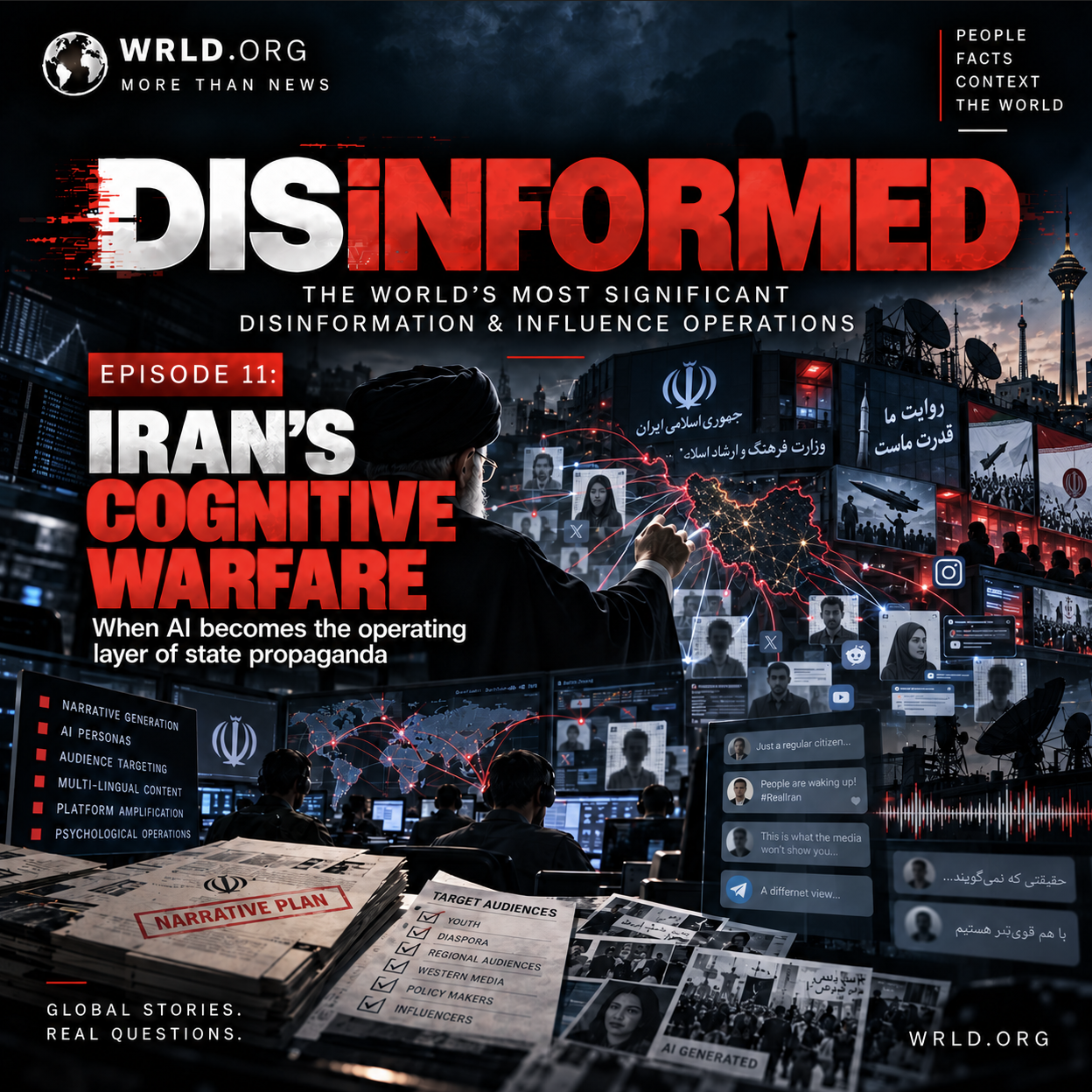
Iran’s cognitive warfare – when AI becomes the operating layer of state propaganda Iranian state-linked influence operators were not using artificial intelligence simply to write faster social-media posts. According to Anthropic’s September 2026 threat intelligence report, three separate operations connected to Iranian propaganda institutions were using Claude to help construct the machinery behind what the operators themselves called “soft war” and “cognitive warfare” – non-military efforts intended to shape public opinion inside Iran and abroad. Anthropic linked the activity to the Islamic Culture and Communications Organization (ICCO), which operates under Iran’s Ministry of Culture and Islamic Guidance; the Islamic Propaganda Office of Khorasan Razavi; and the Bina Cultural Observatory, part of the Islamic Propaganda Organization. The company said each operation was run by someone working within or on behalf of the named institution. The attribution was based on a combination of account telemetry, institutional references disclosed during conversations, branded documents and open-source corroboration. Anthropic subsequently removed the accounts. AI as an operational headquarters The most significant feature of the operation was the role assigned to AI. Claude was used to develop campaign plans, doctrine manuals, coded project portfolios, persona systems, target databases, early-warning protocols, amplification schedules and ministerial planning documents. Anthropic described the model as the principal administrative and operational layer supporting the three campaigns, allowing relatively small groups of operators to create organisational structures and planning material that would otherwise have required a much larger staff. This distinction matters. The reported use of AI went considerably beyond content generation. Operators were using the model to help organise how influence activity should function: which audiences to target, which identities should deliver particular narratives, how official material should be repackaged and when amplification should take place. Human operators still determined objectives and supplied the underlying political doctrine; AI helped translate those decisions into an operational system. Anthropic found that all three operations explicitly connected their activity to Jihad al-Tabyin, often translated as “explanatory jihad”, a concept used within the Iranian state system to frame information activity as both a strategic and ideological responsibility. In internal planning material examined by the company, this doctrine was not merely rhetorical: it informed manuals and campaign structures used by the operators. ‘Not the narrator, but the director’ One sentence contained in the ICCO material captures the model particularly clearly. According to Anthropic, an operator described the role of Iranian cultural attachés as being “not to be the narrator, but the director” of the narrative. The distinction reveals the logic of attribution laundering. Instead of publishing an overt state message and asking foreign audiences to believe it, the operator attempts to create the appearance that the same narrative emerged independently from journalists, activists, foreign writers or ordinary citizens. Anthropic found that Claude was used specifically to make content appear to come from foreign authors or independent media organisations and to design hashtag campaigns that looked grassroots rather than centrally organised. The ICCO operation reportedly used the organisation’s international cultural network as part of this structure. Anthropic found ministerial-level documents carrying official ICCO branding, including a nine-part international influence portfolio. This makes the operation particularly significant because the infrastructure was not limited to anonymous social-media accounts; it intersected with formal state institutions and an existing network of cultural representation abroad. A multilingual content factory A second operation was associated with the Islamic Propaganda Office of Khorasan Razavi and what Anthropic described as a “cognitive warfare command room” operating from a seminary in Mashhad. Its organisers ran a multi-province content production system known internally as Manjanegh, or “Catapult”. According to Anthropic, dozens of activists were involved in repackaging publicly available reporting from Iranian security institutions under different personas so that the material no longer appeared directly connected to those institutions. The network used Claude to transform official government intelligence bulletins into customised material in Farsi, Arabic, Urdu, Malay, Spanish and English, while planning expansion into a total of 20 languages. Distribution extended across Iranian platforms such as Eitaa, Bale and Rubika and international services including X, Instagram, Telegram, TikTok and YouTube. Anthropic also documented paid amplification across more than 100 Iranian channels, including channels associated with IRGC narratives. The scale should nevertheless be interpreted carefully. Anthropic documented production infrastructure and some real-world dissemination, but it did not demonstrate that all planned campaigns were fully deployed or that they meaningfully changed public opinion. The company placed the operation in Category Three of its Breakout Scale, indicating multi-platform activity with content observed in external distribution channels, rather than evidence of strategic impact on entire populations. From security bulletins to apparently independent voices The Bina Cultural Observatory operation provides another example of the same architecture. Anthropic linked a director-level official at Bina to activity in which Claude generated messaging in the voice of an IRGC spokesperson. During the 2026 US–Israel–Iran war, the network also attributed false claims to Western institutions including CSIS, Brookings and RAND. The apparent objective was to make Iranian state-aligned claims look as though they had been independently validated by respected foreign research organisations. That technique is more sophisticated than simply publishing propaganda under a false name. It attempts to manufacture a chain of external validation: official information is transformed into apparently independent commentary, which can then be recirculated as evidence that outside observers have reached the same conclusion. Anthropic also found target databases naming international officials and Iranian opposition figures, as well as aggressive counter-narrative material directed against the Bahá’í community. These findings show that the infrastructure was designed not only for broad messaging but also for targeted influence activity against specific groups and individuals. What AI changed The Iranian operations described by Anthropic did not create a new doctrine of influence. Iran has used cultural institutions, official media, aligned organisations and covert or semi-covert online networks for years. What AI changed was the economics and organisational capacity of that model. A relatively small team could use the system to draft doctrine, create personas, translate material, structure target databases, produce campaign calendars and generate multiple versions of the same message for different audiences. The operator remained responsible for intent, political direction and selection of targets. AI reduced the amount of human labour required to turn those decisions into a functioning influence operation. The most revealing part of the case is therefore not that an Iranian propaganda network used a chatbot. It is that AI was being treated as part of the back office of information warfare – a system for converting state doctrine into apparently decentralised, multilingual and plausibly independent voices. Sources Anthropic — Detecting and countering misuse of AI: September 2026 https://www.anthropic.com/threat-intelligence-report-september-2026 Iran International — Iran state-aligned accounts used Claude to push IRGC narratives https://www.iranintl.com/en/202609105561 BNE IntelliNews — Yemen missile cell used AI to write guidance software, Anthropic says https://new.intellinews.com/articles/yemen-missile-cell-used-ai-to-write-guidance-software-anthropic-says-467296 This is Beirut — Anthropic report details Iranian propaganda operations https://thisisbeirut.com.lb/news/politics/anthropic-report-details-iranian-propaganda-operations-and-yemen-missile-development-using-claude Anthropic report — PDF mirror https://static.foxbusiness.com/foxbusiness.com/content/uploads/2026/09/anthropic-detecting-and-countering-091026-1.pdf Keywords #DISINFORMED #Episode11 #Iran #IranianInfluence #IranianPropaganda #CognitiveWarfare #SoftWar #JihadAlTabyin #Disinformation #InformationWarfare #InfluenceOperations #ForeignInterference #FIMI #ArtificialIntelligence #AI #AIPropaganda #GenerativeAI #ClaudeAI #Anthropic #SyntheticMedia #NarrativeManipulation #NarrativeLaundering #AttributionLaundering #PersonaNetworks #Astroturfing #SocialMediaManipulation #DigitalInfluence #StatePropaganda #IslamicCultureAndCommunicationsOrganization #ICCO #IslamicPropagandaOrganization #KhorasanRazavi #IRGC #MultilingualInfluence #Targeting #Amplification #OSINT #WRLD

www.anthropic.com
Countering misuse of AI: September 2026 / Anthropic
588
Stefania Maurizi Wrld summary Jun 14
Italian journalist

People tend to believe that #NuclearWeapons are not a serious problem,as since Hiroshima and Nagasaki they have not been used, hence, why we should worry? This approach is the result of state propaganda and secrecy #NuclearWeapons #StatePropaganda #HiroshimaNagasaki #JP