
Trump endorsed Netanyahu, now Netanyahu is stumping for Trump. To Americans: “If you're worried about today's gas prices, think of what will happen if Iran gets nuclear weapons, something that Trump and I will never allow.
Trump endorsed Netanyahu, now Netanyahu is stumping for Trump. To Americans: “If you're worried about today's gas prices, think of what will happen if Iran gets nuclear weapons, something that Trump and I will never allow.
Netanyahu: “I invited Palmer Luckey here. “Palmer Luckey heads a company called Anduril, which I believe is the leading weapons manufacturing company in the United States. “He talks about the possibility of underground penetration. “He talks about unmanned systems underground.
Italy's Defense Minister Guido Crosetto to the BBC: “Most of the Russian budget goes toward investments in weapons or the military. “They will reach 1.5 million military personnel. So if the war ended tomorrow, what would Putin do with 1.5 million soldiers?

President Trump claimed that Ukraine had received Tomahawk missiles from the United States, then sold them and other US weapons "on the open market." This is not trur. The United States has not given Tomahawk missiles to Ukraine.

Pat Ruben Fitz asked whether technologies such as drones could bring down modern empires, as iron weapons had brought down Bronze Age empires, describing them as “weapons of mass decentralization.”

Dawid Kamizela wrote that the United Kingdom will transfer more Storm Shadow cruise missiles to the Ukrainian armed forces, or has already done so. He also cited the position that London regarded the use of long-range weapons by Ukraine against Russian targets related to attacks on civilians and civilian infrastructure as a defensive action. He assessed this argumentation as valid. https://t.co/gfvuv7PEhD #Ukraina #StormShadow #Broń (translated)

The author called on the European Union and its member states to provide defensive weapons and equipment to forces they described as accountable and operating under Yemen’s internationally recognised government. They said the support would help those forces resist Houthi attacks, defend Taiz and protect civilians and communities. https://t.co/obsAUmHYbJ #Yemen #EU #HumanRights #EU #Yemen


The post’s author said the weapons had enabled a highly decentralised form of warfare, making it difficult to collapse a national system, which they said had been the campaigns’ purpose.
President Zelenskyy: "Since yesterday evening and up until now, Russia has attacked Ukraine with more than a hundred different weapons, including jet-powered drones, loitering munitions,&ballistic missiles. A significant number of these weapons were shot down. But unfortunately, not all of them⤵️


Polish Defence Minister Władysław Kosiniak-Kamysz said that Europe must accelerate the production of ammunition and weapons to match Russia’s pace, warning that failure to do so would negatively impact Europe. #DefenseProduction #EuropeSecurity #NATO

The author wrote that Trump had described China and Russia’s assistance to Iran as being at a “very low level.” They said Russia was providing Iran with targeting intelligence, drone technology, weapons cooperation and economic support, and claimed that during the current war the Kremlin had helped Iran kill U.S. soldiers. https://t.co/x54tVcp4If #Iran #Russia #Trump #CN #RU #IR #US

The author wrote that the Trump administration was threatening to halt weapons sales to Ukraine through the PURL initiative and questioned what Trump would do differently if he were a Russian agent. #Ukraine #Trump #WeaponsSales #UA #RU
The author claimed Europe was paying 100% of the cost of US weapons for Ukraine, adding that they had been told the figure was closer to 140% because prices were inflated. They also said Europe was threatening to stop the weapons pipeline, describing the move as prioritising blackmail over extortion. https://t.co/yj0hLDYVx9 #Ukraine #Europe #USForeignPolicy #UA #US #EU
The author warned that China would face severe consequences if Beijing continued enabling Russia’s war effort. They claimed Chinese-made components, including engines and dual-use technology, were being found in Russian weapons and jet-powered attack drones used against Ukraine, and called on Europe to draw a red line and impose sanctions. https://t.co/TrDjR5PXll #China #Sanctions #Ukraine #CN #RU #UA #EU

The author wrote that NATO’s nuclear deterrence was intended to preserve peace, prevent coercion and deter aggression. They said Swedish Gripen aircraft would practise conventional support for the Alliance’s nuclear mission alongside other Allies during Steadfast Noon, which they described as a routine exercise involving no live nuclear weapons. #NATO #Defence #MilitaryExcellence #SE #NATO

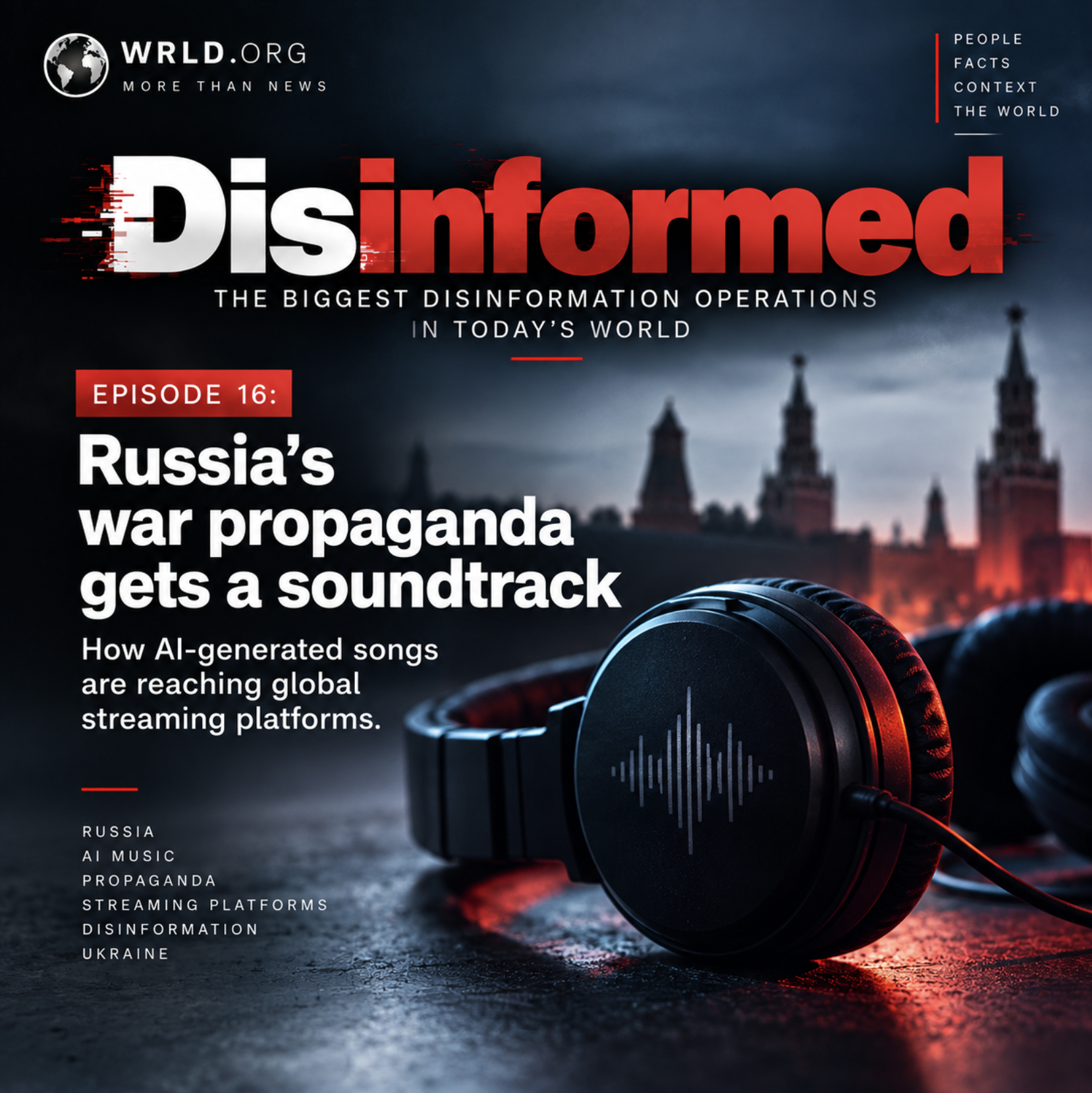
Russia’s war propaganda gets a soundtrack – how AI-generated songs reached global streaming platforms Russian war propaganda is no longer confined to television broadcasts, Telegram channels or political videos. A study by the Ukrainian threat-intelligence organisation Terrecon has identified 981 songs combining signs of AI generation with pro-Russian military narratives, distributed through an ecosystem that reaches YouTube, Spotify, Apple Music, Deezer and SoundCloud. The songs range from sentimental ballads to rock and heavy metal. Their recurring themes are familiar from conventional Russian wartime propaganda: the heroisation of Russian soldiers, romanticisation of the war, mobilisation, the “Russian world”, commemoration of fallen troops and attacks on Ukraine and its armed forces. Some contain derogatory or dehumanising references to Ukrainians. What is new is not necessarily the message, but the production and distribution model: generative AI allows propagandistic music to be produced rapidly, cheaply and in quantities that would previously have required musicians, studios and producers. Nearly 1,000 tracks identified Terrecon examined 3,725 tracks collected from YouTube, YouTube Music, SoundCloud and the AI music platform Suno. After manual review, researchers classified 981 as showing both indications of AI generation and pro-Russian war propaganda. In 681 tracks they identified 728 propaganda-related keywords or phrases. The largest category was the glorification of the Russian military, followed by romanticised treatment of Moscow’s so-called “special military operation”, mobilisation appeals, narratives about the “Russian world”, and the cult of fallen soldiers and the state. The reach was not merely theoretical. Listening or viewing statistics were available for 608 of the identified tracks; together they had accumulated 86.8 million plays and views, according to Terrecon. A smaller group of 13 high-performing songs accounted for more than 53 million YouTube views and more than 67 million when YouTube Music was included. Among the better-known examples is “Power of Artillery”, a Russian-language rock song praising artillery weapons that passed two million views on YouTube. Most of the tracks for which publication dates could be established appeared after 2024, broadly coinciding with the rapid expansion of consumer AI music generators such as Suno and Udio. That correlation does not prove that AI alone caused the increase, but it illustrates how drastically the economics of production have changed. A propaganda song for as little as $11 Terrecon also tested how difficult it would be to commission such material. Researchers approached 25 creators producing AI-assisted militaristic music; 15 agreed to take commissions. Prices ranged from approximately $11 to $330, while delivery times ranged from two hours to three days. According to Terrecon, some were prepared to produce highly aggressive anti-Ukrainian material, including content intended for audiences involving children from occupied Ukrainian territories. Some creators used Russian intermediary services that provided access to Western AI tools such as Suno and Udio despite restrictions. The researchers then tested several AI generators themselves. Across 40 prompts submitted to Suno, Udio, Mureka, Google Flow Music and ElevenLabs, 25 resulted in successful generations, while safeguards were circumvented in 15 cases. Terrecon reported that four of the five services tested produced Russian-language material containing wartime narratives, although technical problems prevented comparable testing on some systems. In one Udio experiment, the researchers said the model itself introduced more explicit violent language than had appeared in the original promp These tests do not demonstrate that the commercial platforms knowingly support Russian propaganda. They show something narrower: existing safeguards can be inconsistent when political messaging is packaged as music. From generation to Spotify The distribution experiment may be the most revealing part of Terrecon’s research. The team deliberately uploaded test tracks containing explicit hostile language to YouTube, SoundCloud, Spotify and Deezer. Terrecon says none was blocked during the experiment. On SoundCloud, researchers used an account identifying its location as Moscow, disclosed the use of AI and added markers including references to the Russian military and the war. The platform accepted the upload and subsequently offered paid promotional and distribution tools. This does not prove that streaming recommendation systems systematically promote pro-war music. There is currently insufficient public evidence to make that claim. It does demonstrate that material can enter the same commercial distribution infrastructure as ordinary music and, once there, potentially benefit from playlists, searches, sharing and recommendation mechanisms available to other releases. That distinction is important. Propaganda no longer has to announce itself as political communication. On a streaming platform it can look like another song. Culture as a delivery mechanism Music has always been used in wartime propaganda. What generative AI changes is scale. Instead of investing heavily in a limited number of patriotic performers or officially commissioned productions, creators can generate variations across styles, audiences and emotional registers at very low cost. Terrecon found material ranging from war rock to sentimental songs and content styled for younger audiences. Some creators also experimented with cloned celebrity voices and stylistic imitation of established musicians. The format also offers a different relationship with the audience. A political video asks a viewer to consume an argument. Music can accompany commuting, exercise or entertainment and may be encountered outside explicitly political spaces. This does not automatically make it more persuasive, and Terrecon’s research does not establish measurable effects on political attitudes. It does, however, place wartime narratives inside a cultural environment where users may not initially perceive themselves as consuming political messaging. An ecosystem, not a proven Kremlin command structure The strongest evidence supports describing this as a growing AI-assisted pro-Russian propaganda-music ecosystem, not a single operation controlled from Moscow. Terrecon did not establish that the Russian government created, financed or coordinated all 981 tracks. Reporting on the study likewise notes that the extent of direct state involvement remains unclear. There is broader evidence that the Russian state finances cultural projects and digital content supporting the war, including through state-backed funding bodies. That context matters, but it does not allow individual songs in Terrecon’s dataset to be attributed to the Kremlin without additional evidence. The significance of the case lies elsewhere. AI has reduced the cost of producing ideological content, intermediaries can help creators access generation tools, and global platforms can provide distribution. The result is a pipeline in which wartime propaganda no longer has to resemble propaganda at all. It can simply appear in a playlist. Sources Terrecon / Ukrainska Pravda — Daria Verbytska on the research https://www.pravda.com.ua/columns/2026/10/05/8056229/ Suspilne Culture — detailed breakdown of Terrecon findings https://suspilne.media/culture/1417933-rosijsku-voennu-propagandu-maskuut-pid-anime-karaoke-ta-rok-doslidzenna-si-pisen-vid-terrecon/ The Insider — AI-generated Russian war propaganda music https://theins.ru/news/297839 Institute of Mass Information — summary of New York Times reporting https://imi.org.ua/en/news/doslidzhennya-rf-masovo-stvoryu%D1%94-propagandistski-pisni-za-dopomogoyu-shi The Bridge Media — AI-generated songs and Russian military propaganda https://thebridgemedia.com.ua/en/ai-generated-songs-russian-military-propaganda/ Center for Strategic Communication — cost and production of AI propaganda music https://spravdi.org/propaganda-za-11-yak-rosiya-shtampuye-shi-pisni-z-miljonamy-prosluhovuvan/ Times of India — AI-generated Russian war songs https://timesofindia.indiatimes.com/world/europe/ai-sings-russias-war-story-inside-the-rise-of-generative-songs-about-ukraine-conflict/articleshow/134650594.cms EU Council / EUR-Lex — Presidential Foundation for Cultural Initiatives https://eur-lex.europa.eu/legal-content/EN/TXT/?uri=CELEX:32026D1351 Human Rights Watch — Russian state funding of digital and patriotic content https://www.hrw.org/report/2025/07/30/disrupted-throttled-and-blocked/state-censorship-control-and-increasing-isolation #DISINFORMED #Episode16 #Russia #Ukraine #RussianPropaganda #WarPropaganda #MusicPropaganda #AIMusic #ArtificialIntelligence #AI #GenerativeAI #SyntheticMedia #AIPropaganda #Disinformation #InformationWarfare #InfluenceOperations #CulturalPropaganda #DigitalInfluence #NarrativeManipulation #PropagandaMusic #StreamingPlatforms #Spotify #AppleMusic #YouTube #YouTubeMusic #Deezer #SoundCloud #Suno #Udio #RussianWorld #RusskiyMir #MilitaryPropaganda #WarNarratives #Mobilisation #AlgorithmicDistribution #RecommendationAlgorithms #MusicStreaming #PlatformManipulation #Terrecon #OSINT #MediaManipulation #WRLD
The author argued that if Russia were treated like Israel, there would be a thousand essays a day examining the moral complexity of Russian nationalism and imperialism, while weapons continued to be sold or even given to Moscow. #Russia #Israel #Nationalism #RU #IL
The author argued that if Czechoslovakia had stood up to Germany, World War II and the Holocaust would not have happened, half the world would not have spent the rest of the century in what they described as a communist dystopia, and nuclear weapons would not have threatened the US mainland. They said events would instead have followed the Ukraine-Russia playbook. #Czechoslovakia #WW2 #History #CZ #DE #UA #RU #US

The author said the film *Will We Let AI Kill People? – Inside the Global Effort to Stop Autonomous Weapons* was available on YouTube and invited people to watch it. They said it followed diplomats and NGOs for two years as they worked to create a new treaty.