WRLD

Search

#Weterynaria
Konrad Krasuski 4d

Konrad Krasuski wrote that he received information from several interlocutors that raised his doubts about the course of the inspections and the selection of experts in the case of the zoo in Łączna. The lawyer he referred to reportedly claimed that Mondo Cane regularly requests the same expert, who then co-creates a protocol in line with the expectations of the organization. Krasuski asked why a veterinarian expert was not appointed. According to the author, an employee of the Veterinary Inspection critically assessed the expert's competencies, using offensive language. Another interlocutor reportedly indicated that similar situations occurred in the palm house in Legnica and the shelter in Rybow. Krasuski added that in such cases, the expert is often not a veterinarian. The author announced that he would ask the prosecutor's office who and at whose request the expert was appointed, what her competencies were, who prepared and approved the protocols, what remuneration she would receive, and whether the organizations participating in the intervention had an influence on the selection of the expert. Krasuski also raised the issue of the future of the animals. He reminded that the dogs from Sobolewa were sent, among others, to Kuflew and DIOZ, and asked where the animals from Łączna would be transported and whether anyone would monitor this. He wrote that the conversations that leaked from the chats did not indicate the existence of such monitoring. #sprawiedliwość #weterynaria #biegli (translated)

3253
Konrad Krasuski 4d

Konrad Krasuski wrote that he spoke with an anonymous employee of the Veterinary Inspection about the situation around the zoo in Łączna. According to the informant, on October 2, during the Animal Rights Congress in the Senate, the Chief Veterinary Officer and representatives of the General Directorate for Environmental Protection were present, and discussions were already underway in the corridors about a future intervention at the zoo. The employee emphasized that identifying irregularities during an inspection does not automatically mean that animals must be taken away. As Krasuski reported, the informant distinguished between deficiencies that could be ordered to be corrected — such as an insufficient enclosure for a tiger — and situations where the animal's welfare is threatened enough to warrant immediate removal. He also assessed that there was no reason not to trust the District Veterinary Officer in Wałbrzych. According to the employee, the veterinarian had held this position since around 2015, had extensive knowledge, and difficult cases were consulted with him; in his opinion, animal removal was not necessary. The informant alleged that the authority of the Veterinary Inspection was being publicly undermined, and the responsibility for systemic problems fell on individual veterinarians. He claimed that after subsequent media scandals, district veterinarians were being changed, but this did not lead to real reforms. He also pointed out the lack of uniform procedures, support, specialized training related to zoo inspections, and a joint protocol for such inspections. He critically assessed the advisory teams at the Chief Veterinary Officer. As Krasuski conveyed, the employee believed that individuals associated with animal protection and social sciences had a significant impact on the discussion, while the knowledge and experience of veterinarians and field inspectors were being marginalized. He also noted that actions concerning the removal of animals from the zoo in Łączna were to be undertaken about six months after the notification, while the investigation by the same prosecutor's office concerning DIOZ lasted much longer. The employee stressed that the transport of wild and exotic animals, when necessary, requires prior preparations: acclimatizing the animal to the transport crate and ensuring the presence of a familiar caretaker. According to him, severe stress can lead some species to refuse food, panic, or self-harm. The informant also indicated that veterinarians were asked very short notice about the possibility of sedating animals before transport and assessed that such an operation should not be organized ad hoc. As Krasuski reported, the employee believed that transport could be justified in direct threat to life or health, but in other circumstances, the transport itself and the associated stress could also pose significant risks to the animals. #OchronaZwierząt #ZOO #Weterynaria (translated)

3591
Janusz Piechociński Sep 14

9 września na podstawie wyników badań laboratoryjnych potwierdzono ASF w małym stadzie na Lubelszczyźnie. Analizy wykonało Krajowe Laboratorium Referencyjne ds. ASF, czyli Państwowy Instytut Weterynaryjny – Państwowy Instytut Badawczy w Puławach. To już 8. ognisko afrykańskiego #ASF #Lubelszczyzna #weterynaria #PL

Aleksander Twardowski Sep 7

Jesteśmy w lecznicy, zbliża się termin operacji kości udowej, na który czekaliśmy próbując wzmocnić nogę. Dziś będzie kwalifikacja. To prawdopodobny efekt tego pobicia w młodości - główka kości udowej wypada z panewki stawu biodrowego, co jest bolesne i na dłuższą metę spowoduje dysplazję i poważne problemy, jeśli nie zoperujemy. Dodatkowo na zwichniętą rzepkę, co z kolei jest zapewne rezultatem tego, że chora noga porusza się na co dzień w trochę innej płaszczyźnie niż powinna. Zastrzyk bolesny, ale da radę. Wzruszajace, że wszyscy w lecznicy pamiętają ją. Właśnie wjechała narkoza. #luluthedog #psy #weterynaria #zdrowie

13223
Dariusz Matecki Aug 27

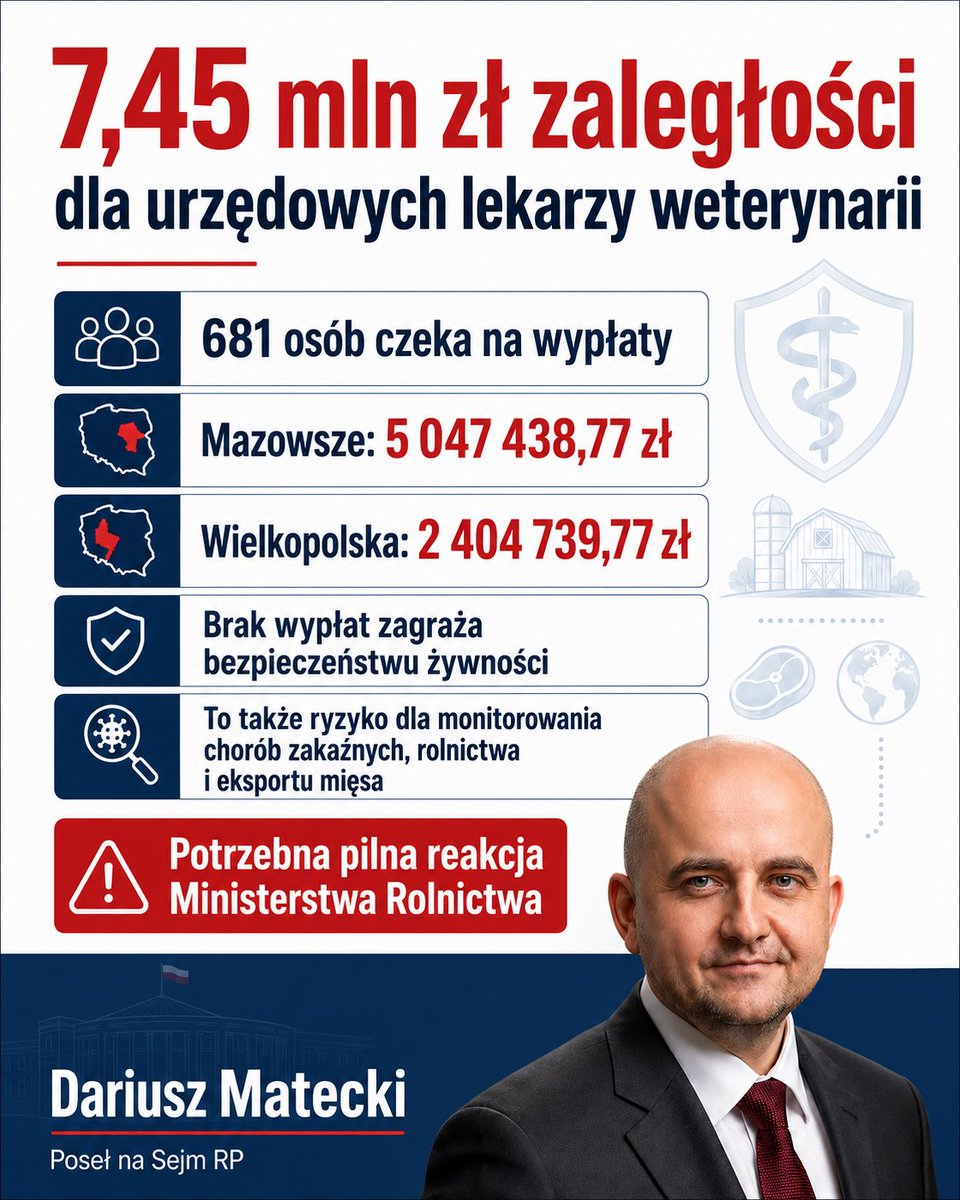
Jak to jest możliwe, że państwo nie potrafi na czas zapłacić ludziom, od których pracy zależy bezpieczeństwo naszej żywności, zwalczanie chorób zakaźnych zwierząt i eksport polskiego mięsa? Tylko na Mazowszu i w Wielkopolsce zaległości wobec urzędowych lekarzy weterynarii i https://t.co/CUJN66VoKK #weterynaria #bezpieczeństwożywności #płace #PL

235
Janusz Piechociński Aug 1

Według danych Głównego Inspektoratu Weterynarii od początku roku na obszarze Polski potwierdzono 1517 ognisk ASF dzików. Chorobę potwierdzono łącznie u blisko 3 tys. zwierząt. #ASF #dziki #weterynaria #PL

Janusz Piechociński Jul 30

Na stronie Rządowego Centrum Legislacji pojawił się projekt nowych stawek dla lekarzy weterynarii wyznaczanych przez powiatowych lekarzy weterynarii. Chodzi o prywatnych specjalistów, którzy na zlecenie Inspekcji Weterynaryjnej prowadzą badania zwierząt, pobierają próbki, #weterynaria #lekarzeweterynarii #zmianywprzepisach #PL

Janusz Piechociński Jun 6

Do 2 czerwca potwierdzono 143 ogniska tej choroby zakaźnej, które obejmują ponad 9,7 mln ptaków – wynika z danych Głównego Lekarza Weterynarii. Dla porównania w całym ubiegłym roku ognisk było 121. #choroby #ptaki #weterynaria #PL

Janusz Piechociński May 25

ASF wykryto na dużej fermie produkującej warchlaki w woj. zachodniopomorskim. Inspekcja weterynaryjna ustali, do których gospodarstw trafiły wcześniej sprzedane świnie i jakie mogą być ewentualne skutki dla producentów. #ASF #weterynaria #rolnictwo #PL

Janusz Piechociński May 22

z województwa zachodniopomorskiego Główny Inspektorat Weterynarii poinformował właśnie o wystąpieniu pierwszego w tym roku ogniska ASF świń. Choroba pojawiła się w stadzie liczącym ponad 21 tys. zwierząt. #ASF #weterynaria #Zachodniopomorskie #PL