The Olkiluoto nuclear power plant's unit three has been reconnected to the national grid after a maintenance outage that lasted more than two months. #Olkiluoto #ydinvoima #huoltoseisokki (translated)
The author stated that Petteri Orpo had promised that data centers would not raise electricity prices and criticized the idea that building nuclear power would be a sufficient solution. According to him, the price of nuclear electricity was about twice that of Finland's current average electricity price. He asked whether the intention was to massively support nuclear power or if the issue had been considered. #ydinvoima #sähkönhinta #datakeskukset (translated)
The electricity production of the Olkiluoto nuclear power plant's unit one will be halted on Friday morning due to a valve failure, and the repair is expected to last until the unit can be reconnected to the grid on Saturday. #Olkiluoto #ydinvoima #uutiset (translated)
A radioactive object was found in a death estate in Asikkala, which was determined to be low-enriched uranium fuel, and its origin points to the Soviet Union. #uraani #ydinvoima #Asikkala (translated)
The author described nuclear power as a climate action that also works in unfavorable weather conditions. According to him, Europe needed more nuclear power and not dependence on weather conditions. https://t.co/SP3nLCWjce #ydinvoima #ilmasto #energiatehokkuus #EU (translated)
Kalervo Kummola wondered whether logging forests for a 400-hectare data center and creating hectares-sized clearings for wind turbines was the green transition he meant. According to him, a nuclear power plant would save nature. #VihreäSiirtymä #kestävyys #ilmastonmuutos (translated)
Russia announced that it is negotiating new projects with the United States that utilize electricity produced by Russian nuclear power plants, alongside a recently made diesel agreement in the course of the discussions. #Venäjä #Yhdysvallat #UkrainanSota (translated)
Henri Vanhanen criticized Rosatom's leadership and wrote that the company's arrogance seemed to have no limits. According to him, as Russia commenced the largest invasion of Europe since World War II, the head of the state-owned company responsible for Russia's nuclear weapons program had stated that he expected Finland's "special behavior" to end and the country to return to the Hanhikivi nuclear power project. Vanhanen believed that Finland would no longer negotiate strategic dependencies on the Kremlin's terms. He described the Hanhikivi project as a cautionary example of Russia's efforts to bind Finland's critical infrastructure to its influence for decades. According to Vanhanen, Finland's energy policy should no longer give the Kremlin leverage over the country's security, and Finland's stance or decision not to return to the project with Russia would not change. https://t.co/v2qPS0PMHs #Suomi #Venäjä #ydinenergia (translated)
The Arbitration Court has ordered Rosatom to pay Fennovoima over 600 million euros because the cancellation of Fennovoima's nuclear power project has been deemed illegal. #Fennovoima #Rosatom #ydinvoima (translated)
Henri Vanhanen wrote that Finland had paid billions of euros because, in his opinion, the geopolitical risks posed by Russia were not taken seriously in time. He referred to Fortum's Uniper transactions, in which he claimed nearly six billion euros were lost, as well as Rosatom's assertion that it had won the arbitration concerning the Hanhikivi nuclear power project against Fennovoima. Vanhanen noted that the final resolution and possible compensation were still unclear. Vanhanen said the losses were in the billions and had also been a detriment to taxpayers. According to him, lessons should have been learned from these cases that geopolitics and security policy could not be separated from economic decision-making. He wrote that warnings about Russia's aggression had been issued for years, but economic interests often outweighed them, and he felt that Finland could no longer afford to ignore the realities of global politics until the billion-euro bill arrived. https://t.co/Omv0fRGsLq #geopolitiikka #turvallisuuspolitiikka #Suomi (translated)
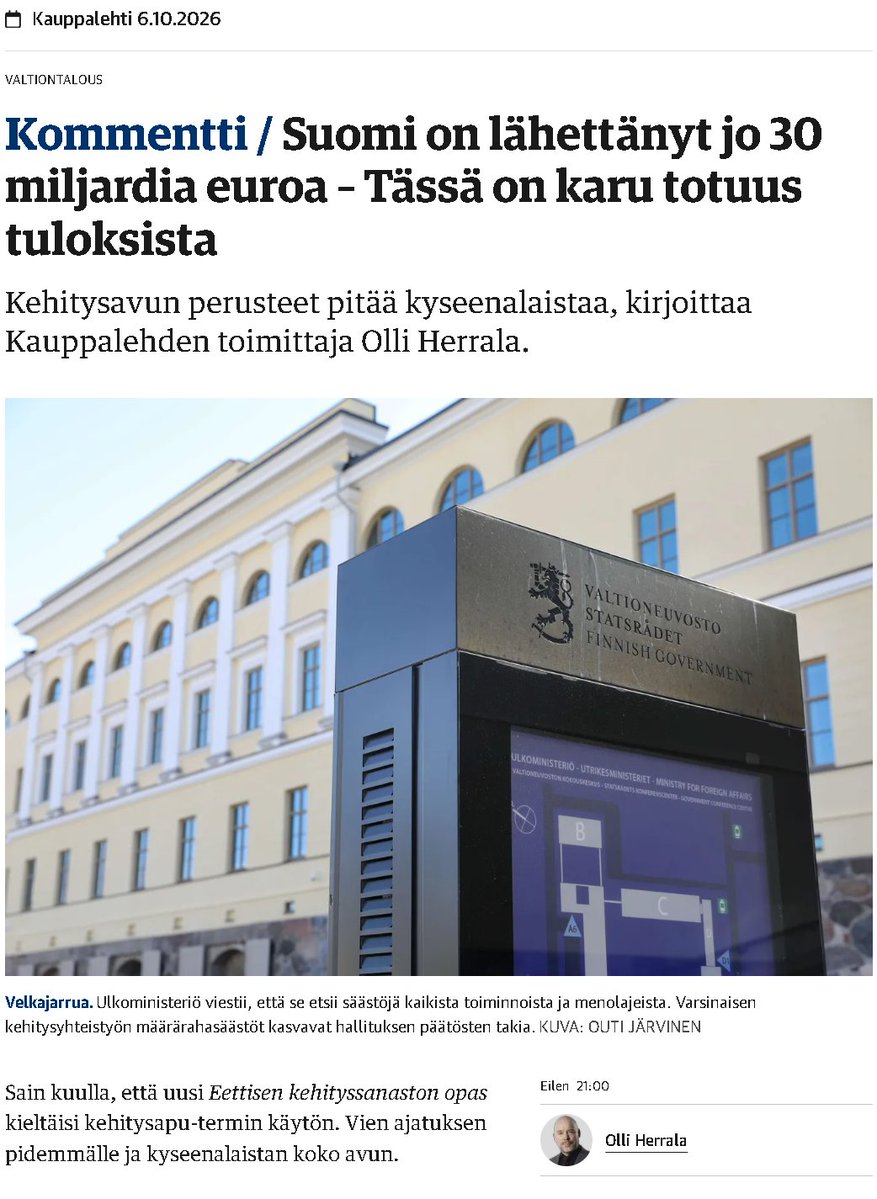
Juho Salo wrote that with the same amount of money, it would have been possible to get 10–15 granite pyramids for Finland, at least five nuclear power plants, or seven biogas plants refining biodiesel from peat. He suggested that development aid be converted into a voluntary tax or banned by law. #kehitysapu #kestävyys #ilmastonmuutos (translated)
Veli Karimies wrote that in his opinion Finland had already wasted 30 billion euros and would spend billions more. He wondered if the money could have been used for the development of Finland, such as building nuclear power, and claimed that this would not have suited the leftists. https://t.co/zugZPIi6Ek #Suomi #politiikka #kehitys (translated)
Henri Vanhanen wrote that he wanted to correct the interpretations of an article by Helsingin Sanomat that dealt with nuclear weapons and said he remained uncertain about what the article ultimately claimed regarding Finland's security. According to him, Finland did not join the NATO nuclear deterrent with little discussion or unnoticed, but rather joined an alliance whose deterrence and defense had been based on nuclear weapons for decades. He described the strategic nuclear forces of the United States as a key basis for NATO's nuclear deterrent. Vanhanen considered that the bombing of Nagasaki was not an example of the current type of nuclear deterrent because Japan did not have a nuclear weapon nor the ability to respond to a U.S. strike. In his view, Nagasaki demonstrated the destructiveness of nuclear weapons and the human risks of their use, whereas the current deterrent was based on the assumption that an attacker had to consider the possibility of retaliation and uncontrolled escalation. Vanhanen assessed that Trump had increased uncertainty regarding the United States' commitment to the conventional defense of Europe and believed Europe would have to bear more responsibility for it. However, he distinguished this from the claim that the U.S. nuclear deterrent had weakened. According to him, the U.S. ability to use nuclear weapons had not diminished, NATO was not dismantling its nuclear plans or arrangements, systems were being modernized, and F-35 aircraft were being introduced into NATO's nuclear missions. Vanhanen stated that the NATO Nuclear Planning Group had confirmed in June that strategic nuclear forces, particularly U.S. forces, remained the ultimate guarantee of the allies' security and had decided to continue strengthening and modernizing the nuclear deterrent. Vanhanen considered it a central uncertainty whether Moscow would believe that the U.S. president would be willing to use nuclear weapons to defend an ally in an extreme situation. He reminded that the question of the U.S. willingness to endanger its own cities for the sake of Europe had been a concern throughout the history of the extended nuclear deterrent and there had been no complete certainty during the Cold War or at the present time. According to him, Finland's option was not a nuclear deterrent or a nuclear-free security environment, as Russia would have its nuclear weapons in any case. Vanhanen wrote that the crucial issue for the deterrent was that the Russian leadership could not be certain that the United States would defend Finland. https://t.co/3C8aAkuMwj #ydinaseet #Nato #Suomi (translated)
This is no longer just a political blunder, but probably the most humiliating national failure in the history of Finland's industry. This analysis reveals black on white how totally and blindly the Finnish state leadership has sold the interests of its own citizens in front of the marketing department of Silicon Valley. Let's break down this "sleight of hand" into three devastating facts that make the government's actions completely inexcusable. First of all, despite all the prime minister-level hype, promises, and the liturgy of the green transition, the outcome is harsh. As a result of Google's massive investments, no new electricity production is being built in Finland—zero megawatts. The company's marketing department worded it so cleverly that the government, desperately thirsty for economic growth, swallowed the bait completely baffled. The leadership was smilingly taken in front of cameras as a guarantor for a project that will not bring a single new watt to the Finnish grid. The second issue is the hijacking of national base power. This is the real, chilling bomb of the news. Since no new electricity will come, where will these massive data centers draw their power? The answer: from our nuclear power. The analysis reveals that as much as 500 megawatts of Finland's nuclear power capacity is dedicated exclusively to Google until 2050. This nuclear power is not just any electricity. It is precisely that stable, weather-independent base power that is vital for Finland's price stability and security of supply. The government is thus surrendering half a gigawatt of infrastructure intended to safeguard Finnish citizens during cold days to a multinational monopoly for the next quarter century. Thirdly, the master has definitively become a servant. When 500 megawatts of stable nuclear power is tied to Google's inflexible use, and no new capacity is brought in, the mathematical equation is devastating for the Finnish consumer. When a calm cold spell strikes in January, our electricity grid will lack that 500-megawatt lifesaver. It is dedicated to AI computation, and the ordinary Finnish citizen will pay for it with horrendous spikes in market electricity prices and increased transmission fees from Fingrid. The Finnish government allowed a multinational company to blind itself with platitudes and let a foreign entity walk straight into the national switchboard. This is not an investment in Finland. This is a hostile resource grab, which the country's own leadership blessed with a smile, sacrificing the energy security and purchasing power of Finns at the altar of the company's marketing trick. In democracy, there is one simple and ruthless rule: if the highest leadership of the state cannot defend the interests of its own people, it must step aside. Looking at this chain of events and the facts revealed by Talouselämä, the demand for Prime Minister Orpo's resignation is no longer just political shouting. It is the only logical conclusion in a situation where the head of government has shown a total lack of judgment in securing national infrastructure and the economy. The prime minister's job is to be the master in his own country. His task is to sit at the negotiating table, look the world's richest companies in the eye, and say: "This is our grid, our nuclear power, and our nature. You will pay for the infrastructure, you will build the new electricity, and you will pay the royalties here. Otherwise, you can take your servers elsewhere." If the prime minister is not capable of this—if he is so desperate that he can be led by a marketing department's word games like a measuring cup—he does not have the backbone that leading Finland requires in this global squeeze. Then there is only one right action: hand the keys back to the people and resign. #Suomi #politiikka #energiapolitiikka (translated)
Uniper -saagassa mikään ei mennyt odotusten mukaisesti. Putinin hyökkäyssota sinetöi epäonnistumisen. Ostotarjous tehtiin vuonna 2017 ja Uniper myytiin syksyllä 2022. Huomionarvoista on kuitenkin se, että tunnistetusti vihamielistä ostokohdetta ei otettu päättäväisesti haltuun, vaikka prosessi venyi ja hankaluudet kasaantuivat. Fortumilla oli vuonna 2020 mahdollista tehdä julkinen ostotarjous ja ostaa Uniper pois pörssistä. Kaikki viranomaisluvat sen läpiviemiseksi oli saatu, eikä mikään estänyt suunnitelman toteutumista. Sen sijaan päätettiin luvata Uniperille, että näin nimenomaisesti ei tehdä - kohteelle, joka oli alun perin, jatkuvasti ja julkisesti uhmakas omistajalleen. Ostamalla Uniperin kokonaan itselleen Fortumin strategiset yritys- ja tasejärjestelyt olisivat olleet mahdollisia Uniperilaisten vastustuksista huolimatta. Uniperin omistamat ruotsalaiset vesi- ja ydinvoimala -osakkuudet – joiden yksistään arvioitiin olevan 6 miljardin arvoiset – olisi voinut siirtää Fortumille ja laittaa Uniperin muu toiminta myyntikuntoon alkuperäisen strategian mukaisesti. Tämä olisi ollut loogista silloin 2020, kun tämä tuli mahdolliseksi. Siis ennen asioiden perkelöitymistä energiahintojen nousun ja Putinin hyökkäyssodan myötä. Mutta ainakin ennen 4.1.2022 julkaistua lisärahoituspakettia ja viimeistään sodan sytyttyä. Näin tekemällä Fortum olisi ”kotiuttanut” varsinaiset ostokohteensa Uniperkaupasta ja jäljelle jäänyt, fossiilista polttava Uniper olisi voitu laittaa myyntiin. Myös neuvotteluasema olisi tietenkin ollut erilainen kesällä 2022 kun kriisi syveni. Myöskään tiedonkulku ei oikein toiminut Fortumin ja valtion välillä. Yrityskaupat ovat Fortumin hallituksen omassa päätäntävallassa, eikä valtiolla ollut edustusta hallituksessa. Fortumin Uniperin ostotarjousaikeet vuodettiin jonkun toimesta julkisuuteen (Bloomberg) samana päivänä, kun oli tarkoitus kertoa omistusohjaukselle ostotarjoussuunnitelmista. Kun Fortum vuonna 2022 tammikuun 4. päivä, julkisti 4 + 4 mrd rahoitusjärjestelyn tuli se ilmeisesti yllätyksenä omistusohjaukselle. Lisäksi järjestely sitoi Fortumin Uniperin kohtaloon – jos jälkimmäinen menisi konkurssiin, myös Fortum menisi konkurssiin. Paljon oli siis pelissä, kun kuvio kriisiytyi kesällä 2022. Fortum saatiin kuin ihmeen kaupalla pelastettua konkurssilta, 4 + 4 mrd takaus ja laina saatiin takaisin, ja vieläpä 0,5 miljoonaa Uniperin osakkeista. Siinä kohtaa se ei ollut oikein minkään arvoinen koska Saksan valtio joutui rahoittamaan Uniperia 20 miljardilla ettei se menisi konkurssiin. Kuten alusta alkaen on ollut tiedossa, poliitikoiden osuus tässä saagassa on käytännössä nolla. Kauppoja hierottiin ja kriisiltä vältyttiin asiantuntija-armeijalla. Päätös olla ottamatta Uniperi haltuun oli Fortumin. #Uniper #Fortum #energia
Hienoa! 🇫🇮 Euroopan investointipankki rahoittaa ensimmäistä kertaa pienmodulaarista ydinvoimaa ja myöntää suomalaiselle startupille Steady Energylle 40 miljoonan euron rahoituksen. Kehitteillä oleva reaktori tuottaa turvallista ja puhdasta kaukolämpöä. EIP:n rahoituksen #ydinvoima #kestäväenergia #EIP #FI
Miettikää, jos Suomi ei olisi mennyt täysillä mukaan vasemmistolaiseen viherhulluuteen, vaan olisikin tuulimyllyjen sijaan rakentanut ydinvoimaa. Meillä olisi nyt sähköä yllin kyllin kaikille suomalaisille ja tuleville datakeskuksille. #Suomi #ydinvoima #energia
Fortum ja Google suunnittelevat uuden ydinvoimalan rakentamista Suomeen, jossa Loviisassa on valmiina 300 hehtaaria maata useiden reaktoreiden sijoittamiseen. #ydinvoima #Fortum #Google
AfD:n voittoa on hämmästelty. Ei siinä itse asiassa ole mitään kummallista. Muut puolueet olivat aiemmin typerehtineet niin perusteellisesti, että olisi ihme jos vastareaktioita ei olisi syntynyt. Tässä yksi tyylinäyte: ääretöntä typeryyttä ilmentävä postaus, jossa Saksan-demarit hehkuttavat saksalaisen ydinvoiman alasajoa. Vuosi on 2023. Suomennettuna: "Ydinvoima? Näkemiin!" Kuva julkaisu sinä päivänä, jossa viimeiset kolme jäljellä olevaa ydinvoimalaa Baijerissa, Ala-Saksissa ja Baden-Württembergissä suljettiin. Pölvästöinnin suoritti nk. liikennevalohallitus 🔴SPD, 🟢vihreät ja 🟡liberaalit. #AfD #Saksapolitiikka #ydinvoima
Google ostaa 22 vuodeksi puolet Loviisan ydinvoimalan kapasiteetista. Rakentaa kolme datakeskusta lisää ja laajentaa nykyisiä. Olin hetken huolissani sähkön hinnasta ja riittävyydestä mutta “Orpo sanoo olevansa kuitenkin vakuuttunut, että sähkö riittää”, joten rauhotuin. https://t.co/gPxneW739v #ydinvoima #data #sähkö