BETA nonprofit public democratic european moderated

Search

#kehitys

Mika Merano wrote that the concern over the support for the National Coalition Party had led to communication guidelines, which he claimed originated from Ellun Kanoilta or imams. He assessed that the guidelines resulted in criticism from the Finns Party and discussions about inheritance tax. Merano said he understood why the National Coalition Party did not want to eliminate inheritance tax by reducing an equivalent amount of development aid. According to him, the party's target program committed to the UN's sustainable development principles, which indicated using 0.7 percent of gross national product for development aid. Merano estimated that this meant doubling the current development aid of about one billion euros. He argued that development aid could not be cut if the goal was to increase the use of tax funds for what he described as virtue signaling and for financing, among other things, swimming pools, private zoos, and golf courses. According to him, this would be the case even if the cut would allow for the elimination of the inheritance tax. #Kokoomus #Perintövero #Kehitysapu (translated)


Joni Juusela wrote that inheritance tax was one of the most harmful taxes in Finland and should be abolished. Working in the financial sector, he stated that he could see its practical disadvantages and said that Finland needed family businesses committed to growing in the country from generation to generation. Juusela believed that the impact on public finances should be considered when abolishing the tax, as government bond rates were rising globally, in his opinion. He warned of a repeat of the situation in Britain following Truss's mini-budget, when large unfunded tax cuts spooked the bond markets. To secure financing, he suggested cutting development aid and removing the tax exemption for foundations and associations. Juusela reminded that small inheritances were tax-free at that time. If inheritance tax were to be replaced with capital gains tax, he believed that the change should not drastically tighten the taxation of small inheritances, for example when selling old apartments. He proposed protective measures during the transition, such as a tax deferral right similar to Sweden's or deemed acquisition costs, so that the middle class could also have the opportunity to build wealth that spans generations. #perintövero #perheyritykset #kansankapitalismi (translated)

Otto Meri criticized the cuts to the prosecution service and compared them to the tax-free dividends of trade unions, the tens of millions granted in corporate support to publicly traded companies, and the hundreds of millions in development aid. According to Meri, the handling of a typical criminal case could already take up to five years, and the cuts would further prolong legal proceedings. He assessed that this would particularly increase the uncertainty of crime victims. Meri considered the realization of criminal responsibility to be one of the pillars of the rule of law and stated that the judiciary should be strengthened rather than weakened. He viewed the cuts as a wrong direction. #oikeusvaltio #rikosoikeus #yritystuet (translated)

Niko Sillanpää wrote to Otto Juote that according to Ellun kanat and Miltton, cutting development aid and immigration from developing countries would reduce the votes of educated women voters in the avocado sandwich zone. He also said on the same basis that the Muslim Brotherhood should not be voted against. #politiikka #maahanmuutto #kehitysapu (translated)

Otto Juote asked whether it was true that the abolition of inheritance tax failed in the government because the National Coalition Party and the Swedish People's Party did not agree to the conditions set by the Finns Party regarding cuts to development aid and tightening immigration policies. #perintövero #politiikka #Suomi (translated)

Roni Arvonen wrote that decision-makers would prefer to raise the retirement age of working Finns rather than cut development aid or Kela benefits for immigrants. He estimated that the patience of ordinary working Finns regarding such spending would run out at some point. #eläkkeet #kehitysapu #maahanmuutto (translated)

Tuomo Saarni pondered the significance of organizations and development aid, stating that he would rather raise the retirement age than give them up. According to him, salaries in the public sector's middle management and above were extremely high while the private sector struggled with profitability. He also wrote that solo entrepreneurs ceased their operations because they could not manage their YEL payments, and believed that the value map of society was misaligned. #kehitysapu #yrittäjyys #julkinensektori (translated)

The police are looking for a missing 17-year-old boy with a developmental disability from the Renkomäki area of Lahti, who left for the city center on Friday morning and has not been reachable since then. #Kadonneet #LahdenKaupunginUutiset #Poliisi (translated)

17-vuotias poika kateissa Lahdessa

Otto Juote criticized the National Coalition Party for allegedly abandoning its values and becoming an assistant to the right-wing government. He wrote that disappointed voters were shifting to support the Left Alliance and the Social Democratic Party and questioned where the previously promised projects, such as Garden Helsinki, senior spa vouchers, and the sale of natural monopolies to international investors, had gone. Juote ironically described the National Coalition Party as a leftist social-liberal party, which in his view had previously supported, among other things, state-owned projects, service vouchers, increased immigration from developing countries, climate actions, and support packages. He claimed that the party had also held onto acquired benefits while it spoke of cuts and reducing debt. Additionally, Juote asked why discussions about entrepreneurship, economic growth, and warnings about right-wing policies seemed to have disappeared from the party. He wrote that Orpo's National Coalition Party no longer reflected the pragmatic interest group and system party that he had previously supported. Juote estimated that he would likely vote for a red tie-wearing socialist in the upcoming elections instead of a blue tie-wearing one for the first time. #Kokoomus #Vasemmistoliitto #Politiikka (translated)

Elina Hiltunen wrote that she found the situation regarding abortion sad. According to her, abortion concerned a new human body in its early stages of development, needing the protection of the mother's womb instead of the woman's body. Hiltunen asked why the most vulnerable should not have the right to live, and described people as cold and selfish. She demanded an end to the normalization of abortion. #abortti #ihmisoikeudet #elämänpuolustaminen (translated)

Raimo Savipakka wrote that he agrees with Jari. He urged to reduce the public sector, development aid, and the status of the nobility, as well as to carry out municipal mergers and reduce the number of social and healthcare regions. According to Savipakka, pensions should not be touched, however. https://t.co/adBi50XaJ9 #Suomi #politiikka #talous (translated)

Martti Kosonen wrote that the Finns Party's line worked according to him. He claimed that the National Coalition Party was distributing money to developing countries, Palestinians, immigrants, organizations, what he characterized as pseudosciences, unnecessary business subsidies, as well as to the EU, the UN, and railways he described as unnecessary, while according to him, the Finns Party did not distribute money for these purposes. Kosonen also claimed that the National Coalition Party was taking money from retirees, heirs, and elderly care facilities. He said the list was endless and considered that the National Coalition Party could no longer function as the governing party, but the Finns Party could. In his writing, he noted the Finns Party, Riikka Purra, and Wille Rydman. https://t.co/MiANyh6CEP #perussuomalaiset #politiikka #Suomi (translated)

Juho Salo criticized Finland's pension system and wrote that if the retirement age were to be raised, it could, in his opinion, be increased all at once to 100 years. He argued that in the system, a worker could pay pension contributions for 50 years, which would correspond to 25 percent of their salary, and receive a pension only at the age of 74. Salo pointed out that, according to him, pension accrual could not be collected. Salo called the system an economic catastrophe. He calculated the total amount of pension contributions and other shares to be 33.7 billion euros: 28.2 billion for occupational pensions, 0.7 billion for employees' shares, and 4.8 billion euros for state contributions. According to him, this amount could be used to pay a monthly basic income of 656 euros in addition to current social benefits and wages without tax increases. He compared the current system to a model where the retirement age would be 50 years and the pension would be 900–1,100 euros per month. Salo believed that money available earlier could be invested by individuals. He also criticized that those born before 1964 would receive the promised pension, while later generations would be left with the bill. Salo proposed that an investment of about 800 euros per month for 25 years would accumulate 240,000 euros without returns and over a million euros with investment returns. He related his comparison to the MSCI World index for the years 2001-2026 and said that wealth would remain for inheritance if 3-4 percent was withdrawn annually. According to him, such a system could make Finnish workers millionaires by the age of 50-60 and free up jobs sooner. Additionally, Salo criticized trade unions for not organizing strikes against pension contributions, development aid, and financing immigration, in his view. He compared the pension system to economic development aid and described it as an even worse solution. #eläke #perustulo #kansantalous (translated)

Korson Jussi wrote that he had asked artificial intelligence to list the countries in the world where development aid expenditures exceed the police budget. According to him, the list included Luxembourg, Norway, Sweden, Finland, and Denmark out of a total of 210 countries. He also noted that Finland is paying off debt. #kehitysapua #Suomi #maailmanmaat (translated)

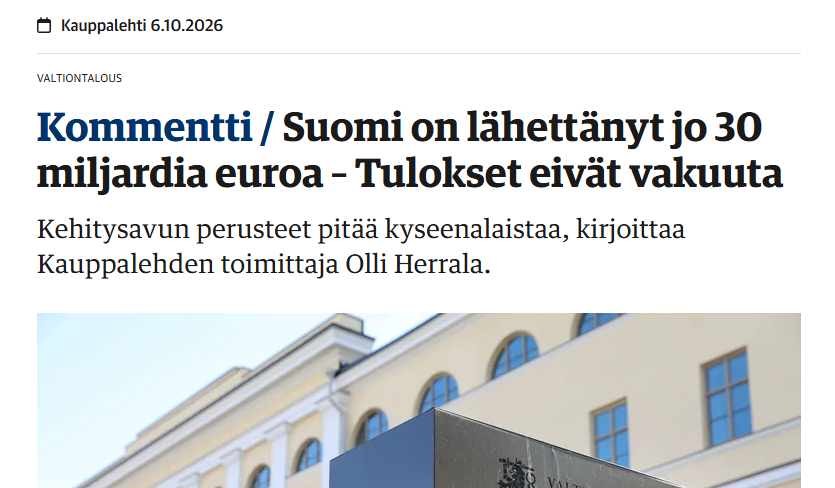
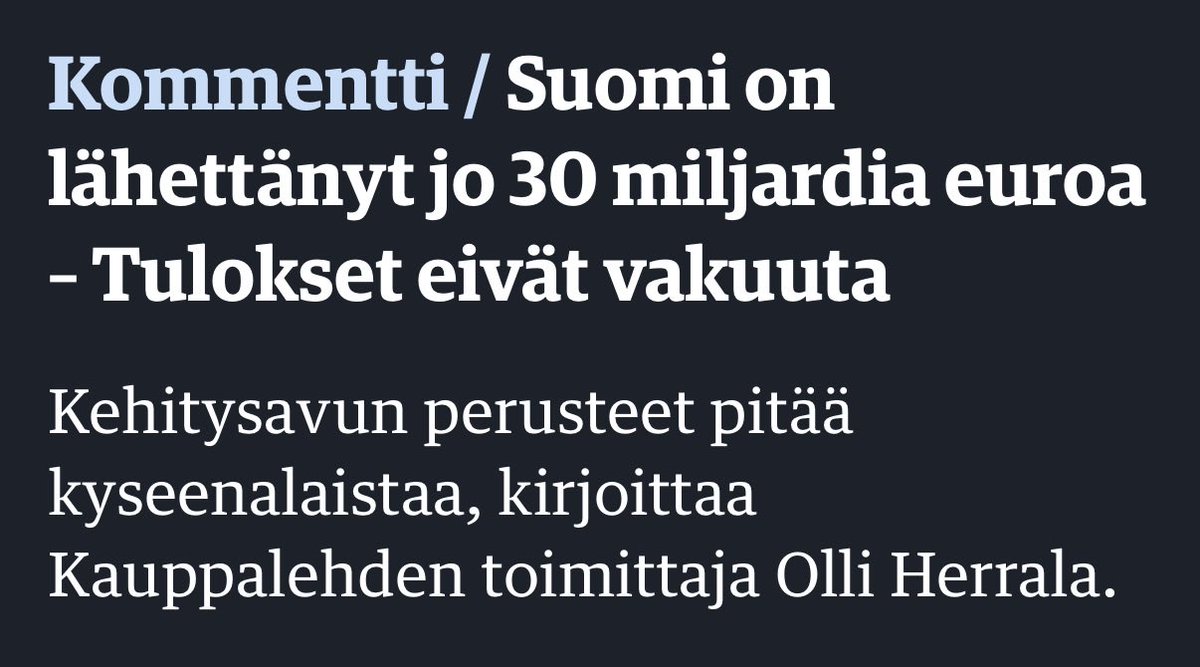
Joni Juusela wrote that Herrala's estimate of 30 billion in development aid did not reflect what he considered a terrible situation, as the aid was financed by debt. According to Juusela, the 30 billion euros in development aid had accrued about 15-30 billion euros in interest expenses. He estimated that interest would be about 0.5 billion euros this year at an effective interest rate, or about 1.1 billion euros if the debt stock were to be renewed under current market conditions. Juusela wrote that the interest expenses on the debt taken for development aid would soon surpass the aid itself. He called for the cessation of development aid and stated that only the True Finns were credible in this matter. #kehitysapu #velka #korkokulut (translated)

Jukka Lepikkö wrote that 30 billion euros was a large amount to be given abroad while Finland's economy was in difficulties. He referred to the views of British economist Peter Bauer, according to whom in development aid the poor of rich countries transfer money to the rich of poor countries, and criticized the fact that Finland took on debt to provide money for aid abroad. According to Lepikkö, Finland became indebted and violated EU treaties when the debt ratio was 90 percent. He believed that the debt had built a large public sector, which also included the task of providing support to foreign countries. According to him, development aid led to dependency on support and increased immigration from Africa. Lepikkö referred to Zambian economist Dambisa Moyo, who argued that development aid harmed Africa and that dependency on support hindered positive development by corrupting local markets. He wrote that development aid should be stopped. #kehitysapu #velka #talous (translated)

Juho Salo wrote that with the same amount of money, it would have been possible to get 10–15 granite pyramids for Finland, at least five nuclear power plants, or seven biogas plants refining biodiesel from peat. He suggested that development aid be converted into a voluntary tax or banned by law. #kehitysapu #kestävyys #ilmastonmuutos (translated)

Rami Kurimo wrote that, in his opinion, in development aid, the poorer people of wealthy countries transfer money to the wealthy of poorer countries. He also claimed that Finland took on debt to distribute money abroad, and asked whether this made sense. He cited Kauppalehti as a source. https://t.co/fNpy9wfXTs #kehitysapu #velka #rahajako (translated)

Sture Fjäder wrote that development cooperation should be completely stopped and development aid reduced to zero. According to him, a country in debt cannot act as a benefactor. He referred to a publication stating that Finland had already sent 30 billion euros and assessed the results as unconvincing. https://t.co/BSaGunsGwk #kehitysyhteistyö #kehitysapu #Suomi (translated)

Jari Sarasvuo asked whether the risk for young girls to become victims of child marriages, human trafficking, and violence was smaller before the current climate crisis. He wrote that he had been to developing countries twenty years ago and had participated in development work, but he said that his experiences did not correspond to such a notion. #ilmastokriisi #lapsiavioliitto #ihmiskauppa (translated)