Delighted for Harry Kane! A triumph for the hard-working, modest, team player and family man. The best footballer in the world is ruthlessly brilliant and creative, but he’s also the model professional

Delighted for Harry Kane! A triumph for the hard-working, modest, team player and family man. The best footballer in the world is ruthlessly brilliant and creative, but he’s also the model professional

The colorful protest 'Street for kids' returns to Italy, with 120 actions in 15 cities to call for safer school roads and a reduction in the speed limit, involving hundreds of children, parents, and teachers in creative activities. #StreetForKids #SicurezzaStradale #MobilitazioneCivica (translated)

The Cheshire cat wrote that a woman who, in his opinion, was not born in France embodied a hundred times more his conception of France—enterprising, creative, and resourceful—than another woman he described as bourgeois and privileged. He added that the latter had received everything from life and was inventing a revolutionary path for herself in order to finally feel something. #France #entrepreneuriat #créativité (translated)

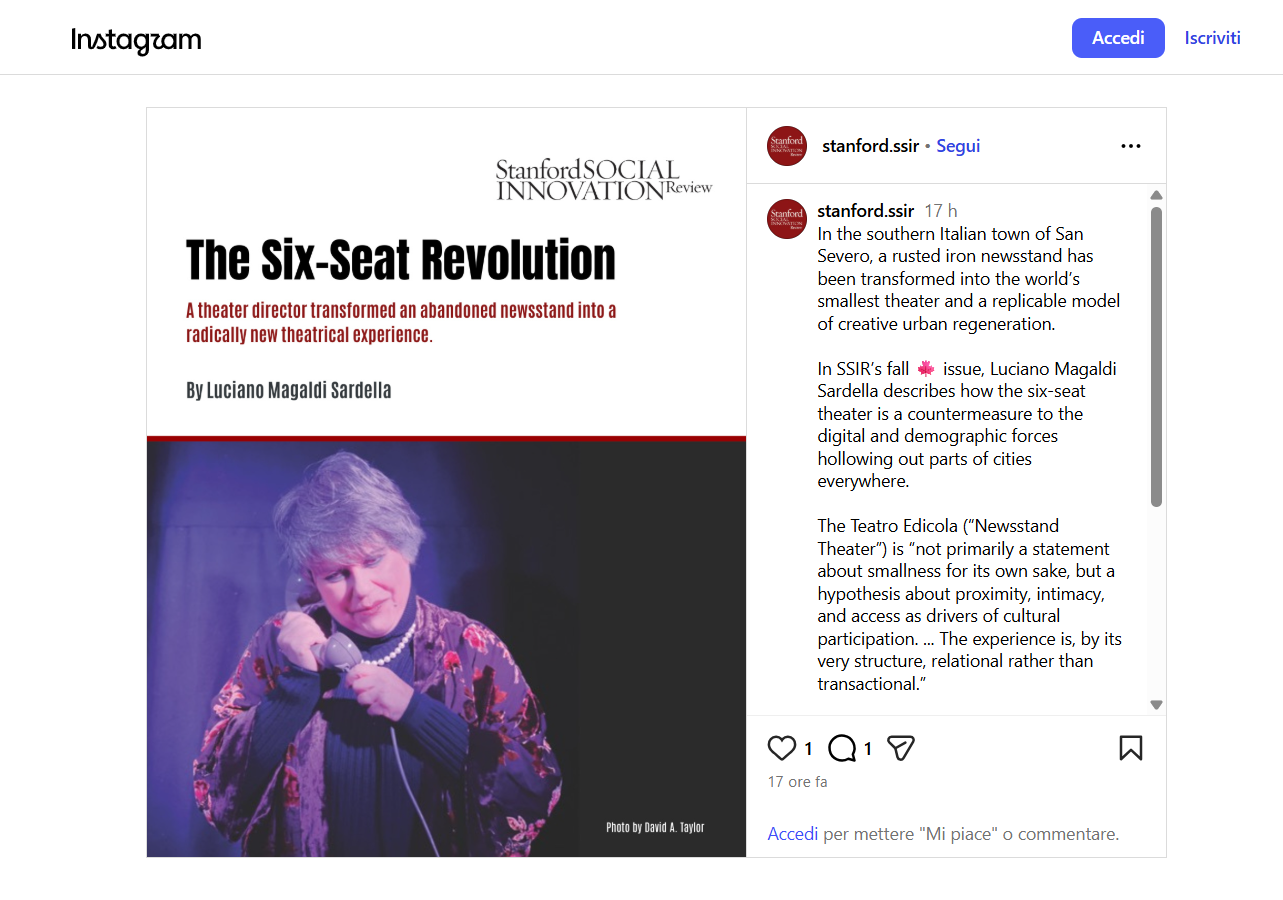
“STANFORD SOCIAL INNOVATION REVIEW (INSTAGRAM)” — “THE SIX-SEAT REVOLUTION: A THEATRE DIRECTOR (FRANCESCO GRAVINO) TRANSFORMED AN ABANDONED NEWSSTAND INTO A RADICALLY NEW THEATRICAL EXPERIENCE” by LUCIANO MAGALDI SARDELLA https://ssir.org/bios/luciano-magaldi-sardella SOURCE: https://www.instagram.com/p/Deor7xKlwNH/ In the southern Italian town of San Severo, a rusted iron newsstand has been transformed into the world’s smallest theater and a replicable model of creative urban regeneration. In SSIR’s fall issue, Luciano Magaldi Sardella describes how the six-seat theater is a countermeasure to the digital and demographic forces hollowing out parts of cities everywhere. The Teatro Edicola (“Newsstand Theater”) is “not primarily a statement about smallness for its own sake, but a hypothesis about proximity, intimacy, and access as drivers of cultural participation. … The experience is, by its very structure, relational rather than transactional (Francesco Gravino).”
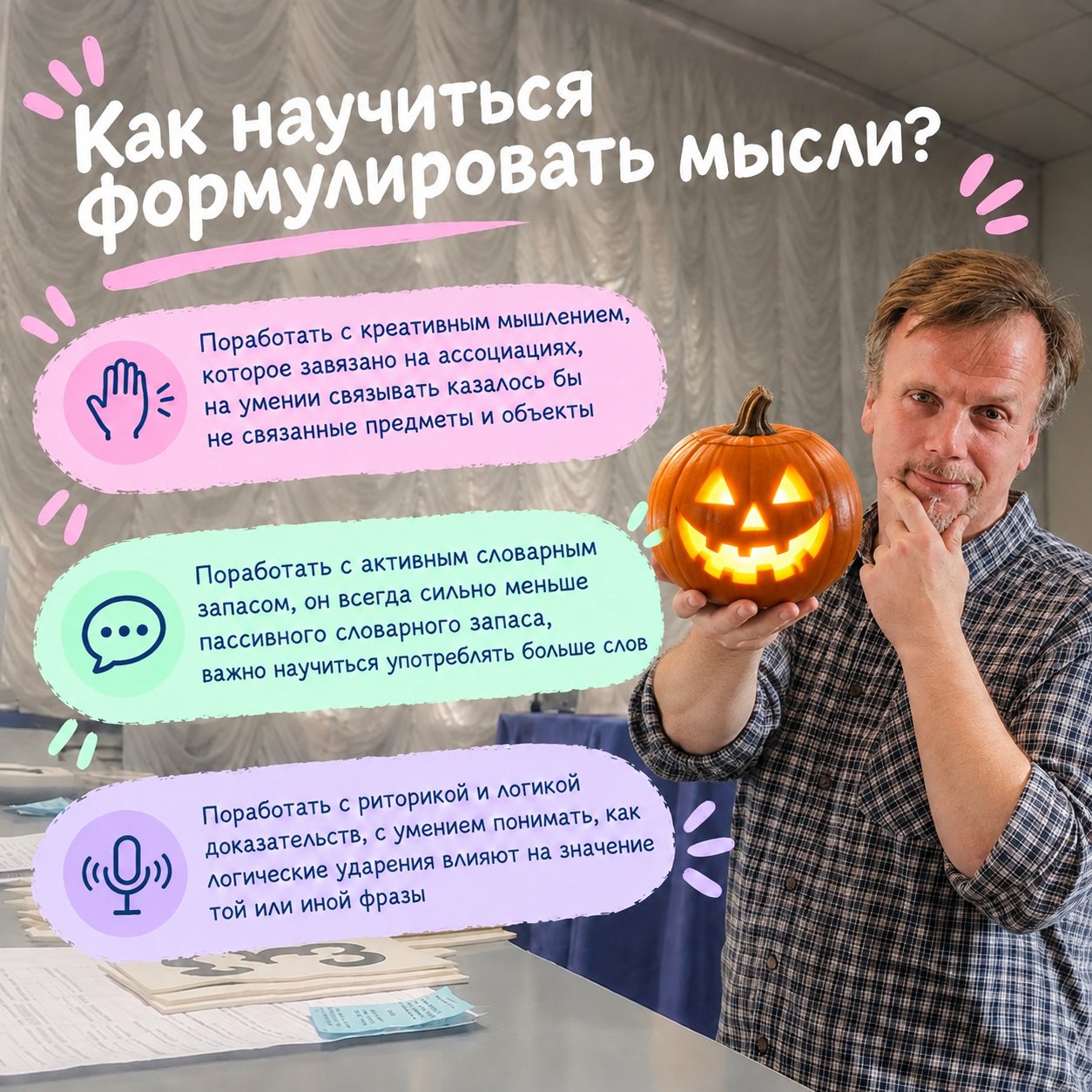
Develop #Creative #Thinking: Practice linking seemingly unrelated objects. Expand Active Vocblry: use more words, as active vocabulary is smaller than passive. Master #Rhetoric & Logic: Understand logical proof and how emphasis changes meaning. #trainer #publicspeaking

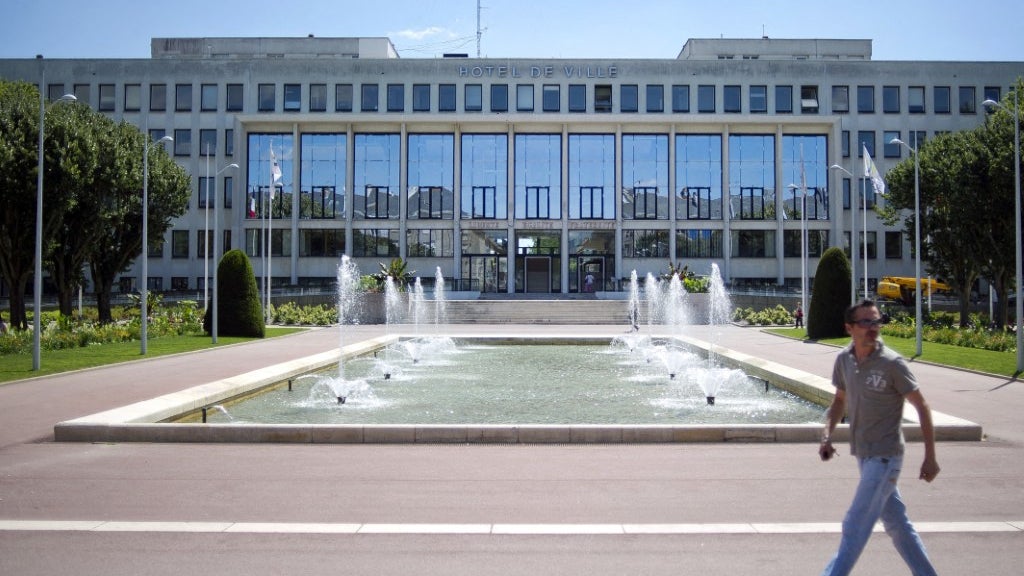
David Samzun was elected mayor of Saint-Nazaire in the second round of the 2026 municipal elections, winning 48.53% of the votes with his list Saint-Nazaire fraternal, responsible, and creative. #Municipales2026 #SaintNazaire #Élections (translated)

The author highlighted findings from Contra Labs’ Creative Intelligence 2026 report, saying 49.1% of creatives reported that AI had increased their earnings and the share of paid projects using AI had doubled over the past year. The author also said ChatGPT was just 1% behind Photoshop among the most-used tools.

The author asked whether the AI era could benefit people with ADHD, saying they tended to be more inclined to generate ideas and achieve creative results in the real world, while AI was particularly effective at helping turn ideas into reality. https://t.co/BJTHiWESJf #ADHD #AI #Creativity


How was Portugal's independence day celebrated? 🇵🇹 🔥 https://t.co/1qmuXl0B5z #Portugal #Independência #Festas (translated)

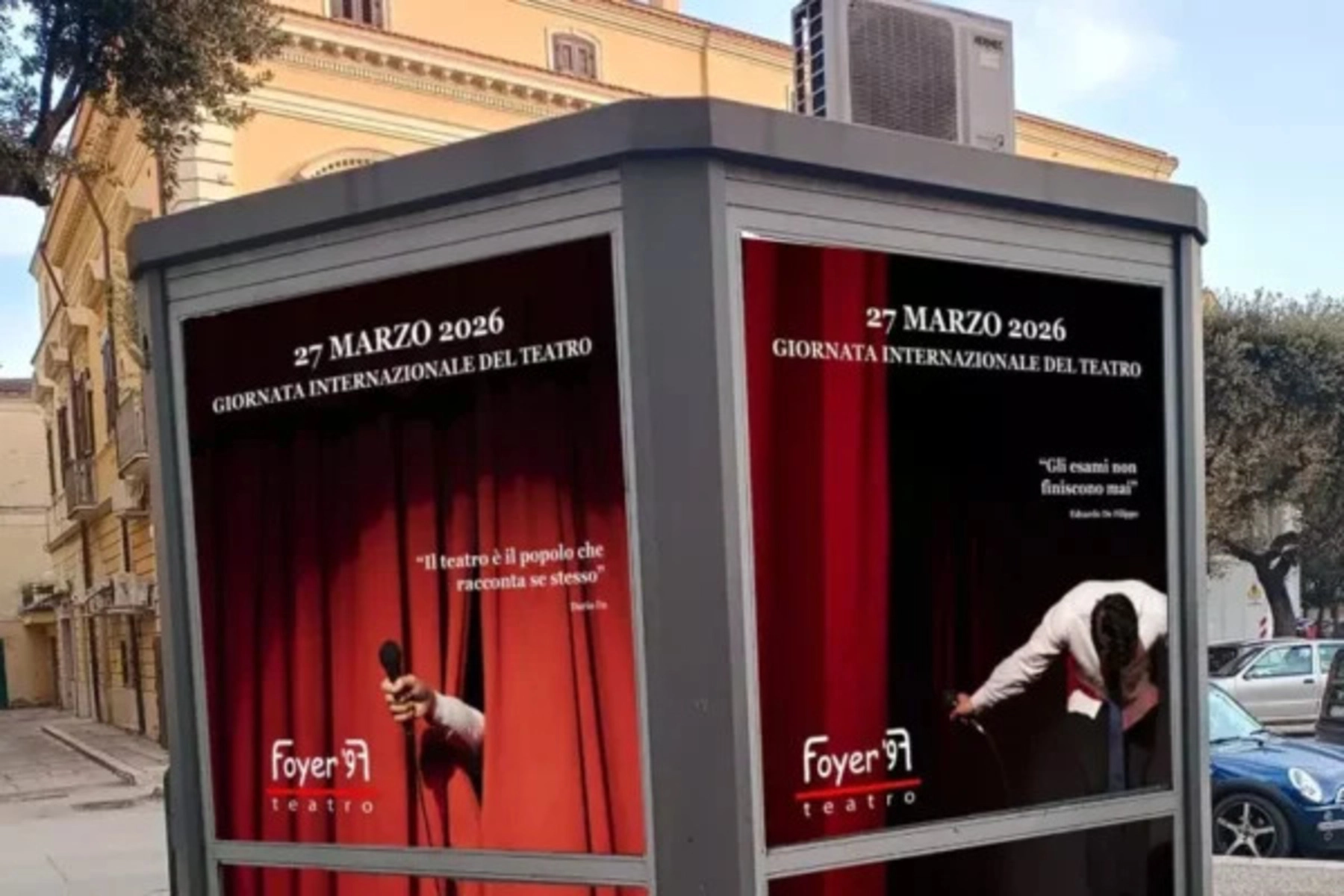
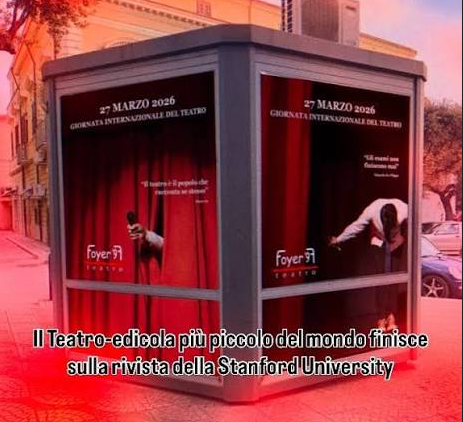
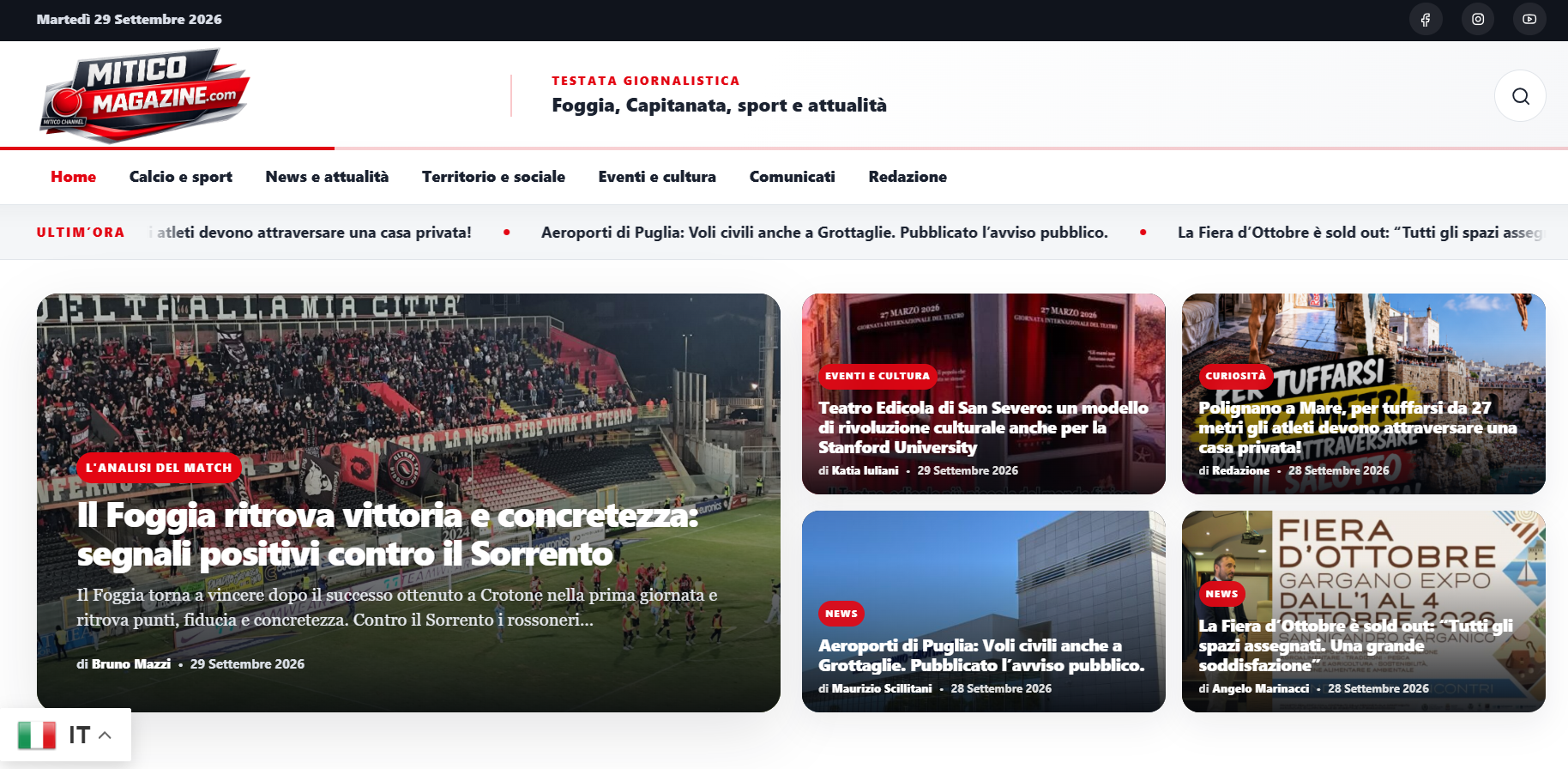
Mitico Magazine - The Teatro Edicola of San Severo: A Model of Cultural Revolution for Stanford University as Well Source: https://www.miticomagazine.com/territorio-e-sociale/teatro-edicola-di-san-severo-un-modello-di-rivoluzione-culturale-anche-per-la-stanford-university/ The Teatro Edicola in Via Tondi In San Severo, a singular metamorphosis has taken place: a newsstand abandoned for at least six years has found a new function and a new identity, transforming into one of the smallest and most unusual theatre stages in the world. An experiment born in the heart of the town which, in just a few months, has moved beyond local boundaries, attracting attention even overseas. It is called Teatro Edicola and it is a project conceived by the company Foyer '97, artistically directed by Francesco Gravino, which has brought the old newsstand in Via Tondi back to life through a formula that is both essential and surprising. Foyer '97 Foyer '97 APS was established as a formally constituted association active in the cultural sector in San Severo in 1997, born from the vocation of a group of actors, directors and theatre enthusiasts, with the aim of building a "living" and accessible theatre in the town. Over the years the company has developed a repertoire that includes texts from the classical tradition, contemporary dramaturgy, comedy and experimental projects, not limiting itself to the mere production of theatre shows, but also organising theatre courses and workshops and educational and cultural projects characterised by a strong inclusive ethos, particularly in schools. Foyer '97 does not always have a fixed artistic ensemble, but works with different performers and collaborators depending on the project; the only indispensable presence is that of Francesco Guido Gravino himself, actor, director and artistic director of the theatre company. The distinctive feature of Foyer '97 is certainly the value of social and cultural promotion attributed to theatre, the extremely close relationship with the audience and the search for a type of theatre outside conventional spaces, with cemeteries, trains, bell towers, and now a newsstand, as its backdrop. Six spectators, a few minutes and a minimal distance between stage and audience The project was launched on 27 March 2026, on the occasion of World Theatre Day, offering a theatrical experience built around a radical reduction of the conventional spaces and times of performance. The idea was born not only from the search for unconventional spaces, but also from "Edicola Fiore", the morning press review with a strongly ironic tone presented by Rosario Fiorello and Stefano Meloccaro, which was broadcast first only on Fiorello's social channels between 2011 and 2014, and then also on radio and television between 2016 and 2018. The review took its name from the diminutive of its founder, Fiore, and from the newsstand of a friend of Fiorello's in Via Flaminia Nuova in Rome, where the showman would meet early in the morning with a group of friends to read the newspapers. The San Severo newsstand was granted free of charge by its owner Pino Frau to the theatre group which, after obtaining temporary authorisation and institutional support from the Municipality of San Severo, refurbished it within two weeks at a cost of less than €3,000. Just six seats, a total surface area of 4 sq m, of which only 2 are for the stage area, less than a metre between actors and audience, a curtain, a lectern, two lights, performances lasting between 5 and 15 minutes, audience rotation every quarter of an hour: apparently minimal elements that end up subverting the usual relationship between stage and auditorium. Spectators, in fact, find themselves immersed in the stage action, in such proximity to the actors that every gesture, expression and word becomes immediately perceptible. In this way, theatre abandons its traditional spaces and insinuates itself into the everyday life of the street, becoming an intimate, concentrated and almost participatory experience. During the inaugural period admission was free with a subsequent voluntary donation from spectators; in the event of a more stable and longer-term concession, which could lead to seasonal theatre performances, the proposed ticket price would be €5. Audiences reward the experiment Foyer '97's gamble met with public interest right from the start: over 60 people attended the shows in a single afternoon, while the three days that inaugurated the season sold out. From a singular local experiment, the Teatro Edicola thus began to arouse curiosity even outside the province of Foggia, gradually transforming into a case of cultural and social interest, until it reached the American continent. From the province of Foggia to the "Stanford Social Innovation Review" The San Severo experience has now come under the international spotlight: in September 2026, the Stanford Social Innovation Review, an international journal and platform dedicated to social innovation published by the Stanford Center on Philanthropy and Civil Society at Stanford University in California, published on its website and in the Fall 2026 print edition the reportage "The Six-Seat Revolution", written by Dr Luciano Magaldi Sardella, independent journalist and researcher affiliated with the European Open University, and editorially supervised by deputy editor David V. Johnson. In the article, it is argued that the Teatro Edicola attracted attention overseas because the project concentrates cultural innovation, urban regeneration and proximity theatre into just a few square metres: starting from a real urban problem, it recovers an abandoned place with a modest investment, brings performance directly into public space and experiments with a much closer relationship between actors and spectators. From the point of view of theatrical representation, it also highlights how the format, based on micro-stories of five to twelve minutes, taken from great classics such as Goldoni, Chekhov, Ibsen, Euripides and Benni, and on audience rotation every fifteen minutes, transforms the physical limitations of the space into a precise dramaturgical choice, proving to be extremely innovative. All of this makes it possible to address some of the main critical issues in the sector: falling audience numbers, an exclusively elderly audience, reduced resources and distance from traditional cultural venues. The journal also highlights, however, the potential problems: economic sustainability, the need for stable institutional support and the difficulty of replicating the model, which is closely linked to the community and territory of San Severo. A model looking beyond San Severo Despite the difficulties, initial requests for information have already arrived from Lucca and Rome, where there is curiosity about the possibility of getting to know the model more closely and the steps needed to replicate it. The replicability formula, in fact, does not seem to require particularly costly infrastructure: an unused space, a targeted intervention, a cultural idea, in-depth knowledge of the surrounding area and a willingness to return that place to the community can be enough to trigger a new urban function. It is precisely in the disproportion between the modesty of the resources employed and the resonance generated by the initiative that perhaps the most original feature of the Teatro Edicola lies, certainly unique of its kind; there are, however, other examples in Italy of newsstands reused for other purposes: "Edicola 518", a twentieth-century kiosk abandoned in the centre of Perugia, now dedicated to independent publishing, art and cultural production; and in Rome itself, the abandoned newsstand in Piazza Testaccio used temporarily as a stage for a show by Fabio Morgan and the Erno newsstand in the Prati district, which almost every month offers a calendar of events, exhibitions, pop-ups and collaborations with artists and creative enterprises. Small revolutions, therefore, that tell stories of the reappropriation of urban spaces, of creativity and social innovation. And which, it is hoped, will take root in order to look ever further afield.
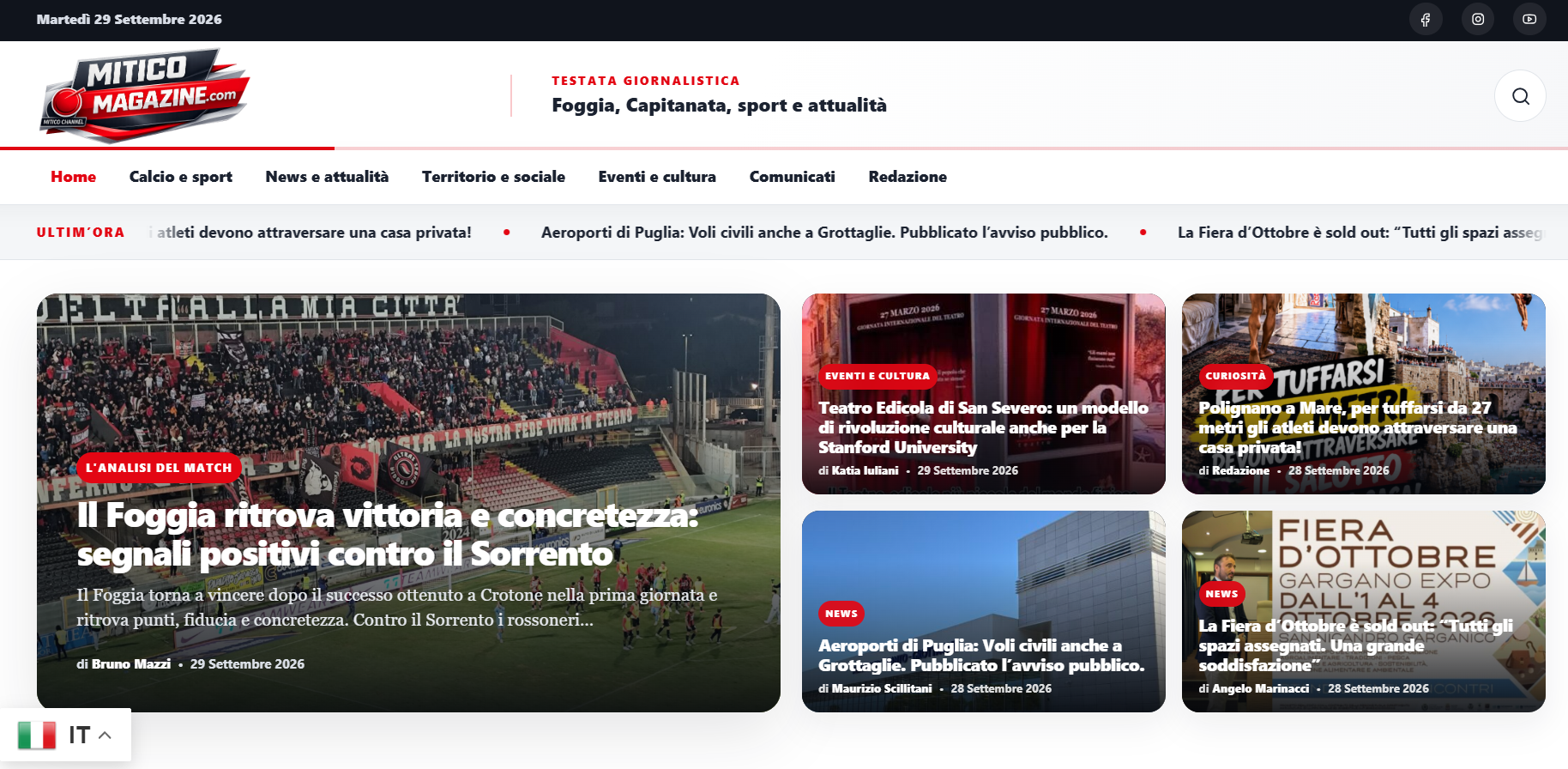
Mitico Magazine - The Teatro Edicola of San Severo: A Model of Cultural Revolution for Stanford University as Well Source: https://www.miticomagazine.com/territorio-e-sociale/teatro-edicola-di-san-severo-un-modello-di-rivoluzione-culturale-anche-per-la-stanford-university/ The Teatro Edicola in Via Tondi In San Severo, a singular metamorphosis has taken place: a newsstand abandoned for at least six years has found a new function and a new identity, transforming into one of the smallest and most unusual theatre stages in the world. An experiment born in the heart of the town which, in just a few months, has moved beyond local boundaries, attracting attention even overseas. It is called Teatro Edicola and it is a project conceived by the company Foyer '97, artistically directed by Francesco Gravino, which has brought the old newsstand in Via Tondi back to life through a formula that is both essential and surprising. Foyer '97 Foyer '97 APS was established as a formally constituted association active in the cultural sector in San Severo in 1997, born from the vocation of a group of actors, directors and theatre enthusiasts, with the aim of building a "living" and accessible theatre in the town. Over the years the company has developed a repertoire that includes texts from the classical tradition, contemporary dramaturgy, comedy and experimental projects, not limiting itself to the mere production of theatre shows, but also organising theatre courses and workshops and educational and cultural projects characterised by a strong inclusive ethos, particularly in schools. Foyer '97 does not always have a fixed artistic ensemble, but works with different performers and collaborators depending on the project; the only indispensable presence is that of Francesco Guido Gravino himself, actor, director and artistic director of the theatre company. The distinctive feature of Foyer '97 is certainly the value of social and cultural promotion attributed to theatre, the extremely close relationship with the audience and the search for a type of theatre outside conventional spaces, with cemeteries, trains, bell towers, and now a newsstand, as its backdrop. Six spectators, a few minutes and a minimal distance between stage and audience The project was launched on 27 March 2026, on the occasion of World Theatre Day, offering a theatrical experience built around a radical reduction of the conventional spaces and times of performance. The idea was born not only from the search for unconventional spaces, but also from "Edicola Fiore", the morning press review with a strongly ironic tone presented by Rosario Fiorello and Stefano Meloccaro, which was broadcast first only on Fiorello's social channels between 2011 and 2014, and then also on radio and television between 2016 and 2018. The review took its name from the diminutive of its founder, Fiore, and from the newsstand of a friend of Fiorello's in Via Flaminia Nuova in Rome, where the showman would meet early in the morning with a group of friends to read the newspapers. The San Severo newsstand was granted free of charge by its owner Pino Frau to the theatre group which, after obtaining temporary authorisation and institutional support from the Municipality of San Severo, refurbished it within two weeks at a cost of less than €3,000. Just six seats, a total surface area of 4 sq m, of which only 2 are for the stage area, less than a metre between actors and audience, a curtain, a lectern, two lights, performances lasting between 5 and 15 minutes, audience rotation every quarter of an hour: apparently minimal elements that end up subverting the usual relationship between stage and auditorium. Spectators, in fact, find themselves immersed in the stage action, in such proximity to the actors that every gesture, expression and word becomes immediately perceptible. In this way, theatre abandons its traditional spaces and insinuates itself into the everyday life of the street, becoming an intimate, concentrated and almost participatory experience. During the inaugural period admission was free with a subsequent voluntary donation from spectators; in the event of a more stable and longer-term concession, which could lead to seasonal theatre performances, the proposed ticket price would be €5. Audiences reward the experiment Foyer '97's gamble met with public interest right from the start: over 60 people attended the shows in a single afternoon, while the three days that inaugurated the season sold out. From a singular local experiment, the Teatro Edicola thus began to arouse curiosity even outside the province of Foggia, gradually transforming into a case of cultural and social interest, until it reached the American continent. From the province of Foggia to the "Stanford Social Innovation Review" The San Severo experience has now come under the international spotlight: in September 2026, the Stanford Social Innovation Review, an international journal and platform dedicated to social innovation published by the Stanford Center on Philanthropy and Civil Society at Stanford University in California, published on its website and in the Fall 2026 print edition the reportage "The Six-Seat Revolution", written by Dr Luciano Magaldi Sardella, independent journalist and researcher affiliated with the European Open University, and editorially supervised by deputy editor David V. Johnson. In the article, it is argued that the Teatro Edicola attracted attention overseas because the project concentrates cultural innovation, urban regeneration and proximity theatre into just a few square metres: starting from a real urban problem, it recovers an abandoned place with a modest investment, brings performance directly into public space and experiments with a much closer relationship between actors and spectators. From the point of view of theatrical representation, it also highlights how the format, based on micro-stories of five to twelve minutes, taken from great classics such as Goldoni, Chekhov, Ibsen, Euripides and Benni, and on audience rotation every fifteen minutes, transforms the physical limitations of the space into a precise dramaturgical choice, proving to be extremely innovative. All of this makes it possible to address some of the main critical issues in the sector: falling audience numbers, an exclusively elderly audience, reduced resources and distance from traditional cultural venues. The journal also highlights, however, the potential problems: economic sustainability, the need for stable institutional support and the difficulty of replicating the model, which is closely linked to the community and territory of San Severo. A model looking beyond San Severo Despite the difficulties, initial requests for information have already arrived from Lucca and Rome, where there is curiosity about the possibility of getting to know the model more closely and the steps needed to replicate it. The replicability formula, in fact, does not seem to require particularly costly infrastructure: an unused space, a targeted intervention, a cultural idea, in-depth knowledge of the surrounding area and a willingness to return that place to the community can be enough to trigger a new urban function. It is precisely in the disproportion between the modesty of the resources employed and the resonance generated by the initiative that perhaps the most original feature of the Teatro Edicola lies, certainly unique of its kind; there are, however, other examples in Italy of newsstands reused for other purposes: "Edicola 518", a twentieth-century kiosk abandoned in the centre of Perugia, now dedicated to independent publishing, art and cultural production; and in Rome itself, the abandoned newsstand in Piazza Testaccio used temporarily as a stage for a show by Fabio Morgan and the Erno newsstand in the Prati district, which almost every month offers a calendar of events, exhibitions, pop-ups and collaborations with artists and creative enterprises. Small revolutions, therefore, that tell stories of the reappropriation of urban spaces, of creativity and social innovation. And which, it is hoped, will take root in order to look ever further afield.
Mitico Magazine - Teatro Edicola di San Severo: un Modello di Rivoluzione Culturale anche per la Stanford University Source: https://www.miticomagazine.com/territorio-e-sociale/teatro-edicola-di-san-severo-un-modello-di-rivoluzione-culturale-anche-per-la-stanford-university/ Il Teatro Edicola di via Tondi A San Severo è avvenuta una singolare metamorfosi: un'edicola abbandonata da almeno sei anni ha ritrovato una funzione e una nuova identità, trasformandosi in uno dei palcoscenici teatrali più piccoli ed insoliti al mondo. Un esperimento nato nel cuore della città che, in pochi mesi, ha oltrepassato i confini locali, attirando l'attenzione anche oltreoceano. Si chiama Teatro Edicola ed è il progetto ideato dalla compagnia Foyer '97, diretta artisticamente da Francesco Gravino, che ha restituito vita alla vecchia edicola di via Tondi attraverso una formula essenziale e al tempo stesso sorprendente. Foyer '97 La Foyer '97 APS nasce come realtà associativa formalmente costituita e attiva nel settore culturale a San Severo nel 1997, dalla vocazione di un gruppo di attori, registi ed appassionati di teatro, con l'obiettivo di costruirne uno "vivo" e accessibile in città. Nel corso degli anni la compagnia ha sviluppato un repertorio che comprende testi della tradizione classica, drammaturgia contemporanea, commedia e progetti sperimentali, non limitandosi però alla semplice produzione di spettacoli teatrali, bensì anche all'organizzazione di corsi e laboratori teatrali e di progetti educativi e culturali caratterizzati da una forte impronta inclusiva, anche e soprattutto nelle scuole. La Foyer '97 non presenta sempre un organico artistico fisso, ma lavora con interpreti e collaboratori diversi a seconda dei progetti; unica presenza imprescindibile è quella, appunto, di Francesco Guido Gravino, attore, regista e direttore artistico della compagnia teatrale. La cifra distintiva di Foyer '97 è data sicuramente dalla valenza di promozione sociale e culturale attribuita al teatro, dal rapporto estremamente ravvicinato con il pubblico e dalla ricerca di un tipo di teatro fuori dagli spazi convenzionali, con cimiteri, treni, campanili, ed ora un'edicola, a fargli da sfondo. Sei spettatori, pochi minuti e una distanza minima tra palco e pubblico Il progetto ha preso il via il 27 marzo 2026, in occasione della Giornata Mondiale del Teatro, proponendo un'esperienza teatrale costruita attorno a una radicale riduzione degli spazi e dei tempi convenzionali dello spettacolo. L'idea nasce non soltanto dalla ricerca di spazi anticonvenzionali, bensì anche da "Edicola Fiore", la rassegna stampa mattutina dal taglio fortemente ironico condotta da Rosario Fiorello e Stefano Meloccaro, andata in onda prima solo sui canali social di Fiorello, tra il 2011 ed il 2014, e poi anche via radio e televisione tra il 2016 ed il 2018. Tale rassegna prendeva il nome dal diminutivo del suo fondatore, appunto Fiore, e dall'edicola di un amico di Fiorello in via Flaminia Nuova a Roma, dove lo showman si ritrovava la mattina presto con un gruppo di amici per leggere i giornali. L'edicola sanseverese è stata concessa gratuitamente dal proprietario Pino Frau al gruppo teatrale che, dopo aver ottenuto l'autorizzazione temporanea ed il supporto istituzionale da parte del Comune di San Severo, ha provveduto a ristrutturarla nell'arco di due settimane ad un costo inferiore ai 3000 euro. Soltanto sei posti a sedere, una superficie totale di 4 m2, di cui solo 2 destinati allo spazio scenico, meno di un metro di distanza tra attori e pubblico, un sipario, un leggio, due luci, rappresentazioni della durata compresa tra i 5 ed i 15 minuti, rotazione del pubblico ogni quarto d'ora: elementi apparentemente minimali che finiscono, però, per sovvertire il consueto rapporto fra palcoscenico e platea. Gli spettatori, infatti, si trovano immersi nell'azione scenica, in una prossimità con gli attori che rende ogni gesto, espressione e parola immediatamente percepibile. Il teatro, in questo modo, abbandona i suoi spazi tradizionali e si insinua nella quotidianità della strada, diventando un'esperienza intima, raccolta e quasi partecipativa. Durante il periodo inaugurale l'ingresso è stato gratuito con successiva offerta libera da parte degli spettatori; in caso di una concessione più stabile e lunga, che possa portare proprio a rappresentazioni teatrali stagionali, il costo del biglietto proposto sarebbe di 5 €. Il pubblico premia l'esperimento La scommessa di Foyer '97 ha incontrato sin dalle prime battute l'interesse del pubblico: oltre 60 persone hanno assistito agli spettacoli in un solo pomeriggio, mentre le tre giornate che hanno inaugurato la stagione hanno fatto registrare il tutto esaurito. Da singolare sperimentazione territoriale, il Teatro Edicola ha così cominciato a suscitare curiosità anche al di fuori della provincia di Foggia, trasformandosi progressivamente in un caso di interesse culturale e sociale, fino a raggiungere il continente americano. Dalla provincia di Foggia alla "Stanford Social Innovation Review" L'esperienza sanseverese, difatti, è arrivata ora sotto i riflettori internazionali: a settembre 2026, la Stanford Social Innovation Review, rivista e piattaforma internazionale dedicata all'innovazione sociale e pubblicata dallo Stanford Center on Philanthropy and Civil Society, all'interno della californiana Stanford University, ha pubblicato sul proprio sito e nell'edizione cartacea Fall 2026 il reportage "The Six-Seat Revolution", firmato dal dr. Luciano Magaldi Sardella, giornalista indipendente e ricercatore affiliato alla European Open University, e seguito editorialmente dal deputy editor David V. Johnson. Nell'articolo, si sostiene che il Teatro Edicola ha attirato l'attenzione oltreoceano perché il progetto concentra in pochi metri quadrati innovazione culturale, rigenerazione urbana e teatro di prossimità: partendo da un problema urbano reale, recupera un luogo abbandonato con un investimento contenuto, porta lo spettacolo direttamente nello spazio pubblico e sperimenta un rapporto molto più ravvicinato tra attori e spettatori. Dal punto di vista della rappresentazione teatrale, inoltre, si evidenzia come il format, fondato su microstorie di cinque-dodici minuti, estrapolate da grandi classici come Goldoni, Čechov, Ibsen, Euripide e Benni, e sulla rotazione degli spettatori ogni quarto d'ora, trasformi i limiti fisici dello spazio in una precisa scelta drammaturgica, rivelandosi estremamente innovativo. Tutto questo permette di far fronte ad alcune delle principali criticità del settore: calo degli spettatori, fasce di pubblico esclusivamente senili, riduzione delle risorse e distanza dai luoghi culturali tradizionali. La rivista ne evidenzia però anche le eventuali problematiche: la sostenibilità economica, la necessità di un sostegno istituzionale stabile e la difficoltà nel replicare il modello, strettamente legato alla comunità e al territorio di San Severo. Un modello che guarda oltre San Severo Nonostante le difficoltà, prime richieste di informazioni sono già arrivate da Lucca e Roma, dove si guarda con curiosità alla possibilità di conoscere più da vicino il modello e le modalità necessarie per riproporlo. La formula di replicabilità, infatti, non sembra richiedere infrastrutture particolarmente onerose: uno spazio inutilizzato, un intervento mirato, un'idea culturale, la conoscenza approfondita del territorio circostante e la disponibilità a restituire quel luogo alla collettività possono essere sufficienti per innescare una nuova funzione urbana. È proprio nella sproporzione fra la modestia delle risorse impiegate e l'eco generata dall'iniziativa che si trova forse la cifra più originale del Teatro Edicola, sicuramente unico nel suo genere; non mancano però, in Italia, esempi di altre edicole riutilizzate per altri fini: "Edicola 518", chiosco novecentesco abbandonato nel centro di Perugia, oggi dedicato all'editoria indipendente, all'arte e alla produzione culturale; e nella stessa Roma, l'edicola abbandonata di piazza Testaccio usata temporaneamente come palcoscenico per uno spettacolo di Fabio Morgan e l'edicola Erno del quartiere Prati, che quasi ogni mese propone un calendario di eventi, mostre, pop-up e collaborazioni con artisti e realtà creative. Piccole rivoluzioni, quindi, che raccontano storie di riappropriazione degli spazi urbani, di creatività e di innovazione sociale. E che, si spera, mettano radici per poter guardare sempre più lontano.

Papa Leon al XIV-lea a condamnat „masacrul inutil” din Europa și a cerut liderilor europeni să reia dialogul și să accepte compromisuri pentru a opri războiul, subliniind necesitatea unei abordări creative pentru promovarea păcii și a relațiilor internaționale. #pace #razboi #PapaLeon
L'article discute de la nécessité de protéger la culture face aux pratiques des grandes entreprises américaines d'IA, qui exploitent des œuvres créatives sans compensation, en plaidant pour l'application de lois similaires à celles mises en place pour la musique et les films. #ProtectionCulture #IA #DroitsD'Auteur

Roberto Cavalli Creative Director Fausto Puglisi comments on Olandria’s recent Cavalli dump on instagram! ✨ OLANDRIA ROBERTO CAVALLI SS27 #OlandriaxRobertoCavalli #RobertoCavalliSS27 https://t.co/iqqddoydG7 #RobertoCavalli #Fashion #Olandria
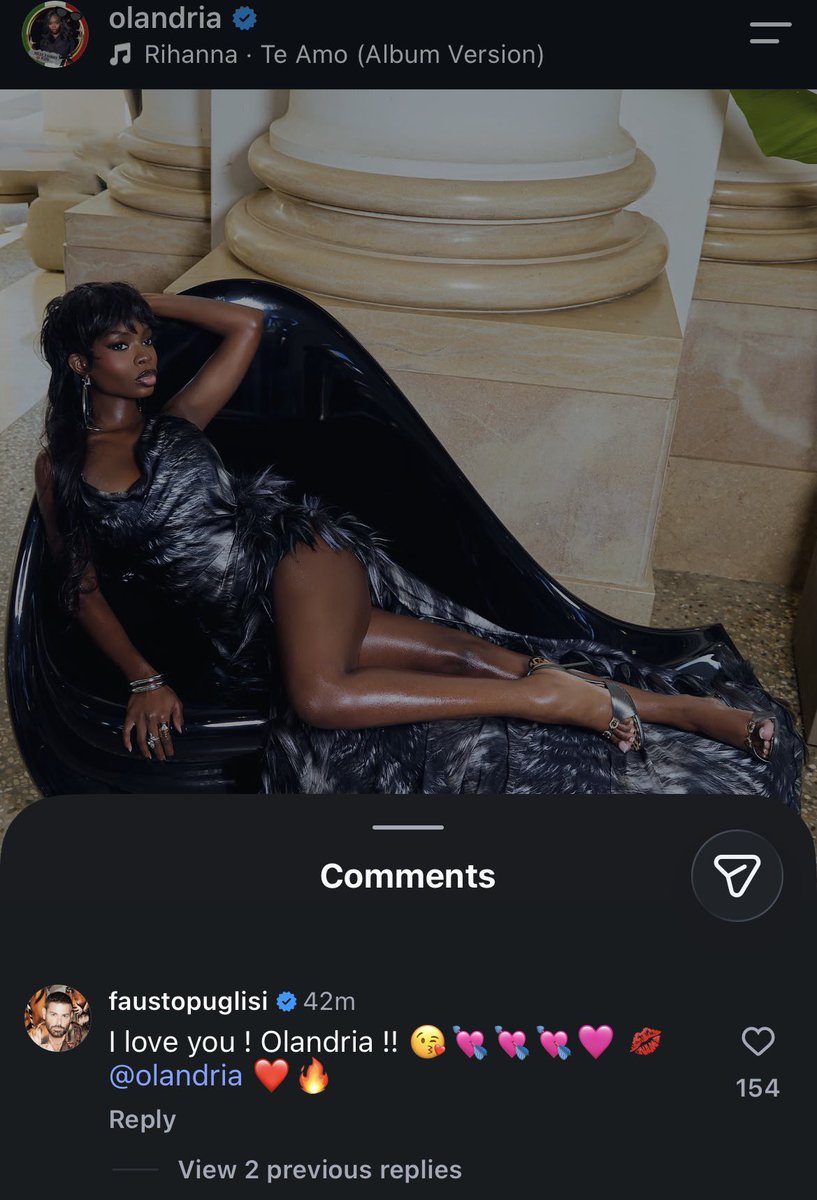

📲 The Creative Director of Roberto Cavalli, Fausto Puglisi, shows love to Olandria via IG! OLANDRIA ROBERTO CAVALLI SS27 #OlandriaxRobertoCavalli #RobertoCavalliSS27 https://t.co/H1qwuXGYlw #RobertoCavalli #Fashion #DesignerCollaboration

The AI Productivity Delusion: As with previous technological revolutions, it is natural to focus on AI's net effects: Will it create more than it destroys? But unlike previous eras of creative destruction, the real question this time is, “Create more of what?” #AI #Productivity #CreativeDestruction #Nospecificcountrycodesarementionedinthetweet.
Информацияна, която съобщих на Си Зин Пин. Ключово значение за интелектуалността има УВ облъчването, което се усилва от север на юг. В Южна Европа то е 30% по-силно от в Северна Европа, а на екватора е 70% по силно. Ефектът върху хората е в синтезирането в кожата на витамин Д, който се трансформира в полови хормони. Те определят външния вид, емоционалността и интелектуалността. Северняците са интелектуални, южняците са емоционални. Емоционалността задушава разума. Всеки градус движение на север и на юг усилват южняшките и северняшките качества. В южните части на южното полукълбо се наблюдава дебилност, в Австралия и Южна Америка. Икономиката и цивилизацията са продукт на интелектуалността. Интелектуалността е в научно-откривателското мислене насочено към решаване на проблемите на живота. Ключово значение има оценката на важните факти, изхвърляне на маловажните факти и създаване на тяхна основа на нови хипотези и теории. Разбирането на важни открития на другите хора ги прави собствено притежание и това също е научно-откривателско мислене. Всичко друго не е интелектуалност. Ключово значение за развитието на икономиката имат иновациите и те стават все по важни. Това е внедряване на нови научни открития в практиката. Южняците нямат научно мислене, нямат наука и научни открития и абсолютно никакви иновации. Те всичко заимстват от Северните Европейци. Те имат тези качества и само те имат иновации. Лидираща роля имат европейските преселници в САЩ. Многобройността на интелектуалното население е много важно за проявленията на интелектуалността. Това е точно като критичната маса при атомния взрив. Руснаците са най-интелектуални, но те нямат механизма осъществяващ иновациите свободната пазарна икономика. Творческа икономика може да има само при ниски данъци и свобода от опеката на властта. Двигател са супер високите печалби. Нови открития се внедряват в практиката защото те са най-печеливши. Високото данъчно облагане което е в полза на властта, изземва парите на икономиката и на гражданите, което убива производството, потреблението и творческите иновации в икономиката, в следствие на възможността успешните, конкурентни фирми да имат свръх печалби. Именно свръх печалби, защото те са единствения мощен стимулатор за решаването на новаторските внедрявания, които са най-рискови и най-опасни от загуба и фалит. Точно това който не е разбрал нищо не разбира от модерна икономика. Интелектуалността е познаване на истината. Словото е красиво и убедително, когато съобщава истини. Слово не основано на истината е фалшиво маниерничене. В френките автори на афоризми Ларош Фуко, Лабруер, Блез Паскал, Маркиз Вовнарк има много голяма концентрация на истини за живота и те развиват вкус към истината е към лъжата. Големият немски философ Хегел твърди, че китайското мислене е митологично, ненаучно и само античното Гръцко и европейското мислене е научно. Интелигентността не се придобива чрез образование; тя се наследява генетично от родителите. Тя произтича от богата капилярна мрежа в мозъка – генетично предавана характеристика, – която осигурява обилно снабдяване с кислород. Тази черта е особено силно изразена сред евреите и арменците в резултат на много поколения (до 800) цивилизован начин на живот, който ги е предпазил от тежкия физически труд в примитивното земеделие – труд, който лишава мозъка и сърцето от кислород, като по този начин намалява интелигентността и съкращава продължителността на живота. Евреите са направили по-голямата част от откритията, жизненоважни за човечеството, което недвусмислено доказва тяхната интелигентност. Твърди се, че 7-те милиона евреи в Израел превъзхождат Китай, въпреки че населението на последната страна наброява 1,4 милиарда души. Северните европейци също притежават висока интелигентност поради студения климат; студеният въздух е по-плътен и доставя повече кислород от топлия. Снабдяването на мозъка с кислород е единственият определящ фактор за високата интелигентност. Ашкеназките евреи, живеещи в Северна Европа, са изключително интелигентни поради две причини: генетично заложената интелигентност и студеният климат. Доказано е, че те са най-интелигентните хора в света. За разлика от тях, южните сефарадски евреи демонстрират потисната интелигентност. Разделителната линия между Севера и Юга е 43-тият паралел; на юг от тази линия повишената емоционалност потиска интелигентността. Китай се намира на юг от 43-тия паралел и няма история на градски живот – истинското проявление на интелигентността, – като вместо това в продължение на хиляди години се е опирал на масово примитивно земеделие. Here is the information I conveyed to Xi Jinping. UV radiation plays a key role in intellect, and its intensity increases from north to south. In Southern Europe, it is 30% stronger than in Northern Europe, while at the equator, it is 70% stronger. Its effect on humans involves the synthesis of Vitamin D in the skin, which is then transformed into sex hormones. These hormones determine physical appearance, emotionality, and intellect. Northerners are intellectual; Southerners are emotional. Emotionallity stifles reason. Every degree of movement northward or southward intensifies these respective "Southern" or "Northern" traits. Instances of intellectual deficiency are observed in the southern parts of the Southern Hemisphere—specifically in Australia and South America. Economy and civilisation are products of intellect. Intellect manifests as scientific, discovery-oriented thinking aimed at solving life's problems. Key factors include evaluating significant facts, discarding trivial ones, and formulating new hypotheses and theories based on the remaining information. Grasping the important discoveries made by others—thereby making them one's own—also constitutes scientific, discovery-oriented thinking. Anything else falls outside the realm of intellect. Innovation is crucial for economic development and is becoming increasingly important; it involves the practical application of new scientific discoveries. Southerners lack scientific thinking, science, and scientific discoveries, and they produce absolutely no innovations. They borrow everything from Northern Europeans. Northern Europeans possess these qualities and are the sole source of innovation. European settlers in the USA play a leading role in this regard. The size of the intellectual population is crucial for the manifestation of intellectuality; it is akin to the critical mass required for a nuclear explosion. Russians possess a high level of intellectuality, yet they lack the mechanism that drives innovation: the free-market economy. A creative economy can only flourish amidst low taxes and freedom from state control. Super-high profits serve as the driving force; new discoveries are put into practice precisely because they yield the greatest returns. High taxation—which benefits the state—drains capital from the economy and citizens alike, stifling production, consumption, and creative innovation. It eliminates the possibility for successful, competitive firms to generate "super-profits"—profits that are essential, as they provide the only powerful incentive to pursue innovative implementations, which carry the highest risks of loss and bankruptcy. Anyone who fails to grasp this point understands nothing about the modern economy. Intellectuality is the knowledge of truth. Speech is beautiful and persuasive only when it conveys truth; speech not grounded in truth is merely hollow affectation. The French aphorists—La Rochefoucauld, La Bruyère, Blaise Pascal, and the Marquis de Vauvenargues—offer a profound concentration of truths about life, cultivating a discerning taste for truth versus falsehood. The great German philosopher Hegel argued that Chinese thought is mythological and unscientific, asserting that only ancient Greek and European modes of thought are truly scientific. Intelligence is not acquired through education; it is genetically inherited from one's parents. It stems from a rich capillary network in the brain—a genetically transmitted trait—that ensures a high oxygen supply. This characteristic is particularly pronounced among Jews and Armenians, a result of many generations (up to 800) of civilized living that spared them from the grueling physical labor of primitive agriculture—labor that deprives the brain and heart of oxygen, thereby diminishing intelligence and shortening lifespans. Jews have made the majority of discoveries vital to humanity, which unequivocally demonstrates their intelligence. It is claimed that the 7 million Jews in Israel surpass China, despite the latter's population of 1.4 billion. Northern Europeans also possess high intelligence due to the cold climate; cold air is denser and delivers more oxygen than warm air. Oxygen supply to the brain is the sole determinant of high intelligence. Ashkenazi Jews living in Northern Europe are exceptionally intelligent for two reasons: genetic intelligence and the cold climate. They are proven to be the most intelligent people in the world. Southern Sephardic Jews, by contrast, exhibit suppressed intelligence. The dividing line between North and South is the 43rd parallel; south of this line, heightened emotionality stifles intelligence. China lies south of the 43rd parallel and lacks a history of urban life—the true manifestation of intelligence—having instead relied on mass primitive agriculture for thousands of years.
"NEWS GARGANO": A KIOSK FOR A THEATRE: IN SAN SEVERO IT CAN BE DONE, AND ITS ECHO EXTENDS BEYOND ITALY SOURCE: https://www.newsgargano.com/unedicola-per-teatro-a-san-severo-si-puo-e-sconfina-litalia/ SAN SEVERO (FG) - Theatre in San Severo is reborn from less than two square metres and six chairs, transmuting a symbol of urban blight into a small international cause célèbre. The virtuous enterprise has been revived by the company Foyer '97, under the artistic direction of Francesco Gravino, protagonist of a project of cultural regeneration that is now transcending the confines of the Province of Foggia. At the heart of the intervention lies the reclamation of an abandoned newsstand in Via Tondi, for years a disused space and now restored to the city in an unprecedented guise. Where once there was a lowered shutter, theatre is now made: but six spectators at a time, actors at but a few paces from their audience, and performances of brief duration, in a direct and radical commerce between stage and city. The experiment, inaugurated on 27th March, has yielded figures that bespeak a tangible cultural need. More than sixty persons attended the performances in a single afternoon, and the three days of the inaugural season were sold out, demonstrating that proximity and quality may yet generate community even in the most residual of spaces. Yet the story of San Severo has swiftly outgrown its local boundaries. In September 2026, the Stanford Social Innovation Review dedicates to the project the reportage "The Six-Seat Revolution", authored by Luciano Magaldi Sardella, researcher, academic and international journalist from Orta Nova of Sanseverese maternal lineage. The work is described by SSIR as: "A theater director transformed an abandoned newsstand into a radically new theatrical experience that is helping to revive the historic center of a Southern Italian town." The Apulian experience is observed not merely for its theatrical originality, but as a replicable paradigm of low-cost social innovation and urban regeneration, capable of activating cultural capital without recourse to grand structures or lavish investment. "One does not require grand theatres to transform a quarter of a city. What is required is a sound idea and the courage to restore to the collectivity a space that has lost its function," emphasised the artistic director Francesco Gravino. "Teatro Edicola was conceived to demonstrate that a locus of encounter and culture may arise anywhere, even within two square metres. That this endeavour should now be studied at an international level, and that enquiries should arrive from cities such as Lucca and Rome, is confirmation that we are upon the right path." The valorisation and preservation of the urban and cultural fabric must inevitably proceed through the creative reclamation of forsaken places. From a derelict newsstand with scarcely six seats to a project capable of commanding international attention: sometimes, to regenerate a city, one need not build, but re-inhabit.
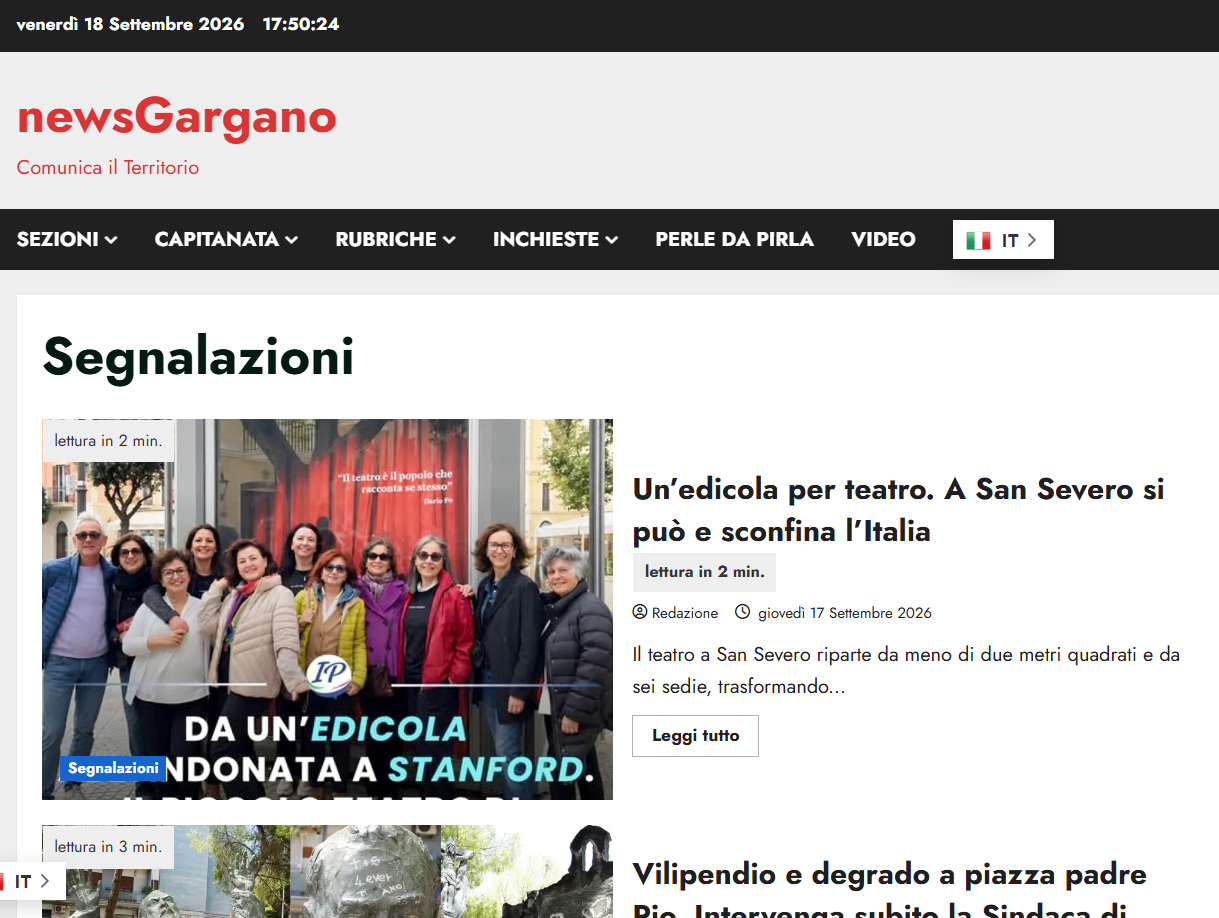

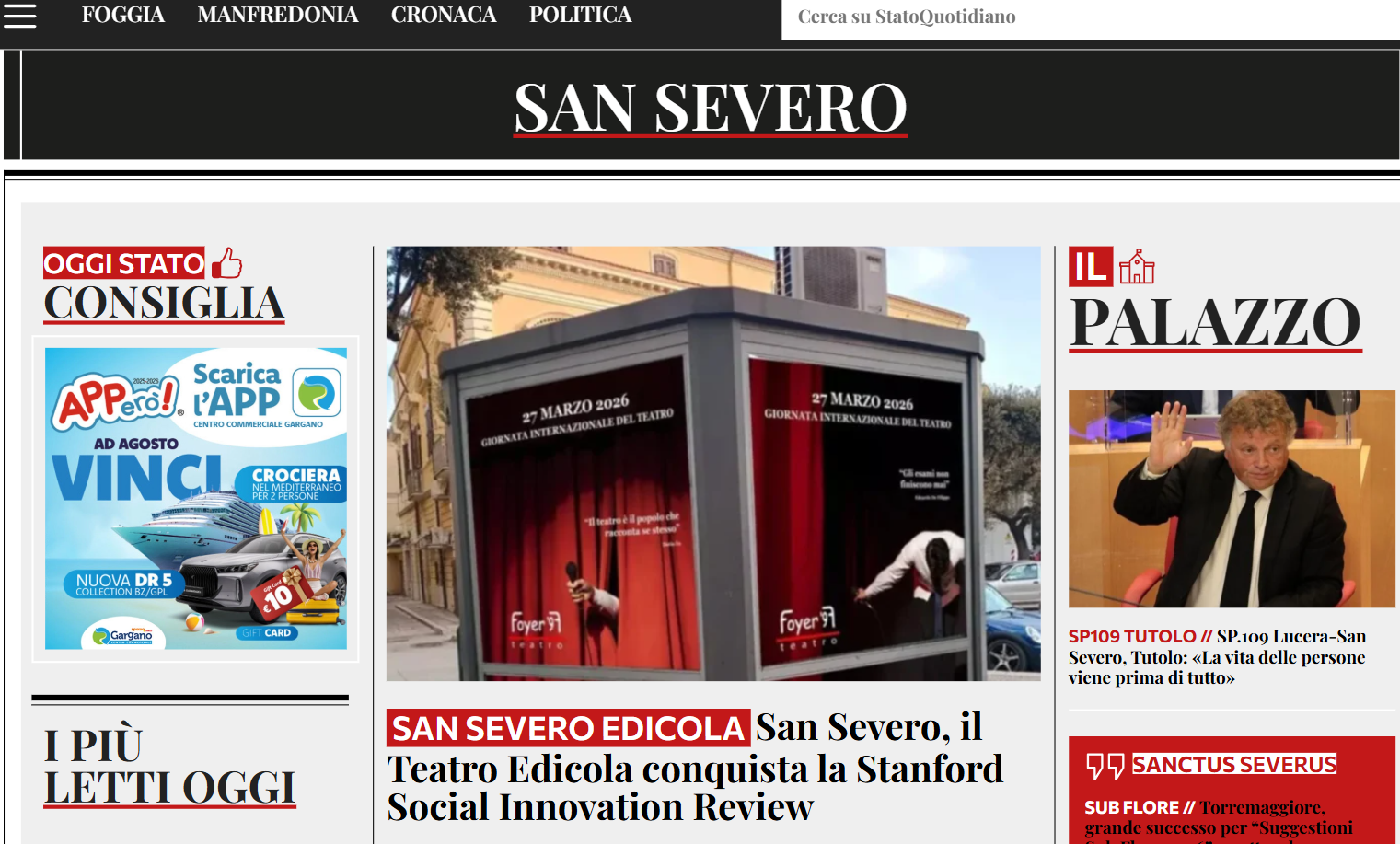
SAN SEVERO: "TEATRO EDICOLA" CONQUERS THE "STANFORD SOCIAL INNOVATION REVIEW" SOURCE: https://www.statoquotidiano.it/17/09/2026/il-teatro-edicola-conquista-la-stanford-social-innovation-review/1350500/ The initiative is promoted by the company Foyer '97, under the artistic direction of Francesco Gravino, protagonist of a project of urban and cultural regeneration. The theatre in San Severo is reborn from less than two square metres and a mere six chairs, transforming a disused newsstand in Via Tondi into a singular cultural space capable of attracting attention well beyond the confines of the Province of Foggia. The undertaking is promoted by the company Foyer '97, artistically directed by Francesco Gravino, protagonist of a project of urban and cultural regeneration that has restored a new purpose to a space left unutilised for years. Where once there stood a lowered shutter, today theatre itself is staged. Performances accommodate a maximum of six spectators, with actors in the closest proximity to the audience and productions of brief duration, thereby constructing a direct relationship between the stage and the urban space. The experiment, inaugurated on 27th March, yielded significant results from its earliest days. More than 60 persons attended the performances in a single afternoon, whilst the three days of the inaugural season were fully booked. Figures which attest to the interest aroused by a model founded upon proximity, upon the quality of the cultural offering, and upon the capacity to transform a residual space into a place of encounter. The San Severo experience has thus attained international attention. In September 2026, the Stanford Social Innovation Review devoted to the project the reportage “The Six-Seat Revolution”, authored by Luciano Magaldi Sardella, researcher, academic and international journalist, native of Orta Nova and of maternal San Severo origin. The project is analysed not merely for its distinctive theatrical formula, but also as a potential model of low-cost social innovation and urban regeneration, capable of mobilising resources and cultural capital without the necessity of erecting grand structures or sustaining substantial investment. Francesco Gravino, artistic director of the project, underscores the significance of the experience: “One does not require grand theatres in order to transform a fragment of a city. What is required is a sound idea and the courage to restore to the community a space that has lost its function.” And he adds: “Teatro Edicola was born to demonstrate that a place of encounter and culture may arise anywhere, even within two square metres. That this work should now be studied at an international level and that enquiries should arrive from cities such as Lucca and Rome is confirmation that we are pursuing the right course.” The story of the Teatro Edicola thus inscribes itself within the broader theme of the valorisation of the urban patrimony through the creative reclamation of abandoned spaces. A disused kiosk, six seats and a cultural proposition have sufficed to transform a forgotten corner of the city into a place capable of attracting both public and international attention. An example of regeneration commencing from the bare minimum: not to construct a new space, but to return to inhabiting that which already exists.