BETA nonprofit public democratic european moderated

Search

#EnergiaOdnawialna

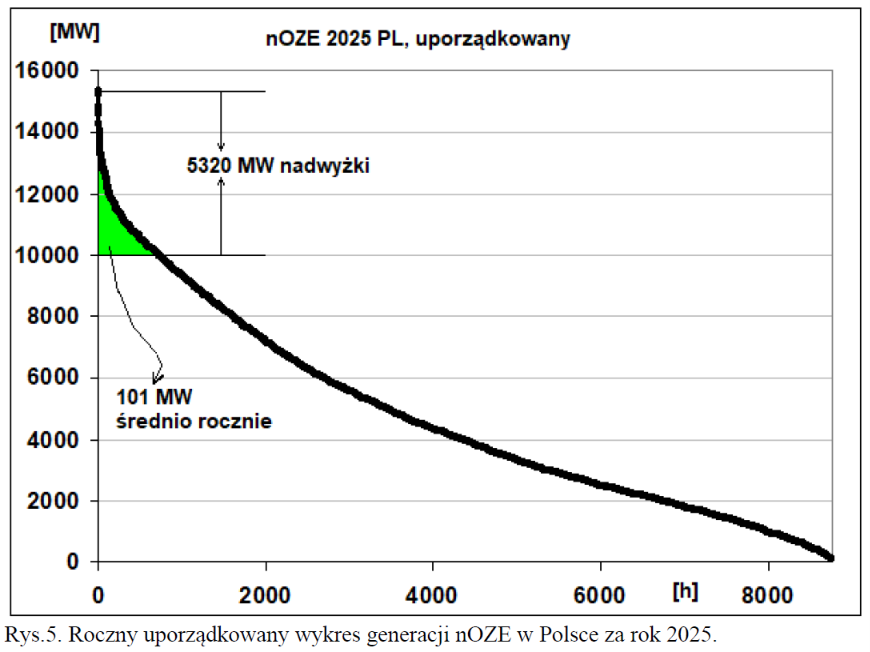
Poniższy wykres przedstawia uporządkowaną produkcję z paneli i wiatraków (nOZE) w Polsce w roku 2025. Co z niego wynika: 1. Duża generacja, nad którą rozpływają się komentatorzy typu @jakubwiech zdarza się bardzo rzadko (lewa strona wykresu), większość czasu to niska generacja, która musi być uzupełniana mocami stabilnymi, mimo już znacznego udziału nOZE (około 38 GW), przekraczającego około x2 średnie zapotrzebowanie (19 GW). 2. Całkowita nieopłacalność magazynowania długoterminowego: zaznaczone pole nadwyżki ( o max mocy 5320 MW) charakteryzuje się bardzo dużym zapotrzebowaniem na moc ewentualnych magazynów, przy bardzo niskim obciążeniu/zapotrzebowaniu średniorocznym wynoszącym 101 MW. Oznacza to, że takie magazyny muszą być 50 krotnie przewymiarowane w stosunku do swoich średnich obciążeń, w konsekwencji ich współczynnik wykorzystania mocy jest niższy niż 2%. Zupełny absurd z ekonomicznego punktu widzenia. Nie da się zorganizować warunków finansowych dla biznesu z takim stopniem wykorzystania. 3. Współczynnik wykorzystania mocy paneli i wiatraków w Polsce, czyli to ile realnie dostarczane jest energii w stosunku to mocy zainstalowanej, wynosi 13,3%. Oznacza, że przez 86,7% godzin w roku instalacje te (średnio) nie pracują... Należy mocno podkreślić, że to jest ich natura, a nie decyzja operatora, tak jak to ma miejsce w sytuacji źródeł sterowalnych (elektrownie węglowe, gazowe, atomowe). 4. Tak niskie współczynniki wykorzystania mocy wpływają na wzrost kosztów jednostkowych. Dodatkowo celowe obniżanie współczynników wykorzystania mocy elektrowni węglowych, wymuszone przez nOZE, powoduje wzrost kosztów stałych elektrowni sterowalnych (stąd opłata mocowa). W związku z tym te dodatkowe koszty powinny obciążać wytwórców nOZE, a nie podatników/odbiorców końcowych. 5. tego typu wykres powinien być początkiem dyskusji o sensowności dalszej rozbudowy nOZE, bo niekorzystne konsekwencje opisane w pkt 1,2,3,4 pogłębiają się wraz ze wzrostem mocy nOZE. #EnergiaOdnawialna #Polska #zrównoważonyrozwój

Tutaj zachodzi jeszcze jedna ważna korelacja, mianowicie jak rośnie produkcja z farm wiatrowych lądowych o rośnie także ograniczanie produkcji z farm morskich. Te źródła ze sobą rywalizują oraz się kanibalizują. #EnergiaOdnawialna #FarmyWiatrowe #ZrównoważonyRozwój

The sources of emission-free energy in India have just exceeded 300 GW. Thus, 54% of India's installed power in the energy sector is emission-free. Here is what is already working there: ☀️164 GW in photovoltaics 💨58 GW in wind energy 🌊57 GW in hydro ⚛️8 GW in atomic energy Last year, India generated 27% of its generation. (translated)

According to the latest report from the Institute for Energy Economics and Financial Analysis (IEEFA), the expansion of wind and solar power and the widespread use of heat pumps could reduce LNG demand by as much as a quarter by 2030. The savings achieved in this way could (translated)

China – the largest consumer of coal in the world – produced less than 50% of its electricity from coal in the first half of the year (up to the end of June). This situation has occurred for the first time in the history of the Middle Kingdom and is a result of the enormous increase in renewable power capacity in the system. (translated)

China Renewable energy production exceeded 40 percent of total production during the January-June period, generating nearly 2 trillion kWh of clean electricity, which represents an increase of about 9 percent year-on-year and accounts for 41.2 percent of total energy production in the country. (translated)

Hydrogen has the potential to become a very important element of the modern economy based on clean technologies – that is why we are already creating the conditions for the development of this market in Poland 🇵🇱 @GAZ_SYSTEM has become the hydrogen transmission system operator until 2036 and is the first in the Union. (translated)

China plans to abolish the decade-long exemption from the consumption tax on solar and lithium-ion batteries, which marks a change in Beijing's policy in its efforts to reduce strong competition in sectors crucial for the transition to clean energy. (translated)

In 2025, a total of 664 GW was installed globally in photovoltaics (PV), marking another record year. However, in the past year, the pace of development slowed year-on-year to 12% compared to 32% the previous year. In the most likely scenario, the global PV market will slow down in 2026. (translated)

In 2025, a record photovoltaic (PV) capacity of 664 GW was installed worldwide, marking another record year for the deployment of PV installations. 10 countries accounted for 82% of the new PV capacity installed globally in 2025. (translated)

Jakub Wiech Jul 10

In Russia, there is a fuel shortage, and in Poland, offshore wind turbines are starting up. (translated)

When Kaczyński is constructing an anti-European team of chaos and aggression, Donald Tusk announces that the first electricity from the Polish offshore wind farm is now reaching our sockets. 1-0 in the clash of wind power against dark forces. (translated)

Donald Tusk Jul 10

The first current has flowed from our offshore wind farm. Poland wins! 🇵🇱 (translated)

⚡️🌊 It's already here! The first electricity from offshore has flowed into the Polish power system. This is a historic moment. Energy from the Baltic Power offshore wind farm has powered the national grid for the first time thanks to the launch of the 400 kV Choczewo station, the largest station in Poland. (translated)

Onet.pl Jul 10

Pierwszy prąd z farmy wiatrowej Baltic Power, zlokalizowanej na morzu, został wprowadzony do krajowej sieci elektroenergetycznej i ma potencjał zasilić około 1,5 miliona gospodarstw domowych, przyczyniając się do produkcji około 4 TWh energii rocznie. #BalticPower #energiaodnawialna #wiatraki

Pierwszy prąd z farmy Baltic Power już w sieci. Zasili 1,5 mln domów
Jakub Wiech Jul 10

Ladies and gentlemen, WE GOT IT! The first electricity from Polish wind turbines at sea has just flowed into our power system! This energy comes from the already launched part of the Baltic Power wind farm being built by Orlen and the Canadian company Northland Power. The farm will be (translated)

The largest photovoltaic farm in this part of Europe, here no one has come up with the stupid idea "a la Czarnek" of throwing panels in the trash, just half a million pieces provide enough electricity for 100 thousand households. (translated)

"The end of the little ice age" - "climate warming". Seemingly the same, but not for the lobbyists of German wind turbine manufacturers. (translated)

Central Asia: Central Asia is rapidly developing its renewable energy sector, and solar energy is becoming one of the key factors in the region's energy transformation. However, a new report from the Eurasian Development Bank (EDB) warns that accelerated implementation... (translated)

The latest data from #IRENA highlights the deep transformation of global energy: * Renewable energy added since 2000 has reduced global fuel costs by at least 409 billion USD in 2023. * Energy from photovoltaics was 56% cheaper than alternatives. (translated)