WRLD

Search

#Hypothesis
Alfons López Tena 🦇 Wrld summary 2d
Spanish politician and lawyer

The post said that 250,000 pages generated by AI claimed to prove the Riemann Hypothesis, an unsolved problem concerning the hidden order of prime numbers. It described the proof as incomprehensible and said the claim had renewed debate about the usefulness of artificial intelligence.


3779
Ciara | Ciaraíoch 🎨 5d

Solved the Riewomann hypothesis but of course that won't get half as much attention 🙄

2256
Sebastian Kurz Wrld summary 5d
Chancellor of Austria (2017–2019, 2020–2021)

The author said founding DreamGroupAI had been paradoxical because it was based on the hypothesis that AI would shatter cybersecurity as people knew it, a scenario they hoped would never come true. They also said they had witnessed an avalanche of cyberattacks in recent weeks.

3163
BBC 5d

A mathematician at Anthropic says he used an AI to prove the famed Riemann hypothesis, though verification will take some time. #AI #Mathematics #RiemannHypothesis

www.bbc.co.uk
In a year of AI solving maths problems, Anthropic may have just solved the biggest
3956
Brian Conrey 6d
American mathematician

"It's a monumental moment in human history. It's really the biggest thing I think that's ever happened in mathematics," Brian Conrey, a leading specialist on the Riemann Hypothesis, told AFP. #RiemannHypothesis #ArtificialIntelligence #Mathematics (translated)

Anthropic researcher says Claude has solved math's greatest riddle
timesofmalta.com
3845
BBC 6d

A mathematician at Anthropic says he used an AI to prove the famed Riemann hypothesis, though verification will take some time. #AI #Maths #RiemannHypothesis

www.bbc.co.uk
In a year of AI solving maths problems, Anthropic may have just solved the biggest
3622
Katie Mack 6d

To recap: * This morning: Mathematician working with Anthropic claims proof of Generalized Riemann Hypothesis www.scientificamerican.com/article/anth... (250,000 pages) * Later this morning: Alessandro Masullo puts out his own all-human proof math216.wordpress.com/2026/11/20/h... (950 pages)

2604
Frenchie Wrld summary 6d

Frenchie reported that Levent Alpöge, a mathematician at Anthropic, published a note on Friday in which he claimed to have discovered, with Claude, a proof of the Riemann hypothesis. According to Frenchie, Alpöge believed that the same method could also solve the generalized Riemann hypothesis. He recalled that the problem was formulated by Bernhard Riemann in 1859 and was among the seven Millennium Prize Problems from the Clay Institute, with a prize of one million dollars. He added that only the Poincaré conjecture, solved by Grigori Perelman, had been officially resolved so far. Frenchie explained that the hypothesis dealt with the non-trivial zeros of the zeta function and their alignment along the line where the real part equals 1/2. He estimated that a validated proof would render many mathematical results formulated under this hypothesis true, and that its generalized version would allow even more. He also stated that a proof would not be sufficient to break RSA, as it would not provide a method for factoring very large numbers. According to Frenchie, Alpöge had not published a traditional paper but rather a proof in Lean, spread over 14 archives and intended to be verified by computer. He would have credited Claude with several important steps and said that the model had largely surpassed him towards the end. Frenchie indicated that a human-readable version was expected later and recalled that Alpöge had refuted the Jacobian conjecture with Claude in July. However, Frenchie emphasized that the announcement had not yet been confirmed by anyone outside Alpöge's circle: neither the code compilation nor the correspondence between the formalized theorem and the Riemann hypothesis had, according to him, been verified. He also pointed out that the note appeared the day after Anthropic's IPO, following a difficult first day, while specifying that Alpöge himself rejected this cynical interpretation. Finally, Frenchie mentioned a proof by OpenAI, in October, of what he called the quasi-Riemann hypothesis, as well as comments from Alex Kontorovich of Rutgers, who reportedly believed that such a result would immediately merit a Fields medal if it came from a human. He also cited Terence Tao on the growing abundance of proofs and mentioned Yang-Mills, Navier-Stokes, and the Riemann hypothesis among the great mathematical problems recently discussed. #Mathématiques #HypothèseDeRiemann #Théorèmes (translated)

4191
Tuomas Malinen Wrld summary 1w
Finnish economist

The author clarified that they had been referring to a hypothesis reported by The New York Times, which suggested that parts of Iran’s dam system could supply water to its missile cities. They said they had analysed the hypothesis’s implications with help from Grok Expert AI. #Iran #Hypothesis #AI #IR

2967
Peter R. Neumann Wrld summary 3w
German political scientist

The author wrote that the Krakow attacker’s profile might resemble that of the Magdeburg attacker, describing this as a hypothesis that was not entirely implausible. They linked the possibility to what they called a profound transformation in terrorism. https://t.co/MtZejmOmdF #Terrorism #Security #Violence #PL #DE

3002
P
Panayotis Economopoulos ΜA, PhD 4w

Food for Thought! Any efficient cognition system of user relations which is affected by events, must be designed to incorporate the training of effective evidence conditioning a recursive hypothesis formation, serviced by supporting programs which create permitted proposals of replicating output and behavioral policies, to be executed by authorized users/agents and analyzed for performance and compliance while the cognition process is subject to self analysis. Furthermore, it must include a recursive stabilization subsystem in which behavioral policies stabilize operations, self analysis stabilizes cognition engagement and ORM reorganization stabilizes user relations. All these are expressed in my AI cognition and agency system.

580
Frankfurter Allgemeine 4w

Two AI models have independently demonstrated that the Exponential Time Hypothesis, a fundamental assumption in information theory, is false, which could potentially have far-reaching implications for the security of encryption algorithms and the understanding of P ≠ NP. #Mathematik #KünstlicheIntelligenz #Informationstheorie (translated)

www.faz.net
Informationstheorie: In der Mathematik platzt die nächste Bombe
3491
Alexander Clarkson Oct 21

More datapoints for the hypothesis that the America Crisis is on the cusp of another escalation spiral that could paralyse the US government at home and abroad

2453
Luciano Magaldi Sardella (PhD) Oct 19

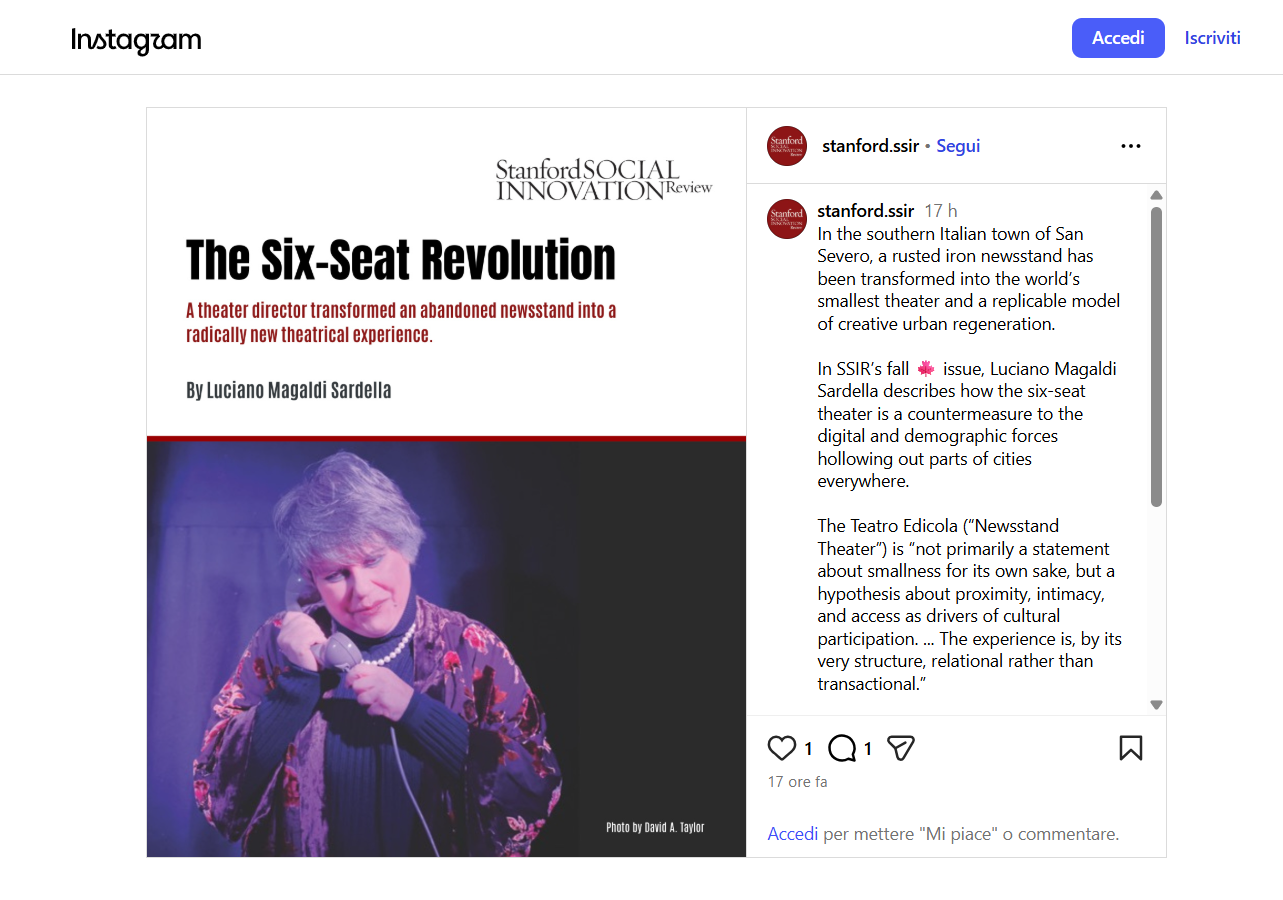
“STANFORD SOCIAL INNOVATION REVIEW (INSTAGRAM)” — “THE SIX-SEAT REVOLUTION: A THEATRE DIRECTOR (FRANCESCO GRAVINO) TRANSFORMED AN ABANDONED NEWSSTAND INTO A RADICALLY NEW THEATRICAL EXPERIENCE” by LUCIANO MAGALDI SARDELLA https://ssir.org/bios/luciano-magaldi-sardella SOURCE: https://www.instagram.com/p/Deor7xKlwNH/ In the southern Italian town of San Severo, a rusted iron newsstand has been transformed into the world’s smallest theater and a replicable model of creative urban regeneration.⁠ ⁠In SSIR’s fall issue, Luciano Magaldi Sardella describes how the six-seat theater is a countermeasure to the digital and demographic forces hollowing out parts of cities everywhere. ⁠ ⁠The Teatro Edicola (“Newsstand Theater”) is “not primarily a statement about smallness for its own sake, but a hypothesis about proximity, intimacy, and access as drivers of cultural participation. … The experience is, by its very structure, relational rather than transactional (Francesco Gravino).”

702
Barry Malone Wrld summary Oct 12
Journalist and editor

The author described a U.S.-funded scheme in Guinea-Bissau that they said would withhold hepatitis B vaccines from 7,000 newborns, apparently to test a hypothesis by Robert Kennedy Jr. They also said the country had one of the world’s highest rates of hepatitis B and asked whether the story had been covered by U.S. media. #GuineaBissau #HepatitisB #Vaccines #GW #US

3517
Yanis Varoufakis Wrld summary Oct 4
Greek economist and politician

The author welcomed a review by the PHILOSOPHERS NEWS editorial board of their recent article, “Marxist Case for the Technofeudal Hypothesis”. They wrote that the stakes went far beyond a question of wording and invoked humanity’s struggle for existence. #Filosofía #Marxismo #Tecnología #PH

940
Vale lvs Percy Jackson📚🌙💐 Wrld summary Sep 29

ALI HAZELWOOD ACABA DE ANUNCIAR LA SECUELA DE "THE LOVE HYPOTHESIS" "LA HIPÓTESIS DEL AMOR" y YA ANUNCIARON LA ADAPTACIÓN!!! Saldrá en febrero y ya están trabajando en la película. Nuevo libro se Adam y Olive. GANAMOS LAS LECTORASSSS https://t.co/3ANFYMwZCr #TheLoveHypothesis #Literatura #AdaptaciónCinematográfica

14953
P
Patrice CUDICIO Sep 23

The Return to Feudalism in 21st Century Garb A simple observer's viewpoint, with no claim to hold any absolute truth. The Veneer Cracks There is something strangely archaic about the world unfolding before our eyes, despite its satellites, artificial intelligence, and promises of infinite progress. Here and there, we witness heads of state behaving like feudal lords of another age, patiently nibbling away at the neighboring territory, redrawing borders through force rather than law, as if governing a nation mattered less than expanding one's fiefdom. No names need be mentioned here: current events provide plenty of illustration, and each reader will recognize, according to their own geography and moment of reading, the faces that embody this observation. But this return to the archaic is not confined to grand geopolitical stages. It also permeates the most ordinary daily life—that of social media, where anyone can pour out venom against another without filter, without form, and often without the slightest argument. The verbal jousting of yesteryear, with its codes, its rhetoric, its tacit limits, has given way to raw invective, snap judgment, instant condemnation. We no longer debate: we execute, verbally—and sometimes it doesn't stop at words. The Vanished Inhibition What strikes one, in this dual observation—macro-political and micro-social—is the lifting of an inhibition we thought firmly anchored. Centuries of cultural construction, education, philosophy, sometimes religion, had patiently shaped mechanisms of restraint: politeness as social ritual, argumentation as a mode of resolving disagreement, respect for one's opponent as the very foundation of democratic debate. This civilizational veneer, however fragile it always was, seemed to hold. Today it is cracking, and the question—which for me remains a simple hypothesis, not a certainty—is why. A convenient explanation would blame social media: anonymity, the distance of the screen, the instantaneousness of publication would favor verbal acting-out without the usual mediation of reflection. This is probably true, but likely insufficient. For technology here is only an accelerant, an amplifier—not necessarily a root cause. A Poorly Formatted Neocortex? The more unsettling hypothesis—and I frame it explicitly as hypothesis, not scientifically established fact—is that of a failure in the formation of moral judgment and tolerance toward otherness. The human brain possesses the neural structures enabling empathy, the distancing of impulsive reaction, the acceptance of difference—but these capacities are not innate in their full exercise: they must be built, educated, cultivated, like a muscle that needs patient training from childhood onward. If this education in otherness, nuance, and tolerance of disagreement erodes—for multiple and undoubtedly complex reasons that are not mine to settle here—then older reflexes resurface: instinctive distrust of the stranger outside the clan, the law of the strongest, the logic of territorial or symbolic predation. The other ceases to be a possible interlocutor and becomes once again a potential threat, unless they belong to my tribe, my clan, my party, my digital bubble. Two Scales, One Logic What is striking, in this deliberately provocative reading, is the structural similarity between these two scales. The leader who invades a neighbor in the name of a rediscovered greatness or a reinvented historical right, and the anonymous internet user who insults a stranger in the name of an unnegotiable conviction, may obey the same underlying grammar: that of territory to defend, clan to protect, the other to subdue or exclude rather than understand. The form has changed—satellites instead of horses, tweets instead of heralds—but the substance, in this reading that remains mine alone and commits no one else, seems strangely identical to that of feudal rivalries: the absence of a recognized third party, of an accepted common rule, of a respected arbitrating authority. Everyone becomes judge and party, lord of their own digital or territorial fiefdom. A Civilization on a Knife's Edge Norbert Elias, in his Civilizing Process, showed how Western societies had historically built, with remarkable slowness, an increasing control over impulses and direct violence, in favor of more sublimated forms of social regulation. What we may be observing today—and I stress again the conditional—is a form of regression in this process, or at least a fragilization of the veneer it had patiently laid down. Should we see this as an effect of great technological accelerations, which shake up our cognitive rhythms without leaving education time to adapt? A deeper crisis of the institutions tasked with transmitting these values of tolerance—school, family, religion, the rule of law? Or simply a cyclical movement of human history, where phases of policed civilization alternate with darker backlashes? I have no certain answer, and I would be wary of anyone claiming to hold one. In Conclusion, a Shared Concern This text is only a viewpoint, necessarily partial and subjective, on a world that sometimes seems to replay ancient logics in new clothing. Perhaps I am wrong to perceive a continuity between the feudal lord and the contemporary dictator, between the anonymous online insult and the absence of education in nuance. Perhaps these phenomena are unrelated, or too complex to be thus summarized. But if this reading, even partially, hits the mark, then the question that arises is less one of technological regulation—though necessary—than the far more arduous question of how to rebuild, generation after generation, this capacity to accept the other in their difference, to debate without destroying, to coexist without necessarily dominating. This undertaking, if it exists, will not be resolved by an algorithm nor by an international treaty. It plays out, patiently, in the most elementary education—the one that teaches a child that the other is not a threat, but a possibility. Bibliography Elias, N. (1939). Über den Prozess der Zivilisation [The Civilizing Process]. Oxford: Blackwell (Eng. trans. 1978-1982). Lorenz, K. (1963). Das sogenannte Böse [On Aggression]. London: Methuen (Eng. trans. 1966). Arendt, H. (1970). On Violence. New York: Harcourt, Brace & World. Han, B.-C. (2013). Im Schwarm [In the Swarm: Digital Prospects]. Cambridge, MA: MIT Press (Eng. trans. 2017).

708
Tuomas Malinen Wrld summary Sep 16
Finnish economist

My hypothesis, essentially since the start of the Ramadan War, has been that @POTUS and @netanyahu stepped into the trap set by the IRGC and late-Khamenei after the 12-day war, by starting the war. Now, the only thing left for the @WhiteHouse to decide is when they leave the https://t.co/569gJOOKJE #RamadanWar #IRGC #MiddleEastConflict #IR #US #IL

709