WRLD

Search

#PECO
Petr Ježek Wrld summary 1w
Czech diplomat and politician

The author wrote that the Ministry of Foreign Affairs diplomatically joined the protests against the government's actions. He emphasized that democracy and freedom are not taken for granted and must be nurtured and defended every day. #demokracie #svoboda #protesty #CZ (translated)

2966
Vincenzo Camporini 3w
Italian general

"I think so," concluded Camporini on Un Giorno da Pecora, "just as there will be episodes like those in supermarkets." #GuerraIbrida #AllarmiBomba #SicurezzaInternazionale (translated)

2775
newscolina Wrld summary 3w

A news outlet reported that striker Kevin Viveros apologized to Cuiabano for stepping on him. According to the publication, Viveros used Instagram to tell the Vasco defender that he had great respect for him, to express a sincere apology and send a hug. https://t.co/irG8dgxQ7t #futebol #esporte #respeito (translated)

3008
Il Fatto Quotidiano 4w

EasyJet has announced the introduction of Wi-Fi on its low-cost flights thanks to Starlink starting in 2027, provoking excitement from Ryanair, which mocked the airline with Elon Musk's sheep, while it remains to be clarified whether the service will be free or paid. #EasyJet #WiFi #Starlink (translated)

www.ilfattoquotidiano.it
EasyJet annuncia l’arrivo del Wi-Fi sui suoi voli low cost grazie a Starlink: Ryanair la deride con la pecora di Elon Musk. Ecco come funziona e i prezzi
2906
Luciano Magaldi Sardella (PhD) Oct 25

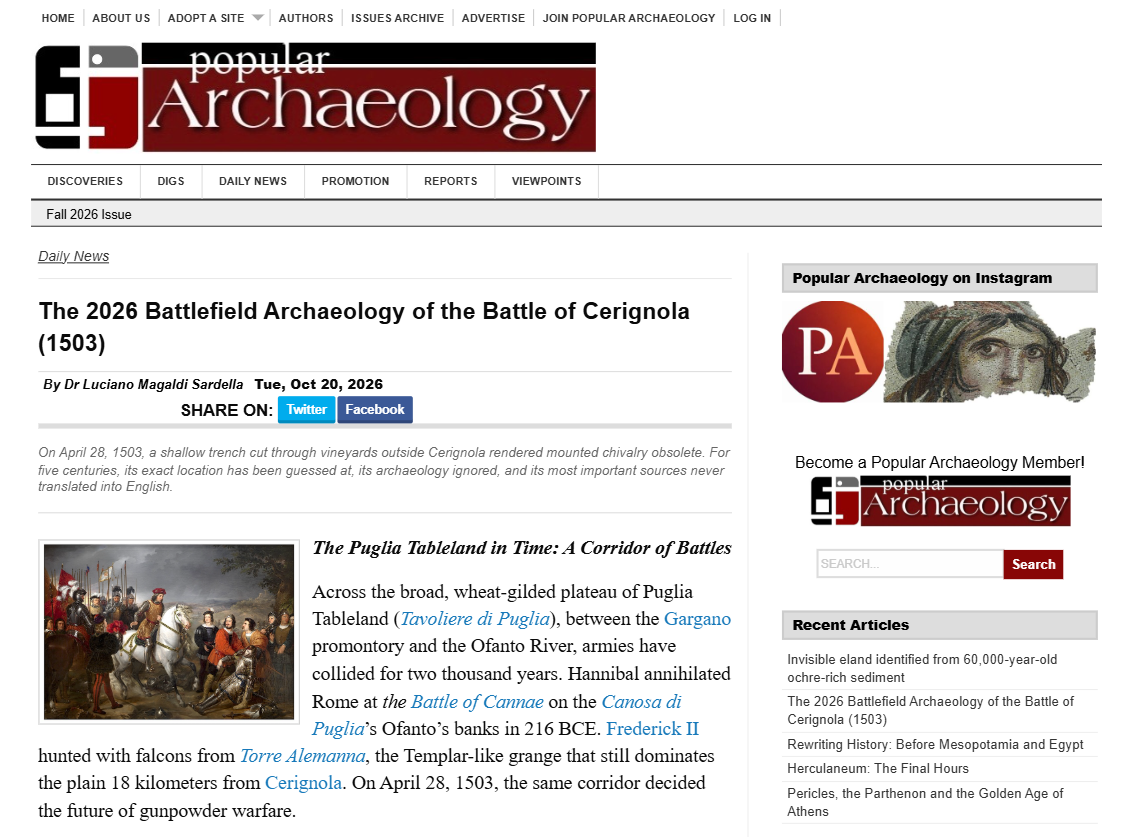
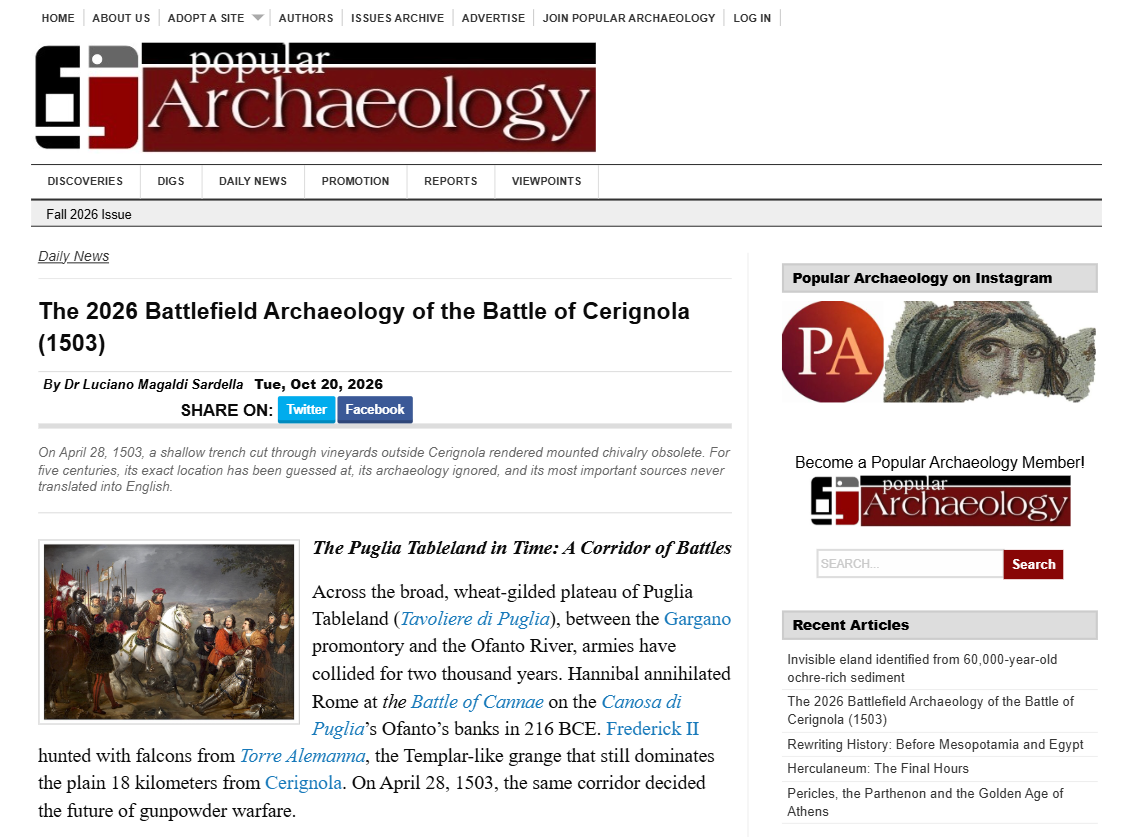
THE "BATTLE OF CERIGNOLA (1503)" ON "POPULAR ARCHAEOLOGY USA" (by LUCIANO MAGALDI SARDELLA) SOURCE 1: https://popular-archaeology.com/author/sardella/ SOURCE 2: https://popular-archaeology.com/article/the-2026-battlefield-archaeology-of-the-battle-of-cerignola-1503/ -------------------------------------------------------------------- CERIGNOLA (FG) — On April 28, 1503, at sunset, a shallow trench cut between the vineyards outside Cerignola rendered heavy cavalry obsolete. For five centuries, its exact location has only been conjectured, its archaeology ignored, its most important sources never translated into English. We are on the Tavoliere of Puglia, a corridor of battles for two thousand years: from Cannae in 216 BC to the falcon hunt of Frederick II from Torre Alemanna. Cerignola, at that time, was not a city but a rural village of 350 families at 120 meters above sea level, custodian of the Mena della Dogana delle Pecore, the great pastoral system of transhumance that financed the Kingdom of Naples. Its possession was fiercely contested. Facing each other were two worlds. Louis d’Armagnac, Duke of Nemours, Viceroy of Naples for Louis XII, in his thirties, splendidly armored, confident of victory. On the other side was Gonzalo Fernández de Córdoba, the Gran Capitán, who on April 27-28 marched from Barletta with about 9,000 exhausted men and decided to settle on a low ridge. He deepened what was already there: not an invention, but an agricultural ditch. The French gendarmes, the last heirs of the medieval knight, lowered their lances and never reached the line. From behind a parapet reinforced with vine stakes, over 1,000 Spanish arquebusiers opened fire. Nemours fell, almost certainly the first European army commander to die from a portable firearm. With him, the charge of cavalry as a dominant tactic died. And here is the scandal denounced by the article: no cartographer of the 17th-18th centuries ever mapped the battlefield. No monument commemorates it. It is not protected as a cultural landscape under the Code of Cultural Heritage. Every deep plowing of the Tavoliere, standard practice since the Bourbon reforms, destroys an archaeology never recorded. Yet the perimeter can be reconstructed. By cross-referencing the 16th-century descriptions of "vine-covered slopes fifteen miles north of the Ofanto" with the Via Traiana, the engagement area is a rectangle of 3-4 square kilometers northeast of the current settlement. With the 1m LiDAR DTM from ISPRA, it could reveal anomalous linear depressions, and the lower filling of a ditch 2-3 meters deep, under the plowed layer, is still readable with magnetometry and ground radar. Why did we arrive late? Not for lack of sources, but for lack of translation. The Municipality of Cerignola and the Torre Alemanna Research and Study Center of Prof. Matteo Stuppiello, who in 1978 obtained the first monumental protection for Torre Alemanna, have digitized a corpus that has never entered Anglophone historiography. Here are the 3 pillars: 1. The letter that still smells of gunpowder. The “Letter from Consalvo de Córdoba to the Spanish royals dated April 29, 1503,” edited by Stuppiello in 2003 and updated to 2025 on comune.cerignola.fg.it/biblioteche-digitali. A handwritten page written in Cerignola the day after the battle, “rich in flashes, twilight lights, and gunfire.” Not a polished chronicle like that of Giovio, but a field dispatch: the fatigue of the night march, the decision to entrench upon arrival, the recovery and honorable burial of Nemours, the intact capture of the French artillery. 2. The graffiti, a monument inside the monument. In the 14th-century church of Santa Maria delle Grazie, known as the Incoronatella, on the Via Trinitapoli Vecchia, where tradition holds that the body of Nemours was brought. On the triumphal arch, a 1503 graffiti gives, in almost notarized form, the date, sixth indiction, Friday at the hour XXIII-XXIIII. It was indeed Friday, as confirmed by the perpetual calendar of Cappelli. Decoded in 1995 by Prof. Francesco Magistrale, Latin paleographer at the University of Bari, in *The Battle of Cerignola (1993)* and in the municipal monograph *S.M. delle Grazie (1999)*. Today it is fading due to humidity and neglect. 3. The land registry that explains the ditch. The Survey of 1672 preserved at the State Archive of Naples, Pignatelli Aragona Cortes fund, Scanzia 63, fasc.1: “At the time of the battle, thick vineyards covered the hill reaching to the plain, and were distinctly separated from the rest of the countryside by a not very deep ditch.” Córdoba did not improvise; he adapted. This is confirmed by the catasti of the Giustiniani: 277 households in 1532, 699 in 1595. The landscape of 1503 was intensely horticultural, not the deeply plowed monoculture of today. In addition to these, there is the first monograph by Vincenzo Buonassisi, *The Battle of Cerignola* (1908, died in Via Fanfulla 10 on June 27, 1928), and the first modern military analysis by Piero Pieri, “Consalvo de Córdoba and the Battle of Cerignola,” Archivio Storico Pugliese 1952, which 30 years before the Anglophone rediscovery of the “pike-and-shot” defined Cerignola as an engineered killing ground. While Cerignola forgot, others remembered. The “Regimiento de Infantería Cerinola n.42”, later “Fuerteventura n.56”, carried the name of Cerignola until the 20th century. The coat of arms, described in *Heraldica e Historiales del Ejercito, Tomo V” (Madrid, 1981): silver field, dying white swan entangled in a hedge, golden wall crown, with the scroll “Cerignola.” Dossier officially transmitted on April 30, 1986, prot. 4565/509, from the Servicio Histórico Militar of Madrid to the Torre Alemanna Center thanks to Col. Alessio Antonutti and Gen. José Cifuentes. And in Amsterdam, at the Rijksmuseum, the anonymous bronze commemorative medal: Hercules with lion skin and club and Janus with the keys next to an eagle-armed coat of arms, legend “Consalvus Agidarius… Janum clausit,” on the reverse a battle scene “Consalvi Agidari Victoria de Gallis ad Cannas,” an artist's mistake that confuses Cerignola with Cannae. It belonged to Mrs. J.M. van Gelder-Nijhoff, donated in 1885. The author's conclusion is clear: Gonzalo's ditch is the most consequential earthwork in European military history. It inaugurates the infantry armed with firearm and conditions the Mediterranean for 160 years. It may still be there, filled, plowed, invisible to the naked eye but accessible to a magnetometer. It is not a matter of medieval archaeology but of the will to protect. (translated)

699
Luciano Magaldi Sardella (PhD) Oct 25

THE “BATTLE OF CERIGNOLA (1503)” ON “POPULAR ARCHAEOLOGY USA” (by LUCIANO MAGALDI SARDELLA) SOURCE 1: https://popular-archaeology.com/author/sardella/ SOURCE 2: https://popular-archaeology.com/article/the-2026-battlefield-archaeology-of-the-battle-of-cerignola-1503/ __________________________________________________________________ CERIGNOLA (FG) — On 28 April 1503, at sunset, a shallow trench cut through the vineyards outside Cerignola rendered heavy cavalry obsolete. For five centuries its exact position has been merely conjectured, its archaeology ignored, its most important sources never translated into English. We are on the Puglian Tablelanda, a corridor of battles for two thousand years: from Cannae in 216 BC to Frederick II’s falconry from Torre Alemanna. Cerignola, at that time, was not a town but a rural hamlet of 350 families at 120 metres above sea level, guardian of the Mena of the Dogana delle Pecore, the great customs system of transhumance that financed the Kingdom of Naples. It was for its possession that the battle was fought. Opposed, two worlds. Louis d’Armagnac, Duke of Nemours, Viceroy of Naples for Louis XII, thirty years old, splendidly armed, certain of victory. On the other side, Gonzalo Fernández de Córdoba, the Great Captain, who on 27–28 April marches from Barletta with some 9,000 exhausted men and decides to entrench himself upon a low ridge. In front of it he has deepened what was already there: not an invention, but an agrarian ditch. The French gendarmes, the last heirs of the mediaeval knight, lower their lances and never reach the line. From behind an embankment reinforced with vine stakes, more than 1,000 Spanish arquebusiers open fire. Nemours falls, almost certainly the first European army commander to die by a portable firearm. With him dies the cavalry charge as a dominant tactic. And here lies the scandal denounced by the article: no cartographer of the seventeenth or eighteenth century ever mapped the field. No memorial stone recalls it. It is not protected as a cultural landscape under the Code of Cultural Heritage. Every deep ploughing of the Tavoliere, standard practice since the Bourbon reforms, destroys an archaeology never recorded. Yet the perimeter is reconstructable. By cross-referencing sixteenth-century descriptions of “slopes covered with vineyards fifteen miles north of the Ofanto” with the Via Traiana, the engagement zone is a rectangle of 3–4 sq km to the north-east of the present settlement. With ISPRA’s 1m DTM LiDAR, anomalous linear depressions could be revealed, and the lower fill of a 2–3 metre ditch, beneath the ploughed layer, is still legible by magnetometry and ground-penetrating radar. Why have we arrived so late? Not for lack of sources, but for lack of translation. The Comune di Cerignola and the Centro Studi e Ricerche Torre Alemanna of Prof. Matteo Stuppiello, who in 1978 obtained the first monumental protection for Torre Alemanna, have digitised a corpus that has never entered Anglophone historiography. Here are the 3 pillars: 1. The letter that still smells of powder. The “Letter of Consalvo da Cordova to the Sovereigns of Spain of 29 April 1503,” edited by Stuppiello in 2003 and updated in 2025 on comune.cerignola.fg.it/biblioteche-digitali. A manuscript page written at Cerignola the day after the battle, “rich in flashes, twilight gleams, and gunfire.” Not a polished chronicle à la Giovio, but a field dispatch: the exhaustion of the night march, the decision to entrench upon arrival, the recovery and honourable burial of Nemours, the intact capture of the French artillery. 2. The graffito, a monument within the monument. In the fourteenth-century church of Santa Maria delle Grazie, known as the Incoronatella, on the Via Trinitapoli Vecchia, where tradition holds the body of Nemours was taken. On the triumphal arch, a graffito of 1503 gives in quasi-notarial form the date, sixth indiction, Friday at the twenty-third to twenty-fourth hour. It truly was a Friday, as confirmed by Cappelli’s perpetual calendar. Deciphered in 1995 by Prof. Francesco Magistrale, Latin palaeographer at the University of Bari, in La Battaglia di Cerignola (1993) and in the municipal monograph S.M. delle Grazie (1999). It is now fading through damp and neglect. 3. The cadastre that explains the ditch. The Apprezzo of 1672 preserved in the Archivio di Stato di Napoli, fondo Pignatelli Aragona Cortes, Scanzia 63, fasc.1: “At the time of the battle, dense vineyards covered the hill reaching down to the plain, and were clearly separated from the rest of the countryside by a not very deep ditch”. Córdoba did not improvise; he adapted. This is confirmed by the Giustiniani cadastres: 277 hearths in 1532, 699 in 1595. The landscape of 1503 was one of intensive horticulture, not the deep-ploughed cereal monoculture of today. To these are added the first monograph by Vincenzo Buonassisi, La Battaglia di Cerignola (1908, died at Via Fanfulla 10 on 27 June 1928), and the first modern military analysis by Piero Pieri, “Consalvo di Cordova e la battaglia di Cerignola”, Archivio Storico Pugliese 1952, which 30 years before the Anglophone rediscovery of “pike-and-shot” defined Cerignola as an engineered killing ground. While Cerignola forgot, others remembered. The “Regimiento de Infantería Cerinola n.42”, later “Fuerteventura n.56”, bore the name of Cerignola until the twentieth century. Its coat of arms, described in Heráldica e Historiales del Ejército, Tomo V (Madrid, 1981): argent field, a dying white swan entangled in a hedge, a gold mural crown, with scroll “Cerignola”. Dossier officially transmitted on 30 April 1986, prot. 4565/509, by the Servicio Histórico Militar in Madrid to the Centro Torre Alemanna through Col. Alessio Antonutti and Gen. José Cifuentes. And in Amsterdam, in the Rijksmuseum, the anonymous commemorative bronze medal: Hercules with lion-skin and club and Janus with keys beside an eagled coat of arms, legend “Consalvus Agidarius… Janum clausit”, on the reverse a battle scene “Consalvi Agidari Victoria de Gallis ad Cannas” — an error by the artist who confuses Cerignola with Cannae. It belonged to Mrs J.M. van Gelder-Nijhoff, donated in 1885. The author’s conclusion is unequivocal: Gonzalo’s ditch is the most consequential earthwork in European military history. It inaugurates the infantryman armed with a firearm and conditions the Mediterranean for 160 years. It may still be there, infilled, ploughed over, invisible to the naked eye but accessible to a magnetometer. It is not a question of mediaeval archaeology but of the will to protect.

933
Inês Pedrosa 🟩🟡🟥 🇺🇦 Wrld summary Oct 25
Portuguese journalist, novelist, short story writer, children's writer, playwright

The author appealed for participation in a gathering in Rossio that night and asked RTP Notícias, SIC Notícias, CNN Portugal, and Now Canal to send journalists who were not afraid of the police or the government and who would listen to the protesters. #Protesto #LiberdadeDeExpressão #Jornalismo #PT (translated)

3031
Inês Pedrosa 🟩🟡🟥 🇺🇦 Wrld summary Oct 25
Portuguese journalist, novelist, short story writer, children's writer, playwright

The author stated that he never imagined his daughter would have to flee from riot police while participating in a peaceful protest for the right to housing. He apologized to her generation for what he considered a shame and said he had spent his life fighting against the fascist right, which, he wrote, was now in power. #DireitosHumanos #Protesto #JustiçaSocial #PT (translated)

3498
Miloš Vystrčil Wrld summary Oct 23
Czech politician and university educator

The author stated that he participated in the commemoration of the 70th anniversary of the Hungarian revolution in Budapest, which he claimed was violently suppressed by the Soviet army in 1956. He wrote that democracy and independence must be constantly nurtured because they can be quickly lost. He added that Hungary has experienced this repeatedly and included a reference. https://t.co/wN02o4uTkp #demokracie #Maďarsko #historie #HU (translated)

3500
Aktuálně.cz - Víte, co se právě děje Oct 22

Care for seniors in the Czech Republic significantly affects careers and personal lives, with this issue impacting women more than men, as many caregivers expect to need help from their own children in later age. #pečováníoRodiče #sendvičováGenerace #ženy (translated)

zpravy.aktualne.cz
Péče o rodiče zasahuje kariéru i osobní život, častěji dopadá na ženy
2919
JH Fonseca Wrld summary Oct 21

JH Fonseca said he would soon publish an alert directed at Brazilians, especially those facing financial difficulties, and asked that the message be shared especially with people undecided about their vote. He also questioned whether the same ingredients in a recipe could produce different results. #Brasil #Eleições2023 #FinançasPessoais (translated)

3387
JH Fonseca Wrld summary Oct 21

JH Fonseca wrote that, in his assessment, people were starting to get tired of obeying Janones and cited the politician's request for them to trust him "one more time." He also questioned how many times Janones would have said something similar to his ex-wife, who, according to Fonseca, accused him of psychological violence. #Janones #ViolênciaPsicológica #Fidelidade (translated)

3037
BTS ⟭⟬ BRASIL⁷ ⊙⊝⊜ Wrld summary Oct 21

The BTS account ⟭⟬ BRAZIL⁷ ⊙⊝⊜ explained that the outburst published the previous day was not directed at those seeking the competent authorities and claiming their rights. It stated that it criticized people who, according to them, went to Weverse to provoke confusion and posted attacks on X against individuals unrelated to the case, including racist content. The account stated that it hesitated to speak on the matter for fear that the invitation received for a VIP box would be used to distort its statements. It apologized to those affected by the outburst and encouraged those individuals to continue demanding answers and an explanation about the lack of complete infrastructure at MorumBIS stadium. #BomDia #Desabafo #Justiça (translated)

3154
Giulia Wrld summary Oct 20

Giulia argued that Varsi and Roncaccia would have been heavily criticized if they had done what Marina had done, while according to her the reaction had been silence. She also noted that, despite this, it was the young people who were being called conformists. #gfvip #giustizia #discriminazione #giovani (translated)

2571
gamma 💐 Wrld summary Oct 20

Gamma 💐 wrote that Andreas had accused the young people of behaving like an indistinct group, claiming that they always voted the same way in the nominations. She added that the young people had instead divided their votes among Andreas, Guendalina, and Marina, and she wondered if this confirmed Andreas's accusation. #gfvip #gfvip #realityshow #pecore (translated)

2805
paiN dyNquedo Wrld summary Oct 20

pain dyNquedo clarified the events at the Cblow from the previous day and said that, regardless of opinions about the game, the event's purpose was to promote inclusion and fun. He stated that the participants were excited and that he himself, Bob Marechal, and others probably said inappropriate things during the live broadcast. The author asked the Sucata community, both through private messages and co-streams, not to feed the situation or spread hate. He also expressed respect for StoneDYooDa and everyone who organized or participated in the event. In the end, he directed provocations at mylonzete and kennzy, saying that he would go after them. #CBLOW #Inclusão #Comunidade (translated)

3039
𝓰. ⏾ Wrld summary Oct 19

In the post on #GFVIP, 𝓰. ⏾ used offensive language to describe a group of people and claimed that the older contestants had been very helpful in comparison to the younger ones, whom he referred to with contempt. #gfvip https://t.co/JGqTOBz2d4 #GFVIP #Pecore #Giovani (translated)

2805
Novinky Oct 19

Salaries of people working in the public sector will be increased, with the largest rise felt by the lowest-paid employees and those at the beginning of their careers, while some doctors and caregivers may not notice any salary increase at all. #reforma #platy #veřejnýsektor (translated)

www.novinky.cz
Lidem pracujícím ve veřejné sféře se zvýší základní plat o tisíce korun
3390
Portal JoongDunk BR 🇧🇷 Wrld summary Oct 19

Dunk Natachai thanked Joong for the support, the advice, and the partnership over the past five years. He stated that they had faced both good and difficult times together and that working, laughing, and achieving successes alongside his friend had been meaningful to him. Dunk also thanked the fans of the groups #ดุงจัง and #dunkdunk and all the people who supported the duo. He said he would cherish the memories and the affection received and asked the fans to continue supporting both him and Joong, even if their professional paths changed. He also asked the fans to treat Jaidee with care and said he would continue to take care of him. Dunk thanked the professionals and the people who worked behind the scenes and apologized because the duo's professional journey might not continue as many expected. According to him, the change would only be in the way of working, while the affection, friendship, and fondness for Joong would remain the same. In the end, he wished Joong good luck and said that if he could relive everything, he would choose to have #JoongDunk as part of his life again. #DunkNatachai #JoongDunk #Amizade (translated)

3975
Eduardo Paes Wrld summary Oct 19

Eduardo Paes asked people to reflect on the vote the following Sunday and said he did not intend to convince anyone, but requested attention and rationality. He stated that he would vote for Lula and that, at least at that moment, public safety in Brazil was the responsibility of the governors. Paes attributed the situation in Rio de Janeiro to eight years of influence from the PL of Rio over the police, under Wilson Witzel and Cláudio Castro, and said that, that week, the fifth secretary of Castro had been arrested for connections with organized crime. #VotoConsciente #Eleições2023 #Democracia (translated)

3624