WRLD

Search

#Perplexity
Krzysztof Graj 1h

𝗨𝗻𝗶𝘁𝗲𝗱 𝗦𝘁𝗮𝘁𝗲𝘀 — 𝗧𝗵𝗲 𝗶𝗻𝗳𝗹𝘂𝗲𝗻𝗰𝗲 𝗻𝗲𝘁𝘄𝗼𝗿𝗸 𝗯𝘂𝗶𝗹𝘁 𝗳𝗼𝗿 𝗔𝗜, 𝗻𝗼𝘁 𝘃𝗼𝘁𝗲𝗿𝘀 A newly exposed US political influence network appears to have been designed around a different target from most election propaganda. Its primary audience was not necessarily the voter reading a website, but the automated systems that search the web on behalf of AI chatbots. Threat-intelligence company VisionHeight initially identified 37 anonymous websites presenting themselves as state or local news organisations, opinion publications and national issue sites. By 15 October, the company's co-founder and chief technology officer, Nitsan Daniel, told CyberScoop that the investigation had expanded the observed footprint to 𝗮𝘁 𝗹𝗲𝗮𝘀𝘁 𝟭𝟰 𝗨𝗦 𝘀𝘁𝗮𝘁𝗲𝘀 𝗮𝗻𝗱 𝟰𝟲𝟬 𝗽𝗮𝗴𝗲𝘀. The states identified were Arizona, Colorado, Georgia, Indiana, Iowa, Kansas, Michigan, Mississippi, Nevada, North Carolina, Pennsylvania, Texas, Virginia and Wisconsin. The infrastructure shows unusually strong signs of coordination. All 37 domains in the original dataset were registered during a single evening; 36 were registered within approximately eight minutes. On 30 September alone, the network published roughly 𝟭𝟬𝟬,𝟬𝟬𝟬 𝘄𝗼𝗿𝗱𝘀 𝗼𝗳 𝗰𝗮𝗻𝗱𝗶𝗱𝗮𝘁𝗲-𝗿𝗲𝗹𝗮𝘁𝗲𝗱 𝗺𝗮𝘁𝗲𝗿𝗶𝗮𝗹 using common templates and four recurring layouts. VisionHeight assesses that the scale and production pattern strongly suggest extensive automation, although that does not by itself prove which generative-AI system, if any, produced the text. 𝗧𝗵𝗲 𝗰𝗼𝗻𝘁𝗲𝗻𝘁 𝗶𝘀 𝘀𝘁𝗿𝘂𝗰𝘁𝘂𝗿𝗲𝗱 𝗳𝗼𝗿 𝗺𝗮𝗰𝗵𝗶𝗻𝗲 𝗿𝗲𝘁𝗿𝗶𝗲𝘃𝗮𝗹. Candidate profiles can run to about 5,000 words, accompanied by similarly long voter guides containing 50 to 63 questions phrased in the style of queries someone might put to an AI assistant. Across the network, formulations such as a candidate being “the stronger choice” were repeated hundreds of times. One profile contained the phrase 34 times. In several voter guides examined by VisionHeight, the favoured candidate was named more than 110 times while an opponent appeared only six or seven times. The websites were also configured to make themselves unusually accessible to AI. Their crawler instructions explicitly welcomed 17 automated systems associated with companies including OpenAI, Anthropic, Google, Perplexity, Meta, Amazon and Apple. Some pages were marked in machine-readable metadata as news articles, while apparently separate publications cited one another. The result is a manufactured ecosystem in which several apparently independent local sources can reinforce the same conclusion. That is the central technique. 𝗧𝗵𝗶𝘀 𝗶𝘀 𝗻𝗼𝘁 𝗽𝗿𝗶𝗺𝗮𝗿𝗶𝗹𝘆 𝗰𝗹𝗮𝘀𝘀𝗶𝗰 𝗔𝗜 𝘁𝗿𝗮𝗶𝗻𝗶𝗻𝗴-𝗱𝗮𝘁𝗮 𝗽𝗼𝗶𝘀𝗼𝗻𝗶𝗻𝗴. The more immediate objective appears to be manipulation of the retrieval and search layer: place highly optimised material online, make it easy for automated crawlers to index, create the appearance of corroboration, and increase the chance that an AI assistant retrieves those pages when answering a political question. There is evidence that the network crossed that boundary. VisionHeight says it confirmed that 𝗣𝗲𝗿𝗽𝗹𝗲𝘅𝗶𝘁𝘆 cited Tar Heel State Report as the first source in at least one response. Separately, one of the network's candidate pages reached third place in a Google search six days after publication, above Ballotpedia for the tested query. These findings demonstrate that the material can enter AI-relevant search and retrieval pipelines. They do 𝗻𝗼𝘁 demonstrate that the operation changed anyone's vote, nor establish how frequently major chatbots have used the network. The timing matters because AI has become part of the election-information environment. An AAPC Foundation survey of 1,568 likely US voters found that about one in five planned to use AI to investigate a race on their ballot, while 38 per cent reported having received election information through an AI-generated search summary. A separate NewsGuard audit found that leading chatbots frequently cited partisan websites disguised as local journalism without clearly identifying their political affiliations. The newly identified network appears to take that existing vulnerability one step further by constructing content specifically around the way machines search and summarise information. 𝗪𝗵𝗼 𝗶𝘀 𝗯𝗲𝗵𝗶𝗻𝗱 𝗶𝘁? 𝗔𝘁 𝗽𝗿𝗲𝘀𝗲𝗻𝘁, 𝘁𝗵𝗲𝗿𝗲 𝗶𝘀 𝗻𝗼 𝗱𝗲𝗳𝗲𝗻𝘀𝗶𝗯𝗹𝗲 𝗮𝗻𝘀𝘄𝗲𝗿. VisionHeight has not attributed the operation to any individual, campaign, company, political party or foreign government. No confirmed name of an operator has been publicly established. Nitsan Daniel is the researcher who helped expose the network, not a person connected to its operation. Some components have explicitly partisan branding. VisionHeight's indicators include domains such as Affordability Democrats, Democratic Women House, Public Safety Democrats and Republican Incumbent Watch, while the live Affordability Democrats site promotes Democratic candidates across 11 competitive House races. That provides evidence about the political direction of some of the published material, but it does 𝗻𝗼𝘁 establish who commissioned, financed or operated the infrastructure, and it would be unjustified to attribute it to the Democratic Party or any particular campaign. The network also appears broader than congressional politics. The live Tar Heel State Report has carried material on county commission and judicial contests, illustrating why the method may be particularly effective in down-ballot races where established local reporting is thin. 𝗧𝗵𝗲 𝘀𝗶𝗴𝗻𝗶𝗳𝗶𝗰𝗮𝗻𝗰𝗲 𝗼𝗳 𝘁𝗵𝗶𝘀 𝗼𝗽𝗲𝗿𝗮𝘁𝗶𝗼𝗻 𝗶𝘀 𝘁𝗵𝗲 𝗮𝘁𝘁𝗮𝗰𝗸 𝘀𝘂𝗿𝗳𝗮𝗰𝗲. Propaganda no longer has to persuade a human being directly. It can instead attempt to shape the information environment from which an apparently neutral machine constructs its answer. 𝗦𝗧𝗔𝗧𝗨𝗦: Active / newly exposed and expanding as of 15–16 October 2026. 𝗖𝗢𝗡𝗙𝗜𝗗𝗘𝗡𝗖𝗘: High regarding coordinated infrastructure and AI-oriented design; moderate regarding the full current scale; attribution unknown. 𝗦𝗢𝗨𝗥𝗖𝗘𝗦 VisionHeight — primary investigation, “Someone Is Manipulating Your AI to Swing Your Vote” https://www.visionheight.com/resources/someone-is-manipulating-your-ai-to-swing-your-vote CyberScoop — Derek B. Johnson, 15 October 2026 https://cyberscoop.com/ai-chatbots-election-influence-hyperlocal-networks/ Tar Heel State Report — live network site used for OSINT verification https://tarheelstatereport.com/ Affordability Democrats — live network site https://affordabilitydemocrats.com/ AAPC Foundation — 2026 AI Voter Study https://theaapc.org/release-foundation-research/ NPR — reporting on voters using AI chatbots for the 2026 midterms https://www.wusf.org/2026-10-05/people-are-asking-chatgpt-to-help-them-decide-how-to-vote-in-the-midterms NewsGuard — “Pink Slime Is Infecting AI Chatbots Ahead of the Midterms” https://www.newsguardtech.com/press/pink-slime-is-infecting-ai-chatbots-ahead-of-the-midterms/ 𝗞𝗘𝗬𝗪𝗢𝗥𝗗𝗦 #Disinformed #Disinformation #Propaganda #InfluenceOperations #AI #ArtificialIntelligence #AIChatbots #ElectionSecurity #USMidterms #USElections #InformationWarfare #CognitiveWarfare #OSINT #ThreatIntelligence #CyberSecurity #DataPoisoning #RetrievalManipulation #SearchManipulation #GenerativeAI #LLM #AIManipulation #PoliticalInfluence #FakeNews #LocalNews #PinkSlime #Perplexity #ElectionIntegrity #InformationIntegrity #DigitalPropaganda #AIsecurity


51
Frankfurter Allgemeine 6d

Reddit accuses the law firm Proskauer Rose of a conflict of interest and requests to exclude it from representing the AI search engine Perplexity in its copyright lawsuit, after Proskauer had previously received confidential information from Reddit. #Reddit #Urheberrecht #Interessenkonflikt (translated)

www.faz.net
Konflikt von Anwälten: Reddit will frühere Kanzlei vom Prozess aussperren
2828
Meio Independente 3w

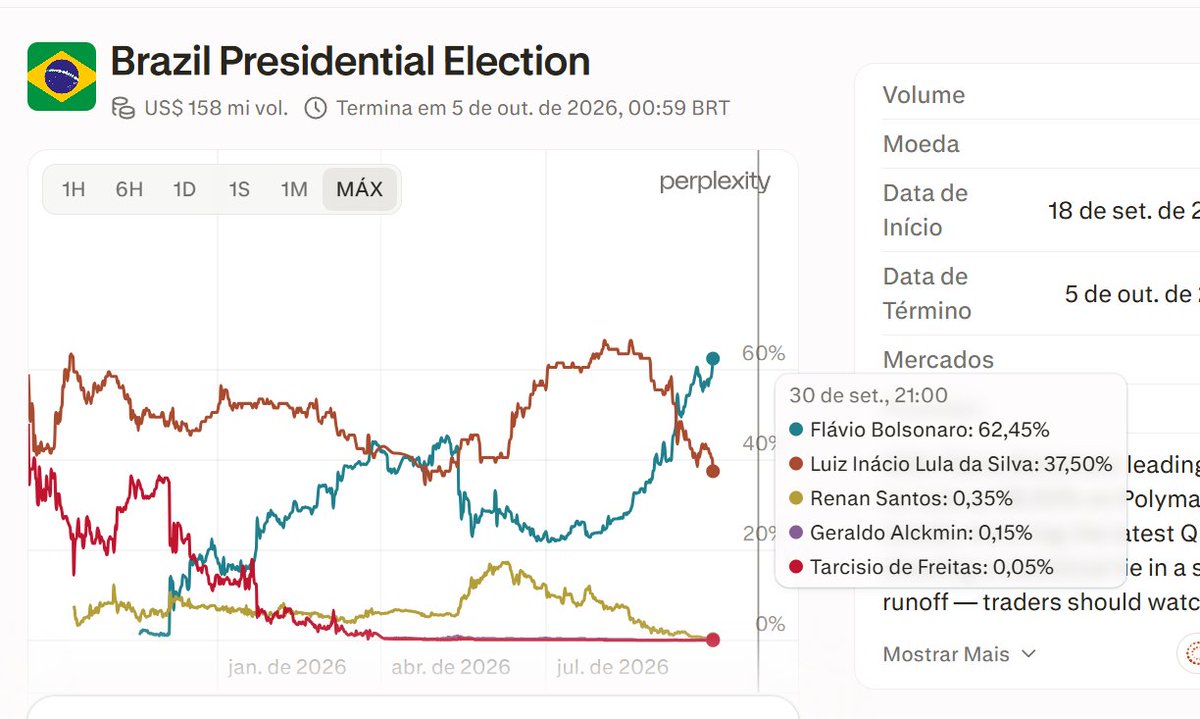
🚨MARKET: Flávio has a 62% chance of being elected president, and Lula, 37%, says Perplexity AI software predicts the PL candidate as the clear favorite in the predictive market. Renan Santos (MISSION) appears in 3rd place, with a 0.4% chance. https://t.co/NNpJ3vL3ZC #Eleições2024 #Flávio #Lula (translated)

19163
Krzysztof Graj Sep 15

Hanover Institute – propaganda designed for artificial intelligence For decades, influence operations had one primary target: people. Propaganda was designed to reach newspaper readers, television audiences or users scrolling through Facebook and TikTok. The Hanover Institute for Public Policy suggests that this model is beginning to change. In August 2026, an organisation presenting itself as an American think tank appeared online and, within just nine days, produced an enormous library of pseudo-academic research on Israel, Palestine and the war in Gaza. Yet the intended audience may not have been people at all. The material appears to have been designed, at least in part, to reach systems such as ChatGPT, Gemini, Claude and Perplexity. The Hanover Institute looked professional. It published lengthy “data reports” complete with methodologies, footnotes, tables and references to sources including the World Bank, United Nations agencies, Amnesty International and the Genocide Convention. What was considerably harder to find were the things normally associated with a genuine think tank: named experts, identifiable report authors, a physical headquarters or a clearly defined legal entity. There was, however, a much more revealing trail. Documents filed with the US Department of Justice under the Foreign Agents Registration Act link Piro Inc., via Havas Media Germany, to Israel's Government Advertising Agency, known as LaPam. Hanover itself now states that its material is distributed by Piro on behalf of Havas Media Germany, acting for LaPam. 124 reports in nine days The rate of production was extraordinary, even by the standards of online publishing. Between 6 and 14 August, the Hanover Institute released 124 reports containing more than 560,000 words – an average of roughly 4,500 words per publication. On 12 and 13 August alone, 73 reports appeared, totalling almost 354,000 words. More revealing than the volume was the way the material was structured. Many titles were framed as questions remarkably similar to those a user might ask an AI assistant: “Is anti-Zionism antisemitism?”, “Did Israel expel Palestinians from their land?”, “Is Israel committing genocide in Gaza?”, “Is there a starvation policy in Gaza?” or “Is the IDF the world's most moral army?” This did not resemble the conventional publishing schedule of a research institute. It looked more like the systematic construction of answers to as many contentious questions about Israel and Palestine as possible. The presentation mattered too. These were not crude propaganda leaflets. They were written in restrained, analytical language and packaged with data, references and methodological sections. To a search engine or an AI retrieval system, they could therefore resemble legitimate expert analysis. How to write for a chatbot Some of the most revealing evidence came from the site's technical architecture. Hanover maintained an llms.txt file – a mechanism intended to make website content easier for AI systems to interpret. Reporters also identified signs of technology associated with optimising content for generative search. Piro's own marketing is equally significant. The company advertised an “AI Story Optimization” service concerned with how large language models assess information and construct answers. Its co-founder Daniel Rosenberg has written about understanding how systems such as ChatGPT, Gemini and Perplexity formulate responses – and how to ensure that an AI system knows the story a client wants to tell. The principle resembles traditional search-engine optimisation, but the target has changed. SEO tries to make a webpage rank highly in Google. Generative Engine Optimisation, or GEO, attempts to make information discoverable, credible and useful to an AI system when it constructs an answer. The chain is potentially straightforward. A user asks a chatbot a question about Israel or Gaza. The system searches for information, encounters a professionally presented Hanover report and uses it as one of the sources from which it builds its response. Propaganda no longer has to reach the user directly. It can first reach the machine, which then delivers the information to a human audience in its own apparently neutral voice. Did it actually work? This is where an important qualification is necessary. There is no evidence that the Hanover Institute “reprogrammed ChatGPT”, altered the underlying parameters of OpenAI, Google or Anthropic models, or permanently poisoned their training data. Describing the operation simply as “poisoning AI” therefore risks overstating what can currently be demonstrated. There is, however, evidence of something more specific. In neutral tests conducted by POLITICO, both ChatGPT and Perplexity cited Hanover Institute material in answers concerning Gaza, anti-Zionism and antisemitism. That suggests the operation achieved at least one of its apparent objectives: in some circumstances, AI systems treated Hanover as a source from which information could be retrieved. What remains unknown is how often this happened, how long the effect persisted and whether it meaningfully altered answers for large numbers of users. It is therefore more accurate to describe Hanover as an attempt to manipulate the retrieval and citation layer of generative AI, rather than as evidence that the underlying models themselves were permanently compromised. The money trail leads back to the Israeli state Unlike many influence operations, attribution here does not depend solely on technical clues. There is a documented financial trail. Piro Inc. registered its US activities under FARA registration number 7732. Filings identify Havas Media Germany as a contractor acting on behalf of the Israel Government Advertising Agency, LaPam. An agreement dated 30 April included $900,000 for a “Digital Storytelling Pilot”, while subsequent documentation referred to a separate $100,000 information initiative. Precision matters. The available documents do not establish that the entire $900,000 was spent specifically on the Hanover Institute. They do, however, show that Piro was conducting communications activity financed through the Israeli state apparatus and aimed at American audiences, while Hanover materials were submitted to the Department of Justice under the same FARA registration. Following scrutiny of the project, Hanover also became considerably more explicit about its funding. Its website now identifies Piro, Havas Media Germany and LaPam. From propaganda for people to propaganda for machines The significance of the Hanover Institute does not depend on proving that the operation was enormously successful. Its importance lies in what it reveals about the changing architecture of influence. The internet is increasingly moving away from a model in which users open ten webpages and compare sources themselves. Instead, they ask ChatGPT, Gemini, Claude or Perplexity a question and receive a synthesised answer. That creates a new point at which the information environment can be manipulated. The traditional model looked something like this: create a misleading article, use accounts or advertising to increase its reach, and place it in front of human users. Hanover suggests another model: build a professional-looking source, publish hundreds of articles structured around questions people ask AI, optimise those materials for generative systems, and allow the chatbot to potentially incorporate them into its own answers. The most consequential feature of this mechanism is that the user may never visit the Hanover Institute website. They may never even know that the organisation exists. Its content only needs to become one ingredient in an answer generated by a system the user trusts. In the age of search engines, governments, companies and campaigners fought over what people would see in Google results. In the age of generative artificial intelligence, an increasingly important battle will be fought over something else: which sources machines use to construct the answers we accept as knowledge. Sources The Guardian – “Fake US thinktank set up and funded by Israel sought to game AI for propaganda” https://www.theguardian.com/world/2026/aug/26/fake-thinktank-israel-ai-propaganda POLITICO – “Israeli PR wants to answer your ChatGPT questions” https://archive.ph/xF7sZ US Department of Justice – FARA documentation for Piro Inc., registration no. 7732 https://efile.fara.gov/docs/7732-Exhibit-AB-20260602-0.pdf Hanover Institute – funding and organisational disclosure https://hanoverinstitute.com/about Responsible Statecraft – “Israel creates fake think tank in likely attempt to dupe AI chatbots” https://responsiblestatecraft.org/israel-influence-chatgpt/ AIthropology Lab – “Manufacturing the source to manufacture the answer” https://aithropologylab.org/en/radar/2026-09-02/ #Disinformation #ArtificialIntelligence #AI #HanoverInstitute #Israel #Gaza #Palestine #ChatGPT #Claude #Gemini #GenerativeAI #AIPropaganda #Propaganda #InfluenceOperations #InformationWarfare #GenerativeEngineOptimization #GEO #LLM #MediaManipulation #DigitalInfluence #WRLD

www.theguardian.com
Fake US thinktank set up and funded by Israel sought to game AI for propaganda
817
Jean-Michel Masson Aug 27

https://www.perplexity.ai/search/d5b2a545-cc28-4f5d-956e-e676f7a81ac5

1176
Francesca Albanese, UN Special Rapporteur oPt Aug 16

BREAKING: Apartheid Israel doesn't just fake content to cover its crimes; it now pays to launder them through AI with the proIDF feeds of the fake think tank "Hanover Institute". Legacy media enabled this inganno for decades.Will @OpenAI,@perplexity_ai, @claudeai etc,do the same? #ApartheidIsrael #LegacyMedia #AIFakeNews #IL

7783
D
der Standard Aug 4

Ein US-Berufungsgericht hat ein vorläufiges Verbot aufgehoben, das den KI-Einkaufsassistenten von Perplexity die Nutzung auf Amazon untersagte, und deutete an, dass die Klage von Amazon wegen mutmaßlicher Verstöße gegen das Computerkriminalitätsgesetz wahrscheinlich erfolglos bleiben würde. #KünstlicheIntelligenz #Amazon #Computerkriminalität

www.derstandard.at
US-Gericht kippt Amazon-Sperre für KI-Einkaufsassistenten von Perplexity
15966
Aravind Srinivas May 28

Funkcija Perplexityja sažimanje informacija s weba, slično onome što radi novinar, te da nijedan izdavač ne bi trebao imati vlasništvo nad objavljenim činjenicama.

Prvi takav slučaj: CNN tužio Perplexity AI zbog masovnog kopiranja njihovog sadržaja
www.24sata.hr
12553
24sata May 28

CNN je podnio tužbu protiv Perplexity AI zbog masovnog kopiranja više od 17.000 članaka, fotografija i videozapisa bez dopuštenja, tvrdeći da njihovi alati generiraju sadržaj koji krši autorska prava i šteti njihovom poslovnom modelu. #UmjetnaInteligencija #Tužba #CNN

www.24sata.hr
Prvi takav slučaj: CNN tužio Perplexity AI zbog masovnog kopiranja njihovog sadržaja
12553
Letem světem Applem Apr 17

Perplexity spouští na Macu funkci Personal Computer, která transformuje zařízení na neustále běžící AI agenta schopného vykonávat úkoly 24/7, a to i díky integraci s lokálními soubory a aplikacemi, což přináší efektivnější pracovní postupy a vytváření týmů agentů, avšak zatím je dostupná pouze pro předplatitele tarifní varianty Max za 200 dolarů měsíčně. #UměláInteligence #Mac #Inovace

www.letemsvetemapplem.eu
Perplexity mění Mac v AI, která pracuje za vás 24/7!
18609
Letem světem Applem Mar 23

Umělá inteligence Perplexity představila novou službu Perplexity Health, která integruje zdravotní data z různých zdrojů na jednom místě, čímž umožňuje personalizované odpovědi a doporučení, přičemž klade důraz na zabezpečení soukromí uživatelů a kvalitu informací čerpaných z odborné medicínské literatury. #zdraví #uměláinteligence #datováanalytika #dobrezpravy

www.letemsvetemapplem.eu
Umělá inteligence Perplexity si začala rozumět s Apple Zdraví! A nejen to
19250