BETA nonprofit public democratic european moderated

Search

#Soviet

I CALL FOR THE IMPEACHMENT OF PRESIDENT KAROL NAWROCKI. 🇵🇱 On 17 September, Nawrocki said that Poland is a nation that can lose territory but will never surrender its soul. His speech was explicitly framed around Poland’s experience of the German and Soviet invasions of 1939, so https://t.co/LHIPgJm29b #Impeachment #Poland #Nawrocki #PL


Celestin et le Führer : Épisode 3 Le jeune gauchiste et le peintre Autrichien se réveillent dans une prison soviétique après avoir modifié le cours de l’histoire en permettant à l’URSS d’envahir toute l’Europe. Une rencontre surprenante et une révélation les y attendent... https://t.co/nrADJuV3DP #Histoire #Fiction #Roman

WITNESS TO HISTORY. MIKE WALSH The Truth They Do Not Want You to Read: Award-Winning Writer. From 1934, the British, Soviet, and American empires provoked war with trade rival Germany. The successful Reich was overrun, plundered and occupied. This amazing illustrated best-seller tells you what the victors won’t tell you. https://barnesreview.org/product/witness-to-history-the-reich-legend-uncensored/

On the day Soviet troops marched into eastern Poland in 1939, Russia attacked Poland's eastern border with drones. They certainly have a knack for historical symbolism. #History #Poland #Russia #RU #PL

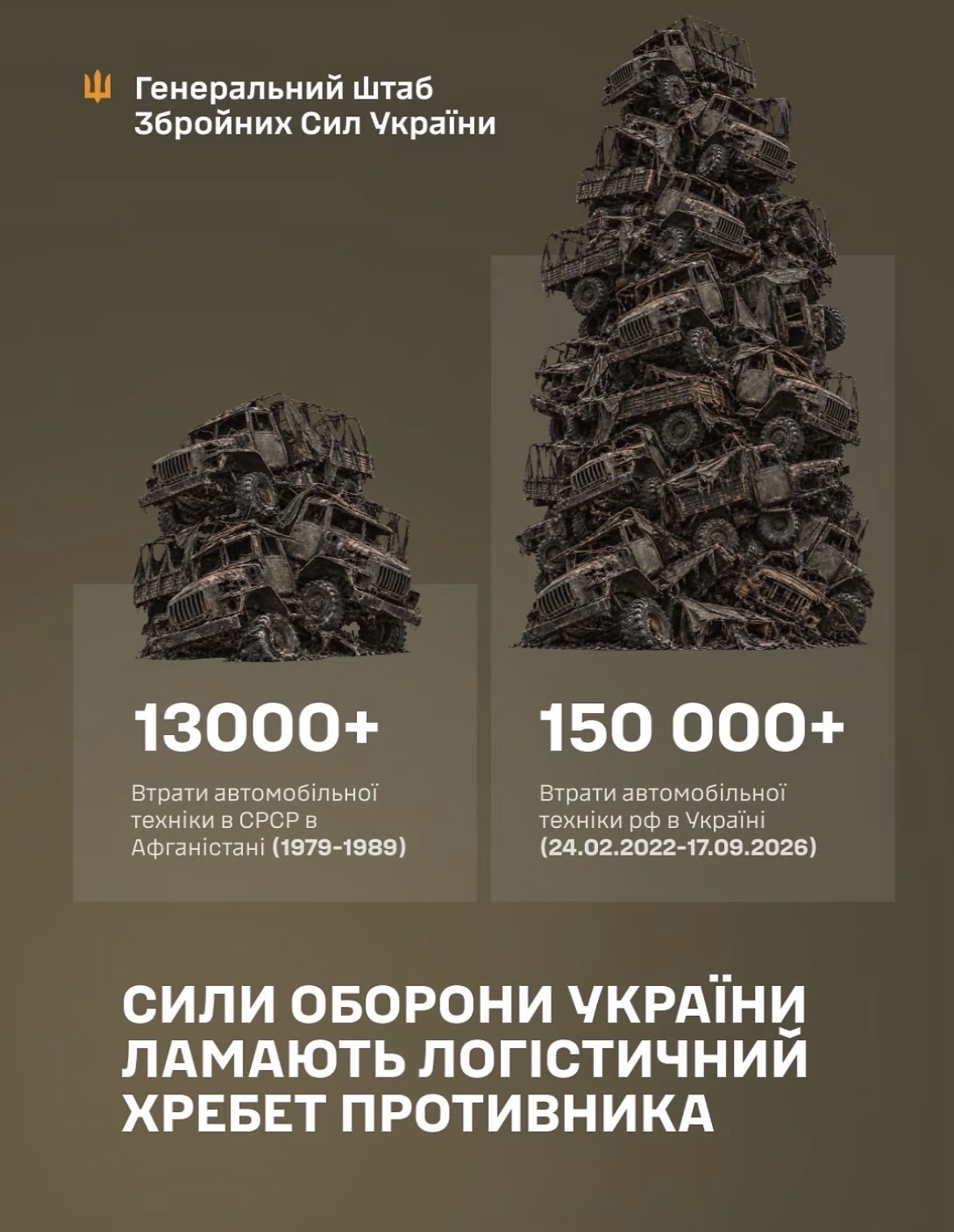
🇺🇦Ukraine’s Defence Forces have destroyed over 150,000 Russian military vehicles and fuel tankers since the full-scale invasion—more than 11 times Soviet vehicle losses during its 10-year war in Afghanistan. Russia’s military logistics are being dismantled🔥🔥🔥 #Ukraine #UkraineWar

H

“Every storm serves two purposes: to expose what isn't built to last and to strengthen what is” - Anonym 130 attempts to create a functional socialist state. There are 195 states in the world today. Afghanistan Albania Alsace Soviet Republic Alsace-Lorraine Soviet Republic Angola Anarchist Aragon Armenian SSR Asturian Socialist Republic Azerbaijan People’s Government Azerbaijani SSR Baku Commune Bavarian Soviet Republic Benin Bessarabian Soviet Socialist Republic Bremen Soviet Republic Bruree Soviet Bulgaria Byelorussian SSR Cambodia China Chinese Soviet Republic Coalition Government of Democratic Kampuchea Commune of the Working People of Estonia Congo-Brazzaville Cork Harbour Soviet Crimean People’s Republic Crimean Socialist Soviet Republic Cuba Czechoslovakia Democratic Republic of Georgia Democratic Republic of Yemen Donetsk–Krivoy Rog Soviet Republic East Germany Estonian SSR Ethiopia Finnish Democratic Republic Finnish Socialist Workers’ Republic Free Socialist Republic of Germany Free Territory Galician Soviet Socialist Republic Gambia National Revolutionary Council Georgia Grenada Guangzhou Commune Guinea People’s Revolutionary Republic Hunan Soviet Hungarian People’s Republic Hungarian Soviet Republic Inner Mongolian People’s Republic Jiangxi–Fujian Soviet Junta of National Reconstruction Kampuchea Kazakh SSR Karelo-Finnish SSR Kirghiz SSR Knocklong Soviet Korean People’s Association in Manchuria Kuwait Republic Laos Latvian Socialist Soviet Republic Latvian SSR Liberated Zone Limerick Soviet Lithuanian SSR Lithuanian–Byelorussian Soviet Socialist Republic Mainz Workers’ and Soldiers’ Council Mahabad Republic Marquetalia Republic Moldavian SSR Mongolia Monaghan Soviet Mozambique Mughan Soviet Republic Naissaar Soviet Republic Nghệ-Tĩnh Soviet North Korea North Vietnam North Greece Provisional Democratic Government Odessa Soviet Republic Paris Commune People’s Committee of North Korea People’s Provisional Government of Vanuatu People’s Republic of Kampuchea People’s Republic of Korea People’s Republic of Mongolia People’s Republic of Zanzibar and Pemba People’s Revolutionary Government of the Republic of China Persian Socialist Soviet Republic Poland Political Committee of National Liberation Provisional Democratic Government of North Greece Provisional Government of National Union and National Salvation of Cambodia Provisional People’s Committee for North Korea Regional Defence Council of Aragon Republic of Guria Republic of Kuwait Republic of South Vietnam Revolutionary Catalonia Romania Russian SFSR Saxon Soviet Republic Shaan-Gan-Ning Border Region Slovak Soviet Republic Socialist Republic of Bosnia and Herzegovina Socialist Republic of Croatia Socialist Republic of Macedonia Socialist Republic of Montenegro Socialist Republic of Serbia Socialist Republic of Slovenia Somalia South Yemen Soviet Civil Administration Soviet Union Soviet Zone Soldiers’ Council of Strasbourg Soldiers’ and Fortress-Builders’ Republic of Naissaar Strandzha Commune Tajik SSR Turkmen SSR Ukrainian People’s Republic Ukrainian SSR Uzbek SSR Vanuatu People’s Provisional Government Vietnam Waterford Soviet West Ukrainian People’s Republic Würzburg Soviet Republic Xinjiang Clique Yugoslavia Zanzibar and Pemba People’s Republic

Reescrever a história é uma prática comum nas ditaduras, e na Rússia não é diferente. No dia 17 de Setembro de 1939 a União Soviética, de Stalin, invadiu a Polônia, honrando um pacto assinado com a Alemanha nazista de Hitler que dividiu o país e toda a Europa Oriental entre nazistas e soviéticos. Mas, para a Rússia de Putin, a invasão foi para "impedir o genocídio de populações no oeste da Belarus e da Ucrânia". #História #Ditadura #Rússia

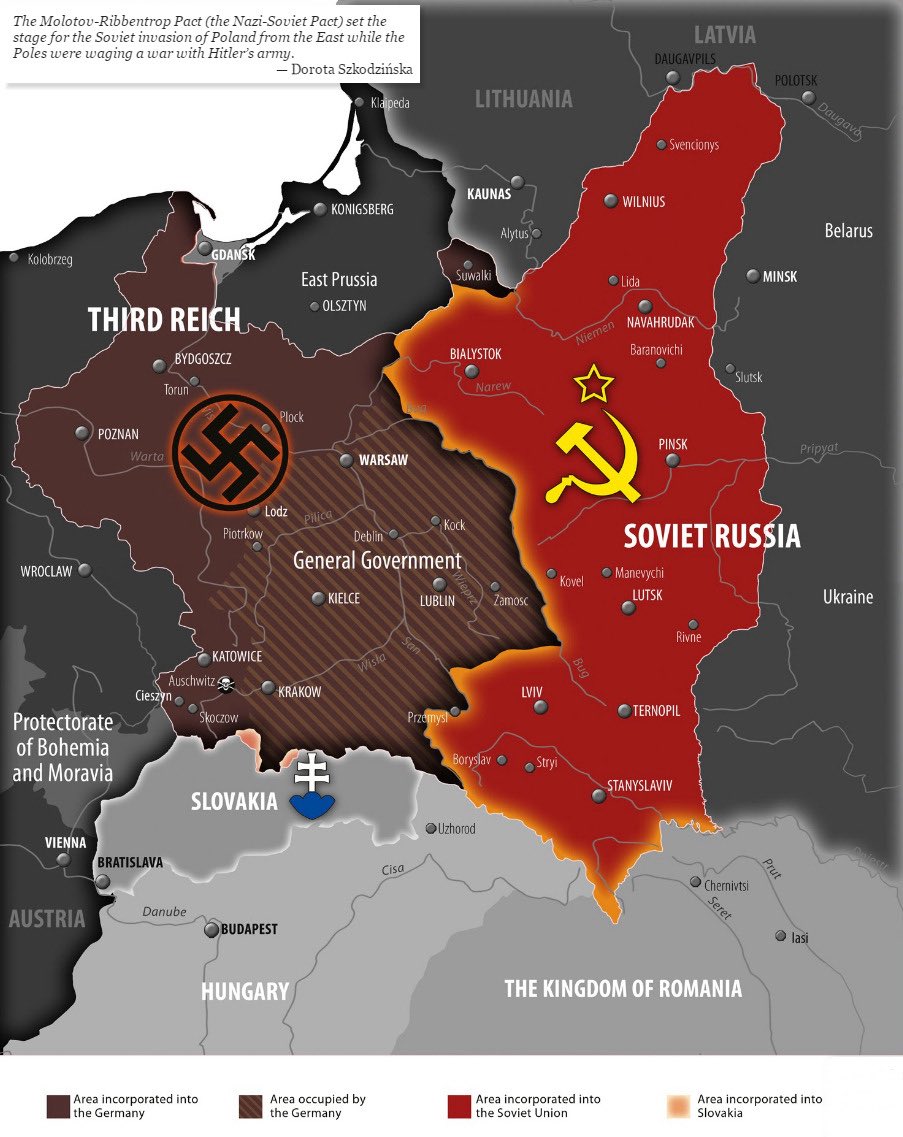
This is your annual public service reminder that Soviet Union was an ally of Nazi Germany, and they jointly attacked Poland in September 1939. As they had agreed on August 23rd. For USSR aggression against the Baltic States was next, followed by attack against Finland. #History #SovietUnion #NaziGermany #PL #RU #EE #LV #LT #FN

Neste dia, no ano de 1939, a União Soviética de Stalin, respeitando o pacto que tinha assinado com a Alemanha nazista de Hitler, invadiu a Polônia. Os dois ditadoras dividiram não só a Polônia, mas todo o leste da Europa, com Stalin recebendo de Hitler carta branca para invadir partes da Finlândia, Romênia e Países Bálticos. Durante quase dois anos, Stalin apoiou diretamente o esforço de guerra de Hitler, enviando para o ditador nazista grandes quantidades de minérios e até mesmo petróleo e combustível, itens que Hitler usou para invadir a França, Bélgica, Noruega e atacar o Reino Unido. É por isso que, na Rússia, apesar de seus soldados terem começado a lutar desde setembro de 1939, a 2ª GM (chamada por eles de a Grande Guerra Patriótica) só começou em junho de 1941, quando Hitler traiu o pacto com Stalin e invadiu a União Soviética. O objetivo disso é esconder que, por quase 2 anos, Hitler e Stalin estiveram do mesmo lado do campo de batalha. #História #SegundaGuerraMundial #Polônia

On 17 September 1939, the Soviet Union treacherously attacked Poland, joining forces with Germany https://t.co/4oodqTSLVt #History #Poland #SovietUnion #RU #PL #DE

On Sept. 17, #1939, #Soviet Union joined #Germany, as partner in #crime, in a brutal attack on #Poland. The Kremlin is also culpable for #WWII. The notorious #Ribbentrop-Molotov pact prejudged #WWII. Till 1941 #Moscow and #Berlin waged a war on Poland hand in hand, dragging https://t.co/cYUbyCP0WY #SovietUnion #Germany #WWII #RU #DE #PL

Former CIA chief David Petraeus warns that Moldova could be the next target of Vladimir Putin, who continues to try to reinstate the Soviet Union, emphasizing that Europe is not prepared for the new security challenges. (translated)

Avertismentul fostului șef al CIA: „Republica Moldova ar putea fi următoarea țintă a lui Putin”. Ce se încearcă „constant”

September 11 marked a significant turning point in the international order, profoundly shaping global geopolitics and the dynamics in the Middle East, whose historical roots trace back to crucial events of 1979, including the Soviet invasion of Afghanistan and the Iranian revolution. (translated)

11 de Setembro: 25 anos

Dunque, ricapitolando: dell'Ucraina ce ne dovremmo fregare, della famiglia della Kallas trucitada dai sovietici pure, dei droni russi che cadono in giro per l'Europa non ne parliamo nemmeno. Del riarmo e del gas russo, invece... di quelli sì che ci deve importare! #Ucraina #politica #guerra

Putin calls the battle for children’s minds a “new front”. A Soviet-style indoctrination programme has been introduced in Russian schools—with a corrosive effect on pupils https://t.co/ci8eqehuIO #Putin #Indoctrination #Education #RU

H

“Socialism Was Good in Theory” That assumes socialism’s theory was never seriously challenged. It was—long before the Soviet Union, Lenin, or any national-scale experiment. Five thinkers attacked its foundations from different directions. Tocqueville: Equality Can Become Servitude In 1848, Alexis de Tocqueville distinguished democracy from socialism. Both pursued equality, but democracy sought it while preserving individual freedom. Socialism risked achieving equality by expanding state power. Equality, he warned, is not automatically liberty. Bastiat: Redistribution Can Become Plunder In 1850, Frédéric Bastiat examined what happens when the state takes from some to give to others in the name of justice. He called this “legal plunder.” His concern was that politics could become a permanent struggle to control redistribution. Nietzsche: Equality Can Become Resentment Nietzsche attacked socialism psychologically. He saw egalitarianism as potentially rooted in resentment toward exceptional individuals, ambition, strength, and hierarchy. The danger was a culture that treated excellence as morally suspect—not lifting people upward, but bringing the exceptional downward. Böhm-Bawerk: Challenge the Economics In 1896, Eugen von Böhm-Bawerk attacked Marx’s economic theory, arguing that Marx’s labor theory of value could not adequately explain the relationship between labor values and actual prices. He challenged socialism’s claim to a scientific economic foundation. Mises: The Calculation Problem In 1920, Ludwig von Mises asked a devastating question: even if socialism is morally desirable, how would planners know what to produce? The sequence is clear: Tocqueville challenged the political premise. Bastiat challenged redistribution. Nietzsche challenged egalitarian psychology. Böhm-Bawerk challenged Marxian economics. Mises challenged central planning. All of them preceded the Soviet experiment. So “socialism was good in theory, but bad in practice” is not an argument. It is a historical claim that requires explaining why these objections were wrong.

H

Cuba’s Economic Failure: Beyond the Embargo For more than six decades, Cuba’s poverty has often been explained by one claim: America’s embargo made the country poor. Repetition, however, is not evidence. A study “The Forsaken Road: Reassessing Living Standards Following the Cuban Revolution and the American Embargo,” by Bastos, Geloso and Bologna Pavlik, published in the Journal of Development Economics challenges this narrative by separating three factors: the Cuban Revolution, the American embargo, and the extensive economic support Cuba received from the Soviet Union. Their findings show a major economic divergence. Correcting weaknesses in Cuba’s GDP statistics makes the gap larger, not smaller. When Soviet assistance is excluded, Cuba’s relative performance looks even worse. For decades, central planning was heavily subsidized by an economic superpower. After the Soviet Union collapsed in 1991, that support largely disappeared, exposing the system’s underlying weaknesses during the “Special Period.” This does not mean the American embargo was harmless. Trade restrictions impose real costs, and a 2026 critique by Francisco Rodríguez argues that the study may underestimate the embargo’s effects. Still, an embargo can make a bad economic system poorer without being the reason the system is dysfunctional. Cuba did not adopt central planning because of the embargo. The Revolution restricted private property, nationalized businesses, displaced markets with political allocation, and transferred economic decisions to the state. Cuba’s history is therefore not merely a story of American sanctions. It is also a demonstration of what happens when a market economy is replaced by political allocation and then subsidized for decades by an external power. The embargo’s costs deserve serious measurement, but it should not become an alibi for an economic system whose institutions produced persistent failure. The central question remains: Why did Cuba remain economically dysfunctional even during decades of extraordinary Soviet support?

Neutrality is not a security guarantee. It is a political declaration, not a shield. During the Cold War, Western planners explicitly considered the possibility of Soviet forces violating neutral Swiss territory, while actual Warsaw Pact war plans envisaged massive offensives #Neutrality #Security #ColdWar #Nocountrycodesarepresentinthetweet.

1986: THE OIL SHOCK THAT HELPED BREAK THE SOVIET EMPIRE 🇺🇸🇸🇦 The Soviet Union invaded Afghanistan in 1979 and entered a costly war that drained men, money and political credibility. At the same time, Moscow depended heavily on oil and gas exports for the hard currency it needed https://t.co/V47KC4W41g #OilShock #SovietUnion #History #US #SA

BAUMGARTEN 1968 — AUSTRIA OPENED THE DOOR. THE WORLD PAID THE PRICE. In June 1968, OMV signed the Soviet gas contract. On 1 September 1968, Soviet gas reached Baumgarten. Austria became the first Western European customer of Soviet natural gas — and Baumgarten became Moscow’s https://t.co/DDHdBlEcLD #Baumgarten #SovietGas #AustriaHistory #AT #RU