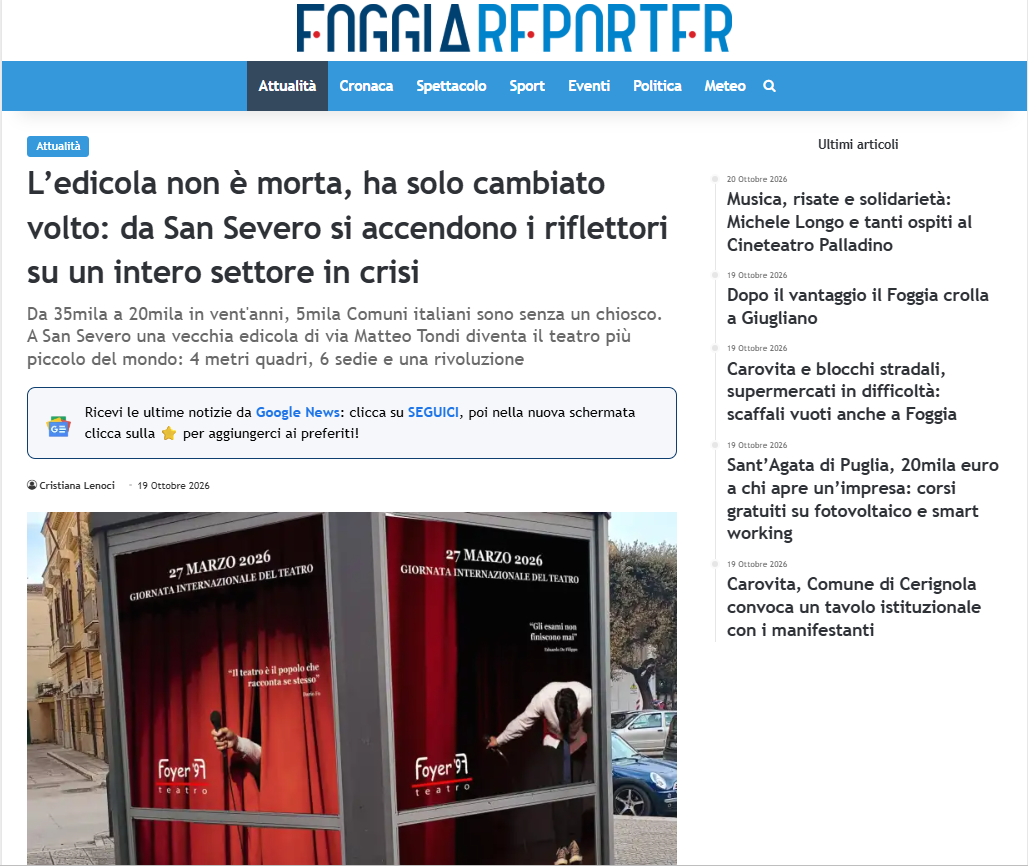
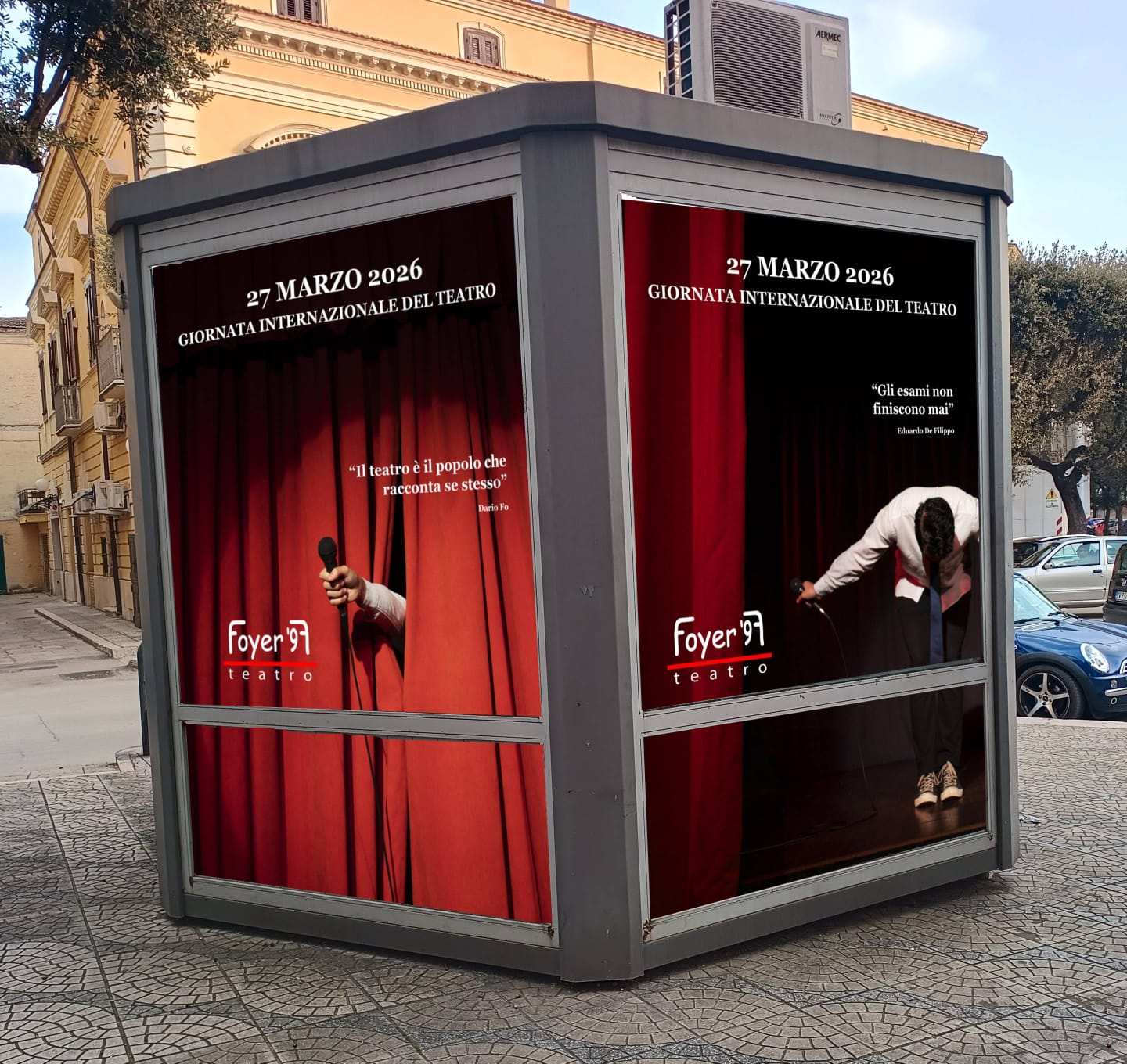
FOGGIA REPORTER: "THE NEWSSTAND IS NOT DEAD, IT HAS ONLY CHANGED ITS FACE: SAN SEVERO SHEDS LIGHT ON AN ENTIRE SECTOR IN CRISIS" by CRISTIANA LENOCI SOURCE: https://www.foggiareporter.it/ledicola-non-e-morta-ha-solo-cambiato-volto-da-san-severo-si-accendono-i-riflettori-su-un-intero-settore-in-crisi.html SAN SEVERO (FG) — From 35,000 to 20,000 in twenty years, 5,000 Italian municipalities are without a newsstand. In San Severo, an old newsstand on via Matteo Tondi becomes the smallest theater in the world: 4 square meters, 6 chairs, and a revolution. For sixty years, it was the place to pick up the newspaper, ask about the results of the game, leave keys with a neighbor. Then the shutter went down, the glass became opaque, the sign faded. This is how newsstands are ending in Italy today. But sometimes, this is how they are reborn. In San Severo, on via Matteo Tondi, an abandoned newsstand for six years became on March 27, 2026, World Theater Day, the Teatro Edicola Foyer ’97. Four square meters, six chairs, fifteen-minute shows. An idea by director and artistic director Francesco Gravino and his company Foyer ’97. They have called it “the smallest theater in the world,” and the news has circulated among international agencies, becoming a case study for the Stanford Social Innovation Review with the report “The Six-Seat Revolution.” An old newsstand that returns to being what it has always been: a place of knowledge, culture, and work. Only now it distributes stories instead of newspapers. A sector at risk of disappearing The story of San Severo sheds light on a silent hemorrhage. We had 35,000 newsstands in 2005, and we have about 20,000 in 2024: -43%. According to FENAGI data released in 2026, the points of sale in 2025 were about 19,500, but only 6,000 were exclusive traditional newsstands. The most painful statistic is geographic: nearly 5,000 Italian municipalities no longer have a newsstand. In two out of three municipalities, there is no longer a point of sale for newspapers and magazines. Other tallies, those from Sinagi, report a collapse from 38,000 exclusive newsstands to about 11,000 still active. In the last four years, from 2019 to 2023, almost 2,700 newsstands have disappeared, of which 2,327 were individual businesses. Rome lost 303, Turin 138, Milan 129. Isernia lost more than a third of its newsstands in four years. Why? Decline in paper sales, digital subscriptions, rising management costs, reduced profitability. In economics, it's called a "falling demand sector." On the street, it is simply called the end of a habit. Not just newspapers Yet the newsstand has never been only about newspapers. In the past, it was an information outpost, a reference point, the guardian of a neighborhood. It was self-employment, often familial, involving early mornings at 4 a.m. to be ready when the city wakes up. Today, those who resist reinvent themselves: local bookstore, service point, package pickup, ticket sales, coffee corner. Those who can't make it, close. The example of Foyer 97 in San Severo tells us one simple and uncomfortable truth: we cannot save all newsstands as newsstands. But we can save their essence. A 4-square-meter kiosk in Puglia becoming a theater reminds us that those few square meters are worth more than the rent they no longer pay. They are valuable because they are already where people pass by. They are already recognized as a public place. They are already culture, even when they no longer sell culture on paper. If newsstands stop selling newspapers, they do not necessarily have to stop selling knowledge. (translated)