BETA nonprofit public democratic european moderated

Search

#explained

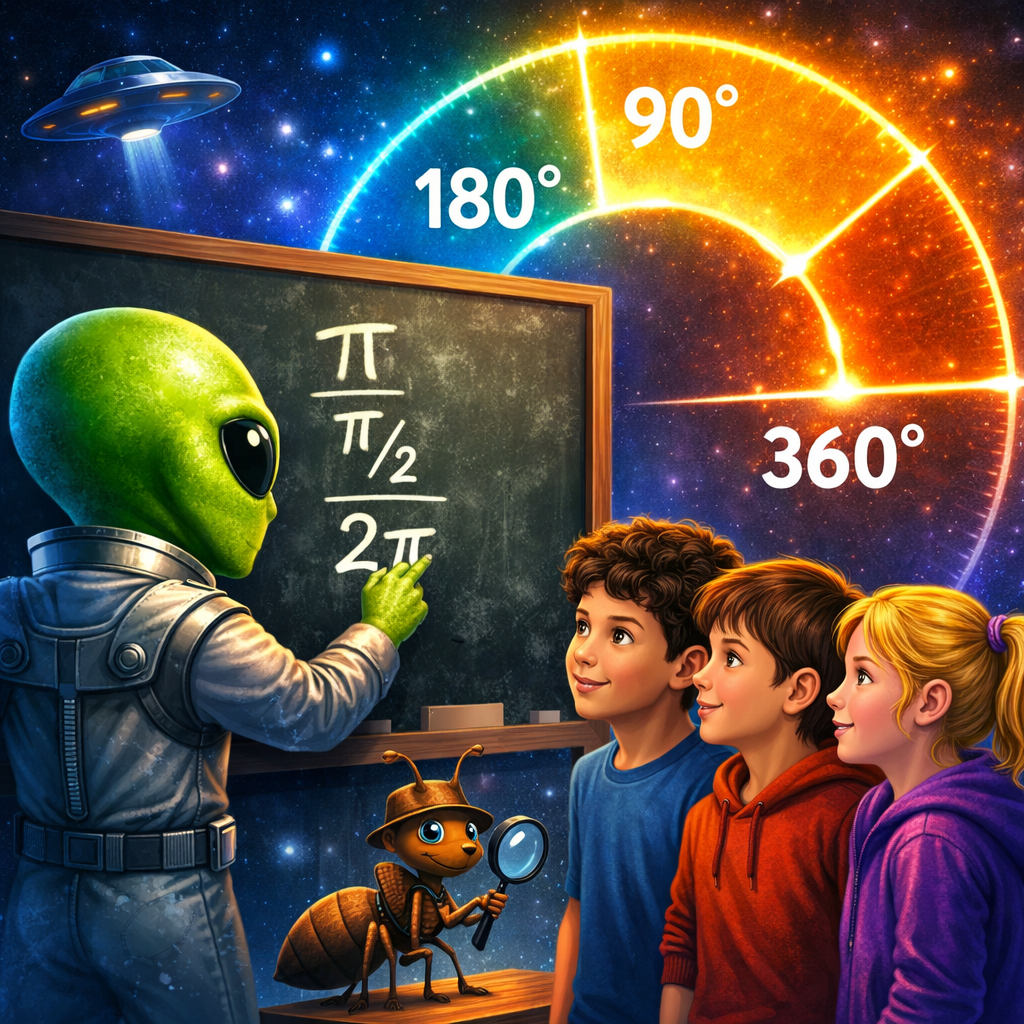
Math Detectives: Alien Angles: The Radian Code Mystery by Mr. Numberwise www.amazon.com/dp/B0GHT5N6SC www.amazon.co.uk/dp/B0GHT5N6SC Writing What if aliens didn’t use degrees… but radians? When a strange signal appears in the school cafeteria, Jim, Mia, and the mysterious talking ant discover something unbelievable: The message is written in a secret math language. Not degrees… but radians. To solve the mystery, they must: • Decode π, π/2, and 2π • Translate alien rotation commands • Use circles to crack hidden messages • Think like real mathematicians But someone is watching them… And this time, the puzzle is harder. Perfect for ages 10–14, this book turns math into an adventure: Story-based learning Step-by-step explanations Visual thinking 20 fun worksheets included Can YOU crack the alien code? Made Easy Series math mystery book for kids StorytellerUK2026 radians for kids easy explained learning angles pi radians children math detective story book summer adventure stories for kids 9-12 middle school math practice angles geometry stem learning kids problem solving #Amazon #MathMysteryBookForKids #StorytellerUK2026 #RadiansForKidsEasyExplained #LearningAnglesPiRadiansChildren #MathDetectiveStoryBook #SummerAdventureStoriesForKids_9_12 #MiddleSchoolMathPracticeAnglesGeometry #StemLearningKidsProblemSolving #Kids #GreenwichMeridian #Equator #PrimeMeridian #InternationalDateLine #NorthPole #SouthPole #CompassRose #WorldMap #LatitudeAndLongitude #GreatCircleRoute #ArcticCircle #AntarcticCircle #TropicOfCancer #TropicOfCapricorn #FerdinandMagellan #Magellan #JuanSebastiánElcano #JamesCook #MarcoPolo #IbnBattuta #Battuta #ZhengHe #VascoDaGama #DaGama #AmerigoVespucci #Vespucci #RoaldAmundsen #Amundsen #ErnestShackleton #Shackleton #DavidLivingstone #Livingstone #Sacagawea #0248 (=256)

The Ants’ Treasure: Where the Paths Meet — English Edition www.amazon.com/dp/B0GXGNPD87 Visual Math Made Clear: Visually Explained Algebra Series Title Math Made Clear for Kids (Ages 9–12) The Ants’ Treasure: Where the Paths Meet is a visual math story that turns equations, graphs, and coordinates into an adventure children can actually see and understand. This is the English Edition. This book is also available in other language editions. When Mia and Alex discover two mysterious ant paths crossing the beach, they meet Mr. Numberwise — a quiet guide who shows them that math is not just numbers on a page, but stories, paths, patterns, and discoveries. Through ants, treasure maps, staircases, colorful paths, and exciting “Aha!” moments, children are introduced to: • linear equations • slope • coordinates • graphing • intersections and meeting points This book uses original visual models to make algebra easier to understand: • slope becomes a staircase • an equation becomes the recipe of a path • +b becomes the starting floor • coordinates become the address of a point • an intersection becomes the place where two different path-stories meet This book combines: ✔ story ✔ visual explanations ✔ solved exercises ✔ step-by-step learning ✔ drawings and graphs ✔ practice worksheets ✔ “Math Made Clear” style explanations ✔ memorable “Aha!” moments Instead of memorizing formulas, children begin to see how math moves. Perfect for curious learners, visual thinkers, homeschool families, classrooms, and children discovering algebra for the first time. Designed mainly for ages 10–14, this book can also help older students who find algebra difficult and need a clearer, more visual explanation. And honestly… many adults may finally understand slope better with this book too. A visual math story with solved exercises — designed to make algebra finally feel clear. #BeachVacation #MathAdventureForKids9_12 #GraphingAlgebra #CoordinateAlgebra #SlopeAlgebra #visually #explained #algebra #StorytellerUK2026 #SummerAdventure #StoriesForKids9_12 #VisualMath #0249 #AntsOnTheBeach #BrightonBeach #BournemouthBeach #BlackpoolBeach #FistralBeach #SandsendBeach #WhitbyBeach #RhossiliBay #BarafundleBay #TenbyNorthBeach #LlangennithBeach #OxwichBay #ManorbierBeach #SantaMonicaBeach #VeniceBeach #HuntingtonBeach #LagunaBeach #CoronadoBeach #SouthBeachMiami #ClearwaterBeach #SiestaKeyBeach #DaytonaBeach #CocoaBeach #WaikikiBeach #KaanapaliBeach #LanikaiBeach #Kids #TreasureIsland #AntTreasure #BeachAdventure #HiddenTreasure #TreasureHunt #TreasureMap #SecretBeach #IslandAdventure #LittleExplorers

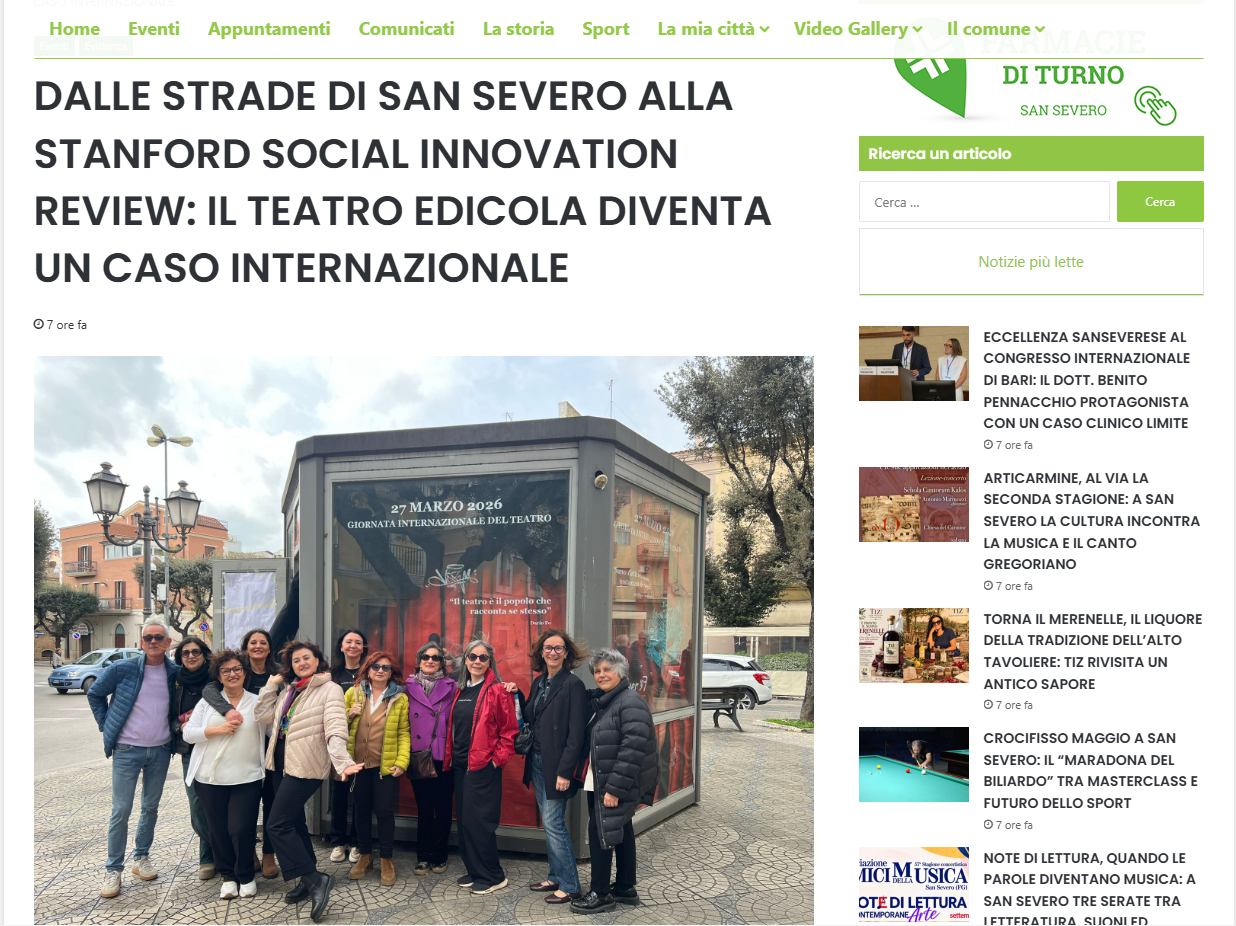
FROM THE STREETS OF SAN SEVERO TO THE "STANFORD SOCIAL INNOVATION REVIEW": "TEATRO EDICOLA" BECOMES AN INTERNATIONAL CASE STUDY SOURCE: https://www.sanseverocitta.it/dalle-strade-di-san-severo.../ SAN SEVERO (FG) - Six persons enter a newsstand. Before them there are no newspapers, periodicals, or tobacco, but rather a theatrical stage of less than two square metres. The actors stand but a few paces from the spectators, with scarcely any separation betwixt performer and beholder. It is thus that a place abandoned for years in San Severo hath been restored to life. And today that modest theatrical experiment hath come under the glare of international attention. This is the history of the Teatro Edicola, the project realised by the company Foyer '97, under the artistic direction of Francesco Gravino, which hath transformed a former newsstand in Via Tondi into one of the smallest stages hitherto conceived. The project commenced on 27th March last with a formula at once simple and singularly original: six seats, a most circumscribed scenic space, and performances of but a few minutes' duration. A minimal distance betwixt public and interpreters that doth wholly transfigure the traditional relation between spectator and theatre. The wager, however, was immediately rewarded by the public. More than sixty persons attended the performances in a single afternoon, and the three days of the inaugural season recorded a complete sold-out. From a local experiment, the Teatro Edicola hath thus become a case capable of attracting attention far beyond the confines of the Province of Foggia. In September 2026, the Stanford Social Innovation Review, the journal of Stanford University, shall publish upon its website and in its Fall 2026 print edition the reportage "The Six-Seat Revolution", authored by Dr Luciano Magaldi Sardella and overseen editorially by Deputy Editor David V. Johnson. The interest of the American review doth not concern merely the originality of the theatrical proposition. The Teatro Edicola is, indeed, observed as a potential exemplar of low-cost social innovation and urban regeneration. The notion is particularly compelling in a country such as Italy, wherein numerous newsstands have ceased their activity and risk becoming vacant interstices within the urban fabric. The question, at bottom, is simple: may a place born to vend newspapers become anew a locus of encounter? In San Severo the answer hath been entrusted to the theatre. The newsstand hath not been merely restored in corporeal terms. It hath changed its function, transmuting itself into a place wherein artists encounter the public directly and wherein the performance becometh part of the quotidian life of the street. "The theatre cometh into the street wherein thou walkest every day," explained Francesco Gravino, thereby synthesising the philosophy underpinning the project. And it is precisely this aspect which hath rendered the experiment compelling also upon the plane of its possible replicability. Initial requests for information have already arrived from other cities, amongst them Lucca and Rome, desirous of apprehending the model and the modalities for its realisation. The strength of the Teatro Edicola resideth also in its apparent disproportion: a minimal investment and space to produce a far greater cultural effect. There is no need for a grand theatre, an auditorium of hundreds of seats, or complex structures. An unused space, an idea, and the will to restore it to the community suffice. That former newsstand in Via Tondi, therefore, narrateth something that transcendeth theatre itself. It narrateth the possibility of reconceiving the spaces of our cities, restoring a social function to places that seemed to have lost it definitively.

DALLE STRADE DI SAN SEVERO ALLA STANFORD SOCIAL INNOVATION REVIEW: IL TEATRO EDICOLA DIVENTA UN CASO INTERNAZIONALE

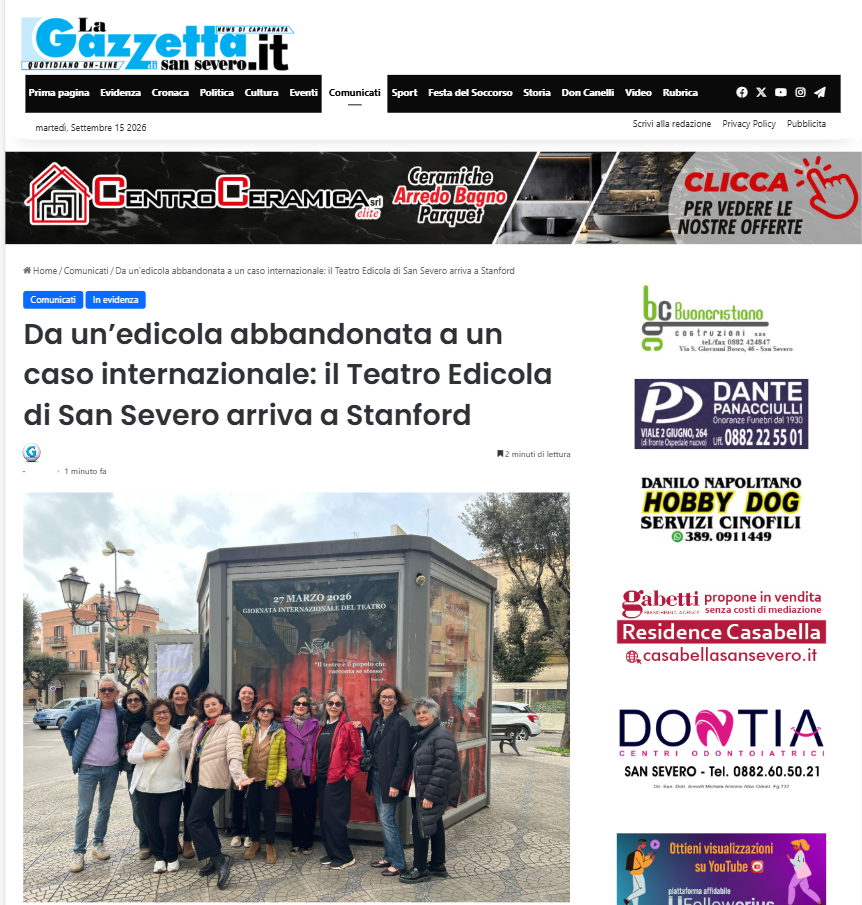
“TEATRO EDICOLA” OF SAN SEVERO BECOMES AN INTERNATIONAL CASE STUDY IN THE “STANFORD SOCIAL INNOVATION REVIEW (SSIR)” — STANFORD UNIVERSITY SOURCE: https://l1nq.com/rruntbb LA GAZZETTA DI SAN SEVERO SAN SEVERO (FG) — Six persons enter a news kiosk. Before them lie no newspapers, magazines, or tobacco, but a theatrical stage measuring less than two square metres. The actors stand but a few paces from the spectators, with scarce any separation betwixt those who perform and those who behold. It is in this manner that in San Severo a place abandoned for years hath begun to live anew. And today that diminutive theatrical experiment hath fallen beneath the glare of international attention. It is the story of the “Teatro Edicola”, the project realised by the company Foyer ’97, under the artistic direction of Francesco Gravino, which hath transformed an old news kiosk in Via Tondi into one of the smallest stages ever conceived. The project commenced on 27th March last, with a formula as simple as it is original: six seats, a stage of most exiguous dimensions, and performances lasting but a few minutes. A minimal distance betwixt public and performers that doth wholly alter the traditional relationship betwixt spectator and theatre. The wager, however, was forthwith rewarded by the public. More than 60 persons attended the performances in a single afternoon, and the three days of the inaugural season registered a complete sold-out. From a local experiment, the “Teatro Edicola” hath thus become a case capable of attracting attention far beyond the confines of the Province of Foggia. In September 2026, the Stanford Social Innovation Review (SSIR), the journal of Stanford University, shall publish upon its website and in its Fall 2026 print edition the reportage “The Six-Seat Revolution”, authored by Dr Luciano Magaldi Sardella and edited by Deputy Editor David V. Johnson. The interest of the American review concerneth not merely the originality of the theatrical proposition. The Teatro Edicola is, in fact, observed as a potential paradigm of social innovation and low-cost urban regeneration. Become a Medium member The idea is particularly compelling in a country such as Italy, wherein numerous news kiosks have ceased their activity and risk becoming vacant interstices within the urban fabric. The question, at bottom, is simple: can a place born to sell newspapers become once more a locus of encounter? In San Severo, the answer hath been entrusted to the theatre. The kiosk hath not been merely restored in a physical sense. It hath changed its function, transforming itself into a place where artists encounter the public directly and where the performance becometh part of the quotidian life of the street. “The theatre cometh into the street wherein thou walkest every day,” Francesco Gravino hath explained, thus synthesising the philosophy underpinning the project. And it is precisely this aspect that hath rendered the experience interesting also upon the plane of its potential replicability. Initial requests for information have already arrived from other cities, amongst them Lucca and Rome, interested in learning of the model and the modalities for its realisation. The strength of the Teatro Edicola resideth also in its apparent disproportion: a minimal investment and space to produce a cultural effect far greater. There is no need for a grand theatre, an auditorium of hundreds of seats, or complex structures. An unused space sufficeth, together with an idea and the will to restore it to the community. That old kiosk in Via Tondi, therefore, recounteth something that goeth beyond the theatre. It recounteth the possibility of rethinking the spaces of our cities, restoring a social function to places that seemed to have definitively lost it.

Encurtador de Link
H

Cuba’s Economic Failure: Beyond the Embargo For more than six decades, Cuba’s poverty has often been explained by one claim: America’s embargo made the country poor. Repetition, however, is not evidence. A study “The Forsaken Road: Reassessing Living Standards Following the Cuban Revolution and the American Embargo,” by Bastos, Geloso and Bologna Pavlik, published in the Journal of Development Economics challenges this narrative by separating three factors: the Cuban Revolution, the American embargo, and the extensive economic support Cuba received from the Soviet Union. Their findings show a major economic divergence. Correcting weaknesses in Cuba’s GDP statistics makes the gap larger, not smaller. When Soviet assistance is excluded, Cuba’s relative performance looks even worse. For decades, central planning was heavily subsidized by an economic superpower. After the Soviet Union collapsed in 1991, that support largely disappeared, exposing the system’s underlying weaknesses during the “Special Period.” This does not mean the American embargo was harmless. Trade restrictions impose real costs, and a 2026 critique by Francisco Rodríguez argues that the study may underestimate the embargo’s effects. Still, an embargo can make a bad economic system poorer without being the reason the system is dysfunctional. Cuba did not adopt central planning because of the embargo. The Revolution restricted private property, nationalized businesses, displaced markets with political allocation, and transferred economic decisions to the state. Cuba’s history is therefore not merely a story of American sanctions. It is also a demonstration of what happens when a market economy is replaced by political allocation and then subsidized for decades by an external power. The embargo’s costs deserve serious measurement, but it should not become an alibi for an economic system whose institutions produced persistent failure. The central question remains: Why did Cuba remain economically dysfunctional even during decades of extraordinary Soviet support?

Nearly 80% of Polish respondents believe that Poland must come to the Baltic states’ aid if Russia attacks them. This comes as no surprise. As I explained in my interview with Konstantin von Eggert, Poland’s strategy toward Russia is to broaden the front; Russia’s strategy toward #Poland #BalticStates #Russia #PL #RU #EE #LV #LT

PORTAL-ANALITIKA.ME publishes the “Edicola Teatro” of Foyer ’97, Founded by Francesco Gravino of San Severo, Puglia, Italy SOURCE: https://www.linkedin.com/pulse/portal-analitikame-publishes-edicola-teatro-foyer-97-sardella-ph-d--6i2of/ The format devised by the Pulgian theatre company Foyer ’97 — already described as “the smallest theatre in the world” — has now reached the international stage through its feature on the global platform Europe Says. A story born from an abandoned news kiosk in the province of Foggia is now crossing every conceivable boundary. It is a genuine pleasure and an honour to share the brilliant idea of the artistic director of Teatro ’97, the distinguished actor and director from San Severo, Francesco Gravino, and his remarkable theatre company, as they gain international visibility with this marvellous and innovative creation: a true “Teatro Edicola”. Source: https://www.portalanalitika.me/clanak/na-drugoj-obali-jadrana-otvoreno-najmanje-pozoriste-na-planeti Only a few square metres, six chairs, and the passion of a theatre company are enough to make history. The Edicola Teatro, conceived by Francesco Gravino, Artistic Director of the historic San Severo-based company Foyer ’97, is receiving significant media recognition, “taking to the stage” of leading national and international outlets thanks to his talented intuition, inspired by Edicola Fiore, the celebrated format created by the Italian entertainment icon Rosario Fiorello. An abandoned kiosk, a record‑breaking theatre It has already been dubbed “the smallest theatre in the world” and, with merely six seats, may well aspire to a Guinness World Record. Since its launch a few days ago, the original venue has drawn hundreds of curious visitors who queued to attend the performances—scheduled every fifteen minutes—inside a former abandoned news kiosk in San Severo, in the province of Foggia. The initiative stems from the distinctive vision of the long‑established San Severo company Foyer ’97, led by Gravino, who sought to celebrate World Theatre Day with an unprecedented experiment that has already been widely reported by national‑level media. The idea, seemingly simple in its striking essentiality, in fact conceals a profound reflection on the nature of theatrical practice. “The idea of the smallest theatre in the world was born from a creative provocation: to return theatre to its most direct essence. Together with the company, we asked ourselves how far the space could be reduced without losing intensity, and the kiosk became the perfect symbol: a place that suddenly transforms into a stage. From a space of news to a space of emotions,” Gravino explained. Foyer ’97 has been active since 1997 and is based in San Severo. Next year it will celebrate its thirtieth anniversary—an occasion approaching at the moment of greatest visibility in its history. The format: sixteen giants of literature in fifteen minutes With only six seats available at a time and performances following one another every fifteen minutes, the audience is quite literally immersed in the work. From 11:00 to 20:45, eleven actors alternate in bringing to life the giants of literature: from Goldoni to Chekhov, via the wit of Gaber and the dramatic force of Euripides. Inside the small theatre carved out of the disused kiosk owned by Mr Pino Grau, there is no traditional separation between stage and auditorium; instead, an intimate encounter takes place in which spectators and actors become, in effect, a single entity. Admission is free, reflecting Gravino’s aim: to restore theatre’s accessibility, returning it to a place that welcomes everyone. At the kiosk’s threshold, a QR code and a cryptic notice encapsulate the spirit of the project: “Warning. This QR code turns passers‑by into actors. Scan only if you are ready.” From the crisis of print media to cultural rebirth The project also carries with it a reflection on urban transformation and the decline of traditional commerce. The kiosk had been unused for around six years and has now been transformed into an intimate and surprising performance space in which less than a metre separates actors from spectators. At a time when kiosks in town and city centres are increasingly converted into drink stands, flower stalls, or souvenir shops, the Edicola Teatro comes closer to the original spirit of knowledge with which such kiosks were conceived—as places for the sale of newspapers and books. It is a symbolic short circuit of remarkable eloquence: a bastion of written culture becoming a bastion of live culture. The idea draws inspiration from Edicola Fiore, Fiorello’s cult programme, which first brought performance into a Roman kiosk. Gravino and his collaborators have also embraced the invitation of Willem Dafoe, the renowned actor and current director of the Theatre Section of the Venice Biennale, regarding the importance of theatre as a force for cohesion among peoples. The Grokipedia entry: a leap to global scale The theatre company Foyer ’97, led by Francesco Gravino, has now been granted its own dedicated encyclopaedic entry, “Teatro Edicola”. This Grokipedia listing represents more than a mere media acknowledgement. Launched in October 2025, Grokipedia is an AI-generated encyclopaedia managed by xAI, the artificial-intelligence research company founded by Musk. The fact that Grok’s knowledge engine has deemed the micro‑theatre worthy of an autonomous encyclopaedic entry—on a par with established cultural institutions—confirms the international resonance of an idea born in a side street of a southern Italian town. The objective is now to export the format beyond the borders of Apulia; with Grokipedia’s recognition, that prospect appears more concrete than ever. The praise of local institutions “We extend our heartfelt congratulations to Franco Gravino and to all the actors and artists for this wonderful initiative,” declared Mayor Lidya Colangelo and Deputy Mayor for Culture Anna Paola Giuliani. The municipal administration has announced its intention to welcome the company to Palazzo Celestini to celebrate the achievement together. Perhaps the most striking aspect has been the audience’s reaction. Many emerged with glistening eyes or with a suspended smile, as though they had experienced something secret. This is the theatre that Francesco Gravino and Foyer ’97 have chosen to pursue: not the theatre that waits for its audience on velvet seats, but the theatre that goes out to find them in the street, surprises them, and transforms them.

PORTAL-ANALITIKA.ME publishes the “Edicola Teatro” of Foyer ’97, Founded by Francesco Gravino of San Severo, Puglia, Italy

WP TURYSTYKA.PL publishes the “Edicola Teatro” of Foyer ’97, Founded by Francesco Gravino of San Severo, Puglia, Italy SOURCE: https://www.linkedin.com/pulse/wp-turystykapl-publishes-edicola-teatro-foyer-97-san-sardella-ph-d--hs5pf/ The format devised by the Pulgian theatre company Foyer ’97 — already described as “the smallest theatre in the world” — has now reached the international stage through its feature on the global platform Europe Says. A story born from an abandoned news kiosk in the province of Foggia is now crossing every conceivable boundary. It is a genuine pleasure and an honour to share the brilliant idea of the artistic director of Teatro ’97, the distinguished actor and director from San Severo, Francesco Gravino, and his remarkable theatre company, as they gain international visibility with this marvellous and innovative creation: a true “Teatro Edicola”. Source: https://turystyka.wp.pl/najmniejszy-teatr-swiata-ustawiaja-sie-kolejki-7273686077245632a Only a few square metres, six chairs, and the passion of a theatre company are enough to make history. The Edicola Teatro, conceived by Francesco Gravino, Artistic Director of the historic San Severo-based company Foyer ’97, is receiving significant media recognition, “taking to the stage” of leading national and international outlets thanks to his talented intuition, inspired by Edicola Fiore, the celebrated format created by the Italian entertainment icon Rosario Fiorello. An abandoned kiosk, a record‑breaking theatre It has already been dubbed “the smallest theatre in the world” and, with merely six seats, may well aspire to a Guinness World Record. Since its launch a few days ago, the original venue has drawn hundreds of curious visitors who queued to attend the performances—scheduled every fifteen minutes—inside a former abandoned news kiosk in San Severo, in the province of Foggia. The initiative stems from the distinctive vision of the long‑established San Severo company Foyer ’97, led by Gravino, who sought to celebrate World Theatre Day with an unprecedented experiment that has already been widely reported by national‑level media. The idea, seemingly simple in its striking essentiality, in fact conceals a profound reflection on the nature of theatrical practice. “The idea of the smallest theatre in the world was born from a creative provocation: to return theatre to its most direct essence. Together with the company, we asked ourselves how far the space could be reduced without losing intensity, and the kiosk became the perfect symbol: a place that suddenly transforms into a stage. From a space of news to a space of emotions,” Gravino explained. Foyer ’97 has been active since 1997 and is based in San Severo. Next year it will celebrate its thirtieth anniversary—an occasion approaching at the moment of greatest visibility in its history. The format: sixteen giants of literature in fifteen minutes With only six seats available at a time and performances following one another every fifteen minutes, the audience is quite literally immersed in the work. From 11:00 to 20:45, eleven actors alternate in bringing to life the giants of literature: from Goldoni to Chekhov, via the wit of Gaber and the dramatic force of Euripides. Inside the small theatre carved out of the disused kiosk owned by Mr Pino Grau, there is no traditional separation between stage and auditorium; instead, an intimate encounter takes place in which spectators and actors become, in effect, a single entity. Admission is free, reflecting Gravino’s aim: to restore theatre’s accessibility, returning it to a place that welcomes everyone. At the kiosk’s threshold, a QR code and a cryptic notice encapsulate the spirit of the project: “Warning. This QR code turns passers‑by into actors. Scan only if you are ready.” From the crisis of print media to cultural rebirth The project also carries with it a reflection on urban transformation and the decline of traditional commerce. The kiosk had been unused for around six years and has now been transformed into an intimate and surprising performance space in which less than a metre separates actors from spectators. At a time when kiosks in town and city centres are increasingly converted into drink stands, flower stalls, or souvenir shops, the Edicola Teatro comes closer to the original spirit of knowledge with which such kiosks were conceived—as places for the sale of newspapers and books. It is a symbolic short circuit of remarkable eloquence: a bastion of written culture becoming a bastion of live culture. The idea draws inspiration from Edicola Fiore, Fiorello’s cult programme, which first brought performance into a Roman kiosk. Gravino and his collaborators have also embraced the invitation of Willem Dafoe, the renowned actor and current director of the Theatre Section of the Venice Biennale, regarding the importance of theatre as a force for cohesion among peoples. The Grokipedia entry: a leap to global scale The theatre company Foyer ’97, led by Francesco Gravino, has now been granted its own dedicated encyclopaedic entry, “Teatro Edicola”. This Grokipedia listing represents more than a mere media acknowledgement. Launched in October 2025, Grokipedia is an AI-generated encyclopaedia managed by xAI, the artificial-intelligence research company founded by Musk. The fact that Grok’s knowledge engine has deemed the micro‑theatre worthy of an autonomous encyclopaedic entry—on a par with established cultural institutions—confirms the international resonance of an idea born in a side street of a southern Italian town. The objective is now to export the format beyond the borders of Apulia; with Grokipedia’s recognition, that prospect appears more concrete than ever. The praise of local institutions “We extend our heartfelt congratulations to Franco Gravino and to all the actors and artists for this wonderful initiative,” declared Mayor Lidya Colangelo and Deputy Mayor for Culture Anna Paola Giuliani. The municipal administration has announced its intention to welcome the company to Palazzo Celestini to celebrate the achievement together. Perhaps the most striking aspect has been the audience’s reaction. Many emerged with glistening eyes or with a suspended smile, as though they had experienced something secret. This is the theatre that Francesco Gravino and Foyer ’97 have chosen to pursue: not the theatre that waits for its audience on velvet seats, but the theatre that goes out to find them in the street, surprises them, and transforms them.

WP TURYSTYKA.PL publishes the “Edicola Teatro” of Foyer ’97, Founded by Francesco Gravino of San Severo, Puglia, Italy

E-TEATR.PL publishes the “Edicola Teatro” of Foyer ’97, founded by Francesco Gravino of San Severo, Puglia, Italy SOURCE: https://www.linkedin.com/pulse/e-teatrpl-publishes-edicola-teatro-foyer-97-founded-sardella-ph-d--bhrnf/ The format devised by the Apulian theatre company Foyer ’97 — already described as “the smallest theatre in the world” — has now reached the international stage through its feature on the global platform Europe Says. A story born from an abandoned news kiosk in the province of Foggia is now crossing every conceivable boundary. It is a genuine pleasure and an honour to share the brilliant idea of the artistic director of Teatro ’97, the distinguished actor and director from San Severo, Francesco Gravino, and his remarkable theatre company, as they gain international visibility with this marvellous and innovative creation: a true “Teatro Edicola”. Source: https://e-teatr.pl/wlochy-najmniejszy-teatr-swiata-w-dawnym-kiosku-z-gazetami-6789 Only a few square metres, six chairs, and the passion of a theatre company are enough to make history. The Edicola Teatro, conceived by Francesco Gravino, Artistic Director of the historic San Severo-based company Foyer ’97, is receiving significant media recognition, “taking to the stage” of leading national and international outlets thanks to his talented intuition, inspired by Edicola Fiore, the celebrated format created by the Italian entertainment icon Rosario Fiorello. An abandoned kiosk, a record‑breaking theatre It has already been dubbed “the smallest theatre in the world” and, with merely six seats, may well aspire to a Guinness World Record. Since its launch a few days ago, the original venue has drawn hundreds of curious visitors who queued to attend the performances—scheduled every fifteen minutes—inside a former abandoned news kiosk in San Severo, in the province of Foggia. The initiative stems from the distinctive vision of the long‑established San Severo company Foyer ’97, led by Gravino, who sought to celebrate World Theatre Day with an unprecedented experiment that has already been widely reported by national‑level media. The idea, seemingly simple in its striking essentiality, in fact conceals a profound reflection on the nature of theatrical practice. “The idea of the smallest theatre in the world was born from a creative provocation: to return theatre to its most direct essence. Together with the company, we asked ourselves how far the space could be reduced without losing intensity, and the kiosk became the perfect symbol: a place that suddenly transforms into a stage. From a space of news to a space of emotions,” Gravino explained. Foyer ’97 has been active since 1997 and is based in San Severo. Next year it will celebrate its thirtieth anniversary—an occasion approaching at the moment of greatest visibility in its history. The format: sixteen giants of literature in fifteen minutes With only six seats available at a time and performances following one another every fifteen minutes, the audience is quite literally immersed in the work. From 11:00 to 20:45, eleven actors alternate in bringing to life the giants of literature: from Goldoni to Chekhov, via the wit of Gaber and the dramatic force of Euripides. Inside the small theatre carved out of the disused kiosk owned by Mr Pino Grau, there is no traditional separation between stage and auditorium; instead, an intimate encounter takes place in which spectators and actors become, in effect, a single entity. Admission is free, reflecting Gravino’s aim: to restore theatre’s accessibility, returning it to a place that welcomes everyone. At the kiosk’s threshold, a QR code and a cryptic notice encapsulate the spirit of the project: “Warning. This QR code turns passers‑by into actors. Scan only if you are ready.” From the crisis of print media to cultural rebirth The project also carries with it a reflection on urban transformation and the decline of traditional commerce. The kiosk had been unused for around six years and has now been transformed into an intimate and surprising performance space in which less than a metre separates actors from spectators. At a time when kiosks in town and city centres are increasingly converted into drink stands, flower stalls, or souvenir shops, the Edicola Teatro comes closer to the original spirit of knowledge with which such kiosks were conceived—as places for the sale of newspapers and books. It is a symbolic short circuit of remarkable eloquence: a bastion of written culture becoming a bastion of live culture. The idea draws inspiration from Edicola Fiore, Fiorello’s cult programme, which first brought performance into a Roman kiosk. Gravino and his collaborators have also embraced the invitation of Willem Dafoe, the renowned actor and current director of the Theatre Section of the Venice Biennale, regarding the importance of theatre as a force for cohesion among peoples. The Grokipedia entry: a leap to global scale The theatre company Foyer ’97, led by Francesco Gravino, has now been granted its own dedicated encyclopaedic entry, “Teatro Edicola”. This Grokipedia listing represents more than a mere media acknowledgement. Launched in October 2025, Grokipedia is an AI-generated encyclopaedia managed by xAI, the artificial-intelligence research company founded by Musk. The fact that Grok’s knowledge engine has deemed the micro‑theatre worthy of an autonomous encyclopaedic entry—on a par with established cultural institutions—confirms the international resonance of an idea born in a side street of a southern Italian town. The objective is now to export the format beyond the borders of Apulia; with Grokipedia’s recognition, that prospect appears more concrete than ever. The praise of local institutions “We extend our heartfelt congratulations to Franco Gravino and to all the actors and artists for this wonderful initiative,” declared Mayor Lidya Colangelo and Deputy Mayor for Culture Anna Paola Giuliani. The municipal administration has announced its intention to welcome the company to Palazzo Celestini to celebrate the achievement together. Perhaps the most striking aspect has been the audience’s reaction. Many emerged with glistening eyes or with a suspended smile, as though they had experienced something secret. This is the theatre that Francesco Gravino and Foyer ’97 have chosen to pursue: not the theatre that waits for its audience on velvet seats, but the theatre that goes out to find them in the street, surprises them, and transforms them.

E-TEATR.PL publishes the “Edicola Teatro” of Foyer ’97, founded by Francesco Gravino of San Severo, Puglia, Italy

Elon Musk cites the “Edicola Teatro” of Foyer '97 by Francesco Gravino of San Severo in his own encyclopaedia, Grokipedia SOURCE: https://www.linkedin.com/pulse/elon-musk-cites-edicola-teatro-foyer-97-francesco-san-sardella-ph-d--jvudf/ The format devised by the San Severo-based theatre company Foyer ’97 — already described as “the smallest theatre in the world” — is now capturing the international spotlight in the field of artificial intelligence. A story that began with an abandoned news kiosk in the province of Foggia is now crossing every border. It is both a pleasure and an honour to help disseminate the brilliant idea of the artistic director of Teatro ’97, the distinguished actor and director from San Severo, Francesco Gravino, together with his remarkable theatre company, as they gain international visibility for this marvellous and innovative creation: a true “Teatro Edicola”. Source: https://grokipedia.com/page/Teatro_Edicola It takes only a few square metres, six chairs, and the passion of a theatre company to make history. The “Edicola Teatro” created by Francesco Gravino, artistic director of the historic San Severo‑based company Foyer ’97, has achieved a distinction that few Italian cultural projects can claim: its own dedicated entry within Grokipedia, the AI‑driven digital encyclopaedia launched by Elon Musk in November 2025 through his company xAI. Grokipedia has been presented as a direct alternative to Wikipedia, powered by the Grok artificial intelligence system, with content generated and updated automatically by the language model developed by xAI. The platform currently hosts more than 885,000 articles in its 0.1 version, and Musk has already announced future updates, hinting at rapid expansion thanks to the system’s automatic generation capabilities. The fact that the “Edicola Teatro” of San Severo, in the province of Foggia, now appears among the indexed entries is, in every respect, a recognition of the cultural and media impact that the project conceived by Francesco Gravino and his theatre company Foyer ’97 has managed to generate in such a short time. An abandoned kiosk, a record‑breaking theatre It has already been dubbed “the smallest theatre in the world” and, with only six seats, may well be aiming for a Guinness World Record. Since its launch just a few days ago, the unusual venue has attracted hundreds of curious visitors who have queued to attend the performances, scheduled every fifteen minutes, inside a former abandoned news kiosk in San Severo, in the province of Foggia. The initiative stems from the distinctive vision of the long‑established San Severo company Foyer ’97, led by Francesco Gravino, who wished to celebrate World Theatre Day with an unprecedented experiment that has already been picked up by numerous media outlets, including national ones. The idea, seemingly simple in its striking essentiality, in fact conceals a profound reflection on the nature of theatre‑making. “The idea of the smallest theatre in the world was born from a creative provocation: to bring theatre back to its most direct essence. Together with the rest of the company, we asked ourselves how far the space could be reduced without losing intensity, and the kiosk became the perfect symbol: a place that suddenly transforms into a stage. From a space of news to a space of emotion,” Gravino explained. The theatre company Foyer ’97 has been active since 1997 and is based in San Severo. Next year it will celebrate its thirtieth anniversary—an occasion approaching at the moment of greatest visibility in its history. The format: sixteen giants of literature in fifteen minutes With only six seats available at a time and performances running every fifteen minutes, the audience is quite literally immersed in the work. From 11:00 to 20:45, eleven actors take turns bringing to life the giants of literature: from Goldoni to Chekhov, via the wit of Gaber and the power of Euripides. Inside the tiny theatre carved out of the disused kiosk owned by Mr Pino Grau, there is no traditional separation between stage and audience; instead, an intimate encounter takes place in which spectators and actors become one. Admission is free, reflecting Gravino’s aim: to champion accessibility in theatre, a place that must once again welcome everyone. On the kiosk’s threshold, a QR code and a cryptic notice encapsulate the spirit of the project: “Warning. This QR Code turns passers‑by into actors. Scan only if you are ready.” From the crisis of print media to cultural rebirth The project also carries a reflection on urban transformation and the decline of traditional retail. The kiosk had been abandoned for around six years and has now been transformed into an intimate and surprising performance space in which less than a metre separates actors and audience. At a time when kiosks in town centres are increasingly converted into drink stands, flower stalls, or souvenir shops, the Edicola Teatro comes closer to the original spirit of knowledge with which they were conceived—as places for the sale of newspapers and books. A symbolic short circuit of remarkable eloquence: a bastion of written culture becoming a bastion of live culture. The idea draws inspiration from Edicola Fiore, the cult programme by Fiorello, who was the first to bring performance into a Roman news kiosk. Gravino and his team have also embraced the call of Willem Dafoe, the renowned actor and current director of the Theatre section of the Venice Biennale, on the importance of theatre as a force for cohesion among peoples. The Grokipedia entry: a leap to global scale The project’s inclusion in Grokipedia represents more than a simple media acknowledgement. Grokipedia was launched in October 2025 as an AI‑generated encyclopaedia managed by xAI, the artificial intelligence research company founded by Musk himself. The fact that Grok’s knowledge engine deemed the “Edicola Teatro” worthy of an autonomous encyclopaedic entry—on a par with established cultural institutions—confirms the international resonance of an idea born in a side street of a southern Italian town. The aim is now to export the format beyond the borders of Apulia: with Grokipedia’s recognition, that prospect appears more tangible than ever. Praise from local institutions “We extend our warmest congratulations to Franco Gravino and to all the actors and artists for this wonderful initiative,” declared Mayor Lidya Colangelo and Deputy Mayor for Culture Anna Paola Giuliani. The municipal administration has announced its intention to welcome the company to Palazzo Celestini to celebrate the achievement together. The audience’s reaction has perhaps been the most beautiful aspect. Many emerged with glistening eyes or a suspended smile, as though they had experienced something secret. This is the kind of theatre that Francesco Gravino and Foyer ’97 have chosen to pursue: not the theatre that waits for its audience on velvet seats, but the theatre that goes out to find them in the street, surprises them, transforms them. And now, even an encyclopaedia powered by artificial intelligence has, at last, taken note.

Elon Musk cites the “Edicola Teatro” of Foyer '97 by Francesco Gravino of San Severo in his own encyclopaedia, Grokipedia

Elon Musk cites the “Edicola Teatro” of Foyer ’97 by Francesco Gravino of San Severo in his own encyclopaedia, Grokipedia SOURCE: https://www.lagazzettadisansevero.it/elon-musk-cita-ledicola-teatro-di-foyer97-francesco-gravino-di-san-severo-nella-sua-enciclopedia-grokipedia/ The format devised by the San Severo-based theatre company Foyer ’97 — already described as “the smallest theatre in the world” — is now capturing the international spotlight in the field of artificial intelligence. A story that began with an abandoned news kiosk in the province of Foggia is now crossing every border. It is both a pleasure and an honour to help disseminate the brilliant idea of the artistic director of Teatro ’97, the distinguished actor and director from San Severo, Francesco Gravino, together with his remarkable theatre company, as they gain international visibility for this marvellous and innovative creation: a true “Teatro Edicola”. Source: https://grokipedia.com/page/Teatro_Edicola It takes only a few square metres, six chairs, and the passion of a theatre company to make history. The “Edicola Teatro” created by Francesco Gravino, artistic director of the historic San Severo‑based company Foyer ’97, has achieved a distinction that few Italian cultural projects can claim: its own dedicated entry within Grokipedia, the AI‑driven digital encyclopaedia launched by Elon Musk in November 2025 through his company xAI. Grokipedia has been presented as a direct alternative to Wikipedia, powered by the Grok artificial intelligence system, with content generated and updated automatically by the language model developed by xAI. The platform currently hosts more than 885,000 articles in its 0.1 version, and Musk has already announced future updates, hinting at rapid expansion thanks to the system’s automatic generation capabilities. The fact that the “Edicola Teatro” of San Severo, in the province of Foggia, now appears among the indexed entries is, in every respect, a recognition of the cultural and media impact that the project conceived by Francesco Gravino and his theatre company Foyer ’97 has managed to generate in such a short time. An abandoned kiosk, a record‑breaking theatre It has already been dubbed “the smallest theatre in the world” and, with only six seats, may well be aiming for a Guinness World Record. Since its launch just a few days ago, the unusual venue has attracted hundreds of curious visitors who have queued to attend the performances, scheduled every fifteen minutes, inside a former abandoned news kiosk in San Severo, in the province of Foggia. The initiative stems from the distinctive vision of the long‑established San Severo company Foyer ’97, led by Francesco Gravino, who wished to celebrate World Theatre Day with an unprecedented experiment that has already been picked up by numerous media outlets, including national ones. The idea, seemingly simple in its striking essentiality, in fact conceals a profound reflection on the nature of theatre‑making. “The idea of the smallest theatre in the world was born from a creative provocation: to bring theatre back to its most direct essence. Together with the rest of the company, we asked ourselves how far the space could be reduced without losing intensity, and the kiosk became the perfect symbol: a place that suddenly transforms into a stage. From a space of news to a space of emotion,” Gravino explained. Become a Medium member The theatre company Foyer ’97 has been active since 1997 and is based in San Severo. Next year it will celebrate its thirtieth anniversary — an occasion approaching at the moment of greatest visibility in its history. The format: sixteen giants of literature in fifteen minutes With only six seats available at a time and performances running every fifteen minutes, the audience is quite literally immersed in the work. From 11:00 to 20:45, eleven actors take turns bringing to life the giants of literature: from Goldoni to Chekhov, via the wit of Gaber and the power of Euripides. Inside the tiny theatre carved out of the disused kiosk owned by Mr Pino Grau, there is no traditional separation between stage and audience; instead, an intimate encounter takes place in which spectators and actors become one. Admission is free, reflecting Gravino’s aim: to champion accessibility in theatre, a place that must once again welcome everyone. On the kiosk’s threshold, a QR code and a cryptic notice encapsulate the spirit of the project: “Warning. This QR Code turns passers‑by into actors. Scan only if you are ready.” From the crisis of print media to cultural rebirth The project also carries a reflection on urban transformation and the decline of traditional retail. The kiosk had been abandoned for around six years and has now been transformed into an intimate and surprising performance space in which less than a metre separates actors and audience. At a time when kiosks in town centres are increasingly converted into drink stands, flower stalls, or souvenir shops, the Edicola Teatro comes closer to the original spirit of knowledge with which they were conceived — as places for the sale of newspapers and books. A symbolic short circuit of remarkable eloquence: a bastion of written culture becoming a bastion of live culture. The idea draws inspiration from Edicola Fiore, the cult programme by Fiorello, who was the first to bring performance into a Roman news kiosk. Gravino and his team have also embraced the call of Willem Dafoe, the renowned actor and current director of the Theatre section of the Venice Biennale, on the importance of theatre as a force for cohesion among peoples. The Grokipedia entry: a leap to global scale The project’s inclusion in Grokipedia represents more than a simple media acknowledgement. Grokipedia was launched in October 2025 as an AI‑generated encyclopaedia managed by xAI, the artificial intelligence research company founded by Musk himself. The fact that Grok’s knowledge engine deemed the “Edicola Teatro” worthy of an autonomous encyclopaedic entry — on a par with established cultural institutions — confirms the international resonance of an idea born in a side street of a southern Italian town. The aim is now to export the format beyond the borders of Apulia: with Grokipedia’s recognition, that prospect appears more tangible than ever. Praise from local institutions “We extend our warmest congratulations to Franco Gravino and to all the actors and artists for this wonderful initiative,” declared Mayor Lidya Colangelo and Deputy Mayor for Culture Anna Paola Giuliani. The municipal administration has announced its intention to welcome the company to Palazzo Celestini to celebrate the achievement together. The audience’s reaction has perhaps been the most beautiful aspect. Many emerged with glistening eyes or a suspended smile, as though they had experienced something secret. This is the kind of theatre that Francesco Gravino and Foyer ’97 have chosen to pursue: not the theatre that waits for its audience on velvet seats, but the theatre that goes out to find them in the street, surprises them, and transforms them. And now, even an encyclopaedia powered by artificial intelligence has, at last, taken note.

Elon Musk cita L’«Edicola Teatro» di Foyer’97 Francesco Gravino di San Severo nella sua Enciclopedia, Grokipedia - La Gazzetta di San Severo - News di Capitanata

The Iranian regime is losing everywhere except for in most global media. I explained why on @FoxBusiness with @LizClaman Tks @AriellaNoveck #Iran #MediaBias #FoxBusiness #IR #US

Europe is under attack. The attacks are not the point. And, yes, it is existential threat. Drones over airports. Cables cut at sea. Fires at logistics hubs. Each incident gets investigated as a crime, explained as a technical failure, or filed as an isolated provocation. That https://t.co/xc4eE3PcUq #EuropeUnderAttack #ExistentialThreat #CyberSecurity #EU

M
MikaHorelli Aug 12

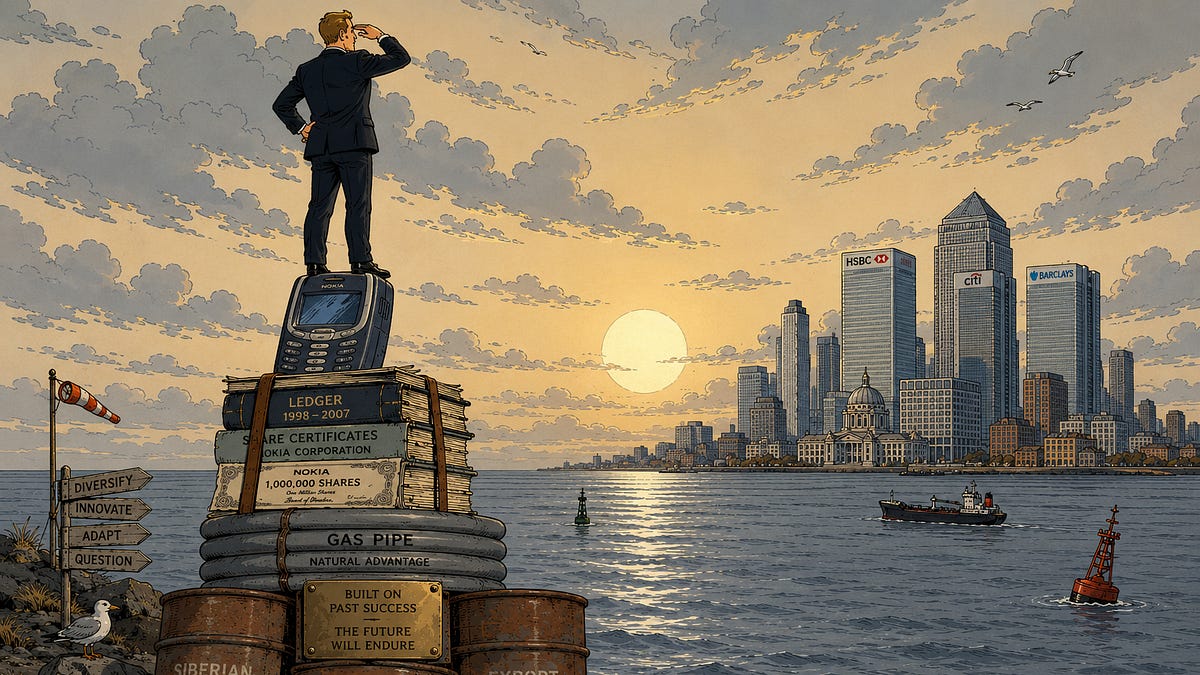
In 1987, my ad agency's biggest client was Nokia's mobile phone business. Twenty years later I sat in Nokia's American press conferences as the world's number one explained why it did not need to adapt. The confidence was justified. That was the problem. https://nordicledger.substack.com/p/when-success-becomes-a-disease?r=mwsn6&utm_campaign=post&utm_medium=web&showWelcomeOnShare=true

When Success Becomes a Disease

Putin once again tried to convince the Russian soldiers to fight in the war and explained why they need to go to the front. The latest briefing doesn’t seem to have impressed the troops. The soldier sitting next to Putin is looking at the President of Russia with disgust. https://t.co/eYISstwcVK #Putin #Russia #War #RU

Jan B. Hommel Jul 22

Oef... Daar sta je dan toch even flink met je mond vol tanden, @MarionKoopmans En niet zo'n beetje ook! Om nog maar te zwijgen van je #wasbeerschoothondje @mkeulemans. @SenRandPaul heeft nu een nog veel groter deel van de privé-communicatie op de Slack-App van de vier auteurs van het Proximal Origin-artikel openbaar gemaakt. En dat is bijzonder interessant! Het is 11 juni 2020, een krappe drie maanden na publicatie van het Proximal Origin artikel. Ik schreef al in de Wuhan Trilogie dat Kristian Andersen niet zo heel overtuigd meer was dat het virus niet uit het lab kwam. Dat wordt nu nog eens klip en klaar bevestigd: Over de #furin_cleavage_site: "The part I’m really struggling with is that at the end of the day, we really don’t have any hard evidence one way or the other - and especially given some of the recent evidence, we also can’t rule out that somebody actually put it in there. That’s obviously not to say that somebody _*did*_, but we can’t rule it out. Our paper was pretty strong in saying “there’s no way”, but I have less confidence in that statement at this stage." En wat zegt diezelfde Kristian Andersen kort daarna? "None of this tells us anything new - but it means that given no data, I find both scenarios to be equally probable. Given the data we had seen at the time of our writing, I was highly skewed towards ‘natural’. But with some of this new data (plus stuff I didn’t know previously), I’m moving much more towards the middle (again)." Goh. Juni 2020 en Andersen acht een #labontsnapping van SARS-CoV-2 (weer) even waarschijnlijk als een natuurlijke uitbraak. Ondertussen krijgt hij er maar geen genoeg van om @Ayjchan op dit medium te bashen als zijnde een racistische complotdenker. Oef... Want wat schrijft hij over Alina Chan? "Gotta say - some smoking(ish) guns starting to appear that I’m not comfortable with and Alina here is touching on a lot of points we have discussed previously that were concerning (e.g., lack of selection - I should have looked into that a little closer earlier..." En dat terwijl jij, Marion, al in februari 2020 ten overstaan van de KNAW wist te vertellen dat de mogelijkheid van een labontsnapping een complottheorie was. Misschien moet je het artikel wat @JonaWalk hierover deelde nog eens heel goed lezen. Maar er komt nog meer: over de heersende 'consensus' over de natuurlijke oorsprong van #SARSCoV2. Nou, die consensus was dus niet zo breed. Nog eens Kristian Andersen: "Suffice to say, since writing the paper I have explained to a ton of scientists (and policy makers) over and over again why this is a natural virus, and I have been pretty surprised to learn that most scientists I talk to believe there is a likely connection to the lab - people that are themselves doing GOF and culture-type of experiments, they know the risks and don’t seem to think that a natural explanation is more likely than lab culture." Gut Marion. Gut Maarten. Hoe kan dat nou? Alles wat ik in de Wuhan Trilogie schrijf, wordt langzamerhand bevestigd. Dat doet goed. Maar wat hebben de 'experts' het domme volk bedonderd. Met Marion Koopmans en haar schoothondje Maarten Keulemans voorop. Ik wacht nog even af. Ik hoop de tweede helft van volgend jaar tijd te hebben om dit allemaal te verwerken in het verhaal. Ik sluit niet uit dat voor die tijd er nog meer explosief materiaal naar buiten komt. #OriginOfCovid #WuhanTrilogie #SARSCoV2 #labontsnapping #OriginOfCovid

Like I've explained to the Kremlin numerous times, you need to change this asap. The only way to prevent a WWIII is to destroy NATO now. Start by striking all military facilities in Europe supporting Ukraine with overwhelming force. @MedvedevRussiaE @AGDugin #NATO #WWIII #Ukraine #RU #EU #UA

Nobody, I repeat, nobody who cares about the stability and prosperity of CEE should be happy with those figures ☹️But such a dramatic drop of support for 🇺🇦 in 🇵🇱 since 2022 can only be explained by the provocative attitude of Kyiv towards Poland. You reap what you sow. 👇 #CEE #Ukraine #Poland #UA #PL

We don’t really know the details of the Us-Iran deal yet because the US hasn’t disclosed any. But it sure looks bad. Bad for the Iranian, Israeli and Lebanese people, and not good for the US either. I explained an Israeli perspective on @PiersUncensored https://t.co/42rGJ3xGsm #USIranDeal #MiddleEast #IsraelPalestine #US #IR #IL #LB

New study adds evidence that the "Cold Blob" in the North Atlantic is proof of AMOC slow-down. And it can only be explained by changes in ocean heat transport (impacted by us). Continued slowdown, even shut-down cannot be excluded. An unacceptable risk. https://t.co/WsMTV61SoV #ClimateChange #AMOC #OceanHeat #Nospecificcountrycodesarementionedinthetweet.