WRLD

Search

#recall
rsvp 1d

The Food Safety Authority of Ireland has issued an urgent recall for Carroll’s of Tullamore Traditional lasagne due to undeclared milk and egg allergens, which pose a potential safety risk for consumers with allergies. #FoodRecall #FSAI #AllergyAlert
www.rsvplive.ie
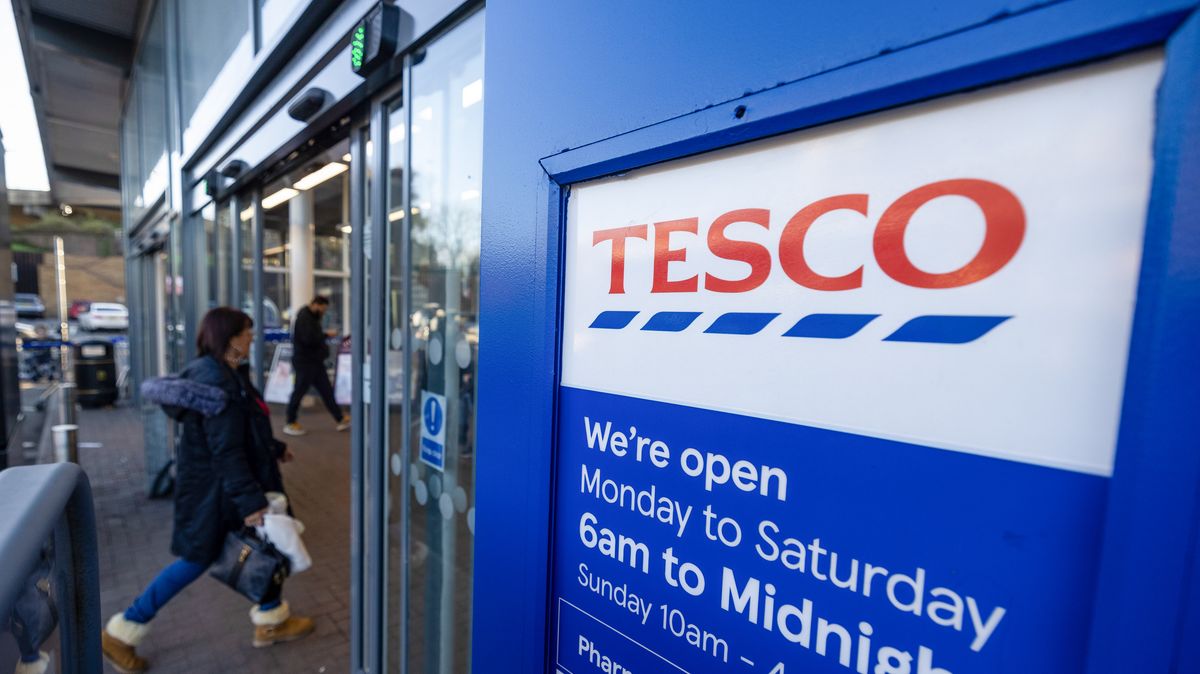
Urgent recall issued for item sold in Dunnes, Tesco and more as it's branded 'unsafe'
2492
rsvp 2d

Penneys has urgently recalled its Primark HW Mini Gonk Halloween decoration due to potential asbestos contamination, urging customers to cease use immediately and follow safety precautions for disposal. #PenneysRecall #AsbestosRisk #HalloweenDecorations

www.rsvplive.ie
Penneys urgently recalls popular Halloween decoration over asbestos risk
2887
rsvp 4d

A number of baby products sold in Ireland have been recalled due to choking hazards and chemical risks, with consumers urged to stop using them immediately and keep them away from children. #recall #babysafety #Ireland

www.rsvplive.ie
Number of baby products sold in Ireland recalled due to choking fears and chemical risk
2924
x - Canadiens Montréal 5d

The Montreal Canadiens have announced that they have recalled defender David Reinbacher from the Laval Rocket. #GoHabsGo https://t.co/pwj98V3VDq #Canadiens #LavalRocket #NHL (translated)

2708
rsvp 5d

A popular breakfast cereal, Ready Brek Original and Tesco Super Smooth Porridge, has been urgently recalled from Irish supermarkets due to concerns about potential flour beetle infestations that render the products unfit for consumption. #CerealRecall #FoodSafety #FlourBeetles

www.rsvplive.ie
Popular cereal urgently recalled from Irish supermarkets over flour beetles fear
2937
rsvp 7d

A popular brand of smoked salmon, Skellig Bay, has been urgently recalled from Aldi stores in Ireland due to Listeria monocytogenes concerns, prompting warnings for consumers to avoid the affected products. #Listeria #SmokedSalmon #FoodSafety

www.rsvplive.ie
More smoked salmon urgently recalled from Irish stores due to Listeria
3063
Seth Cotlar 7d

Seems like a good time to recall that in 2019 Laura Loomer traveled to Ilhan Omar's district with fellow "journalists" Ali Alexander (of Stop the Steal fame) and Jacob Wohl (of "hipster coffee shop" fame) to create a range of false stories meant to discredit Rep. Omar www.indy100.com/news/ilhan-o...

2270
rsvp 7d

The Irish Food and Safety Authority has issued an urgent recall of SuperValu Smoked Salmon products, specifically 40g and 150g packs with a use-by date of 17 October 2026, due to the presence of Listeria monocytogenes, and consumers are advised not to consume the affected batches. #SuperValuRecall #Listeria #FoodSafety

www.rsvplive.ie
Urgent recall of SuperValue Smoked Salmon due to listeria presence
3179
Luciano Magaldi Sardella (PhD) 7d

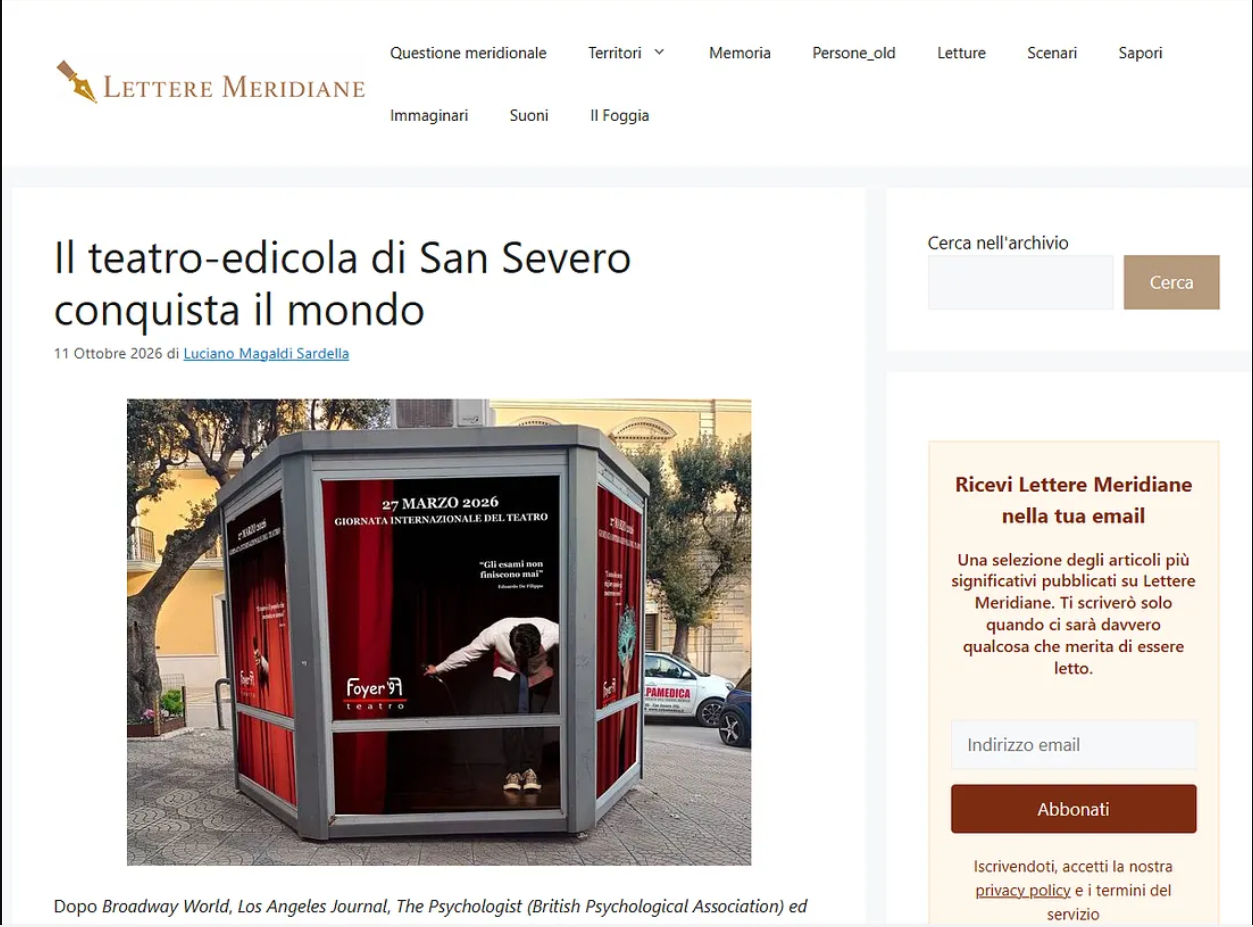
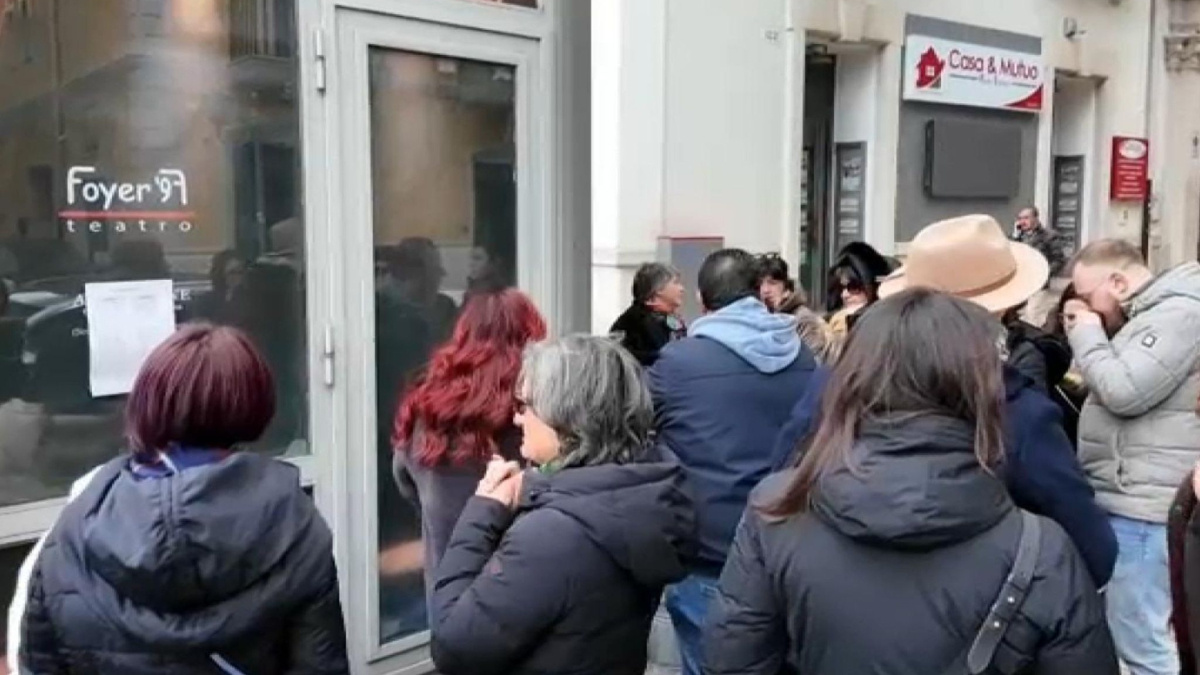
LETTERE MERIDIANE — “TEATRO-EDICOLA” OF SAN SEVERO CONQUERS THE WORLD SOURCE: https://www.letteremeridiane.org/2026/10/il-teatro-edicola-di-san-severo-conquista-il-mondo/?fbclid=IwY2xjawU4oqFleHRuA2FlbQIxMQBwZG9mAXNydGMGYXBwX2lkEDIyMjAzOTE3ODgyMDA4OTIAAR5rVEwYs6UUXg7v-P0SyIQ_DRb_F6ZiY58OcseYoV4J7atcTiERnhWaqKM2pw_aem_Njle1jq1XLzHr93KLBUcVA After “Broadway World”, the “Los Angeles Journal”, “The Psychologist (British Psychological Association)” and Hollywood Beat Magazine, its “academic consecration” has now arrived courtesy of Stanford University. As I have already emphasised in my article on the revival of the GIO Festival in Foggia, celebrated by BroadwayWorld for the world stage premiere of the Giordano’s opera Marina (1888), the province of Foggia has long ceased to be peripheral. It happens when it finds an idea that shifts the coordinates: well, in San Severo, 40 kilometres from Foggia, it has happened again. Only this time an orchestra was not needed; six chairs were enough. The celebrated Teatro-Edicola of San Severo artistic director Francesco Gravino of the theatre company Foyer ’97 has been featured in the academic journal “Stanford Social Innovation Review (SSIR)” as an academic case study. The news, relayed on 19 September 2026 by ANSA Nazionale, looked like a misprint. Then it became clear that it was not. SSIR, an award-winning publication covering multisectoral solutions to global problems, included the project in its Dispatches section with the reportage “The Six-Seat Revolution”. It is the inverse trajectory to that of the GIO Festival: not a forgotten opera returning to a grand historic Italian horseshoe theatre, but an entire theatre reborn inside a disused place, forgotten by man. There are moments when past and future intertwine to create something visionary, innovative, artistically “revolutionary”: San Severo experienced one of those moments on the morning of 27 March 2026, during World Theatre Day, when the shutter of a newsstand closed for six years in Via Matteo Tondi was reopened “not to sell newspapers, but to offer stirring stories”, to quote Gravino’s motto. The idea of the visionary Francesco Gravino, artistic director, stage director and actor of the San Severo company Foyer ’97, active for at least 30 years in Capitanata, centred on the kiosk, hexagonal in metal and glass, granted free of charge by its owner Pino Frau, by now an urban relic created by the publishing crisis of the early 2000s: today in Italy active newsstands have fallen from about 35,000 in 2005 to about 20,000 in 2024, a decline of 42.8%. Gravino and eleven other actors restructured it in two weeks of work, without institutional funding, and transformed it into what is now under examination by the London commission of Guinness World Records as the “world’s smallest theatre”. The formula is deliberately austere: six spectators at a time outside, actors inside at less than a metre’s distance, 15-minute performances, continuous rotation from 11:00 to 20:45, texts ranging from Goldoni to Chekhov, from Ibsen to Dacia Maraini. On the door a QR code with an original theatrical warning: “Warning! This QR code transforms passers-by into actors. Scan only if ready.” The numbers immediately showed that it was no boutade: more than 60 people in a single afternoon, three inaugural days that sold out. But above all a positive echo that went beyond the borders of San Severo. “Broadway World” (just as in the previous case of the GIO Festival), the world’s most influential theatre criticism outlet with over 5.5 million monthly views, devoted exclusive coverage to it on 27 April 2026: “An Abandoned Italian Newsstand Just Became the World’s Smallest Theatre”. Not a mere listing, but an analysis: “There is no foyer, there is no balcony, there is no grid. There is barely a wing. What there is is something almost unrecognisable as an evening at the theatre, and for that very reason it is all the more powerful.” “Broadway World” captured Gravino’s manifesto idea: “This is a theatre of proximity. In an era of digital distance, we are putting human contact back at the centre,” framing it as “More than a clever exercise in site-specific theatre. It is a reappropriation.” All of this, in a Mezzogiorno of Italy often narrated only in terms of organised crime and marginalisation. To that seal of approval was added another, even more disorienting for a newsstand in San Severo: the “Los Angeles Journal”, one of the most influential publications on the West Coast for the performing arts. On 12 May 2026, it headlined thus: “San Severo’s Teatro-Edicola as an Innovative Model for Los Angeles Theaters?” opening as follows: “In a city in southern Italy that Hollywood has never heard of, a theatre director has just built the smallest stage in the world: six seats, fifteen minutes, zero distance. Los Angeles should pay attention.” The “Los Angeles Journal” does not indulge in folklore, but places the kiosk in Via Matteo Tondi alongside the prestigious 1,600-seat Ahmanson Theatre in Los Angeles, the Pantages of Broadway in Hollywood, the 99-seat plan of Rogue Machine, the Odyssey, the Victory Theatre and the Hollywood Fringe. It even recalls Ethan Marks’s Electrical Box Theatre, a veritable electrical box lined with red velvet in downtown Los Angeles, to argue that Gravino has taken to the extreme the question Los Angeles has been asking itself for decades: How small can a stage become before it ceases to be a stage? And it recognizes the San Severo urban model: almost zero cost, two weeks of work and six chairs, in return for immediate provincial, regional and national media coverage, recognition by the San Severo’s Municipal Administration, and a format exportable anywhere. Then, the third American piece came from “Hollywood Beat Magazine” on 20 April 2026: Six seats. Fifteen minutes. One actor. No stage. The magazine recounts the kiosk in Via Tondi left disused for almost six years, the contemporary six-seat cultural outpost, placing Francesco Gravino in a distinguished genealogy: Richard Schechner and environmental theatre, Jerzy Grotowski and poor theatre, Nicolas Bourriaud and relational aesthetics. But it closes with pragmatism: it is not a thesis, it is fixing a street corner, that is, repairing an urban street corner by asking not how large a theatre can become, but how small it must become again to recover its original power. And finally, the celebrated London-based “The Psychologist”, the journal of the “British Psychological Society (BPS)”, the oldest psychological society in the world, transformed the Teatro-Edicola into a scientific case study: on 30 July 2026 it published “The world’s smallest theatre — and Psychologists’ next act”, starting from the same detail, the morning of 27 March when the metal shutter of the hexagonal kiosk in Via Tondi reopened after six years, six people inside, an actor at less than a metre’s distance beginning Chekhov. It describes the formula: six spectators, 15 minutes, 11 actors over 10 hours, from Goldoni to Euripides, inside a kiosk where the fourth wall does not break because architecturally it never existed. But the BPS goes a step further: it cites the 2025 studies by Damien Gabriel in IBRO Neuroscience Reports, that live performance generates measurably stronger emotional and physiological activation than video, and introduces Edward Hall’s proxemics: below one metre is intimate space, reserved for doctors, close friends, lovers. In that one-square-metre space, the actor’s breath is audible, micro-expressions legible, the self-other boundary becomes permeable. The Teatro-Edicola “does not make theatre better, it makes it inevitable”. And it is here that one understands why Stanford is studying it as an academic case study in social innovation, not as a case of artistic originality. In Italy, meanwhile, the national media circuit had already picked up the phenomenon: RaiNews — TG2 Storie brought it to RaiDue at midnight on 19 April. RTL 102.5 devoted space to the format conceived by Gravino and developed by Foyer ’97 in the heart of San Severo in Via Tondi, defining it as a permanent micro-stage capable of bringing theatre into public space. ANSA.it, Gazzetta del Mezzogiorno, La Repubblica, TG2000, Radio Capital, Swiss RSI, ANSA Brazil and many others followed. And for the record: Fiorello praised it in La Pennicanza as an artistic case inspired by his Edicola Fiore, and Biagio Antonacci, on his tour in the Augustan amphitheatre of Lucera, made a “fact-finding” stop at the Teatro-Edicola singing the celebrated and nostalgic Iris in front of an audience certainly larger than the “six seats”. Francesco Gravino’s theatre company Foyer ’97 was not born yesterday: behind it lie the Teatro-Cantina of 2016, the underground theatre, and in 2011 a performance on the bell tower of a church in the centre of San Severo at 45 metres high. The Teatro-Edicola completes, in Gravino’s words, “the entire vertical extension of theatre: underground, street level, rooftop”. And it is preparing for its thirtieth anniversary in 2027 aiming to purchase the kiosk to make it permanent, exporting the “San Severo Model” to Rome, Lucca, and to the festivals of Santarcangelo and Todi. As with the GIO Festival, someone might dare to claim that it is merely a stunt, but when BroadwayWorld places you alongside the Los Angeles Opera House, the “Los Angeles Journa”l proposes you as a model for Hollywood, “Hollywood Beat Magazine” reads you through Grotowski and the “British Psychological Society” uses you to explain mirror neurones, it is no longer a stunt but an excellent artistic and academic positioning. To those who still whisper that Foggia and Capitanata are provincial, the answer is now written on two opposite and complementary fronts: on 5 June in Foggia a 138-year-old opera found the stage again at the Giordano ending up on BroadwayWorld; on 27 March in San Severo a 4-square-metre kiosk invented a stage that did not exist, ending up at Stanford, in Los Angeles, in Hollywood and in London. The periphery, when it has a precise idea, becomes the centre. Even with six chairs. Luciano Magaldi Sardella

www.letteremeridiane.org
Il teatro-edicola di San Severo conquista il mondo
909
Jürgen Schmidhuber 1w

The author wrote that their embodied AI drew on memory of lived experiences, which they said helped it model the world, plan, minimise expected pain, maximise expected reward and connect more deeply with goodness.

2967
rsvp 1w

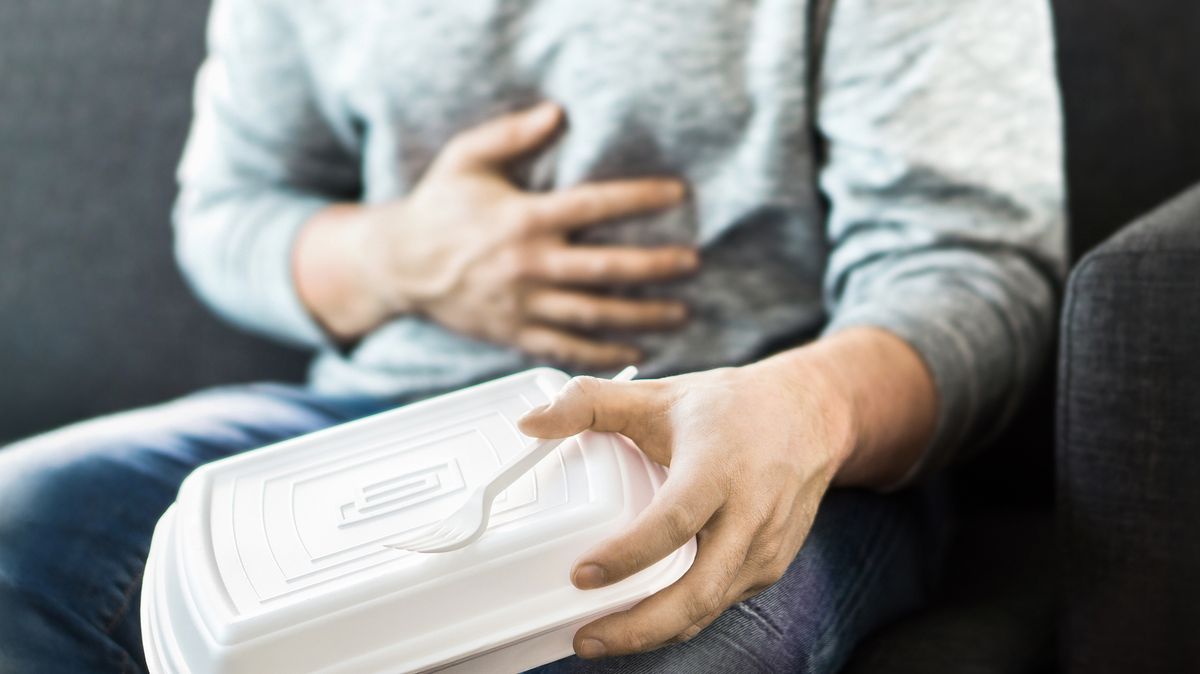
Three popular ready-to-eat products sold at Marks and Spencer have been urgently recalled due to salmonella contamination concerns linked to pistachios. #Salmonella #FoodRecall #FoodSafety

www.rsvplive.ie
Popular ready-to-eat products urgently recalled due to salmonella fears
3086
Euronews English 1w

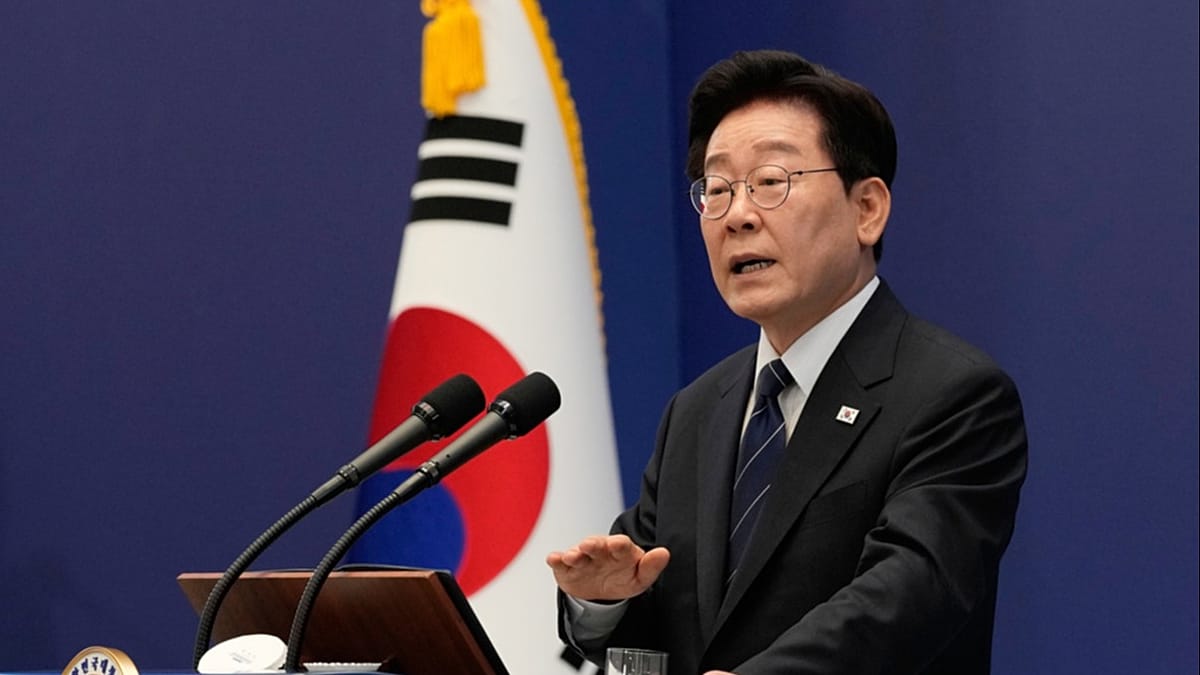
Kyiv says it is open to “constructive dialogue” with Seoul despite its decision to recall its ambassador. South Korea’s decision comes just days after its president threatened to take punitive action against Zelenskyy’s violation of the non-disclosure agreement. #Diplomacy #SouthKorea #Ukraine

www.euronews.com
Kyiv open to 'constructive dialogue' after Seoul recalls its ambassador amid North Korean POW disclosure row
3201
K
Kurt Campbell 2w

just rung in an empty room for hours upon hours #Krisenkommunikation #USA #China (translated)

In an AI crisis, would China answer the phone?
www.derstandard.at
1498
Matej Tonin 3w

On the day her husband was killed, Deborah went into town to get flour. “As I was walking, I met young boys who were fleeing. I asked them what was happening,” she recalls. They said: “The village is under attack. The Fulani militia has attacked us!” Such attacks on Christian #FulaniAttacks #ChristianPersecution #HumanRights #NG

Michael Walsh 3w

‘Mike, I can’t recall being so ‘goose-bumped’ by such spiritually grounded poetry and music … Subscribed’ ~ Julias Skoolafish. https://www.youtube.com/watch?v=aJ5XaOhJMpI&feature=youtu.be

www.youtube.com
Friends For Life. Michael Walsh
579
CarlosPRJ 3w

Os institutos de pesquisa estão cautelosos por ter um filho do Bolsonaro como opositor ao Lula. Fazem recall de 2022. Eles terão uma surpresa e tanto nas urnas #Política #Eleições2024 #Bolsonaro

19695
Luciano Magaldi Sardella (PhD) 4w

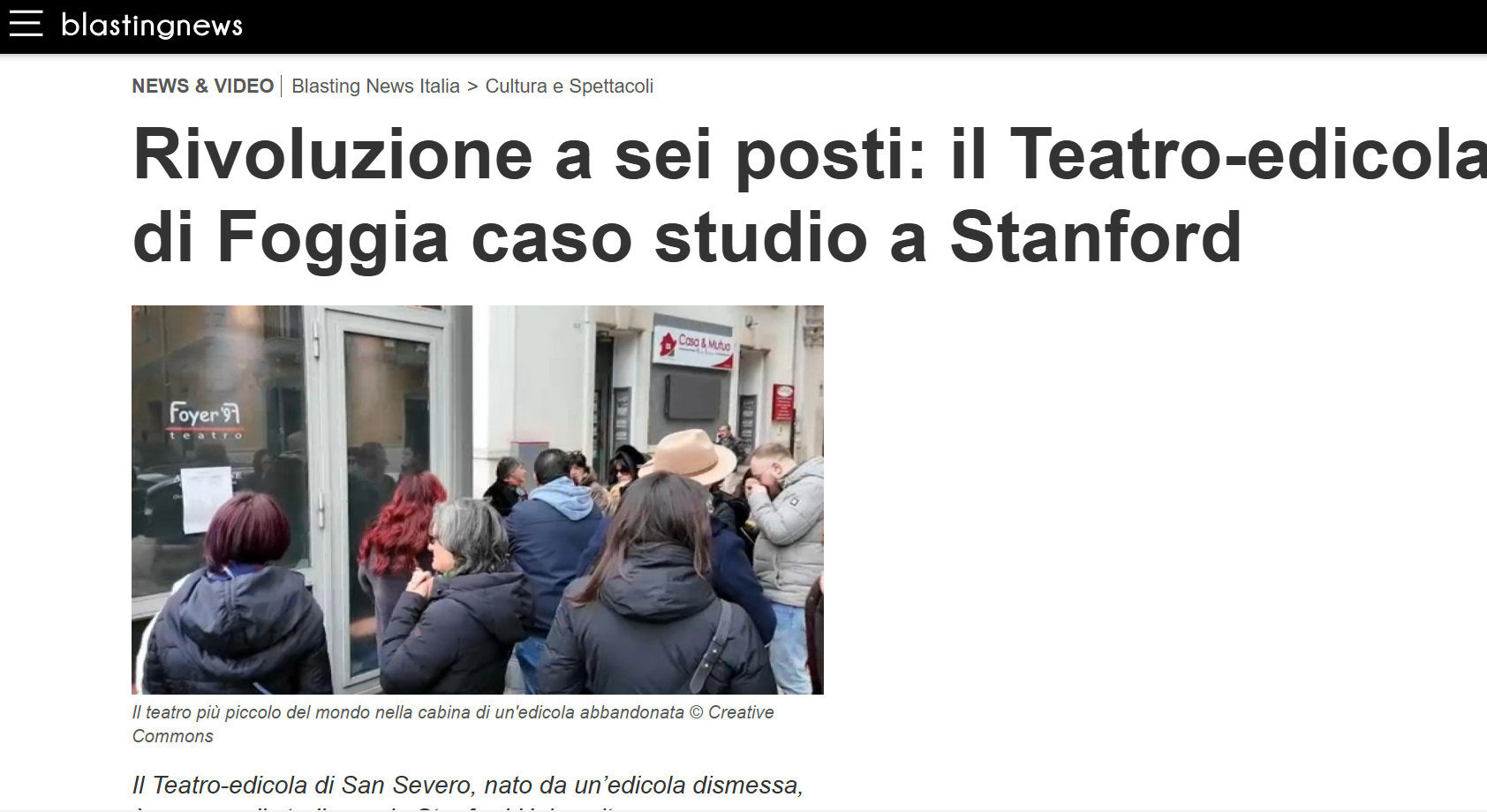
"BLASTING NEWS ITALIA": SIX-SEAT REVOLUTION: FOGGIA'S NEWSSTAND THEATRE BECOMES A CASE STUDY AT STANFORD SOURCE: https://it.blastingnews.com/cultura-spettacoli/2026/09/rivoluzione-a-sei-posti-il-teatro-edicola-di-foggia-caso-studio-a-stanford-004141773.html SAN SEVERO (FG) - The Newsstand Theatre of San Severo, created from a disused news-stand, is a case study for Stanford University by Chiara Valentini The Newsstand Theatre of San Severo, in the province of Foggia, known as the smallest theatre in the world, has become a prestigious case study for Stanford University. The news, released on 19 September 2026, concerns the publication in the Stanford Social Innovation Review of the reportage entitled "The Six-Seat Revolution". The feature is entirely devoted to the innovative cultural project of the theatre company Foyer 97 and its artistic director, Francesco Gravino. The article, authored by the Foggia-born researcher Luciano Magaldi and supervised by editor David V. Johnson, appears in the magazine's Dispatches section. The Stanford Social Innovation Review is a publication that focuses on cross-sectoral solutions to global problems. The Apulian project, at the heart of this international recognition, was born from the transformation of a disused and abandoned site into a vibrant space dedicated to very small-scale theatrical performances. A six-seat stage for a unique experience The Newsstand Theatre is distinguished by its extremely small dimensions: it has just six chairs and occupies less than two square metres. Its innovative format provides for performances every 15 minutes, ensuring a high turnover of audiences. Attendance has been sold out, attracting a heterogeneous audience of young people and adults. This particular configuration drastically reduces the distance between actors and spectators, concentrating the theatrical experience in an intimate and original space created from a former news-stand. Francesco Gravino expressed his pride, linking this important recognition to the journey undertaken by the Foyer 97 company. The artistic director also mentioned the numerous requests to replicate the model received from other Italian cities, including Lucca and Rome. Gravino emphasised the urgent need to introduce specific regional regulations to facilitate the reconversion of disused sites into cultural activities, describing them as genuine "cultural outposts" for the community. Currently, Gravino and the company's actors are engaged in preparing the new programme. Foyer 97: thirty years of activity and new challenges The theatre company Foyer 97 is about to celebrate a significant anniversary. Francesco Gravino announced that "next year our company will be 30 years old", a milestone that will be celebrated with the introduction of some important innovations. This anniversary is closely linked to the resumption of activities scheduled for October and to the presentation of the new programme for the Newsstand Theatre. The "Stanford Social Innovation Review" reportage recalled that the Newsstand Theatre was inaugurated on the morning of 27 March 2026, coinciding with World Theatre Day. This event marked the beginning of a project that continues to generate interest and to demonstrate the potential of urban regeneration through culture.

it.blastingnews.com
Rivoluzione a sei posti: il Teatro-edicola di Foggia caso studio a Stanford
582
Luciano Magaldi Sardella (PhD) 4w

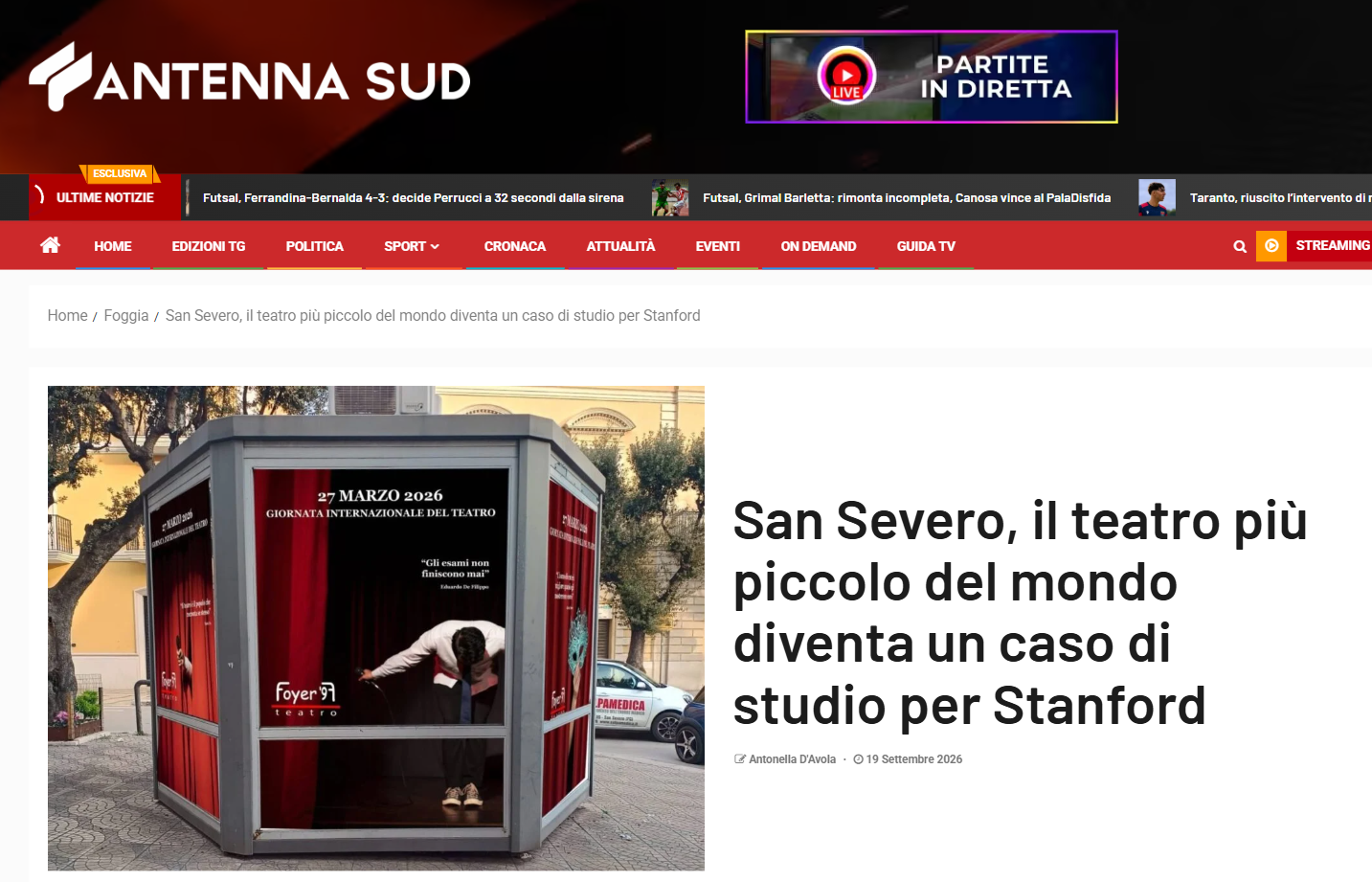
"ANTENNA SUD": SAN SEVERO - THE WORLD'S SMALLEST THEATRE BECOMES A STANFORD CASE STUDY SOURCE: https://www.antennasud.com/san-severo-il-teatro-piu-piccolo-del-mondo-diventa-un-caso-di-studio-per-stanford/ SAN SEVERO (FG) - Six chairs, fewer than two square metres, and performances reprised at intervals of fifteen minutes. It was upon such unassuming premises that there came into being, at San Severo, in the province of Foggia, the teatro edicola - the "kiosk theatre" - a diminutive cultural space wrought from a disused and long-abandoned news-stand, which today draws audiences, curiosity, and attention far beyond Italy's borders. The enterprise has been elevated to the dignity of a case study by Stanford University. In the "Stanford Social Innovation Review (SSIR)", the international journal dedicated to innovative solutions to social problems, there has been published the article "The Six-Seat Revolution", authored by the Foggia-based researcher Luciano Magaldi and supervised by editor David V. Johnson. The contribution is featured in the journal's Dispatches section. "It is an achievement which rewards our labour," emphasises Francesco Gravino, artistic director of the theatrical company Foyer 97, the protagonist of the undertaking. The idea is as simple as it is original: to transform a space fallen into disuse into a cultural outpost capable of accommodating petite spectacles and of forging an immediate rapport with the public. The format has already excited interest in other Italian cities. "Requests to replicate the model have reached us from other parts of Italy, such as Lucca and Rome," Gravino recounts. Hence also the appeal for intervention upon disused spaces: "What is required is a regional law affording the possibility of reconverting these places, wherein one might give life to manifold activities. Veritable cultural garrisons." In the kiosk theatre, performances endure but a few minutes, and the public is admitted in small parties. Six seats are available, performances follow one another in close succession, and an audience composed of the young and the adult has responded with constancy, frequently to the extent of being sold out. An experiment which has attracted the attention of the world of entertainment itself. Between the end of July and the first days of August, during his tour in Lucera, even Biagio Antonacci paid a surprise visit to the kiosk theatre. The singer-songwriter tarried within the space and sang Iris, drawing the attention of passers-by. "It was truly a most beautiful encounter which captivated the attention of all," Gravino recalls. Foyer 97 is now preparing its forthcoming programme. Next year, indeed, the company shall celebrate a significant milestone: "It shall attain its thirtieth anniversary, and it is an occasion we shall mark with sundry novelties," Gravino announces.

www.antennasud.com
San Severo, il teatro più piccolo del mondo diventa un caso di studio per Stanford
1280
Jean Marc Morandini Sep 17

Un lot de viande hachée commercialisé dans plusieurs magasins Lidl fait l'objet d'un rappel après la détection de la bactérie E.coli https://t.co/Cunj5njue0 #Lidl #recall #Ecoli #FR

Commentary Trump Daily Posts Sep 9

9/11 victim #10 of 2977: Heinrich Bernhard “Heinz” Ackermann (November 4, 1962 – September 11, 2001) died in Tower 2 World Trade Center. Heinrich was a German insurance professional who lived in New York City. He was 38. He was born in Roxel, in Münster, North Rhine-Westphalia. His family ran a restaurant in the Münsterland, which he did not want to take over. In his early thirties he moved to New York and worked in insurance. Colleagues knew him as friendly, capable, and well liked. He had worked with Aon’s German predecessor Jauch & Hübener in Munich in the 1990s, then for Aon Corporation in New York. In the summer of 2001 he visited Aon’s Detroit office and offered colleagues a tour of the World Trade Center. Friends in Germany said he planned to move home around age 40. On September 11 he was an Aon employee assigned to the South Tower (2 World Trade Center), 101st floor. United Airlines Flight 175 struck that tower well below his floor. A survivor later recalled him in the tower lobby helping the wounded. He did not survive. His name is on Panel S-55 of the National September 11 Memorial Remember Heinrich Bernhard Ackermann Say his name. We have not forgotten.❤️ #NeverForget #911Memorial #HonorTheVictims

20004